




Telemedicine App Development: 2026 Guide, Costs & Features

 Updated on Aug 04, 2026
Telemedicine app development is the process of building secure software that lets patients consult clinicians remotely through video, messaging, and connected devices. It sits inside a market that Precedence Research values at $188.93 billion for 2026, on the way to $806.89 billion by 2035 (Precedence Research, 2025). This guide walks through what these apps do, what they cost to build, the features and compliance they need, and the step-by-step process our team follows. If you are weighing a virtual care product, start here.
Most guides on this topic explain the category from the outside. This one is written from the delivery side: Saigon Technology has shipped HIPAA-compliant telemedicine products for US physicians, including Welio and AxiaGram, and the cost ranges, process phases, and compliance calls below reflect what those builds actually took, not a generic checklist.
Key Takeaways
- The global telemedicine market reaches an estimated $188.93B in 2026 and grows at a 17.55% CAGR through 2035 (Precedence Research, 2025).
- 71.4% of U.S. physicians used telehealth in their practice in 2024, up from 25.1% in 2018 (AMA, 2024).
- A production-grade build typically runs $75,000 to $250,000+, driven by platform reach, feature depth, and integrations.
- HIPAA, GDPR, and FHIR compliance are non-negotiable and shape architecture from day one.
- Behavioral health now makes up 65.6% of telehealth visit volume, the clearest product opportunity in the category (Trilliant Health, 2026).
What is telemedicine app development?
Telemedicine app development means designing, building, and maintaining software that connects patients with healthcare providers for remote care. The terms telemedicine software development and telehealth app development get used interchangeably, and in practice they describe the same work: video consultations, secure messaging, e-prescriptions, scheduling, and device data flowing between a patient and a clinician.
These apps also support remote patient monitoring, so clinicians can track vitals and step in early when readings drift. The payoff shows up on both sides of the screen. Patients in rural or underserved areas reach care they would otherwise travel hours for. Providers cut no-shows, fill gaps in the schedule, and keep chronic-care patients engaged between visits. A well-built app improves access, sharpens treatment plans, and lowers the operational load on a clinic, which is why healthcare delivery keeps shifting toward virtual-first models.
How big is the telemedicine app market in 2026?
The telemedicine market is large and still climbing fast. Precedence Research estimates it at $160.13 billion in 2025, rising to $188.93 billion in 2026 and $806.89 billion by 2035, a 17.55% compound annual growth rate (Precedence Research, 2025). A second source, Fortune Business Insights, tracks a lower base but a similar slope, with North America holding roughly 48% of global share (Fortune Business Insights, 2026). Different models, same direction.
Demand is real, not just projected. The CDC found that 30.1% of U.S. adults, close to 78 million people, used telemedicine in the prior 12 months as of its latest national survey (CDC/NCHS, 2024). On the provider side, 71.4% of physicians reported using telehealth in their practice in 2024, nearly triple the 25.1% recorded in 2018 (AMA, 2024). Patients like the experience too: J.D. Power scored direct-to-consumer telehealth satisfaction at 730 on a 1,000-point scale (J.D. Power, 2024).
Where the growth is concentrated
Not every segment grows evenly. A few areas pull ahead:
- Behavioral health. Mental and behavioral health now accounts for 65.6% of all telehealth visit volume, up from 18.4% in 2018 (Trilliant Health, 2026). If you build one thing, this is the demand curve to watch.
- Chronic disease management. Remote monitoring keeps long-term patients supported between appointments, and the market for it reaches $36.29 billion in 2026 on its way to $66.33 billion by 2031 (MarketsandMarkets, 2026).
- Mobile-first care. The broader mHealth apps market was worth $37.5 billion in 2024 and is forecast to hit $86.37 billion by 2030 (Grand View Research, 2025).
The challenges that remain
Growth has friction. Older patients, who use healthcare the most, often struggle with digital tools or lack reliable internet, which widens rather than closes the access gap if a product ignores them. Reimbursement rules shift by region and payer. And trust hinges on security: one breach can undo years of adoption. A serious telemedicine software development effort treats accessibility and compliance as design inputs, not afterthoughts.
What are the benefits of telemedicine app development for patients and providers?
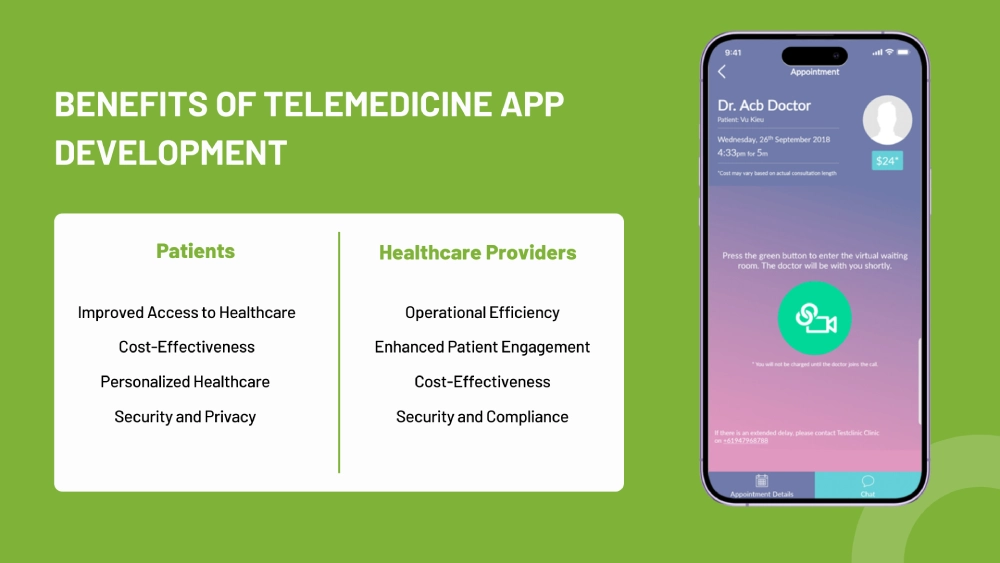
The benefits split cleanly between the two audiences an app serves. For patients, the draw is access and convenience; the CDC’s finding that roughly 78 million U.S. adults have used telemedicine shows the behavior is already mainstream (CDC/NCHS, 2024). For providers, the draw is efficiency and engagement, which is why physician adoption climbed to 71.4% by 2024 (AMA, 2024).
Benefits for patients
Better access to care. Video consultations and online scheduling put a clinician within reach of anyone with a phone, which matters most for rural and underserved communities. No travel, no waiting room, no half-day off work.
Lower cost. Virtual visits cut transportation costs and reduce unnecessary in-person trips. For patients managing tight budgets, that difference decides whether they seek care at all.
Personalized, continuous care. Apps that pull in data from wearables let clinicians track vitals in real time and adjust treatment before a small problem becomes an emergency. Continuity, not just convenience.
Privacy they can trust. Encryption and HIPAA-compliant systems keep medical records confidential in storage and in transit. Strong healthcare data security is what earns patient adoption in the first place.
Benefits for healthcare providers
Operational efficiency. Virtual consultations reduce the need for physical space and cut administrative overhead. Automated booking and digital records free clinicians to focus on care instead of paperwork, and a connected patient portal tightens the whole workflow.
Stronger patient engagement. Real-time access to records helps clinicians build personalized plans, and follow-up through the app keeps patients involved between visits. Engaged patients get better outcomes.
Lower overhead. Fewer large offices and less physical equipment mean lower fixed costs. Providers can assign staff based on actual demand rather than guesswork.
Compliance built in. HIPAA-compliant software built from the ground up protects patient data and gives providers confidence that every consultation stays private and defensible.
Types of telemedicine solutions you can build
Telemedicine is not one product. It spans specialties, each with distinct clinical workflows and design needs. Behavioral health leads by volume at 65.6% of telehealth visits (Trilliant Health, 2026), but the category is much wider than that.
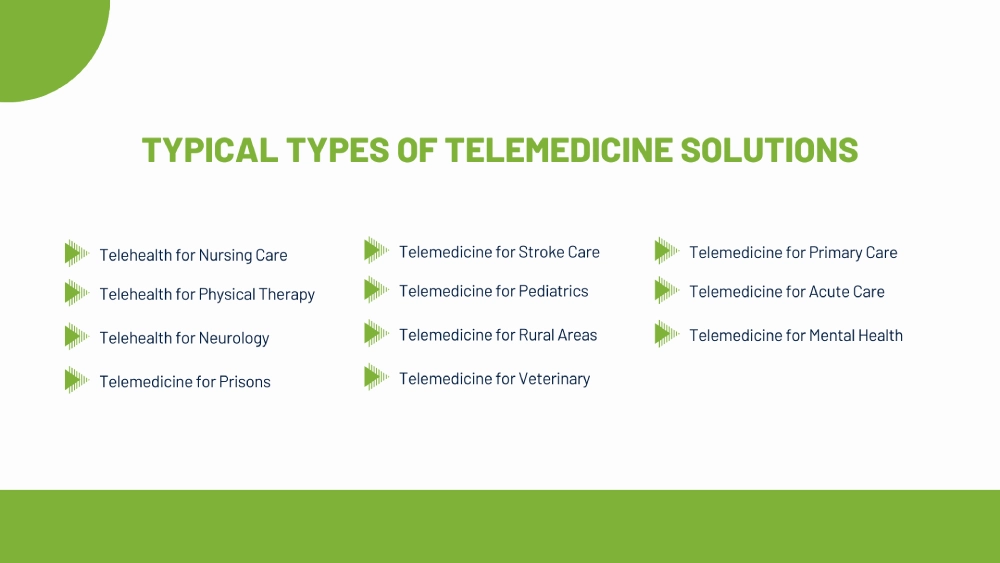
Here are the solution types teams most often ask us to build:
- Nursing care. Remote consultations, health monitoring, and patient education that let nurses provide continuous support.
- Physical therapy. Virtual sessions with progress tracking and customized rehab plans, so recovery does not stall between clinic visits.
- Neurology. Remote symptom monitoring and diagnostics for conditions such as epilepsy or migraine, where timing matters.
- Stroke care. Fast remote evaluation and follow-up that measurably improve recovery outcomes.
- Pediatrics. Remote consultations and monitoring that spare parents a trip while keeping children on schedule for care.
- Rural care. Diagnostics and consultations for regions where the nearest clinic is far away.
- Primary care. Routine check-ups, chronic disease management, and follow-ups that lift patient compliance.
- Acute care. Timely remote assessment and specialist access during emergencies.
- Mental health. Virtual therapy and ongoing monitoring that reduce stigma and widen access. See how mental health app development addresses these needs directly.
- Corrections. Remote consultations that give incarcerated patients timely care and cut logistical strain on facilities.
- Veterinary. Virtual consultations and monitoring for pet owners, a fast-growing niche of its own.

What features does a successful telemedicine app need?
A successful telemedicine app is built around a short list of features that make remote care feel safe and effortless. Given that patient satisfaction with direct-to-consumer telehealth already sits at 730 out of 1,000 (J.D. Power, 2024), the bar for user experience is high. Miss these fundamentals and adoption stalls.
Visit scheduling
Scheduling is the front door. Get it wrong and nothing else matters.
- Online booking. Patients book on their own time, with the calendar synced to real clinician availability to prevent double-booking.
- Reminders. Automated email, SMS, or push notifications cut no-shows and keep follow-ups on track.
Communication tools
Communication is the core of any telehealth app development project.
- Secure video consultations. High-quality video that makes a remote visit feel personal.
- Encrypted messaging. A channel for questions, updates, and post-visit instructions.
- File sharing. Patients upload records, images, and test results for faster decisions.
Treatment planning
- Access to medical records. Real-time history so clinicians decide with full context and avoid errors.
- Templates and e-prescriptions. Reusable templates and digital scripts that patients fill at any pharmacy.
Disease management
- Symptom tracking. Daily logs that reveal patterns and let clinicians adjust early.
- Remote monitoring. Wearable integration for heart rate, blood pressure, and oxygen, shared with the care team automatically.
Analytics and reporting
- Dashboards. Actionable views of patient trends and outcomes for better resource allocation.
- Predictive analysis. Algorithms that flag health risks and recommend preventive steps.
Billing and insurance
- Payment integration. Cards, mobile wallets, and bank transfers handled securely.
- Insurance verification. Real-time eligibility checks so patients know their coverage before a visit.
Security and compliance
- Data encryption. Protection for patient data in storage and in transit.
- Regulatory compliance. Adherence to HIPAA, GDPR, and FHIR interoperability standards.
- Secure authentication. Multi-factor authentication to keep unauthorized users out.
Examples of telemedicine apps
Real products show what these features look like in production. The three below span a custom build, a health-system platform, and a hospital-focused service, each solving a different slice of the market.
Welio: a telemedicine app by Saigon Technology
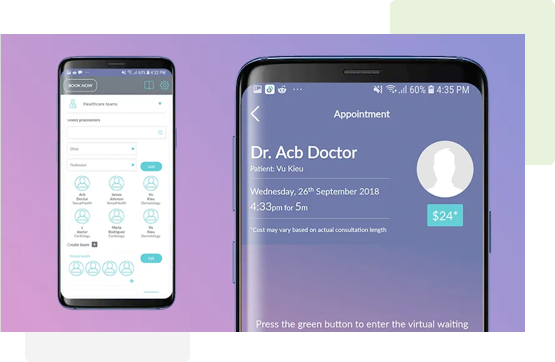
Welio is an on-demand doctor app our team built to improve patient engagement and simplify access to care.
- Features: online booking, secure video consultations, messaging, digital prescriptions, plus billing and insurance processing.
- Technologies: Microsoft Azure, Swift, a .NET backend, and Twilio for SMS. These choices gave the app the scalability and compliance a healthcare product demands.
- Outcome: a working telemedicine solution that widened patient access and lifted operational efficiency for the provider.
AxiaGram: HIPAA-compliant telemedicine for US physicians
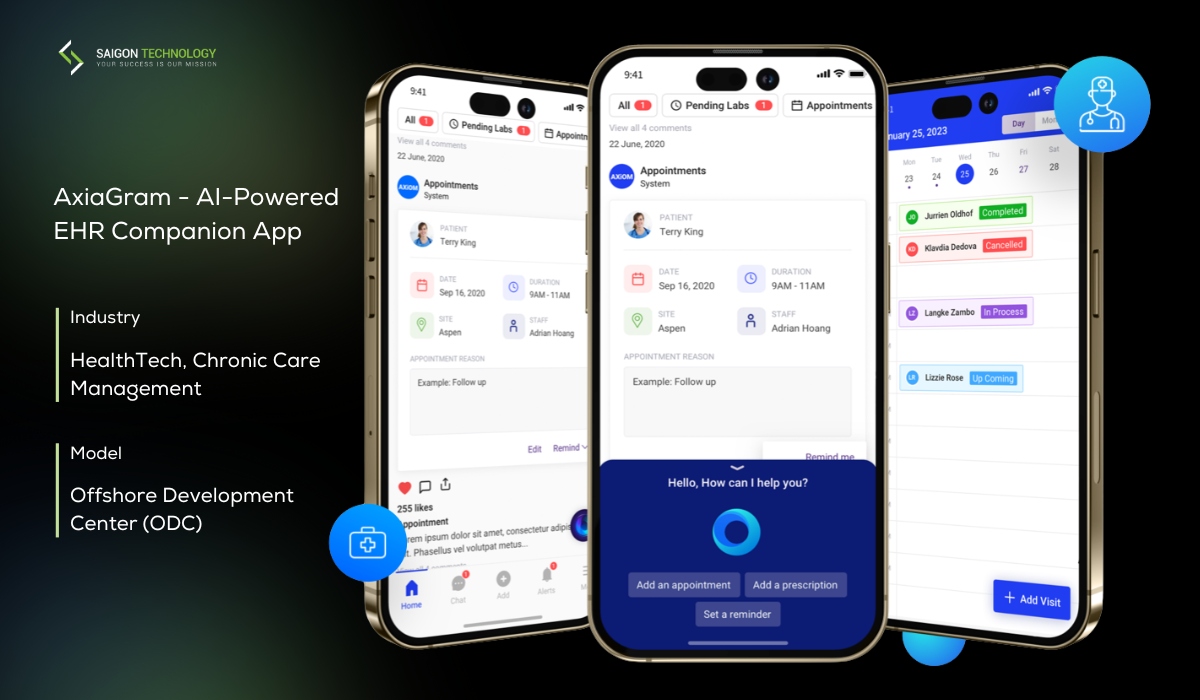
AxiaGram is a HIPAA-compliant telemedicine platform our team built for US physicians, delivered through a dedicated-team engagement.
- Features: EHR-integrated clinical workflows, secure consultations, and provider-side tooling designed around how physicians actually work.
- Approach: a senior-led dedicated team, compliance-first architecture from day one rather than retrofitted before launch.
- Outcome: a 40% reduction in development time and tighter, EHR-integrated clinical workflows, which is the kind of measurable result a compliance-first build should produce.
What both telemedicine app development projects share is the lesson underneath the numbers: on regulated healthcare builds, the schedule risk is rarely the video calls or the UI. It is EHR integration and the compliance work, and teams that leave those to the end pay for it twice.
Learn more about AxiaGram (PDF) →
Sutter Health
Sutter Health’s platform rebuilt primary care around a virtual-first model.
- Features: virtual check-ups, chronic disease management, and real-time monitoring.
- Technologies: cloud-based infrastructure for performance, security, and high availability.
- Outcome: shorter wait times, better access in underserved areas, and smarter resource use.
Learn more about Sutter Health →
Eagle Telemedicine
Eagle Telemedicine helps hospitals absorb patient surges and control costs.
- Features: real-time remote monitoring, predictive analytics, and secure communication.
- Technologies: advanced encryption and compliance controls for data security.
- Outcome: lower overhead, better outcomes, and improved resource management for adopting hospitals.
How do you build a telemedicine app, step by step?
Building a telemedicine app follows seven phases, from requirements to maintenance, and the full path usually runs several months. Because you are handling protected health information, compliance shapes every stage, not just the last one. Here is the process our telehealth app developers follow, and where we have seen projects actually slip: the integration and compliance phases, not the visible features.
1. Planning and requirements
The foundation is detailed requirements work. Map the market and competitors, identify the target audience, and define the product against real user needs. Nail down feature priorities (symptom-based search, real-time video, scheduling), compliance requirements (HIPAA, HITECH), and integration points such as EHRs and health information exchanges. Draft a preliminary architecture and tech stack, then set a budget before a line of code is written.
Duration: about 4 weeks.
2. Project planning
Define scope, deliverables, and boundaries. Pick a development lifecycle, usually Agile, and set the budget, timeline, and KPIs. Assess risks early, from schedule slips to compliance gaps, and plan mitigations.
Duration: about 2 weeks. Roles: project managers, business analysts, developers.
3. UX and UI design
Design a user-centric interface for both patients and clinicians. Map user journeys such as scheduling a video visit, prototype with wireframes, then produce the final visual design.
Duration: from 2 weeks. Roles: UI/UX designers, project managers.
4. Development
This is where the app takes shape. The telemedicine software development team builds backend and frontend together so the care experience stays smooth end to end. Developers implement core features, video, messaging, e-prescriptions, and wire up third-party APIs for payments and insurance.
Duration: 2 to 6+ months, delivered in Agile iterations. Roles: developers, project managers, DevOps engineers.
5. QA and testing
Quality assurance verifies that the app is functional, secure, and compliant. Given the sensitivity of medical data, healthcare application testing is more rigorous than standard software QA, covering functional, usability, integration, security, and load testing.
Duration: continuous. Roles: QA engineers, project managers, developers.
6. Launch
Roll out in stages. Pilot with a focus group, release an MVP with core features, then use early feedback to refine before full deployment.
Duration: 1 to 2 months. Roles: project managers, developers, DevOps engineers.
7. Maintenance and support
Ongoing work keeps the app secure and current: technical support, regular security audits to hold HIPAA compliance, and new features driven by user feedback.
Duration: continuous.
Recommended tech stack
A common, production-ready stack for a telemedicine build:
|
Layer
|
Typical choices
|
|
Cloud platform
|
AWS, Microsoft Azure, Google Cloud
|
|
Backend
|
.NET, Node.js, Java, Python
|
|
Web frontend
|
React, Vue.js, Angular
|
|
Mobile
|
Native (iOS, Android) or cross-platform (Flutter, React Native)
|
|
Real-time communication
|
Twilio (video), Firebase (messaging)
|
|
Compliance & data
|
Encryption at rest/in transit, FHIR interoperability, audit logging
|
Monetization models for telemedicine apps
Telemedicine apps earn revenue through four proven models, and most successful products blend two or more. The model you pick should match how your users actually seek care, whether that is one-off advice or ongoing chronic-care management.
|
Model
|
How it works
|
Best fit
|
|
Pay-per-appointment
|
A one-time fee per consultation, split between platform and clinician
|
Occasional, on-demand care
|
|
Subscription
|
Recurring weekly, monthly, or annual access, often tiered
|
Chronic care, regular follow-ups
|
|
Transaction fee
|
A small cut of each booking or in-app purchase
|
High-volume platforms, e-commerce tie-ins
|
|
In-app advertising
|
Targeted ads for health products, wellness, or insurance
|
Free apps with a large user base
|
Pay-per-appointment keeps things transparent: patients pay only for what they use, and revenue arrives immediately. Subscriptions trade some upfront friction for a steady, predictable stream and stronger retention, which suits any product built around ongoing care. Transaction fees scale directly with usage and pair well with pharmacy or wellness e-commerce. In-app advertising works when the app is free and traffic is high enough to interest advertisers without hurting the experience.
How much does telemedicine app development cost?
A production-grade telemedicine app typically costs between $75,000 and $250,000 or more, depending on scope. The range is wide because a handful of decisions, platform, features, integrations, drive most of the total. In our experience the line items that blow budgets are rarely the obvious ones: EHR integration and compliance work cost more than teams expect, while the video and scheduling features they worry about are largely solved. Understanding those cost drivers upfront is what keeps a project on budget.
What drives the cost
- Platform and reach. Web, iOS, Android, or all three? Native app development delivers top performance but can double time and cost. Cross-platform frameworks like Flutter or React Native balance reach against budget.
- Feature depth. Scheduling, video, messaging, and e-prescriptions are the baseline. Remote monitoring, AI-assisted diagnostics, and EHR integration each add complexity and cost.
- User roles. Patients, clinicians, and admins each need their own interface, authentication, and access controls. Role-based access control is also essential for HIPAA compliance.
- Performance and security. A strong backend, encryption, and secure storage cost more but protect the data and the trust that carry the product.
- Integrations. Connecting to EHR, LIS, and PMS systems, or to legacy infrastructure, adds development time.
- Scalability. Planning for growth, AI analytics, wearables, real-time monitoring, upfront saves money later.
- Team location. Offshore development can cut cost significantly without sacrificing quality. Our MVP-first approach lets you test the idea affordably before committing to a full build. Read more: How to outsource app development effectively.
Cost by build type
|
Build type
|
Typical range
|
What you get
|
|
Basic app
|
$75,000 to $120,000
|
Core features: scheduling, video, messaging, e-prescriptions
|
|
Custom app
|
$150,000 to $250,000+
|
Advanced integrations, AI features, RPM, enterprise scalability
|
A quick note on sourcing these numbers: no tier-one research firm publishes telemedicine build-cost benchmarks, so treat any precise figure, including ours, as directional and tied to scope rather than a market standard.
Working with a telemedicine app development company
Choosing the right partner shapes the outcome as much as any feature decision. The gap between a telemedicine app development company that has shipped healthcare products and one that has not shows up fastest in compliance, where 81% of physicians now use AI in practice (AMA, 2026) and expectations for secure, modern tools keep rising.
“On healthcare builds, the teams that struggle are the ones that treat HIPAA as a launch-week checklist. We design for it from the first architecture call, and it is why our telemedicine projects ship faster, not slower.” (Thanh (Bruce) Pham, CEO, Saigon Technology)
At Saigon Technology, we deliver telemedicine app development services end to end, from consulting through modernization:
- Consulting. We define the feature set, recommend a tech stack, and design a secure, scalable architecture with HIPAA and HITECH compliance built in.
- Custom development. We build tailored solutions, integrate systems such as EHR and CRM, and test rigorously for performance and security.
- Modernization. We restructure aging apps, redesign the UI/UX, and add capabilities like remote monitoring and analytics.
Our team has delivered healthcare projects for clients across the US, UK, Australia, Singapore, and Germany, with ISO 9001 and ISO 27001 certification behind the quality and security process. Contact us for a free quote.
FAQs
1. What technologies are used in telemedicine app development?
Telemedicine apps rely on a layered stack. Cloud platforms include AWS, Azure, and Google Cloud. Backends commonly use .NET, Java, Python, or Node.js. Frontends use React, Vue.js, or Angular, with mobile built natively or on Flutter and React Native. Real-time features run on Twilio for video and Firebase for messaging.
2. How much does it cost to build a telemedicine app?
A basic telemedicine app with core features usually costs $75,000 to $120,000. A custom app with advanced integrations, AI features, and enterprise scalability runs $150,000 to $250,000 or more. Platform reach, feature depth, and integrations are the biggest cost drivers.
3. How long does it take to develop a telemedicine app?
Most builds take several months. Planning and requirements take about 4 weeks, design from 2 weeks, and development 2 to 6+ months depending on scope. A phased launch adds 1 to 2 months, and maintenance continues after release.
4. How do you make a telemedicine app HIPAA compliant?
HIPAA compliance starts in architecture, not after launch. Encrypt data at rest and in transit, enforce role-based access control and multi-factor authentication, keep audit logs, and run regular security audits. Building HIPAA-compliant software from the ground up is the reliable path.
5. How does Saigon Technology ensure quality and security?
Our process is backed by ISO 9001 and ISO 27001 certification, comprehensive functional, performance, and security testing, and compliance with HIPAA, HITECH, and GDPR. We host on platforms like AWS and Google Cloud for scalable storage and strong encryption.
6. How do you build a telemedicine app, step by step?
Seven phases: planning and requirements, project planning, UX and UI design, development, QA and testing, launch, and maintenance. Compliance requirements and integrations are defined in phase one and carried through every stage after.


Related articles
Medical Practice Management Software: Features & Costs 2026
 Van Le - Business Analyst
  21 Oct 2026
Logistics Optimization in 2026: Strategies, Software & AI
16 Oct 2026 
AI Route Optimization: How It Works, Benefits, and Use Cases 2026
14 Oct 2026 
Student Information System: A 2026 Guide for Schools
09 Oct 2026 
Insurance Portal Development in 2026: Types, Features, Cost
07 Oct 2026 
Insurance Claims Automation in 2026: Build, Buy, or Hybrid
01 Oct 2026 
IoT in Healthcare: How Healthcare IoT Systems Work in 2026
25 Sep 2026 
AI in Real Estate: 9 Use Cases and How to Build It (2026)
16 Sep 2026 
AI Healthcare Software Development: Architecture & Cost
13 Sep 2026