








































• OVERVIEW
  • SERVICES
  • WHY CHOOSE US?
  • MODELS
  • TECHNOLOGIES
  • OUR PROCESS
  • FAQS

What Is Learning Management System (LMS) Development? 

What Is Learning Management System (LMS) Development?
  • Learning management system (LMS) development is the process of designing a learning platform around your organization's specific workflows, integrations, and compliance needs, rather than adapting to an off-the-shelf product. A custom LMS gives you greater control over data, architecture, features, and roadmap.
  • Custom LMS development is especially valuable when standard platforms cannot support your workflows, integrations, learner scale, or AI requirements. Instead of adapting your training processes to a pre-built system, you can build the platform around how your organization actually works.

Who We Build For

  • Enterprise L&D and corporate training teams running onboarding, compliance, upskilling, and leadership development across distributed workforces.
  • EdTech startups and platform companies where the learning platform is the product and multi-tenancy, white-labeling, and commercial scale are requirements from day one.
  • K-12 and higher education institutions need student information system integration, accessibility compliance, and instructor tooling that fits how faculty actually teach. This is where our work across the education sector comes in, covering the wider software needs of academic institutions beyond the LMS itself.
  • Regulated industries in healthcare, finance, and government, where certification tracking and audit trails carry legal weight.
  • Training providers and professional associations delivering continuing education, certification programs, and member learning at scale.
over 400 software developers
400+
Software Developers
Over 14 years of experience
14+
Years in Business
Over 850 Projects Successfully Delivered
850+
Projects Successfully Delivered
rating on Clutch
4.8
Star Rating on Clutch

Our LMS Development Services 

atom-01

Custom LMS Software Development

Software development for products where learning is the core offering, not an internal tool. Built for multi-tenancy, commercial scale, and a public roadmap.
chevron-up.svg
beaker-02

Enterprise LMS Development

Systems built for tens of thousands of concurrent learners across regions, business units, and languages, with centralized governance and delegated administration.
chevron-up.svg
backpack

LMS Integration Services

Connecting your LMS to HRIS, CRM, ERP, SSO providers, payment gateways, video conferencing, and BI tooling. See our software integration services for the broader integration practice.
chevron-up.svg
calculator

LMS Migration and Modernization

Moving off a legacy or off-the-shelf platform without losing learner history, course content, or certification records. Our data and platform migration work covers the data side of these projects.
chevron-up.svg
briefcase-01

White-Label and Multi-Tenant LMS

Single codebase, isolated tenants, per-client branding. The standard architecture for EdTech companies and training providers reselling to multiple organizations. This is a common request behind custom LMS projects aimed at resale rather than internal use.
chevron-up.svg
file-code-02

Mobile and Cross-Platform LMS

Native and cross-platform learner apps with offline course access and progress sync. Delivered through our team that builds native and cross-platform apps.
chevron-up.svg
award-01

LMS Content Development

Course authoring tools, content libraries, assessment builders, and SCORM and xAPI packaging pipelines.
chevron-up.svg
globe-slated-02

AI-Native LMS Development

Adaptive learning, automated assessment, and intelligent content operations built into the platform rather than bolted on. See how we build AI into delivery for the underlying practice.
chevron-up.svg

Our Highlight Projects 

Explore our LMS development services and see how we build flexible, scalable solutions for modern learning needs.
e-learning-4

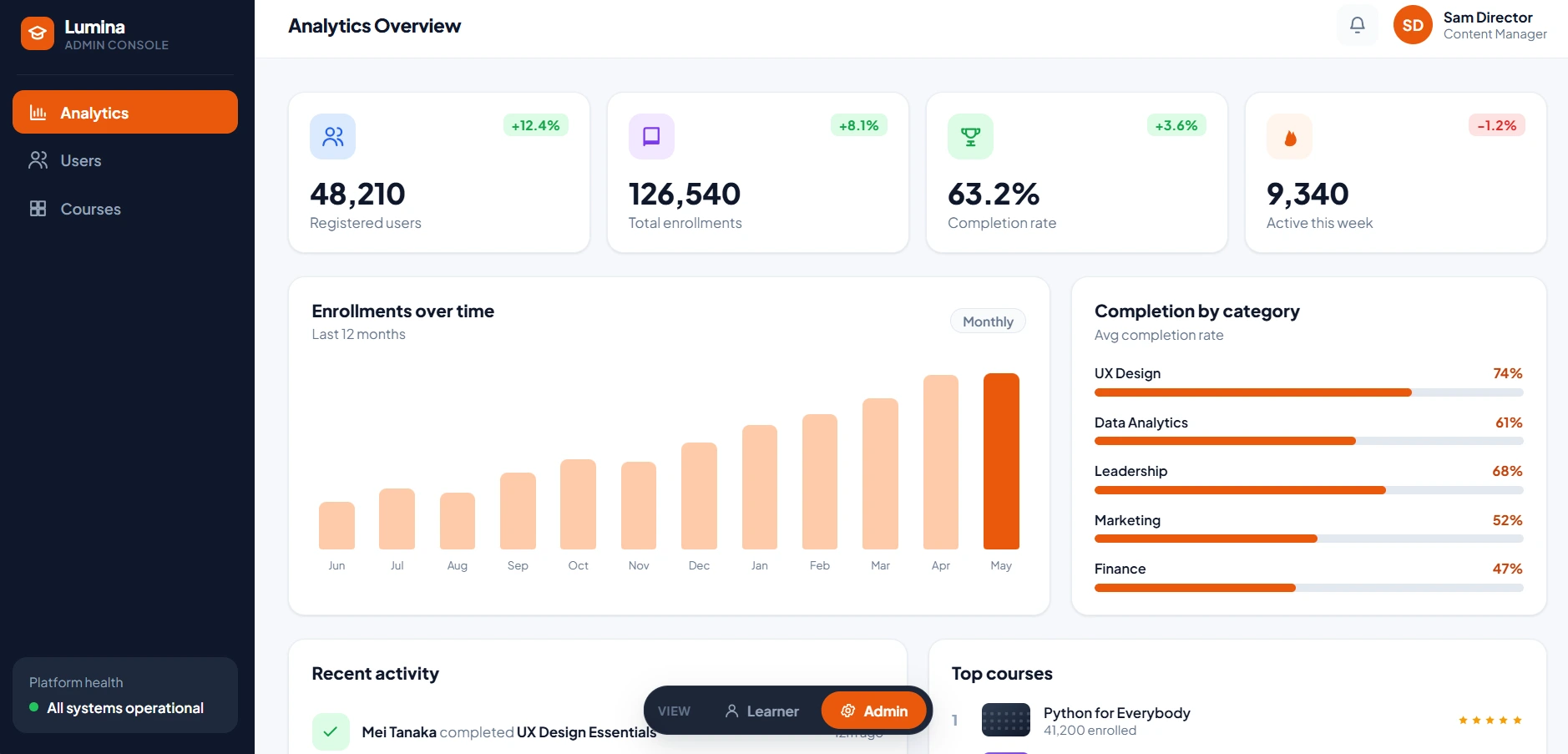
Lumina – A Scalable E-Learning Web Application

  • Industry: E-Learning / EdTech
  • The problem: An EdTech client needed to launch a learning platform without overbuilding before knowing if the market wanted it. It had to support different content types, let content teams publish courses without a developer, and show real proof that learners were progressing.
  • What we built: A learning platform called Lumina, with course discovery, video lessons, quizzes, and certificates, plus a self-service admin dashboard for managing courses and users. Built as a React app the client fully owns.
  • The result: A complete learner journey live in one responsive web app. Content teams publish courses on their own. Quiz scores and completion rates show learner progress. The platform was built to grow, with mobile apps, SSO, and AI features planned without requiring a rebuild. 
  • Read full case study →
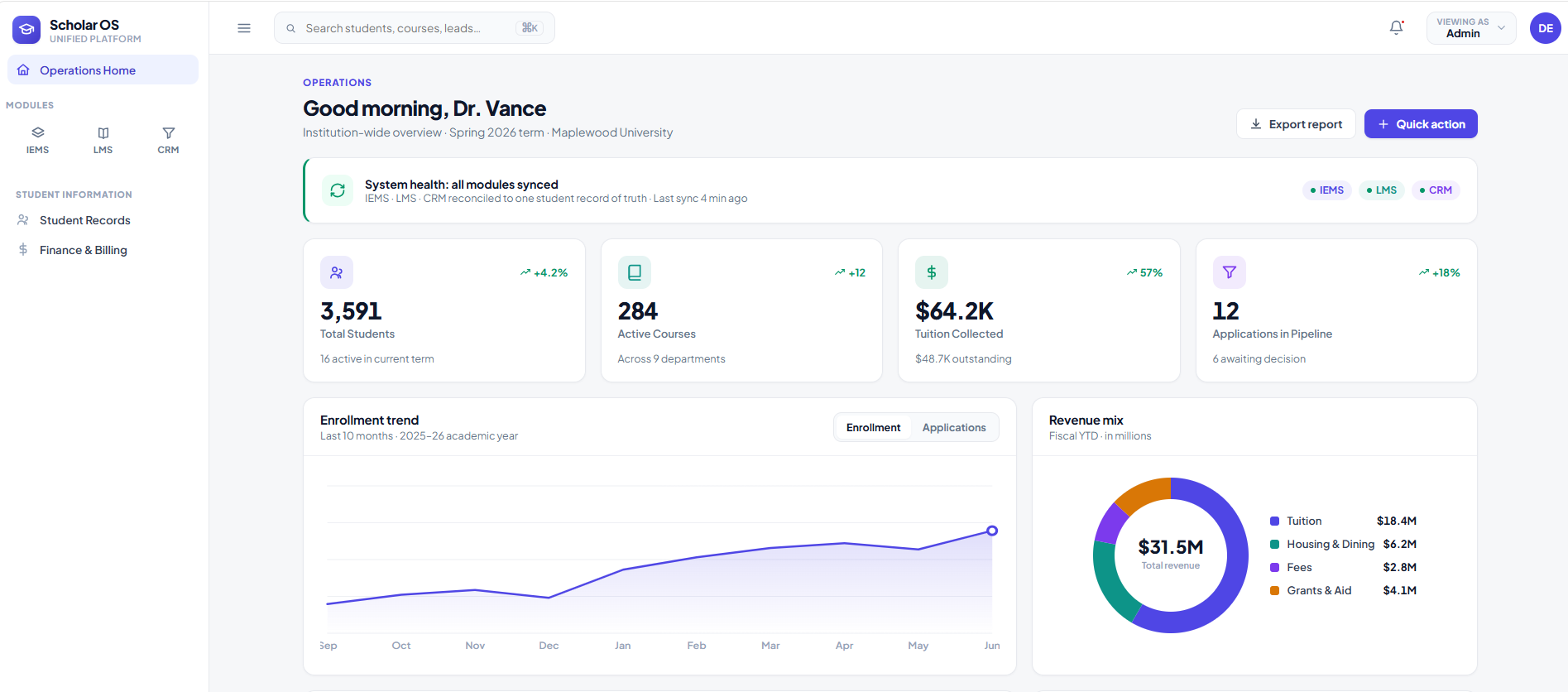
Scholar OS - A Unified Education Platform

Scholar OS – A Unified Education Platform

  • Industry: Education / EdTech
  • The problem: An education institution had student, academic, and financial data scattered across disconnected systems, plus a legacy platform still running day-to-day operations. It needed to modernize without disrupting that system or losing years of historical records.
  • What we built: Saigon Technology built Scholar OS, a unified education platform on Node.js, MySQL, and REST APIs. As part of our LMS development services, we integrated LMS and CRM modules to connect student, academic, and financial data in one place, while the legacy system stayed live through APIs during the transition.
  • The result: Scholar OS gave the institution a single source of truth for student, academic, and financial data, with every existing record preserved. Learning and recruitment workflows now run through integrated LMS and CRM tools, on a foundation built for future growth. 
  • Read full case study →

Build Your LMS. See It Take Shape in 48 Hours.

An AI-accelerated path from your learning requirements to a working LMS prototype, built by engineers who understand learning workflows, integrations, and scalability.
  • Clickable prototype of your LMS workflow and key features
  • Learning journey and user workflow visualization
  • Architecture direction covering integrations, security, and scale
  • Technical recommendation call with our engineering team
Fee live demo - Saigon Technology

Why Choose Saigon Technology?

Our senior-first teams pair experienced engineers with AI-assisted development. With 400+ engineers and AI built into how we deliver, we bring real engineering depth to complex LMS builds. Teams work across time zones, so collaboration stays seamless wherever you're based. 

We combine Agile and DevOps to build software up to 40% faster. Scrum sprints and CI/CD pipelines let us respond to feedback in real time and cut delivery time, with full visibility through tools like Jira.

You keep control of your LMS after we build it. Complete source code and IP ownership transfer to you at project completion, with NDA protection from day one.

Saigon Technology holds ISO 9001 and ISO 27001 certification from BSI, backing solid quality and security practices through every stage of development.

850+ projects delivered for 350+ clients worldwide. That track record carries into complex integration work and education software projects at any scale. Recognized among Fortune's 100 Best Companies to Work For in Southeast Asia in 2025.

Choose from staff augmentation, a dedicated development team, fixed-price, ODC, or build-operate-transfer models. Developer rates range from $22–$46/hour, with AI development from $26–$46/hour.

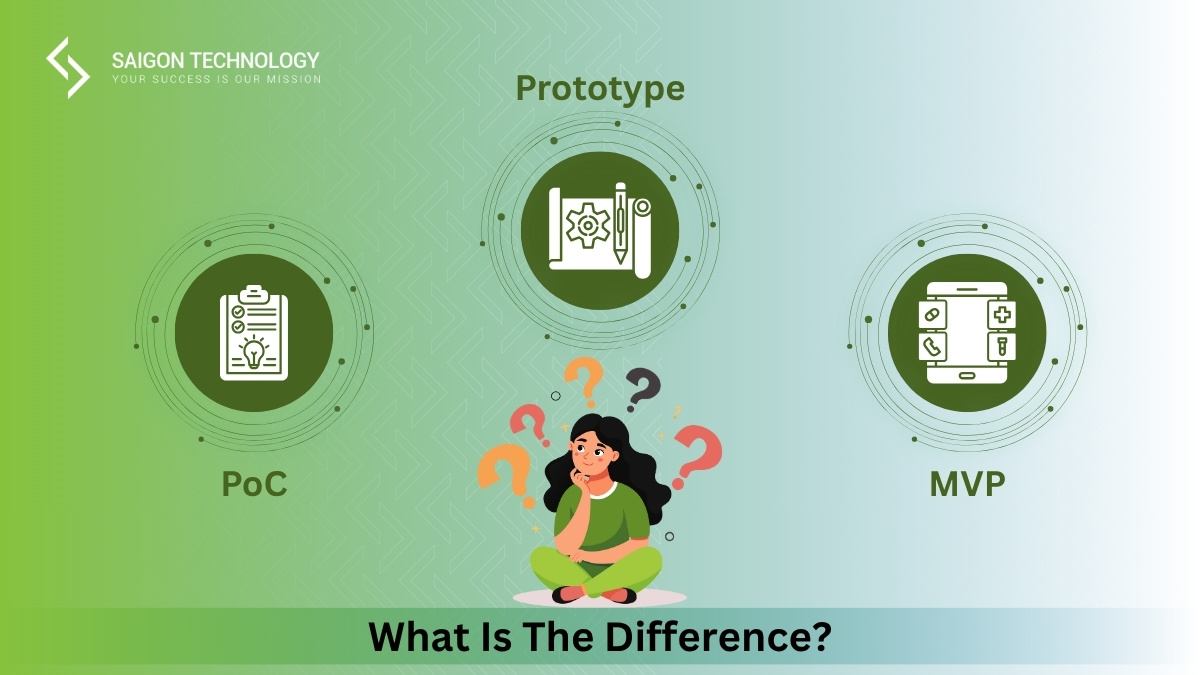
Start with a 2-week risk-free trial or a PoC to validate your architecture, team fit, and technical approach before committing to full custom LMS development.

why choose Saigon Technology 2026

Trusted by Global Clients

Partner-logo2 Partner-logo3 Partner-logo4 Partner-logo6 Partner-logo1 Partner-logo5 Partner-logo9 Partner logo

What Our Clients Say

During our collaboration, Mr. Thanh and his company, Saigon Technology, have consistently demonstrated world-class leadership and execution in complex fintech projects. His ability to scale and lead high-performing engineering teams, while maintaining cost-efficiency and product quality, has been critical to our technology operations. His strategic insights and leadership enabled us to significantly improve system stability and deployment velocity.
Abe Jarrett
Senior Vice President of Software Engineering at Origence, USA
star.svg star.svg star.svg star.svg star.svg
Saigon Technology provided the expert advice and technical development needed for our platform. I truly appreciate their professionalism and ongoing support.
Jason Soo
CEO of Loan City
star.svg star.svg star.svg star.svg star.svg
As the Owner and Director of ISMS Global, Australia, I understand perfectly how challenging it is to find a support team of skilled and professional developers to help grow a system. A few years ago, I found Saigon Technology Software (STS), led by Mr. Thanh Pham (CEO), and I have never looked back. STS has single-handedly taken ISMS camp management software from a concept on a napkin to an international product used by major companies around the world. If you are looking for a trusted partner to help you, then you should be talking to Thanh Pham.
Mr. Paul Upson
Director of ISMS Global, Australia
star.svg star.svg star.svg star.svg star.svg
Over the past year, collaborating with Saigon Technology Solution company, we have brought high-quality financial software solutions. STS helps us meet the strict requirements of the IT market with software engineers, software testers, and internal system control. And all of these are evidence that we have chosen a good software outsourcing partner.
Mr. Corbin van Amelsvoort
Director at Topicus Vietnam
star.svg star.svg star.svg star.svg star.svg
I had the opportunity to work with Thanh (Bruce) Pham and his team. What a nice experience, though! It could be said that I was impressed by his professionalism and his team's enthusiasm. They always asked me to check the right demand and to make sure whether each work point was the best option or not. It was my honor to work with such a great team of software development. Hope to meet them soon in the upcoming time!
Mr. Kirk Duncan
CEO of The Mobile App Man, Sydney, Australia
star.svg star.svg star.svg star.svg star.svg

Why Choose Custom LMS Over Off-the-Shelf Solutions? 

  • Custom: Your LMS adapts to your training model, not the other way around. Build around your courses, learner journeys, approvals, assessments, and business rules, while controlling the experience from branding and login to content delivery. 
  • Off-the-shelf: Works well when your training follows standard course, assessment, and reporting patterns. The trade-off is working within the workflows and customization options the platform provides. 
  • Custom: Connect learning directly to HRIS, CRM, ERP, SSO, and other systems around your actual data flows. This gives your organization more control over how learner, employee, and business data moves between systems.
  • Off-the-shelf: Pre-built integrations handle common use cases. More specialized workflows may require additional connectors, middleware, or custom integration work.
  • Custom: Your infrastructure, database, source code, and IP stay under your control. You can shape the platform roadmap around your business instead of waiting for a vendor to add the features you need.
  • Off-the-shelf: You depend on the provider's roadmap, licensing model, and platform limitations. Changes to pricing, features, or policies can affect how you operate the LMS.
  • Custom: Go beyond course delivery with workflows, analytics, integrations, and experiences designed around your business model. This is especially valuable when learning is part of your product, revenue model, compliance strategy, or competitive advantage.
  • Off-the-shelf: Best suited to organizations that primarily need a ready-made platform for standard training and don't need learning technology to differentiate their business.

LMS Standards and Compliance 

eLearning Interoperability Standards

eLearning Interoperability Standards

We build to widely adopted eLearning standards, including SCORM 1.2, SCORM 2004, xAPI, cmi5, LTI 1.3, AICC, and H5P. SCORM, xAPI, and cmi5 are part of the Advanced Distributed Learning (ADL) Initiative ecosystem, while LTI 1.3 is developed by 1EdTech. These standards help your content and learning tools work across different platforms, reducing the need for re-authoring when your LMS or technology stack changes
Data Protection and Accessibility

Data Protection and Accessibility

Education platforms in the US carry obligations most software does not. We build against FERPA for student records, COPPA where learners are under 13, GDPR for EU learners, and WCAG 2.2 Level AA for accessibility. Accessibility is not optional for public-sector and education buyers in the US, and a VPAT is commonly required during procurement.
Security Architecture

Security Architecture

Zero Trust architecture, AES-256 encryption, OAuth 2.1 and SAML-based SSO, MFA, granular role-based access control, and full audit trails. Saigon Technology is ISO 27001 and ISO 9001 certified.

How Much Does Custom LMS Development Cost?

Custom LMS development typically ranges from $45,000 to $350,000+, depending on scope, integrations, learner volume, mobile needs, compliance, migration complexity, and AI features.

We assess your specific requirements during discovery and break the project into phases before giving you a final quote. 


Typical Project Investment

  • MVP / Pilot. Core course delivery, assessments, basic analytics, single-tenant architecture, and one or two integrations. $45,000 to $90,000.

  • Mid-Market LMS. Broader functionality, mobile apps, SSO and HRIS integrations, advanced analytics, and learning standards support. $90,000 to $180,000.

  • Enterprise LMS. Multi-tenant architecture, complex integrations, AI capabilities, multi-region deployment, compliance requirements, and legacy migration. $180,000 to $350,000+.

chevron-up.svg

What Drives LMS Development Cost?

  • Learner scale: Thousands of concurrent learners need different architecture than a small internal platform.
  • Integrations: Each HRIS, CRM, ERP, SSO, payment, or BI connection adds build and test time.
  • Mobile apps: Native or cross-platform iOS and Android add design, build, and maintenance work.
  • Compliance and security: Data protection, accessibility, and audit requirements add design and testing scope.
  • AI features: Adaptive learning, automated grading, and predictive analytics need extra data and model work.
  • Migration: Moving courses, learner records, and certifications adds effort based on volume and format.
chevron-up.svg

Consider the Total Cost of Ownership

Development cost is only part of the picture. SaaS platforms often charge per learner, plus extra for integrations, analytics, or API access. Self-hosted platforms skip licensing fees but still need infrastructure, maintenance, and support.

For a custom LMS, your cost is development plus hosting and ongoing feature work. Compare both paths over several years, not just the upfront number, to see the real difference. Our engagement models page covers how we structure LMS projects commercially.

chevron-up.svg

Our Tech Stack

Our LMS Development Process

Software Development Process

Discovery and LMS Consultation (2–4 weeks)

We map your learning goals, workflows, learner personas, and existing systems, then review integrations, data flows, user roles, and compliance needs. You walk away with a defined scope, technical requirements, and a project estimate. 

Software Development Process

UX and Learning Experience Design (3–5 weeks)

We turn learner and admin journeys into wireframes and interactive prototypes, covering course discovery, enrollment, progress tracking, assessments, and admin tools. Accessibility is built in from the start, aligned with WCAG 2.2.

mobile app launch and optimization

LMS Development (8–24 weeks)

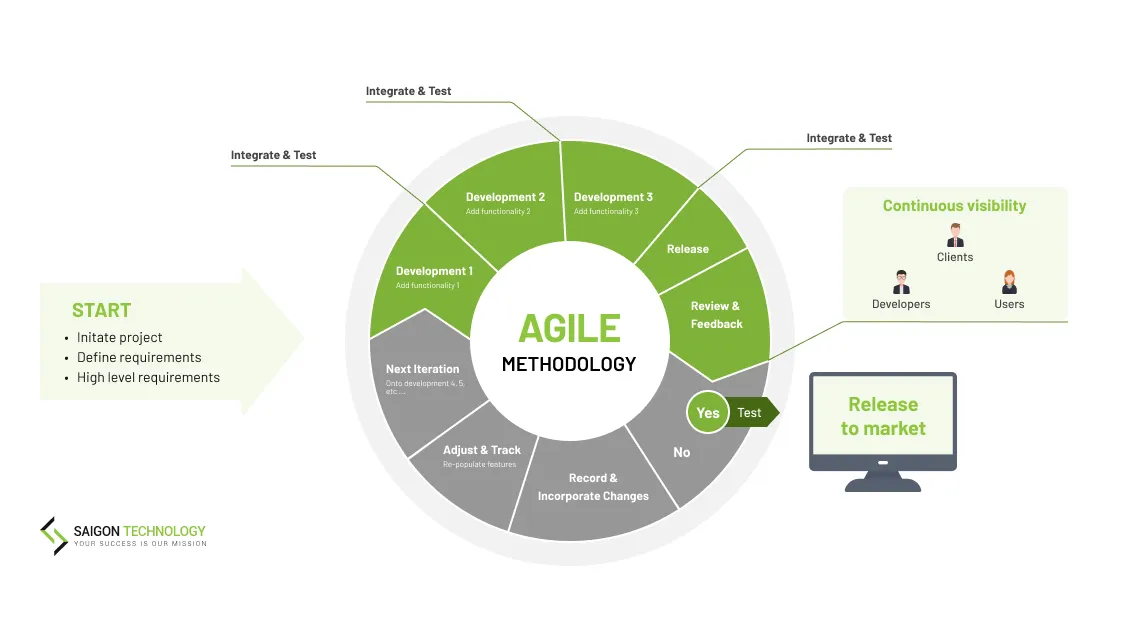
Engineers build in Agile sprints, shipping working software every two weeks. This covers the core platform, user roles, course and content management, assessments, reporting, integrations, and AI features, tested as we go.

qa and app testing

Quality Assurance and Testing (4+ weeks, in parallel)

QA runs alongside development, not after it. We test functionality, integrations, performance, security, accessibility, and standards like SCORM and xAPI, fixing issues before they pile up.

app development

DevOps and Launch (2–4 weeks)

We set up the production environment, CI/CD pipelines, and monitoring. If you're migrating from an existing LMS, we handle data migration and validation too, with a phased rollout to minimize disruption.

app maintenance and support

Maintenance and Support (Ongoing)

After launch, we handle monitoring, security patches, bug fixes, and performance tuning. As your learner base grows, we keep extending the platform, integrations, and learning features.

Our Insights

FAQs

Custom LMS development builds a learning management system around your organization's workflows, integrations, compliance needs, and AI use cases. Unlike an off-the-shelf platform, it gives you control over the data, architecture, source code, and product roadmap, with flexibility to evolve as your training needs grow.

An LMS (learning management system) is built for structured, admin-led training: courses get assigned, completion gets tracked, and compliance gets reported. An LXP (learning experience platform) works the other way around. Learners choose what to learn, guided by personalized recommendations and content shared by peers, more like self-directed learning than a fixed course path. Most companies use both today: the LMS handles required training and compliance, the LXP keeps people learning and growing on their own.

Yes. AI can be integrated into a custom LMS to support adaptive learning paths, intelligent content recommendations, automated assessment generation, AI-assisted grading, predictive learner analytics, NLP-powered content tagging, and AI tutoring assistants. Depending on the use case, we use technologies such as TensorFlow, PyTorch, spaCy, Whisper, and MLflow to build and manage AI capabilities within the learning platform.

LMS development generally runs $45,000 to $350,000 depending on scope. Off-the-shelf platforms typically charge $5 to $15 per learner per month. The crossover point where development becomes cheaper over five years usually falls between 500 and 1,500 learners.

A focused MVP takes roughly 3 to 5 months from discovery to launch. An enterprise platform with multi-tenancy, deep integrations, and AI capabilities takes 6 to 12 months. Integration count and compliance scope drive the timeline more than feature count.

Yes. We build two-way integrations with HRIS, CRM, ERP, SSO providers, payment gateways, and BI platforms through REST, GraphQL, and webhook-based APIs. Integration scope is mapped during discovery so the effort is priced before the build starts.

Build a Custom LMS with Saigon Technology

Tell us what your training program needs to do and we will scope it. As an LMS development company, we provide a technical specification, a phase-level timeline, and a fixed estimate before you commit to a build. Our team responds to every inbound within one business day.

    Contact Message Box

    Schedule a Demo with Our Industry Experts

    Book a free 30-minute call

    • See case studies aligned with your requirements
    • Validate our industry experience
    • Confirm technical fit for your project
    Schedule a Demo

      Your RFP, reviewed by experts in 48 hours

      AI-accelerated path from brief to working prototype. Engineers, not sales.
      • Clickable prototype of your core user flow
      • Workflow visualization mapping the full system
      • Architecture direction covering stack, integrations, and scale
      • Technical recommendation call with our engineering team
      Free Demo Campaign