• OVERVIEW
  • SERVICES
  • WHY CHOOSE US?
  • MODELS
  • TECHNOLOGIES
  • OUR PROCESS
  • FAQS

What Is Insurance Software Development?

What Is Insurance Software Development?
  • Insurance software development is the design, build, integration, and modernization of the systems insurers use to quote, bind, issue, service, and settle policies. It covers custom applications, extensions to licensed insurance core platforms, and the APIs that connect them to billing, document management, and third-party data.
  • Most insurers don't start from a blank page. They run a policy administration system that works, a claims platform that mostly works, and a stack of spreadsheets filling the gaps between them. Software development for insurance usually means closing those gaps without breaking what already pays the bills. Our default is to extend before you replace, and to replace only the parts that hold the business back.
Contributors
Phuc Tran - Program Manager
Meet Phuc (Cris) Tran
Program Manager with 10+ years specializing in healthcare platforms built to HIPAA, HL7, and PDPA standards, with a career leading 60+ engineers and $3.9M budgets overall
Book an Appointment More Details
Van Nguyen - Business Analyst
Meet Van Nguyen
Business Analyst with 9+ years in Insurance, skilled at analyzing complex insurance processes and translating them into actionable requirements
Book an Appointment
over 400 software developers
400+
Software Developers
Over 14 years of experience
14+
Years in Business
Over 850 Projects Successfully Delivered
850+
Projects Successfully Delivered
rating on Clutch
4.8
Star Rating on Clutch

Our Insurance Software Development Services

These insurance industry software solutions cover the quote-to-claim chain, from the rating engine a producer uses to price a risk to the screen a policyholder uses to report a loss. Start with one module or combine several into a program.
software development services - icon 7

Policy Administration and Rating Systems

We build and extend policy administration systems for issuance, endorsements, renewals, and cancellations, with rating engines and quote-to-bind tools that apply your actuarial models, not ours. Policy administration system development starts from the product rules your underwriters already use, so a rate change ships as configuration instead of code. We deliver it through our custom software development practice.
chevron-up.svg
software development services - icon 4

Underwriting Workbenches and Decision Support

Underwriters lose hours re-keying submissions. Our underwriting workbenches pull application data, loss runs, and third-party data into one screen, apply your rules, and flag the cases that need a human look. Where volume justifies it, our AI development team adds ML-powered risk scoring. The underwriter keeps the final decision, and every recommendation is logged.
chevron-up.svg
software development services - icon 2

Claims Management Software

A claims platform has to capture first notice of loss from any channel, route each file to the right adjuster, track reserves, and keep an audit trail for every decision. We build claims systems with document capture, task-specific APIs for repair networks and payment gateways, and a hook at intake where your fraud detection models or a third-party scoring service can check each claim.
chevron-up.svg
software development services - icon 11

Agency Management and Insurance CRM

Insurance agency software development starts with how producers actually sell. We build agency management systems and CRM for insurance that track clients, commissions, renewals, and agent and broker certifications in one record. Renewals stop slipping through email threads.
chevron-up.svg
software development services - icon 9

Core-System Integration

A new tool only helps if it talks to what you already run. Our software integration engineers connect policy, billing, claims, CRM, and document systems through REST APIs, ACORD AL3 and XML messages, payment gateways, e-signature services, and third-party data providers. A scalable API platform lets you add a new MGA or distribution partner without another point-to-point project.
chevron-up.svg
software development services - icon 3

Core Modernization and Cloud Migration

Legacy policy administration systems rarely fail at once; they get slower to change. We modernize them through modular refactoring and cloud-native microservices that take over one function at a time, with phased deployment and zero-downtime releases as the target for every cutover. See our legacy modernization and cloud migration work.
chevron-up.svg
software development services - icon 5

Self-Service Portals and Mobile Apps for Policyholders and Agents

Policyholders want to get a quote, pay a premium, file a claim, and check its status without a phone call. We build insurance portals and customer-facing apps on web and mobile, tested against the devices and browsers your customers and agents really use.
chevron-up.svg
software development services - icon 6

QA, Security Testing and Long-Term Support

Rating logic breaks quietly. A regression suite that recalculates sample policies after every change catches the error before a customer does. Our QA and testing teams run functional, regression, performance, and security tests, and our maintenance and support teams handle patches and release windows agreed with your operations staff.
chevron-up.svg

Case Studies: Regulated, Multi-Party Systems We Have Shipped

Our insurance client projects are covered by NDAs, so we can't publish them here. The three projects below are not insurance core-system builds, but each solves a problem insurance software shares: integration-heavy business logic, multi-party workflows that carry sensitive personal data, and platforms that serve several organizations from one codebase. Contact us, and our engineers will bring that insurance expertise to your project.
Jumar Staffing demo

Jumar Staffing: A BOT-Model Azure and Dynamics 365 Team for a UK Digital-Services Provider

  • Challenge: Jumar, a UK digital-services provider whose clients include public-sector, financial-services, and insurance organizations, needed an agile team in Vietnam to handle complex business logic across a suite of integrations, in English and across time zones. 
  • What we built: A dedicated team under a build-operate-transfer model with staffing services, working tickets across Azure services, Dynamics 365, and the Power Platform, backed by knowledge-transfer documents. 
  • Stack: Azure AD B2C, Key Vault, Service Bus, Function Apps, Logic Apps, Application Insights, Dynamics CRM 365, Power BI, SharePoint, Power Apps, C# microservices, Angular, and SQL Server with temporal tables, which keep a history of every row change. 
  • Read full case study →
Triptomatic

Triptomatic: A Multi-Party Booking Platform With Integration APIs

  • Challenge: Booqit, a Brussels startup, needed one platform where institutions, health insurance funds, and individuals book non-emergency medical transport and dispatch it to transport companies. Users had limited IT skills, forms started on the web had to be finished on mobile, and messaging had to work in real time.
  • What we built: A booking web app and a transporter mobile app covering trips, vehicles, invoices, and chat, plus APIs so transport companies can link their own planning systems.
  • Engagement / timeline: An offshore team of one web developer, one mobile developer, and a project manager, unchanged after the first year, working to a 12-month plan broken into milestones and reported quarterly.
  • Stack: AWS, Node.js, React, React Native, MongoDB, Google Maps API, Twilio, Jest, and Atlassian tooling for automated builds.
  • Read full case study →
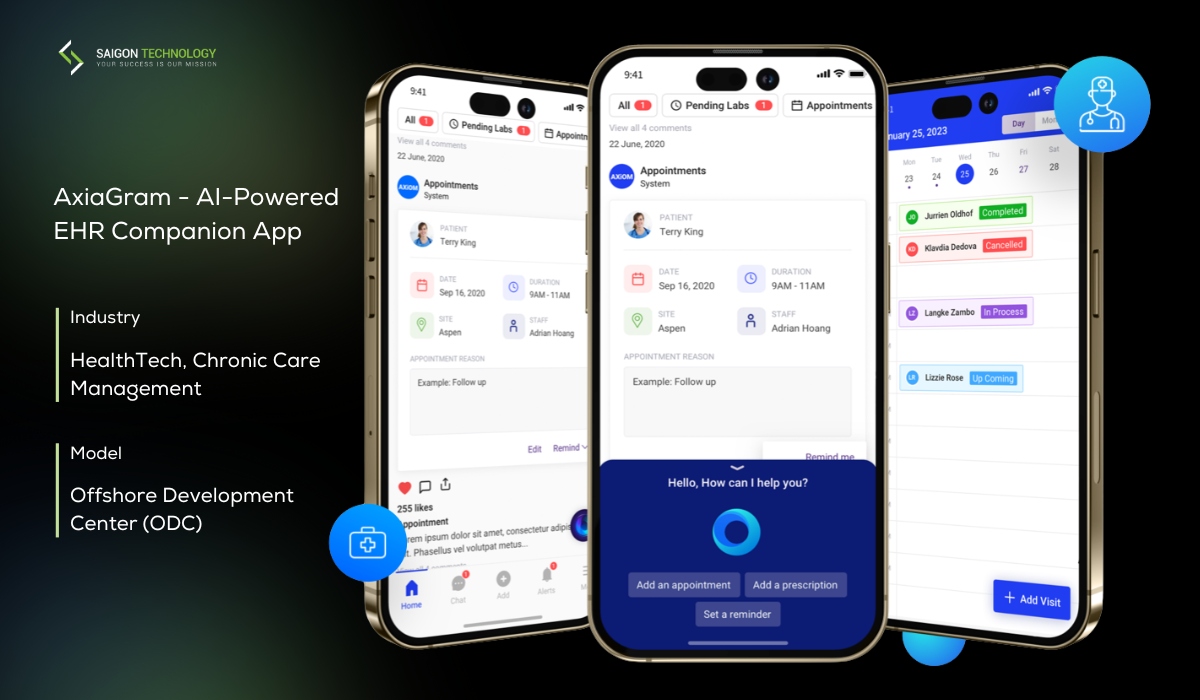
AxiaGram - AI-Powered EHR Companion Appy

HealthTech: A Multi-Tenant SaaS EHR With E-Signature and NLP

  • Challenge: A SaaS EHR platform needed scheduling, patient follow-up, messaging, video and audio calls, document signing, and API integration, all usable by doctors and patients with limited IT skills.
  • What we built: Tenancy models across the database, server, and client code, real-time data with SignalR, video and audio through Agora, electronic signatures, and natural language processing with LUIS. Keeping tenants apart is the same design problem as running several carriers or programs on one platform.
  • Engagement / timeline: A dedicated outsourced team with daily reporting and reviews every two weeks.
  • Stack: ASP.NET 6, SQL Server 2019, React Native, SQLite, SignalR, Agora.io (WebRTC), LUIS, and Swagger.
  • Learn more | Read the full case study (PDF) →

Send Your Insurance RFP. See a Working Prototype in 48 Hours.

Send a full brief and our AI-accelerated workflow turns it into a working prototype within two business days. Your RFP is reviewed by Van Le, Business Analyst, not a sales team, so the questions you get back are about your rating rules, data, and integrations.
  • Clickable prototype of your quote, policy, or claims flow
  • Workflow visualization mapping the full quote-to-claim chain
  • Architecture direction covering core-system integration, policyholder data controls, and scale
  • Technical recommendation call with our engineering team
free demo

Why Choose Saigon Technology as Your Insurance Software Development Company?

A good insurance software development company changes policy, claims, and billing systems without interrupting the business that runs on them. It integrates with the licensed cores insurers already pay for, protects policyholder data under named controls, keeps the same engineers on a multi-year roadmap, and publishes what its time costs. 

Rating tables, endorsement rules, and claims reserves punish shortcuts. At onshore premiums, the regression suite protecting that logic is often the first line item cut. We staff insurance work with senior engineers who use AI for code generation, test scaffolding, and review, so a smaller team covers the same scope with fewer rebuilds. Publishing a rate is rare among insurance software development companies. Ours is $22–$46/hr with senior oversight, and teams keep 10–12 hours of overlap with US East and West Coast working days. 

A policyholder record can hold bank details, claims history, and medical notes. One leak can trigger breach-notification duties in every state where affected customers live. We work under NDAs, role-based access controls, and a secure development lifecycle aligned with GDPR and PDPA. When your regulator names specific controls, we turn them into backlog items with test evidence: access logging, encryption at rest and in transit, and multi-factor authentication. Your compliance team keeps ownership of attestation, and we supply the evidence it needs.

Insurance platforms live for a decade or more. When the engineers who wrote your rating engine leave, the next rate change slows down because nobody remembers why a rule exists. Saigon Technology is one of the Southeast Asia Best Workplaces™ in Technology 2026 (#10, Medium category, Great Place To Work) and a Fortune 100 Best Companies to Work For™ Southeast Asia 2025. Every engineer passes three screening rounds, run by Talent Acquisition, a Tech Lead, and HR.

Replacing a policy administration system in one release is one of the riskiest moves an insurer can make, and often an unnecessary one. Our architects first map what your licensed core already does well. Then they propose the smallest change that fixes the business problem: a rating service beside the core, a claims intake layer in front of it, or a phased migration one product line at a time. Sometimes the honest answer is to configure what you already license. We'll say so.

Both certifications come from BSI, a third-party certification body, not a self-declaration. In an insurer's vendor-risk review, they answer the quality and information-security questions before the first call.

You may have noticed that the case studies above are adjacent work rather than insurance core builds. Our insurance engagements stay under NDA, so we show verifiable work on regulated, multi-party systems instead of an insurance metric we can't publish.

Start with a two-week risk-free trial. Then choose a dedicated team, staff augmentation, fixed price, an offshore development center, or build-operate-transfer, and switch models as the program grows.

Why choose Saigon Technology 2026

Our Clients

Partner-logo2 Partner-logo3 Partner-logo4 Partner-logo6 Partner-logo1 Partner-logo5 Partner-logo9 Partner logo

What Our Clients Say

Saigon Technology provided the expert advice and technical development needed for our platform. I truly appreciate their professionalism and ongoing support.
Jason Soo
CEO of Loan City, Singapore
star.svg star.svg star.svg star.svg star.svg
Over the past year, collaborating with Saigon Technology Solution company, we have brought high-quality financial software solutions. STS helps us meet the strict requirements of the IT market with software engineers, software testers, and internal system control. And all of these are evidence that we have chosen a good software outsourcing partner.
Mr. Corbin van Amelsvoort
Director at Topicus Vietnam
star.svg star.svg star.svg star.svg star.svg
We value Saigon Technology’s strong support in managing the engagement from an internal delivery perspective. They were able to maintain team performance across a relatively large team, provide additional resources when required, and work collaboratively with us on matters such as gap time, discount proposals, and improvements to the working process. Their flexibility and consistent management support contributed positively to the overall partnership.
Sri Vijayasarathy
CTO of Axiagram, USA
star.svg star.svg star.svg star.svg star.svg
What we valued from Saigon Technology was not only the capability of the team itself, but also the consistency behind the delivery. The engagement was supported by strong internal management, clear coordination, and a steady focus on quality, which helped the project run in a reliable and professional manner.
Bryan McConnell
COO of NZPA, New Zealand
star.svg star.svg star.svg star.svg star.svg
Saigon Technology has been a reliable and committed partner in our telehealth project. They consistently delivered on time, provided responsive 24/7 support, and were always available on WhatsApp, even after working hours, whenever we needed urgent assistance. What stood out most was their continuous attention to security and speed, which are essential for a healthcare platform. Their strong ownership and responsiveness made a real difference to the success of the project.
Eric Chiam
CEO of Minmed, Telehealth, Singapore
star.svg star.svg star.svg star.svg star.svg

Build, Buy, or Extend: When Custom Insurance Software Pays Off

Buy a licensed core when your products are standard and speed to market wins. Extend it with custom modules when the core fits most lines but not your distribution, data, or customer experience. Build custom insurance software when the product, channel, or data model is what sets you apart. 

Option Fits when Watch out for Typical Saigon Technology role
License a core platform (PAS, claims, and billing suites) Standard products across many states or lines, and a team that prefers configuration to code License and upgrade costs, limits of the vendor roadmap, long configuration projects Integration, data migration, testing, and custom front ends
Extend the core with custom modules The core holds policy records well, but rating, distribution, or self-service falls short Keeping extensions compatible through core upgrades Rating services, quote-to-bind tools, portals, and APIs beside the core
Full custom build New products, embedded or usage-based distribution, or a data model no suite supports Larger upfront scope, and you own the roadmap and the compliance evidence End-to-end design, build, and long-term support

The gains should show up in business terms:

New rules ship as configuration in a service you control, instead of waiting for a vendor release.

Each release is smaller, so testing and rollback cost less. 

Pricing and claims data your analysts can query for business intelligence (BI).

When a rule changes, you update your own controls and audit trails without joining a vendor queue. 

What Drives the Cost of an Insurance Software Build?

Five things drive the cost of an insurance software build: the number of core systems it integrates with, the lines of business and jurisdictions it covers, the volume of legacy data to migrate, the compliance scope, and the engagement model. Saigon Technology's senior-led rate is $22–$46 per hour, with senior oversight on every team.
Cost driver Why it moves the bill
Core-system integrations Each connection to a policy, billing, or claims system needs data mapping, error handling, and test data from that system's owners
Lines of business and jurisdictions Every line and state adds rating rules, forms, and filing requirements to build and test
Legacy data migration Old policy and claims records need cleansing, reconciliation, and production validation before cutover
Compliance scope Controls such as audit trails, encryption, and access reviews add build work and evidence work
Functional complexity and channels Portals, mobile apps, and agent tools each need their own UI/UX design and device testing
Engagement model A dedicated team suits an evolving roadmap; fixed price suits a tightly scoped module
Market Rate Context

Market Rate Context

For context, market-wide offshore rates run from $25 to $70+ per hour.
No Fixed Price Range

No Fixed Price Range

We don't publish a project price range, because a figure without your scope would mislead you.
Scoped Estimate in 48 Hours

Scoped Estimate in 48 Hours

Send a full brief and our 48-hour RFP response comes back with a scoped estimate.
Where the Saving Comes From

Where the Saving Comes From

The saving comes from a smaller senior team and fewer rebuilds, not a cheaper hour.

Who We Build For

We deliver insurance software services to carriers, MGAs, brokers, insurtechs, and health plans, and to the reinsurers and administrators they exchange data with. Each needs a different mix of speed, integration depth, and regulatory evidence.

Carriers (P&C, Life, and Specialty)

Extend the licensed core with custom rating, claims, or distribution modules, and modernize the parts that slow product launches. Commercial auto, commercial property, general liability, workers' compensation, and professional liability each carry their own rules, which we model from your specifications. 

chevron-up.svg

MGAs and Program Administrators

Launch programs quickly on a delegated-authority stack: quote-to-bind, bordereaux reporting to carriers, and clean data sharing across several capacity providers. 

chevron-up.svg

Brokers and Agencies

Agency management, CRM, and carrier connectivity, so producers stop re-keying the same risk into five carrier portals. 

chevron-up.svg

Startups Building Insurance Products

Insurtech software development from MVP to a production platform that survives carrier due diligence, with security controls, audit trails, and documentation in place from the first sprint. 

chevron-up.svg

Health Plans and Benefits Administrators

Member portals, eligibility checks, and claims data flows, with support for HIPAA requirements for health insurance data and HL7 when a project needs them. For health insurance software development that sits closer to providers, see our healthcare software work.

chevron-up.svg

Key Technologies We Use

How We Deliver Insurance Software Without Stopping the Business

We deliver insurance software in phases, so the systems you run today stay live while new ones take over. Each phase ships behind an integration layer, gets tested against production-shaped data, and goes live one workflow at a time. The seven steps below apply whether you extend a core or build from scratch.

"When the policy system can't go dark, we ship the integration layer first and move one workflow at a time. Rework shrinks because every release is tested against production-shaped data before the next one depends on it." - Phuc (Cris) Tran, Program Manager, Saigon Technology

Software Development Process

Process discovery and regulatory assessment

Requirements elicitation with underwriters, adjusters, agents, and compliance. 

Software Development Process

Architecture and integration map

Solution conceptualization, the systems of record, and the order in which functions move.

Software Development Process

Security and compliance setup

Access roles, encryption, audit logging, and environments configured before feature work starts.

Software Development Process

UI/UX design

Flows for policyholders, agents, and adjusters, tested with real users.

Software Development Process

Agile development

Two-week sprints, with new services running beside the core instead of inside it.

Software Development Process

QA and production validation

Rating-logic regression, security testing, and parallel runs that compare new results with the legacy system.

Software Development Process

Phased deployment and post-launch support

One workflow at a time with a rollback plan, then maintenance and monitoring.

Our Insights

FAQs

Insurance software succeeds or fails on integration and compliance, so we choose technology with both in mind. The regulations table below shows what each rule changes in the software itself, which is the engineering work behind a compliance requirement. 

Technology Stack 

  • Backend: .NET, Java, Node.js, Python 
  • Frontend: React, Angular, TypeScript 
  • Mobile: iOS, Android, React Native, Flutter 
  • AI and data: Python, TensorFlow, PyTorch, scikit-learn, and LLMs for predictive analytics and risk assessment engines 
  • Cloud and DevOps: AWS, Azure, Google Cloud, Docker, Kubernetes, Terraform, Jenkins 

Integration Standards 

We work with ACORD AL3 and XML messages, REST and event-driven APIs, payment gateways, e-signature services, and third-party data providers. Insurance accounting software and actuarial models stay with the teams that own them; we connect to them rather than replace them. Options such as mobile telematics for usage-based insurance, IoT data feeds, robotic process automation (RPA), and blockchain smart contracts for data exchange are choices we weigh against your volumes and partners, not defaults. 

Regulations and What They Change in the Software 

Regulation Where it applies What it changes in the software
NAIC Insurance Data Security Model Law US states that have adopted it A documented security program, risk assessment, event investigation, and notification to the insurance commissioner
NYDFS Cybersecurity Regulation (23 NYCRR 500) Insurers licensed in New York Multi-factor authentication, access privilege reviews, audit trails, and incident reporting
Gramm-Leach-Bliley Act (GLBA) US financial institutions, including insurers Safeguards for nonpublic personal information and privacy notices
California Consumer Privacy Act (CCPA) Personal data of California residents not covered by GLBA Workflows for access, deletion, and opt-out requests
Bank Secrecy Act AML rules Covered life and annuity products KYC/AML workflow automation and suspicious-activity flags
UK GDPR Personal data processed in the UK Lawful-basis records, data-subject requests, and breach reporting
FCA Consumer Duty UK retail insurance products Outcome monitoring and regulatory compliance reporting on fair value and customer support
HIPAA US health plans Safeguards for protected health information and access logs

Saigon Technology holds ISO 9001 and ISO 27001 certification from BSI. We build the controls these rules require and produce the evidence, including real-time alerts for non-compliance where you need them. Certification and attestation stay with your compliance team.


The cost depends on how many core systems the software connects to, how many lines of business and jurisdictions it covers, how much legacy data moves, and the compliance scope. Saigon Technology's senior-led rate is $22–$46 per hour. Send a full brief and our 48-hour RFP response includes a scoped estimate.

Timelines depend on scope, not a standard template. A carrier extending one workflow beside its core moves faster than an insurtech building policy, billing, and claims from zero. Two timings are fixed: a working prototype within 48 hours of a full RFP, and about five days to stand up a dedicated team.
Buy a licensed platform when your products are standard and speed to market matters most. Extend it with custom modules when the core fits your lines but not your distribution, data, or customer experience. Build custom when the product or channel itself sets you apart. The comparison table above sets out all three options.

In the US, plan for state adoptions of the NAIC Insurance Data Security Model Law, GLBA privacy rules, CCPA for California residents, and NYDFS Part 500 in New York. In the UK, UK GDPR and the FCA Consumer Duty apply. Health plans add HIPAA. Your compliance team owns attestation, and the software supplies the evidence.

Yes, in most cases. We connect through the platform's published APIs, ACORD-formatted messages or, for older systems, a controlled integration layer that works on the core's terms. New services run beside the core, so your policy administration system stays the system of record throughout the rollout.

Most insurance programs start with a dedicated team, because rating and claims logic rewards engineers who stay. Fixed price suits a well-scoped module such as a quoting tool. Build-operate-transfer fits insurers who want their own team later. Any model can begin with a two-week risk-free trial.

Extend, Integrate, or Build: Start Your Insurance Platform With Saigon Technology

From a validated prototype to production, our senior engineers and AI-accelerated delivery build custom insurance software solutions that grow with new products, channels, and regulations. Tell our insurance software development services team what your policy, claims, or distribution systems need next, and we'll come back with a plan.

    Contact Message Box

    Schedule a Demo with Our Industry Experts

    Book a free 30-minute call

    • See case studies aligned with your requirements
    • Validate our industry experience
    • Confirm technical fit for your project
    Schedule a Demo

      Your RFP, reviewed by experts in 48 hours

      AI-accelerated path from brief to working prototype. Engineers, not sales.
      • Clickable prototype of your core user flow
      • Workflow visualization mapping the full system
      • Architecture direction covering stack, integrations, and scale
      • Technical recommendation call with our engineering team
      Free Demo Campaign