-
OVERVIEW
-
SERVICES
-
MODELS
-
WHY CHOOSE US ?
-
OUR PROCESS
-
TECHNOLOGIES
-
FAQS
What Are AI Transformation Services?
AI transformation services are engineering engagements that move AI out of pilot and into production systems, rebuilding workflows, data access, and integration points so models can act on live business data. They cover the build layer: retrieval and permissions, evaluation harnesses, human-in-the-loop checkpoints, and integration into systems of record. They differ from AI consulting, which delivers a strategy, and from AI training, which changes how staff work.
In practice that means the unglamorous middle of the project. Getting a model to answer well in a demo takes days. Getting it to read the right records, respect who is allowed to see what, log why it decided something, and update the system your finance team trusts, that takes engineering. We do generative ai transformation work the same way: the model is the easy part, and the integration is the project.
Which half of the problem you have
AI transformation has two halves: how people work, and what the systems can do. Programmes stall when a company buys one and needs the other.
Saigon Technology builds the systems half. If your blocker is adoption, cultural shifts, internal alignment, or upskilling programs, the partner you need runs mindset training and workforce change programmes, a human-centered approach to how teams work, not an engineering team. That is real work, and it is not what we sell. Saying so in week one costs far less than discovering it in month four.

Our AI Transformation Services
AI feature and model development
Data foundation for AI
LLM and RAG integration into existing products
Integration into systems of record
Unblocking systems AI cannot reach
Pilots architected to reach production
Evaluation, QA and rollback
Observability and DevOps for models in production
Case Studies - AI Delivered Into Working Systems
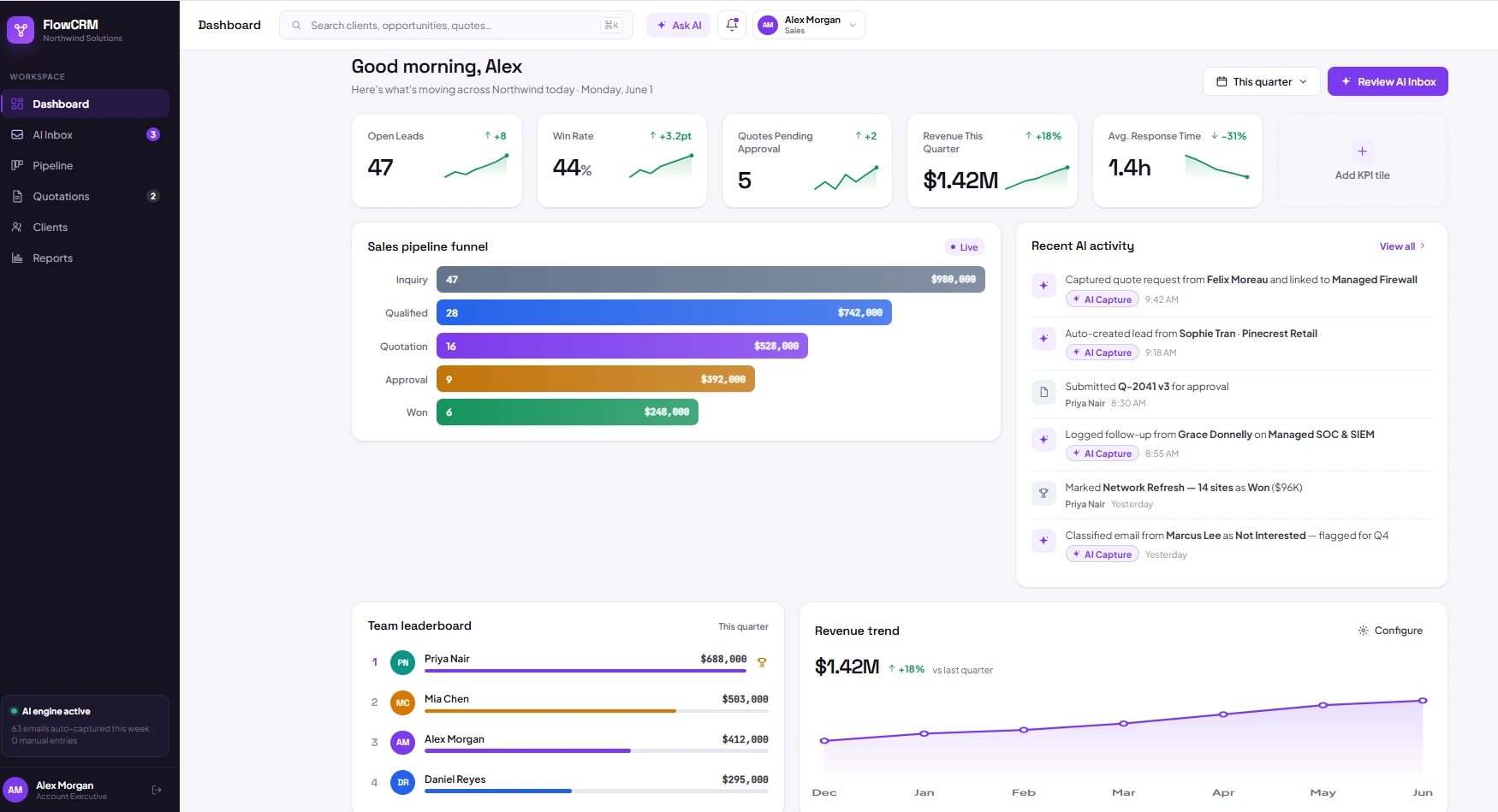
FlowCRM - AI-assisted capture inside the commercial workflow
- Challenge: Leads, quotations, client history, and delivery status lived across scattered inboxes and spreadsheets. Every update meant somebody retyping what had already arrived by email.Â
- What we built: A custom CRM and operational command centre covering the full lead → quotation → delivery lifecycle, with an AI layer that reads incoming Outlook/Exchange mail through Microsoft Graph, extracts sender, subject, content, and attachments, and files each message against the right lead, client, and opportunity automatically.Â
- Engagement / timeline: Custom software development.Â
- Outcome: One source of truth across commercial and execution workflows; CRM data entry automated rather than delegated; version-controlled quotations with role-based access and full audit logs; real-time visibility for sales, operations, and management.Â
- Stack: Web application, Microsoft Graph, AI-assisted classification and tagging, RBAC, audit logging, configurable KPI dashboards.Â
Automatic capture was designed into the data model rather than added at the end, which is why reducing manual entry is a property of the system and not a feature someone has to remember to use. Read the full FlowCRM case study.Â
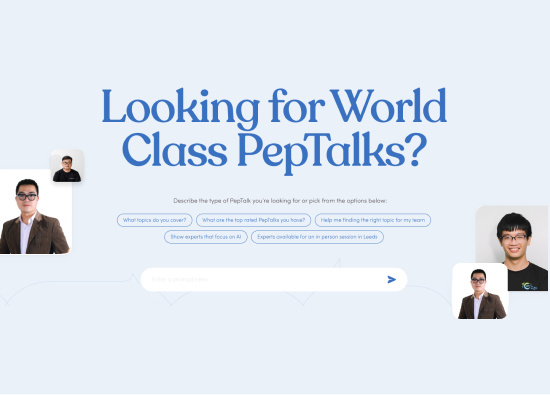
PepTalk - a GenAI chatbot replacing a manual matching process
- Challenge: Clients needed to find and book the right subject-matter expert for an event. Discovery was manual, and the shortlist depended on whoever happened to know the roster.

- What we built: An MVP chatbot that collects requirement keywords, uses text embeddings to search the expert database on semantic similarity, presents expert detail in natural language, then captures booking details and submits the request.

- Engagement / timeline: Fixed-price MVP; team of seven: 1 project manager, 1 business analyst, 4 developers, 1 QC.
- Outcome: A working validation of the concept before further investment.
- Stack: Python, LangChain, ChromaDB, FastAPI, Celery, PostgreSQL, Redis, OpenAI, WebSocket, Docker, Angular.

Read the full PepTalk case study.

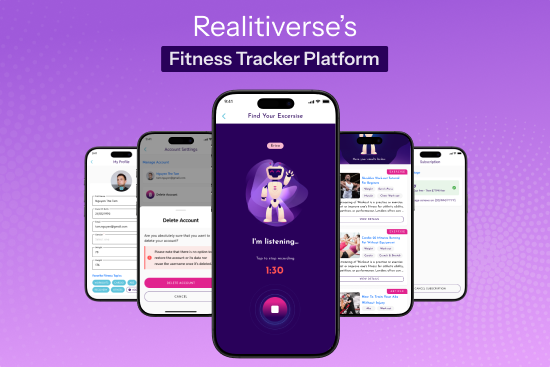
Realitiverse Fitness Tracker - an AI content pipeline with a human gate
- Challenge: A wellness platform needed a large, trustworthy content library without hiring an editorial team.
- What we built: AI-driven exercise and meditation search, plus AI content scanning behind an admin approve/reject gate, a human-in-the-loop checkpoint implemented as system design rather than written into a policy document.
- Engagement / timeline: Fixed-price.
- Outcome: Content volume without unreviewed content reaching users.
- Stack: Angular, .NET, Flutter, Azure Web Services, AI services, Apple IAP.
Read the full Realitiverse case study.
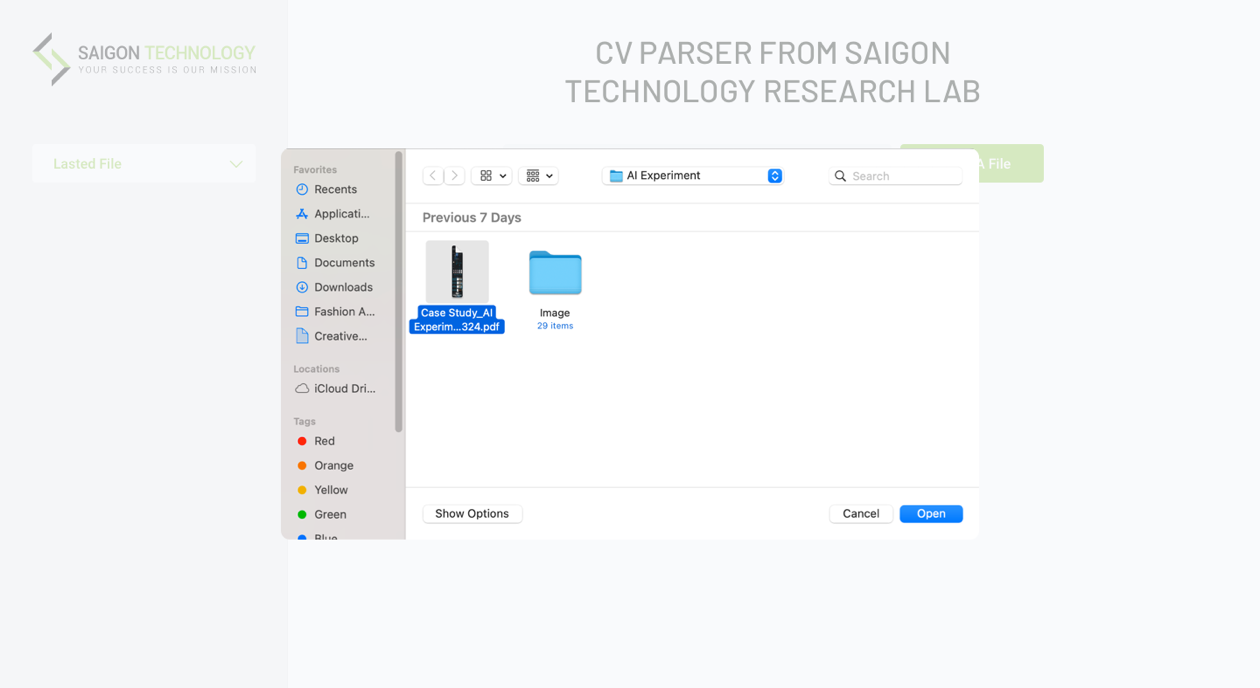
CVParser - an internal process rebuilt around AI
- Challenge: Our own recruiting pipeline required somebody to read every inbound CV before hand-off to tech leads and HR. We ran this one on ourselves first.
- What we built: An end-to-end parser, PDF cleaning and conversion, computer-vision document-layout recognition, then OCR and NLP applied per region to extract name, contact details, experience, and education as structured data.
- Engagement / timeline: Internal build.
- Outcome: Candidate data captured as structured records instead of read manually, making shortlisting a query rather than a reading task.
- Stack: Computer vision, OCR, NLP, Python.
Read the full CVParser case study.
Send Your Brief. See the First Workflow Running in 24 Hours.
- Clickable prototype of your highest-volume manual workflow, its data source, and the decision point AI would take over
- Workflow visualization mapping the full path from source system to AI output to the record it updates
- Architecture direction covering retrieval and permissions, evaluation and rollback, and scale
- Technical recommendation call with our engineering team
Why Choose Saigon Technology as Your AI Transformation Company?
A good ai transformation services partner is judged on what reaches production, not what reaches a slide. It should own the data access, evaluation, and integration work that decides whether a model survives contact with real systems, and say plainly when a workflow should not be automated at all.
Senior engineers paired with applied AI
Our teams are senior-only, working with AI tooling rather than padded with juniors, the stated ratio is one senior engineer plus AI equals three juniors, at listed rates of $22–$46/hour with senior oversight. This matters more on AI work than anywhere else.
When a junior-heavy team runs short on budget, the first things cut are the evaluation harness and the rollback path, the two things that make a model safe to ship. You end up paying less per hour for a system nobody can safely change.Â
Production-ready AI, not demos - inspect it working first
You can look at our AI running before you commit a budget. Our Research Labs at experiment.saigontechnology.vn host working demos, fracture detection, semantic search, OCR, object detection, built by the same engineers who would staff your project. That matters in a market where most AI tools conversations end at a methodology slide.
AI/ML, generative AI, computer vision, and IoT here are shipped systems guided by architects and tech leads, not proofs of concept that stop at the demo.
Auditable AI on real systems - access control, evaluation, rollback
AI transformation means software taking actions on live records, which changes what "secure" has to mean. We build role-based access control at the retrieval layer, so a model cannot surface a document the user was never allowed to open.
Every model decision writes an audit trail. Secure SDLC practices align with GDPR and PDPA, with HL7 and FHIR support where healthcare demands it. Non-deterministic output gets a regression suite and a rollback pat, because "the model got worse" is not a bug report you can act on without one.
Architecture advice from day one - including when not to build
You get solution architecture guidance rather than order-taking. Sometimes that means we tell you the workflow is not ready, or that your blocker is workforce change rather than software. Both answers save more money than a fast start.
ISO 9001 and ISO 27001, certified by BSI (UK)
Third-party certified, not self-declared, quality management and information security audited by an external body, held for over a decade rather than acquired last year.
14+ years · 400+ developers · 850+ projects · 350+ clients · 4.8★ · 3 development centres
On this page we have shown adjacent AI builds rather than a completed end-to-end transformation programme, and labelled them that way. We would rather show verifiable adjacent work than invent a metric, a habit worth checking for in any vendor's case studies.
Stable teams for systems that keep changing
An AI system's prompts, retrieval logic, and evaluation set change continuously, churn breaks what you already shipped, so the engineers who designed it are still here when it has to change.
Award badges - mark for badge treatment at build: Southeast Asia Best Workplaces™ in Technology 2026 - #10, Medium category (Great Place To Work) · Fortune 100 Best Companies to Work For™ Southeast Asia 2025
Two-week risk-free trial, five engagement models
Interview the engineers, then run a two-week risk-free trial before any long-term commitment. Five models: ODC, dedicated team, staff augmentation, fixed-price, and BOT, with no vendor lock-in.
Trusted by Global Clients
What Our Clients Say
Industries We Serve
Who We Build For
The companies that get the most out of AI transformation services already know which decision they want AI to make, and four patterns come up most often.
Not sure the build is the next step? If you need an AI readiness assessment before scoping engineering work, start with AI modernization, that is where readiness and legacy-AI enablement live.
Product companies
Embedding AI into something customers already pay for AI chat co-pilots, search, summarization, or recommendations inside a shipping product.Â
Operations-heavy businesses
Automating one high-volume manual workflow: document handling, customer service automation, or triage, where the saving is measurable in hours per week.
Regulated industries
Healthcare and fintech teams needing auditable AI, HL7/FHIR integration, and GDPR or PDPA alignment as a build requirement, not a later review.
Companies with a stalled pilot
That worked in a notebook and was never architected to reach production.
What Changes After an AI Transformation
The point is not that you own an AI platform for transformation. It is that specific things get measurably better.Â
Fewer people per unit of output
The same scope ships with a smaller team, because the repetitive half of the work is handled by the system.Â
Decisions on live data instead of last month's report
Decision support and AI-powered forecasting tools built on current records, so AI-driven decision-making reflects this week rather than last quarter.
Manual re-entry removed from a named workflow
Not "improved efficiency", a specific task somebody used to do by hand that the system now does, with measurable results you can put in a board pack.
Institutional knowledge that outlives the people who hold it
AI transcription and AI summarization turn expert processes into searchable SOPs, so critical knowledge survives a retiring workforce instead of leaving with it. Knowledge silos become a search box, and onboarding time drops because new staff can find answers without interrupting someone.
Faster service without a bigger team
Customer service automation and AI chat co-pilots shorten resolution times, which is what actually moves customer satisfaction.
A system you can change safely
Because evaluation exists, you can improve a model and prove the improvement, the difference between a system with a future and one nobody dares touch. Â
Our AI Transformation Process
Discovery and workflow mapping
Which decisions change, which stay manual, and what the AI roadmap looks like in dependency order rather than wish order.Â
Data access and retrieval design
Where the data lives, who may see it, and how retrieval will enforce that.
UX and product design
Including where a human stays in the loop and what that screen looks like.
Agile development with an evaluation harness from sprint one
You cannot improve what you cannot measure, and adding measurement later means rebuilding.
QA including non-deterministic regression testing
Plus data analysis tools and dashboards so performance is visible, not asserted.
Launch with observability and rollback
Monitoring, drift detection, and a tested way back.
Maintenance and model iteration
Prompts, retrieval, and evaluation sets evolve; so does the system.
Our Insights
FAQs
How much do AI transformation services cost?
Saigon Technology's listed rate is $22–$46/hour for implementation with senior oversight. Total cost is driven by how many systems must be integrated, whether the source data is already accessible, the compliance regime, and how much evaluation the use case demands. Regulated work and AI/ML sit at the top of the range.
How long does an AI transformation project take?
It depends on the phase, and honest ranges beat a single number. A scoped pilot with a production path designed in typically runs weeks rather than months. Integrating into systems of record takes longer than building the model. Any vendor quoting one fixed duration before seeing your data access situation is guessing.
Should we build AI in-house or outsource it?
Build in-house when AI is your product and you can hire and retain senior ML engineers. Outsource when AI is a capability inside your business, when you need it working this quarter, or when the hard part is integration rather than modelling. Many teams do both, an internal owner, an external build team.
How do you keep an AI system auditable and compliant?
Role-based access control is enforced at the retrieval layer, so models cannot surface records the user could not open directly. Every model decision writes an audit trail with inputs and outputs. Secure SDLC practices align with GDPR and PDPA, and healthcare engagements add HL7/FHIR and HIPAA support.
How do you test AI features that don't return the same answer twice?
With an evaluation harness built before feature work, not after. A fixed set of representative inputs runs against every change, scored on the outcomes that matter, so you can distinguish an improvement from a regression. Human-in-the-loop checkpoints cover what scoring cannot, and a rollback path handles the rest.
Which engagement model fits an AI transformation project?
Most start fixed-price for a scoped pilot, then move to a dedicated team or ODC once the build path is proven, AI work generates follow-on scope, and a fixed contract fights that. Staff augmentation suits teams with an internal AI owner. Five models are available with no vendor lock-in.
What does an AI transformation company do?
An AI transformation company designs and builds the systems an AI programme runs on: the pipelines that feed models, the permissions that constrain them, the tests that prove a change helped, and the integrations that write results back into the tools your teams already use. Some also advise on strategy; we focus on delivery.
What technologies, standards, and compliance frameworks do we build with?
- AI/ML: Python, TensorFlow, PyTorch, scikit-learn, OpenCV, LLMs (including OpenAI models), LangChain, vector stores such as ChromaDB
- Backend: .NET, Java, Node.js, Python (FastAPI, Django)
- Frontend & mobile: React, Angular, Vue.js, TypeScript, React Native, Flutter
- Cloud & DevOps: AWS, Azure, Google Cloud, Docker, Kubernetes, Terraform, Jenkins
- Data: PostgreSQL, MongoDB, Redis, Elasticsearch, Kafka
- Standards and compliance: ISO 9001 and ISO 27001 (BSI, UK); GDPR and PDPA alignment; HIPAA support and HL7/FHIR integration for healthcare engagements; NDAs, role-based access control, secure SDLC, and audit trails as build requirements.