-
OVERVIEW
-
SERVICES
-
MODELS
-
WHY CHOOSE US ?
-
OUR PROCESS
-
TECHNOLOGIES
-
FAQS
What Is Generative AI Integration?
Generative AI integration is the process of embedding generative AI models, such as large language models, into an organization's existing applications, data, and workflows so they automate tasks, generate content, and support decision-making in production. Unlike a standalone proof of concept, true integration connects the model to your ERP, CRM, and legacy systems through secure APIs, with the data pipelines, guardrails, and monitoring needed to run reliably at scale.
That is exactly where Saigon Technology operates. We don't just build a demo, we make generative AI work everywhere it needs to, with security by design, governance, and embedded AI in workflows that your teams actually use.
Our Generative AI Integration Services
Custom Generative AI Application Development
GenAI Readiness & Integration Consulting
LLM Integration & Fine-tuning
NLP & Document Intelligence Integration
Chatbot & Virtual Assistant Integration
GenAI Workflow & Process Automation
Data Pipeline & Analytics Integration
API & Platform Integration
Multi-Cloud & Hybrid GenAI Integration
GenAI Security, Compliance & Governance
Monitoring & Model Optimization
Case Studies
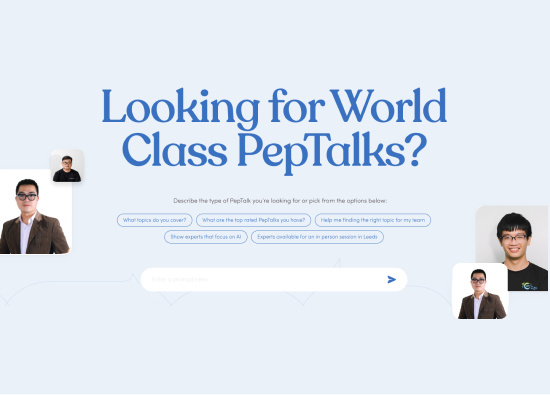
PepTalk: GenAI Chatbot for Expert Matching
- PepTalk needed a smart chatbot that could hold natural-language conversations, understand a client's requirements, and recommend the right experts to book for meetings and events.
- Challenge: bridging the gap between AI expertise and client domain knowledge, working around a third-party model's opacity, and balancing API fees and performance against accuracy.
- Solution: we built a chatbot that collects keywords, then uses text-embedding and semantic similarity to search the expert database and surface close matches, a textbook RAG pattern. We combined large and small OpenAI models to balance speed, cost, and quality, and defined clear acceptance criteria under a fixed-price model.
- Stack: Python, LangChain, ChromaDB, FastAPI, OpenAI, Celery, PostgreSQL, Redis, WebSocket, Angular, Docker.
- Outcome: an end-to-end booking workflow driven by large language models and vector search, delivered by a senior team of 1 PM, 4 developers, 1 BA, and 1 QC.
- Read the full case study →
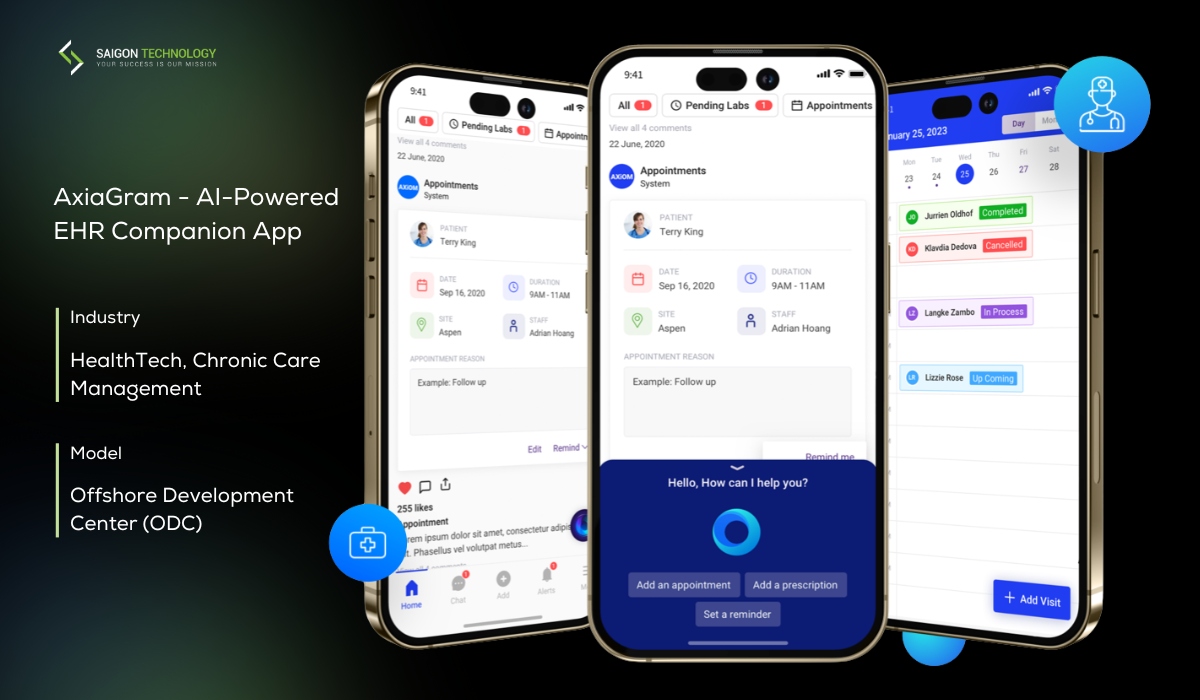
AxiaGram: AI-Powered EHR Companion (40% Faster Delivery)
- AxiaGram is a HIPAA-compliant telemedicine platform for US physicians and care teams, integrated with hospital Electronic Health Records.
- Challenge: deliver secure, voice-driven documentation and remote consultations while integrating cleanly with hospital EHR systems, a true YMYL, FDA regulations-adjacent environment.
- Solution: Voice AI for clinical note-taking, HL7-based EHR integration, secure internal messaging, and real-time video consultations, all on HIPAA-compliant infrastructure.
- Stack: .NET Core, Angular, Azure, HL7, Voice AI, Agora, Wowza, AES-encrypted MySQL.
- Outcome: 40% reduction in development time, 6M+ medical records handled securely, and an ongoing partnership running since 2021, proof that generative ai integration delivers ROI in regulated industries.
- Read the full case study (PDF) →
NLP Toolkit: Production LLM & Transformer Pipelines
- Our Natural Language Processing Toolkit packages a suite of production-ready language capabilities into one application.
- What it does: text summarization (LongT5), sentence similarity (BERT), named-entity recognition (spaCy), grammar correction, and comment/toxicity classification, accessible through a live demo.
- Stack: Python, Hugging Face Transformers, spaCy, Streamlit.
- Why it matters: it demonstrates the model depth behind our generative ai integration work, fine-tuning, transformer-based models, and prompt engineering applied to real text problems, validated in our AI Research Lab before any client build.
- Read the full case study →
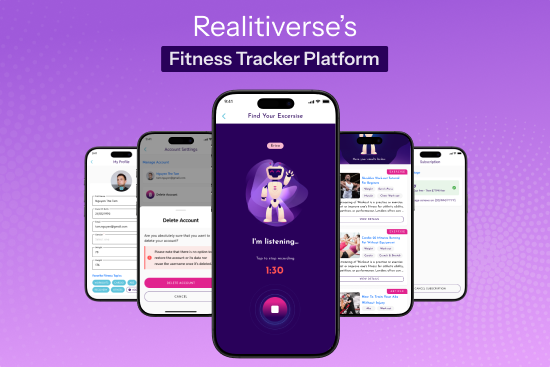
Realitiverse: AI Content Generation with Human Review
- Realitiverse's fitness and mental-wellness platform, built for the Singapore market, uses AI to surface and govern content at scale.
- Challenge: generate a rich library of exercise and meditation content quickly, while keeping quality high.
- Solution: AI-driven search and AI-generated content scanning, paired with an admin quality control workflow to approve or reject material, a practical example of embedded AI in workflows with human oversight.
- Stack: Angular, .NET, Flutter, Azure, AI, Apple IAP.
- Outcome: an AI-augmented content pipeline that scales output without sacrificing trust.
- Read the full case study →
Send Your Workflow. See GenAI Integrated in 24 Hours.
- Working prototype showing GenAI inside your real workflow
- Integration map covering models, prompts, and data sources
- Architecture direction covering security, cost, and scale
- Technical recommendation call with our AI engineering team
Why Choose Saigon Technology as Your Generative AI Integration Company
Most projects stall not because the model is weak, but because integration, governance, and change management are underestimated. As a generative AI integration company, here is how we close that gap:
Senior engineers + AI
"One senior engineer + AI = three juniors": fewer people, more output, less rework, and smarter resource allocation. Learn more: Our talent
ISO 9001 & ISO 27001 certified
Security and quality governance built into our delivery, not bolted on.
14+ years, 850+ projects, 350+ clients
Proven delivery across healthcare, fintech, and logistics.
Vietnam cost-to-quality
Published rates of $28-$46/hour give you a real competitive advantage on integration cost.
Fluent English + 10-12 hours of US time-zone overlap
Fast feedback and clean handoffs for your cross-functional teams.
Two-week risk-free trial
Interview our engineers and validate fit before any long-term commitment.
Architecture advice from day one
We advise on the full solution, not just task execution.
AI Research Lab validation
Live AI demos let us de-risk approaches before a full build.
Trusted by Global Clients
What Our Clients Say
Who We Build For
We tailor generative ai integration to your team's stage, stack, and rules. We build for healthcare, fintech, logistics, eCommerce, and real estate, and we respect each vertical's compliance needs, from HIPAA in healthcare to SOC2 and audit requirements in finance.
Startups & founders
Go from MVP or a prototype to a production GenAI feature fast, with cross-functional teams that fold AI into the product roadmap.
Mid-market CTOs & VPs of Engineering
Embed GenAI into existing systems for operational efficiency and enterprise productivity, without disrupting current workflows.
Product leaders
Ship personalized customer experiences, recommendation systems, and dynamic content generation that move engagement and retention.
Benefits of Generative AI Integration
The right ai integration services turn generative AI from a science project into business outcomes:
Operational efficiency
Automate repetitive tasks and workflow automation to free your team for higher-value work.
Data-driven insights
Analyze large datasets for faster, better decision-making and decision intelligence.
Personalized customer experiences
Dynamic content generation and recommendations that lift customer satisfaction.
Content at scale
Content creation, automated report generation, and personalized marketing copy with brand consistency.
Cost reduction & ROI
Fewer manual hours, lower error rates, and a clear path to competitive advantage.
Scalability
Scalability from 100 to 100,000 users on scalable infrastructure, without rebuilding what works.
Our Generative AI Integration Process
Discovery & GenAI readiness
Data readiness assessment, use case prioritization, risk & feasibility checks, project scope, and success metrics, supported by a cost-benefit analysis that weighs integration cost, api fees, and use case complexity.
Build the solution
Model selection, data integration, and fine-tuning / RAG setup tuned to your data.
Prototype & pilot
A proof of concept (POC), then an MVP or a prototype, validated in pilot phases with iterative rollout.
Testing & evaluation
Testing and evaluation with guardrails, output validation, and review of technical risks, regulatory risks, and ethical risks.
Workflow & systems integration
Connect models to your stack via APIs and connectors, with change management to drive adoption.
Deployment & monitoring
Deployment and monitoring with dashboards and alerts.
Maintenance & optimization
Model retraining and performance tracking & tuning to sustain value.
Our Insights
FAQs
What is generative AI integration?
Generative AI integration embeds generative AI models, like large language models, into your existing applications, data, and workflows. It connects models to systems such as ERP and CRM through secure APIs so they automate tasks, generate content, and support decision-making in production, not just in a demo.
What technologies, standards, and compliance frameworks do we use for Generative AI Integration?
- Models & frameworks: GPT, Claude, Gemini, and Llama large language models; LangChain, Hugging Face Transformers, TensorFlow, PyTorch, and spaCy. We apply prompt engineering, fine-tuning, and emerging agentic AI / agentic architecture patterns where they fit.
- Data & infrastructure: vector database management (ChromaDB, Pinecone, FAISS), data ingestion/processing pipelines, cloud object stores, and storage and data pipelines. For demanding workloads we plan for high-performance computing, specialized GPUs, AI accelerators, scalable infrastructure, energy-efficient hardware, and advanced cooling.
- MLOps & monitoring: Docker, Kubernetes, MLflow, Datadog, monitoring dashboards, orchestration and monitoring, continuous integration and deployment pipelines, data lineage tracking, performance audits, and ongoing monitoring & maintenance.
- Governance & compliance: responsible AI and data governance built in by design, with encryption, access controls, audit logging, audit trails, and recognized compliance frameworks. We align to GDPR, HIPAA, SOC2, PDPA, FDA regulations where relevant, and the European Union AI Act, and we run impact assessments so automation never overrides human judgment. Your data ownership is protected: sensitive data stays in your environment, and prompt injection protection guards every model endpoint.
Which industries benefit most from generative AI integration?
Generative AI integration delivers workflow-specific value in every sector, and the market proves it daily:
- Financial Services - fraud detection, automated report generation, and thematic index creation (as seen with JPMorgan's IndexGPT) plus risk and decision-making support.
- Healthcare & Life Sciences - clinical documentation, drug discovery acceleration, and function-level value across the healthcare operating model.
- Retail & eCommerce - personalized marketing, personalized marketing copy, recommendation systems, and ai-driven inventory optimization.
- Logistics - route and demand intelligence, automated report generation, and document automation.
- Legal & Professional Services - contract summarization and research with intelligent document processors.
- Enterprise platforms - SAP integration (including Generative AI Hub and Joule AI) and other industry-specific AI tools.
Should you build generative AI integration in-house or outsource it?
Deciding whether to build generative AI internally or partner with a generative AI integration company comes down to speed, talent, cost, and risk. Here is how the two paths compare:
|
Factor
|
Build In-House
|
Outsource to Saigon Technology
|
|
Speed to deploy
|
6–24 months of ramp-up
|
Weeks to a working prototype; 3–9 months to production
|
|
Talent
|
Requires scarce, costly AI/ML hires
|

Senior, AI-augmented engineers from day one
|
|

Cost
|
High upfront (talent, infrastructure, R&D)
|
Predictable $28–$46/hour; lower total integration cost
|
|
Integration & compliance
|
Your team owns all risk
|
Built-in ISO 9001/27001 and GDPR/HIPAA/SOC2 expertise
|
|
Control & IP
|
Full control, no lock-in
|
Full IP transfer; no vendor lock-in (multi-cloud)
|
|
Best for
|
Core, proprietary differentiators
|

Faster delivery, lower risk, regulated builds
|

Many teams blend both, keep strategy in-house and outsource delivery to senior engineers who have shipped generative ai integration before.
What does a generative AI integration company do?
A generative AI integration company assesses your workflows, selects and fine-tunes the right models, connects them to your data and systems, and deploys them with security, monitoring, and governance. The goal is reliable, compliant generative ai integration that delivers measurable business value.
How much do generative AI integration services cost?
Cost depends on use case complexity, data readiness, and integration depth. A proof of concept is typically modest, while full production deployment scales with scope. Saigon Technology's published rates of $28-$46/hour and AI-augmented teams keep integration cost predictable, request a cost-benefit analysis for your project.
How long does a generative AI integration project take?
A focused proof of concept often takes 6-12 weeks. Moving to production usually runs 3-9 months, depending on data quality, use case complexity, and team readiness. We use pilot phases and iterative rollout so you see value early and scale with confidence.
Should I build generative AI in-house or outsource it?
Building in-house offers control but demands scarce AI/ML talent and 6–24 months of ramp-up. Outsourcing to an experienced partner is faster and lowers risk, especially for integration, compliance, and monitoring. Many teams blend both — keep strategy in-house and outsource delivery to senior engineers.
How do you keep our data secure and compliant during integration?
We apply security by design: encryption, access controls, audit trails, and prompt injection protection, aligned to GDPR, HIPAA, SOC2, and the EU AI Act. Sensitive data stays in your environment, and fine-tuning uses secure pipelines so your data and IP are never exposed.
Can you integrate generative AI with our existing and legacy systems?
Yes. Instead of costly system overhauls, we use APIs, middleware, and connectors, including unified API gateways and platform connectivity, to integrate generative AI with your ERP, CRM, and legacy platforms while preserving performance and compliance.