
























































-
OVERVIEW
-
SERVICES
-
MODELS
-
WHY CHOOSE US ?
-
OUR PROCESS
-
TECHNOLOGIES
-
FAQS
What Is AI Chatbot Development?
AI chatbot development is the process of designing, training and deploying a conversational system that understands natural language and answers from an organisation's own data. Unlike a scripted bot that follows a decision tree, an AI chatbot combines a large language model with retrieval over approved sources, so it can handle questions nobody wrote a rule for. Production systems add guardrails, human escalation and logging for audit.
That last sentence is where most projects fail. Getting a language model to sound fluent takes days. Getting it to be reliably correct, to refuse politely when it does not know, and to hand a frustrated customer to a person before they give up, is the actual engineering. Our AI chatbot development services are built around that second problem, because it is the one that decides whether the system survives its first month with real users. Useful chatbot development services start with the accuracy question, not with the model.
Our Custom Chatbot Development Services
Custom AI chatbot development
Chatbot consulting and use case discovery
Conversational AI development services and voice assistants
Channel and system connection
Accuracy, guardrails and structured evaluation
Continuous training, monitoring and performance optimization
Case Studies: Conversational AI and Retrieval Systems We Have Built
Two of the three projects below are adjacent proof, meaning retrieval and AI-assisted search rather than a full production chatbot. We would rather show verifiable adjacent work than describe a project we did not deliver.
Read together they cover the components every one of our AI chatbot development services engagements relies on: conversational intent capture, semantic retrieval at scale, and a human check on anything the model produces.
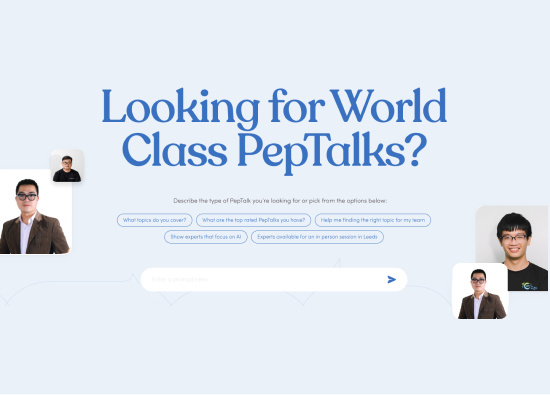
PepTalk: a chatbot that books expert speakers through conversation
- Challenge: PepTalk needed to validate whether clients would find and book subject-matter experts through conversation instead of a search form, and wanted the MVP proven before committing to a platform build.
- What we built: a smart chatbot that collects requirements in natural language across topic, budget, location, duration and format, runs a semantic search against the expert database using text embeddings, surfaces close matches on skills and experience, paraphrases each expert's biography into plain language, then captures contact details and submits the booking request.
- Engagement and timeline: fixed-price MVP, senior-only team of seven (1 project manager, 4 developers, 1 business analyst, 1 quality control).
- Stack: Python, LangChain, ChromaDB, OpenAI, FastAPI, Celery, PostgreSQL, Redis, WebSocket, Docker, Angular.
One detail worth naming: the project ran both large and small OpenAI models against different steps of the flow, because holding cost down per conversation mattered as much as answer quality. That trade-off is a normal part of any LLM build and almost nobody discusses it before a contract is signed. Read the full case study →
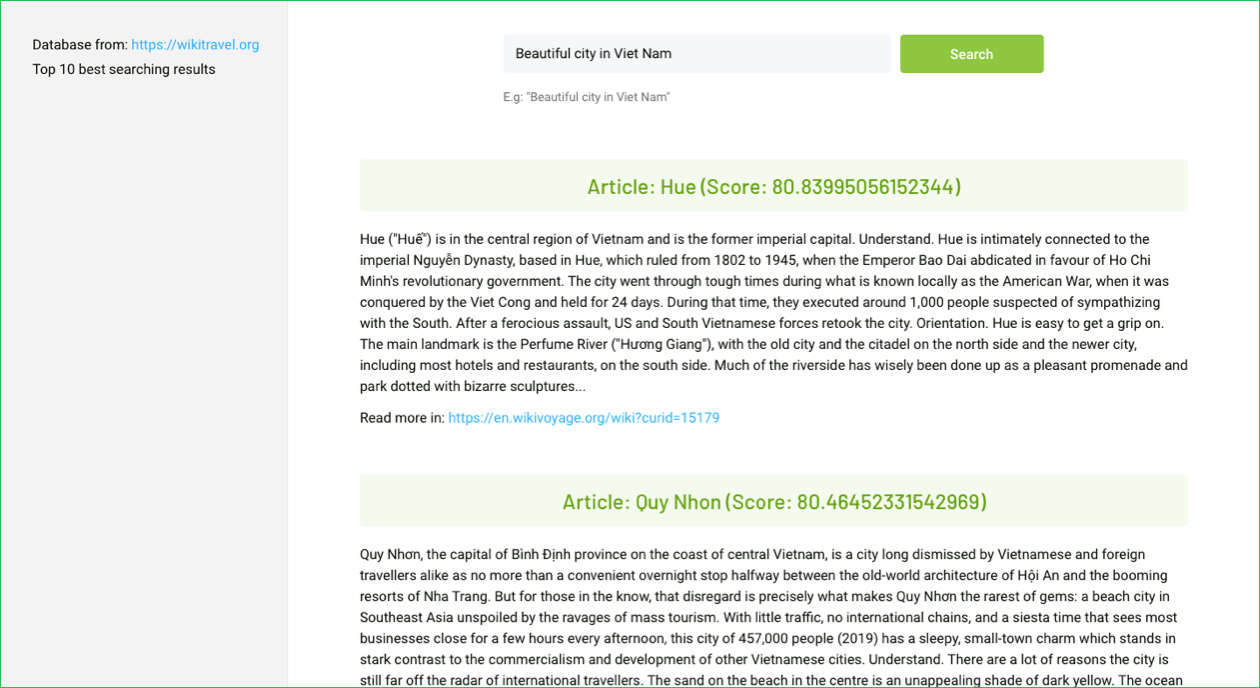
Semantic Search for Travel Documents: the retrieval half of RAG, at scale
- Challenge: keyword search returned irrelevant results because the same words carry different meanings in different contexts, so users could not find destinations by describing what they wanted.
- What we built: a semantic search engine that represents each query and document as an embedding vector, then ranks by meaning rather than by keyword overlap, returning the top matches for a plain-language sentence. Built over 31,249 crawled and cleaned travel articles.
- Engagement and timeline: internal Research Labs build, published as a public demo.
- Stack: Python, deep learning sentence embeddings, vector similarity ranking.
You can run this one yourself at experiment.saigontechnology.vn before you talk to us, alongside our NLP toolkit demos for sentence similarity, named entity recognition and comment classification. Read the full case study →
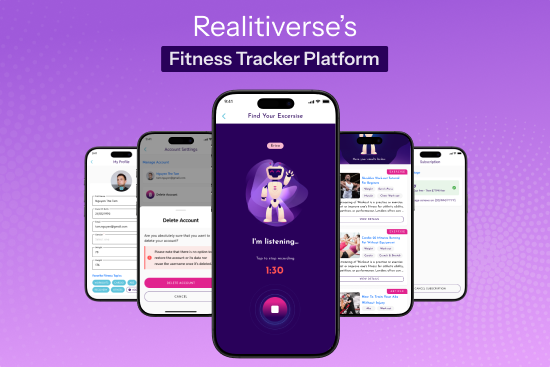
Realitiverse: AI-assisted search with a human approval gate
- Challenge: a wellness platform wanted users to find exercise and meditation guidance conversationally, without publishing AI-generated content that nobody had checked.
- What we built: natural-language search over the content library, plus an administrator workflow that scans AI-suggested articles and requires an explicit approve or reject before anything reaches users.
- Engagement and timeline: fixed-price, delivered against a short implementation window.
- Stack: Angular, .NET, Flutter, Azure Web Services, Apple IAP.
That approval gate is human-in-the-loop governance in its simplest useful form, and it is the pattern we recommend for any bot whose output carries reputational or regulatory weight. Read the full case study →
Send Your Chatbot Brief. See the Conversation Working.
- Clickable prototype of your top three user intents, with the escalation path
- Conversation flow mapping question to retrieval to answer to human handoff
- Architecture direction covering your knowledge sources, guardrails, and scale
- Technical recommendation call with our engineering team
Why Choose Saigon Technology as Your AI Chatbot Development Company?
A good AI chatbot development company proves three things: that its bots answer from your data rather than guessing, that a named engineer owns the accuracy target, and that the system stays maintained after launch. Saigon Technology's AI chatbot development services are delivered by 30+ AI engineers across two dedicated teams in Ho Chi Minh City and Da Nang.
Senior engineers paired with applied AI
Every chatbot team here is senior-led, with no junior padding. That matters more on conversational AI than on a standard web build, because the failure modes are subtle: a bot that answers 90% of questions well and invents the other 10% looks fine in a demo and erodes trust in production.
Senior engineers catch the retrieval gap that produces those answers. Fewer people, less rework, and a total cost measured per delivered outcome instead of per billed hour.
Accuracy you can audit, not accuracy you are promised
Most vendors state that RAG reduces hallucinations and stop there. We publish the method. A labelled evaluation set is built before development begins, every release is scored against it, and the score is visible to you.
Guardrails models constrain output, end-to-end encryption and secure APIs protect data in transit, access controls and audit logs record who saw what, and penetration testing plus security testing run before launch. When a chatbot touches customer records or triggers a transaction, "it usually works" is not an acceptable answer.
Try the retrieval stack before you commit to a build
Our Research Labs demos are public and running at experiment.saigontechnology.vn. You can test semantic search over 31,249 documents, check whether sentence similarity ranks your kind of query sensibly, and see how the toxicity classifier handles your edge cases, all before a contract exists.
This is rare among providers ranking for AI chatbot development work, and it exists because retrieval quality is difficult to judge from a slide. If our approach does not suit your content, finding out in an afternoon costs you nothing.
Domain depth, not technology breadth
We have delivered AI projects, and the useful part is where: healthcare, fintech, logistics and business software. Domain knowledge is what turns a generic bot into one that uses your industry's vocabulary correctly and knows which questions carry compliance weight. A retrieval layer tuned on the wrong corpus returns confident, irrelevant answers, and no amount of prompt work fixes that later.
For regulated work we bring GDPR, PDPA, HIPAA and HL7 experience into the design conversation rather than discovering the requirement during testing, which is the point at which AI chatbot development services get expensive to correct.
ISO 9001 and ISO 27001, certified by BSI (UK)
Third-party certified rather than self-declared, and held for over a decade rather than acquired for a tender. Secure SDLC practices, NDAs and role-based access come as standard on every engagement.
14+ years and 850+ projects behind the delivery team
14+ years · 400+ developers · 850+ projects · 350+ clients · 4.8★ · 3 development centers · 30+ AI engineers. On the three case studies above, outcome metrics are still being cleared for publication, and we have marked them as pending rather than estimating figures. We would rather show verifiable adjacent work than invent a number.
Stable teams, because churn breaks what already shipped
A chatbot is long-lived. Intents drift, products change, and whoever tuned your retrieval logic should still be here in month nine. Recognised in Southeast Asia Best Workplaces™ in Technology 2026, #10 in the Medium category, by Great Place To Work.
A two-week risk-free trial
Work with the actual engineers before committing to anything long-term, across five engagement models: ODC, dedicated team, team augmentation, fixed-price, and end-to-end project delivery.
Trusted by Global Clients
What Our Clients Say
Industries We Serve
Who We Build For
Most demand for custom chatbot development services comes from four places, and the technical build differs less between them than the definition of success does.
Customer support and service teams
Customer support bots that resolve repeat questions, handle order tracking, and pass anything complex to an agent with the transcript attached. The goal is deflection without frustration, measured on resolution rate rather than on containment alone.
Sales and lead generation
Lead generation chatbots that qualify visitors, answer product questions, and route good prospects to sales. Reducing drop-off rates in the first two exchanges usually moves conversion rates more than anything further down the funnel.
Internal operations and enterprise helpdesks
Enterprise chatbot work for HR, IT and finance queues: policy lookups, approval status, reporting requests. Workflow automation and business process automation take the repeat load off internal teams, which is where operational efficiency and cost savings show up first.
Ecommerce and marketplaces
Product discovery, order status, returns and personalized invoice reminders, connected to your catalogue and payment stack. Conversation data doubles as customer analytics, producing data-driven insights on what buyers ask before they abandon a cart.
Benefits of AI Chatbot Development
The business case for AI chatbot development services rarely rests on novelty. It rests on which repeat conversations you can stop staffing manually, and what the data from those conversations tells you.
Chatbot app development services also extend the same conversational layer into mobile, so the experience does not reset when a customer switches device.
Repeat questions stop reaching your team
The top twenty intents usually account for most of the ticket volume. Handling those automatically is where cost savings and operational efficiency actually come from.
Coverage across time zones without night shifts
A bot answers at 3am in whatever language the customer opened with.
One consistent answer, from one source of truth
Knowledge base integration means the bot and your agents cite the same content, so answers stop varying by who picks up the conversation.
Faster agent onboarding
New hires query the same retrieval layer the bot uses, which shortens the ramp from weeks to days.
Conversation data becomes product insight
Live analytics on what people ask, where they drop off, and which answers fail produces customer analytics you cannot get from a search box.
Higher conversion on the paths that matter
Answering an objection in the moment it appears lifts conversion rates more reliably than adding another form field.
Our AI Chatbot Development Process
Every one of our AI chatbot development services engagements runs through the same seven steps, and step two is the one that separates a system you can trust from one you can only hope about. Smaller scopes start as a proof of concept and graduate into the full sequence.
"Retrieval is the easy half. The work that decides whether a chatbot ships is building the evaluation set first, so every answer can be scored against a known-correct source before anyone sees it." - Phong Le, AI Tech Lead, Saigon Technology
Discovery and intent inventory
Discovery workshops, audience analysis and process observations produce a ranked intent list and the requirements behind it.
Structured evaluation set, built first
We assemble labelled question and answer pairs from your real queries before any development starts. This is the step that makes accuracy measurable instead of anecdotal, and it is the step most projects skip.
Conversation and retrieval design
Conversational flow mapping, intent logic, dialogue management, fallback behaviour and escalation rules, alongside the retrieval architecture and UX/UI.
Build and integrate
NLP or generative AI models are selected and tuned, then connected through platform integrations and system integrations to your live systems.
Adversarial and compliance testing
Accuracy scoring against the evaluation set, prompt injection attempts, security testing, and review against the standards your sector requires.
Staged rollout with human fallback
The bot goes live on a narrow intent set with escalation always available, then widens as the scores hold.
Monitor, retrain, optimise
Live analytics, transcript review, continuous learning and performance optimization on a fixed cadence.
Our Insights
FAQs
How much does AI chatbot development cost?
Our minimum engagement is $5,000, and most first builds land above it depending on how many intents you need, how many systems the bot connects to, and whether voice is in scope. We price on delivered outcome rather than hourly seats.
When you compare chatbot development services, ask each vendor what happens after launch, because retraining and monitoring are where quoted budgets usually go quiet. The largest cost drivers are integration needs and customization depth, not the model itself, so scoping those two properly in discovery is what keeps a budget predictable.
How long does it take to build and deploy an AI chatbot?
A narrow proof of concept over one knowledge source runs in weeks. A production chatbot with system integrations, security review and a staged rollout is typically a few months. Architecture complexity and conversation design requirements drive the timeline more than the number of intents, because each integration adds its own testing surface.
Should we build a custom chatbot or buy an off-the-shelf platform?
Buy when your questions are generic, your content is public, and no system needs to be updated by the conversation. Build when answers depend on your proprietary data, when the bot must write to your systems, or when a wrong answer carries regulatory or financial consequence. Many teams combine both. We cover the trade-off in detail in our guide to building versus buying software.
How do you stop the chatbot giving wrong answers?
Three mechanisms working together. Retrieval grounds every answer in your approved content rather than in model memory. A labelled evaluation set scores response accuracy on each release, so regressions are caught before users see them. Guardrails models and confidence thresholds force the bot to escalate to a person instead of guessing when retrieval returns nothing solid.
Which channels and business systems can the chatbot connect to?
Web, mobile apps, social media and messaging platforms, plus internal tools such as Slack and Teams. On the systems side, API-first frameworks connect the bot to CRM, ERP, helpdesk and payment platforms, so it can read live records and trigger actions rather than only answering questions.
What technologies, standards, and compliance requirements are involved in AI chatbot development?
Models and orchestration: large language models (LLMs) including the GPT-4 model family, Claude and Llama, transformer-based models and transformer-based NLP, multimodal AI models, LangChain agents, retrieval-augmented generation, guardrails models, reinforcement learning and HITL/SITL training for tuning.
Retrieval and data: ChromaDB, Pinecone, knowledge graphs, PostgreSQL, Redis, embeddings and vector similarity.
Engineering: Python, Node.js, TensorFlow, FastAPI, WebSocket, Docker, Angular and React, with model deployment and serving on AWS, Azure AI and Google Cloud.
Adjacent capability: NLP and OCR pipelines and computer vision, where a conversation needs to read a document or an image.
Standards and regulation: ISO 9001, ISO 27001, GDPR, CCPA, PDPA, SOC 2, HIPAA and HL7, plus the EU AI Act, which now shapes how transparency and risk classification are handled for conversational systems sold into Europe.
Can a chatbot handle regulated or sensitive data?
Yes, with the controls designed in from the start rather than added later: data minimization so sensitive fields never enter the model context, data anonymization and PII redaction, end-to-end encryption, access controls, audit logs, and retention rules matched to the regulation that applies. For sector-specific requirements, see our guide to healthcare chatbot development.
What does an AI chatbot development company do?
An AI chatbot development company designs, builds, integrates and maintains conversational systems for a business. AI chatbot development services span use case discovery, conversation design, model selection and tuning, retrieval architecture, integration with existing systems, security and compliance review, and ongoing retraining after launch. A vendor doing only the build, without the evaluation and retraining halves, is selling a prototype.