

























































- OVERVIEW
- SERVICES
- WHY CHOOSE US?
- MODELS
- TECHNOLOGIES
- OUR PROCESS
- FAQS
Accelerating Growth with the Right Logistics Software Development Partner
What is logistics software development?
Logistics software development is the process of designing, building, and integrating custom digital systems, including transportation management (TMS), warehouse management (WMS), fleet, supply chain, and order management platforms that automate shipping, tracking, inventory, and delivery operations. A specialized logistics software development company replaces manual workflows and disconnected tools with end-to-end visibility, faster fulfillment, and lower operating costs across freight, last-mile, and fulfillment networks.
- Saigon Technology delivers custom software solutions tailored to logistics-specific workflows. We have been a reliable partner for over 14 years, helping businesses optimize operations through high-quality logistics software development services.
- Precedence Research expects the global TMS market to reach $33.3 billion by 2032, growing at a CAGR of 14.8%. Logistics operations grow more complex by the day, and many companies struggle with rising costs, poor system integration, and a lack of real-time visibility.
- Saigon Technology brings a proven track record of successful projects helping logistics businesses worldwide - clients span the US, Australia, Germany, the UK, and Singapore. We deliver the logistics software development services you need to automate operations, improve efficiency, and scale.
Core Logistics Software Solutions We Deliver
Order Management Software
One platform that centralizes orders from all sales channels and automates pricing & returns. Our Order Management Software selects the best warehouse to make delivery fast and more efficient - saving time and improving customer satisfaction.
Supply Chain Management Software
A custom SCM platform can predict demand, automate purchasing, and track products end-to-end using cloud and blockchain. Saigon Technology builds these platforms to streamline operations, reduce costs, and boost efficiency.
Warehouse Management Systems
Our WMS solutions use barcodes or RFID to track inventory and AI to optimize space. Maximizing storage, improving accuracy, and simplifying warehouse operations are the key advantages.
Transportation Management Systems
Make shipping simple with our Transportation Management System. It automates dispatch, paperwork, and real-time tracking - full visibility and control until the goods arrive. Reliable. Efficient. Hassle-free.
Logistics Automation
We customize Logistics Automation solutions to boost operational efficiency. Saigon Technology integrates robotics and smart conveyors to automate sorting and storage, reduce manual labor, and enhance speed, accuracy, and warehouse performance.
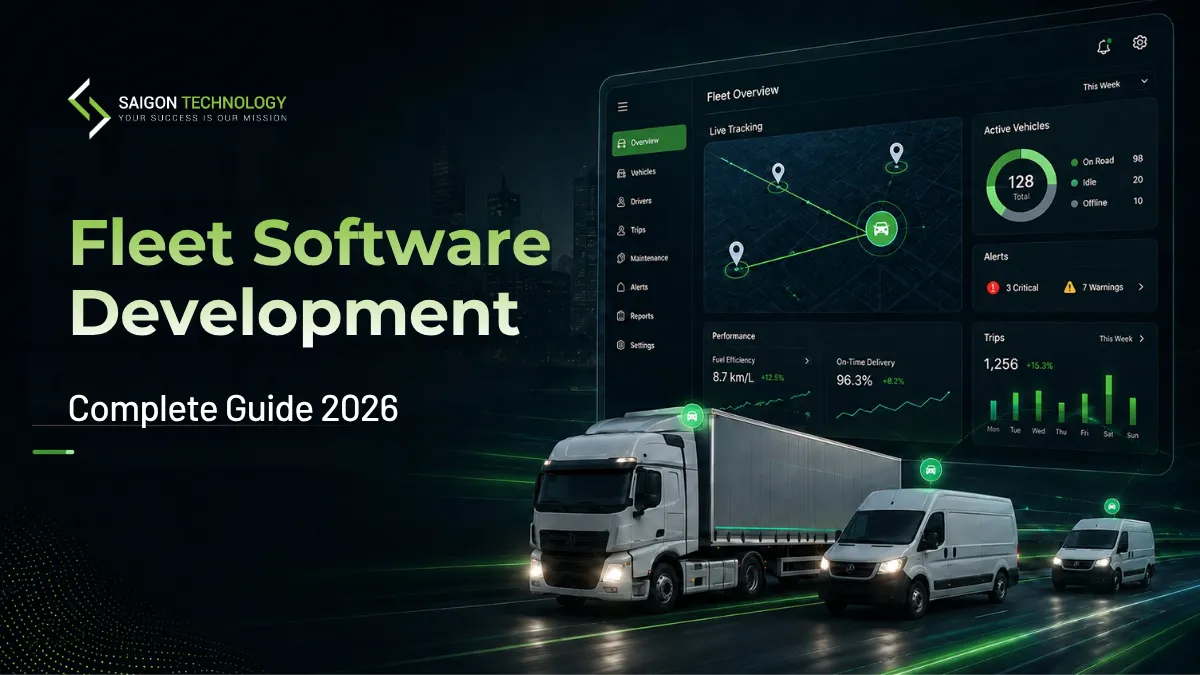
Fleet Management Software Development
Our team develops custom Fleet Management Software with GPS tracking, route optimization, and automated maintenance alerts. These features cut costs, reduce downtime, and create a more efficient logistics operation.
Our Highlight Projects
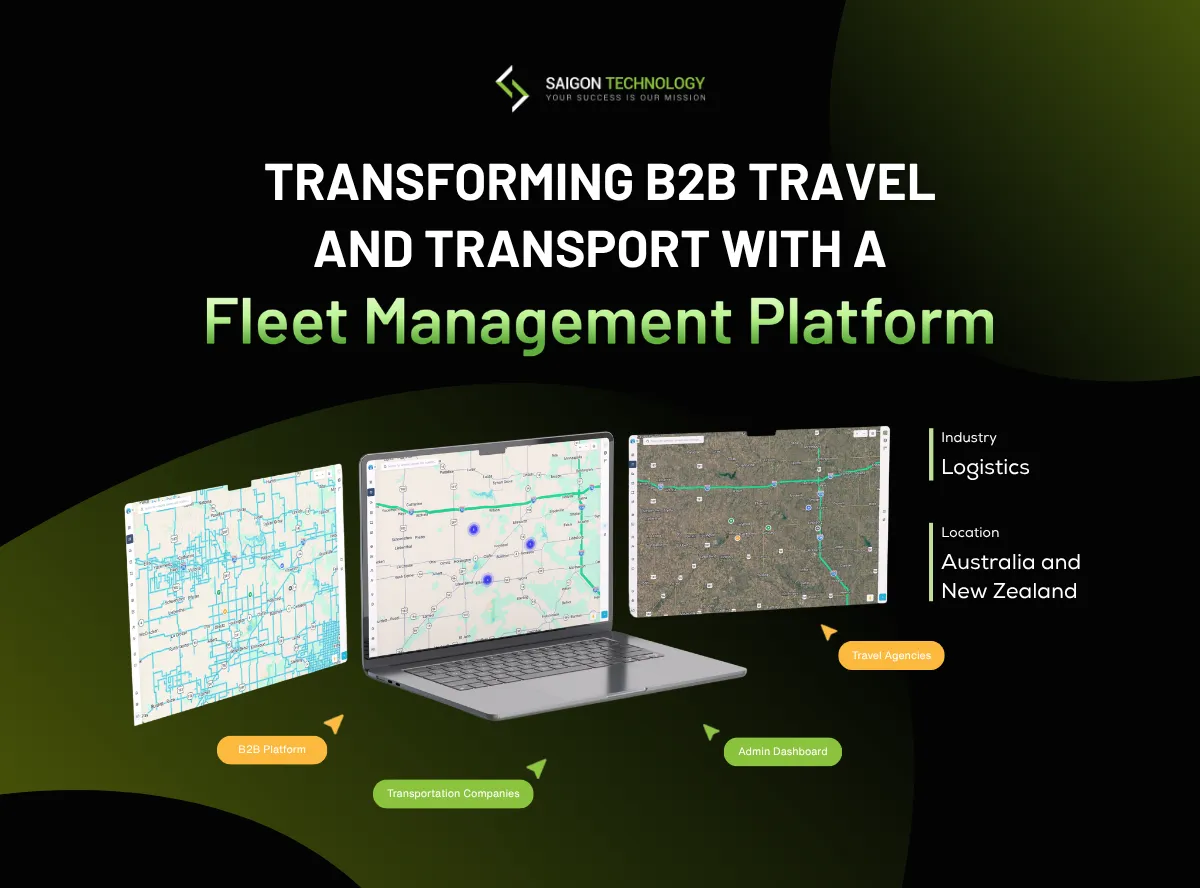
Fleet Management Platform
- Industry: Transportation & Logistics
- Challenges: A leading vehicle leasing and transport company in Australia and New Zealand was running a B2B prototype that depended on manual work, fragmented systems, and disconnected booking, dispatch, and fleet workflows across travel agencies, transport providers, and admins.
- Solutions: Saigon Technology built a centralized B2B fleet management platform on Spring Boot, React, PostgreSQL, MongoDB, and Apache Kafka - with role-based access control, real-time GPS tracking, geofence event alerts, payroll and invoice automation, and OpenAPI integrations. Delivered in 3 months on AWS with Docker, Kubernetes, and CI/CD.
- Results: One unified platform serving three user types (agencies, transporters, admins) replaced spreadsheet workflows; managers gained real-time fleet visibility, drivers got a simpler mobile experience, and standardized booking/payment processes scaled reliably across stakeholders.
- Read full case study
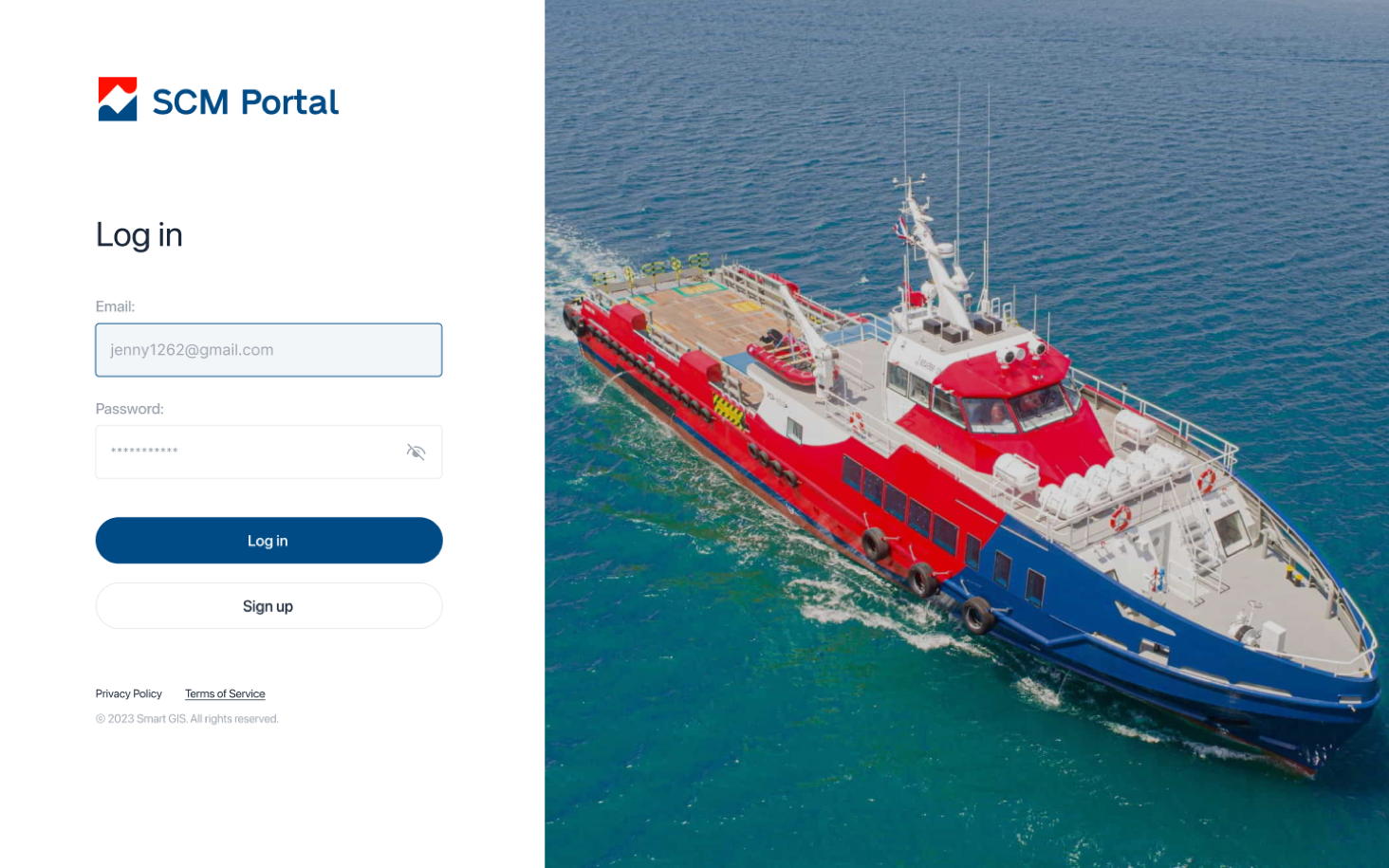
SCM Portal
- Industry: Transportation & LogisticsÂ
- Challenges: The client's old way of working was manual and complicated. They had trouble seeing their documents, working with suppliers, and tracking shipments in real time. They needed a single portal to replace this legacy system.Â
- Solutions: Saigon Technology built a unique portal to manage the supply chain. The system collected all the data, automated approvals, and let everyone involved see the process. It also managed inventory, handled contracts, and controlled what each user could see.Â
- Results: Improved performance, scalability, and usability. Faster, more cost-effective development cycles. The ODC model enabled seamless delivery, reduced risk, and laid a strong foundation.Â
- Read full case study
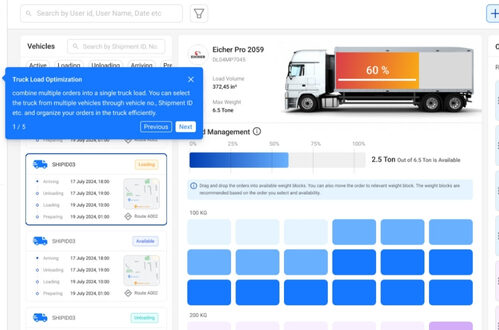
Merit Logistics ODC
- Industry: Logistics & Supply Chain
- Challenges: Their existing ERP system had been built over 6 years by many vendors - performance issues and poor integration. Core modules were out of date, slowing business operations. They needed a long-term solution that wouldn't disrupt ongoing processes.
- Solutions: We set up a dedicated ODC while developing a new ERP system to ensure continuity. We maintained the legacy platform and created an app with AI features for real-time attendance tracking. Agile Scrum kept consistent progress and transparency.
- Results: Improved performance, scalability, and usability across all core functions. The ODC enabled smooth delivery and long-term cost efficiency.
- Read full case study
Send Your RFP. Get a Working Logistics Demo in Hours.
Why Choose Saigon Technology?
14+ Years of Logistics Software Experience
With over a decade in logistics software development, we understand the sector's difficulties - complex supply chains, real-time tracking, and route optimization. Our team creates custom solutions that align with your business goals, cut risk, and maximize ROI. Trusted by logistics companies worldwide.Â
Access to the Top 1% of IT Talent
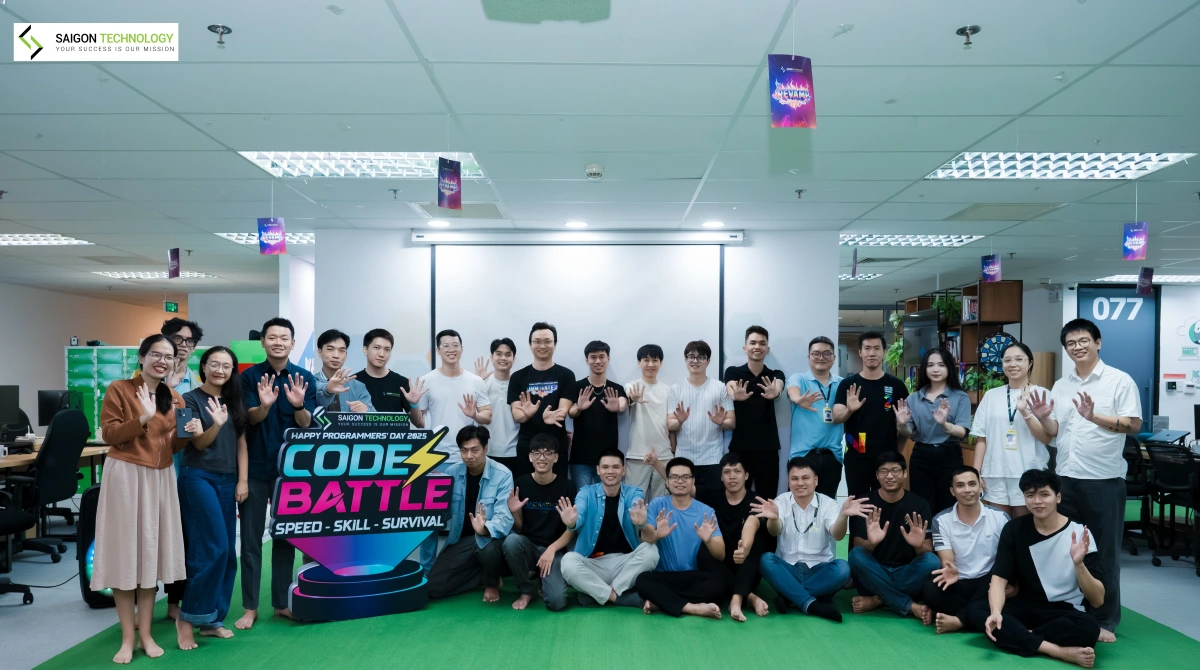
We have software engineers among Vietnam's top 1% tech talent, selected through a strict hiring process and English skill tests. We bring global experience and understand how to work across time zones - so you get high-quality logistics software no matter where you're located. Saigon Technology took part in the FPTU Career Fair 2026 to find great talent and keep bringing better solutions to clients worldwide.
Comprehensive Logistics Software Delivery
We've delivered logistics solutions for a wide range of businesses. Our industry experts include:
- PMs for delivery and communication
- BAs for logistics-specific analysis
- Developers who adapt fast
Every solution is aligned with your specific workflows.
Proven Quality and Security with ISO Certifications
Saigon Technology guarantees quality and security at every stage. We hold ISO 9001 and ISO 27001 certifications for our processes. We use multiple methods to protect data - NDA signing, security policies, strong encryption, and multi-factor authentication. Our Software Maintenance Agreement provides ongoing support after deployment.
Agile and DevOps to Speed Up Software Development
Driving Logistics Innovation with Generative AI
Our teams are experts at integrating AI and generative AI into logistics platforms, for NLP order processing, demand forecasting, and route optimization. Our tech lead advises on technology skills and the types of AI solutions that best fit your logistics project (AWS, Azure, Big Data, blockchain).
Our Esteemed Clientele
Voices of Satisfaction: Client Testimonials
Why Choose Custom Logistics Software Over Off-the-Shelf Solutions?Â
Best Fit Your Unique Workflows
We build custom logistics software that fits how your business works, managing many warehouses, following strict regulations, and meeting special dispatch rules.Â
These solutions support better decision-making, increase internal alignment, and streamline processes.Â
Integrating with Your Existing Systems
Our custom software connects easily with ERP, CRM, WMS, and other logistics systems. The connection is automatic and shares data in real time. Your teams no longer need to sync data by hand, preventing delays and costly mistakes.
Scalable Logistics Software for Long-Term Growth
As your logistics company expands, you may need to change processes, add new users, or enter new markets. In contrast to standard tools, custom platforms provide the flexibility to respond to market demands or add new features.
Maximize ROI with Full Control
Logistics software ownership means cost optimization and freedom. You avoid recurring license fees and can focus on only the needed features. You reduce tech debt and maintain full control over updates, integrations, and infrastructure without dependency on third-party vendors.
Logistics Software Development Services for Your Needs
Custom Software Development
Generative AI Integration
Maintenance & Support
Engagement Models
Staff Augmentation
Scale your tech team with our talent, top 1% pre-vetted developers, QA engineers, DevOps, and more. Ideal for businesses that:Â
- Need expert support for one or more logistics software projectsÂ
- Face seasonal demand spikes or tight delivery windowsÂ
- Handle complex development tasks that need more resourcesÂ
Dedicated Development Team
A full, dedicated team working aligned with your long-term vision, sustained development and ongoing optimization. Ideal for businesses that:
- Seek a cost-efficient approach to long-term development
- Need a focused team for logistics platforms like fleet or tracking systems
- Want a strategic tech partner supporting digital transformation
ODC Model
A tech team in Vietnam under your control, extended resource with operational flexibility and cost savings. Ideal for businesses that:
- Want full control of an offshore development team
- Need to scale logistics software without hiring in-house
- Need consistent delivery for large-scale logistics systems
Fixed Price Model
On time, within budget - best for clear scopes, defined goals, and strict timelines. Ideal for businesses that:
- Operate with fixed budgets and tight deadlines
- Need a completed version of defined software (e.g., tracking or WMS)
- Have well-defined specifications and measurable objectives
Our Logistics Software Development Process
Project Discovery & Requirement Gathering
Kickoff meeting to define project goals - real-time tracking, route optimization, warehouse automation. Business analysis, NDA signed, requirements documented.Â
Demand Analysis & Planning
Our BA creates a detailed Work Breakdown Structure (WBS), maps out logistics workflows, defines scope, and sets timelines for features like inventory control and order management.
Engagement Model & Team Setup
We discuss the right engagement model (ODC, staff augmentation, dedicated team, fixed price), then assemble the project team (PM, devs, QA, etc.), define tools, and handle onboarding.
Terms of Contract Discussion
Complete the deliverables, tech stack, timeline, budget, SLA, and IP protection terms. Legal clarity builds the foundation for long-term collaboration.
PoC / MVP Launch (Upon Request)
If needed, we deliver Proof of Concept or MVP to validate logistics features. Agile cycles and real-time feedback refine the solution before full development.
Software Development
Agile method with full sprint transparency. CI/CD pipelines speed up delivery and reduce errors when coding modules like WMS, TMS, or real-time dashboards.
Quality Assurance & Testing
QC engineers ensure system security, stability, and performance. UAT validates logistics logic in real-world use cases.
Deployment and Integration
We integrate the solution into your existing workflow, sync with current systems, and migrate data. DevOps practices ensure smooth deployment from day one.
Ongoing Maintenance and Support
Performance monitoring, bug fixes, updates, and technical support. Our SLA keeps your logistics system secure, efficient, and ready for growth.
Our Insights
FAQs
What is logistics software development?
Logistics software development is the process of designing, building, and integrating custom digital systems - including transportation management (TMS), warehouse management (WMS), fleet management, supply chain management (SCM), and order management platforms, that automate shipping, tracking, inventory, and delivery operations. A logistics software development company replaces manual workflows and disconnected legacy tools with end-to-end visibility, faster fulfillment, and lower operating costs. Custom platforms are typically built for shippers, third-party logistics (3PL) providers, freight forwarders, carriers, and fulfillment operators that need workflows, integrations, or compliance rules that off-the-shelf logistics SaaS cannot accommodate.
Looking for custom logistics software development services that fit your workflows?
Off-the-shelf logistics tools rarely match how your operations actually run. Multi-warehouse dispatch rules, country-specific customs documentation, temperature-controlled fleet routing, dynamic carrier rates, generic SaaS forces workarounds that grow into technical debt.Â
Saigon Technology builds custom logistics software development services that mirror your real workflows. Our engineering team, 400+ developers across Vietnam under ISO 9001 and ISO 27001 - designs and ships custom TMS, WMS, fleet management, and supply chain platforms calibrated to your business model, integrated with your existing ERP and CRM, and architected to scale with shipment volume.Â
What "custom" actually means in our deliveryÂ
- Workflow-fit, not feature-bloat. We engineer only what your dispatch, warehouse, or fleet operations require - no licensing tax for modules you won't use.Â
- Owned IP and full source code. You own the platform, the data model, and the integrations. No vendor lock-in, no per-seat fees.Â
- Real-time integration with what you already run. Custom APIs and iPaaS connectors to your ERP, CRM, WMS, carrier portals, IoT sensors, and barcode systems, no manual data sync between teams.Â
- Scalable architecture from Day 1. API-first, cloud-ready, modular - the platform grows from 1,000 shipments per day to 100,000 without a re-platform.Â
Custom is the right call when standard tools force compromises on compliance, cargo type, or customer experience. Read our full custom vs. off-the-shelf guide →Â
How much does custom logistics software development cost?
- Custom logistics software development typically costs between $70,000 and $500,000+, depending on scope.
- A focused MVP (single-module TMS, basic WMS, or driver app) usually lands in the $70,000-$150,000 range and ships in 3-5 months.
- A full-platform build (multi-module TMS + WMS + fleet + customer portal with ERP/CRM integration) ranges $250,000-$500,000+ and takes 6-12 months.
Major cost drivers include the number of user roles, integration count (ERP, carrier APIs, EDI, IoT sensors), real-time tracking volume, data architecture (warehouses vs lakes vs time-series), compliance scope (HIPAA, GDPR, ELD), and whether mobile apps are included. We provide a fixed cost estimate after a 1–2 week discovery phase - no surprises.
How long does it take to build logistics software?
A custom logistics software project typically ships its first production version in 3-6 months and reaches full-platform maturity in 9-14 months.
- The Discovery and Business Analysis phase takes 2-4 weeks.
- UI/UX design and system architecture overlap with 4-6 weeks.
- Agile development sprints then run continuously, with the first usable MVP delivered around month 3.
Timeline drivers include the number of integrations (each ERP, WMS, or carrier API typically adds 2-4 weeks), whether mobile driver/warehouse apps are required, compliance certifications (SOC 2 or HIPAA add audit cycles), and team size - Saigon Technology can scale from 3 to 15 engineers per project to compress timelines.
What is the difference between custom and off-the-shelf logistics software?
Off-the-shelf logistics software (ShipStation, Onfleet, generic TMS SaaS) ships fast and is cheap to start, but enforces fixed workflows, charges per-user or per-shipment fees, and limits integrations to vendor-approved APIs. Custom logistics software development delivers a platform calibrated to your exact dispatch rules, warehouse zoning, cargo types, customer SLAs, and compliance scope - with full source-code ownership and no recurring license fees. Custom is the right call when standard tools force operational workarounds, when integrations with legacy ERPs or proprietary hardware aren't supported, or when scaling beyond 1,000 daily shipments makes per-shipment fees prohibitive. For startups validating product-market fit, off-the-shelf is often the correct first step before migrating to custom.
What technologies and platforms do you use for logistics software development?
Saigon Technology's logistics software development team works across a broad modern stack:
- backend (Node.js, .NET, Python/Django, Java/Spring, Go, Ruby on Rails);
- frontend (React, Next.js, Angular, Vue);
- mobile (Swift, Kotlin, Flutter, React Native);
- databases (PostgreSQL, MongoDB, Redis, ClickHouse, TimescaleDB for telemetry);
- cloud (AWS, Azure, GCP) with Docker, Kubernetes, and Terraform;
- AI/ML (TensorFlow, PyTorch, OpenAI API, Google OR-Tools for routing);
- logistics integrations (REST/GraphQL/EDI X12/EDIFACT, MQTT for IoT, Salesforce, SAP, Oracle NetSuite, Mapbox, HERE Maps, Twilio, Stripe).
We select the stack based on your data volume, real-time tracking needs, integration requirements, and existing infrastructure - not on a fixed vendor template.
Do you build TMS, WMS, fleet management, and supply chain systems?
Yes. Saigon Technology delivers end-to-end logistics software development services across all major logistics system categories:
- Transportation Management Systems (TMS) with dispatch automation, route optimization, and real-time tracking;
- Warehouse Management Systems (WMS) with barcode/RFID inventory, picking and packing, and multi-location coordination;
- Fleet Management software with GPS telematics, driver apps, maintenance scheduling, and fuel monitoring;
- Supply Chain Management (SCM) platforms with demand forecasting, supplier portals, and end-to-end traceability;
- Order Management Systems (OMS) handling cross-channel aggregation, returns, and fulfillment routing; and last-mile delivery, freight forwarding, and 3PL operator platforms.
Each system can be built standalone or as integrated modules of a single logistics platform.
How do you ensure data security and compliance in logistics software?
Saigon Technology operates under ISO 9001 and ISO 27001 certifications verified by BSI, with strict NDA enforcement, internal IP protection policies, and role-based access controls in every project. We build logistics platforms compliant with GDPR, HIPAA, SOC 2, PCI-DSS, the U.S. ELD Mandate, and regional data-residency rules (EU, UK, AU, SG). Security practices include end-to-end TLS encryption, AES-256 at-rest encryption, multi-factor authentication, X.509 certificate-based IoT device authentication, blockchain-based audit trails for shipping documentation, and continuous vulnerability scanning via SonarQube and automated dependency monitoring. Sensitive customer and shipment data is segregated, logged, and accessible only through least-privilege IAM roles - with full audit logs retained per compliance requirements.
Do you offer post-launch support and maintenance for logistics platforms?
Yes. Saigon Technology provides 24/7 post-launch support and maintenance under a Software Maintenance Agreement (SMA) tailored to your operations. Standard coverage includes bug fixes, security patches, third-party API changes (carrier APIs and ERP connectors update frequently), regulatory updates (ELD, GDPR, customs documentation rules), performance monitoring, and quarterly architecture reviews. Optional add-ons include feature roadmap execution, scaling support during peak shipping seasons, and integration of new logistics tools as they enter your stack. Critical-path operations such as dispatch and warehouse systems include defined SLAs with response and resolution targets. Maintenance pricing is transparent, fixed monthly retainer or per-incident, and reviewed annually against actual usage.