



































































• OVERVIEW
  • SERVICES
  • WHY CHOOSE US?
  • MODELS
  • TECHNOLOGIES
  • OUR PROCESS
  • FAQS

What Travel and Hospitality Software Development Covers

What Travel and Hospitality Software Development Covers
  • Travel and hospitality software development is the design and engineering of the systems that sell, fulfil, and service travel: booking and reservation platforms, distribution connections to suppliers, property and guest management tools, and the payment and refund flows behind them. It differs from general business software in three ways. Inventory is perishable, prices move while the customer is deciding, and a single confirmed booking usually touches several third-party systems before it settles.
  • That is the work we do. A travel software development company earns its place on the integration layer and the failure paths, not on the front-end alone. We build against global distribution systems (GDS), New Distribution Capability (NDC), channel managers, and OTA and payment APIs, and we design for what happens when one of them is slow, stale, or simply wrong.
Contributors
Tien Nguyen - Project Manager
Meet Tien Nguyen
Project Manager with 5+ years of experience managing travel and business projects
Book an Appointment
Van Le - Business Analyst
Meet Van Le
Business Analyst with 5+ years of experience in business consulting and analyzing travel and business processes
Book an Appointment
over 400 software developers
400+
Software Developers
Over 14 years of experience
14+
Years in Business
Over 850 Projects Successfully Delivered
850+
Projects Successfully Delivered
rating on Clutch
4.8
Star Rating on Clutch

Our Travel Software Development Services

Every engagement below is a capability we deliver today. A travel software development company should be judged on what it has shipped, so each service maps to engineering we already do rather than to a category we could plausibly claim.

These draw on the practices we run across every industry: custom software development, web application development, and mobile app development. The distribution, AI, and replatforming work sits with our software integration, AI development services, and legacy application modernization teams.

mark

Booking and Reservation Platform Development

Multi-inventory search across stays, flights, tours, and transport, with a checkout that holds its quoted price. We build the itinerary model, the pricing breakdown, and the booking state machine that keeps "pending supplier confirmation" honestly distinct from "confirmed."
chevron-up.svg
flag-01

Distribution and API Integration

Connections to GDS providers, NDC content, channel managers, OTA marketplaces, and PCI-compliant payment gateways. We handle real-time inventory synchronization, rate updates, and the reconciliation jobs that catch drift before your customers do.
chevron-up.svg
ticket-01

B2B Travel Portals and Partner Hubs

Agent, supplier, and administrator consoles with B2B and B2C modules, role-based access, commission tracking, and the reporting your partners ask for. Suppliers manage availability and pricing themselves instead of emailing an account manager.
chevron-up.svg
marker-pin-05

Legacy Reservation System Modernization

Legacy system transformation for platforms that cannot keep up: code refactoring, database migration, and a move to microservices architecture behind stable APIs, sequenced so bookings never stop while the work happens.
chevron-up.svg
luggage-01

Traveler Mobile App Development

Native and cross-platform iOS and Android apps with offline itinerary access, contactless check-in flows, push updates on schedule changes, and loyalty and reward systems that read from the same records as your web experience.
chevron-up.svg
globe-04

AI for Travel Platforms

Semantic search over destination and product content, AI-driven predictive analytics for demand, dynamic pricing models, and personalized recommendations. We ship these into production systems rather than leaving them in a notebook.
chevron-up.svg
map-01

QA and Peak-Load Testing

Booking race conditions, double-submission, payment timeouts, and the seasonal traffic spikes that decide your year. We test the paths that only break under load, because those are the ones that reach your reviews.
chevron-up.svg

Travel and Hospitality Projects We Have Delivered 

These three projects span a production B2B travel and transport platform, a design-and-build booking prototype, and an applied-AI retrieval system. They sit at different stages of delivery, and they are labeled that way below.
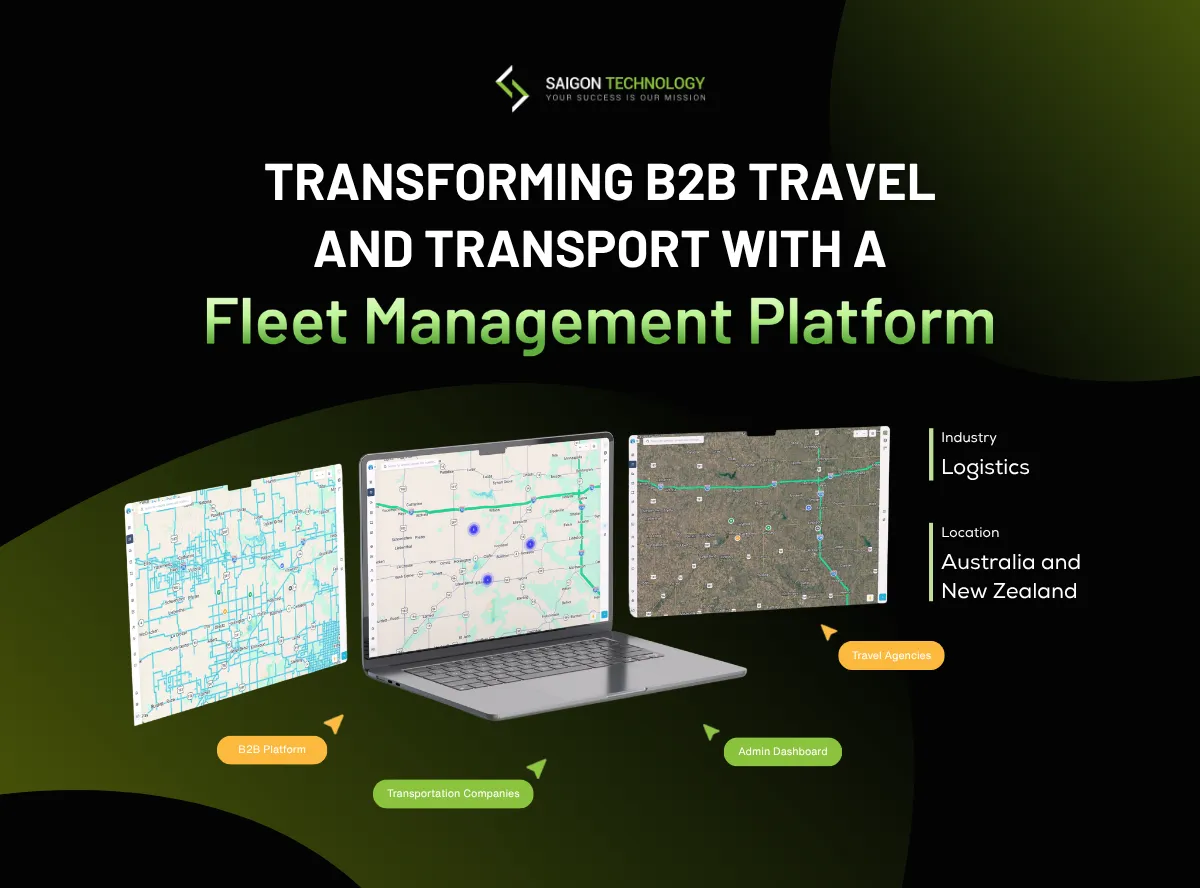
Case study: fleet management platform banner

Fleet Management Platform - B2B travel and transport on one booking rail

  • Challenge: a vehicle leasing and transport company operating across Australia and New Zealand had a prototype still running on manual work and disconnected systems. 
  • What we built: a centralized B2B platform serving three user types. Travel agencies search, book, and manage hotel and car reservations; transport companies manage fleet, drivers, and bookings; administrators handle users, listings, commissions, and reporting. Ten functional modules, including role-based access with audit trails, geolocation and geofencing, rule-based event and notification handling, payroll and invoicing, and API key management. 
  • Engagement and timeline: hybrid engagement model, three months, deployed on AWS. 
  • Stack: React, Redux, Spring Boot, Spring Security, Apache Kafka, Apache Camel, PostgreSQL, MongoDB, Keycloak, Docker, Kubernetes, Redis, OpenStreetMap and Google Maps, Twilio and SendGrid. 
  • Read the full case study →
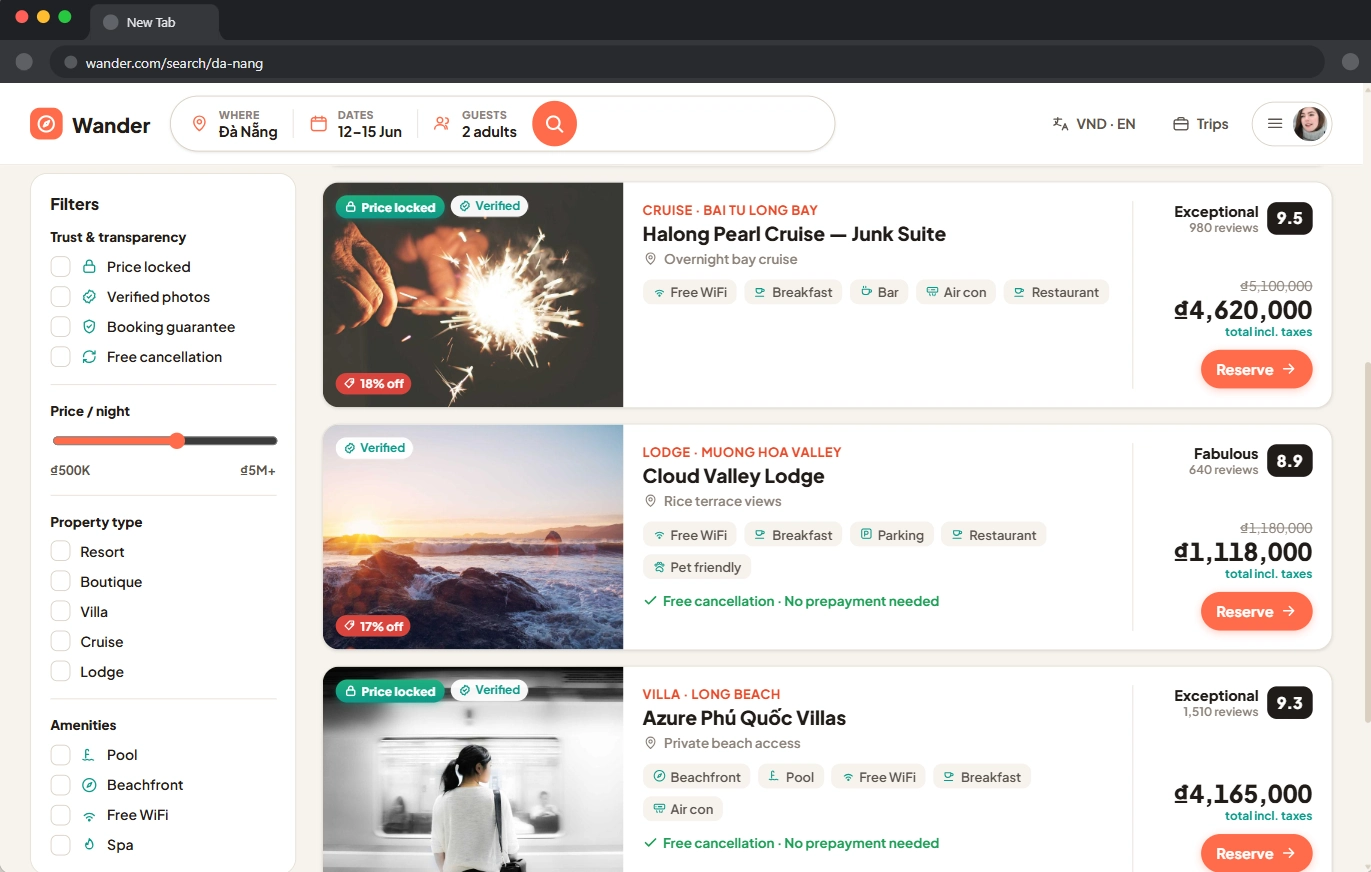
Wander: A Transparent-Pricing Tourism Booking Platform

Wander - a transparent-pricing tourism booking platform (prototype)

  • Challenge: three parties with opposed interests. Travelers want a price that does not move, suppliers want to price dynamically, and the platform needs both to hold at once.
  • What we built: four surfaces on one design system, comprising a traveler mobile app, a responsive web experience, a supplier partner hub, and an administrator console. Stays, flights, tours, and transport under one search with a bundling trip builder. Taxes and fees shown upfront, a price lock held through checkout, a surge cap set as an administrator policy rather than a per-listing setting, a staged refund tracker, and booking states that keep "awaiting supplier" visibly separate from "confirmed."
  • Stack: React component architecture shared across surfaces, CSS custom properties as design tokens driving theming, currency, and language switching, and a hand-built inline SVG icon and chart set.
  • Read the full case study →
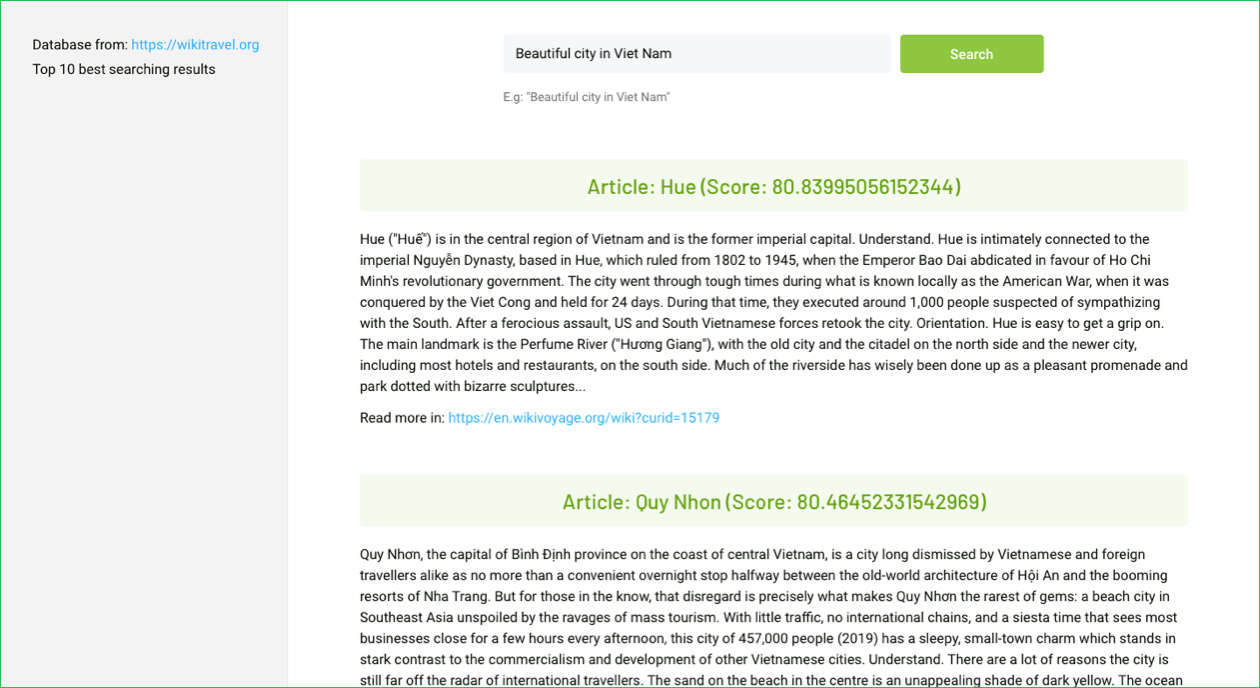
Semantic Search For Travel Place Document - demo

Semantic Search for Travel Place Documents - intent-aware retrieval

  • Challenge: keyword search returns poor results for travel discovery, because place names collide with ordinary vocabulary and intent gets lost.
  • What we built: an embedding-based semantic search engine returning the ten best meaning-matched destination articles, over a cleaned corpus of 31,249 articles.
  • Stack: deep-learning sentence embeddings with vector similarity ranking, on a Python NLP toolchain. The demo is publicly inspectable at experiment.saigontechnology.vn.
  • Read the full case study →

Send Us the Brief. See the Booking Flow Running in 48 Hours.

Most vendors answer a travel RFP with a capability deck. We answer it with something you can click. Send a complete brief and our AI-accelerated process turns it into a working prototype within one business day, reviewed by Tien Nguyen, Project Manager, not by a sales team.
  • Clickable prototype of your booking, inventory, or itinerary flow
  • Workflow visualization mapping the full search-to-settlement chain
  • Architecture direction covering GDS integrations, peak-season throughput, and scale
  • Technical recommendation call with our engineering team
free demo

Why Choose Saigon Technology as Your Travel Software Development Company?

A capable travel software development company combines three things: engineers who have shipped booking and distribution systems before, a security posture that holds up to card and passport data, and integration depth with the suppliers your inventory actually comes from. Saigon Technology brings all three from Vietnam, at rates we publish. 

We publish what we charge: $22 to $46 an hour for senior-led delivery, with 10 to 12 hours of daily overlap with US East and West Coast teams, and engineers who work in fluent English. A published rate is rare among providers ranking for travel software development work, and the number matters more in travel than in most verticals.

Booking platforms are integration-heavy, and when a budget tightens at premium onshore rates, the first things cut are the unglamorous ones: distribution edge cases, retry logic that stays safe when a payment and a booking race each other, and load testing for the two weeks a year that decide your margin. 

Travel handles card data and cross-border personal data at once. We build to PCI DSS for capture and settlement, GDPR for European traveler records, and PDPA, under a secure development lifecycle backed by ISO 27001 practice. The surface is wider than teams expect. Multi-currency settlement adds reconciliation paths, and every channel partner you connect becomes another processor of your customers' data, with its own retention rules and its own audit trail to satisfy when a regulator asks.

Connecting to a supplier is straightforward. Staying correct once traffic arrives is not. Where inventory synchronization is eventually consistent, rate parity drifts and the same room sells twice, and that failure never shows up in an error log. It shows up as a refund and a one-star review. We design against it directly, with idempotent booking operations, reconciliation jobs that catch drift between your record and the supplier's, and event-driven updates instead of polling.

Both certifications are third-party audited rather than self-declared, and we hold Microsoft Gold Partner status. In practice that means documented access control over supplier contracts, traveler records, and payment configuration.

One caveat we would rather state than bury. Of the three projects above, one is a production platform, one is a prototype, and one is a research build. We label them that way deliberately. We would rather show verifiable adjacent work than invent a travel metric.

Ranked #10 in the Medium category of Southeast Asia Best Workplacesâ„¢ in Technology 2026 by Great Place To Work. The engineers who designed your booking rail are still here when it has to change.

Sometimes the honest answer is that a packaged platform already covers your workflow and a custom build would only add cost. We say so. You can also inspect our applied AI work before committing anything, at experiment.saigontechnology.vn.

Interview the engineers yourself, then run a two-week risk-free trial before any long-term commitment. Engagement models include staff augmentation, a dedicated team, fixed-price delivery, an offshore development center, and build-operate-transfer.

Why choose Saigon Technology 2026

Our Clients

Partner-logo2 Partner-logo3 Partner-logo4 Partner-logo6 Partner-logo1 Partner-logo5 Partner-logo9 Partner logo

In Our Clients' Words

What we valued from Saigon Technology was not only the capability of the team itself, but also the consistency behind the delivery. The engagement was supported by strong internal management, clear coordination, and a steady focus on quality, which helped the project run in a reliable and professional manner.
Bryan McConnell
COO of NZPA, New Zealand
star.svg star.svg star.svg star.svg star.svg
During our collaboration, Mr. Thanh and his company, Saigon Technology, have consistently demonstrated world-class leadership and execution in complex fintech projects. His ability to scale and lead high-performing engineering teams, while maintaining cost-efficiency and product quality, has been critical to our technology operations. His strategic insights and leadership enabled us to significantly improve system stability and deployment velocity.
Abe Jarrett
Senior Vice President of Software Engineering at Origence, USA
star.svg star.svg star.svg star.svg star.svg
I had the opportunity to work with Thanh (Bruce) Pham and his team. What a nice experience, though! It could be said that I was impressed by his professionalism and his team's enthusiasm. They always asked me to check the right demand and to make sure whether each work point was the best option or not. It was my honor to work with such a great team of software development. Hope to meet them soon in the upcoming time!
Mr. Kirk Duncan
CEO of The Mobile App Man, Sydney, Australia
star.svg star.svg star.svg star.svg star.svg
I would recommend companies to work with Saigon Technology for their Software development or service needs. The project team is very responsible for their work and would recommend solutions in the interest of the client. The team also responds very quickly to requests, bugs, and questions. One exceptional quality of Saigon Technology was their patience with clients. There were several times when we were slow to respond or test our apps, but the project team was still very accommodating towards us.
Jeremy Heng
Development Manager - Rehau Group PTE
star.svg star.svg star.svg star.svg star.svg
As the Owner and Director of ISMS Global, Australia, I understand perfectly how challenging it is to find a support team of skilled and professional developers to help grow a system. A few years ago, I found Saigon Technology Software (STS), led by Mr. Thanh Pham (CEO), and I have never looked back. STS has single-handedly taken ISMS camp management software from a concept on a napkin to an international product used by major companies around the world. If you are looking for a trusted partner to help you, then you should be talking to Thanh Pham.
Mr. Paul Upson
Director of ISMS Global, Australia
star.svg star.svg star.svg star.svg star.svg

Custom Travel Software vs Off-the-Shelf Platforms: Which Fits Your Business?

Buying is often the right answer, and any travel software development company that tells you otherwise is selling. The real question is whether your booking rail is a cost centre or the product itself. The table below sets custom software development for travel against a packaged platform on the seven criteria that decide it. 

  Off-the-shelf platform Custom build
Time to live Weeks Months
Upfront cost Low, subscription-based Higher, capital expenditure
Fit to your workflow You adapt to the software The software follows your process
Differentiation Same capability as competitors on the same platform Rules and pricing logic nobody else can copy
Integration ceiling Whatever the vendor exposes Any supplier with an API
IP ownership Vendor retains it You own the source
Per-booking economics Fees scale with volume Total cost of ownership falls as you grow

We go deeper on the trade-off in our guide to choosing between custom and off-the-shelf software. Three routes, and when each one wins: 

your workflow matches what the market already sells, volume is modest, and speed matters more than differentiation. A packaged property management system with a channel manager will beat a custom build for most independent properties. 

the booking rail is your product, when margin depends on pricing rules no vendor exposes, when you need the intellectual property for a funding round or an exit, or when per-booking fees have overtaken what engineering would cost.

neither is clean: a packaged core for commodity functions, with custom integration, pricing, and traveler experience built around it. That is a legitimate destination, not a compromise, and it is where a good deal of our work sits.

Who We Build For

Different travel businesses break in different places. A travel software development company that treats them identically will solve the wrong problem well.
Tour operators and destination management companies (DMCs)

Tour operators and destination management companies (DMCs)

Packaging, supplier contracts, and quoting workflows that currently live in spreadsheets and email threads.
OTAs and travel marketplaces

OTAs and travel marketplaces

Two-sided platforms where the traveler experience and supplier self-service have to read from one data model.
Hotels and accommodation groups

Hotels and accommodation groups

Property management system integration, channel management, guest management, and revenue tooling. Our hospitality software development services cover the operational back office as well as the booking front end.
TMCs and corporate travel

TMCs and corporate travel

Policy enforcement, approval chains, expense integration, and duty-of-care reporting.
Transport and fleet operators

Transport and fleet operators

Vehicle tracking, driver assignment, route optimization, and booking integration with agency partners.
Travel startups

Travel startups

A validated prototype first, then a production build, without paying for enterprise scale before you have enterprise volume.

Core Technologies and Tools We Use

How We Build Travel Platforms

What you should expect from a travel software development company is a sequence that de-risks the integration work early rather than leaving it until the end.

"Most travel integrations pass testing and then break in production, because test environments return supplier data instantly and real ones do not. We plan for the slow response and the stale price from the first sprint, not after the first incident." - Tien Nguyen, Project Manager, Saigon Technology

Software Development Process

Discovery and requirement gathering

We map your booking flow, supplier relationships, and settlement path before proposing architecture. Compliance obligations get scoped here, not late.

Software Development Process

UX and product design

Travel-specific user journeys and UI design, with prototyping so you can click the flow before anyone writes production code.

Software Development Process

Agile development

Two-week sprints against a visible backlog, with working software demonstrated at the end of each one.

Software Development Process

QA and testing

Automated regression plus the failure paths that matter in travel: concurrency, timeouts, partial supplier responses.

Software Development Process

Launch

CI/CD pipelines and DevOps practice, with staged rollout so a booking engine never goes live all at once.

Software Development Process

Maintenance and support

Ongoing releases, monitoring, and capacity work ahead of your peak season rather than during it.

Our Insights

FAQs

Standards and distribution: PCI DSS for payment handling, GDPR and PDPA for traveler data, ISO 27001 and ISO 9001 for security and quality management, IATA and NDC conventions for airline content, and connectivity patterns for GDS providers, channel managers, and OTA APIs.

Saigon Technology publishes senior-led rates of $22 to $46 an hour. A focused booking or channel integration typically lands in the low tens of thousands. A multi-surface platform with supplier connections, payments, and analytics runs considerably higher. Scope, the number of third-party integrations, and compliance obligations move the number far more than headcount does. 

Buy when your workflow matches what the market already sells and speed matters more than differentiation. Build when the booking rail itself is your product, when you need to own the intellectual property, or when margin depends on rules no vendor exposes. Many travel businesses run both: a packaged core with custom integration around it.

It depends on surfaces and integrations. Our fleet and booking platform for an Australian and New Zealand transport client covered three user types and ten functional modules in three months. A consumer-facing platform with several supplier connections, payment rails, and a partner console usually takes longer.

We build against global distribution systems, NDC content, channel managers, and OTA and payment APIs, using the event-driven and enterprise service bus patterns our delivered platforms already run on. Certification requirements and commercial access terms differ by provider, so each connection is scoped against your existing agreements during discovery.

Card data moves through PCI-compliant gateways rather than being stored in your application. Traveler records are designed around GDPR principles: lawful basis, retention limits, and export or deletion on request. Role-based access, encryption in transit and at rest, and audit logging apply across every environment, under ISO 27001 practice.

A travel software development company designs and builds the systems travel businesses sell and operate through: booking and reservation platforms, supplier and distribution integrations, property and guest management tools, mobile apps, and the payment and refund flows behind them. Most also modernize older reservation systems that can no longer scale.

A dedicated team suits a multi-surface build with a long roadmap. Staff augmentation suits filling one specific gap, such as an integration specialist, inside an existing team. Fixed-price works for well-defined scope like a single channel connection. Build-operate-transfer suits companies planning their own Vietnam presence later.

Your Peak Season Is Already on the Calendar

Whether you are validating a prototype or replacing a reservation system that has run out of room, our AI-augmented senior engineers build travel platforms that hold up when the traffic arrives. Talk to the people who would do the work, not to an account manager.

    Contact Message Box

    Schedule a Demo with Our Industry Experts

    Book a free 30-minute call

    • See case studies aligned with your requirements
    • Validate our industry experience
    • Confirm technical fit for your project
    Schedule a Demo

      Your RFP, reviewed by experts in 24 hours

      AI-accelerated path from brief to working prototype. Engineers, not sales.
      • Clickable prototype of your core user flow
      • Workflow visualization mapping the full system
      • Architecture direction covering stack, integrations, and scale
      • Technical recommendation call with our engineering team
      Free Demo Campaign