


Investment Management Software: Features, Cost & Build vs Buy (2026)

 Updated on Oct 29, 2026
Investment management software gives asset managers, wealth firms, and fund operators one system for portfolios, trading, risk, compliance, accounting, and investor reporting. This guide covers the features that matter, leading platforms by segment, what a custom build costs, and how to decide between build, buy, and hybrid.
Where the guide explains how a feature is built, it draws on a full-scale US wealth management platform our team has delivered for more than two years through an Offshore Development Center (ODC). Saigon Technology brings 14+ years of software development experience and 850+ delivered projects, including financial platforms for US clients.
Key Takeaways
- Investment management software connects portfolio management, trading, risk, compliance, accounting, and reporting on one data layer.
- The features that separate platforms are multi-protocol trade routing, tax-lot accounting, NAV calculation, pre-trade risk checks, and reconciliation with custodians.
- Allvue, Addepar, Orion, SS&C Advent, and other vendors each fit a different segment, so shortlist by firm type and asset class.
- A custom build costs about $56K-$221K for an MVP, $148K-$707K for a multi-module platform, and $380K-$1.59M for an enterprise platform, at $22-$46 per hour.
- A hybrid approach keeps an established accounting or order management system and builds custom workflows around it.
Key Features of Investment Management Software
A complete platform covers ten workflow areas, from research and portfolio modeling through order execution, risk, compliance, reporting, accounting, deal management, and liquidity. Firms evaluating vendors can use the list as a checklist, and teams scoping a custom build can decide which modules belong in the first release and which can wait. Not every firm needs all ten.
Investment Research and Idea Management
Stores analyst notes, financial models, research reports, and investment ideas in one place, and AI tools can summarize news, earnings calls, and external research so analysts get through more material in less time.
Portfolio Management and Modeling
Tracks holdings, asset allocation, performance, and risk exposure, and lets portfolio managers rebalance and test scenarios before they trade. For taxable and multi-currency portfolios, two capabilities decide whether the numbers hold up: tax-lot accounting, which tracks holdings and gains at the lot level, and an FX service with live rate integration. Both sit at the core of the US wealth platform we built.
Order Management and Trade Execution
Creates, routes, and tracks orders, runs pre-trade compliance checks, allocates fills, and updates portfolio records. Brokers and trading systems can exchange trade messages over the FIX protocol, though some counterparties use REST or proprietary APIs instead. The platform we built handles all three through one multi-protocol gateway, with real-time pre-trade risk checks before an order is released.
Risk Management
Measures market exposure, concentration, and potential losses with tools such as value-at-risk (VaR), stress testing, and factor analysis. Some platforms add machine learning to spot unusual patterns and emerging risks. Models still need human judgment.
Compliance and Regulatory Monitoring
Regulations keep changing. The module checks investment activity against fund mandates, client restrictions, and internal policies. Depending on the platform and jurisdiction, it supports audit trails, compliance alerts, and regulatory reporting, and on our wealth platform a compliance rule engine keeps full audit trails while real-time monitoring raises alerts as trades happen.
Performance Attribution and Investor Reporting
Explains portfolio returns by factors such as asset allocation and security selection. Reporting tools generate performance summaries, investor statements, capital call notices, and dashboards, and on the platform we built a template-based reporting framework automates those outputs.
Investment Accounting and Data Management
Tracks cost basis, income, corporate actions, and net asset value (NAV), and reconciles records with custodians. NAV is only as reliable as its prices. Our platform aggregates prices from multiple sources, reconciles them across vendors, and calculates fund NAV automatically, while a continuous reconciliation engine checks positions against custodian records.
AI and Workflow Automation
AI features can summarize research, flag data anomalies, draft investor communications, and assist with routine analysis. More advanced systems use AI agents to coordinate multi-step workflows, with human review for investment decisions and other sensitive actions.
Investment Deal Management
Supports deal pipelines, due diligence, investment proposals, and approval workflows, which private equity and venture capital firms use to track opportunities, manage deal documents, and coordinate investment committee reviews.
Liquidity Management
Tracks cash flows, available funds, capital calls, and liquidity requirements, so teams can plan funding needs and watch for cash shortfalls. Timing matters as much as totals. On the platform we built, a liquidity forecasting module plans for fund redemptions.
How These Features Fit Together on a Platform We Built
Our ODC team has spent more than two years delivering a full-scale platform for wealth managers, brokers, and custodians in the US market. It covers portfolio management, trading, fund operations, broker management, custodian services, and client onboarding. The table maps each area to the problem it had to solve and what we built.
| Area | The challenge | What we built |
| Portfolio management | Complex portfolios with many assets; tax and currency issues | Tax-lot accounting, an FX microservice with live rates, and a configurable calculation engine for multiple methodologies |
| Trading and order execution | High trade volumes, changing regulations, trades that must go through correctly | A multi-protocol gateway for FIX, REST, and proprietary protocols, real-time pre-trade risk checks, a compliance rule engine with audit trails, and automated reconciliation |
| Fund operations | Accurate fund value, money in and out of funds, complex fee setups, on-time investor reports | Automated NAV calculation, multi-source pricing with vendor reconciliation, a configurable fee engine with accruals, and liquidity forecasting |
| Custodian services | Settlement failures, different market practices, tax and voting rights | A continuous reconciliation engine, a market practice repository, a tax treaty engine, and proxy voting integration |
| Broker management | Proving best execution, tracking commissions, meeting transaction reporting rules | Transaction cost analysis (TCA) tools, a commission calculation engine, and automated regulatory reporting |
| Client onboarding | Secure, personalized onboarding and communication | Digital onboarding with KYC/AML automation and personalized client reporting |
Every action on the platform is stored through event sourcing, so the system keeps a consistent history that operations teams and auditors can trace end to end. Nothing is overwritten. It runs on Microsoft Azure with ASP.NET Core services, Apache Kafka and RabbitMQ messaging, and SignalR for real-time updates.
Portfolio, Wealth, and Investment Operations Software Compared
Investment management software is the system of record for the investment lifecycle, from research and modeling through execution, risk, accounting, and reporting. It replaces spreadsheets and disconnected tools with one data layer that front-, middle-, and back-office teams share, so positions, exposures, and performance look the same to everyone.
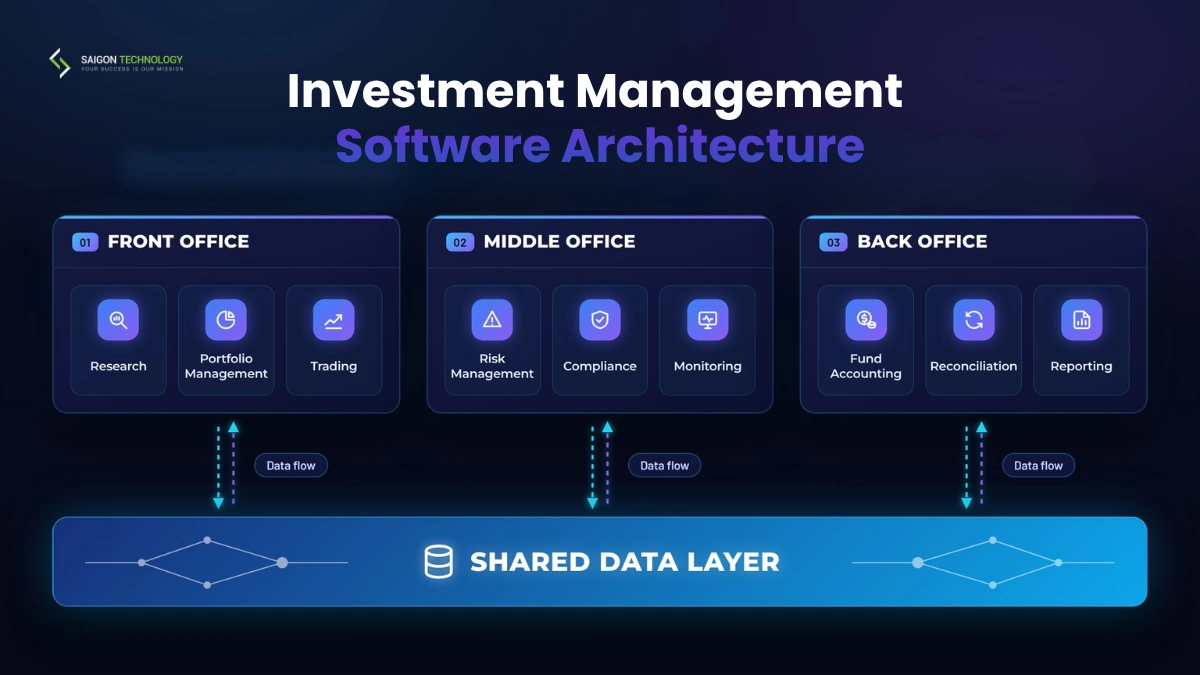
Buyers meet the category under several labels, including investment management system software. Scope matters more than the label. Two neighboring categories overlap with it, and each has a different primary focus:
| Software category | Primary focus |
| Investment portfolio management software | Holdings, asset allocation, performance tracking, and portfolio risk |
| Wealth management software | Client relationships, financial planning, portfolio oversight, and advisor workflows |
| Investment management software | Broader investment operations: portfolio management, trading, risk, compliance, accounting, and reporting |
The right fit depends on your asset classes, operating model, regulatory requirements, and the workflows you need to connect.
Benefits for Investment Firms and Asset Managers
Software for investment management pays off in five places: consistent data, faster decisions, fewer operational errors, more assets per operations headcount, and better investor reporting. AI adds a sixth when it is applied to routine review and preparation work rather than to investment decisions themselves.
- Teams see holdings, risk exposure, and performance from one consistent source instead of reconciling spreadsheets.
- Up-to-date positions let managers respond to market moves without waiting for end-of-day reports.
- Automated compliance checks and audit trails help prevent rule breaches and trade errors, and make every action easier to review.
- Automation absorbs repetitive work, so a firm can manage more assets and portfolios without growing operations headcount at the same rate.
- Automated reports and online dashboards give investors faster access to performance and statements.
- AI tools help teams review research, catch unusual data patterns, and prepare reports.
Types of Platforms by Segment, Scope, Deployment, and Asset Class
Software for investment management splits four ways: by the firms it serves, the workflows it covers, how it is deployed, and the asset classes it handles. Segment is the most useful first filter, because an advisor platform and a hedge fund order management system solve different problems even when their feature lists look alike.
By Firm Segment
| Segment | Typical users | Core workflows |
| Institutional | Asset managers and hedge funds | Portfolio management, trading, and risk analysis |
| Wealth management | Registered investment advisors (RIAs), wealth managers, and family offices | Portfolio oversight, client relationships, and reporting |
| Alternative investments | Private equity (PE), venture capital (VC), private credit, and real estate firms | Fund accounting, investor reporting, and capital calls |
For the engineering side of advisor platforms, see our guide to wealth management software development.
By Scope
Front-office tools cover research, portfolio modeling, and order management. Middle- and back-office tools cover risk, compliance, accounting, reconciliation, and reporting. End-to-end platforms connect all three through shared investment data. Scope drives price.
By Deployment Model
| Model | How it runs | Fits when |
| Cloud SaaS | Vendor-hosted, sold by subscription with ongoing updates | Standard workflows and speed to launch matter most |
| Single-tenant hosted | A dedicated environment for one firm | You need more control over configuration and infrastructure |
| On-premises | The firm’s own infrastructure | Specific security, integration, or legacy system requirements apply |
| Custom cloud build | Built around the firm’s workflows on AWS, Microsoft Azure, or Google Cloud | Core workflows are part of the firm’s edge |
Enterprise-grade platforms often support more than one model. The choice depends on security requirements, scalability, integration needs, and existing infrastructure.
By Asset Class
Public-market platforms handle equities, fixed income, and listed derivatives. Alternative-investment platforms handle private equity, venture capital, private credit, and real estate. Multi-asset platforms track allocation, performance, and risk across both. Firms that invest across classes should check whether one platform covers the full workflow or needs specialist systems integrated alongside it.
Leading Platforms by Firm Segment
No single investment management software product fits every firm. A system built for a $200 million registered investment advisor will not meet the needs of a $5 billion credit fund, so shortlist by segment first. The platforms below are positioned for different parts of the market, as each vendor describes its own product.
| Software | Best for | Key capabilities |
| Allvue Systems | Private equity, private debt, and collateralized loan obligations (CLOs) | Fund and deal management, investor reporting, and private-market workflows |
| Yardi | Real estate investment firms | Property and asset management, real estate accounting, and investor reporting |
| SS&C Advent | Institutional asset managers and hedge funds | Investment accounting, order management, and fund administration |
| Enfusion | Hedge funds and institutional investment managers | Order management, portfolio accounting, and risk analysis |
| Addepar | Wealth managers and family offices | Consolidated reporting across liquid, illiquid, and real asset holdings |
| Orion | Registered investment advisors (RIAs) and wealth managers | Portfolio accounting, trading, rebalancing, and client portals |
| Masttro | Family offices and private wealth managers | Consolidated wealth reporting and complex ownership structures |
Lists age fast. Check each vendor’s current product scope before shortlisting, because products are repackaged and change hands. If no single product covers your workflows, a hybrid approach, such as buying an accounting platform and building the rest, is worth evaluating.
Custom Development vs. Off-the-Shelf Software
Buy where the market offers a mature product that fits, build where your operating model is your edge, and combine the two when only part of the workflow is unique. The comparison below shows where each option tends to win, followed by the signals that point to buying, building, or a hybrid stack.
SaaS vs. Custom Development at a Glance
| Dimension | SaaS / Off-the-Shelf | Custom Development |
| Time to value | Often weeks to months | Typically months to over a year |
| Initial cost | Subscription and implementation fees | Higher upfront development cost |
| Long-term costs | Recurring subscriptions and add-on fees | Maintenance, infrastructure, and upgrades |
| Workflow fit | Standard workflows and supported configurations | Tailored to defined business requirements |
| Compliance | Depends on vendor capabilities and configuration | Controls designed around specific requirements |
| Integrations | Available APIs and supported connectors | Custom integrations based on project needs |
| AI customization | Depends on vendor capabilities | Greater flexibility for proprietary AI |
| Ownership and IP | Vendor owns the core platform | Depends on contractual terms |
Actual costs and timelines depend on scope, vendor pricing, integration complexity, and regulatory requirements.
When to Buy
Choose off-the-shelf investment management software when existing features cover your workflows, your asset classes are mainstream, and speed to market matters more than differentiation. Speed wins here.
When to Build
Consider custom software development when critical workflows, proprietary analytics, or integration requirements cannot be adequately supported by existing platforms. That is where fit pays for itself.
When to Choose Hybrid
Keep an established platform for core accounting or order management, then build custom research, AI, or client-facing tools where you need flexibility. The design work in a hybrid stack sits in the seams. Every system has to agree on positions and history.
“On the US wealth platform we built, every action is stored as an event, and reconciliation runs against that history. That is what keeps a hybrid stack auditable. Whichever system owns accounting, the team can replay how each position and NAV figure was produced.”
– Linh Pham, Senior Solution Architect at Saigon Technology
How Much Does a Custom Build Cost?
A custom platform costs about $56K-$221K for an MVP, $148K-$707K for a multi-module platform, and $380K-$1.59M for an enterprise build at Saigon Technology’s published $22-$46/hour rate. Three things move the number. Module count, integration depth, and an AI layer decide where a project lands, while security requirements and data migration shape the final number.
| Tier | Scope | Team and timeline | Estimated cost |
| MVP | Portfolio tracking, performance reporting, 1-2 custodian or market data feeds | 4-5 people (PM/BA, 2-3 developers, QC), 4-6 months | ~$56K-$221K |
| Multi-module platform | Adds order management over FIX, compliance rule checks, NAV and investment accounting, and investor reporting; 2-3 integrations | 6-8 people (PM, BA, 3-5 developers, QC, part-time UI/UX), 7-12 months | ~$148K-$707K |
| Enterprise platform | Front-to-back operations, AI capabilities, many integrations, DevOps | 9-12 people, 12-18 months | ~$380K-$1.59M |
These are planning estimates, not quotes: team size × months × 160 hours × $22-$46 per hour. They cover the engineering build only and depend on scope, integrations, data migration, and team mix. Market data licenses, SaaS fees, and infrastructure come on top.
SaaS subscriptions vary by vendor, modules, and number of users, and usually add implementation, market data, and support costs. Custom systems need maintenance, too.
Engagement options include dedicated teams, Offshore Development Centers (ODCs), fixed-price projects, and Build-Operate-Transfer (BOT) partnerships; see our engagement models. Builds that also cover lending, payments, or banking sit with our BFSI software development practice.
Security, Compliance, and Financial System Integrations
Investment management system software has to protect financial data, meet the rules that apply to the firm, and connect to the market data, custodian, and trading systems it depends on. Each requirement shapes the architecture early, so treat it as a design input rather than a pre-launch checklist.
Regulatory Compliance
Regulatory requirements depend on a firm’s activities and location. In the US, firms may need to submit SEC filings such as Form ADV for investment advisers or Form PF for certain private fund advisers. FINRA Rule 4511 also sets recordkeeping requirements for FINRA member firms.
In the EU, firms may need to comply with GDPR for personal data protection, MiFID II for investment services, AIFMD for alternative investment fund managers, and EMIR for derivatives transactions. The rules that apply depend on the firm’s business model and activities.
Other requirements may also apply. PCI DSS is relevant when payment card data is in scope, while KYC and AML checks help verify clients and identify financial crime risks. Consult legal and compliance specialists early to determine which requirements your firm and software need to meet.
Security Controls
Common safeguards include AES-256 encryption for stored data, TLS 1.3 for data in transit, MFA, access controls, secure key management, and tamper-resistant audit logs. Encryption alone is not enough. Controls should match the system’s risks and compliance requirements.
Key Financial Integrations
| Integration | Examples |
| Market data | Bloomberg, LSEG Refinitiv, FactSet, Morningstar |
| Custodians | State Street, BNY Mellon, Northern Trust, Pershing |
| Trading and risk | FIX connections to brokers and execution management systems (EMS), plus third-party risk models |
| Regulatory reporting | Form PF, AIFMD Annex IV, EMIR, and MiFID II workflows, where applicable |
| Internal systems | General ledger, CRM, data warehouse, and client portals |
Saigon Technology holds ISO 9001 and ISO 27001 certifications from BSI. On our US Personal Loans platform, we integrated Plaid, GIACT, Oscilar, and LoanPro for identity verification, risk assessment, and loan management. The SmithBot crypto trading platform connects trading bots to cryptocurrency exchanges through their APIs. For integration-heavy projects, see our software integration services.
Development Process: From Workflows to Go-Live
Building custom investment management software takes six stages, from mapping investment workflows to a phased rollout. Each stage ends with something stakeholders can review, which keeps integration and compliance risk visible early instead of surfacing in the final weeks before go-live.
1. Define Requirements and Investment Workflows
Start by understanding how investment teams manage portfolios, execute trades, assess risk, and report performance. Identify user needs, regulatory requirements, and the existing systems the platform must support. Map before you build.
2. Design the Architecture and User Experience
Define how the system will handle data, connect with external services, and support future growth, then design key user journeys and interactive prototypes so stakeholders can review the workflows before development begins.
3. Develop and Validate in Agile Sprints
Build the platform in short development cycles, typically two weeks long. Each sprint delivers working features that stakeholders can review and test, so the team can address issues early.
4. Integrate Financial Systems and Migrate Data
Connect the platform to market data providers, custodians, trading systems, and internal applications. When migrating historical data, reconcile positions and balances to catch inconsistencies before the system goes live. Do it before cutover.
5. Validate Compliance and Strengthen Security
Test core workflows, access controls, data protection, and audit trails, then run security testing and verify that the platform supports the regulatory requirements relevant to the firm’s operations.
6. Deploy, Train Users, and Optimize Performance
Roll out the platform in phases where appropriate, train users, and monitor system performance, then use feedback and operational data to prioritize improvements and plan future releases.
FAQs
What software do most financial advisors use?
Financial advisors typically combine several tools rather than one platform: a CRM, portfolio management and rebalancing software, financial planning software, and the custodian’s own platform for client accounts and assets. Which products fit depends on firm size, custodian relationships, and how much of the stack the firm wants integrated.
What is the best investment portfolio management software?
It depends. Firm size, asset classes, reporting needs, and workflows decide the answer. Orion and Addepar are positioned for wealth management firms, Allvue for alternative investments, and Enfusion for institutional investment operations. Compare platforms on the features and integrations your team needs rather than on rankings alone.
How does portfolio management software differ from a full investment platform?
Portfolio management software focuses on holdings, asset allocation, and investment performance. A full investment platform also covers research, trade execution, risk management, compliance, accounting, and investor reporting. Scope is the difference.
How long does it take to build a custom investment management system?
Our planning estimates put an MVP at 4-6 months with a team of 4-5 people. A multi-module platform takes 7-12 months, and an enterprise platform 12-18 months. Scope, integrations, data migration, and regulatory requirements decide where a project lands.
Is custom-built investment software secure enough for institutional clients?
Yes, if security is addressed throughout development. Common measures include encryption, multi-factor authentication, access controls, audit trails, and penetration testing. The platform should also meet the regulatory and security requirements relevant to the firm’s operations.
Can AI replace a core investment platform?
No. AI can support research, reporting, anomaly detection, and investment analysis, but firms still need core investment management software to hold portfolio data, enforce business rules, and keep reliable financial records. The goal is to integrate AI into existing workflows with validation and human oversight.
Conclusion
The investment management software decision in 2026 comes down to which parts to buy and which to build, so the operating model that sets a firm apart stays in-house. Firms that treat the whole stack as a commodity give up the asset AI makes more valuable: a system that fits how they run capital. Buy the commodity. Build the edge.
Saigon Technology builds wealth and lending platforms for US clients with senior engineering teams and AI-driven delivery. We bring 85+ offshore delivery projects since 2012, ISO 27001 certification, and Microsoft Solutions Partner status, and we assign code and IP to the client as work is delivered. Our AI development services cover the AI layer, while dedicated development teams and Build-Operate-Transfer partnerships suit firms that want to own what gets built.
Hired developers and AI Pods start with a two-week risk-free trial. To scope a build, hybrid, or modernization, talk to our fintech practice.


Related articles
Fintech App Development Cost in 2026: An Honest Breakdown
 Toan (Ted) Do - Project Manager
 24 Apr 2026
How to Build a Fintech App in 2026: A Step-by-Step Guide
14 Apr 2026 
PCI DSS Compliance in Fintech Software Development: A 2026 Guide
03 May 2026 
AI in Fintech: A 2026 Builder’s Guide to Use Cases, Architecture and Regional Rules
04 May 2026 
KYC AML Automation: How to Build It Into Your Fintech Product
13 Jul 2026 
Fintech Cybersecurity: 2026 Threats, Compliance & Controls
13 Aug 2026 
8 Fintech Software Development Trends Reshaping 2026
26 Aug 2026 
Digital Wallet App Development: Cost, Stack & Compliance
28 Oct 2026