• OVERVIEW
  • SERVICES
  • WHY CHOOSE US?
  • MODELS
  • TECHNOLOGIES
  • OUR PROCESS
  • FAQS

Why Hospitals Struggle with Legacy Systems and Off-the-Shelf Software

Why Hospitals Struggle with Legacy Systems and Off-the-Shelf Software
  • Most hospitals run on disconnected systems. Patient records sit in one application, billing in another, lab results in a third, and pharmacy data in a fourth. Staff spend hours every day on manual data entry, duplicate records, and cross-referencing between systems that don't talk to each other. According to a HIMSS survey, clinicians spend nearly 50% of their working hours on administrative tasks instead of direct patient care.
  • The compliance picture gets worse with packaged software. Off-the-shelf hospital management software often needs expensive customization to meet HIPAA, HITECH, or GDPR requirements specific to your facility. When regulatory compliance is treated as an add-on rather than a foundation, audit gaps and data breach risks multiply. Healthcare data breaches now cost an average of $10.93 million per incident, according to the IBM Cost of a Data Breach Report 2023.
  • There is also the scalability problem. When your hospital adds departments, opens satellite clinics, or launches a telehealth program, rigid packaged software hits a ceiling. You end up paying for workarounds, patching together third-party integrations that break after every update, and managing systems that cannot grow with your operations.
  • Then there's vendor lock-in. Many hospitals are stuck with proprietary platforms where every minor workflow change requires the vendor's timeline and budget. You don't own the source code, customization options are limited, and switching costs are prohibitive enough to keep you locked in for years.
over 350 software developers
400+
Software Developers
Over 12 years of experience
14+
Years in Business
Over 800 Projects Successfully Delivered
850+
Projects Successfully Delivered
rating on Clutch
4.8
Star Rating on Clutch

Hospital Management System Modules We Develop

Every hospital operates differently. A 200-bed general hospital has different priorities than a specialty cardiac center or a network of outpatient clinics. That's why we take a modular approach to HMS software development, building exactly what your facility needs and adding modules as you grow. Here's what we deliver across six functional areas.
healthcare - icon 7

Patient Management

Patient management forms the foundation of any hospital management system. We build the following core modules:

  • Registration & demographics - handles both outpatient (OPD) and inpatient (IPD) workflows, with admission, discharge, and transfer (ADT) tracking across departments.
  • Appointment scheduling - automated reminders and calendar integration to reduce no-show rates.
  • Patient portals - self-service access to records, upcoming appointments, and billing information, which directly improves patient engagement and reduces front-desk workload.
  • Bed management - real-time visibility into bed availability, helping admissions teams allocate resources efficiently.
chevron-up.svg
healthcare - icon 3

Clinical and Medical Records

Electronic health records (EHR) are the clinical backbone of hospital management software. Our clinical modules include:

  • EHR/EMR with interoperability - built with HL7 v2.x and FHIR R4 so records can exchange data with labs, pharmacies, payers, and referring physicians.
  • Clinical decision support - flags drug interactions, allergy alerts, and protocol deviations at the point of care.
  • E-prescribing - connects directly to pharmacy systems with interaction checks built in.
  • Medical imaging (PACS) - DICOM-compliant picture archiving and communication systems for hospitals handling imaging.
  • Clinical documentation - SOAP notes, voice-enabled AI documentation, and clinical data management tools.
chevron-up.svg
healthcare - icon 2

Revenue Cycle Management and Billing

Financial health depends on an efficient revenue cycle. Our billing automation modules cover:

  • End-to-end billing workflows - insurance verification, claims management, ICD-10/CPT coding, denial management, and patient billing with payment gateway integration.
  • Financial reporting & analytics - real-time dashboards giving your finance team visibility into accounts receivable, claim denial trends, and revenue performance across departments.
  • 340B program support - specialized inventory management features that track eligible prescriptions and maintain compliance documentation for participating hospitals.
chevron-up.svg
healthcare - icon 1

Ancillary Departments

Hospital operations extend well beyond the patient floor. Each ancillary module connects to the central patient record through standardized interfaces, eliminating the data silos that cause errors and delays.

  • Pharmacy management - inventory tracking, automated dispensing workflows, and formulary management.
  • Laboratory information systems (LIS) - automated specimen tracking, result routing, and quality control.
  • Radiology information systems (RIS) - imaging workflow management from order to report.
  • Blood bank - donor management, crossmatch tracking, and inventory with expiration alerts.
chevron-up.svg
icon 8

Operations and Administration

Administrative efficiency keeps hospitals running. We build:

  • Staff scheduling & workforce management - accounts for shift patterns, certifications, and department needs.
  • Asset & equipment tracking - RFID tags and sensors monitor equipment availability and maintenance schedules, reducing asset wastage.
  • Inventory & supply management - connects purchasing, receiving, and consumption tracking across departments.
  • Facility & maintenance management - rounds out the operational suite, ensuring physical infrastructure supports clinical operations.
chevron-up.svg
icon 4

Advanced Capabilities

Modern hospital management system development increasingly includes AI and IoT capabilities:

  • AI-powered diagnostics & predictive analytics - readmission risk scoring, resource utilization forecasting, and clinical workflow optimization.
  • Telemedicine integration - virtual consultations with full EHR access during video sessions.
  • IoMT (Internet of Medical Things) - connects vital sign monitors, wearable devices, and bedside equipment to the central platform for real-time updates and automated alerting.
  • Multi-facility, multi-language & multi-currency support - for hospital networks operating across regions.
chevron-up.svg

Healthcare Projects We've Delivered

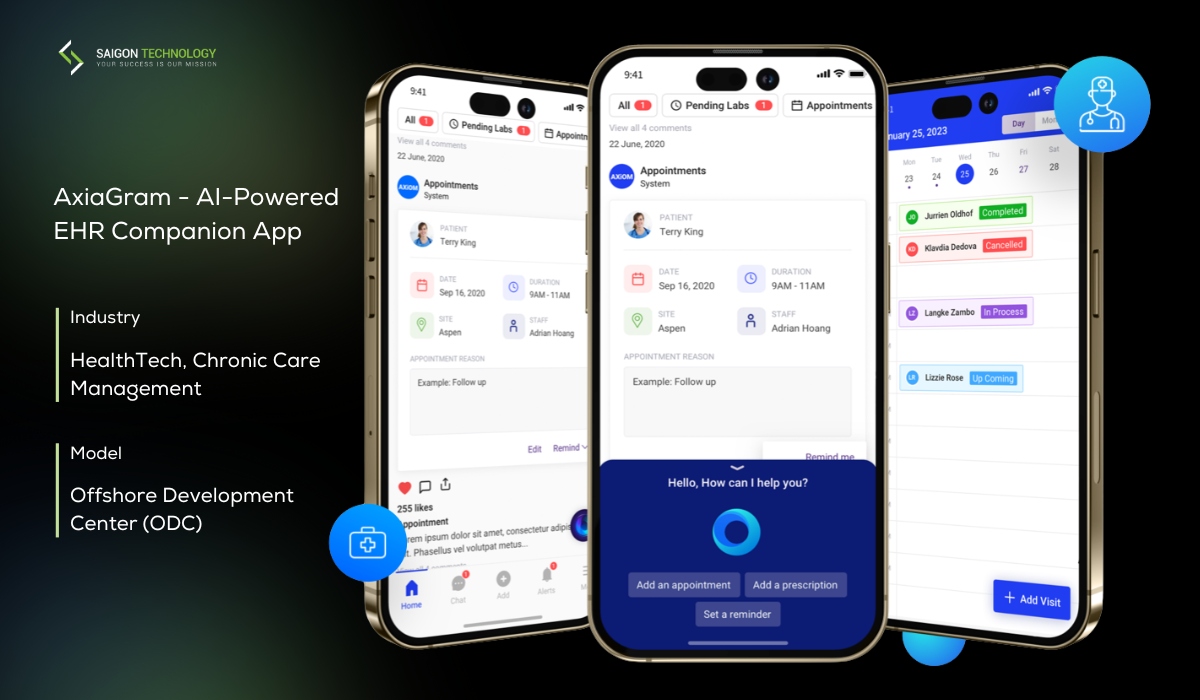
AxiaGram - AI-Powered EHR Companion Appy

AxiaGram (USA) - Healthcare Data Platform

  • Challenge: AxiaGram needed a scalable platform to manage millions of medical records with strict HIPAA compliance and the ability to handle growing data volumes without performance degradation. 
  • Solution: We built a custom healthcare platform with secure data management, role-based access controls, automated clinical workflows, and real-time data analytics. The architecture was designed for horizontal scaling from the start. 
  • Results: 6M+ medical records managed securely. 40% reduction in development time compared to their previous vendor. The engagement continues at $70K/month, reflecting the ongoing value and trust built over the partnership. 
  • Tech stack: .NET Core, AWS (HIPAA-eligible), HL7 integration, AES-256 encryption
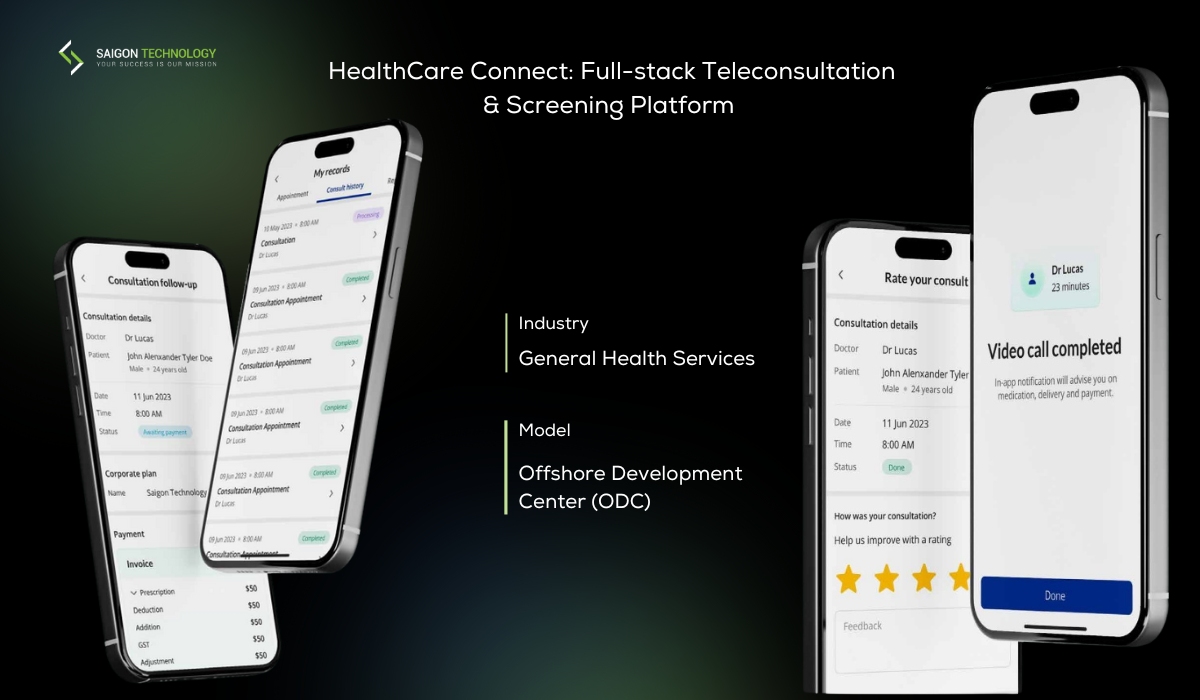
HealthCare Connect: Full-stack Teleconsultation & Screening Platform

HealthCare Connect - Telehealth Platform

  • Challenge: Build a telehealth platform capable of handling high-volume patient interactions with reliable video quality and full EHR integration for clinicians.
  • Solution: We developed a video consultation system with integrated electronic health records access during sessions, appointment scheduling, patient portal, and secure messaging between patients and providers.
  • Results: 50,000+ patient interactions per month with stable performance and high patient satisfaction scores.
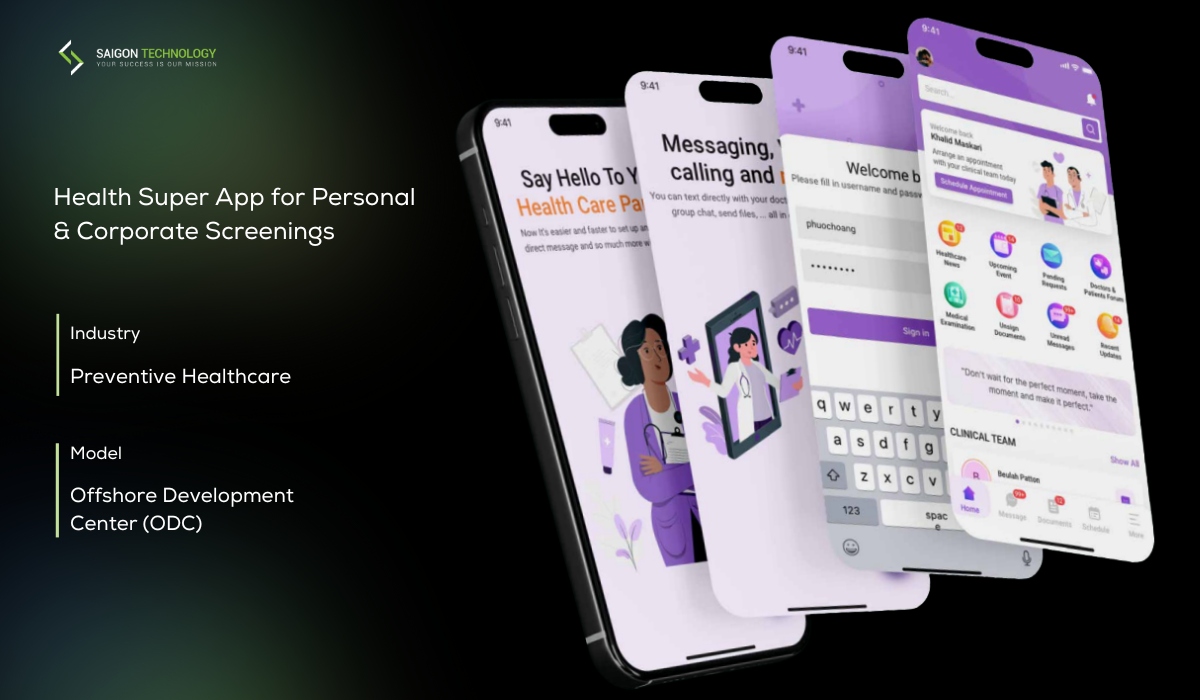
Health Super App for Personal & Corporate Screenings

Health Super App (Southeast Asia) - Preventive Health

  • Challenge: Digitize the health check-in process for preventive care facilities across multiple locations, eliminating paper forms and mappanual record-keeping.
  • Solution: A mobile-first health application with paperless check-in, health tracking dashboards, provider integration, and personalized care plans based on screening results.
  • Results: Thousands of monthly active users. Fully paperless check-in workflow across all participating facilities.

Talk to Phuc Tran, Your Hospital Management System Expert

With 14+ years building HMS platforms across US, EU, AU, and Singapore, Phuc brings HIPAA, HL7, and FHIR expertise to every project. Map your compliance, technical, and delivery risks before a single line of code is written.
Book a Call with Phuc
phuc

HIPAA, HL7, FHIR: Compliance Built In, Not Bolted On

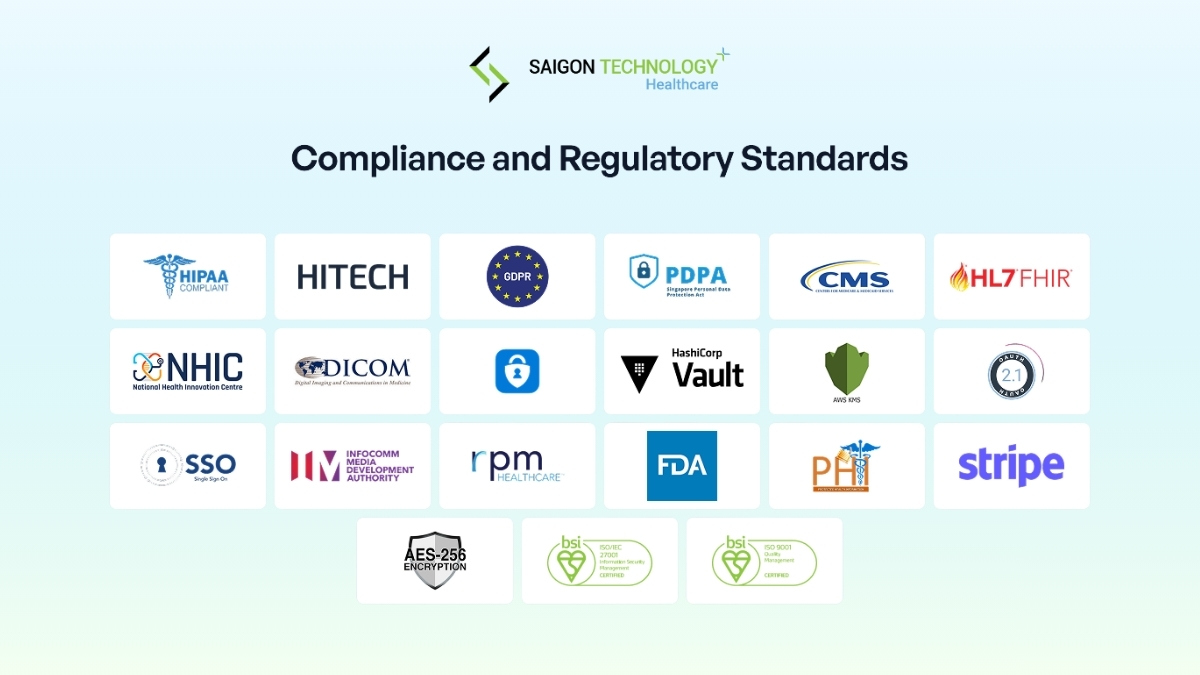
Regulatory compliance is the single biggest concern we hear from hospital IT leaders evaluating custom hospital management system development. And rightly so. A compliance failure doesn't just mean fines; it means patient harm and lost trust. That's why we build compliance into the architecture from the first sprint, not as a final checklist item. 

Every HMS we build includes the technical safeguards required under HIPAA: AES-256 encryption for data at rest and in transit, role-based access controls (RBAC) that limit each user to the minimum data required for their role, audit logs that record every access and modification to protected health information, automatic session timeouts, and breach notification workflows. Our development practices are backed by ISO 27001 certification from BSI (UK), which means information security management is embedded in how we work, not just what we deliver.

Hospitals don't operate in isolation. Your HMS needs to communicate with external labs, pharmacies, insurance payers, health information exchanges (HIE), and referring physicians. We implement HL7 v2.x messaging for legacy system integration and FHIR R4 APIs for modern RESTful interoperability. DICOM support handles medical imaging data exchange. These standards ensure your hospital management system can participate in regional and national health information networks without custom point-to-point interfaces that break when partners upgrade.

Beyond compliance checkboxes, we design security at the infrastructure level: Zero Trust architecture that verifies every access request regardless of network location, OAuth 2.1 with multi-factor authentication (MFA) for secure access controls, encrypted backups with geographic redundancy, intrusion detection systems, and regular penetration testing before and after deployment. Consent management modules track patient data authorizations for jurisdictions that require explicit opt-in.

For hospitals in the EU, we build GDPR-compliant data handling with right-to-erasure workflows and data portability. Southeast Asian hospitals get PDPA compliance modules. Financial reporting modules align with SOX requirements where applicable. Our compliance modules are configurable by jurisdiction, so multi-national hospital networks can run a single platform with region-specific data governance rules.

Compliance, Security, and Privacy Requirements for EHR software

Trusted by Global Companies

Partner-logo2 Partner-logo3 Partner-logo4 Partner-logo6 Partner-logo1 Partner-logo5 Partner-logo9 Partner logo

Client Feedback and Testimonials

Over the past year, collaborating with Saigon Technology Solution company, we have brought high-quality financial software solutions. STS helps us meet the strict requirements of the IT market with software engineers, software testers, and internal system control. And all of these are evidence that we have chosen a good software outsourcing partner.
Mr. Corbin van Amelsvoort
Director at Topicus Vietnam
star.svg star.svg star.svg star.svg star.svg
Mr. RJ Macasaet
Head of Partnership - DMI Global
star.svg star.svg star.svg star.svg star.svg
Saigon Technology has been a reliable and committed partner in our telehealth project. They consistently delivered on time, provided responsive 24/7 support, and were always available on WhatsApp, even after working hours, whenever we needed urgent assistance. What stood out most was their continuous attention to security and speed, which are essential for a healthcare platform. Their strong ownership and responsiveness made a real difference to the success of the project.
Eric Chiam
CEO - Minmed, Telehealth
star.svg star.svg star.svg star.svg star.svg
We value Saigon Technology’s strong support in managing the engagement from an internal delivery perspective. They were able to maintain team performance across a relatively large team, provide additional resources when required, and work collaboratively with us on matters such as gap time, discount proposals, and improvements to the working process. Their flexibility and consistent management support contributed positively to the overall partnership.
Sri Vijayasarathy
CTO at Axiagram
star.svg star.svg star.svg star.svg star.svg
During our collaboration, Mr. Thanh and his company, Saigon Technology, have consistently demonstrated world-class leadership and execution in complex fintech projects. His ability to scale and lead high-performing engineering teams, while maintaining cost-efficiency and product quality, has been critical to our technology operations. His strategic insights and leadership enabled us to significantly improve system stability and deployment velocity.
Abe Jarrett
Senior Vice President of Software Engineering at Origence, USA
star.svg star.svg star.svg star.svg star.svg

Why Companies Trust Saigon Technology for Healthcare Software

Why Choose Saigon Technology?

We're not a generalist agency figuring out HIPAA as we go. Our team has built healthcare platforms across multiple projects: AxiaGram (managing 6M+ medical records), HealthCare Connect (50,000+ patient interactions per month), a regional Health Super App (fully paperless check-in), and an Elderly Health Tracker (real-time IoT monitoring with BLE devices). This proven track record means your developers already understand clinical workflows, healthcare data sensitivity, and compliance requirements before they write their first line of code. 

Our 400+ software engineers go through a three-stage hiring process: technical screening by Talent Acquisition, hands-on assessment by a Tech Lead, and cultural fit evaluation by HR. Only the top 1% of applicants are shortlisted. For hospital management system development projects, we assign developers with specific experience in healthcare interoperability standards, medical data handling, and regulatory compliance. Learn more our talents.

Our rates range from $28 to $46 per hour, backed by ISO 9001 quality management certification. Compared to US-based HMS development at $150 to $250 per hour, hospitals working with us save 60 to 70% on development costs while getting the same compliance rigor, code quality, and project management standards. Three development centers across Vietnam provide timezone flexibility for teams in the US, EU, Australia, and Singapore.

Every line of code we write belongs to you. We execute strict NDAs, maintain ISO 27001-certified security practices, and provide complete source code and documentation transfer at project completion. Your hospital data never leaves your infrastructure; we work in your environments with secure access controls.

Start with zero commitment. Evaluate our developers on your actual HMS requirements, review their code quality, and assess communication before signing a long-term engagement. If it's not the right fit, you owe nothing.

Choose dedicated teams for full HMS builds, staff augmentation if you need HL7/FHIR specialists to reinforce your internal IT team, fixed-price contracts for well-defined modules, or a Build-Operate-Transfer (BOT) model if your long-term plan is to establish your own healthcare development center in Vietnam.

How Much Does Hospital Management System Development Cost?

Custom hospital management system development typically costs between $50,000 and $500,000 or more, depending on the number of modules, compliance requirements, integration complexity, and team size. At Saigon Technology's rates of $28 to $46 per hour, hospitals save 60 to 70% compared to US or European hospital software development costs while maintaining ISO-certified quality and security standards. Here's what drives the cost of hospital management system development:
Number of modules

Number of modules

A core HMS with patient management, appointment scheduling, and basic billing runs at the lower end. Add electronic health records, pharmacy management, laboratory information systems, revenue cycle management, and telehealth, and costs increase with each module's complexity of the design and integration requirements.
Compliance scope

Compliance scope

HIPAA-only compliance is more straightforward than projects requiring HIPAA plus GDPR plus PDPA. Each regulatory framework adds data handling rules, access controls, consent management, and audit capabilities that require dedicated development and testing effort.
Integration complexity

Integration complexity

Building a greenfield system is simpler than connecting to legacy Epic, Cerner, or homegrown systems. Each integration point requires interface development, data mapping, testing, and ongoing maintenance. Health information exchanges (HIE) and insurance payer connections add further complexity.
AI and analytics features

AI and analytics features

Predictive analytics, AI-powered diagnostic assistance, NLP-based clinical documentation, and real-time decision support require specialized AI engineers and longer development cycles.
Deployment scale

Deployment scale

A single hospital deployment is straightforward. Multi-facility networks with centralized data but location-specific workflows, multi-language interfaces, and regional compliance variations increase scope and cost.

Engagement Models for HMS Development

Dedicated Team

Hospital building a complete system from scratch. Best for Full HMS build, 6 to 18 months.

chevron-up.svg

Staff Augmentation

Hospital with in-house team needing HL7/FHIR specialists. Best for Reinforcing internal IT.

chevron-up.svg

Fixed-Price

Adding a patient portal or billing module to existing systems. Best for Well-defined single modules.

chevron-up.svg

ODC (Offshore Dev Center)

Multi-year development program across facilities. Best for Large hospital networks.

chevron-up.svg

BOT (Build-Operate-Transfer)

Establishing your own Vietnam healthcare dev center. Best for Long-term strategy.

chevron-up.svg

Engineering Capabilities & Stack

How Hospital Management System Development Works - From Discovery to Deployment

Building a hospital management system is a major undertaking. Hospitals rightly want to understand the process before committing. Here's how we approach it, step by step, with realistic timelines based on our project experience.
Software Development Process

Discovery and clinical workflow analysis (2 to 4 weeks)

We start by meeting with department heads, clinicians, nursing staff, IT teams, and billing managers to map your current workflows, pain points, compliance requirements, and integration needs. This isn't a generic questionnaire. We shadow clinical staff, document how information actually flows between departments (not how it's supposed to), and identify where manual processes create bottlenecks. The output is a detailed requirements document and system architecture blueprint that becomes the foundation for everything we build. 

Software Development Process

UX/UI design for clinical users (3 to 5 weeks)

Healthcare software fails when it's designed by engineers who have never watched a nurse use a computer during a 12-hour shift. We design interfaces optimized for clinical efficiency: minimal clicks to complete common tasks, role-based dashboards that surface the right information for each user type, mobile-responsive layouts for bedside tablet use, and accessibility compliance. Every design goes through prototype validation with actual clinical staff before a single line of code is written.

Software Development Process

Agile development in sprints (3 to 9 months depending on scope)

We build in two-week sprints with continuous client demos after each sprint. This means you see working software every two weeks, not after six months of silence. Module-by-module delivery lets you start using patient registration while billing is still in development. A full CI/CD pipeline with automated testing catches issues early. Your dedicated team works exclusively on your project with a consistent tech lead throughout.

Software Development Process

Compliance validation and security testing (ongoing plus a dedicated phase)

HIPAA security risk assessments, penetration testing, OWASP Top 10 vulnerability scanning, HL7/FHIR conformance testing, audit trail verification, and access control validation happen throughout development, with a dedicated security review phase before go-live. We don't treat security as a final gate; it's tested in every sprint.

Software Development Process

Integration and data migration (2 to 6 weeks)

We connect your new HMS to existing EHR, laboratory information systems, pharmacy systems, medical imaging archives, and insurance payer platforms. Historical patient data migration follows a structured process: data audit, extraction, transformation, cleansing, validation, deduplication, and staged migration with rollback capability. We run parallel systems during the transition so nothing gets lost.

Software Development Process

Training, go-live, and ongoing support

Role-based training programs ensure clinical staff, administrative personnel, and IT teams each learn the features relevant to their work. We recommend phased go-live, department by department, to minimize disruption. Staff's reluctance to change is real, so our training approach includes hands-on workshops, quick-reference guides, and on-site support during the first weeks. After launch, we provide ongoing maintenance, performance monitoring, system updates, bug resolution, and feature enhancements.

Our Insights

FAQs

A hospital management system is integrated software that automates and connects core hospital operations into a single platform: patient registration and tracking, electronic health records (EHR/EMR), appointment scheduling, medical billing and revenue cycle management, pharmacy management, laboratory information systems, and administrative workflows. Unlike standalone applications that handle one function each, an HMS provides a unified view of all hospital data, reducing manual work, eliminating duplicate records, and improving patient care coordination across departments.
Custom HMS development tailors every module to your hospital's specific clinical workflows, compliance requirements, and growth plans, rather than forcing your processes into a vendor's template. Our end-to-end approach covers:
  • Requirements analysis and discovery
  • UX design built for clinical users
  • Agile development with iterative releases
  • Compliance validation (HIPAA, HL7, FHIR)
  • Integration with existing hospital systems
  • Ongoing support and maintenance
We don't configure templates. We build software around how your hospital works, not the other way around. Who benefits most from custom HMS development?  This approach delivers the highest ROI for:
  • Mid-size hospitals needing flexibility without enterprise overhead
  • Specialty clinics with unique clinical workflows
  • Multi-facility networks requiring centralized data and operations
  • Healthcare startups building digital-first from day one
Off-the-shelf platforms like Epic or Cerner serve large health systems well, but their licensing costs, rigid workflows, and long implementation timelines often don't fit organizations that need agile solutions with full ownership of their code and data. Proven results: AxiaGram (US)  We built a healthcare platform for AxiaGram that:
  • Manages 6M+ medical records
  • Delivered 40% faster development time
  • Was designed around their clinical workflows from day one, not retrofitted from a generic product

A basic HMS with core modules like patient management, appointment scheduling, and billing typically takes 4 to 6 months of development and implementation. A full system with EHR integration, pharmacy, laboratory, telehealth, and AI-powered analytics takes 9 to 15 months. We deliver in phases so you can start using early modules while later ones are still in development. An MVP with your highest-priority features can be ready in as little as 3 months.
We implement HIPAA technical safeguards from the architecture phase: AES-256 encryption for data at rest and in transit, role-based access controls that restrict users to minimum necessary data, audit logs recording every PHI access and modification, automatic session management, encrypted backups, and breach notification workflows. Our development process operates under ISO 27001 certification (BSI, UK), and we conduct HIPAA security risk assessments and penetration testing before every go-live.

Yes. We build interoperability using HL7 v2.x for legacy system messaging and FHIR R4 APIs for modern integrations. We've connected custom healthcare platforms with major EHR systems, laboratory information systems (LIS), pharmacy dispensing systems, medical imaging archives (DICOM), insurance payers, and health information exchanges. Each integration follows IHE profiles where applicable to ensure standards-based data exchange.
Off-the-shelf systems like Epic or Cerner provide broad functionality out of the box but come with high licensing fees (often per-user), rigid workflows that may not match your hospital's processes, and vendor dependency for every customization. Custom HMS development costs more upfront but gives you full ownership of the source code, workflows tailored to how your staff actually works, no recurring per-user license fees, and complete control over future modifications. For mid-size hospitals and specialty clinics, a customized approach often delivers better long-term ROI and operational efficiency.
Yes. Saigon Technology provides full intellectual property transfer on every project. You own 100% of the source code, technical documentation, deployment scripts, and all project deliverables. This is documented in our contract and reinforced by strict NDA agreements. You are never locked into our services to maintain or modify your own software.


We follow a structured data migration process: audit and mapping of your existing data structures, extraction from legacy systems, transformation and cleansing to match the new system's schema, validation and deduplication to ensure data integrity, staged migration with full rollback capability, and a parallel run period where both old and new systems operate simultaneously. Patient records, financial data, clinical histories, and scheduling data are all migrated with verification at each step.
We offer ongoing maintenance and support services including bug resolution, security patches, performance monitoring, system updates, feature enhancements, and 24/7 incident response for critical issues. Support engagement models are flexible: ad-hoc hours for smaller facilities, dedicated support teams for large hospital networks, or a hybrid approach. We also provide regular system health reports and proactive recommendations for optimization based on usage patterns and emerging healthcare technology trends.

Ready to Build Your Hospital Management System?

Partner with ISO-certified engineers and 14+ years of HIPAA, HL7, and FHIR expertise.

    Contact Message Box
    Back2Top

    Schedule a Demo with Our Industry Experts

    Book a free 30-minute call

    • See case studies aligned with your requirements
    • Validate our industry experience
    • Confirm technical fit for your project
    Schedule a Demo