















































- OVERVIEW
- SERVICES
- WHY CHOOSE US?
- MODELS
- TECHNOLOGIES
- OUR PROCESS
- FAQS
What is eLearning Software Development?
- eLearning software development is the engineering practice of designing, building, integrating, and maintaining software that delivers electronic learning experiences. It covers a range of product types including learning management systems (LMS), learning experience platforms (LXP), mobile learning apps, virtual classroom software, course authoring tools, and learning content management systems (LCMS).
- A typical project covers the full lifecycle: discovery and design, web and mobile development, integrations with HR and CRM systems, support for learning standards like SCORM and xAPI, security, accessibility, cloud deployment, and post-launch improvements.
- People usually commission this work for one of four reasons: launching a new EdTech product, replacing an outdated learning platform, running corporate training that generic tools cannot handle, or serving students and teachers with a custom learning platform built around how they actually work.
Custom eLearning Software Solutions We Build
Learning Management Systems (LMS)
eLearning Platforms
Learning Experience Platforms (LXP)
Corporate Training Platforms
Mobile Learning Applications
Virtual Classroom and Online Learning Software
Case Studies: eLearning Platforms We Have Shipped
Lumina eLearning Platform
- Lumina is a scalable custom eLearning platform built to support engaging digital learning experiences across web and mobile.
- What we built: Adaptive learning modules, video streaming, gamification, progress tracking, and a learner analytics dashboard
- eLearning focus: Delivering multimedia content, supporting personalized learning paths, and giving learners and administrators better visibility into progress
- Result: A scalable learning platform that supports rich content delivery and real-time learner insights across a growing user base
- Read full case study →
Scholar OS
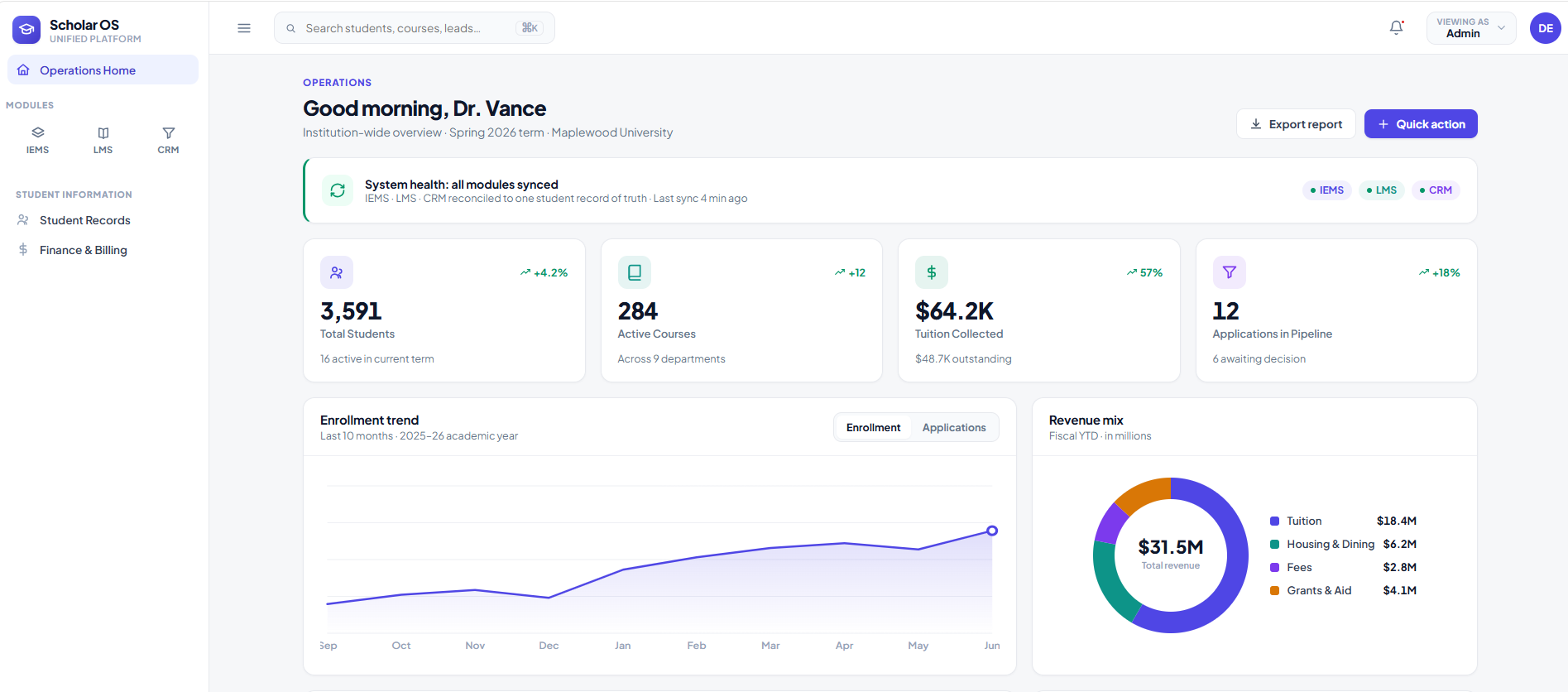
- Scholar OS brings multiple education and learning workflows into a unified platform for students, teachers, administrators, and parents. This engagement shows the breadth of elearning software development services we deliver: from mobile learning to shared analytics, on a single codebase.
- What we built: Unified learning interfaces, role-based access, mobile learning capabilities, single sign-on, and shared analytics
- eLearning focus: Connecting learning activities and user experiences across different user roles within one platform
- Result: A unified system that supports connected learning workflows across multiple institutions
- Read full case study →
See Your eLearning Software Take Shape in 48 Hours
- A clickable prototype showing your core learning workflows and features
- Learner, instructor, and administrator journeys mapped out
- Architecture direction covering integrations, security, scalability, and learning standards (SCORM, xAPI, LTI)
- A technical recommendation session with our senior engineering team
Why Choose Saigon Technology for eLearning Software Development?
A good eLearning software development company should do more than ship features. It should help you make sound architecture decisions, protect learner data, keep the product maintainable as requirements change, and make the cost of engineering clear from the start.
Senior Engineers at a Published $22–$46/hr
Senior engineers use AI for code generation, test scaffolding, and code review, helping teams cover more development scope without sacrificing engineering oversight. Our published development rate is $22–$46/hr, with teams able to maintain 10–12 hours of daily overlap with US working hours for engagements that require extended collaboration.
Learner Data Protected Under ISO 27001
eLearning platforms handle learner profiles, assessment results, course activity, and other sensitive data. Depending on the product and security requirements, our solutions can include role-based access control, encryption at rest, TLS in transit, MFA, and accessibility considerations aligned with WCAG 2.2 AA.
Our ISO 27001 certification provides an independently assessed information security framework, while specific requirements such as GDPR, FERPA, or HIPAA are addressed based on your product, data, and compliance scope
Engineers Who Stay With Your Platform
eLearning platforms evolve for years. Our longer-term engagement models let the engineers who understand your platform continue developing it as requirements change. Saigon Technology was named one of the Fortune 100 Best Companies to Work For™ in Southeast Asia in 2025.
Architecture Advice, Including When Not to Rebuild
Replacing an LMS in one release is not always the right technical or business decision. We first map what your existing stack already does well, then identify the smallest change that addresses the actual problem. That might mean adding an LXP layer, building a mobile experience around an existing content API, integrating a third-party service, or migrating in phases. If extending Moodle, Canvas, or Open edX makes more sense than replacing it, we can build around that decision.
ISO 9001 and ISO 27001, Certified by BSI
Quality and information security are independently assessed rather than based only on internal claims. Saigon Technology holds ISO 9001 for quality management and ISO 27001 for information security, helping address common vendor due-diligence requirements before development begins.
14+ Years, 850+ Projects, 350+ Clients
Saigon Technology has delivered software since 2012, with 850+ projects and 350+ clients across global markets. Our experience includes 310+ web and mobile app builds and 85+ offshore dedicated teams.
Two-Week Risk-Free Trial
You do not have to commit to a long-term engagement before seeing how the team works. Qualifying projects can start with a 2-week risk-free trial to validate technical fit, communication, and delivery expectations. After the trial, you can continue with a dedicated development team, staff augmentation, fixed-price project, ODC, or BOT model. See our software pricing models for an overview of the tradeoffs between engagement options.
Our Clients
What Our Clients Say
Custom vs. Off-the-Shelf eLearning Software: What Fits Your Needs?
Off-the-shelf platforms can cover standard learning workflows, while custom eLearning software gives you more control over learning experiences, integrations, data, and AI capabilities. Extending an existing LMS can be a middle ground when the core platform fits your needs but not the details around it.
| Approach | Best for | Considerations |
|---|---|---|
| Off-the-Shelf | Standard learning workflows and faster deployment | Licensing costs, vendor roadmap, limited customization and integrations |
| Extend an Existing LMS | An LMS that handles core workflows but needs more flexibility | Platform constraints, upgrade compatibility, customization complexity |
| Custom eLearning Software Development | Unique learning workflows, learner experiences, data models, or AI requirements | Higher upfront effort, but full product ownership |
Here's what each approach actually looks like once you're building.
Faster eLearning Launches
Start with proven course, learner, assessment, and reporting capabilities instead of building standard functionality from scratch.
Flexible Learning Experiences
Extend or customize learning workflows as your courses, learner groups, content, and training requirements evolve. This is where eLearning software development earns its cost: the platform grows with you instead of forcing you back into a vendor's release cycle.
Connected Learning Ecosystem
Connect your eLearning platform with HRIS, CRM, identity providers, content repositories, video conferencing tools, and other learning technologies your organization already runs.
AI for Personalized Learning
Add AI-powered recommendations, learning assistants, content generation, assessment, and predictive analytics built around your specific learning workflows, not a generic AI feature bolted onto someone else's product.
Our eLearning Software Development Services
eLearning Software Consulting
Custom eLearning Software
LMS Development and Customization
eLearning Platform Integration
AI-Powered eLearning Development
eLearning Modernization and Support
How Much Does eLearning Software Development Cost?
Custom eLearning software development varies by project. Our engineering rates range from $22 to $46 per hour, depending on seniority and engagement duration. Total cost depends on features, complexity, integrations, and scale. For a working estimate, a 60-minute scoping call with a senior engineer helps define the scope and budget range.
Feature Complexity and User Roles
More user roles, customization, and learning workflows increase development effort. A simple course-and-quiz platform requires less work than one with adaptive assessments, certifications, and role-based permissions.
Mobile Apps and Integrations
Native or cross-platform iOS and Android apps add development scope. Third-party integrations do too, especially for enterprise platforms connecting HRIS, CRM, SSO, payment, and other systems.
AI Functionality and Data Migration
AI features such as personalization and predictive analytics may require additional data pipelines and infrastructure. Legacy content and learner records may also require mapping, migration, and validation
Security, Compliance, and Scale
Requirements such as WCAG, GDPR, HIPAA, and FERPA can add architecture and testing work depending on the product scope. Learner volume, concurrent sessions, and geographic distribution also shape infrastructure requirements.
Our eLearning Software Development Process
Discovery and Requirements (1–2 weeks)
We map out your target learners, business goals, learning workflows, and compliance needs like WCAG, FERPA, HIPAA, and GDPR. You get a scoped requirements document, learner personas, and a technical constraints map.
Product Strategy and Architecture (1–2 weeks)
Senior engineers define the MVP scope, architecture, data model, and integrations, using AI-accelerated MVP development to speed up exploration and validate proven patterns. Microservices or cloud-native approaches are recommended when they fit the platform’s growth plans.
UX and UI Design (2–3 weeks)
We create user journeys, wireframes, prototypes, and a design system. Learner experience gets extra attention here because completion rates depend on it, and we validate with real learners before writing production code.
Development and Integration (8–16 weeks)
We build in two-week sprints, with automated testing and deployment on every commit. Integrations to HRIS, CRM, LMS, and content systems are built in parallel, so the platform launches already connected, not with a promise to connect later.
QA and Security Testing (1–2 Weeks)
We run functional, performance, cross-browser, and security testing, plus usability testing with real learners. We also test for SCORM, xAPI, and cmi5 conformance so your content works across other systems.
Deployment and Continuous Improvement (ongoing)
We roll out on AWS, Azure, or GCP with safety nets like feature flags and rollback plans. After launch, we review analytics, gather feedback, and iterate monthly, with the same engineering team handling maintenance and scaling.
Our Insights
FAQs
What eLearning software can you develop?
We develop custom LMS, eLearning platforms, learning experience platforms (LXP), corporate training platforms, mobile learning applications, virtual classroom software, eLearning authoring tools, and learning content management systems (LCMS). If your product is a hybrid of several of these categories, that is common, and our discovery process starts by mapping your requirements to the right product architecture.
How much does it cost to develop eLearning software?
Costs vary by scope and complexity. Basic MVPs sit at the lower end, while custom LMS and enterprise platforms with AI, integrations, and mobile apps cost more. Our senior engineering rates are $22–$46 per hour. Send us a full brief for a scoped estimate within 48 hours.
How long does it take to build an eLearning platform?
Timelines depend on scope. A basic MVP typically ships in 8 to 12 weeks. A custom LMS or eLearning platform with integrations and mobile support typically ships in 16 to 24 weeks. An enterprise learning platform with AI, complex integrations, content migration, and compliance requirements typically ships in 24 to 40 weeks.
Can you integrate an LMS with HR or CRM software?
Yes. We routinely integrate learning platforms with Workday, SAP SuccessFactors, BambooHR, Salesforce, HubSpot, and any REST, GraphQL, SAML, or OAuth-based system. For enterprises with many source systems, we build iPaaS layers so the LMS talks to your stack without brittle point-to-point connections.
Can you add AI features to an eLearning platform?
Yes. We build AI personalization, AI tutors and learning assistants, AI-powered content creation, automated assessment and feedback, and predictive learning analytics. Our #2 ranking in AI Application Development Platforms means we bring practical AI engineering experience, not just marketing framing.
Do you support SCORM, xAPI, and LTI?
Yes, in full. We deliver against SCORM 1.2 and 2004, xAPI (Tin Can), cmi5, LTI 1.3, and QTI. Every content object and learning record we ship conforms to the standards your existing tooling and reporting infrastructure requires.
Can you develop mobile eLearning apps?
Yes. Our eLearning application development services cover native iOS (Swift) and Android (Kotlin), plus cross-platform apps in React Native and Flutter. Every mobile learning app we ship supports offline mode, push notifications, adaptive content, and progress sync with the web platform.