




AI Route Optimization: How It Works, Benefits, and Use Cases 2026

 Updated on Oct 14, 2026
Logistics teams in 2026 are under pressure from three directions: fuel costs, driver shortages, and customer expectations of two-hour delivery windows. AI route optimization is the operational answer.
AI-driven route optimization applies machine learning algorithms to compute delivery or service routes in real time, factoring in live traffic, vehicle constraints, driver schedules, and delivery windows. Unlike static route planning, it adjusts routes while drivers are on the road. Early adopters report 5-15% fuel savings and 10-30% faster deliveries. UPS alone attributes $300-400 million per year in savings to its ORION system.
This guide covers how AI route optimization works, which algorithms power it, where it delivers the biggest returns, and when a custom build beats off-the-shelf tools.
Key Takeaways
- Machine learning (VRP solvers, Deep Reinforcement Learning, Graph Neural Networks) adjusts routes in real time for traffic, weather, and delivery windows, something static plans can’t do.
- Documented results: 5-15% fuel savings, 10-30% faster deliveries. UPS saves $300-400 million a year through ORION.
- The technology also improves driver safety and cuts emissions by enforcing Hours of Service limits and reducing unnecessary mileage.
- SaaS tools cover most standard cases; custom builds suit enterprises with unique constraints or proprietary data.
- A production-grade system typically ships an MVP in 12-16 weeks and reaches full production in 6-9 months.
What Is AI Route Optimization?
AI route optimization is a software approach that uses machine learning algorithms and real-time data to compute the most cost-effective delivery routes for a fleet. The system ingests live traffic, weather, road closures, vehicle telematics, driver schedules, and order constraints, then generates route plans that balance delivery time, fuel consumption, and customer commitments.
Traditional route optimization relies on static rules and dispatcher judgment. Routes are built the night before and followed until something breaks. AI route optimization treats routing as a continuous optimization problem rather than a daily task, which is why it scales where traditional methods stall.
The underlying computational problem belongs to a class called the Vehicle Routing Problem (VRP), a generalization of the Traveling Salesman Problem (TSP). Classical solvers handle small cases exactly. AI methods built on reinforcement learning scale to enterprise fleets with thousands of vehicles.
How Does AI Route Optimization Work?
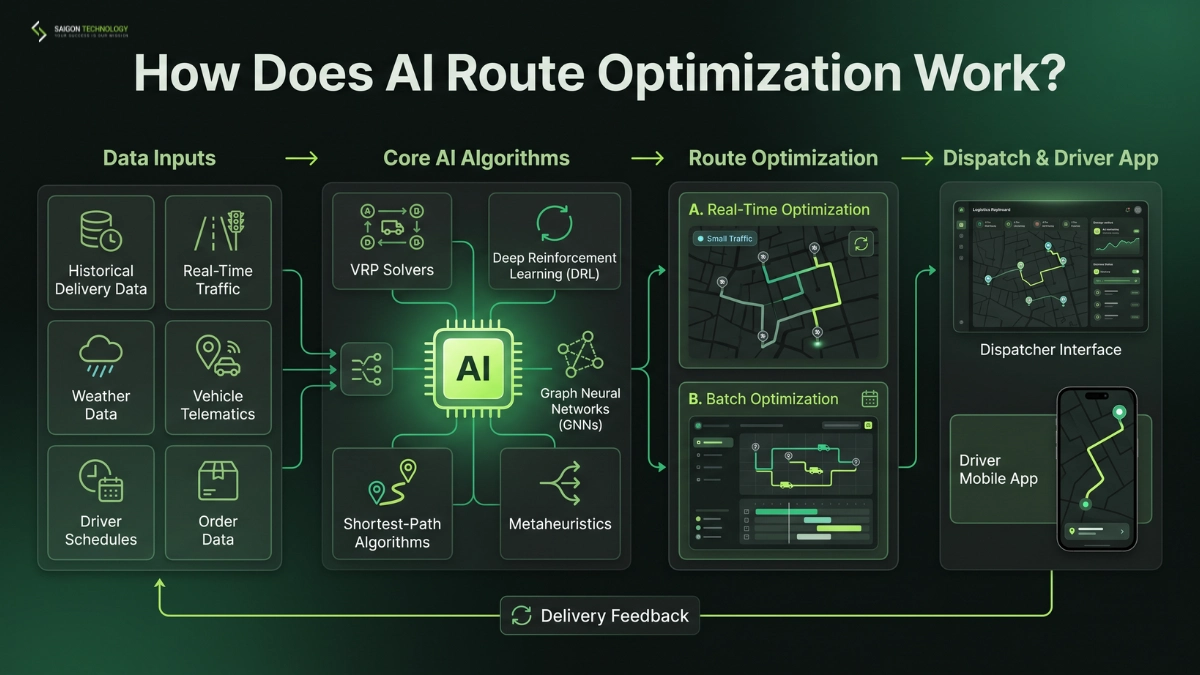
AI route optimization software works through a pipeline of data ingestion, algorithmic optimization, and dispatch.
Data inputs required
A production system typically uses several types of data:
- Historical delivery data: Previous routes, actual travel times, and stop durations.
- Real-time traffic: Traffic conditions and travel-time estimates from providers such as Google Maps Platform, HERE, or TomTom.
- Weather data: Current conditions and forecasts from sources such as NOAA or OpenWeather.
- Vehicle telematics: GPS location, fuel consumption, and vehicle diagnostics, where available.
- Driver schedules: Shift availability, breaks, and applicable FMCSA Hours of Service regulations.
- Order data: Addresses, delivery time windows, package dimensions, and other constraints from ERP, warehouse management (WMS), or e-commerce systems.
Historical and contextual data is critical. The system learns patterns the dispatcher cannot see, such as how traffic on a specific corridor varies by day of week. IoT sensors feed telemetry that improves prediction accuracy over time. See our guide on IoT in transportation and logistics.
Core AI algorithms used
AI route optimization combines different algorithms to plan routes, assign vehicles, and predict travel times:
- VRP solvers: Tools like Google OR-Tools and VROOM assign stops to vehicles based on capacity, delivery windows, and working hours.
- Deep reinforcement learning (DRL): Learns routing decisions through rewards and penalties.
- Graph neural networks (GNNs): Analyze road network connections to help predict travel times.
- Shortest-path algorithms: Dijkstra’s algorithm and A* find efficient paths between locations.
- Metaheuristics: Genetic algorithms and Ant Colony Optimization explore solutions for complex routing problems.
These methods serve different roles. For example, a system may use a VRP solver to assign stops, a shortest-path algorithm to find routes, and machine learning to predict travel times.
The best combination depends on fleet size, delivery constraints, data quality, and performance requirements. Not every system needs every algorithm.
Real-time vs. batch optimization
Real-time optimization updates routes during the workday when conditions change, such as a traffic incident, a canceled order, or an unavailable driver. It is useful for last-mile delivery, field service, and on-demand transportation.
Batch optimization calculates routes at scheduled intervals, often overnight for next-day deliveries. It works well when dispatchers have most orders and vehicle assignments available before operations begin.
Many enterprise fleets combine both approaches: batch optimization creates the initial plan, while real-time optimization adjusts routes as needed. Whether a custom-built solution outperforms SaaS software depends on the fleet’s requirements, integration needs, flexibility, and total cost of ownership.
AI Route Optimization vs. Traditional Route Planning
These two approaches solve the same business problem through different means, and the differences matter when evaluating a change.
Traditional route planning vs. AI route optimization
| Dimension | Traditional Route Planning | AI Route Optimization |
| Data inputs | Addresses, driver availability, fixed rules | Addresses + live traffic + telematics + weather + history |
| Adjustment to real-time conditions | None; routes fixed after dispatch | Dynamic; re-routes when conditions change |
| Scalability | Breaks past ~50 vehicles or 500 stops | Scales to thousands of vehicles |
| Driver personalization | None | Learns driver skill level and preferences |
| Fuel and cost impact | Baseline | 5-15% fuel reduction documented |
| Setup complexity | Low (spreadsheet or basic TMS) | Medium to High (integrations needed) |
| Best for | SMB fleets with predictable routes | Mid-market and enterprise fleets with variable conditions |
Traditional methods still work for small, repetitive routes. The moment a fleet exceeds a hundred vehicles or routes vary daily, manual dispatch cannot keep pace. That is where AI-powered route optimization pays back.
Key Business Benefits of AI Route Optimization
AI for route optimization can help logistics teams reduce operating costs, improve delivery performance, and make better use of their fleets. Actual results depend on fleet size, route complexity, and implementation.
- Lower fuel costs. UPS’s ORION system was projected to save approximately 10 million gallons of fuel annually at full deployment, alongside $300–400 million in annual cost savings (INFORMS).
- Faster deliveries. A last-mile routing project reported a 10% reduction in delivery times after deployment (Omdena case study).
- Improved on-time delivery. Better travel-time estimates and route adjustments can help dispatchers manage delays and provide customers with more accurate arrival windows.
- Higher driver productivity. Automated planning reduces manual scheduling work and can help drivers complete more stops within their available shifts.
- Lower emissions. Reducing unnecessary mileage can lower fuel consumption and greenhouse gas emissions. UPS projected a reduction of 100,000 metric tons of CO₂ annually from ORION at full deployment (INFORMS).
- Lower delivery costs. Better vehicle utilization, fewer unnecessary miles, and reduced overtime can help lower operating costs. The actual savings depend on existing fleet operations.
- A better driver experience. More realistic schedules and balanced workloads can reduce operational pressure on drivers and support retention.
In our Fleet Management Platform case study, dispatchers reduced daily route planning time from two hours to under five minutes.
How AI Route Optimization Supports Sustainable Logistics
Smarter routing cuts unnecessary mileage, fuel use, and emissions, helping logistics teams move closer to their ESG goals. Transportation often makes up a large share of a company’s carbon footprint: logistics and distribution account for around 15% of Unilever’s total greenhouse gas emissions (WBCSD).
Reducing fuel consumption and emissions
Shorter, smarter routes mean less driving time and less fuel burned. A 2021 study of heavy-vehicle operations found that route optimization cut monthly travel distance by 10%, fuel use by 11%, and emissions by 10% for one truck studied (Cleaner Engineering and Technology). Results vary by vehicle type and route conditions.
Low-emission zone routing
Many cities restrict vehicle access based on emissions standards. AI route optimization software can factor in these zones and vehicle restrictions automatically, so dispatchers get compliant routes without manual checks.
EV route optimization
Electric fleets add new constraints: battery range, charge level, and charging station locations. Routing systems built for these inputs help fleet managers plan charging stops and assign the right vehicle to each route, cutting wasted detours.
Balancing delivery efficiency and carbon emissions
The fastest route isn’t always the greenest. AI-powered route optimization can weigh time, cost, and emissions together, so teams can balance speed with sustainability goals. It also makes mileage and fuel data easy to track, which helps measure progress toward emissions targets.
Industry Use Cases for AI Route Optimization
Route optimization shows up differently in each industry, shaped by its own constraints. Five sectors lead adoption today.
Last-mile delivery and e-commerce
E-commerce drove the first wave of investment in route optimization for delivery. Order volume, same-day expectations, and delivery density make manual dispatch impossible. Amazon Logistics, Walmart’s last-mile network, and Instacart all run AI-powered routing. SMB brands reach similar quality through tools like Route4Me or by building on NextBillion.ai‘s routing API.
Fleet management
Our Fleet Management Platform engagement is a representative example: the client cut idle time and gave dispatchers a dashboard that replaced three separate tools. For the engineering patterns, see our guide on fleet management software development.
Field service operations
Field service (HVAC repair, cable installation, utility maintenance) faces a different problem. The dispatcher must assign the right technician based on skills, parts availability, and time commitments. Route optimization AI handles this well, with integrations into Salesforce Field Service, ServiceMax, and FieldAware.
Shipping, freight, and flight routing
Long-haul freight is a batch optimization problem. Loads are matched to carriers and routes planned the night before. Flight routing follows similar principles but is constrained by air traffic control, weather at altitude, and fuel burn curves specific to each airframe. Both compound per-trip optimizations into millions at carrier scale.
Warehouse-to-door operations
AI route optimization logistics is also an integration problem between the warehouse and the delivery fleet. Routing decisions depend on pick times, dock scheduling, and inventory accuracy. Our guide on warehouse management system development covers how to connect the WMS to a routing engine.
Real-World Examples: AI Route Optimization in Action
Large logistics companies demonstrate how route optimization can reduce unnecessary mileage, improve fuel efficiency, and help manage complex delivery networks. The following examples show reported results and practical applications at scale.
UPS ORION: 130 Million Fewer Miles a Year
UPS’s On-Road Integrated Optimization and Navigation (ORION) system optimizes delivery routes across a large fleet. In its 2021 investor presentation, UPS reported that ORION enhancements helped reduce driving by more than 130 million miles and save 10 million gallons of fuel annually. UPS had previously projected $300 million to $400 million in annual cost savings from full deployment (UPS investor presentation, UPS investor announcement).
Walmart: 30 Million Unnecessary Miles Avoided
Walmart developed route optimization technology to improve truck routing and trailer utilization. The company reported avoiding 30 million unnecessary miles and 94 million pounds of CO₂ emissions through its logistics technology (Walmart announcement).
FedEx: Adapting Delivery Routes to Changing Needs
FedEx’s Stops Sequencing tool uses AI to optimize delivery routes based on factors such as package volume and shipper requests. This illustrates how routing technology can help delivery teams adapt plans to operational requirements (FedEx).
Businesses can integrate routing APIs like the Google Maps Platform Route Optimization API to optimize routes based on travel time, cost, vehicle capacity, and delivery windows. For companies using a Transportation Management System (TMS), this can connect route planning with shipment scheduling and fleet coordination.
Build vs. Buy: Choosing the Right Route Optimization Solution
When choosing AI route optimization software, businesses need to decide whether to use an existing platform or build a custom solution. The right option depends on your routing needs, existing systems, budget, and the level of control your operations require.
When to buy and when to build
| Buy an Existing Solution | Build a Custom Solution |
| Your routing needs fit the software’s standard features. | Your operations have complex or industry-specific routing requirements. |
| You want to launch quickly with predictable costs. | You need to integrate routing deeply with ERP, WMS, or other internal systems. |
| Your existing systems support integration with the vendor. | Your routing logic gives your business a competitive advantage. |
| Route planning is a standard operational task. | You need greater control over features, data, and deployment. |
A hybrid approach may also work if an existing platform handles most of your routing needs but requires custom features for specific workflows. This lets you use proven routing technology while adapting the solution to your business.
Several tools are available, depending on your approach. Platforms such as Route4Me and OptimoRoute provide ready-made route planning features. APIs from Google Maps Platform and NextBillion.ai can be integrated into existing applications. For teams developing their own routing engine, open-source tools such as Google OR-Tools and VROOM offer additional options.
How to Build Custom AI Route Optimization Software
Building a custom route optimization system involves understanding business needs, preparing reliable data, and testing the system under real operating conditions. The process typically includes six steps.
Step 1: Define Routing Requirements
Identify what the software needs to optimize, including travel time, fuel costs, delivery windows, vehicle capacity, and driver availability.
Step 2: Collect and Prepare Data
Gather accurate data from ERP systems, warehouse management software, GPS tracking, and traffic services. Our Smart GIS case study provides an example of working with geospatial data.
Step 3: Choose the Right Algorithms
Select algorithms based on your routing needs. Tools such as Google OR-Tools can solve vehicle routing problems, while machine learning can help predict travel times and support dynamic rerouting.
Step 4: Design the System Architecture
Connect the optimization engine with existing business systems, dispatch tools, and driver mobile apps. A modular architecture makes future updates easier.
Step 5: Build, Test, and Deploy
Develop the software in stages and compare its results with existing routing methods. Test route efficiency, delivery times, and operating costs before deploying it across the fleet.
Learn more about AI-augmented software development.
Step 6: Monitor and Improve
Track on-time delivery, estimated versus actual arrival times, mileage, and fuel consumption. Use operational data and driver feedback to improve routing decisions over time.
Saigon Technology develops tailored solutions for complex logistics needs. Explore our logistics software development services to learn more.
Cost of Building Custom AI Route Optimization Software
The cost of custom route optimization software depends on fleet size, routing complexity, integration requirements, and the level of automation needed. The following estimates provide a starting point for budgeting.
Estimated timeline and cost by project scope
| Project scope | Estimated timeline | Estimated cost |
| MVP: Core routing, basic constraints, essential integrations | 3–4 months | $25,000–$50,000 |
| Advanced solution: Multiple routing constraints, dashboards, and system integrations | 4–7 months | $50,000–$120,000 |
| Enterprise solution: Real-time rerouting, complex fleet operations, multi-region support | 8–12+ months | $120,000–$300,000+ |
Key cost drivers include the complexity of routing constraints, the number of system integrations, real-time data processing, user interface requirements, and team size.
Saigon Technology’s rates for a senior developer range from $22 to $46 per hour. The final project budget depends on the scope, team composition, and delivery timeline.
Explore our engagement models or dedicated development team options to understand which approach best fits your project.
Frequently Asked Questions
How does AI enhance route optimization software?
AI enhances route optimization software in four ways. Machine learning algorithms process more variables than rule-based systems. Deep reinforcement learning agents learn optimal routing policies from historical data. Real-time traffic feeds let the system re-plan mid-route. Predictive analytics on driver behavior and demand reduce surprises before they hit the dispatcher.
What is the difference between AI route planning and AI route optimization?
AI route planning refers to designing routes before dispatch, often in a batch cycle. AI route optimization is broader, covering planning plus mid-shift re-optimization and continuous learning. Modern platforms handle both, and the two terms are often used interchangeably in vendor marketing.
What are the best free AI route optimization tools?
For teams with technical expertise, Google OR-Tools and VROOM are free, open-source options for solving vehicle routing problems. Businesses looking for ready-to-use tools can try Route4Me’s 7-day free trial or OptimoRoute’s 30-day trial. Google Maps Platform’s Route Optimization API also offers limited free usage for eligible services, with charges applying beyond the relevant monthly limits. The best option depends on your technical resources, fleet requirements, and budget.
Should I buy AI route optimization software or build custom?
Buy SaaS when your fleet is under 500 vehicles, constraints are standard, and you need to deploy within 90 days. Build custom when fleet is larger, constraints are unusual (hazmat, cold chain, multi-modal), or you need deep ERP and WMS integration. A hybrid approach works for many enterprises.
How will AI route optimization evolve in the future?
- Agentic AI for routing: AI agents can monitor fleet conditions and reroute vehicles when drivers call in sick, orders change, or traffic incidents occur. More complex situations can be escalated to human dispatchers.
- Generative AI for scenario modeling: Managers can ask questions such as “What if we add 50 drivers in Dallas?” and get simulated routes, cost estimates, and potential returns.
- Autonomous vehicle integration: Routing systems will need to account for self-driving vehicle restrictions, charging stations, and handoff points between autonomous vehicles and human drivers.
- Carbon-optimized routing: AI can weigh emissions alongside travel time and cost, helping businesses track their footprint and support sustainability goals.
Build a Custom Route Optimization Solution With Saigon Technology
Every mile you save on the road is money back in your margins. Smart routing cuts fuel costs, speeds up deliveries, and helps your fleet run leaner, but only when the system is built around how your operation actually works.
Off-the-shelf platforms work fine for standard routes and small fleets. Once you’re running 500+ vehicles, juggling hazmat or cold-chain constraints, or need deep ERP and WMS integration, a custom-built solution stops being a nice-to-have and starts paying for itself fast.
Planning a custom routing project? Submit your RFP and get a pricing proposal back in 48 hours.


Related articles
Fleet Management Software Development: Complete Guide (2026)
 Thien (Tim) Nguyen
  28 May 2026
Warehouse Management System Development: Architecture, Workflows & Build Decisions for Engineering Teams
28 May 2026 
Transportation Management System (TMS): The 2026 Guide
08 Jul 2026 
IoT in Transportation and Logistics: 12 Use Cases, Benefits & ROI Guide (2026)
30 Jul 2026