


Embedded Finance Platform: A Buyer’s Guide to Features, Costs, and Providers

 Updated on Nov 05, 2026
An embedded finance platform is the API layer that lets a non-bank software platform add banking, payments, lending, or insurance to its product at the point of need, without becoming a bank itself. It fits ISVs, vertical SaaS teams, and banks evaluating non-bank distribution. Saigon Technology’s fintech software engineering practice helps teams compare embedded finance platforms and build the integration, from KYC checks to AI-driven risk decisioning. See the platform types and evaluation criteria below.
Key Takeaways
- An embedded finance platform lets you add banking, payments, lending, or insurance to your product through APIs, without obtaining a banking license yourself.
- Platforms generally fall into five types: embedded payments, embedded banking, card issuing, embedded lending, and embedded insurance, each with different integration and compliance demands.
- No two embedded finance platforms allocate compliance ownership the same way. Confirm in writing who is legally responsible for KYC, AML, and consumer protection before you integrate.
- US regulators tightened oversight of bank-fintech partnerships in 2023, so platform due diligence now matters as much as API quality.
- The right embedded finance platform depends on your audience (ISV, vertical SaaS, or bank) and how much compliance risk you’re willing to take on directly.
Embedded Finance vs. Banking-as-a-Service vs. Open Banking
These terms get used interchangeably, but each describes a different layer of the same stack.
| Concept | Main purpose | Key functionality | Example |
| Embedded Finance | Integrate financial services into a non-financial product | Financial products built inside non-financial apps | A SaaS platform offering payments |
| Banking-as-a-Service (BaaS) | Provide banking infrastructure | Banking APIs and core infrastructure | A banking API provider |
| Open Banking | Share financial data with consent | Account data access | Account aggregation |
| Embedded Payments | Integrate payment processing into a product | Checkout, payouts | eCommerce checkout |
Embedded finance is the umbrella category; BaaS is the infrastructure underneath it. Every embedded finance feature relies on some form of BaaS to hold the license and move the money, but a BaaS provider doesn’t always build the end-user experience itself; some only supply the rails and leave the product layer to the software platform.
Embedded payments vs. embedded finance is really a scope question: embedded payments is one category inside the broader embedded finance umbrella, focused specifically on moving money rather than issuing accounts, cards, or credit.
Open banking is narrower: it governs data access specifically, formalized in the US by the CFPB’s Personal Financial Data Rights rule, effective January 17, 2025 (CFPB). Embedded finance platforms often use open banking data feeds as one input, not the whole system.
How Does an Embedded Finance Platform Work?
Key Participants
- Software platform. The product the end user interacts with. It owns the user experience and initiates financial actions on the user’s behalf.
- Embedded finance provider. The technology layer that exposes APIs for payments, accounts, cards, or lending, and often orchestrates the request to the right partner.
- Partner bank or licensed financial institution. Holds the actual banking or lending license and is legally accountable for the underlying financial product.
- Third-party providers. Specialist technology providers plugged into the flow for identity verification, fraud and risk scoring, or card issuing, such as a KYC vendor or a credit bureau.
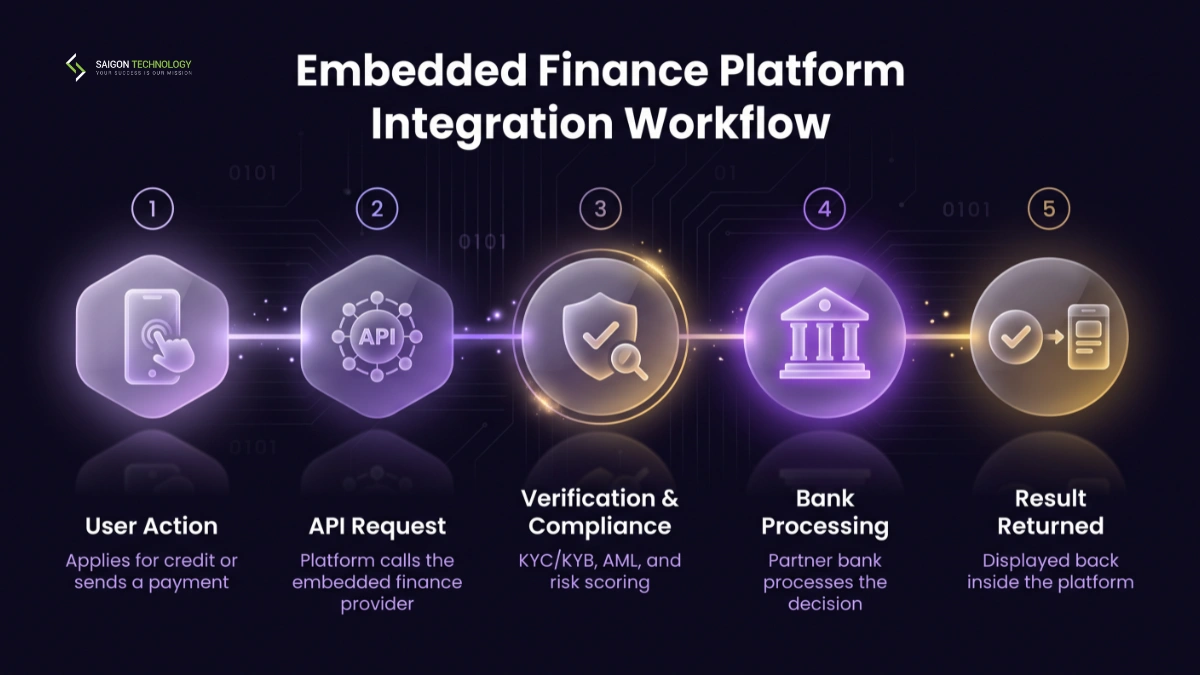
Integration Workflow
- The user initiates a financial action inside the software platform, such as applying for credit or sending a payment.
- The platform sends the request to the embedded finance provider through its API.
- The provider runs verification and compliance checks: identity, KYC/KYB, AML, and risk scoring.
- The partner bank or financial institution processes the underlying transaction or credit decision.
- The result returns to the platform, which displays it to the user inside the existing product experience.
Types of Embedded Finance Platforms and Their Examples
Embedded finance platforms generally fall into five categories, each supporting different financial services and business use cases.
| Platform type | Key functions | Typical use cases | Example |
| Embedded Payments | Checkout, payouts, invoicing | eCommerce, SaaS | Shopify |
| Embedded Banking | Business accounts, digital wallets | Vertical SaaS | Shopify Balance |
| Card Issuing | Virtual and physical cards | Expense management | DasherDirect |
| Embedded Lending | BNPL, credit lines | eCommerce, B2B | Toast Capital |
| Embedded Insurance | Device and shipping insurance | eCommerce, travel | Integrated insurance offers |
Embedded Payments
Lets a platform handle payments directly within its product, including checkout, invoicing, supplier payouts, worker payouts, and bill pay, often built on the same payment gateway infrastructure used in standalone payment products. This is one of the most established embedded finance categories, typically relying on existing card and ACH payment networks.
Embedded Banking
Provides users with business bank accounts, branded debit cards, or digital wallets, often delivered as white-labeled banking services under the software platform’s own brand, without requiring them to use a separate banking app. A partner bank manages the underlying deposits and banking infrastructure, while the software platform delivers the user experience. Shopify Balance is one example, and the pattern overlaps closely with standalone neobank app development.
Card Issuing
Allows software companies to issue virtual or physical cards linked to user accounts, often with programmable spending controls. Common applications include expense management, fleet management, and gig-economy platforms. DoorDash’s DasherDirect card is an example designed for delivery drivers.
Embedded Lending
Integrates financing options such as BNPL, point-of-sale financing, invoice financing, and credit lines into a platform’s existing workflow. For example, Toast Capital offers working-capital financing to restaurant businesses using data from their activity on the Toast platform.
Embedded Insurance
Integrates insurance coverage into the purchase or service experience of a non-insurance platform. Common offerings include device protection, shipping insurance, and business liability coverage, typically provided through a licensed insurer or managing general agent (MGA).
Core Features of an Embedded Finance Platform
- API and Integration. The platform connects through REST APIs, SDKs, and webhooks, the same way it would integrate with any other backend service. Sandbox documentation quality here is usually the clearest early signal of how smooth production support will be.
- Payment Processing. Covers transaction processing, payouts, settlement, and automated reconciliation, typically running over the same card and ACH rails the Federal Reserve oversees and increasingly orchestrated through API-driven payment infrastructure.
- Identity and Compliance. Know Your Customer (KYC), Know Your Business (KYB), and Anti-Money Laundering (AML) checks run on every new account or transaction, usually through a dedicated identity-verification vendor plugged into the provider’s API.
- Ledger and Account Management. Handles account creation, balance tracking, and transaction records, the system of record the platform and the partner bank both rely on to agree on what happened and when.
- AI Risk Scoring and Fraud Detection. Credit assessment, fraud detection, transaction monitoring, and underwriting decisions increasingly run on machine-learning models rather than static rules, the same pattern we build into our AI development services work on embedded lending projects.
- Security and Data Protection. Encryption, role-based access control (RBAC), audit logs, and PCI DSS compliance, maintained by the PCI Security Standards Council, protect both the platform and its users’ financial data.
Benefits of an Embedded Finance Platform
Embedded finance creates value on two sides of the relationship: for the end customer using the financial product, and for the software platform that offers it.
Benefits for End Customers (SMBs and Users)
- Less time on manual admin. When payments, payouts, and accounts sit inside the same platform a customer already uses, automated reconciliation and manual processing drop sharply compared with juggling a separate bank and payment processor.
- Faster access to funds. Integrated financial tools and payouts shorten the gap between earning revenue and being able to use it, which matters most for SMBs managing tight cash flow.
- More flexible funding than a traditional bank. Embedded lending products can approve and fund SMBs faster than a traditional loan application, since underwriting draws on the platform’s own transaction data instead of a lengthy manual review.
- Transparent pricing. A platform that owns the financial experience end-to-end can present one clear fee structure, instead of the layered, sometimes-hidden costs common with legacy payment providers.
- Trust carried over from the core product. Customers who already trust a platform for their day-to-day work are more willing to extend that trust to a financial product it offers, which smooths adoption and lifts overall customer satisfaction.
Benefits for the Software Platform
- New, diversified revenue streams. Transaction fees, interest, and card-interchange revenue reduce a platform’s dependence on subscription pricing alone.
- Multiple monetization points per transaction. A single customer action, such as spending through a platform-issued card, can generate revenue at more than one stage (processing, then interchange), rather than once.
- Higher retention and switching costs. Once a customer’s financial accounts live inside a platform, moving to a competitor means migrating money, not just data, which raises the practical cost of switching.
- Deeper product stickiness. Embedded financial tools pull customers into daily, habitual use of the platform, rather than occasional logins, turning the software into part of the customer’s core financial workflow.
Embedded Finance Use Cases by Industry
| Industry | Embedded finance use cases |
| eCommerce | Checkout, BNPL, merchant financing |
| SaaS | Business accounts, payments, invoicing |
| Healthcare | Patient financing, payment plans |
| Logistics | Driver payouts, fuel cards |
| Gig Economy | Instant payouts, debit cards |
| B2B Marketplace | Invoice financing, working capital |
B2B marketplaces can integrate financial services that help businesses manage larger purchases and payment terms. Common use cases include invoice financing, trade credit (such as net-30 payment terms), and business lines of credit. For example, TreviPay provides B2B trade credit solutions that allow eligible buyers to purchase goods or services now and pay later, while helping sellers manage payment collection.
Security, Compliance, and Implementation Challenges
Security, compliance, and implementation challenges differ by provider, but most buyers run into the same three risk categories.
Regulatory Compliance and Responsibility
- KYC, KYB, and AML checks have to run correctly at every step, not just at onboarding.
- Consumer protection rules apply even when the software platform, not a bank, is the brand the user sees.
- Responsibility gets split between the platform, the embedded finance provider, and the partner bank. The 2023 interagency guidance from the FDIC, Federal Reserve, and OCC makes clear that the bank remains accountable for the risk its fintech partners introduce (FDIC FIL-29-2023).
Data Security and Privacy
- Financial and personal data needs protection at rest and in transit, not just at the point of collection, the core discipline behind a dedicated fintech cybersecurity program.
- API vulnerabilities are a bigger attack surface in embedded finance than in a typical SaaS integration, since a compromised API can expose account and transaction data directly.
- Unauthorized access, whether from a credential leak or a misconfigured permission, can affect real customer funds, not just data.
- Encryption and access control, including role-based permissions, are table stakes for any provider handling regulated financial data.
Third-Party Dependency and Scalability
- Partner bank dependency means your product’s financial features are only as stable as that bank relationship, and bank-fintech partnerships have ended abruptly before.
- Provider changes and service disruptions on the vendor’s side become your outage, even when your own code hasn’t changed.
- Data portability determines how painful it is to switch providers later. Confirm what happens to account data and transaction history before you commit.
- Integration complexity and transaction volume grow together. A platform built for a handful of pilot customers doesn’t always hold up once volume scales, a pattern we cover in more depth in our 2026 fintech software development trends article.
How to Choose an Embedded Finance Platform
Comparing embedded finance solutions comes down to six criteria that determine both integration effort and long-term risk.
| Evaluation criteria | What to check |
| Product requirements | Supported financial products and target markets |
| API capabilities | Documentation, sandbox, SDKs, webhooks |
| Pricing | Setup fees, transaction fees, revenue sharing |
| Compliance | KYC/AML responsibility, banking partners |
| Scalability | Transaction volume, product expansion |
| Data portability | Data ownership and provider migration |
- Buy. Fastest to launch and the lowest upfront engineering effort, since the provider already holds the infrastructure and compliance posture.
- Build. Gives you the most control over architecture and customization, at the cost of owning compliance and infrastructure yourself.
- Hybrid. Combines a provider’s infrastructure with systems and workflows your own engineering team builds on top, the right fit when a team needs deep customization without taking on a banking license itself.
Applying This Framework in Practice
We built this evaluation framework from direct experience. On our Personal Loans Platform project, we worked with a US lending client on a hybrid build: a Java Spring Boot and Next.js application on AWS that integrates Oscilar for AI-powered risk scoring, Plaid for bank-account verification, GIACT for identity and account validation, and LoanPro for loan servicing.
The platform has been in production for more than three years, running KYC and AML checks automatically on every application rather than through manual review.
The lesson that carried over into how we evaluate embedded finance platforms for other clients: the AI-driven risk-scoring layer and the compliance layer need to be designed together from day one, not bolted on after launch.
Embedded Finance Platform Costs and Timeline
| Cost component | Description |
| Setup and onboarding | Initial provider and account setup |
| API integration | Development and customization |
| Transaction fees | Processing and payout fees |
| Compliance | KYC, AML, and verification |
| Maintenance | Monitoring, support, and updates |
Cost factors to weigh:
- Number of financial products you’re adding.
- Integration complexity and how much custom development it requires.
- Security and compliance requirements for your industry and market.
- Transaction volume, since many providers price on a per-transaction or revenue-share basis.
- Whether you choose to buy, build, or go hybrid.
Implementation Timeline and Engineering Cost
The table above covers provider-side fees. Engineering cost, building and integrating the platform, is separate, and often underestimated. For a broader comparison of fintech build costs beyond embedded finance specifically, see our breakdown of what it costs to build a fintech app.
| Phase | Typical duration |
| Discovery and provider evaluation | 2–4 weeks |
| API integration and development | 8–14 weeks |
| Compliance integration and testing | 4–6 weeks |
| Launch and support | Ongoing |
Most buy or hybrid implementations take approximately 4–6 months, depending on the number of financial products, provider integrations, and compliance requirements.
For reference, Saigon Technology’s engineering rates range from $22 to $46 per hour. Based on an estimated 800 to 1,500 engineering hours, development costs typically range from $17,600 to $69,000. Actual costs depend on project scope, team composition, and technical complexity.
This estimate covers engineering services only. It excludes provider setup fees, transaction charges, KYC/AML verification costs, and revenue-sharing fees. Actual costs depend on project scope, team composition, and integration complexity.
Frequently Asked Questions
What is an embedded finance platform?
An embedded finance platform is a technology layer, delivered through APIs or licensed software, that lets a non-financial company offer banking, payment, lending, card, or insurance features directly inside its own product. It typically partners with a chartered bank or licensed provider behind the scenes, so the software company doesn’t need its own banking license.
What’s the difference between embedded finance and banking-as-a-service?
Banking-as-a-service (BaaS) is the infrastructure layer that exposes banking functions through an API. Embedded finance is the product-level financial feature a user actually experiences inside a non-bank app. Every embedded finance feature depends on some form of BaaS underneath it, but BaaS providers don’t always build the end-user experience themselves.
What are some examples of embedded finance?
Common examples include a point-of-sale platform offering working-capital loans to its merchants, a gig-economy app issuing instant-pay debit cards to workers, and an e-commerce platform offering a branded business bank account to its sellers. Buy now pay later (BNPL) at checkout is also a widely recognized embedded finance example.
Who are the largest embedded finance companies and BaaS providers?
The list of embedded finance companies and BaaS providers shifts constantly as the market consolidates, spanning payment-focused providers, full-stack banking infrastructure companies, and card-issuing specialists. Rather than naming a fixed list, evaluate any provider against the comparison criteria in this guide: product requirements, API capabilities, pricing, compliance, scalability, and data portability.
What are the benefits of embedded finance for a SaaS platform?
The main benefits are a new revenue stream from transaction fees or revenue share, lower acquisition cost for financial features because they sit inside a workflow users already use, and higher retention and customer satisfaction, since switching cost rises once a customer’s financial accounts live inside the platform.
Is embedded finance the same as open banking?
No. Open banking governs how third parties access a consumer’s financial account data with consent, formalized in the US through the CFPB’s Personal Financial Data Rights rule, effective January 17, 2025. Embedded finance is broader: it covers the financial products and features themselves, and it often uses open banking data feeds as one input, not the whole system.
How do you evaluate an embedded finance platform before integrating?
Start with the platform’s API documentation and sandbox, confirm compliance ownership in writing, check what happens to your data if you switch providers, weigh time-to-launch against how much control you need, and ask which bank sits behind the platform and how stable that relationship is.
How does embedded finance work, technically?
A software platform calls the embedded finance provider’s API to create accounts, move money, issue cards, or originate credit on behalf of its users, while the provider, or its partner bank, holds the underlying license, manages compliance, and settles funds. The software platform’s job is the user experience and workflow; the provider’s job is the regulated financial infrastructure underneath it.
Conclusion
An embedded finance platform lets you add banking, payments, lending, or insurance to your product without becoming a licensed financial institution yourself. The platform you choose determines how much compliance and operational risk you inherit, so compare providers on the criteria above and decide whether to buy, build, or go hybrid before a sandbox call becomes a production dependency.
Need an engineering partner that has shipped KYC/AML automation and AI-powered risk decisioning in production? Talk to Saigon Technology’s fintech engineering team, backed by ISO 27001 practices and 14+ years delivering 850+ projects. For builds beyond embedded finance, our custom software development team covers the rest.


Related articles

AI-Powered Banking: Revolutionizing the Financial Landscape
 Thanh (Bruce) Pham - CEO of Saigon Technology
 12 Jun 2024
Finance App Development: The Complete Guide
12 Feb 2025 
Fintech App Development Cost in 2026: An Honest Breakdown
24 Apr 2026 
PCI DSS Compliance in Fintech Software Development: A 2026 Guide
03 May 2026 
8 Fintech Software Development Trends Reshaping 2026
26 Aug 2026 
Digital Wallet App Development: Cost, Stack & Compliance
28 Oct 2026