-
OVERVIEW
-
SERVICES
-
MODELS
-
WHY CHOOSE US ?
-
OUR PROCESS
-
TECHNOLOGIES
-
FAQS
Enterprise Software Projects Fail When the Foundation Is Wrong
Enterprise software initiatives often fail not because of poor coding, but because the foundation is wrong from the start. Before evaluating solutions, it’s important to understand what typically causes projects to stall or fail.
1. Scaling ChallengesÂ
Internal teams are stretched thin, while hiring experienced engineers takes time. As delivery slows, business demands continue to grow, creating a widening gap between system capabilities and actual needs.
2. Legacy System BurdenÂ
Older platforms are costly to maintain and difficult to integrate. Every update carries risk, and delays in modernization increase both technical debt and security exposure.
3. Vendor RiskÂ
Missed deadlines, poor communication, and unreliable delivery are common issues. Choosing the wrong partner can delay critical initiatives for months or even quarters.
4. Compliance PressureÂ
Requirements like HIPAA or PCI DSS must be built into the system from the start. If not, projects face significant risk, especially in regulated industries.
These are the exact problems we have spent over 14 years solving.
Enterprise Software Development Services Built for Scale, Security, and Speed
Custom Enterprise Software Development
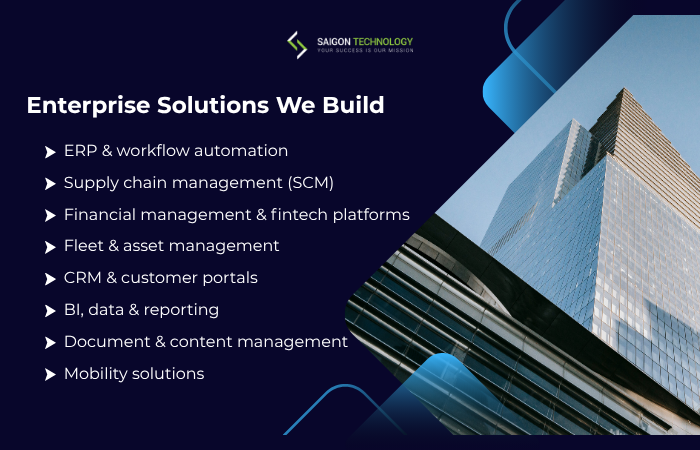
We build custom enterprise software tailored to your workflows, data, and compliance requirements. Our solutions are designed to fit your existing systems, team capabilities, and long-term scalability goals.

What we deliver:Â
- ERP and CRM systems customized to your business processes
- Business intelligence dashboards for real-time insights
- Workflow automation tools to reduce manual operations
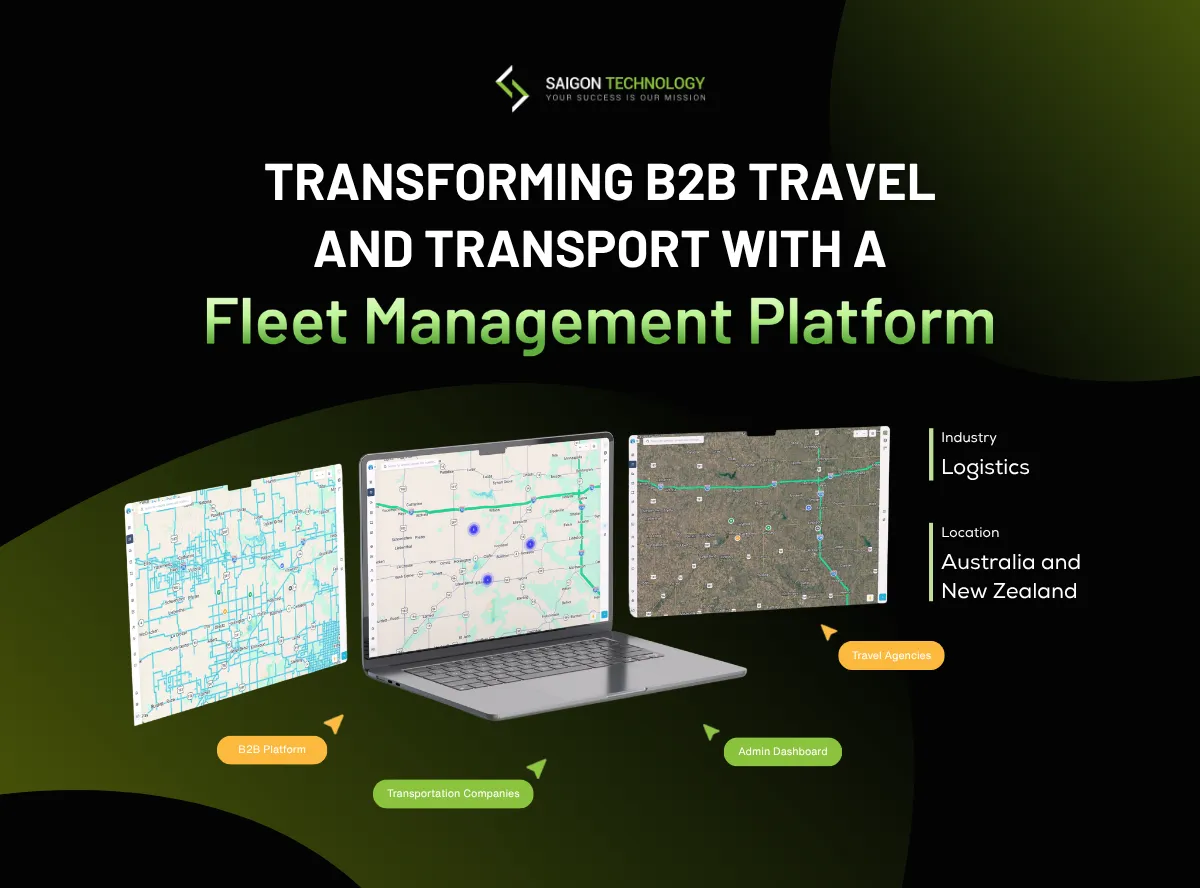
- Industry-specific applications (fintech, healthcare, logistics, manufacturing)
- Scalable architecture designed for long-term growth
Legacy System Modernization
We modernize outdated systems without disrupting daily operations. Our phased approach identifies risks, defines the target architecture, and delivers upgrades step by step.


Common modernization paths:Â
- Monolith-to-microservices migration
- Database re-platforming (from on-premise Oracle/SQL Server to cloud-managed databases)
- UI/UXÂ modernization for legacy front ends
- API-first architecture redesign
Enterprise Application Integration
We connect your ERP, CRM, and third-party systems into a unified environment, eliminating data silos and reducing manual work through consistent, automated data flow across your organization.
What we deliver:Â Â
- API development (REST, GraphQL)
- Enterprise Service Bus (ESB) implementation
- Real-time data streaming (Kafka, RabbitMQ)
- ETL pipelines and data synchronization
- Integration with enterprise platforms (SAP, Salesforce, Oracle, Microsoft Dynamics)
Digital Transformation Consulting
We define your technology roadmap and execute it with confidence. We don’t just advise - we build, deploy, and support systems aligned with your business goals.

What we deliver:Â
- Technology assessment and modernization roadmap
- Cloud strategy and migration (AWS, Azure, Google Cloud)
- Enterprise architecture design
- Process automation and workflow transformation
- End-to-end implementation and delivery
Enterprise Mobility Solutions
Extend your enterprise systems to mobile environments with secure, offline-first applications designed for field teams and remote workers.

What we deliver:Â
- Cross-platform mobile apps (React Native, Flutter)
- Offline-first applications for low-connectivity environments
- Secure access with role-based authentication
- Real-time data synchronization across systems
- Integration with core enterprise platforms
Enterprise AI & Automation
Apply AI and machine learning to automate workflows, extract insights from data, and reduce manual processes across your organization.

What we deliver:Â
- Workflow automation using AI/ML models
- Natural language processing (NLP) for documents and communication
- Computer vision for image and video analysis
- Predictive analytics for decision support
- AI integration into existing enterprise systems
Real-World Enterprise Software Success Stories
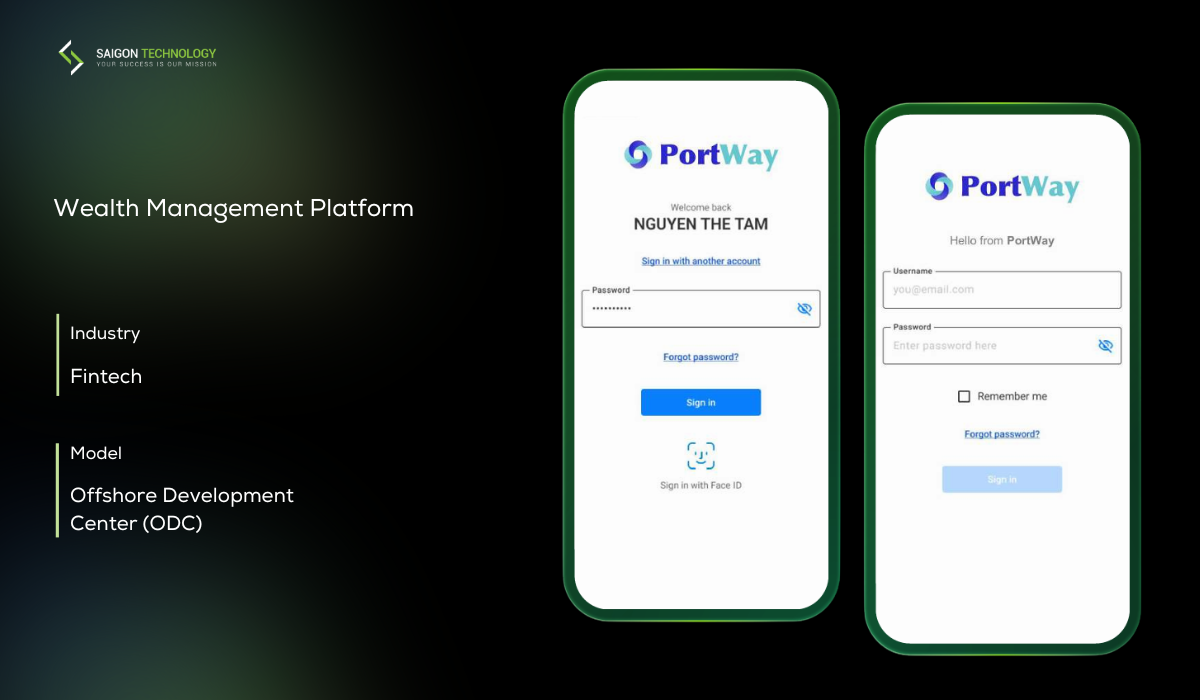
Wealth Management Platform - Fintech (USA)
- Summary: We built a full-scale wealth management platform for a US fintech client, supporting portfolio management, trading, fund operations, and custodian services. The engagement has been running for over 2 years under an ODC model. See our guide on ODC setup in Vietnam.
- Challenges:Â The client needed to manage complex multi-asset portfolios, execute trades with low latency, maintain real-time data accuracy, and meet strict regulatory and audit requirements across multiple modules.Â
- Solutions:Â We developed a microservices-based platform on Azure using ASP.NET Core and React. The system supports real-time trading, distributed portfolio processing, configurable fee and calculation engines, and event-driven architecture for scalability and consistency.
- Compliance: The system supports automated regulatory reporting, GDPR compliance, KYC/AML onboarding, secure client communications, and full audit trails through an event-driven architecture.
- Impact:Â The platform is now a production-ready wealth management system for the US market, supporting real-time portfolio analytics, automated trade execution, fund management, and broker operations in one integrated platform.Â
Facilitation Tool - Collaboration Platform (Australia)
- Summary:Â We built a cloud-based collaboration platform for an Australian client. The solution includes an online graphic editor with real-time synchronization, running on a scalable serverless architecture on AWS.
- Challenges:Â The project started with unclear and changing requirements. It also needed to support real-time collaboration across multiple users. High demands for scalability, performance, and system reliability added complexity.
- Solutions: We used a serverless architecture on AWS to ensure scalability and performance. We built real-time collaboration features with synchronized user actions. The project followed an Agile approach, focusing on MVP delivery to speed up development and allow continuous feedback.
- Compliance:Â The platform was built on AWS following cloud security best practices. Testing processes were applied to ensure system stability, performance, and secure access control.
- Impact:Â The platform was delivered as a scalable, production-ready solution. It enables smooth real-time collaboration and supports business growth. The phased delivery approach helped reduce risks and improve development efficiency.
Our Case Studies
Build Secure, Production-Ready AI for Enterprise Systems
Why Choose Saigon Technology as Your Enterprise Software Development Company?
2-Week Risk-Free Trial
Start by interviewing candidates based on your requirements. Then evaluate real performance through a two-week risk-free trial before making a long-term commitment.Â
Full IP Protection
Strict NDAs, full source code ownership transfer, and enforced security policies across all development centers ensure your intellectual property is fully protected.Â
You retain complete control over your code, data, and system architecture from day one.Â
Fortune 100 Best Companies to Work For SE Asia 2025
Low developer turnover ensures team stability. The engineers who start your project stay through delivery, reducing knowledge loss and maintaining consistency.
14+ Years of Enterprise-Scale Delivery
We have built enterprise software since 2012. Our teams work with clients in the US, EU, Australia, and Singapore across financial services, healthcare, logistics, and retail. We have handled legacy migrations, multi-system integrations, and high-availability platforms that require deep enterprise experience.
Top-Tier Engineering Talent with Enterprise Experience
Your enterprise project is delivered by experienced engineers and architects with deep expertise in both legacy and modern systems. Based in Ho Chi Minh City and Da Nang City, our teams follow established engineering standards and structured development practices used by international teams.
ISO 9001 & ISO/IEC 27001 Certified
We are an AWS Partner and Microsoft Gold Partner. We hold ISO/IEC 27001 and ISO 9001 certifications, verified by BSI Group. What this means for you: your project follows strict rules for data security, access control, and quality management from day one.
Structured Delivery with Clear Ownership
We follow Agile methodologies with clear processes, regular feedback loops, and continuous updates. Each project is led by a dedicated project manager and technical lead, ensuring clear direction, risk control, and consistent progress from start to finish.
You have direct access to key team members, along with weekly reports, sprint demos, and a shared project dashboard, giving you full visibility into timelines, priorities, and delivery status.
Seamless Global Collaboration
Modern Product Engineering with Applied AI
We deliver across web, mobile, and cloud, with growing capabilities in AI/ML and computer vision. Our Research Labs validate new technologies through working prototypes before applying them to production systems, helping you adopt innovation with lower risk.
Among Our Clients
Industries We Transform
Engagement Models for Enterprise ProjectsÂ
We offer flexible engagement models that adapt to different project types, timelines, and organizational preferences.Â
Offshore Development Center (ODC)
A dedicated facility with your own team, processes, and management. This model provides long-term strategic partnership with full operational control.Â
Best for:Â Â
- Large-scale, long-term enterprise programs
- Building a dedicated engineering team under your control
- Ongoing product development with evolving requirementsÂ
Team control: You manage the team directly. We provide infrastructure, HR, and operational support.Â
Typical timeline: 12+ months, designed for ongoing operations.Â
Cost structure: Monthly operational fee per team member plus facility costs.
Build-Operate-Transfer (BOT)
We build and operate your development center in Vietnam, then transfer full ownership once the team and processes are fully established.
Best for:Â Â
- Establishing your own engineering team in Vietnam
- Expanding operations without upfront setup complexity
- Transitioning to full ownership after initial setup
Team control: We manage during the build and operate phases. Full control transfers to you at the agreed milestone.
Typical timeline: 12-24 months through transfer.
Cost structure: Phased pricing aligned with build, operate, and transfer stages
Dedicated Development Team
A full enterprise team works exclusively on your project, including developers, QA, a project manager, and an architect. We handle hiring, HR, and infrastructure. You control priorities and roadmap. Best for:Â
- Long-term enterprise platform development where requirements evolve
- Ongoing feature roadmaps with complex integrations
- Scaling engineering capacity without in-house hiring
Team control: You manage priorities and sprint backlogs directly.
Typical timeline: 6+ months, with a 3-month minimum commitment.
Cost structure: Monthly, per team member.
Staff Augmentation
We embed senior engineers or specialists into your existing enterprise team. They follow your processes, tools, and management structure.
Best for:Â
- Filling skill gaps quickly for enterprise initiatives
- Supporting tight deadlines on large-scale deployments
- Adding specific expertise (e.g., system integration, cloud migration, security compliance)
Team control: Your managers lead. Our engineers plug into your workflow.
Typical timeline: 1 to 12+ months, with ramp-up in 1 to 2 weeks.
Cost structure: Monthly or hourly.
Fixed-Price Project
We agree on the scope, timeline, deliverables, and budget upfront. Saigon Technology owns project planning, execution, risk management, and delivery. This model works well when you need budget predictability for enterprise initiatives.
Best for:Â
- Well-defined enterprise projects with clear requirements
- Legacy modernization or system migration with fixed scope
- Projects that require predictable cost and stakeholder-approved budgets
Team control: We manage delivery end-to-end. You review at milestones.
Typical timeline: 3 to 12 months depending on scope.
Cost structure: Milestone-based payments. Scope changes handled through a change request process with pre-approved rates.
Key Business Benefits of Enterprise SoftwareÂ
Enterprise software helps your business run more efficiently, scale faster, and stay competitive.Â
Improve Efficiency and Reduce Costs
Streamline internal processes with business process management and workflow automation. Use cloud technology to reduce infrastructure and operating costs.Â
Make Faster, Data-Driven Decisions
Use enterprise data management to centralize your data. Give teams access to real-time, reliable insights.
Scale with Business Growth
Build custom enterprise software that supports more users, data, and integrations without performance issues.
Modernize Systems with Minimal Risk
Upgrade legacy systems step by step with a structured modernization approach. Avoid disruption to daily operations.
Increase Productivity and Ensure Predictable Results
Enable mobile access with enterprise mobility development. Improve collaboration and deliver consistent, predictable outcomes.
Our Enterprise Software Development Process
Phase 1: Discovery and Architecture (2 to 4 weeks)
We start by understanding your business before writing any code. Our architects and business analysts work with your team to document requirements, map processes, define system boundaries, and identify integration points.Â
Outcome:Â Technical specification, architecture blueprint, and a project plan with clear milestones.Â
Phase 2: Team Assembly and Onboarding
We assemble a dedicated team aligned with your technology stack, domain, and project requirements. You interview and approve each team member before onboarding begins. The team is integrated into your workflows, tools, and communication processes to ensure a smooth start.
Outcome:Â A fully onboarded team ready to contribute, without recruitment delays or setup overhead.
Phase 3: Iterative Development (Agile sprints, typically 2-week cycles)
Development is delivered in 2-week Agile sprints, with working, tested features at the end of each cycle. You receive sprint demos, progress reports, and full visibility into delivery through your preferred project management tools (Jira, Azure DevOps, or others). Your product owner can join daily standups and work directly with the development team.
Outcome:Â Continuous delivery of working software with full transparency and control over progress.
Phase 4: Quality Assurance and Security Testing
QA runs in parallel with development. We implement automated tests (unit, integration, end-to-end), perform manual testing, and conduct security assessments including OWASP Top 10 checks, penetration testing, and code-level vulnerability scanning. For regulated industries, we include compliance testing aligned with standards such as HIPAA, PCI DSS, and GDPR.
Outcome:Â Production-ready software that meets performance, security, and compliance requirements.
Phase 5: Deployment and Stabilization (2 to 4 weeks post-launch)
We deploy through automated CI/CD pipelines with staged environments (development, staging, UAT, production). After launch, a dedicated team monitors system performance, resolves production issues, and fine-tunes infrastructure during the stabilization period.
Outcome:Â Stable production system with controlled deployment and minimal disruption.
Phase 6: Handover or Ongoing Support
We provide full documentation, including architecture diagrams, API documentation, runbooks, and deployment guides. Knowledge transfer sessions ensure your team can operate the system independently. If needed, we continue with ongoing support under defined SLAs.
Outcome:Â Full system ownership or reliable long-term support with guaranteed response times.
Our Insights
FAQs
What is enterprise software development?
Enterprise software development is the process of designing, building, and maintaining large-scale systems that support core business operations. These systems handle complex workflows, high data volumes, strict compliance requirements, and integrations across multiple platforms. Unlike standard applications, enterprise systems must ensure high reliability, scalability, and long-term maintainability, as failures can impact entire business operations.Â
Should we build custom enterprise software or buy an off-the-shelf solution?
It depends on how unique your workflows are.
- Off-the-shelf works when your processes are standard and you can adapt to the software.
- Custom enterprise software makes more sense when you need specific integrations, compliance controls, or workflows that no existing product supports well.
Most enterprise clients come to us after outgrowing off-the-shelf tools that cannot scale or adapt to their operations.
How long does a typical enterprise software project take?
A focused enterprise application typically takes 4 to 6 months. Large-scale platforms with multiple integrations can take 9 to 18 months. We break every project into milestones during the discovery phase so you can track progress at each stage.
What happens if requirements change during the project?
Requirements change in every enterprise project. We manage this through a structured change request process. Each change is assessed for impact on timeline and budget, then approved before implementation. You stay in control without scope creep.Â
Can you work with our existing development team?
Yes. Our engineers integrate into your team, follow your processes, and use your tools. We work as an extension of your organization, not a separate vendor. Team size scales up or down based on your project needs.
How do you handle security and compliance for enterprise projects?
We follow ISO 27001 certified practices including encrypted data transmission, access control, secure development environments, and regular penetration testing. For regulated industries, we implement additional controls for HIPAA, PCI DSS, or SOC 2. Security is built into our development process from day one, not added at the end.
What types of custom enterprise solutions does Saigon Technology deliver?
We deliver enterprise solutions such as ERP, CRM, data platforms, workflow automation, and cloud-native applications. Each solution is built around your business processes, integration needs, and compliance requirements, covering the full lifecycle from design to ongoing support.
We select the technology stack based on your existing architecture, business goals, and scalability requirements, rather than forcing a fixed set of tools.
What technology stack do you use for enterprise software development?
Backend:Â .NET Core, Java (Spring Boot), Node.js, Python. These are selected to align with your current systems and team capabilities.
Frontend:Â React, Angular, Vue. We build modern, high-performance interfaces that are easy to maintain.
Mobile:Â React Native, Flutter, Kotlin, Swift. These support both cross-platform and native applications, including offline-first use cases.
Cloud & DevOps:Â AWS, Azure, Google Cloud, Docker, Kubernetes, CI/CD. This enables scalable infrastructure and automated deployments.
AI/ML:Â TensorFlow, PyTorch, NLP, Computer Vision. These are applied in production systems, not just prototypes.
Security:Â OAuth 2.1, SSO, AES-256, Zero Trust. Security is built into the architecture from the start.
How enterprise software development pricing works?
Enterprise software pricing depends on scope, team size, technology stack, and compliance requirements. More complex systems with multiple integrations and security standards require higher investment.
Typical hourly rates:Â
- Junior: $18–$30/hour
- Mid-level: $28–$45/hour
- Senior: $40–$70/hour
- Tech Lead / Architect: $55–$95/hour
Costs are also influenced by system complexity, number of integrations, and compliance needs such as HIPAA or PCI DSS. Engagement models (fixed price vs. dedicated team) also impact the total budget. Vietnam typically offers 40–60% lower rates than the US or Europe for equivalent talent.