




























































-
OVERVIEW
-
SERVICES
-
MODELS
-
WHY CHOOSE US ?
-
OUR PROCESS
-
TECHNOLOGIES
-
FAQS
What Is AI Integration?
AI integration is the work of connecting AI models, such as large language models, prediction models or computer vision, to the software, data and workflows a business already runs, so AI output reaches the systems where decisions are made. It covers data access, APIs, security controls, testing and monitoring as well as the model call itself.
| Bolt-on AI tool | Integrated AI | |
|---|---|---|
| Where the output lands | A separate chat window or export that staff copy by hand | Inside the CRM record, EHR note or approval queue where the work already happens |
| Who controls the data | The tool vendor's defaults | Your access rules, retention policy and audit trail |
| What happens when the model is wrong or offline | Someone notices, or nobody does | Validation catches bad output, and a fallback keeps the workflow running |
Most of the effort in AI integration services sits outside the model. Someone has to decide which fields the AI may read, where its answer gets written, who owns the data contract between the two systems, and what the business does when a score looks wrong. We settle those questions early. They decide whether the AI can ship at all.
Our AI Integration Services
AI Features Inside Your Product
AI CRM and ERP Integration
ChatGPT, OpenAI and Claude Integration
Prebuilt AI Services Wired Into Regulated Workflows
Workflow Automation With AI Agents
AI in Legacy Applications
Data Pipelines, Retrieval and Monitoring
Case Studies: AI Connected to Systems Our Clients Already Run
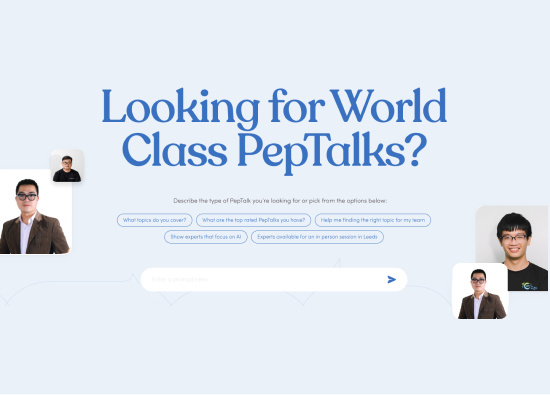
PepTalk: Semantic Search Wired Into a Booking Workflow
- Challenge: PepTalk needed a chatbot that could read a client's meeting or event brief and recommend the right expert. The model was a third-party service with no view into its logic. OpenAI costs had to stay in check, and the frameworks changed mid-build.
- What we built: typed keywords become text embeddings that drive a semantic search of the expert database through LangChain and ChromaDB. FastAPI, Celery and Redis handle requests in the background over WebSocket. When a user picks an expert, the chatbot collects contact details and submits the request, which opens PepTalk's booking workflow.
- Engagement / timeline: a fixed-price MVP with acceptance criteria agreed before development. One project manager, four developers, one business analyst and one QC engineer, with client reviews at every milestone.
- Outcome: one conversation takes a user from a typed requirement to matched experts and a submitted booking. Small and large OpenAI models split routine and complex queries to balance speed and accuracy.
- Stack: Python, LangChain, ChromaDB, FastAPI, Jinja2, Celery, PostgreSQL, Redis, OpenAI, WebSocket, Docker, Angular.
- Read the PepTalk case study →
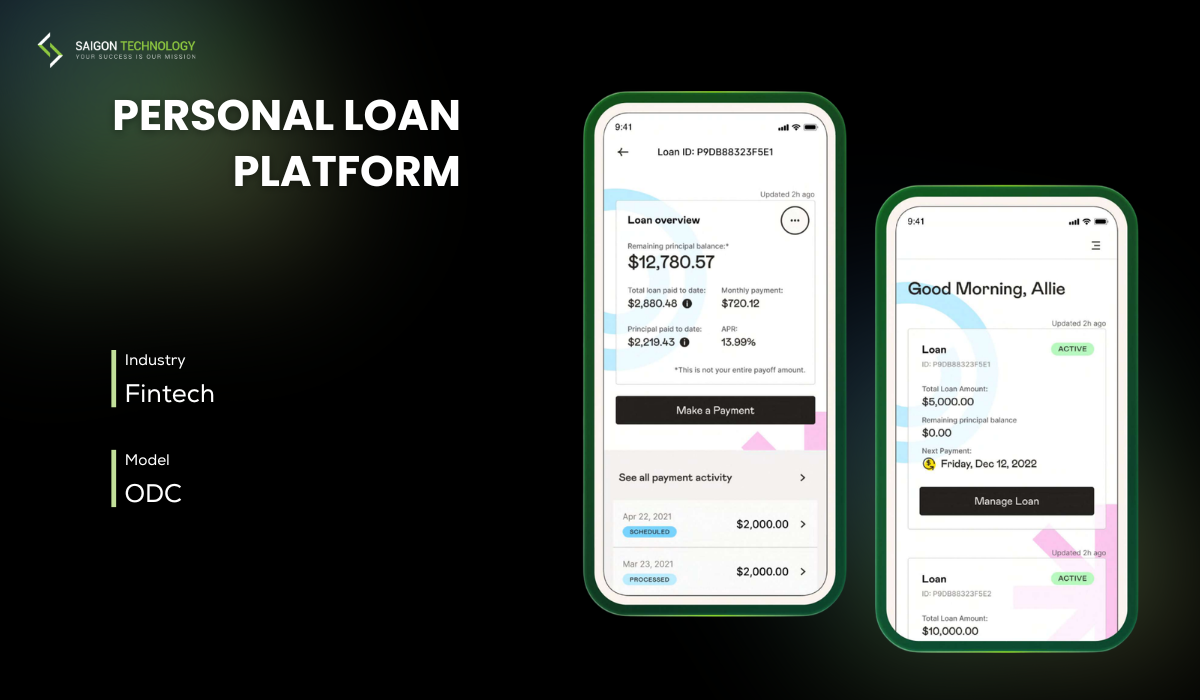
Personal Loan Platform: Third-Party AI Risk Scoring in a US Lending Stack
- Challenge: a US lender needed one system for the whole loan lifecycle, from identity checks to collections. Provider data came in different formats, third-party APIs were slow or failed, and ML-based risk scores were hard to explain.
- What we built: Oscilar's AI-powered risk scoring, Equifax data and the lender's own rules, combined in one risk view. Data is cleaned before it is sent. Failed checks retry in the background or fall back to another source, while Plaid, GIACT and TALX cover bank, employment and income verification. LoanPro runs servicing through an API.
- Engagement / timeline: an Offshore Development Center serving the US market for more than three years.
- Outcome: the AI supplies a score, and the lender's rules and teams make the call. Each decision traces back through Oscilar's logs and rules the business reviews regularly, and verification, underwriting and servicing each keep a full audit trail.
- Stack: Java 18, Spring Boot, React, Next.js, Python (Airflow), AWS (ECS, Cognito, DynamoDB, S3), Kafka, GraphQL, gRPC, Terraform, OAuth 2.1 and OpenID Connect.
- Learn more | Read the full Personal Loan Platform case study (PDF) →
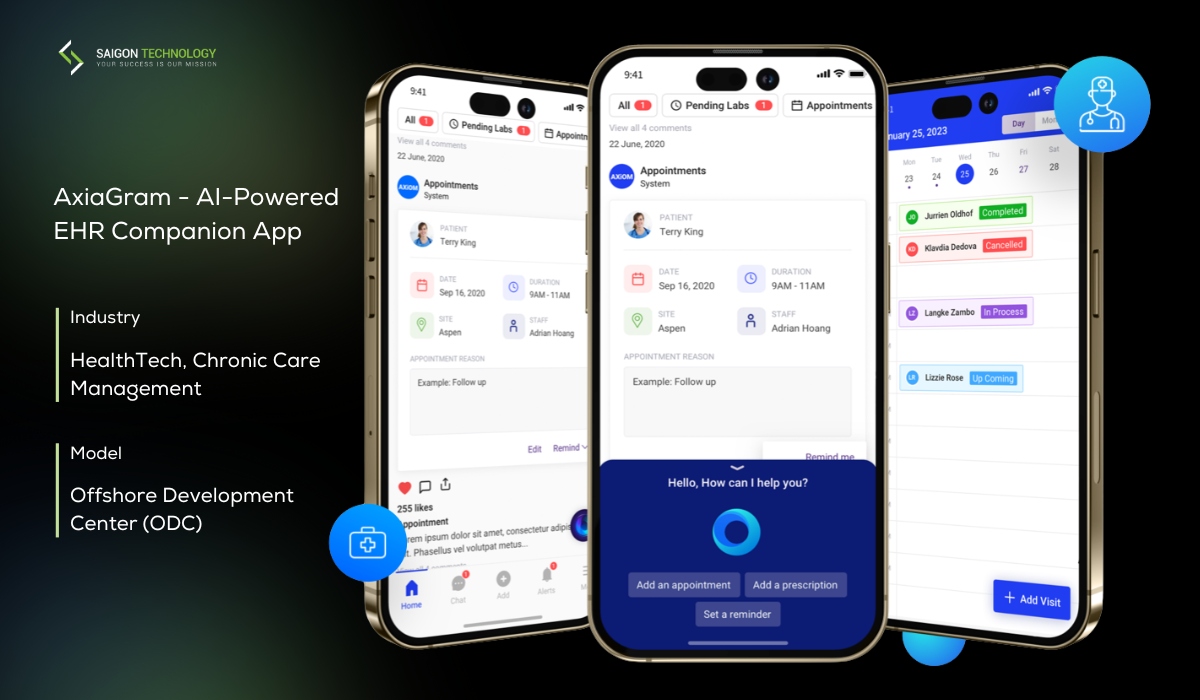
AxiaGram: Voice AI Writing Into Hospital EHR Systems
- Challenge: AxiaGram is a HIPAA-compliant telemedicine platform for US chronic care. Its clinicians needed to document visits by voice and consult remotely, with every note landing in the hospital's existing EHR.
- What we built: AI voice note-taking tied to HL7 integration with US hospital EHR systems. Around it sit electronic visit verification with geo-tagging and digital signatures, secure care-team messaging, and real-time video on Agora and Wowza.
- Engagement / timeline: an Offshore Development Center, in an ongoing partnership since 2021.
- Outcome: development time cut by 40%. More than 6 million medical records are handled under AES encryption and HIPAA-compliant controls.
- Stack: .NET Core, Angular, Azure, HL7, Voice AI, Agora, Wowza, MySQL with AES encryption.
- Learn more | Read the full Healthtech case study (PDF) →
Send Your RFP. See Your AI Integration Prototyped in 48 Hours.
- Clickable prototype of the AI feature inside your app, CRM, or back-office flow
- Workflow visualization mapping the full path from data source to model to system of record
- Architecture direction covering model access, data privacy controls, and scale
- Technical recommendation call with our engineering team
Why Choose Saigon Technology as Your AI Integration Company?
A good AI integration company connects models to the systems a business already runs without weakening them. That means senior engineers who read existing code and data contracts, security controls on every model call, a published rate, and a team that will still be there when the model needs replacing. Saigon Technology delivers AI integration services on those terms.
Security Controls on Every Model Call
An AI integration opens a new path into your data, and an unlogged path into regulated records is the failure that matters most here. We treat each model call as a controlled access point: role-based access, scoped credentials, PII redaction wherever the model has no need for the field, and an audit trail for every read and write.
Our engineers work under NDAs and ISO 27001 practices, align personal-data handling with GDPR and PDPA, and apply HIPAA and HL7 controls on healthcare work. Audit trails, encryption and access control are already in production on the lending and clinical projects above.
Senior Engineers, a Published Rate of $26–$46/hr
Most AI integration work is reading someone else's system: undocumented APIs, old schemas, business rules nobody wrote down. A junior-heavy team is more likely to break those contracts, and the rework lands on your side. Our senior engineers own architecture and code review, and AI-assisted delivery lets a smaller team cover the same scope, so the bill drops per delivered outcome even when the hourly rate doesn't.
The listed rate comes with senior oversight, and teams keep 10–12 hours of overlap with US East and West Coast working days. Few AI integration companies ranking for this work publish a rate at all.
A Team That Stays After the Model Changes
AI integrations are long-lived. Other systems call the APIs you ship, models get deprecated, and prompts move through versions, so the people who designed the integration need to be around when it changes. Churn breaks what you already shipped. Saigon Technology is one of the Southeast Asia Best Workplaces™ in Technology 2026 (#10, Medium category, Great Place To Work), and every engineer passes three screening rounds with Talent Acquisition, a Tech Lead and HR before joining a client team.
A Named AI Tech Lead Behind the Team
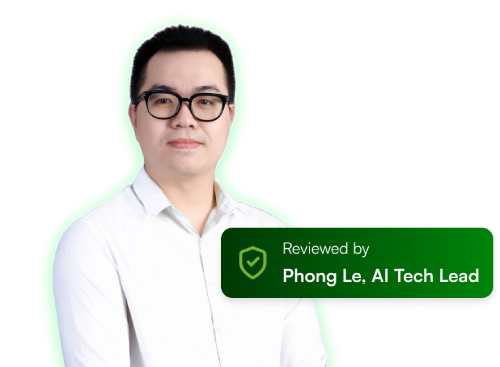
Phong Le, our AI Tech Lead, oversees model choice and retrieval design on our AI work. Behind him sit 30+ AI engineers in two dedicated teams, with 100+ AI projects delivered.
ISO 9001 and ISO 27001 (BSI), Microsoft Solutions Partner
Both certifications are issued by BSI in the UK and audited externally. For an AI integrator, that means change and access management follow a documented, checked process.
14+ Years · 400+ Developers · 850+ Projects · 350+ Clients · 4.8★
Delivered from three development centers in Ho Chi Minh City and Da Nang. Our largest AI integration engagements stay under NDA, so we show published work on booking, lending and clinical systems instead of metrics we can't share.
Advice on When Not to Add AI
Sometimes a rules engine or a plain API connection is the better answer, and we will say so. Before a larger build, you can try working demos in our Research Labs.
Two-Week Risk-Free Trial
Interview the engineers, then run a two-week risk-free trial before any long-term commitment. Engagements run as staff augmentation, a dedicated team, fixed-price or an ODC.
Trusted by Teams That Run Critical Systems
What Our Clients Say
Industries Where We Integrate AI
Who We Build For
Three kinds of teams hire us as their AI integration agency.
Product and SaaS Teams
You want AI features in a product that is already shipping, from in-app search to a support assistant built with our AI chatbot development team, without breaking multi-tenant data separation or slowing the release train.
Enterprises Running Core Systems
Enterprise AI integration services for companies whose CRM, ERP and data warehouse carry years of process, from AI CRM integration to ERP approvals. Here change control and access reviews come before any model call.
Healthcare and Fintech Teams
Regulated work where HIPAA and HL7 apply to clinical data, GDPR and PDPA govern personal data, and every AI-assisted decision needs an audit trail.
What AI Integration for Business Should Change
Good AI integration services change how work moves through systems you already pay for. The list below covers what should change, and the table shows where each change appears in our own projects. Custom AI integration earns its cost when at least one of these changes describes a problem you have today.
| Benefit | Where it shows up in our work | What made it work |
|---|---|---|
| Less manual verification | Personal Loan Platform | Plaid, GIACT and TALX checks that retry in the background or fall back to another source |
| Shorter path to a booking | PepTalk | Text embeddings driving a semantic search, then a chatbot that submits the booking request |
| AI inside the tools staff already use | AxiaGram | HL7 integration that writes AI voice notes into hospital EHR systems |
| Lower cost of switching models | Our architecture step (see the process below) | A model abstraction layer, approved before the build starts |
| Running cost you can predict | PepTalk | Small and large OpenAI models splitting routine and complex queries |
That is the common thread in AI integration for business. Value shows up where AI output meets a record, a rule or a person who acts on it, so that is where we spend the engineering time.
Less manual verification
Identity, income and bank checks run through connected providers, with automatic retries when one fails.
Shorter path to a booking
A typed request becomes matched options and a submitted booking in one conversation.
AI inside the tools staff already use
Dictated notes land in the EHR clinicians already work in, with no new app to adopt.
Lower cost of switching models
The model sits behind a service layer, so a provider change stays out of the business logic.
Running cost you can predict
Routine requests go to smaller models and hard ones to larger models.
Our AI Integration Process
Each AI integration service we deliver follows seven steps, and each step ends with something you sign off. We run the steps in Agile sprints with DevOps pipelines, so you see working software at every sprint review instead of one large reveal at the end.
The same seven steps apply to every pattern on this page, from one AI field in a CRM to an agent working through an approval queue. That keeps our AI integration solutions consistent enough to audit.
Use case discovery and systems review
We run a business process analysis, prioritize use cases by value and risk, and name the system of record, the data owner and the person who signs off. You approve the use case and an initial risk and cost assessment.
Data and technical readiness
An integration feasibility check covering data quality, API structures, access scopes, system complexity and PII handling. You approve the data access plan.
Architecture and model selection
The model sits behind a model abstraction layer, and candidates are tested for fit, cost and latency against your expected traffic. You approve the architecture and the model choice.
Build and integrate
API and third-party service integration, event-driven workflows, data pipelines, and human review steps for any action that touches money, patients or customers. You approve each sprint demo.
"When the model is a third-party service, you can't see inside it. So we control everything around it: clean what goes in, log every decision that comes out, and keep your own business rules in charge of the final call." - Phong Le, AI Tech Lead at Saigon Technology
Evaluation and security testing
Automated and manual QA against a golden set of real examples, regression runs, prompt versioning and security testing. You approve the test report.
Staged rollout
Production deployment to a limited group first, with a fallback to the existing path if the model fails. You approve the go-live.
Monitoring and improvement
Model and system monitoring for cost, latency, drift and accuracy against the golden set, with retraining and prompt updates as your data changes.
Our Insights
FAQs
How much do AI integration services cost?
Cost depends on how many systems the AI touches, how ready your data is, which compliance rules apply and how heavily the model will be used. Saigon Technology's published rate is $26–$46/hr with senior oversight. After a short review of your systems and the use case, we give you a scoped estimate, so you know the size of the work before you commit.
How long does an AI integration project take?
It depends on data readiness and the number of systems involved. A single AI integration service scoped to one system moves much faster than an AI layer spanning a CRM, an ERP and a data warehouse. We usually ship one focused use case, prove it with real users, then expand.
Should we build AI integration in-house or hire an AI integration company?
Build in-house when your team already runs model evaluation, monitoring and on-call for AI features. Hire an AI integration company, or an experienced AI integrator, when the gap is integration experience, speed or regulated-data controls. A common middle path: our engineers deliver the first integration alongside your team, then hand over documented patterns your developers can reuse.
How do you keep our data secure and compliant when AI connects to our systems?
Each model call gets scoped access, and data the model does not need is redacted or never sent. Every read and write goes into an audit trail. We work under NDAs and ISO 27001 practices, align with GDPR and Singapore's PDPA, apply HIPAA and HL7 on healthcare projects, and map EU deployments to the EU AI Act risk tiers.
Identity runs on OAuth 2.1 and OpenID Connect with role-based access controls, and ISO 9001 sits alongside ISO 27001 for change management. Where a decision affects people, as in lending, we add explainability through decision logs and regular rule reviews.
Can you add AI to a legacy system without rebuilding it?
Usually, yes. We add an API facade around the older system or subscribe to events it already emits, so the AI can read and write without changes to core code. A failed model call falls back to the original process. If the platform itself needs rework, our AI modernization team covers it.
How do you avoid lock-in to one AI vendor?
We place the model behind a service layer with standard prompt templates, swappable endpoints and provider-neutral logging. Moving to another provider, or sending routine requests to a smaller model, then becomes a configuration change. Before we commit to a model, we run a replaceability assessment alongside the model evaluation for cost, latency and output quality.
What AI models, tools and platforms do you work with?
We choose models and platforms per use case, then keep them replaceable. These are the stacks from our delivered projects, the model APIs behind our ChatGPT integration services, and the cloud AI platforms we evaluate during model selection:
- Models: OpenAI (ChatGPT), Anthropic Claude, Google Gemini, Llama, plus NLP and predictive models built with TensorFlow, PyTorch and scikit-learn.
- Cloud AI platforms we evaluate: Azure OpenAI, Amazon Bedrock, Google Vertex AI, Azure AI Foundry, AWS Textract and Google Document AI, with ONNX Runtime and TensorFlow Lite for on-device inference.
- AI frameworks and retrieval: Python, LangChain, ChromaDB, FastAPI, Celery, OpenCV.
- Integration and data: REST, GraphQL, gRPC, Kafka, Airflow, HL7; .NET, Java and Spring Boot, Node.js.
- Cloud and DevOps: AWS, Azure, Google Cloud, Docker, Kubernetes, Terraform, CI/CD pipelines.
As a Microsoft Solutions Partner, we see Azure OpenAI as a natural starting point for Microsoft-stack teams, but data residency and cost decide the final choice. When an AI agent needs standard access to your tools, we connect it through MCP integration services, and the same team handles custom MCP server development.
Why work with an AI integration company in Vietnam?
A Vietnam-based team gives US and European buyers senior engineering at offshore rates. Saigon Technology adds 10–12 hours of overlap with US time zones, a published $26–$46/hr rate and a two-week risk-free trial. Among AI integration companies, we also offer enterprise AI integration services through staff augmentation, a dedicated team, fixed-price projects or an ODC.