





































• OVERVIEW
  • SERVICES
  • MODELS
  • WHY CHOOSE US ?
  • OUR PROCESS
  • TECHNOLOGIES
  • FAQS

What Are Software Maintenance and Support Services?

Software maintenance and support services are the ongoing engineering activities that keep production software working after release. Maintenance is planned and proactive, scheduled fixes, dependency updates, refactoring, and improvements. Support is reactive, handling incidents and user-reported problems that threaten system stability or cause downtime. Most organizations need both, delivered by one accountable team.

The distinction matters commercially. A vendor selling only support will keep your system alive but let technical debt compound. A vendor selling only maintenance will ship improvements while nobody answers the phone at 2 a.m. Saigon Technology delivers both under a single agreement, which is also the cheaper arrangement, the cost of ownership of a system rises fastest when planned work is deferred until it becomes an emergency.

Meet Phuc Tran - Program Manager

Detail arrow-narrow-right-white.svg

Meet Can Le - DevOps Tech Lead

Detail arrow-narrow-right-white.svg
over 400 software developers
400+
Software Developers
Over 14 years of experience
14+
Years in Business
Over 850 Projects Successfully Delivered
850+
Projects Successfully Delivered
rating on Clutch
4.8
Star Rating on Clutch

Our Software Maintenance Services

Our software maintenance services follow the four established maintenance types. Each one answers a different question about your system, and each maps to engineering capability we already deliver.
lock-keyhole-square

Corrective Software Maintenance - fixing what is broken

Corrective software maintenance resolves defects in logic, code, and configuration. Our engineers work from evidence rather than guesswork:

  • Root-cause analysis on every recurring incident, not just symptom suppression
  • Log investigation across application, database, and infrastructure layers
  • Regression testing before release, so a fix in one module does not break another, supported by our software QA and testing practice
  • Documented reproduction steps and a permanent fix, so the same ticket does not return next quarter
chevron-up.svg
file-shield-03

Perfective Software Maintenance - making a working system better

Perfective software maintenance improves software that is not broken:

  • Performance enhancements: query tuning, caching, and profiling of slow paths
  • Cloud resource consumption optimization, which usually pays for a meaningful share of the retainer
  • UI and workflow refinements based on real usage
  • New features and modules delivered on the same cadence as the rest of your roadmap
chevron-up.svg
key-01

Adaptive Software Maintenance - keeping pace with everything you don't control

Your software depends on platforms that change without asking you. Adaptive software maintenance absorbs those changes:

  • Operating system, runtime, and framework version upgrades
  • API contract changes in third-party integrations, payment providers, identity services, data vendors
  • Cloud infrastructure migrations and platform deprecations
  • Compliance-driven changes when a regulation or standard is revised

This is frequently the work that silently breaks production, and it is where our software integration experience carries directly across.

chevron-up.svg
file-lock-02

Preventive Software Maintenance - reducing tomorrow's incidents

Preventive software maintenance is the work that never appears in a ticket queue because it stops problems forming:

  • Targeted refactoring of fragile, high-change modules
  • Technical debt paydown, prioritized by change frequency rather than by age
  • Data security hardening: dependency scanning, patch currency, access review
  • Test coverage added where the codebase has none, guided by our DevOps services
chevron-up.svg

Software Maintenance and Support Services in Practice

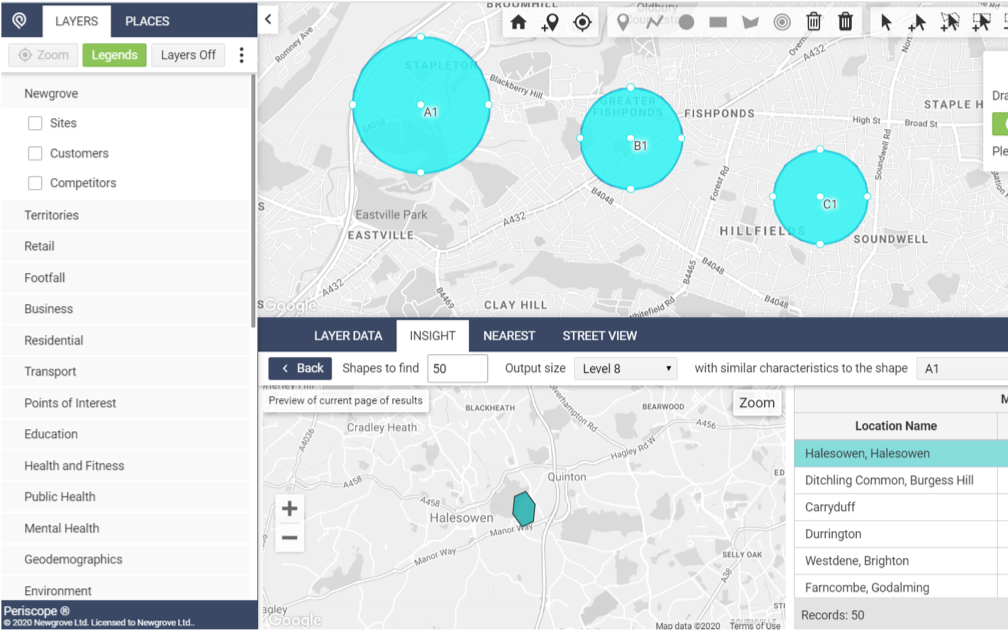
Smart GIS - demo

Smart GIS - taking over an active product roadmap

  • Challenge: The client, a location-intelligence software company, needed an offshore team to handle feature additions and core product maintenance on their existing Periscope product. Our team was new to the GIS domain, and the application carried heavy mathematical logic behind a demanding front end. 
  • What we did: Started with one senior full-stack engineer at expert level in .NET Core and Angular, then scaled the team by a back-end and a front-end developer after the first two months. JetBrains YouTrack drove maintenance and enhancement planning, feature prioritization, user-story decomposition, and continuous delivery. 
  • Engagement: Offshore team, daily status reporting with the UK-based client team.
  • Outcome: Sustained maintenance and enhancement of a live product, including front-end performance work on map layers holding over a million records. 
  • Stack: .NET Core, Angular 9+, Azure Service Fabric, spatial database / MSSQL, Google Maps API, web workers. 
  • Read the full case study →
ARB AUSTRALIA - 1

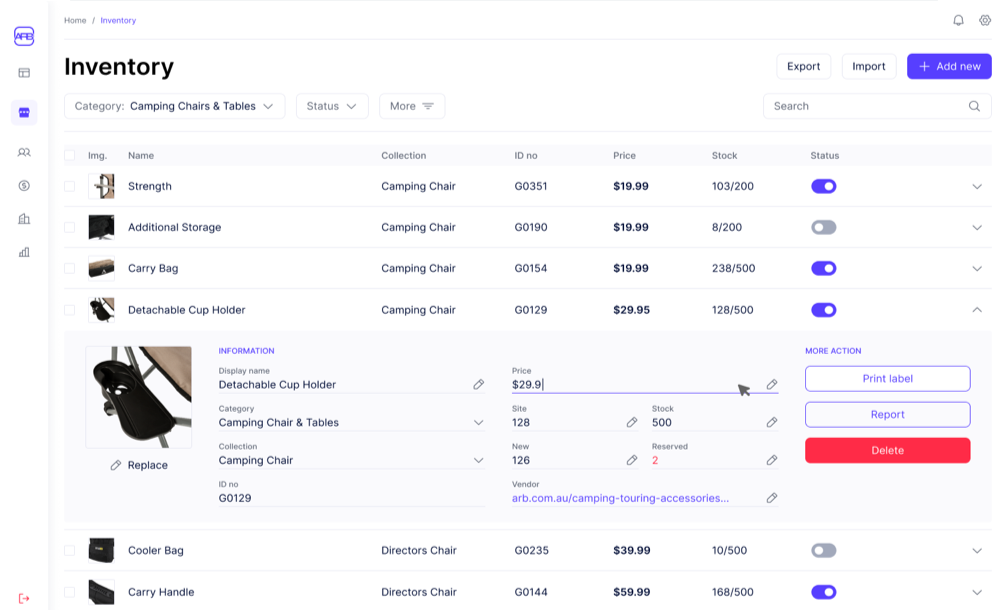
ARB Australia - stabilizing a codebase nobody had maintained

  • Challenge: The client had an existing Ionic application that had not been maintained. It had performance problems, and Ionic itself was in market decline, developers were leaving the framework, making the system progressively harder to maintain.
  • What we did: Migrated to React Native, built an automated CI/CD pipeline for application delivery, and moved from Azure DevOps to Oracle Cloud to reduce running costs. A single codebase now serves both mobile and web, which removed the inconsistency risk of maintaining two.
  • Engagement: Flexible, part-time, hourly, a hosted team of one React Native developer plus a part-time DevOps engineer.
  • Outcome: Consistency across mobile and web, improved scalability, lower development cost, and simplified ongoing maintenance and support.
  • Stack: React Native, REST API, Azure DevOps, Oracle Cloud, cloud migration services.
  • Read the full case study →
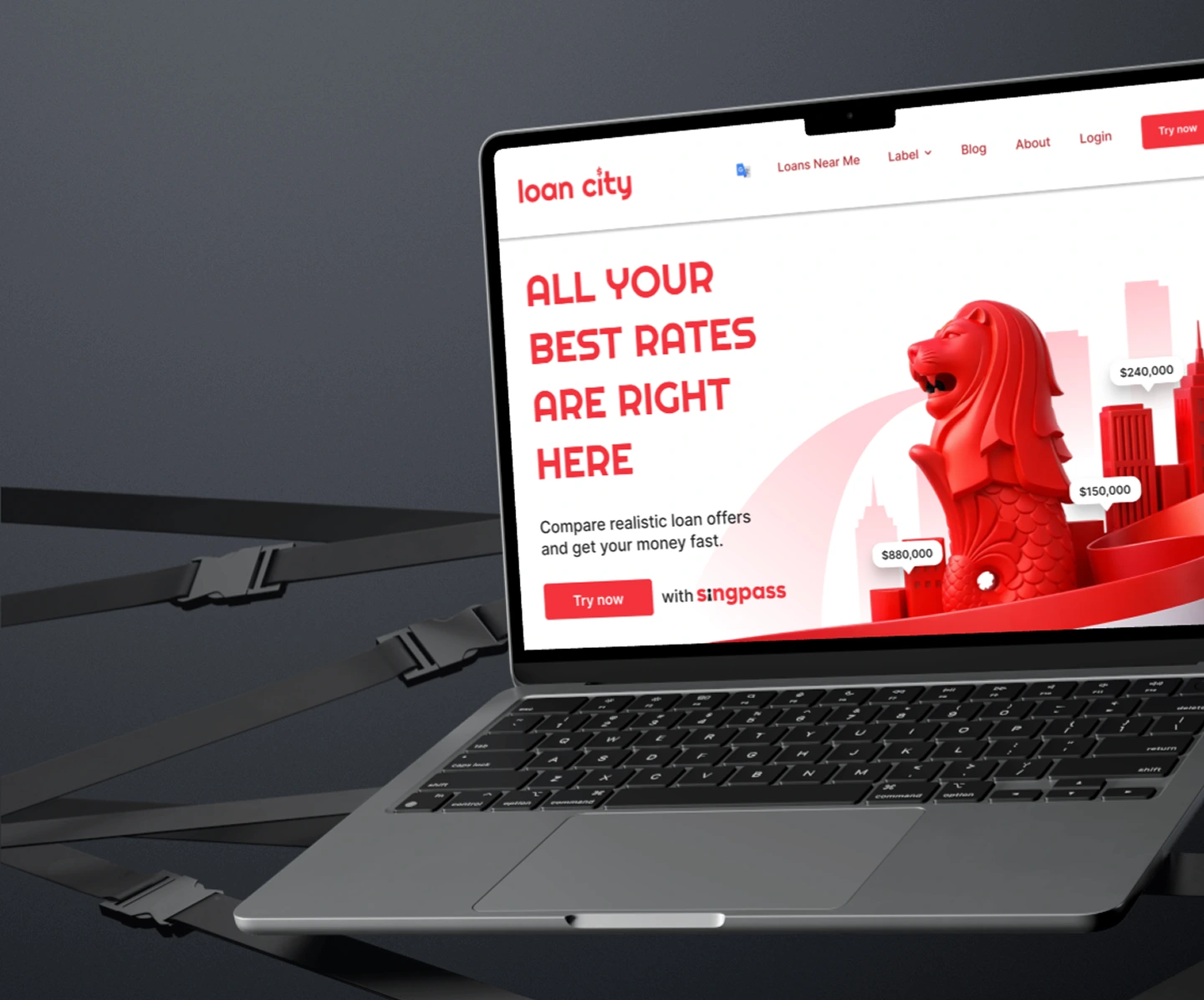
Loan City - A Digital Loan Comparison Platform

Loan City - post-launch ownership without losing context

  • Challenge: A Singapore fintech launched a three-portal digital loan platform on a fixed-price, three-month build. The risk at go-live was the usual one: whoever maintains the system next has to relearn everything the build team already knew.
  • What we did: Transitioned the engagement from fixed-price to an Offshore Development Center model at go-live, deliberately retaining the original developers and QA engineers to preserve domain knowledge. Ongoing work covered regular updates, performance optimization, and new feature development.
  • Engagement: Fixed-Price (Phase 1) → ODC (post go-live), 9-person senior cross-functional team during the build.
  • Outcome: No knowledge transfer gap at handover, and a shift from project-based vendor to long-term engineering partner.
  • Read the full case study →

Send Us Your System. Get a Health and Risk Report in 24 Hours.

An AI-accelerated path from system access to a health, stability, and risk assessment, run by our engineers, not a sales team.
  • Health assessment of your live system
  • Risk map of stability, security, and tech-debt issues
  • Support direction covering SLAs, monitoring, and priorities
  • Maintenance strategy call with our engineering team
free demo

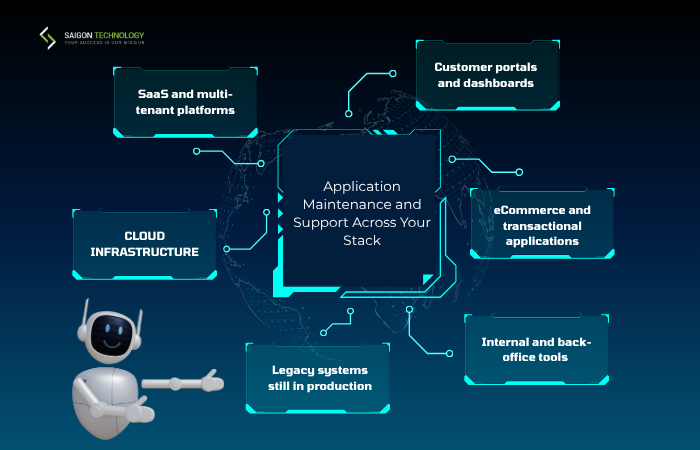
Application Maintenance and Support Across Your Stack

Application maintenance and support is not one job. A multi-tenant SaaS platform and a fifteen-year-old internal tool fail in completely different ways. We maintain:

Tenant isolation, per-tenant configuration, release management across a shared codebase

Authentication, reporting, and the integrations behind them

Payment paths, checkout reliability, peak-load readiness

Including systems integrated with ERP and business intelligence platforms, as in our SCM Portal work with SAP and ERP data

Where documentation is thin and the original team has moved on. When the right answer is to modernize rather than maintain, we will say so and point you at legacy application modernization

Underneath all of the above

Application Maintenance and Support Across Your Stack

Trusted by Global Clients

Partner-logo2 Partner-logo3 Partner-logo4 Partner-logo6 Partner-logo1 Partner-logo5 Partner-logo9 Partner logo

What Our Clients Say

Saigon Technology provided the expert advice and technical development we needed to successfully launch our platform. Thanks to their dedication and expertise, we are now fully operational. I truly appreciate their professionalism and ongoing support.
Mr. Jowen Kuah
CTO of Loan City Pte Ltd, Singapore
star.svg star.svg star.svg star.svg star.svg
As the Owner and Director of ISMS Global, Australia, I understand perfectly how challenging it is to find a support team of skilled and professional developers to help grow a system. A few years ago, I found Saigon Technology Software (STS), led by Mr. Thanh Pham (CEO), and I have never looked back. STS has single-handedly taken ISMS camp management software from a concept on a napkin to an international product used by major companies around the world. If you are looking for a trusted partner to help you, then you should be talking to Thanh Pham.
Mr. Paul Upson
Director of ISMS Global, Australia
star.svg star.svg star.svg star.svg star.svg
We value Saigon Technology’s strong support in managing the engagement from an internal delivery perspective. They were able to maintain team performance across a relatively large team, provide additional resources when required, and work collaboratively with us on matters such as gap time, discount proposals, and improvements to the working process. Their flexibility and consistent management support contributed positively to the overall partnership.
Sri Vijayasarathy
CTO of Axiagram, USA
star.svg star.svg star.svg star.svg star.svg
During our collaboration, Mr. Thanh and his company, Saigon Technology, have consistently demonstrated world-class leadership and execution in complex fintech projects. His ability to scale and lead high-performing engineering teams, while maintaining cost-efficiency and product quality, has been critical to our technology operations. His strategic insights and leadership enabled us to significantly improve system stability and deployment velocity.
Abe Jarrett
Senior Vice President of Software Engineering at Origence, USA
star.svg star.svg star.svg star.svg star.svg
We are very happy with Saigon Technology’s support throughout the telehealth project. The team consistently met deadlines, remained highly responsive even outside normal working hours, and provided reliable 24/7 support whenever urgent issues arose. We especially appreciated their strong focus on both system security and performance, which were critical to the success of our platform. Their commitment, responsiveness, and sense of ownership gave us great confidence in the partnership.
Eric Chiam
CEO of Minmed, Telehealth, Singapore
star.svg star.svg star.svg star.svg star.svg
What we valued from Saigon Technology was not only the capability of the team itself, but also the consistency behind the delivery. The engagement was supported by strong internal management, clear coordination, and a steady focus on quality, which helped the project run in a reliable and professional manner.
Bryan McConnell
COO of NZPA, New Zealand
star.svg star.svg star.svg star.svg star.svg

Why Choose Saigon Technology as Your Software Maintenance and Support Company

A good software maintenance and support company does three things: it inherits an unfamiliar codebase without breaking it, it commits to response times in writing, and it keeps the same engineers on your system long enough for them to know it well. Saigon Technology has provided software maintenance and support services on production systems since 2012. 

We inherit codebases we did not write

This is the part most vendors gloss over. Taking over software you did not build is a specific discipline, not a smaller version of building it. Our onboarding produces artifacts, not familiarity: a component and dependency map, a documented list of known defects and fragile areas, and runbooks for deployment and rollback.

All of it lands in a shared unified knowledge base rather than in one engineer's memory, the difference between a team that survives someone leaving and one that does not. Where the original developers are still available, as on the Loan City engagement, we keep them on the system instead of restarting the learning curve. 

chevron-up.svg

Engineers with AI leverage, at $22–$46/hour

Our listed rate for implementation work is $22–$46/hour with senior oversight, and our teams are senior-first: one senior engineer with AI assistance replaces roughly three juniors, with less rework. This matters more on maintenance than on new builds. At premium onshore rates, the line items cut first are exactly the ones maintenance depends on, regression coverage, runbook upkeep, dependency currency.

Our rate structure means that work stays in scope instead of becoming the thing nobody funded. We also hold 10–12 hours of working overlap with US East and West Coast teams, so a P1 does not wait for a timezone.

chevron-up.svg

Security posture built for standing production access

Maintenance means continuous access to live systems and, often, live data, a materially different risk profile from project work. We operate a secure SDLC with role-based access control, NDAs, and audit trails, aligned to GDPR and PDPA, with HIPAA and HL7 support where healthcare engagements require it. Data security is handled as an access-governance problem, not a checkbox: named engineers, scoped credentials, and revocation on rotation.

chevron-up.svg

The same engineers, year after year

Retention is a technical argument on a maintenance retainer, not a culture note. Churn on your vendor's side means paying twice for knowledge you already bought. Saigon Technology was ranked #10 in the Medium category of Southeast Asia Best Workplacesâ„¢ in Technology 2026 by Great Place To Work, and we shortlist from the top 1% of engineers we screen. The practical effect is that the people who mapped your system are still on it when it has to change.

chevron-up.svg

ISO 9001 and ISO 27001 certified, Microsoft Gold Partner

Certified by BSI (UK), with result-proven processes audited annually rather than self-declared.

chevron-up.svg

14+ years · 400+ developers · 850+ projects · 350+ clients · 3 development centers

Delivered across healthcare, fintech, logistics, eCommerce, and real estate.

chevron-up.svg

Engagement models that flex, and a two-week trial before you commit

Retainer, dedicated team, staff augmentation, or ODC, plus team scalability in both directions. Interview the engineers first and run a two-week risk-free trial before any long-term commitment.

chevron-up.svg

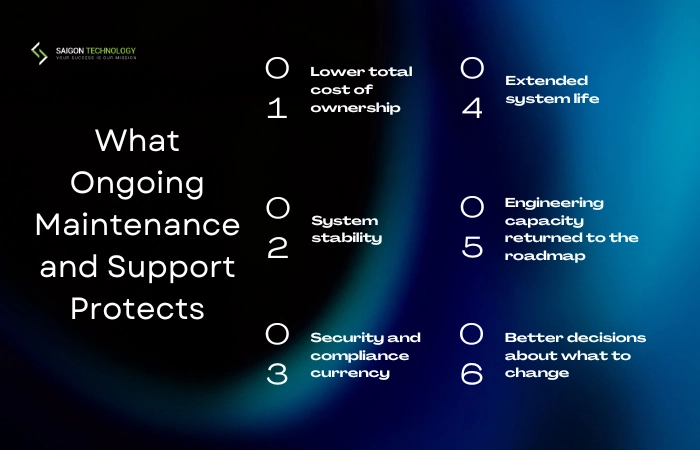
What Ongoing Maintenance and Support Protects

Deferred maintenance is not a saving. It is a loan against next year's engineering budget, and the interest is compounding. 

What Ongoing Maintenance and Support Protects

Planned work is cheaper than emergency work, every time. Industry convention puts annual maintenance at 15–20% of original build cost; unplanned remediation runs well above that. 

Fewer unplanned outages, and fewer repeat incidents once root-cause analysis replaces symptom patching.

Dependencies patched and standards tracked as they change, not audited retroactively.


Including systems integrated with ERP and business intelligence platforms, as in our SCM Portal work with SAP and ERP data

Your senior people stop being a help desk.

Business analysis for maintenance and support means change requests get evaluated against business value before they consume a sprint.

Our Software Maintenance and Support Process

We do not start by writing code. We start by understanding a system we did not build.
Software Development Process

Discovery and requirements

We map what needs supporting, technically and commercially. Discovery and requirements interviews with your dev leads, then an application health audit: codebase size, system age, architectural style, known bugs, compliance demands, and overall software complexity. You get a written baseline before anything changes.

Software Development Process

Knowledge transfer

Architecture and data-flow diagrams, deployment and rollback procedures, environment configuration, and access to code, pipelines, and dashboards. Everything goes into a knowledge base with runbooks and support and maintenance documentation, a shared unified knowledge base, not individual notes.

Software Development Process

Stabilize

Clear the known-defect backlog, close security gaps, and establish regression coverage where none exists. Stability and risk modelling identifies what would hurt most if it failed; we stress-test those paths against load spikes and dependency failures before they find you first.

Software Development Process

Maintain and monitor

Steady state. Monitoring and alerting, patch currency, incident handling against agreed SLAs, and disciplined release management, documented release procedures and change and configuration management so every change is traceable. Support workflows are defined per severity, with escalation paths agreed up front.

Software Development Process

Improve and report

Monthly KPI reporting: SLA attainment, incident volume and trend, incident heatmaps, root cause patterns, preventive fixes shipped, and stakeholder satisfaction. Where your users need it, we provide training for users on changed functionality. Reports drive the next quarter's priorities instead of sitting in an inbox.

Core Technologies and Tools We Use

Claude
ChatGPT
scikit learn
dmlc XGBoost
lightGBM
Lightning
LLaMA
Keras
Onnx
Apache Airflow
OpenCV
Spark
Pytorch
Spacy
TensorFlow
Python
CatBoost
Yolo
mlflow
Kubeflow
NLTK
AWS
Google Cloud
Azure
Gitops
Nexus
AWS Cloudformation
Docker
Terraform
Kubernetes
Argo
Jenkins
BeautifulSoup
Scrapy
selenium

Our Insights

FAQs

The four types are corrective, adaptive, perfective, and preventive. Corrective fixes defects. Adaptive adjusts software to changes in operating systems, APIs, and infrastructure. Perfective improves performance and adds features. Preventive reduces future failures through refactoring and technical debt reduction. Most engagements need all four.

Maintenance is proactive and planned, scheduled improvements, upgrades, and refactoring that address non-urgent work. Support is reactive, resolving urgent incidents that disrupt operation or cause downtime. Maintenance protects the system's future; support protects today's users. A complete agreement covers both.

We staff a conventional multi-tier support (L1, L2, L3, L4) structure and agree the escalation paths before we take the wheel.

  1. End-user support (L1) handles first-line questions, query tracking, configuration and account administration, and password and access issues, escalating what it cannot close — delivered by support specialists.
  2. Application support (L2) covers continuous software monitoring and health checks, performance issues, log investigation, database administration, and basic infrastructure requests, delivered by application and infrastructure support engineers.
  3. Development support (L3/L4) handles code-level defect resolution, new features and integrations, and complex infrastructure work, delivered by software engineers, QA engineers, DevOps engineers, cloud platform specialists, and external vendor engineers where a third-party platform is involved.

Every incident is classified by business impact.

  • P1 - critical outage means the system is down or unusable.
  • P2 - major function broken means a key feature is failing and business operations are affected.
  • P3 - minor defect means a workaround exists and the issue is not business-critical.
  • P4 - cosmetic or request covers UI issues and improvement suggestions.

System monitoring and incident management runs underneath every support tier: proactive alerting on threshold breaches, 24 × 7 monitoring coverage where your system warrants it, and a documented incident lead for every P1.

SLAs are agreed per engagement rather than sold as a fixed package, and reported against monthly, so SLA compliance is measurable rather than asserted. Response and resolution targets are set per severity level during onboarding, against your system's availability requirements and coverage hours. Coverage scales with your needs, scalable ongoing support means adding or removing tiers without renegotiating the whole contract.

Saigon Technology's listed rate for implementation work is $22–$46/hour with senior oversight. Annual support and maintenance costs typically run 15–20% of original build cost. Actual pricing depends on software complexity, coverage hours, change frequency, number of users, and documentation quality, the main drivers of total cost of ownership.

Yes - most of our maintenance engagements start that way. We run a structured knowledge transfer producing a dependency map, a documented defect and risk register, and deployment runbooks before taking responsibility. On the ARB Australia engagement we inherited an unmaintained codebase and stabilized it; on Loan City we retained the original engineers through the transition.

It depends on your sourcing model constraints. In-house software maintenance gives maximum control but requires hiring for legacy and niche skills and carries fixed cost through quiet periods. Outsourced software maintenance ramps faster and scales both ways. Many clients choose in-house management with outsourced resources; others move to fully outsourced maintenance and support including infrastructure maintenance and support.

Reporting covers SLA attainment, incident volume and trends, root cause patterns, preventive fixes delivered, and change throughput. Do not publish specific figures or frequencies until delivery confirms what we commit to contractually.

Keep Your Software Working, Long After Launch

Software does not stay finished. Our AI-augmented senior engineers take ownership of production systems and keep them stable, secure, and still shippable years after release, so your team can spend its time on what comes next.

    Contact Message Box

    Schedule a Demo with Our Industry Experts

    Book a free 30-minute call

    • See case studies aligned with your requirements
    • Validate our industry experience
    • Confirm technical fit for your project
    Schedule a Demo

      Your RFP, reviewed by experts in 24 hours

      AI-accelerated path from brief to working prototype. Engineers, not sales.
      • Clickable prototype of your core user flow
      • Workflow visualization mapping the full system
      • Architecture direction covering stack, integrations, and scale
      • Technical recommendation call with our engineering team
      Free Demo Campaign