


Medical Practice Management Software: Features & Costs 2026

 Updated on Oct 21, 2026
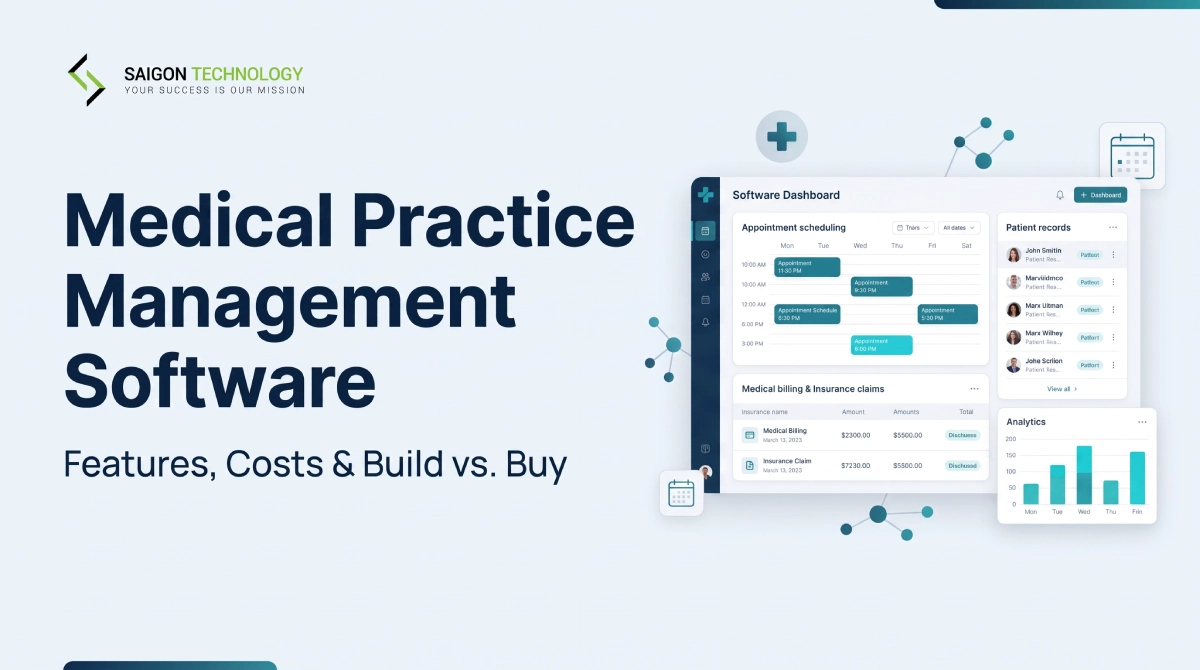
A front desk juggling three insurance verifications at once, a billing team chasing down a claim denied last month, a provider’s calendar that never quite matches who actually shows up: this is the daily friction medical practice management software is built to fix. The right platform turns scattered admin work into one coordinated system, freeing clinicians to focus on care instead of paperwork.
In 2026, buyers face a sharper question: adopt an off-the-shelf SaaS platform, or build a custom system that fits a specific workflow and integrates deeply with existing tools. This guide covers what the software does, how it differs from an EHR, the features worth paying for, deployment options, real cost ranges, HIPAA and FHIR requirements, and a build-vs-buy framework from our healthcare software development practice‘s 14+ years of experience across 850+ projects.
Key Takeaways
- Medical practice management software runs scheduling, billing, claims, reporting, and patient communication.
- Core features include appointment management, insurance verification, revenue cycle management, and EHR integration.
- Cloud-based platforms suit many practices, while on-premise or hybrid options offer alternatives for specific requirements.
- SaaS is usually priced per provider per month; AdvancedMD, for example, lists $429-$1,070 for medical specialties. A custom build runs about $70K-$265K for an MVP and $222K-$994K for a full platform at Saigon Technology’s $22-$46/hour.
- Custom software suits practices that need specialized workflows, deeper integrations, or greater control.
Core Features of a Medical Practice Management System
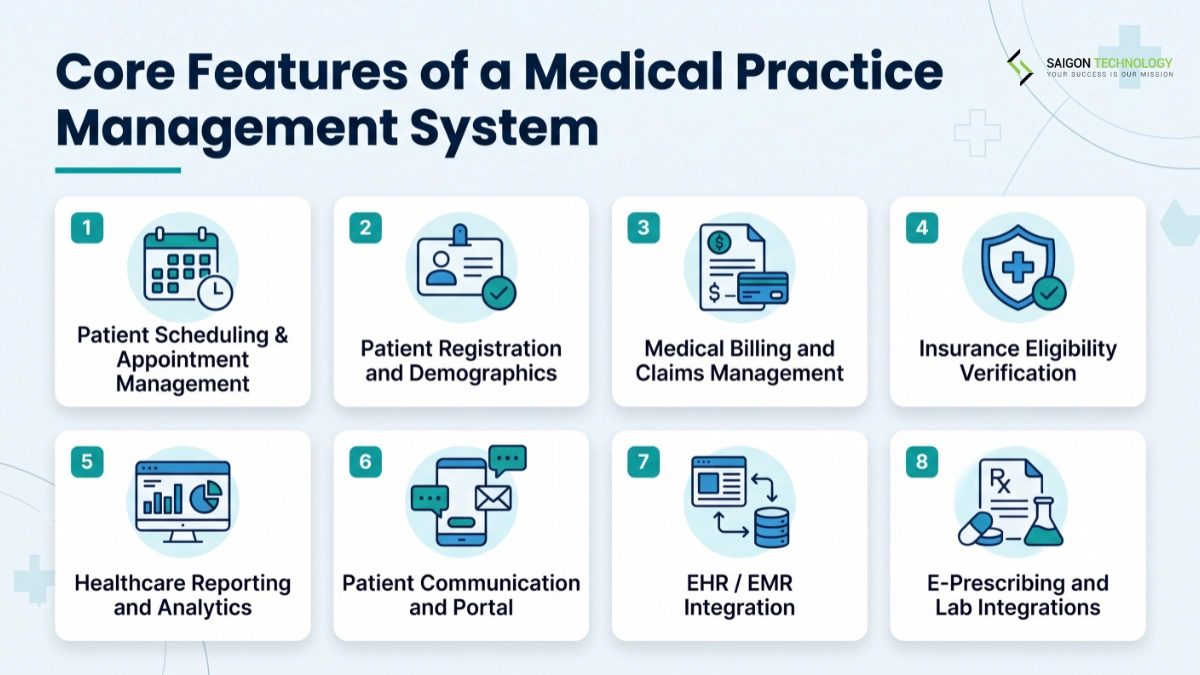
Medical practice management software is a healthcare-specific application that automates the administrative, financial, and operational workflows of a clinic: appointment scheduling, patient registration, insurance eligibility verification, medical coding, claims, payments, and reporting. It is the system the front desk, billing team, and practice manager live in every day, and the strongest platforms share the eight core modules below.
A buyer evaluating options or a healthtech team scoping a custom build should treat these as the baseline.
1. Patient Scheduling and Appointment Management
Online booking, provider calendars, resource allocation, recurring visits, no-show automation, and intelligent scheduling interfaces that balance staff schedules against patient appointments. Automation here is where most clinics see the fastest administrative-workload reduction.
2. Patient Registration and Demographics
Digital intake forms, ID capture, insurance information verification, consent management, and patient information and records management tools. Clean registration data is what keeps downstream claims clean.
3. Medical Billing and Claims Management
Billing modules that cover CPT and ICD-10 medical coding and billing, charge capture, claim scrubbing, electronic submission to clearinghouses, denial rate calculation, denial management, patient statements, and payment posting. This is where revenue cycle management reporting lives.
4. Insurance Eligibility Verification
Real-time payer checks over 270/271 EDI transactions. Modern eligibility verification solutions cut claim denials by catching coverage gaps before the visit, not after.
5. Healthcare Reporting and Analytics
Customizable reporting functionalities for financial information, clinical information, and administrative information. Operational dashboards track days-in-AR, denial rate, no-show rate, and provider productivity. Modern healthcare data analysis tools apply machine learning to flag anomalies in real time.
6. Patient Communication and Portal
Secure messaging, bill pay, appointment reminders over SMS and email, intake pre-visit, and post-visit follow-up. In our builds we commonly use Twilio for SMS and SendGrid for email, with the portal itself integrated with the patient information system.
7. EHR / EMR Integration
HL7 v2 for legacy connections, FHIR R4 for modern ones, SMART on FHIR for app-level embedding, and dedicated interfaces for lab results and reports. A practice management system that cannot read and write to the EHR is a silo. Our software integration team handles this layer for most of our healthcare clients.
8. E-Prescribing and Lab Integrations
Surescripts for controlled and non-controlled prescriptions, direct lab orders and result retrieval, and interoperability with pharmacy benefit managers.
Beyond the baseline, some platforms add imaging workflows (DICOM, PACS), telemedicine and telehealth development modules, CRM-style patient relationship management, and marketing tools. Treat these as extensions that sit on top of the core eight.
Practice Management System vs. EHR: Which Do You Need?
A practice management system differs from an electronic health record (EHR) in scope. The EHR stores clinical information: diagnoses, medications, lab results, imaging, clinical notes. The practice management system stores administrative information: demographics, insurance, appointments, charges, claims. Modern suites bundle both, while many clinics still run them as separate best-of-breed systems linked through HL7 and FHIR interfaces.
Most clinics ask this question backwards. They start by shopping for an EHR, then discover six months in that the real pain is scheduling and billing. The right choice depends on where the operational bottleneck lives.
Standalone medical practice management software remains common in specialty billing shops, multi-location physician groups consolidating several EHRs, and healthtech vendors building products on top of existing clinical systems.
PMS vs. EHR vs. EMR: a quick disambiguation
|
|
Medical practice management system
|
EHR / EMR
|
|
Scope
|
Administrative, financial, operational
|
Clinical, longitudinal patient record
|
|
Primary data
|
Appointments, insurance, charges, claims, payments
|
Diagnoses, medications, labs, imaging, notes
|
|
Primary users
|
Front-desk staff, billing specialists, practice managers
|
Clinicians, nurses, allied health professionals
|
An EMR (electronic medical record) is a clinic-local digital chart. An EHR (electronic health record) is designed to be shared across care settings. In practice, the two terms are used interchangeably in the US market. For the clinical side of the stack, see how custom EHR platforms are built.
Standalone or integrated?
|
Comparison
|
Standalone PMS
|
Standalone EHR
|
Integrated PMS + EHR
|
|
Primary focus
|
Scheduling, billing, and claims
|
Clinical records and documentation
|
Administrative and clinical workflows
|
|
Best for
|
Improving administrative efficiency
|
Managing patient care and records
|
Connecting administrative and clinical teams
|
|
Integration
|
Often needs an EHR connection
|
May need separate billing and scheduling tools
|
Connects core workflows within one platform
|
|
Cost considerations
|
Depends on features and integrations
|
Depends on clinical features and implementation
|
May simplify maintenance but require a larger initial investment
|
A standalone PMS or EHR works well for one specific need, while an integrated platform makes more sense when administrative and clinical teams need to share the same data. Whichever you choose, check how well it connects to your existing systems: standards like HL7 and FHIR enable data exchange, though results vary by system, and a phased integration can improve workflows without replacing everything at once.
Saigon Technology’s AxiaGram project shows this in practice: rather than replacing the EHR, we built a companion app that connects to hospital EHR systems through HL7 integration and adds AI-powered voice note-taking. The platform has handled more than 6 million medical records, and the engagement cut development time by 40%. The right choice depends on what’s slowing your practice down, what you already run, how deep the integration needs to go, and your budget. Pick the option that removes the real bottleneck without forcing a full rebuild.
A multi-specialty group facing this exact decision may also want to look at our related work in hospital management system development and remote patient monitoring, both of which sit on the same integration patterns described above.
Cloud-Based vs. On-Premise Healthcare Practice Management Software
Cloud deployment is the 2026 default for healthcare practice management software. The practical question is which deployment model fits your PHI residency rules, integration load, and in-house IT capacity.
|
|
Cloud / SaaS
|
On-premise
|
Hybrid
|
|
Onboarding speed
|
Days to weeks
|
Months
|
Weeks to months
|
|
Upfront cost
|
Subscription only
|
Hardware, licenses, implementation
|
Mixed
|
|
Updates
|
Vendor-managed, automatic
|
In-house, scheduled
|
Mixed
|
|
PHI residency
|
Vendor-controlled under BAA
|
Full in-house control
|
Flexible
|
|
Compliance posture
|
AWS HIPAA, Azure Health Data Services with BAA
|
In-house control, in-house burden
|
Depends on split
|
|
Fit
|
Clinics, physician groups, healthtech vendors
|
Hospital-affiliated groups, strict residency requirements
|
Groups splitting application from PHI store
|
- Cloud-based medical practice management software built on AWS or Azure, covered by a Business Associate Agreement, is the pragmatic choice for most clinics.
- On-premise still fits where regulatory or contractual rules force on-site PHI storage. Hybrid deployments, with the application tier in the cloud and the PHI store on-premise, are a reasonable middle path for groups that cannot move clinical data to a public cloud yet.
- If your organization is migrating off legacy infrastructure, our cloud migration services team can scope that transition alongside the PMS build itself, and our SaaS application development team builds multi-tenant platforms for healthtech vendors productizing a PMS.
Build vs. Buy: When to Develop a Custom PMS
Buy a SaaS platform when your workflows are standard and speed to launch matters most. Build a custom system when your workflows, integration depth, or data-ownership needs go beyond what a vendor’s roadmap covers. The two checklists below show where that line usually falls, and the five questions after them settle borderline cases for healthcare practice management software.
When to buy off-the-shelf
- The clinic is single-specialty with standard workflows
- Billing follows typical CPT/ICD-10 patterns with mainstream payers
- The practice has fewer than five providers
- Integration needs are limited to one EHR with a mature FHIR interface
- Time-to-launch matters more than long-term differentiation
When to build custom
- Workflows are specialty-specific or unusual (surgical centers, concierge medicine, chronic-care programs, multi-site specialty groups)
- Integration depth is high: multiple EHRs, lab systems, specialty devices, third-party software, or deep lab-result and reports pipelines
- The organization is a healthtech vendor productizing the platform
- A private-equity-backed group is consolidating three or more legacy PMS systems
- Data ownership and architectural control are strategic priorities
Five questions to decide
- How unusual is our workflow versus the market standard?
- How many systems does the PMS need to integrate with, and how deeply?
- What is our scale trajectory over the next three years?
- Do we need to own the data model, or are we comfortable with a vendor’s?
- Does the PMS become competitive differentiation, or is it a cost center?
|
Cost factor
|
SaaS platform
|
Custom medical practice management software
|
|
Initial cost
|
Low upfront cost; setup fees may apply
|
About $70K-$265K for an MVP; about $222K-$994K for a full platform
|
|
Recurring cost
|
Per provider per month, often quoted rather than published
|
Engineering support at $22-$46/hour
|
|
Timeline to launch
|
Weeks
|
4-6 months for an MVP; 9-15 months for a full platform
|
|
Customization ceiling
|
Limited by vendor capabilities
|
High flexibility and control
|
|
Data ownership
|
Governed by vendor contracts
|
Greater control, subject to contractual terms and applicable laws
|
A hybrid approach can help practices launch quickly with SaaS and transition to custom software as their needs evolve. Saigon Technology offers healthcare software development support at $22-$46 per hour, depending on expertise and team requirements. For how scope, integrations, and compliance move a budget, see what moves the budget on a healthcare build.
The custom ranges above are planning estimates, not quotes, built the same way as any engagement: people × months × 160 hours × the hourly rate. An MVP covering scheduling, registration, and billing usually needs 5-6 people (project manager, business analyst, 2-3 developers, QA) for 4-6 months, or 3,200-5,760 hours. A full platform that adds EHR integration, reporting, a patient portal, and e-prescribing usually needs 7-9 people for 9-15 months, or 10,080-21,600 hours. Integration count and specialty workflows move a project within these ranges more than anything else.
“When a clinic asks us to replace its practice management system, we first list every system it has to talk to: the EHR, the clearinghouse, labs, the patient portal. That integration count, more than the feature list, usually decides whether building beats buying.”
— Phuc (Cris) Tran, Program Manager, Saigon Technology
HIPAA, HL7, and FHIR: Compliance and Interoperability by Design
A HIPAA-compliant system comes from architecture decisions made on day one: who can access what, how every access is logged, how data is encrypted, and how protected health information moves between the PMS, the EHR, and payers.
The HIPAA Security Rule in architecture
The rule has three safeguard categories. Administrative safeguards show up as role-based access control, documented policies, workforce training, and a periodic evaluation of how well those controls work. Physical safeguards cover facilities and devices. On a cloud platform, the provider takes on data-center controls under a shared responsibility model set out in its HIPAA BAA. The practice and its development partner remain responsible for everything they configure and run on top.
Technical safeguards cover access control, audit controls, integrity, authentication, and transmission security. The rule lists encryption at rest and in transit as addressable rather than naming an algorithm, so the specific choices are an engineering decision. In our builds, that means AES-256 encryption at rest, TLS 1.3 in transit, audit trails on every access to protected health information, multi-factor authentication, and session management. We recommend security audits at least quarterly on top of the periodic evaluation the rule requires. Our guide to building HIPAA-ready healthcare applications walks through the full control set.
Where a practice management system meets the EHR
A practice management system exchanges five kinds of data with the EHR, labs, and payers, and each flow has its own standard. Getting these flows right is most of the integration work in a medical practice management software build:
|
Data flow
|
HL7 v2 message
|
FHIR R4 resources
|
Payer standard
|
|
Registration and demographics
|
ADT
|
Patient, Coverage
|
n/a
|
|
Scheduling
|
SIU
|
Appointment, Schedule, Slot
|
n/a
|
|
Charges and claims
|
DFT
|
Encounter, ChargeItem, Claim
|
X12 837 claim, 835 remittance
|
|
Eligibility
|
n/a
|
CoverageEligibilityRequest
|
X12 270/271
|
|
Lab results
|
ORU
|
Observation, DiagnosticReport
|
n/a
|
Most installed EHRs still exchange these feeds as HL7 v2 messages. FHIR R4 is a REST and JSON standard that is far easier to build against, and the ONC certification criterion for standardized APIs (45 CFR 170.315(g)(10)) points to FHIR Release 4.0.1 as its base standard (45 CFR 170.215). A new practice management system should therefore implement FHIR R4 as the primary interface and keep HL7 v2 as a compatibility layer. Our guide to connecting HL7 v2 and FHIR interfaces covers the message-level detail.
App embedding and the major EHR vendors
SMART on FHIR lets third-party applications embed inside EHRs with scoped access to patient data, and the same ONC API standards adopt the SMART App Launch framework. For healthtech vendors, it is the fastest path into the clinical workflow of a hospital or large group. Any EHR certified to ONC’s standardized API criterion must offer a FHIR-based API, and both Epic and Oracle Health, formerly Cerner, publish FHIR R4 APIs for developers. A properly architected medical practice management system can read and write to any of them, with the integration shape depending on the version and the use case.
Saigon Technology holds ISO 27001 for information security and ISO 9001 for quality management. Our healthcare builds meet HIPAA requirements where the workload needs them and support HL7 interoperability. The AxiaGram HL7 integration described earlier is one example; another is HealthCare Connect, a teleconsultation and health-screening platform for multi-location clinics that exchanges lab data over HL7 and handles more than 50,000 patient interactions each month. Our offshore development center team has worked on it since 2022.
Best Medical Practice Management Software in 2026: A Buyer’s Criteria Framework
Instead of ranking vendors (which ages fast and invites complaints), apply this seven-criteria framework to any top medical practice management software shortlist.
|
Criterion
|
What to check
|
|
Specialty fit
|
OB-GYN, dermatology, orthopedics, and primary care all have different workflow signatures. A platform optimized for one is rarely strong at another.
|
|
Billing and RCM depth
|
How many clearinghouses are supported? How mature is denial management? Does the system calculate denial rates by payer, by provider, by code?
|
|
EHR integration posture
|
Native, HL7, FHIR, or none? Can it embed via SMART on FHIR?
|
|
Patient experience features
|
Portal, SMS reminders, telemedicine integration, personalized patient communication, bill pay.
|
|
Reporting flexibility
|
Canned reports or customizable reporting functionalities with export to BI tools? Can analytics expose both clinical information and financial information in one view?
|
|
Compliance posture
|
HIPAA, HITECH, SOC 2, state-level privacy rules, BAA coverage.
|
|
Total cost of ownership
|
Seat price plus implementation, training, data migration, custom report development, and integration maintenance.
|
Running the same shortlist against these seven criteria produces a usable scorecard. Any vendor who cannot answer each criterion with a specific capability is not a serious option.
The 2026 Shift: AI-Native Capabilities in Modern PMS Platforms
AI in a medical practice management system targets the same admin bottlenecks as the core modules: documentation, scheduling, claims, reporting, and intake. The five patterns below are the main ones, and each adds a HIPAA decision about where the model runs and which patient data it can see.
- Ambient AI scribing: voice capture during visits auto-populates documentation and reduces clinician typing time. On AxiaGram we built AI-powered, voice-controlled note-taking for care teams; for speech-to-text, our healthcare stack includes models such as Whisper.
- Predictive scheduling: machine learning models predict no-show probability per appointment and recommend overbook strategy by provider and time slot.
- AI-assisted claim triage: models flag likely denials before submission, giving billers a chance to fix problems upstream. Over time this collapses days-in-AR.
- Natural-language reporting: a practice manager asks “show me no-show rate by provider last quarter” and gets a chart back.
- AI-powered patient intake: NLP extracts structured data from unstructured patient inputs, and medical image recognition can route uploaded ID cards or insurance cards into the right fields.
Operating AI responsibly inside a HIPAA-compliant system requires decisions about model residency, PHI handling in prompts, audit trails for AI decisions, and vendor BAAs for third-party models. Our AI development services team integrates these capabilities under HIPAA-aligned architectures.
Case Study: AxiaGram, an EHR-Integrated Companion App for Chronic Care
Business problem
AxiaGram, a US healthtech company serving physicians and care teams in chronic care management, needed a HIPAA-compliant telemedicine platform that works alongside the EHR systems its clinics and hospitals already run. It had to support secure remote consultations, care-team messaging, and voice-driven documentation, at a development cost that could scale with demand.
Engineering challenge
The platform had to stay connected to hospital EHR systems, stream real-time video consultations reliably, and keep a fast-growing volume of medical records secure.
Solution
We built the platform on .NET Core and Angular, deployed on Azure. We integrated HL7 for clinical data exchange with hospital EHR systems, added AI-powered voice-controlled note-taking, Electronic Visit Verification (EVV) with geo-tagging and digital signature, and secure internal messaging for care teams. Real-time video consultations run on Agora and Wowza. The data layer is HIPAA-compliant, with AES-256 encryption, role-based access, and complete audit trails. An offshore development center (ODC) team has worked on the platform since 2021.
Results
Development time was cut by 40%, and the HL7 integration keeps the companion app connected to hospital EHR workflows. The platform has handled more than 6 million medical records, and AxiaGram has kept Saigon Technology as its ongoing engineering partner since 2021.
Frequently Asked Questions
How much does a practice management system cost?
SaaS medical practice management software is usually priced per provider per month, and many vendors quote rather than publish prices. As one published example, AdvancedMD lists $429 to $1,070 per provider per month for medical specialties on its pricing page (vendor data, retrieved October 2026); implementation, training, and data migration can add to that. A custom build at Saigon Technology’s $22 to $46 per hour typically lands around $70K to $265K for an MVP and $222K to $994K for a full platform, depending on integrations and specialty workflows.
Can practice management software be HIPAA-compliant?
Yes, when it is built and operated to the HIPAA Security Rule. The rule has three categories of safeguards: administrative (policies, access controls, training, periodic evaluation), physical (facility and device controls, shared with the cloud provider under a BAA), and technical (access control, audit controls, integrity, authentication, and transmission security). The rule treats encryption as addressable rather than prescribing an algorithm; AES-256 at rest and TLS 1.3 in transit are common engineering choices. Compliance depends on how the system is built and operated.
Can a PMS integrate with Epic, Oracle Health (Cerner), or athenahealth?
Yes. Epic and Oracle Health both publish FHIR R4 APIs, and any EHR certified to ONC’s standardized API criterion must offer a FHIR-based API; for athenahealth or another EHR, check its certification and what write access its developer program allows. Older installations also support HL7 v2. Integration depth varies by use case: read-only data exchange is straightforward, bi-directional writes require more work, and embedding inside the EHR workflow typically uses SMART on FHIR.
How long does it take to build a custom PMS?
An MVP covering core scheduling, registration, and billing modules usually takes 4 to 6 months, often scoped through our MVP development engagement. A full production platform with EHR integration, reporting and analytics, patient portal, and e-prescribing typically takes 9 to 15 months, depending on specialty coverage and integration scope.
How is a practice management system different from an EHR?
The practice management system handles administrative and financial data: appointments, insurance, charges, claims, and payments. The EHR handles clinical data: diagnoses, medications, labs, imaging, and clinical notes. Many clinics run both, linked through HL7 or FHIR.
Choosing the Right Path for Your Practice
Medical practice management software decides how efficiently a clinic runs. Every option needs the eight core modules and a HIPAA-ready architecture with HL7 and FHIR interfaces. The real choice is whether to adopt a SaaS platform, build a custom system, or run a hybrid of the two. The right choice depends on specialty, scale, integration depth, and strategic data ownership.
Saigon Technology has been building healthcare software since 2012. Our 400+ engineers have delivered 850+ projects across 350+ global clients, including HIPAA-grade platforms like AxiaGram, HealthCare Connect, and a remote health-tracking platform for older adults. We are a Microsoft Solutions Partner, hold ISO 27001 and ISO 9001 certifications, and were named to the Fortune 100 Best Companies to Work For™ Southeast Asia 2025 list.
If you are planning a medical practice management software build, modernization, or integration project, our healthcare engineering team can scope the work and share concrete delivery options.


Related articles

Healthcare Cloud Migration: A HIPAA-Ready Roadmap from Real-World Builds
 Phuc (Cris) Tran - Program Manager
 14 Jul 2026
Healthcare Chatbot Development: The Complete 2026 Guide
19 Aug 2026 
AI Governance Framework: A Practical Guide for Enterprises (2026)
04 Sep 2026 
AI Healthcare Software Development: Architecture & Cost
13 Sep 2026 
IoT in Healthcare: How Healthcare IoT Systems Work in 2026
25 Sep 2026 
Insurance Portal Development in 2026: Types, Features, Cost
07 Oct 2026