




Fleet Management Software Development: Complete Guide (2026)

 Updated on Oct 16, 2026
Managing a modern fleet is harder than it used to be. EV adoption, tighter last-mile delivery windows, FMCSA audits, and real-time dispatch expectations have turned fleet operations into a serious engineering problem. Off-the-shelf tools like Fleetio or Motive work well for standard fleets. But complex workflows, custom integrations, and data residency requirements change the equation. You need software built for your operation.
Fleet management software development is the process of designing, building, and deploying custom software that lets businesses track, manage, and optimize vehicle fleets in real time, covering GPS tracking, predictive maintenance, driver behavior, compliance, and route optimization.
The global fleet management market is projected to reach $52 billion by 20, growing at 10.5% annually (MarketsandMarkets, 2024). Most of that growth is moving toward custom and integrated systems rather than generic SaaS. This guide covers what to build, how to build it, what it costs, and when custom beats off the shelf.
Key Takeaways
- Custom fleet software gives you full control over features, data ownership, and integrations; off-the-shelf tools do not
- Core features: real-time GPS tracking, predictive maintenance, driver behavior monitoring, ELD compliance, and route optimization
- Tech stack: .NET or Node.js backend, React or Flutter frontend, AWS or Azure cloud, OBD-II and CAN bus IoT layer
- Timeline: 3–4 months for an MVP, 8–12 months for a full system
- Cost: $30,000–$80,000 for MVP; $80,000–$200,000+ for mid-tier to enterprise; offshore at $22–$46/hour
What Is Fleet Management Software Development?
Fleet management software development services cover everything from requirements gathering and architecture design to deployment and post-launch support. The goal: custom platforms that help organizations manage vehicle fleets. The system tracks location, condition, compliance status, and operational performance in real time.
This is different from buying a SaaS product. Custom fleet management software is built to fit your workflows and data model, not the vendor’s. No off-the-shelf roadmap controls what gets built or when.
A complete fleet management system has three layers:
- Application layer: web dashboard and mobile apps for fleet managers, dispatchers, and drivers
- Backend layer: APIs, business logic, real-time data processing, and third-party integrations (ERP, ELD devices, GPS providers)
- IoT and telematics layer: OBD-II and CAN bus protocols, GPS data ingestion, and telematics data streaming pipelines
The result is a platform that consolidates operational efficiency, resource utilization, compliance data, and driver behavior monitoring into one source of truth.
Who builds custom fleet software? Logistics and transportation companies, government fleet operators, construction businesses, healthcare providers, and EV operators whose needs standard SaaS tools cannot meet.
Three forces drive the move to custom.
- Data ownership. Your telematics data and AI models stay under your control, not a vendor’s.
- AI integration depth. Generic SaaS exposes ML features as paid add-ons, often a year behind open-source.
- Integration breadth. A 200-truck fleet touches ERP, fuel card, TMS, and compliance systems. Shallow SaaS connectors can’t handle that depth, and connecting fleet ops with procurement, inventory, and fulfillment takes coordination across the whole supply chain. Our supply chain software development services help businesses integrate these workflows and gain full operational visibility.
Essential Features of Fleet Management Software
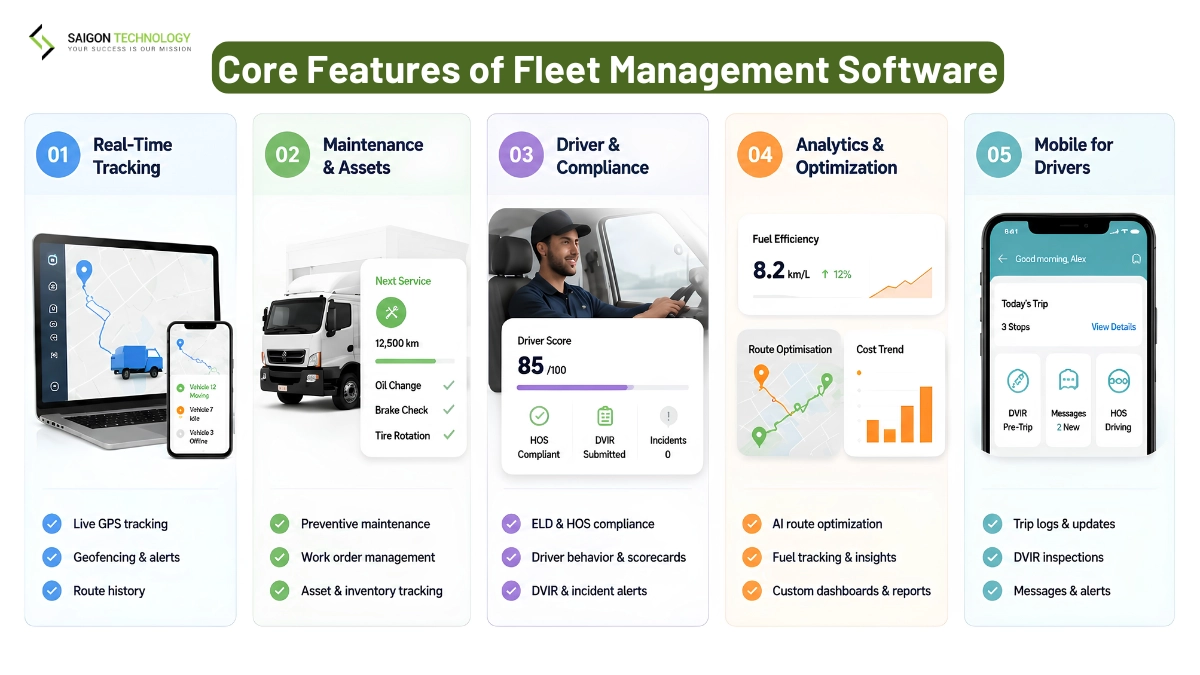
The right feature set depends on your fleet size, compliance requirements, and operational complexity. Build what drives cost and risk in your operation. Nothing more.
Real-Time Tracking and Visibility
- Real-time GPS monitoring: live vehicle locations on an interactive map, updated every 10–30 seconds
- Geofencing and geofence violation alerts: instant notifications when a vehicle leaves an approved zone, critical for theft prevention and route adherence
- Historical playback: replay any vehicle’s full route for incident review or driver coaching
- Fleet availability dashboards: live view of which vehicles are active, idle, in maintenance, or offline
- Real-time fleet data integration: live data pushed to dispatch teams and end customers via route management app or API
- Fleet management app development: mobile-first driver apps for iOS and Android, covering trip logging, DVIR, dispatch updates, and GPS reporting
Maintenance and Asset Management
- Predictive maintenance scheduling: machine learning algorithms trained on OBD-II sensor data and mileage catch problems before breakdowns happen. Proactive maintenance instead of reactive repair
- Work order management: digital creation, assignment, and tracking of maintenance tasks from request to sign-off
- Fleet inventory management: spare parts, asset lifecycle tracking, and equipment assignment across locations
- OBD-II and CAN bus device integration: direct vehicle diagnostic reads including fault codes, fuel level, and odometer
- Vehicle maintenance expense budgeting: cost tracking per vehicle feeding into financial reporting and asset lifecycle decisions
Driver and Compliance Management
Compliance is where the cost of the wrong tool is highest. The FMCSA’s ELD mandate requires electronic logging for most commercial vehicles. Missing it means fines and shutdowns. Fleet management regulations evolve. The FMCSA’s Hours of Service rules were revised as recently as 2020 and continue to be updated. Your system needs to keep up.
- Driver behavior monitoring: automated scoring of harsh braking, rapid acceleration, speeding, and idling
- Driver scorecards: aggregated performance scores per driver for coaching and incentive programs
- Electronic logging devices (ELD) integration: automated Hours of Service (HOS) logging that meets FMCSA requirements without manual entry
- Automated compliance and reporting: DOT records, IFTA fuel tax, and HOS alerts generated from system data
- DVIR (Driver Vehicle Inspection Reports): digital pre- and post-trip inspections submitted from the driver mobile app, replacing paper logs
- Automated incident management: real-time alerts for driver safety events including collisions, near-misses, and geofence violations
Analytics and Route Optimization
- AI-powered route optimization: routing optimization algorithms accounting for real-time traffic, delivery windows, load capacity, and HOS constraints To understand how these systems evaluate traffic, delivery windows, vehicle capacity, and other constraints, read more about how AI route optimization works.
- Predictive analytics: demand forecasting and operational trend analysis for fleet planning and cost optimization
- Fuel consumption tracking: per-vehicle and per-route efficiency data supporting cost control and EV transition planning
- Customizable dashboards: role-specific KPIs for fleet managers, dispatchers, drivers, and finance
- Load management and delivery scheduling: dynamic dispatch management based on vehicle capacity, location, and driver availability
- Data-driven reporting: exportable reports for executive decisions, audits, and insurance

How Fleet Management Software Architecture Works
Modern fleet management software typically follows a layered architecture that supports real-time vehicle tracking, third-party integrations, and scalable data processing.
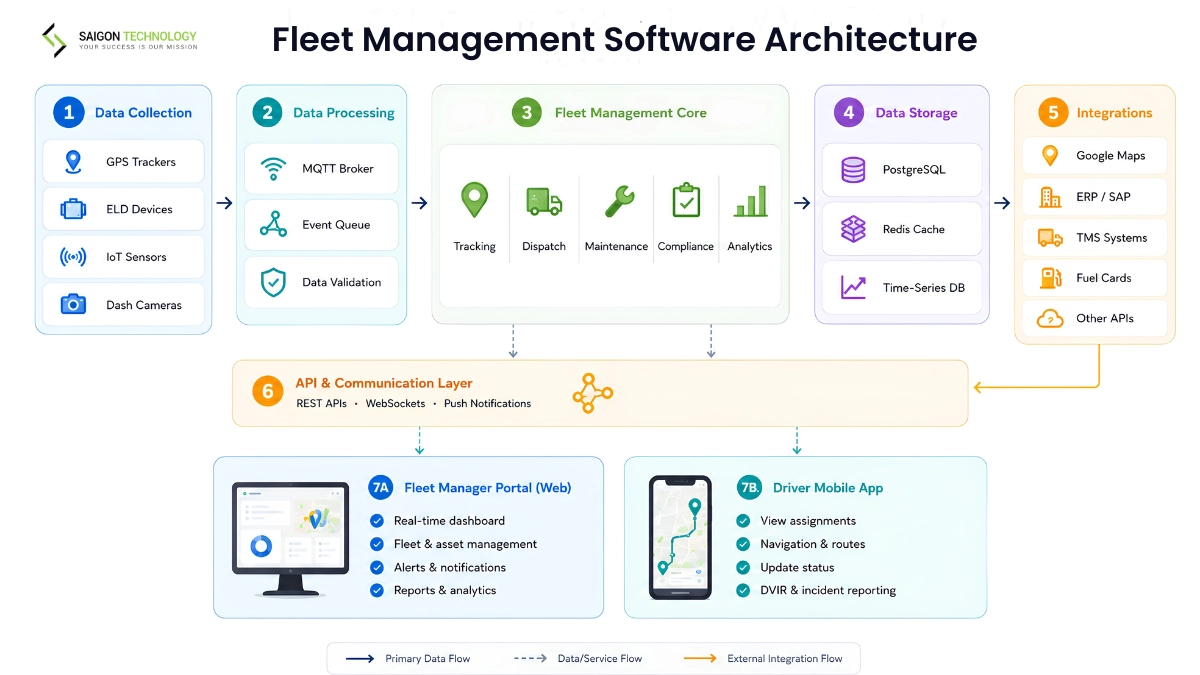
A production-ready fleet platform generally has five layers:
- Device Layer: Collects GPS, telematics, and sensor data from connected vehicles.
- Data Processing: Securely ingests and processes high-volume telemetry using event-driven messaging.
- Business Services: Powers tracking, dispatch, maintenance, compliance, and reporting.
- Data Storage: Combines relational, in-memory, and time-series databases for different workloads.
- Application Layer: Delivers real-time information through web dashboards, mobile apps, and APIs.
Fleet Management Software Tech Stack
Fleet software has two constraints most enterprise apps do not. First: high-volume real-time data from IoT devices. Second: reliable operation on mobile networks across varied environments. Technology stack selection must address both.
These technologies support a range of IoT use cases in transportation and logistics, including vehicle tracking, asset monitoring, and real-time condition monitoring.
| Layer | Technologies | Why for Fleet |
| Backend | .NET / Node.js / Java / Python | Node.js for high-concurrency IoT event streams; .NET for enterprise-grade compliance systems |
| Frontend | React / Angular / Vue.js / TypeScript | React dominates real-time fleet dashboards with live map updates |
| Mobile | React Native / Flutter / iOS / Android | Cross-platform for driver apps; native where low-latency hardware access matters |
| Cloud | AWS / Microsoft Azure | AWS IoT Core for telemetry ingestion; Azure for M365 organizations |
| Database | PostgreSQL / MongoDB / Redis | PostgreSQL for transactional records; MongoDB for telemetry time-series; Redis for real-time caching |
| Real-time | Apache Kafka / RabbitMQ / WebSockets | Kafka for high-volume concurrent vehicle streams; WebSockets for live dashboard updates |
| IoT | OBD-II / CAN bus / GPS protocols / MQTT | MQTT is the standard lightweight protocol for vehicle-to-server communication |
| AI and ML | Python, TensorFlow, scikit-learn | Machine learning algorithms for predictive maintenance, route optimization, driver behavior scoring |
| Architecture | Microservices / Cloud-native / API-first | Independent scaling of tracking, compliance, and analytics modules via API integrations |
Architecture patterns:
Monolithic architecture works for an MVP or fleets under 50 vehicles. Microservices architecture and cloud-based architecture are the right choice for production systems, allowing independent scaling of tracking, compliance, and analytics modules.
For database architecture, fleet telemetry is time-series and geospatial by nature. A normalized OLTP schema works at 100 vehicles and fails at 1,000. Design the data model and partitioning strategy early.
Cloud-based vs. on-premise solutions vs. hybrid architectures depends on data residency requirements. Government and healthcare operators often need on-premise or private cloud. Most commercial operators use cloud-native. Hybrid architectures keep sensitive workloads on-premise while pushing analytics to the cloud.

Common Integration Partners
No fleet operator wants a platform that replaces every existing system. They want one that plays well with what’s already running. Treat these as partners you consume from, not competitors to replace.
| Category | Common partners and integration surface |
| Telematics and ELD platforms | Samsara (REST API), Geotab (MyGeotab SDK), Verizon Connect (REVEAL API), Motive (REST API & Webhooks), Omnitracs, Trimble Transportation, Azuga, GPS Insight, Teletrac Navman |
| Fuel cards | WEX, Fleetcor, Comdata, U.S. Bank Voyager (fuel transactions, IFTA reporting, fraud detection) |
| Mapping and routing | Google Maps Platform, HERE Technologies (truck routing), Mapbox (offline maps), PTV Group (route optimization) |
| ERP & Back Office | SAP, Oracle NetSuite, Microsoft Dynamics 365, QuickBooks Online |
| TMS and load boards | McLeod, Trimble TMW, Descartes, DAT, Truckstop |
| Insurance telematics | Progressive, Nationwide, Travelers (usage based insurance) |
| Cloud IoT | AWS IoT Core, Azure IoT Hub, Apache Kafka, Google Cloud Pub/Sub |
From our experience, integrations often determine whether fleet software delivers real business value. The most successful projects focus on connecting the systems that teams already use every day, rather than replacing them.
How to Build Fleet Management Software: Step by Step
Skipping phases is the most common reason fleet software projects miss on value. Do not skip discovery or MVP validation.
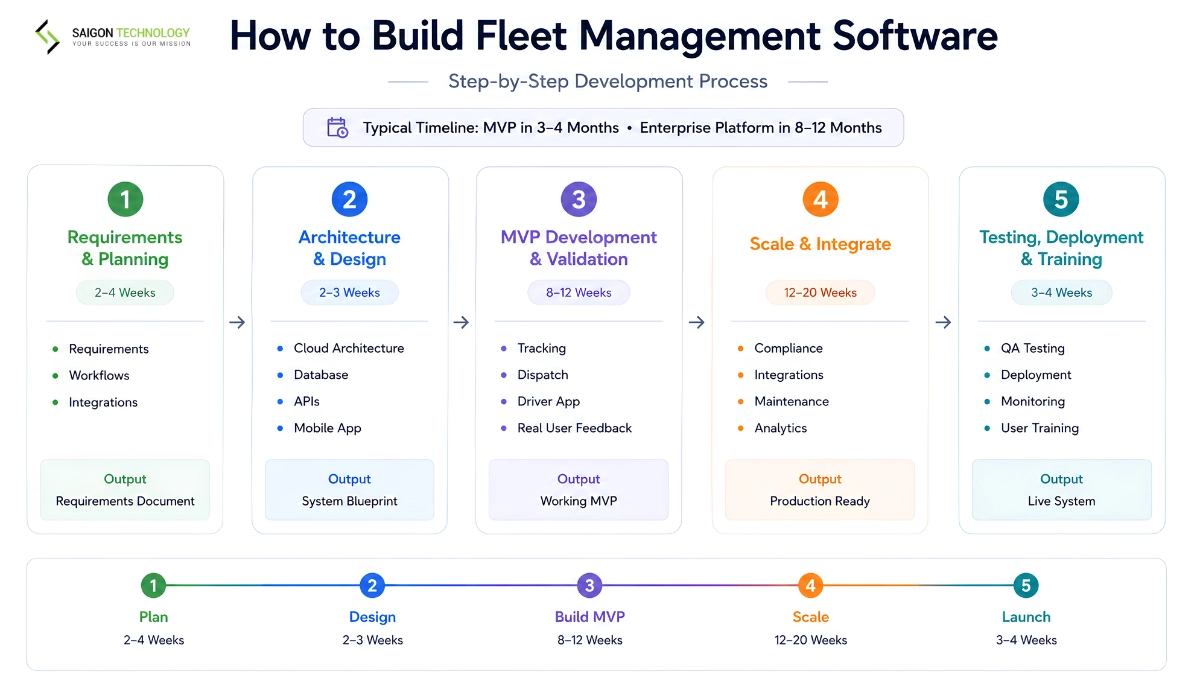
Step 1: Requirements Gathering and Planning (2–4 weeks)
Document your fleet size, vehicle types, dispatch workflows, and fleet management regulations you must comply with. Map every system that needs integration: SAP, ERP, GPS hardware, fuel cards. The output is a scope document and feature priority matrix signed off by both business and engineering.
Scope creep is the biggest driver of cost overrun. Locking scope here prevents it later.
Step 2: Architecture and Tech Stack Design (2–3 weeks)
Define cloud versus on-premise versus hybrid. Set the database architecture for telemetry and transactional data. Design the API layer for IoT devices and third-party integrations. Define the mobile architecture. This produces the blueprint. Changing core architecture after development starts is expensive. Saigon Technology runs this phase using our Agile methodology: collaborative, documented, not a waterfall handoff.
Step 3: Minimum Viable Product (MVP) Development (8–12 weeks)
Custom fleet management software development starts here: real-time GPS tracking, the fleet dashboard, driver assignment, trip logging, and the driver mobile app. Deploy to staging, then test with real fleet users.
Real dispatcher and driver user feedback surfaces requirements no discovery phase fully captures. Adjusting in sprint 4 is far cheaper than sprint 14. A working MVP in 3–4 months also gives leadership proof of value before the team commits the full budget.
Step 4: Iterative Feature Development and Integration and Deployment (12–20 weeks)
Expand to three modules:
- Compliance: ELD, HOS, DVIR, automated incident management
- Maintenance: predictive maintenance fleet development, work orders
- Integrations: ERP via REST APIs, ELD device APIs, fuel card providers
Then build the AI analytics engine for route optimization, driver behavior scoring, and predictive analytics.
Two-week Agile sprints with a demo after each. Iterative feature development means the business sees working software every two weeks, not after 12 months. Post each sprint, collect user feedback to shape the next.
Step 5: Testing, Deployment, and Training (3–4 weeks)
Load testing, penetration testing, role-based access control validation, and user acceptance testing with real fleet staff. Deploy to cloud infrastructure, run structured onboarding, and set up post-launch monitoring for system health and data pipeline integrity.
Total timeline: MVP in 3–4 months. Full enterprise system in 8–12 months.
Fleet Management Software Development Cost
Most agencies give quotes only after lengthy discovery calls. The ranges below cover the majority of real fleet software projects. Use these for budgeting and expense management before your first vendor conversation.
| Scope | What’s Included | Estimated Cost |
| MVP | GPS tracking, fleet dashboard, driver mobile app, trip logging | $30,000–$80,000 |
| Mid-tier | MVP + compliance module (ELD, HOS, DVIR), maintenance scheduling, 2–3 integrations | $80,000–$200,000 |
| Enterprise | Full platform: AI route optimization, predictive maintenance, ERP integration, custom IoT hardware support | $200,000+ |
Main cost drivers:
- Feature scope and number of modules
- Third-party API fees and integration complexity
- Custom hardware support for OBD-II devices or CAN bus adapters
- Hardware costs for telematics hardware your fleet does not already have
- Cloud infrastructure and hosting costs
- Ongoing operating costs: maintenance, security patches, and iterative development run 15–20% of the build cost per year
This is the build vs. buy decision framework in numbers:
| Market | Hourly Rate | 10-Person Team Annual Cost |
| US-based developers | $150–$250/hr | $3M–$5M |
| Saigon Technology (Vietnam) | $22–46/hr | $440K–$920K |
The same budget buys far more engineering capacity offshore. For a full breakdown, see our guide to custom software development cost.
A fleet SaaS platform at $50 per vehicle per month costs about $360,000 annually for 600 vehicles. A custom solution built for around $150,000, with approximately $25,000 per year in maintenance, can offer a lower long-term total cost of ownership while giving you full control over your platform and data.
Custom Fleet Software vs. Off-the-Shelf: Which Is Right?
The build-versus-buy decision is about operational fit, data control, and time horizon. Not just budget.
| Criteria | Custom-Built | Off-the-Shelf (Fleetio, Motive, Geotab) |
| Upfront cost | Higher ($30K–$200K+) | Lower (monthly SaaS) |
| Long-term TCO | Lower, no recurring fees | Higher, compounds annually |
| Feature flexibility | 100% fit to your workflows | Limited to the vendor’s roadmap |
| ERP / SAP integration | Deep custom integration via API integrations | Pre-built connectors only |
| Data ownership | You own everything | Data on vendor servers |
| AI and ML | Custom models on your data | Vendor-determined features |
| Compliance | Fully configurable for fleet management regulations | Standard templates only |
| Visibility and transparency | Full access to operational data and audit logs | Limited to vendor’s reporting |
| Time to launch | 3–12 months | Days to weeks |
Build custom when:
- Your fleet has 50+ vehicles with workflows that do not fit standard SaaS
- You need deep SAP or ERP integration with two-way data sync
- You operate in a regulated industry: government, healthcare, defense
- You need first- and last-mile delivery solutions with custom dispatch logic
- Operational costs and maintenance expenses from disconnected tools exceed the build cost
- Integration with fleet management systems across ERP, TMS, and warehouse tools requires deep API work
- Your 3+ year TCO for SaaS exceeds the build cost
Buy off-the-shelf when:
- Your fleet is under 20 vehicles with standard workflows
- You need operational capability in weeks, not months
- Standard FMCSA and DOT compliance tools are sufficient
- You have no internal IT team to support a custom system
Running a legacy fleet system? Legacy application modernization is often the more practical first step than a full rebuild.
How AI and Emerging Tech Are Shaping Fleet Software in 2026
The next generation of fleet management software is not just about tracking and compliance. These capabilities are moving from experimental to production-ready. McKinsey estimates that AI and advanced analytics in logistics could generate $1.3–2 trillion in annual value across the supply chain.
AI-powered fleet optimization is shifting from rule-based routing to models that learn from real operational data: historical traffic patterns, driver behavior history, fuel efficiency curves, and maintenance event timing. The result is demand forecasting for dispatch planning and dynamic route adjustment during active trips.
Generative AI and LLM interfaces are entering fleet platforms as natural-language query layers. Fleet managers can ask “which drivers have the most HOS violations this month” and get a structured answer without writing SQL or opening a separate BI tool. Large language model development is reducing the gap between data and decision.
Edge computing is reducing latency for safety-critical events. Instead of sending video to the cloud for driver behavior analysis, on-device models process footage in real time. This enables autonomous decision-making for alerts: a drowsiness detection model can trigger a warning within milliseconds, not seconds.
Vehicle diagnostics from OBD-II devices are becoming the input layer for predictive maintenance at scale. Rather than scheduling service by mileage, AI models trained on engine fault codes, temperature sensors, and historical repair records predict failure windows at the vehicle level.
From the field: Our AI development services team ships these capabilities into production. These are not roadmap items. Generative AI development services, machine learning algorithms for fleet optimization, and edge-deployed safety models are part of our current delivery work.
Common Pitfalls and How to Avoid Them
Most fleet software projects ship eventually. The ones that ship on time and on budget avoid the same recurring mistakes.
Underestimating hardware integration. Telematics vendors, dash cam manufacturers, and ELD providers each have their own protocols, firmware quirks, and certification timelines. Teams that treat hardware integration as a two-week task routinely lose two months. Build a hardware integration spike into the first month of development, not the last.
Designing for the dispatcher and ignoring the driver. The dispatcher’s interface gets the executive demo. The driver’s app gets the actual usage. Drivers using a clunky app work around it: leaving it logged off, entering data after the fact, or ignoring alerts. Field test the driver app with real drivers in real cabs before locking the design.
Skipping the data model. Fleet data is time-series and geospatial by nature. Storing it in a normalized OLTP schema works for the first 100 vehicles and fails at 1,000. Decide early how telemetry will be partitioned, retained, and downsampled. Migrating later is painful and almost always under-budgeted.
Ignoring regulatory drift. Hours-of-service rules, emissions reporting, and data privacy law all change. The EU AI Act, in force from 2025, affects how driver-facing computer vision can be deployed. A compliance review every six months is cheaper than a regulatory finding.
Building everything from scratch. Mapping, routing, geocoding, and reverse geocoding are commodity services. Building them in-house adds months of work for capabilities that Mapbox, HERE, or Google already offer at fractions of a cent per request. Save custom development for the parts that are truly yours: dispatch logic, driver scoring, predictive maintenance, and the AI assistant.
Real-World Example: Fleet Management Platform by Saigon Technology
Transportation & Logistics is one of Saigon Technology’s core industry verticals. One example is a fleet management platform developed for a vehicle leasing and transportation company operating across Australia and New Zealand.
The problem
A logistics operator running a mixed fleet needed to replace manual dispatch by phone and paper-based maintenance logs. Scheduling conflicts and missing compliance data were creating gaps in DOT audits. The operation was growing faster than the manual process could handle.
The engineering challenge
The fleet had two hardware generations: newer vehicles with OBD-II and older units with CAN bus only. Any solution had to work across both without requiring a full hardware replacement.
What we built
We built a hardware-agnostic IoT ingestion pipeline using MQTT and Apache Kafka that normalized data from both hardware types into a single stream. The platform ran on React, Node.js, and AWS, with a React Native driver mobile app for iOS and Android. The compliance module automated HOS logging and generated DVIR-compliant inspection reports directly from driver mobile submissions.
The outcome
- Dispatch moved from phone-based coordination to a real-time assignment board
- Maintenance alerts from live OBD-II data replaced fixed-interval schedules, enabling proactive maintenance and cutting unnecessary service events
- Compliance documentation that had created audit risk was fully automated
- Fleet managers gained full visibility across the entire fleet from a single dashboard for the first time
Read the full fleet management platform case study →
FAQs
How long does it take to develop fleet management software?
Fleet management software typically takes 3–4 months to develop for an MVP and 8–12 months for a full-featured enterprise platform. The exact timeline depends on features, integrations, and project complexity.
How much does it cost to build fleet management software?
Development costs typically range from $30,000 to $80,000 for an MVP, $80,000 to $200,000 for a mid-tier platform, and $200,000+ for an enterprise solution. The final cost depends on features, integrations, cloud infrastructure, AI capabilities, and compliance requirements.
What is the difference between fleet management software and a telematics system?
A telematics system collects vehicle data such as GPS location, speed, engine diagnostics, and fuel usage through GPS trackers, ELD devices, or onboard sensors. Fleet management software builds on that data by adding dispatch, maintenance, compliance, reporting, driver management, and business workflows in a single platform.
Can fleet management software integrate with SAP or ERP systems?
Yes. Integration uses REST APIs or custom middleware. Fleet data maps to SAP modules: Plant Maintenance (PM), Materials Management (MM), and Financial Accounting (FI). Our software maintenance and support team maintains these integrations over multi-year engagements.
Do fleet management systems require a mobile app?
Yes. For fleets with drivers in the field, a mobile app is essential. It enables drivers to receive assignments, navigate routes, submit DVIR inspections, record trip logs, capture proof of delivery, and communicate with dispatchers in real time.
What compliance requirements should fleet management software support in the US?
For commercial fleets operating in the United States, software commonly supports FMCSA regulations, including Electronic Logging Devices (ELD), Hours of Service (HOS), and Driver Vehicle Inspection Reports (DVIR). Additional requirements may vary depending on the industry and operating region.
How much does it cost to maintain fleet management software after launch?
Ongoing maintenance runs 15–20% of the initial build cost per year. That covers hosting, security patches, compliance updates, bug fixes, and new features. Offshore maintenance at $22–$46/hr is far more cost-effective than an in-house team at US rates.
How is data security handled in fleet management software?
Fleet management platforms commonly protect sensitive operational data using role-based access control (RBAC), AES-256 encryption, TLS encryption for data in transit, audit logs, regular backups, and continuous security monitoring. Additional measures such as ISO 27001 controls or Zero Trust architecture may be required for highly regulated industries.
Start Small, Scale Smart: Building Your Transportation MVP
Instead of listing every feature from the start, begin with a well-scoped MVP: focus on core tracking, test it with real dispatchers and drivers, and then expand based on real-world feedback.
Saigon Technology has delivered fleet and transportation platforms for clients across the US, Europe, and the Asia-Pacific region. If you want a technical assessment or a clear answer on whether a custom solution is the right path, our team is available for a free consultation.


Related articles
ERP Software Development: A 2026 Guide for Decision-Makers
 Thanh (Bruce) Pham - CEO of Saigon Technology
  19 May 2026
Logistics Software Development Cost: $30K–$500K Guide
28 May 2026 
Warehouse Management System Development: Architecture, Workflows & Build Decisions for Engineering Teams
28 May 2026 
LLM Security Risks: What Every CTO Must Know Before Shipping AI Features
25 Jun 2026 
AI Code Review: Best Tools, Features, Pricing & Comparison Guide (2026)
03 Jul 2026 
Transportation Management System (TMS): The 2026 Guide
08 Jul 2026