




Patient Portal Development: Features, Cost & Step-by-Step Process (2026)

 Updated on May 08, 2026
Your patients expect more than phone calls and paper forms. They want to book visits anytime, message their care team from a phone, and view test results the same day. A well-built patient portal makes all of this possible.
Patient portal development has become a top priority for health systems of all sizes. The Office of the National Coordinator for Health IT (ONC) found that over 73% of people in the U.S. had access to a patient portal by 2022. With the 21st Century Cures Act now blocking information delays and penalizing data blocking, building a secure, HIPAA-compliant portal is no longer optional.
At Saigon Technology, we have delivered 800+ software projects including HIPAA-compliant patient portals and health record systems for U.S. and international healthcare providers. This guide shares what we have learned about planning and building patient portals that actually get used, from feature selection and compliance requirements to integration, cost planning, and the build vs. buy decision.
Key Takeaways
- Patient portal development involves building a secure, HIPAA-compliant web and mobile application that gives patients access to health records, appointment scheduling, secure messaging, and billing.
- Core technical requirements include clinical system integration (via HL7 FHIR R4 APIs), strong authentication, AES-256 encryption, and mobile-responsive design.
- The build vs. buy decision depends on your budget, customization needs, EHR vendor, and existing infrastructure.
- Development typically takes 4-9 months and costs $50,000 to $400,000+, depending on scope and integration complexity.
- Start with an MVP focused on the features patients use most, then iterate based on feedback and usage data.
What Is Patient Portal Development?
Patient portal development is the process of designing and building secure web and mobile applications that give patients direct access to their health records, provider communication, and care management tools. These systems connect to electronic health record (EHR) and electronic medical record (EMR) platforms through standardized APIs like HL7 FHIR, and must comply with regulations including HIPAA (U.S.), GDPR (EU/UK), and PDPA (Singapore).
A patient portal is different from an EHR system. The EHR is the provider-facing clinical record. The portal is the patient-facing layer that lets people view their own data, send messages, schedule visits, and pay bills without calling the office.
For healthcare organizations evaluating broader digital transformation, patient portals are one component of a full healthcare software development strategy that may also include telehealth platforms, clinical decision support, and remote monitoring systems.
Why Healthcare Providers Are Investing in Patient Portals
Healthcare leaders see patient portals as central to their digital strategy. Rising costs, new federal regulations, and growing patient demand drive this shift. The payoff is stronger patient engagement, lower operational overhead, and better clinical outcomes, especially when supported by well-designed digital health applications.
Rising Patient Expectations for Digital Access
Patients now expect healthcare to work like banking or online shopping. They want self-service scheduling, online bill pay, and fast access to lab results on any device.
Providers who deliver these features earn higher patient satisfaction scores and stronger retention. Those who fall behind risk losing patients to competitors who offer a better digital experience.
Regulatory Pressure: HIPAA and Interoperability Laws
Federal rules require providers to give patients electronic access to their health data. HIPAA sets the baseline for how patient information must be stored, transmitted, and accessed. The 21st Century Cures Act goes further by requiring open data sharing between systems and prohibiting information blocking.
Non-compliance penalties are significant. HIPAA fines range from $100 to $50,000 per violation, and the HITECH Act set a maximum of $1.5 million per violation category. This makes portal investment a regulatory requirement, not just a feature upgrade.
Operational Efficiency and Cost Reduction
Patient portals cut operational costs by automating routine tasks: appointment booking, prescription refills, intake forms, billing inquiries, and insurance verification.
Staff can then focus on direct patient care instead of phone calls and paperwork. Portals also reduce unnecessary in-person visits for tasks that can be handled digitally, freeing up clinical capacity and reducing wait times.
On top of that, portal usage data gives administrators clearer visibility into patient behavior, service demand, and operational bottlenecks.
Essential Features of a Patient Portal
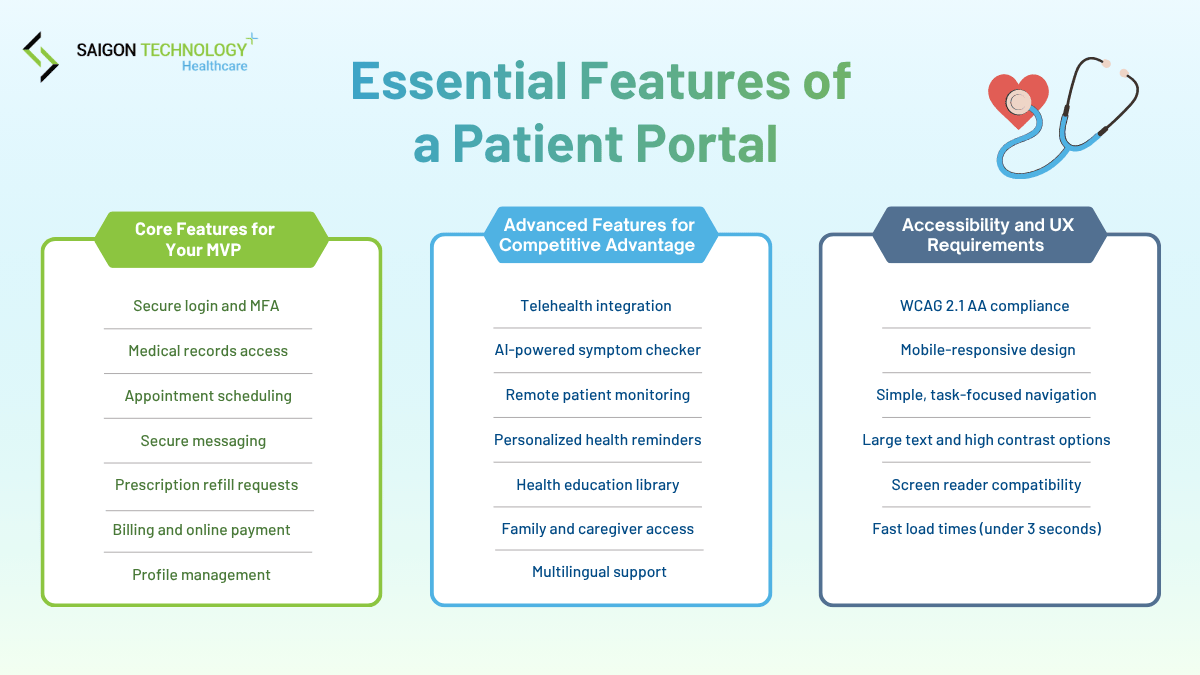
Choosing the right patient portal features starts with identifying what your patients will actually use. A strong portal balances clinical needs with user experience. Below is a breakdown of core, advanced, and accessibility features to guide your planning.
Core Features (MVP)
These are the must-have features for any patient portal to function and meet compliance standards.
| Feature | What It Does |
| Secure login and MFA | Protects patient data with multi-factor authentication (TOTP, SMS, or biometric) |
| Medical records access | Lets patients view lab results, visit summaries, diagnoses, and immunization history |
| Appointment scheduling | Allows patients to book, reschedule, or cancel visits online with real-time availability |
| Secure messaging | Enables encrypted, HIPAA-compliant patient-provider communication |
| Prescription refill requests | Lets patients request medication refills without calling the office |
| Billing and online payment | Shows invoices, payment history, and supports digital payment processing (PCI DSS compliant) |
| Profile management | Lets patients update personal details, insurance information, and emergency contacts |
Advanced Features for Competitive Advantage
These features set your portal apart and drive deeper engagement. They are not required at launch, but should be on your product roadmap.
| Feature | What It Does |
| Telehealth integration | Connects patients to providers through video or chat visits directly from the portal |
| AI-powered symptom checker | Guides patients through a pre-visit triage to help them understand when to seek care |
| Remote patient monitoring | Syncs health data from wearables and home devices (blood pressure monitors, glucose meters) in real time |
| Personalized health reminders | Sends automated alerts for medications, screenings, annual check-ups, and follow-ups |
| Health education library | Offers curated content based on patient conditions, procedures, and treatment plans |
| Family and caregiver access | Lets authorized users manage care for dependents, elderly parents, or patients with disabilities |
| Multilingual support | Serves diverse patient populations in their preferred language |
Accessibility and UX Requirements
A portal only works if every patient can use it. Accessibility and usability are not optional; they are compliance requirements (ADA, Section 508) and directly affect adoption rates.
| Requirement | Why It Matters |
| WCAG 2.1 AA compliance | Ensures access for users with visual, motor, or cognitive disabilities |
| Mobile-responsive design | Over 60% of patients access portals from phones or tablets |
| Simple, task-focused navigation | Reduces confusion and lowers support call volume |
| Large text and high contrast options | Improves readability for elderly and low-vision users |
| Screen reader compatibility | Makes all content and actions accessible through assistive technology |
| Fast load times (under 3 seconds) | Keeps patients engaged and reduces abandonment |
How to Build a Patient Portal: Step-by-Step Process
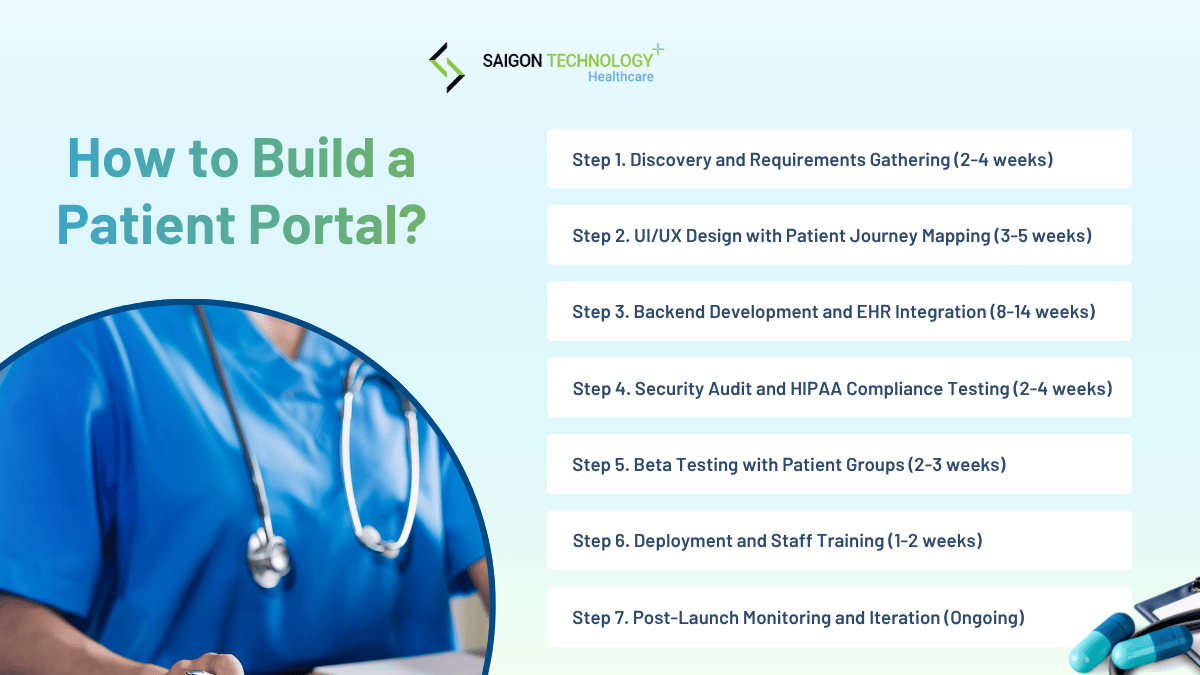
Step 1. Discovery and Requirements Gathering (2-4 weeks)
Start with a requirements analysis. Define your clinical goals, patient needs, and technical constraints. Interview providers, front-desk staff, patients, and IT administrators. Document regulatory requirements: HIPAA, GDPR, state-specific health data laws, and any payer-specific requirements.
A solution architect should assess your current systems and map out integrations with your clinical platform, lab systems, billing, and pharmacy. The output is a detailed project specification that guides every phase ahead.
From our experience: The most common planning mistake is underestimating EHR integration scope. If you use Epic, Cerner (now Oracle Health), or Allscripts, expect the integration spec alone to take 1-2 weeks. Legacy systems with limited API support take longer.
Step 2. UI/UX Design with Patient Journey Mapping (3-5 weeks)
Design the portal around real patient workflows. Map each touchpoint: login, viewing test results, booking an appointment, sending a message, paying a bill. Build wireframes and a clickable prototype. Test them with actual patients and clinical staff.
Strong UI/UX design at this stage prevents costly revisions after development starts. In our patient portal projects, we typically run 2-3 rounds of usability testing before signing off on the design.
Step 3. Backend Development and EHR Integration (8-14 weeks)
This is the most time-intensive phase. Your development team builds the core platform and connects it to clinical record systems through secure APIs (HL7 FHIR R4, HL7 v2, or vendor-specific endpoints).
Use agile sprints to deliver features in increments. Start with the MVP features first, then add advanced capabilities. Each sprint should produce a testable build that clinicians and stakeholders can review.
Recommended tech stack (based on our recent patient portal projects):
| Layer | Technologies |
| Frontend | React (Next.js) or Angular 16+, mobile-responsive |
| Backend | .NET Core/ASP.NET 6+ or Node.js with Express |
| Database | PostgreSQL or SQL Server with AES-256 encryption at rest |
| Authentication | OAuth 2.1, SAML/OpenID SSO, MFA (TOTP + biometric) |
| Cloud hosting | AWS (HIPAA-eligible) or Microsoft Azure with signed BAA |
| Integration | HL7 FHIR R4 APIs, DICOM for medical imaging |
| CI/CD | GitHub Actions, Docker/Kubernetes |
Step 4. Security Audit and HIPAA Compliance Testing (2-4 weeks)
Run penetration tests, vulnerability scans, and access control reviews. Verify that all data encryption (AES-256 at rest, TLS 1.2+ in transit), authentication flows, and audit logging meet HIPAA standards. This quality assurance and testing phase must cover every integration point, API endpoint, and data flow.
Skipping this step puts patient data and your organization at legal and financial risk.
Step 5. Beta Testing with Patient Groups (2-3 weeks)
Release the portal to a small group of real patients (typically 50-100 users across different age groups and technical comfort levels). Collect feedback on usability, speed, mobile experience, and clarity of medical information.
This phase catches issues that internal testing often misses, especially around health literacy, navigation confusion, and accessibility gaps.
Step 6. Deployment and Staff Training (1-2 weeks)
Roll out the portal to your full patient base. Train front-desk staff, nurses, and providers on how the system works, how to respond to portal messages, and how to troubleshoot common patient issues.
Provide quick-start guides, FAQ documents, and short video walkthroughs. A smooth launch depends on staff confidence as much as code quality.
Step 7. Post-Launch Monitoring and Iteration (Ongoing)
Track usage data, error rates, adoption rates, and patient feedback after go-live. Plan regular sprint cycles (every 4-6 weeks) for updates, bug fixes, and new features.
A patient portal is never finished. Continuous iteration keeps it secure, relevant, and aligned with changing patient needs and regulatory requirements.
How Much Does Patient Portal Development Cost?
Patient portal development typically costs between $50,000 and $400,000+, depending on feature scope, clinical system integration complexity, and compliance requirements. Here is what healthcare organizations can expect:
| Portal Type | Cost Range | Timeline | What’s Included |
| Basic MVP portal | $50,000-$100,000 | 3-4 months | Records access, scheduling, messaging, billing, MFA |
| Mid-range with integrations | $100,000-$200,000 | 5-7 months | MVP + EHR integration (Epic/Oracle Health), telehealth, reminders |
| Enterprise full-featured platform | $200,000-$400,000+ | 8-12 months | Full integration suite, AI features, remote monitoring, multilingual |
What Drives Cost Differences
The biggest cost variables are:
- EHR vendor and API maturity. Epic’s Open.Epic APIs are well-documented. Legacy systems with limited API support require custom middleware, which adds $20,000-$50,000+.
- Number of integrations. Each additional system (lab, pharmacy, billing, imaging) adds development and testing time.
- Compliance scope. HIPAA-only vs. HIPAA + GDPR + PDPA significantly affects architecture decisions and testing requirements.
- UI/UX complexity. A basic responsive design costs less than a fully accessible, multilingual portal with custom branding.
Ongoing Costs
| Category | Estimated Cost |
| Cloud hosting (HIPAA-eligible) | $1,000-$5,000/month |
| Maintenance and updates | 15-20% of initial build cost per year |
| Support, monitoring, and user training | Varies by patient base size |
These ranges reflect typical project costs based on our experience with U.S. and international healthcare clients. Your costs will vary based on your specific clinical system vendor, number of integrations, patient volume, and compliance requirements.
Patient Portal Requirements: Compliance and Technical
Building a patient portal means meeting strict compliance standards and technical benchmarks. Below are the specific requirements healthcare organizations need to address.
HIPAA Compliance (U.S.)
HIPAA is the baseline compliance standard for any patient portal handling protected health information (PHI) in the United States. Here are the specific technical requirements:
| Requirement | What It Covers |
| Data encryption | AES-256 encryption for data at rest, TLS 1.2+ for data in transit, SHA-256 for data integrity verification |
| Role-based access control (RBAC) | Access controls ensuring only authorized users (patients, providers, admins) can view or modify specific records |
| Multi-factor authentication | MFA at login using TOTP codes, SMS verification, or biometric authentication |
| Secure encrypted messaging | All patient-provider communication must use end-to-end encrypted messaging channels |
| Audit logs | Every PHI access event must be logged with timestamps, user IDs, IP addresses, and action details |
| Business Associate Agreements (BAAs) | Any third-party vendor handling PHI must sign a BAA confirming HIPAA compliance |
| SSL and PCI DSS certification | Portals processing payments must use SSL/TLS and meet PCI DSS standards |
| Breach notification | Documented breach notification process; notification required within 60 days of discovery |
Global Compliance Considerations
| Regulation | Region | Key Requirements |
| GDPR | EU and UK | Explicit consent for data processing, right to access and delete data, breach notification within 72 hours |
| PDPA | Singapore | Consent for data collection, patient right to access and correct records |
| Australia Privacy Act | Australia | Strict rules on data storage, cross-border data transfer, and patient access rights |
EHR/EMR Integration Standards
| Standard or System | Role in Integration |
| HL7 FHIR R4 APIs | The primary standard for clinical data exchange between portals and health systems; supports RESTful API patterns |
| HL7 v2.x | Legacy standard still used by many hospital systems; often required for ADT (Admit/Discharge/Transfer) messages |
| DICOM | Standard protocol for medical imaging data; required for radiology and imaging system connections |
| Epic (Open.Epic) | Largest U.S. EHR vendor; integration via the Open.Epic developer portal |
| Oracle Health (formerly Cerner) | FHIR APIs available through HealtheDataLab |
| Allscripts | Supports both FHIR and HL7 v2 integration |
| Healthcare CRM and LIS | Connect patient engagement workflows and lab information system data to the portal |
Infrastructure Requirements
| Requirement | What to Plan For |
| HIPAA-eligible cloud hosting | AWS, Microsoft Azure, or Google Cloud with signed BAAs and HIPAA-eligible service configurations |
| Security certifications | SOC 2 Type II and HITRUST CSF certifications to meet healthcare security standards |
| Data storage compliance | Region-specific storage (e.g., EU data stays in EU), encrypted backups, and documented retention policies |
| Third-party integration readiness | Architecture that supports secure API connections with labs, pharmacies, imaging centers, and payment gateways |
Custom vs. SaaS Patient Portals: Which Should You Choose?
Each approach involves trade-offs in flexibility, cost, and speed to market. The right choice depends on your budget, timeline, existing clinical infrastructure, and long-term goals.
| Criteria | Custom Development | SaaS Portal |
| Flexibility | Fully tailored to your workflows, branding, and patient population | Limited to vendor-provided features and configurations |
| Time to market | 4-12 months depending on scope | Days to weeks with pre-built setup |
| Upfront cost | Higher: $50,000-$400,000+ | Lower: subscription-based monthly fees ($10,000-$50,000/year estimated) |
| Long-term cost | Lower over time since you own the product | Ongoing fees that increase with usage, users, and feature tiers |
| Clinical system integration | Deep, custom integration with any system via FHIR, HL7, or vendor APIs | Limited to vendor-supported connections |
| Scalability | Scales with your architecture and infrastructure | Depends on vendor infrastructure and your subscription tier |
| Compliance control | Full control over HIPAA configuration, encryption, and access policies | Shared responsibility model with the vendor |
| Data ownership | You own the code, data, and infrastructure | Vendor owns the platform; you license access |
When to choose custom: You have complex multi-system environments, unique clinical workflows, multiple clinical system vendors, or need full data ownership and long-term flexibility. Custom development also makes sense when you plan to serve the portal to a large patient base (50,000+) where per-user SaaS pricing becomes expensive.
When to choose SaaS: You run a smaller practice on a single platform (like Epic MyChart or Oracle Health Patient Portal), need to launch fast, and have standard workflows. SaaS portals work well as a starting point.
Hybrid approach: Many organizations start with their clinical system vendor’s built-in portal, then add custom-developed features through FHIR APIs as their needs grow.
Common Challenges in Patient Portal Development
Building a patient portal involves more than technology. These are the challenges we see most often, and how to address them.
Low Patient Adoption
Even well-built portals can fail if patients find the sign-up process confusing, the mobile experience frustrating, or the navigation unclear. Adoption rates for new portals typically range from 20-40% in the first six months.
What works: Simplify the onboarding flow to 3 steps or fewer. Make the most common actions (view results, book appointment, send message) accessible within one tap from the home screen. Send activation emails and text reminders. Train front-desk staff to help patients register during check-in.
Clinical System Integration Challenges
Connecting a portal to clinical systems is the most technically challenging part of the project, especially with older clinical platforms that have limited API support. A portal without a solid connection to these systems has limited long-term value.
How to manage this: Use standardized HL7 FHIR R4 APIs wherever possible. For legacy systems, build middleware to translate between older formats (HL7 v2) and modern API standards. Budget 20-30% more time for integration than your initial estimate, especially for multi-system environments.
Compliance and Security Gaps
Gaps in encryption, access control, or audit logging can create serious legal exposure. A single HIPAA violation can cost $100 to $50,000, and breaches involving multiple records can result in millions in fines plus reputational damage.
How to prevent this: Build security into the architecture from day one. Use AES-256 encryption for all stored PHI, enforce RBAC at every endpoint, log all access events, and run penetration tests before launch and quarterly after. Work with a development partner who has ISO 27001 certification and healthcare compliance experience.
Scope Creep and Budget Overruns
Requirements tend to expand during development as stakeholders see what is possible. Poor initial scoping is the most common cause of delays and cost overruns.
How to control this: Define a clear MVP scope before development starts. Document what is in scope and what is deferred to Phase 2. Use agile sprints with a fixed backlog per sprint. Add new features only through a formal change request process.
Real-World Results: Patient Portal Case Studies
AxiaGram: Managing 6M+ Medical Records
When a U.S. healthcare organization needed a system to manage over 6 million medical records, Saigon Technology’s dedicated development team built a HIPAA-compliant platform that cut development time by 40% compared to the client’s original in-house estimates. The project involved complex clinical system integration, role-based access for multiple provider types, and secure patient-facing record access.
HealthCare Connect: 50,000+ Monthly Patient Interactions
For a telehealth platform requiring patient portal capabilities, our team built a system handling over 50,000 patient interactions per month, including video consultations, secure messaging, appointment scheduling, and health record access, all within a HIPAA-compliant architecture.
See more healthcare projects and our development approach.
FAQs
How long does it take to develop a patient portal?
It typically takes 4-9 months from planning to launch. An MVP with core features (health records, scheduling, and secure messaging) takes 3-4 months. A full system with deep EHR integration (Epic, Oracle Health, Allscripts), telehealth, and AI features takes 8-12 months. The most time-intensive phase is backend development and clinical system integration, which alone takes 8-14 weeks.
What are the HIPAA requirements for patient portals?
HIPAA requires portals to use AES-256 encryption for stored data and TLS 1.2+ for data in transit. You also need role-based access controls, full audit logs of all PHI access and changes, signed BAAs with every third-party vendor, and a documented breach notification process (notification required within 60 days of discovery).
Portals must also enforce automatic session timeouts and multi-factor authentication. Fines range from $100 to $50,000 per violation, with annual caps up to $1.5 million per violation category.
Can I integrate a patient portal with my existing EHR system?
Yes. Most modern portals integrate via HL7 FHIR R4 APIs. Epic offers integration through the Open.Epic developer portal. Oracle Health (formerly Cerner) provides FHIR APIs through HealtheDataLab. Allscripts supports both FHIR and HL7 v2 standards.
Integration complexity depends on your EHR vendor’s API maturity, the number of systems involved, and whether you need real-time or batch data synchronization.
Should I build a custom patient portal or buy a SaaS solution?
Custom portals cost $50,000-$400,000+ but give you full control over features, UX, data, and integrations. SaaS options like Epic MyChart or Oracle Health Patient Portal cost an estimated $10,000-$50,000 per year and launch in 2-3 months, but limit customization.
Choose custom if you have complex multi-system setups, unique workflows, or a large patient base where per-user SaaS fees become costly. Choose SaaS if you use a single clinical system with standard processes. Many organizations mix both: start with the vendor portal, then extend with custom features through FHIR APIs.
What is the difference between a patient portal and an EHR?
An EHR (Electronic Health Record) is the provider-facing system where clinicians document patient care, manage orders, and track clinical data. A patient portal is the patient-facing application that gives individuals secure access to view their own records, communicate with providers, schedule appointments, and manage billing.
The portal connects to the EHR through APIs but serves a different user and purpose.
Is a patient portal required by law?
In the U.S., there is no specific federal law mandating patient portals by name. However, the 21st Century Cures Act requires providers to give patients electronic access to their health information and prohibits information blocking. HIPAA Privacy Rule gives patients the right to access their records electronically.
In practice, a patient portal is the most common and practical way to meet these requirements. Centers for Medicare & Medicaid Services incentive programs (like Promoting Interoperability) also tie reimbursement bonuses to patient electronic access metrics.
How do I choose the best technology stack for a patient portal?
The right stack depends on your existing infrastructure, team skills, and compliance needs. For most healthcare portal projects, we recommend: React or Angular for the frontend (strong component libraries and accessibility support), .NET Core or Node.js for the backend (mature, well-supported frameworks with strong security libraries), PostgreSQL or SQL Server for the database, and AWS or Azure for HIPAA-eligible cloud hosting with signed BAAs.
The integration layer should support HL7 FHIR R4 and include API rate limiting, OAuth 2.1 authentication, and comprehensive audit logging.
Conclusion
Patient portal development is a clear, phased process that requires healthcare domain expertise, HIPAA compliance experience, and strong clinical system integration skills. Whether you build a basic MVP or a full-featured platform, success comes from well-defined requirements, the right tech stack, and a development partner who understands both the technical and regulatory sides.
Next steps:
- Define your feature scope and identify your MVP
- Decide between build, buy, or hybrid based on your existing clinical infrastructure and budget
- Plan for 4-9 months of development with a budget of $50,000-$400,000+
- Choose a partner with proven healthcare software delivery and HIPAA expertise
Need a development partner with healthcare experience? Saigon Technology’s teams specialize in HIPAA-compliant patient portal development, from requirements through launch and ongoing support. We have delivered 800+ projects with ISO 9001 and ISO 27001 certification.


Related articles

Logistics Optimization in 2026: Strategies, Software & AI
 Huy (Harvey) Bui - Project Manager
  16 Oct 2026
AI Route Optimization: How It Works, Benefits, and Use Cases 2026
14 Oct 2026 
Student Information System: A 2026 Guide for Schools
09 Oct 2026 
Insurance Portal Development in 2026: Types, Features, Cost
07 Oct 2026 
Insurance Claims Automation in 2026: Build, Buy, or Hybrid
01 Oct 2026 
IoT in Healthcare: How Healthcare IoT Systems Work in 2026
25 Sep 2026 
AI in Real Estate: 9 Use Cases and How to Build It (2026)
16 Sep 2026 
AI Healthcare Software Development: Architecture & Cost
13 Sep 2026 
8 Fintech Software Development Trends Reshaping 2026
26 Aug 2026