-
OVERVIEW
-
SERVICES
-
MODELS
-
WHY CHOOSE US ?
-
OUR PROCESS
-
TECHNOLOGIES
-
FAQS
What Are Offshore AI Developers?
Offshore AI developers are machine learning and data engineers employed by a partner company in another country, working as part of your engineering organisation on your AI systems. They differ from generalist offshore engineering teams in what they are accountable for: training and evaluating models, building the data pipelines that feed them, and keeping them accurate in production as inputs shift. The role spans data engineering, model development, and MLOps, not application code alone.
That distinction matters commercially. A team that can build a web application cannot necessarily tell you whether your training data is representative, why a model's accuracy degraded after launch, or what it costs to serve inference at your volume. Those questions decide whether an AI project reaches production, and they are the questions our AI engineers are hired to answer.
Our Offshore AI Development and Engineering Services
Embed offshore AI engineers in your existing team
Offshore AI and ML engineering PODs
Generative AI and LLM integration
Machine learning, computer vision, and NLP engineering
MLOps and model operations
Data engineering and data annotation
Dedicated offshore AI team or AI development center (ODC)
AI system support, updates, and model maintenance
Build-Operate-Transfer for an AI center
Case Studies: AI-Augmented Delivery and Offshore Engineering in Production
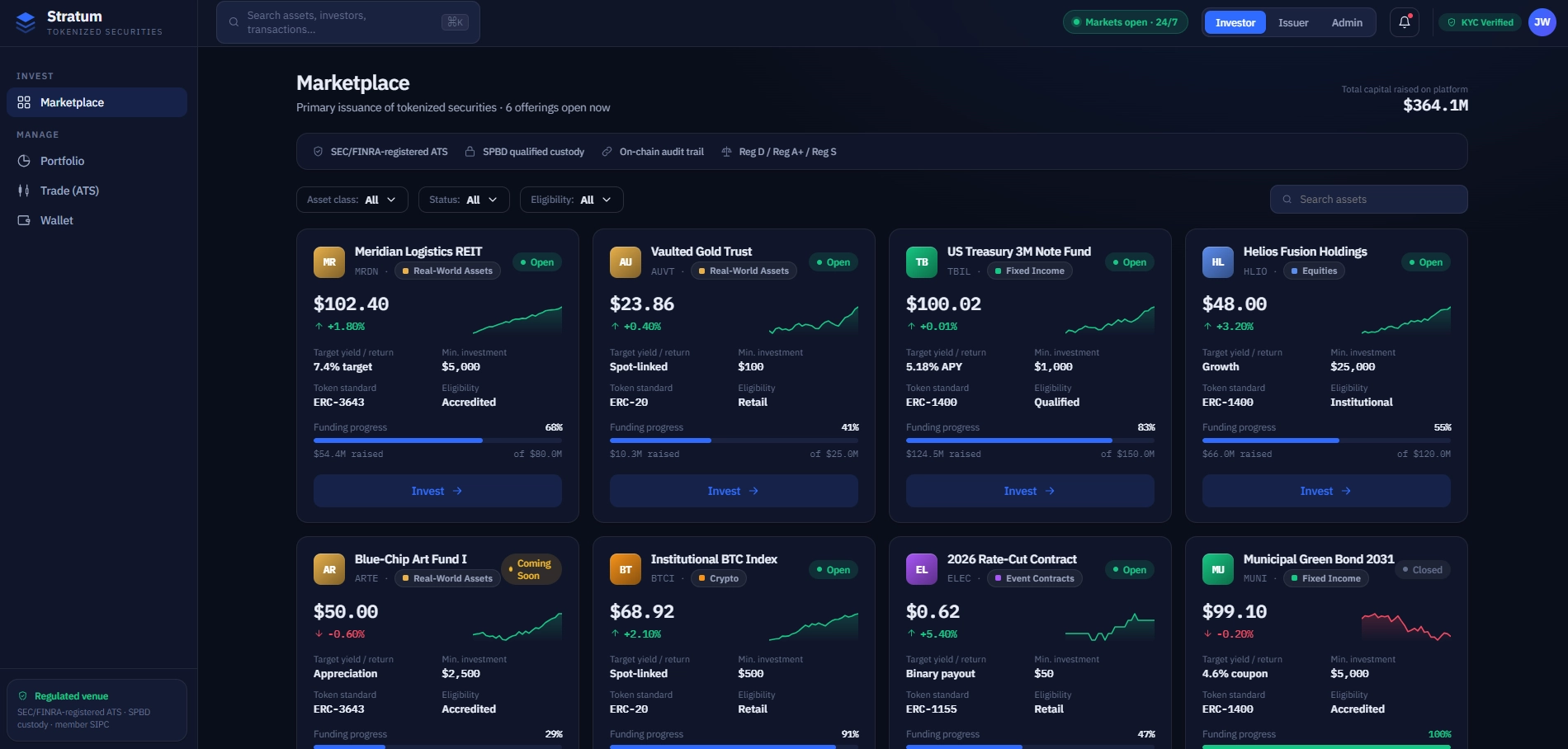
AI-Augmented Engineering for a Multi-Asset Capital Markets Platform
- Challenge: ship features faster across a complex multi-service platform without compromising correctness or safety, while expanding partner-facing APIs and sustaining production reliability on regulated financial systems.Â
- What we built: a Primary Issuance backend with new API endpoints, service-layer logic, and database migrations; external partner-facing REST APIs; and a unified multi-asset platform covering primary issuance, secondary market trading, crypto, equities, event contracts, fixed income, and real-world assets.Â
- How AI was used: engineers use AI coding assistants the way they use a linter or an IDE, to accelerate implementation, generate tests, reduce boilerplate, write documentation, and speed up code review. This is AI applied to delivery, not a machine learning product.Â
- Engagement: Forward Deployed AI Engineer model, with engineers embedded in the client's teams.Â
- Stack: Kotlin/Ktor, TypeScript, Next.js, React Native, GCP, BigQuery, Cloud Pub/Sub, Docker, Kubernetes, GitLab CI/CD, HashiCorp Vault.Â
- Read the full case study →
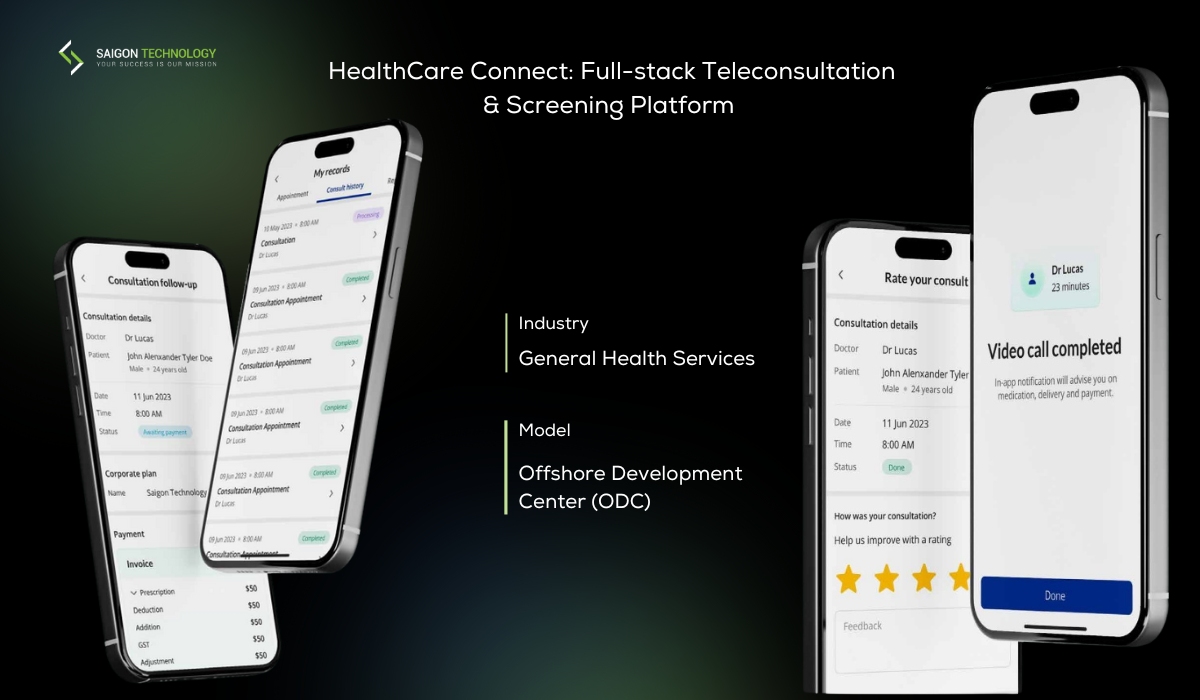
HealthCare Connect: Teleconsultation and Screening Platform
- Challenge: automate screening and consultation workflows across multi-location clinics, connect external lab and delivery systems, and flag abnormal results fast enough to act on.
- What we built: teleconsultation with real-time video and prescription management, HL7 lab integration with automated report generation, online screening booking with digital consent, QR code check-in with payment reconciliation, and a critical-value alerting system across email and SMS.
- Engagement: Offshore Development Center, ongoing since 2022.
- Outcome: handled more than 50,000 patient interactions each month, with reduced missed follow-ups through automated reminders.
- Stack: Angular, Node.js, PostgreSQL, WebRTC, HL7, Stripe. End-to-end encryption, aligned with HIPAA and PDPA.
- Read the full case study (PDF) →
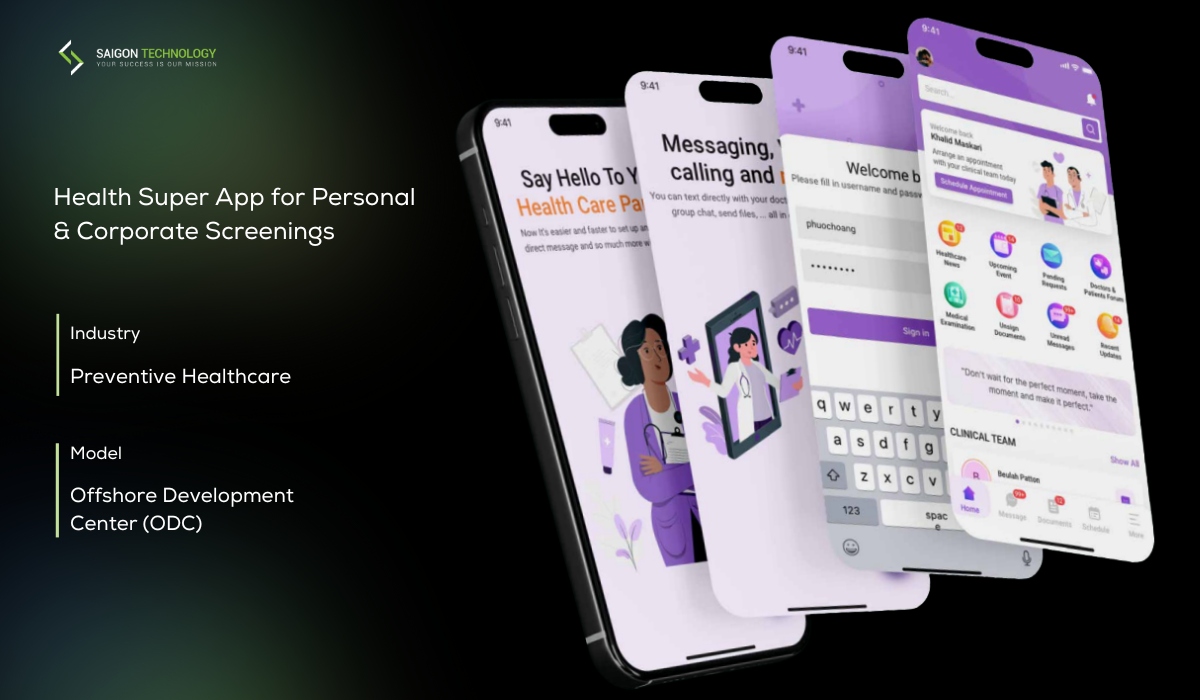
Health Super App for Personal and Corporate Screenings
- Challenge: serve individual and corporate users in one mobile application, with distinct booking workflows, dynamic pricing, and refund logic tied to screening changes.
- What we built: personal and corporate screening journeys, QR check-in with digital consent, follow-up booking for pending radiology and vaccinations, and a health dashboard with result trends and alerts.
- Engagement: Offshore Development Center, ongoing since 2022, deployed across clinics and corporate programmes in Southeast Asia.
- Stack: React Native, Node.js, Firebase, PostgreSQL, Stripe. AES-256 encryption, aligned with PDPA in Singapore.
- Read the full case study (PDF) →
Send Your AI Brief. See a Working Prototype in Two Business Days.
- Clickable prototype of your model, data pipeline, or inference flow
- Workflow visualization mapping the full data-to-decision chain
- Architecture direction covering model hosting, data-pipeline integration, and scale
- Technical recommendation call with our engineering team
Why Choose Saigon Technology as Your Offshore AI ML Company
A good offshore AI ML company supplies engineers who have shipped models into production, not just trained them in notebooks. Judge any such partner on four things: whether senior engineers own the architecture, whether security covers training data as well as code, whether you can inspect working models before you sign, and whether the team stays.Â
Engineers paired with AI, at a published $22-$46 per hour
Our stated ratio: one senior engineer plus AI tooling in place of three juniors. That matters more on AI work, because the expensive failures are silent. A junior-heavy team ships a model that scores well on a held-out split and degrades quietly in production, so you pay twice: once to build it, once to learn why it stopped working. Our published rate is $22-$46 per hour with senior oversight included, against a market band of roughly $40 to $70 plus. At onshore rates, monitoring and retraining pipelines are the first line items cut.Â
"A senior engineer with AI tooling reviews more code than they write. That changes the arithmetic: you need fewer people on the same scope, and fewer handoffs means fewer defects to pay for twice." - Thanh Pham, Chief Executive Officer, Saigon TechnologyÂ
See the models working before you commit
Most AI capability claims are unverifiable at the point you have to decide. Ours are not. Our Research Labs publish working demos at experiment.saigontechnology.vn: fracture detection on medical imaging, semantic search, OCR, and object detection. Open them, feed them inputs, judge the output before a contract exists.
That is rare among providers ranking for offshore AI work, and it changes the first conversation from whether we can build it to whether the approach fits your data.
Your models, your training data, your weights
AI engagements create assets that generic outsourcing contracts describe badly. Who owns a fine-tuned model, where its training data came from, and what happens to the weights at contract end are all worth settling in writing before work starts, not at renewal. We operate under ISO 27001 with role-based access controls, NDAs, and a secure lifecycle aligned to GDPR and PDPA, covering training data and model artefacts, not just source code.
The team that trained your model is still there when it drifts
A model is a long-lived deliverable. It needs retraining as inputs shift, and the engineers who chose its features and evaluation criteria are the ones who can do that safely. Churn on an AI team does not just slow new work, it strands what you already deployed. That is why we read workplace recognition as a technical signal: ranked #10 in the Medium category of Southeast Asia Best Workplacesâ„¢ in Technology 2026 by Great Place To Work, and named to Fortune 100 Best Companies to Work Forâ„¢ Southeast Asia 2025.
ISO 9001 and ISO 27001, certified by BSI (UK)
Third-party audited, not self-declared, and held for over a decade rather than acquired for a tender. Also a Microsoft Gold Partner. For a regulated buyer, that is the difference between trusting our security posture and reading an auditor's view.
Saigon Technology at a glance
| Published rate |
$22-$46/hour, senior-led
|
| Team |
400+ developers · 3 development centers
|
| Track record |
14+ years · 850+ projects · 350+ clients · 4.8-star Clutch rating
|
| Certifications |
ISO 9001, ISO 27001 (BSI, UK) · Microsoft Gold Partner
|
| Engagement models |
Staff augmentation · dedicated team · project-based · fixed-price · Build-Operate-Transfer
|
| AI verticals |
Healthcare · financial services · logistics · business software
|
|
US overlap
|
10 to 12 hours with East and West Coast teamsÂ
|
On this page you will notice our case studies are offshore delivery and AI-augmented engineering rather than a headline AI build with a percentage attached. That is deliberate. We would rather show work you can verify than quote a number we cannot source.
Five engagement models, and a trial before you commit
Staff augmentation, dedicated team, project-based outsourcing, fixed-price, and Build-Operate-Transfer. Interview candidates first, then run a two-week risk-free trial on real tasks before committing. If the fit is wrong, you find out in week two rather than quarter two.
Architecture advice from day one, including when not to build
Sometimes your problem does not need a model, or your data is not ready. We would rather say so in week one than bill for a year discovering it.
Trusted by Global Clients
What Our Clients Say
Industries We Serve
Offshore AI Engineers vs Onshore Hiring: What Actually Changes
Going offshore changes three things, not just the rate: how fast you can start, how much senior attention you get per dollar, and how much control you keep. The tables below are our own assessment, not third-party research: cost and time zones, then talent depth.
| Where you hire | Typical cost | Time-zone overlap with US |
|---|---|---|
| Onshore hire | Highest | Full |
| Southeast Asia | Low | Limited, needs scheduling |
| Eastern Europe | Mid | US mornings |
| Latin America | Mid | Strong |
| India | Low | Limited |
| Where you hire | AI talent depth | Best fit |
|---|---|---|
| Onshore hire | Deep, scarce, contested | Work that must sit in-house |
| Southeast Asia | Growing, strong in applied ML and data engineering | Long-running delivery and applied AI at sustained cost |
| Eastern Europe | Deep in enterprise ML and computer vision | R&D-heavy enterprise ML |
| Latin America | Growing, strong Python base | Real-time collaboration |
| India | Largest pool, widest variance | Very large-scale execution |
No region wins on every axis. Southeast Asia costs less and suits sustained delivery, not real-time bursts. We hold 10 to 12 hours of US overlap.
Access to a global talent pool
Senior ML, MLOps, and computer vision skills that local markets ration, available without a multi-quarter search.Â
Cost per outcome, not cost per hour
The saving comes from needing a smaller senior team on the same scope and rebuilding less, not from a cheaper hourly rate. Rate alone is the wrong number to optimise. Our guide to how to hire offshore developers works through that trade-off in detail.
Scaling teams in both directions
Add engineers for a model launch, reduce after it stabilises, without severance exposure or a hiring freeze problem.
Faster project turnaround time
Parallel work across data engineering, modelling, and MLOps rather than a sequential queue behind one internal specialist.
Risk management transferred
Recruitment, retention, payroll, and infrastructure sit with us. You keep the roadmap and the architecture.
How We Build Your Offshore AI Team
Requirements analysis
We map the AI problem, not just the job description: data available, the decision the model has to support, the target accuracy, and the constraint that actually binds. This is where we tell you if the scope is wrong.Â
Role definition and candidate shortlists
We define whether you need an ML engineer, a data engineer, an MLOps engineer, or an architect, then shortlist against it. Every candidate passes three independent screening rounds covering engineering depth, English proficiency, soft skills, and logical thinking, assessed by Talent Acquisition, a Tech Lead, and HR.
Your interviews and technical assessments
You interview every engineer and run your own technical assessments before anyone joins. No allocation without your approval.
Two-week risk-free trial
Work with the team on real tasks before any long-term commitment.
Onboarding into your process
Your repositories, your sprint rituals, your code review standards, your definition of done. We agree communication tools, regular syncs, and named owners on both sides in week one.
Delivery against measurable KPIs
Model accuracy, latency, time to insight, and delivery predictability, reviewed in sprint ceremonies under an agile methodology with CI/CD pipelines and visible progress.
MLOps handover and ongoing support
Retraining schedules, monitoring, drift detection, and knowledge sharing so the capability stays with you, not only with us.
Our Insights
FAQs
Who do we build AI teams for?
- Companies with an AI roadmap and no AI headcount. You have executive commitment and a backlog of use cases, and local hiring cycles for senior ML engineers are measured in quarters.
- Product teams scaling a model already in production. The prototype worked. Now it needs a retraining pipeline, monitoring, and someone accountable for model drift.
- Regulated industries. Healthcare and financial services teams that need AI built under HIPAA, HL7, GDPR, or PDPA constraints, with auditable access controls over training data.
- Startups validating an AI product. You need a working proof of concept and an honest read on feasibility before raising or committing a budget.
What AI stack, standards, and compliance do we build on?
Languages and frameworks: Python, TensorFlow, PyTorch, scikit-learn, OpenCV, and large language models including the ChatGPT and LLaMA families. Java, .NET, Node.js, and TypeScript where AI has to integrate with an existing application estate.
Data and MLOps: pipeline and warehouse development, feature stores, vector databases, experiment tracking, model registries, drift detection, and CI/CD for models. Cloud and DevOps on AWS, Azure, and Google Cloud with Docker, Kubernetes, and Terraform.
Frontend and mobile: React, Angular, Vue.js, React Native, and Flutter, for the interfaces that put a model in front of a user.
Certifications we hold: ISO 9001 for quality management and ISO 27001 for information security, both issued by BSI in the UK. Microsoft Gold Partner.
Regulatory alignment: GDPR and PDPA by default, with NDAs, role-based access controls, and a secure development lifecycle covering source code, training data, and model artefacts. HIPAA and HL7 for healthcare engagements that require them. Where your sector requires a standard we do not hold, we will say so directly rather than imply coverage.

Should you embed an offshore AI engineer or hire a full-time one?
Embedding places an experienced offshore AI engineer inside your team on a contract basis, usually within weeks, with recruitment, payroll, and retention handled by the provider. A full-time hire gives you permanent capacity and full cultural integration, but takes a quarter or more to fill for senior ML roles and carries fixed cost through quiet periods. Embedding suits variable or urgent capacity; direct hiring suits a permanent core capability.Â
Embedded AI engineers or an AI consulting retainer: which do you need?
Embedded engineers build under your direction, inside your process, on your backlog. A consulting retainer gives you advice and recommendations, usually delivered as documents and workshops, with implementation left to you. Embedding is execution capacity you control; consulting is expertise you buy access to. Many companies use consulting to choose a direction, then embedded engineers to build it.
How much does it cost to hire an offshore AI team?
Our published rate is $22 to $46 per hour with senior oversight included, against a market band of roughly $40 to $70+ per hour. AI and ML work sits at the upper end of any provider's range, as does regulated-industry work in healthcare and finance. Monthly cost per full-time engineer typically runs $3,200 to $10,500 depending on seniority and specialisation.


How long does it take to onboard an offshore AI team?
What we can commit to is the sequence: role definition, shortlisting against three screening rounds, your interviews and technical assessments, then a two-week risk-free trial before any long-term commitment.
Should we choose onshore or offshore for AI development?
Keep it onshore when the work cannot leave your building for regulatory or security reasons, or when it depends on continuous real-time collaboration with people who are also onshore. Choose offshore when the constraint is senior AI capacity you cannot hire locally, when the work runs for quarters rather than weeks, and when cost per delivered outcome matters more than same-timezone availability. Many teams run both.


Who owns the trained models, the training data, and the fine-tuned weights?
You do. Ownership of models, derived datasets, and fine-tuned weights should be stated explicitly in the contract, alongside where training data originated and what happens to artefacts at contract end. Ask any provider for its ISO 27001 certificate or SOC 2 report and for written confirmation that IP assignment covers model artefacts, not source code alone. We work under ISO 27001 with role-based access controls over training data.
What roles can we hire as offshore AI engineers?
ML engineers, data engineers, MLOps engineers, NLP engineers, computer vision engineers, data scientists, and AI solution architects. Teams are backed by a senior bench including a Senior Solution Architect, backend and frontend Tech Leads, a Tech Lead (AI, Python), and Project Managers, with domain depth in healthcare, financial services, logistics, and business software. If the team also needs non-AI engineering roles, you can hire software developers under the same engagement models.