
































































-
OVERVIEW
-
SERVICES
-
MODELS
-
WHY CHOOSE US ?
-
OUR PROCESS
-
TECHNOLOGIES
-
FAQS
What Is AI Modernization?
AI modernization is the practice of using AI to modernize legacy software, and of restructuring that software so AI can work on it afterwards. It runs in two directions at once: AI as the method (reading undocumented code, proposing refactors, generating tests) and AI-readiness as the outcome (clean interfaces and reachable data, so models and agents can operate against the system in production).
Most treatments pick one direction. That is why so many programmes stall: teams buy tooling to accelerate a rebuild without fixing the data surfaces the models will later need, or they chase AI-ready architectures while the technical debt underneath stays unread and unchanged.
Saigon Technology runs both directions as a single sequence. Every engagement starts with comprehension, you cannot safely change what nobody has read, and finishes with an AI-native foundation the business can actually build on. That is what AI-native modernization means in practice, rather than as a slogan.
Our AI Modernization Services
AI Readiness Assessment
AI-Assisted Code Comprehension
This is the hard part, and it is where most programmes fail. When the people who wrote a system have gone, its business rules live only in the code. We use AI-powered static code analysis and large-language-model tooling to recover those rules from COBOL, legacy .NET, and Java estates, including mainframe codebases where mainframe modernization has stalled for years.
The output is documentation: extracted logic, process signals, and the institutional knowledge and domain knowledge your team lost, written down before a single line changes.
AI-Assisted Refactoring and Re-Engineering
With rules recovered, change becomes safe. LLM-assisted code generation accelerates the mechanical work: modernizing syntax, breaking apart monoliths, replacing dead dependencies, while senior engineers own every architectural decision. This is AI-driven engineering applied inside a disciplined SDLC, not autocomplete pointed at production.
Whether a given component should rehost, refactor, encapsulate, or be rebuilt outright is an evidence-based call rather than a template, our guide to the 7 Rs of legacy modernization walks through the options in plain English.
AI-Driven Test Synthesis and Regression Safety
Making Legacy Data Reachable by AI
GenAI and Agent Integration
Cloud-Native Re-Platforming
Case Studies - AI Delivered Into Real Production Systems
These three are AI build engagements rather than legacy rebuilds. We would rather show you verifiable adjacent work than dress a greenfield project up as a modernization.
Some of our modernization work sits under non-disclosure agreements that bar us from publishing details, which is why the three engagements above are AI builds rather than rebuilds. The same protection applies to your system. Detailed references are available under NDA on request, and a senior engineer can walk you through comparable work on a call.
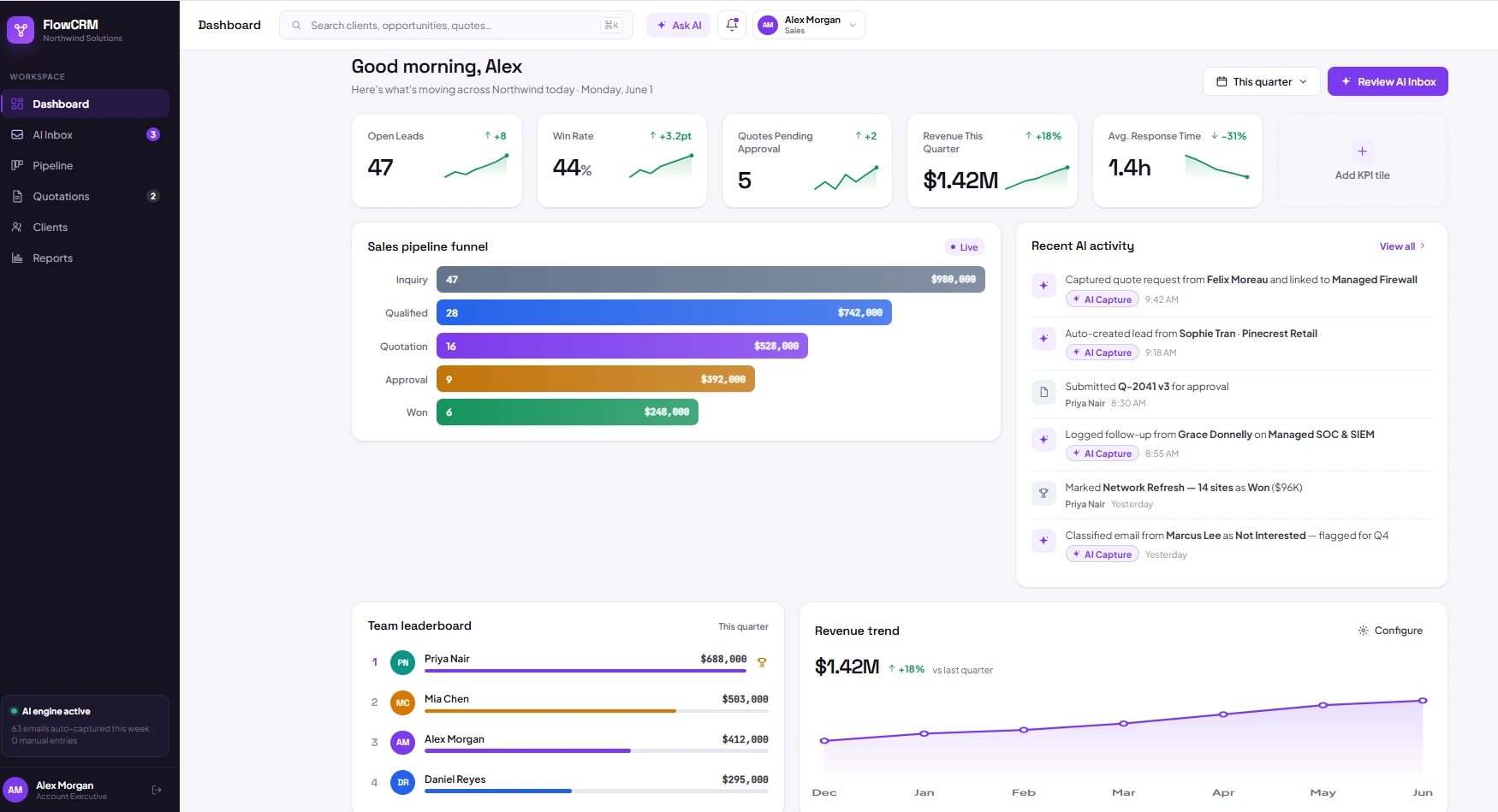
FlowCRM - AI-Assisted Capture Replacing Inbox-and-Spreadsheet Sprawl
- Challenge: leads, quotations, client history, and delivery status lived across scattered inboxes and spreadsheets, with no single source of truth and heavy manual re-entry.
- What we built: a custom CRM and operational command centre covering the full lead-to-quotation-to-delivery lifecycle, with an AI-assisted layer that reads incoming mail, extracts the data, and files it against the right lead, client, and opportunity automatically.
- Engagement: custom software development.
- Outcome: one source of truth across commercial and execution workflows; automation of CRM data entry; version-controlled quotations with role-based access and full audit logs; real-time insights across departments for sales, operations, and management.
- Stack: web-based application, Microsoft Outlook / Exchange via Microsoft Graph, AI-assisted classification and tagging, role-based access control, audit logging, configurable KPI dashboards.
Design note: automatic capture was built into the data model rather than bolted on at the end, reducing manual entry is a property of the system, not a feature toggle. Read the full FlowCRM case study.
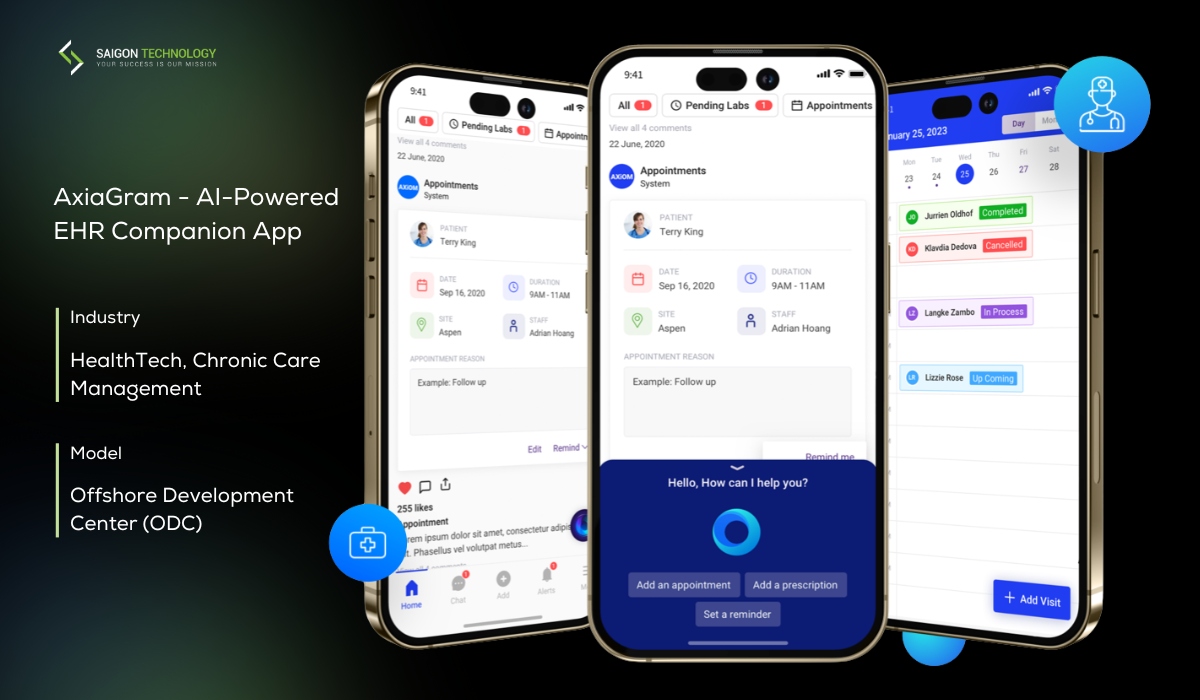
AxiaGram - AI EHR Companion Integrated With US Hospital Systems
- Challenge: clinicians needed remote consultations and documentation that fit existing hospital record systems instead of adding another disconnected tool.
- What we built: a telemedicine and care-coordination platform with voice-driven clinical note-taking powered by AI, secure video consultations, internal care-team messaging, and electronic visit verification with geo-tagging and digital signature.
- Engagement: Offshore Development Center.
- Outcome: integrated with US hospital record systems so documentation flowed into existing clinical workflows rather than around them.
- Read the full case study (PDF) →
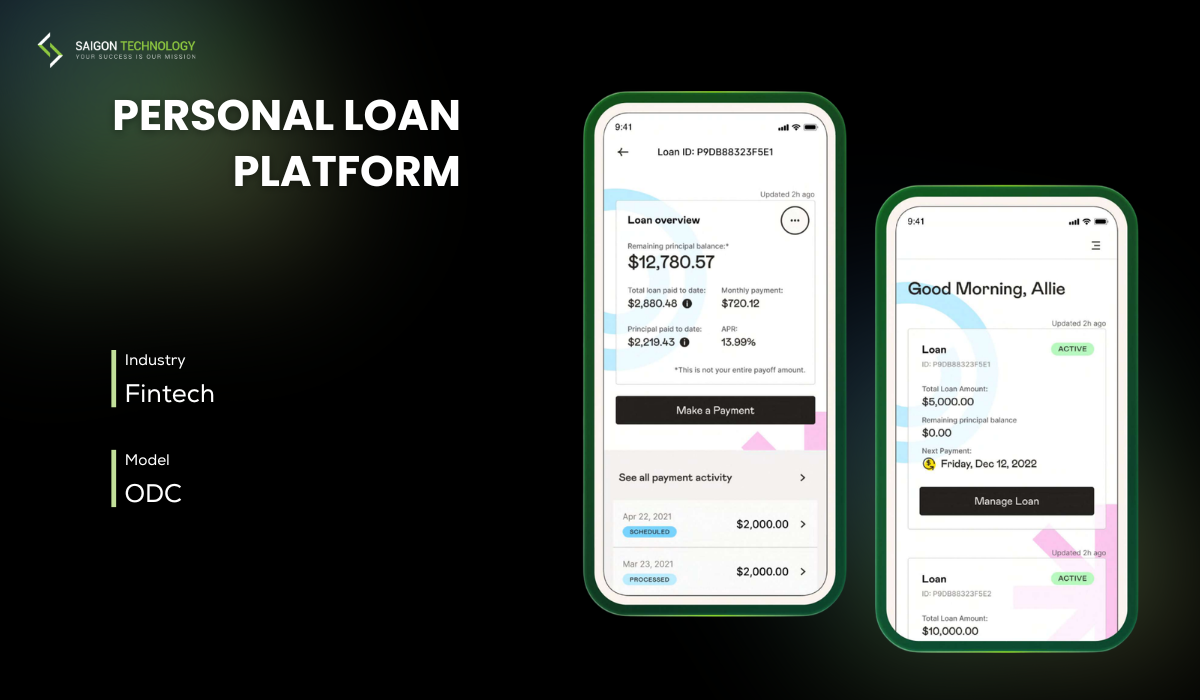
Personal Loans Application - AI-Supported Underwriting and Fraud Decisioning
- Challenge: a lender needed the full loan lifecycle automated, onboarding, identity and income verification, underwriting, disbursement, repayment, and collections, with fraud caught in real time.
- What we built: a loan management platform with identity, employment, income, and bank-account verification, plus machine learning and predictive analytics supporting credit-risk assessment through a configurable decisioning framework with traceable decision logs.
- Engagement: Offshore Development Center.
- Read the full case study (PDF) →
Send Your Legacy System. See the Path Out in 48 Hours.
- Clickable prototype of your legacy workflow, data model, or integration surface
- Workflow visualization mapping the full legacy-to-modernized chain
- Architecture direction covering code comprehension, regression safety, and scale
- Technical recommendation call with our engineering team
Why Choose Saigon Technology as Your AI Modernization Company
A good AI modernization company can prove it understood your system before it changed anything. That means recovering the business rules buried in undocumented code, testing the new build against the old behaviour rather than a specification, and putting senior engineers, not a junior bench, on decisions that are expensive to reverse.
Senior engineers plus AI, at $22–$46/hour
Our published rate for implementation work is $22–$46/hour, senior-led throughout, with 10–12 hours of daily overlap for US East and West Coast teams and developers fluent in English. The economics matter specifically on modernization: one senior engineer working with AI tooling replaces roughly three juniors, and modernization is exactly the work where junior-heavy staffing is most dangerous.
At premium onshore rates, the line items cut first are hardening, documentation, and regression coverage, the three things that determine whether a modernized system survives its second year.
Security and compliance when the work touches production
Modernization edits systems that are already live, already holding customer data, and already inside an audit scope. We work under a secure SDLC with NDAs, role-based access, and compliance controls aligned to GDPR and PDPA, extending to HIPAA and HL7 for healthcare and to PCI-DSS and SOC 2 expectations in financial services.
Where we apply AI to your codebase, we treat it as responsible AI in the plain sense: your source and data stay inside agreed boundaries, model use is disclosed, and a named engineer signs off on every change that reaches production.
We read the system before we change it
Most modernization risk is not technical difficulty, it is acting on a system nobody currently understands. Our AI-assisted code comprehension practice exists to remove that risk: we recover business rules from undocumented COBOL, .NET, and Java estates and write them down before refactoring begins. It is the difference between a migration that preserves behaviour and one that silently changes it, and it is why we can quote transformation risk honestly instead of discovering it in month four.
The engineers who modernize it are still here in year three
Modernization output is long-lived, versioned systems, APIs other teams call, roadmaps measured in years. Churn breaks what you already shipped, because the reasoning behind an architectural decision leaves with the person who made it. Saigon Technology was ranked #10 in Southeast Asia Best Workplaces™ in Technology 2026 (Medium category) by Great Place To Work, a technology-sector list, and we shortlist from roughly the top 1% of engineers we screen. Low churn is a delivery guarantee, not a culture note.
ISO 9001 and ISO 27001 certified, Microsoft Gold Partner
Both certifications are issued by BSI (UK) and audited, not self-declared. For modernization that means quality and information-security practice are already evidenced when your procurement or security team asks.
14+ years · 400+ developers · 850+ projects · 350+ clients · 3 development centers
No proprietary platform to sell you
We are stack-agnostic. You are not buying a licence to a modernization product that becomes your next migration, a position that is rare among providers ranking for AI modernization work.
We will tell you not to modernize
Sometimes the correct answer is a targeted integration, or nothing at all. You get architecture advice from day one, including the case against the rebuild, and our Research Labs at experiment.saigontechnology.vn let us de-risk an AI approach before you fund a full build.
Trusted by Global Clients
What Our Clients Say
Who We Modernize For
Regulated mid-market companies
in finance and healthcare, where modernization has to clear a compliance gate before it clears a technical one.
Scale-ups on an outgrown monolith
where every release is slower than the last and business continuity now depends on one fragile deployment.
Enterprises with an AI mandate and a data problem
the strategy is approved, but the data the models need sits inside systems that cannot expose it at enterprise scale.
Teams who lost the authors
The system runs, revenue depends on it, and nobody currently employed can explain how it works.
What Does AI Actually Change About Modernization?
AI changes the cost of understanding a legacy system, historically the single expense that made modernization unaffordable. It does not change the sequence the work has to follow, and it does not remove the obligation to prove the result. What shrinks is comprehension effort; what stays is engineering discipline.
Five changes are concrete enough to plan around. Together they mark the difference between AI application modernization and a conventional rebuild with better tooling, and they are the right test to hold AI-powered application modernization services against.
Comprehension time on undocumented code
The largest single change, and the one that compounds: every architectural decision downstream depends on having read the system first.
Regression confidence
Suites generated from observed legacy behaviour let you evidence equivalence rather than assert it, the difference between a migration you can sign off and one you hope holds.
Reduced rebuild scope
Documented APIs around systems that already work mean less gets rebuilt at all. The cheapest modernization is the part you scope out.
An AI-ready data layer
Operational data locked inside the estate becomes reachable by models and agents, which is what makes the phase after this one possible.
Lower total cost through staffing, not discounting
One senior engineer working with AI tooling in place of three juniors changes the cost base rather than the rate card.
Our AI Modernization Process
Assessment and AI-readiness audit
Inventory, dependency mapping, and a ranked modernization order.
Code comprehension and business-rule recovery
The recovered logic is a written deliverable you keep, whoever does the build.
Architecture direction
Target state, integration surfaces, and the explicit scope of what is not changing.
Incremental re-engineering
Delivered through incremental migration strategies in shippable slices, so value arrives before the programme ends and no single cutover carries all the risk.
Test synthesis and regression validation
The new behaviour measured against the old.
Cutover with rollback readiness
Staged release, monitored, reversible.
Maintenance and support
Our Insights
FAQs
What is AI modernization?
AI modernization means modernizing legacy software using AI, then restructuring it so AI can work on it afterwards. In practice that means comprehension first, recovering business rules out of undocumented systems, followed by AI-assisted refactoring, generated regression tests, and documented interfaces that make legacy data reachable by models and agents.
What does an AI modernization company do?
It assesses your legacy estate, recovers the business rules hidden in undocumented code, re-engineers the system in incremental slices, and validates that the modernized version behaves identically to the original. A capable partner also tells you which systems to leave alone.
How much does AI modernization cost?
Saigon Technology's published rate for implementation work is $22–$46 per hour, senior-led, with monthly costs per full-time engineer from $3,200 to $10,500 depending on seniority and specialization. Total cost depends on estate size and how much of the original behaviour must be preserved exactly. We scope from an assessment, not a guess.
How long does an AI modernization project take?
An AI-readiness assessment typically runs two to four weeks. Beyond that, timelines depend on estate size and how much undocumented logic must be recovered first. We deliver in incremental slices so value lands before the full programme completes, rather than in one high-risk cutover.
What is an AI readiness assessment?
An AI readiness assessment inventories your applications, data, and infrastructure, then scores each system against what your AI roadmap requires. It identifies where data is unreachable, where technical debt blocks change, and which systems are worth modernizing first, producing a ranked plan rather than a general recommendation.
How do you measure the ROI of AI-assisted modernization?
Measure your own baseline first. Most vendor claims in this market are unsourced percentages, and none of them describe your estate. The only comparison that means anything is the one between your system before the work and the same system after it.
Capture these before any code changes:
- Comprehension time - how long it currently takes an engineer to answer "what does this module do?" This is where AI-powered business operations automation and code-analysis tooling move the number most.
- Change lead time and failure rate - how long a small change takes to reach production, and how often it is rolled back.
- Annual maintenance cost reduction - licence, infrastructure, and support spend on the legacy estate, itemized so savings are attributable later.
- Incident volume and mean time to recovery, giving you the real-time production visibility to see whether reliability actually improved.
Then instrument the modernized system so operational efficiency is observable rather than asserted: deployment frequency, test coverage against recovered legacy behaviour, and API latency at the new integration surfaces.
Measuring AI ROI honestly means holding those structured metrics against a pre-modernization baseline. Practical frameworks beat vendor benchmarks here, your baseline is the only comparison that reflects your estate, and they are what turn data-driven decision-making into a defensible business case for the next phase. That is how a modernized platform becomes one of your future-ready platforms on the evidence rather than on the brochure.
What technologies and compliance standards do we use for AI modernization?
Legacy estates we read: COBOL and mainframe batch systems, legacy .NET Framework and classic ASP, older Java and J2EE, monolithic PHP, stored-procedure-heavy SQL Server and Oracle, and the middleware layers wired between them. Naming the source stack matters more than naming the target one, the constraint on any modernization is what can be understood, not what it can become.
Target stack - backend: .NET, Java, Node.js, Python · Frontend: React, Angular, Vue.js, TypeScript · AI/ML: Python, TensorFlow, PyTorch, scikit-learn, LLMs, applied machine learning · Cloud and DevOps: AWS, Azure, Google Cloud, Docker, Kubernetes, Terraform, Jenkins, the cloud-native toolchain we re-platform onto.
Standards and compliance: ISO 9001 (quality) and ISO 27001 (information security), both issued by BSI (UK). Engineering practice aligned to GDPR and PDPA for data protection and privacy, HIPAA and HL7 where healthcare data is in scope, and PCI-DSS and SOC 2 control expectations for payment and financial workloads. Compliance controls - NDAs, role-based access, audit logging, and secure SDLC, apply to every engagement, not only regulated ones.
How do you prove a modernized system still behaves the same?
We generate test suites from the legacy system's actual observed behaviour, not from a specification, then run the modernized build against them. Combined with data-integrity validation and staged cutover with rollback readiness, that gives you evidence of equivalence instead of assurances. There is no single AI modernization framework that removes this step.