


Digital Wallet App Development: Cost, Stack & Compliance

 Updated on Oct 28, 2026
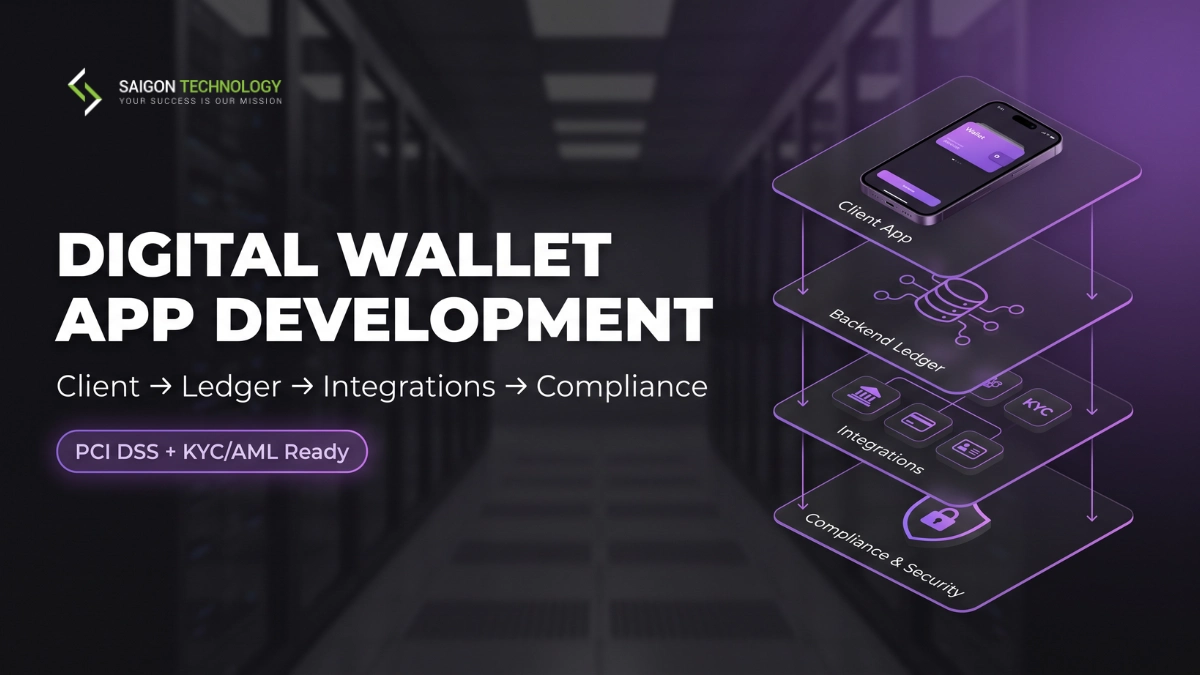
Digital wallet app development is the work of building a mobile or web app that stores payment credentials, moves money between people and merchants, and connects to card networks, banks and open finance rails. Wallets are now the default way people pay online: they accounted for 56% of online spending and 33% of in-person spending worldwide in 2025, according to the Worldpay Global Payments Report 2026.
That reach is also why a wallet is a regulated fintech platform rather than a mobile project. It has to handle real money movement, KYC and anti-money-laundering checks, PCI DSS controls, and competition from Apple Pay, Google Wallet and PayPal. This guide covers wallet types, core features, the tech stack, security and compliance, KYC workflows, a build roadmap, cost tiers calculated from a published rate, common challenges, and monetization.
Key Takeaways
- Most of the effort in a wallet goes into platform engineering: the ledger, risk engine and compliance stack decide whether the product scales, far more than the mobile UI does.
- At Saigon Technology’s published $22-$46 per hour, engineering builds range from about $42K for a closed-loop MVP to about $883K for an open-loop consumer wallet, before licensing and third-party fees.
- Compliance is usually the longest critical path. Licensing or sponsor-bank onboarding can hold go-live after the code is ready, so it starts on day one.
- Seven wallet models cover most products, from closed-loop brand wallets to non-custodial crypto wallets. Picking the wrong one causes months of rework.
- Transaction fees alone rarely carry a wallet. Margin usually comes from interchange sharing, FX, float, premium tiers, BNPL and merchant partnerships.
- Saigon Technology has built digital wallet and payment apps for clients, plus lending and wealth platforms for US fintech companies, under ISO 9001 and ISO 27001 certified processes.
Types of Digital Wallets
The wallet model is the first architectural decision in digital wallet app development, because it sets the payment integrations, fund flows, security controls and regulatory obligations everything else depends on. Common models are closed-loop, semi-closed-loop, open-loop, account-based and crypto wallets, and hybrid wallets combine several payment methods or asset types in one app.
| Wallet type | Where funds can be used | Typical use cases | Regulatory considerations |
| Closed-loop wallet | Within the issuing brand’s ecosystem | Retailer wallets, stored-value gift cards, airline loyalty wallets | Depends on stored-value rules, redemption options and jurisdiction |
| Semi-closed-loop wallet | At participating merchants in a defined network | Campus wallets, mall wallets, merchant-network wallets | Depends on network structure, fund flows and local payment rules |
| Open-loop payment wallet | Wherever the linked card or payment network is accepted | Apple Pay, Google Wallet | Depends on whether the provider holds or transfers funds |
| Account-based payment wallet | Supported merchants, transfers and payment services | PayPal, Cash App | Depends on money transmission, stored value and jurisdiction |
| Custodial crypto wallet | Supported blockchain networks, with fiat access where offered | Exchange-linked wallets, crypto platforms | May involve crypto custody, transfer and exchange requirements |
| Non-custodial crypto wallet | Supported blockchain networks, with keys held by the user | MetaMask-style self-custody wallets | Depends on whether the provider offers other regulated services |
| Hybrid or device-integrated wallet | Several payment methods or assets, sometimes through connected devices | Wearable payments, in-car payments, fiat-and-crypto apps | Depends on the underlying payment, asset and service models |
The model also decides hot vs cold wallet architecture. A hot wallet keeps keys online for instant signing; a cold wallet keeps them offline for security. Most consumer wallets run as hot wallets and keep the operator’s own float in cold storage.
We built a custodial crypto wallet inside the Baibai exchange for a financial company in Hong Kong. Users could deposit, withdraw and transfer crypto, wallets were protected with 2FA, and admins could change fees and limits in real time. For broader product shaping, see our guide on how to build a fintech app.
How a Digital Wallet Works
A digital wallet stores tokenized payment credentials on the device and the backend, authenticates the user with biometrics or a PIN, and routes each transaction to card networks, bank rails or a blockchain. Behind the app, four layers work as one system: the client (iOS, Android, web), the wallet backend (ledger, accounts, risk engine), the integrations layer (card networks, banks, KYC providers, payment processors), and the compliance and observability layer (logging, fraud monitoring, audit, key management).
The ledger records every balance movement as a double-entry transaction and is reconciled against partner reports. Sensitive data such as card numbers is replaced with network or device tokens, so raw card numbers never pass through the wallet operator’s servers.
Must-Have Features of a Digital Wallet App
A wallet’s feature set depends on its payment model, target market and regulation. A good MVP covers secure access, reliable payments and the few flows users need on day one.
Core Features (MVP)
- Secure onboarding with biometric login and device binding
- KYC verification with document capture and a liveness check
- Account funding via cards, bank transfer or open banking
- P2P transfers with contact lookup and request-money
- QR code payments for merchant checkout
- Transaction history with search and filters
- Push notifications for every payment, transfer and failed attempt
- Payment processing through Stripe, Adyen or local processors
- Fraud monitoring that flags suspicious activity and triggers step-up authentication
- Multi-currency support with transparent FX, if the market needs it
NFC payments and bill pay are worth adding when they match the wallet’s main use case. NFC often needs platform approval and an eligible payment partner.
Advanced Features (v1 and Beyond)
- Virtual card issuance through an eligible issuing partner
- Spending analytics and budgeting
- Subscription management with cancel-and-replace controls
- Rewards and cashback through loyalty or merchant tie-ups
- Cross-border transfers with transparent FX
- Family and sub-account controls with spending limits
- Insurance, investments or BNPL, where permitted
- An admin console for support, refunds, limits, fees and dispute handling
Launching with too many features is a common mistake in digital wallet app development. A focused closed-loop MVP on a BaaS partner typically takes 3-5 months to build, while a P2P wallet with KYC, bank linking and both mobile platforms takes 5-8 months, depending on scope and integrations.
Build, White-Label or BaaS?
Before writing code, decide how much of the wallet you will own. The choice sets your licensing path, your time to market and how far you can differentiate later.
| Approach | What you own | Best fit | Trade-off |
| White-label wallet | Branding and configuration | Pilots and brands testing demand | Fast to launch, but the roadmap and data model belong to the vendor |
| Custom app on a BaaS partner | App, ledger logic and UX; the partner holds the license and accounts | Most MVPs and closed-loop or P2P wallets | Faster compliance, but partner fees and partner rules shape the product |
| Fully custom with your own license | Everything, including the license and money flows | Scaled operators and multi-market open-loop wallets | Most control and margin, with the longest regulatory track |
The decision rule: start on a BaaS partner unless owning the license is part of the business model, and design the ledger so you can move to your own license later without rebuilding it.
Benefits of Digital Wallet App Development
A wallet is less a payment feature than a distribution channel for financial products. The business case combines revenue, retention and control over checkout.
For the business:
- Lower payment costs through direct bank rails such as FedNow, SEPA Instant, Pix and UPI, with less exposure to interchange
- Less cost in cash handling, refund processing and reconciliation
- Engagement and loyalty through transaction-triggered offers and loyalty program integration
- First-party data for expanding into credit, insurance and investment products
- Control over the checkout, which otherwise sits with Apple, Google or a card network
- Cross-border payments, with compliance planned per market
- API integration with the ERP, CRM, POS and loyalty systems the business already runs
For the end user:
- One-tap payments with no card re-entry
- Real-time tracking of every balance movement
- Spending limits on sub-accounts for family or team use
- Multi-currency balances for travelers and remote workers
- Access to digital payments for people without a traditional bank card
Technology Stack for Digital Wallet App Development
The right stack depends on wallet type, geography, and whether the business holds its own license or runs on a BaaS partner. The table below lists the choices we see most often in wallet and fintech builds.
| Layer | Common choices | Notes |
| Mobile (native) | Swift (iOS), Kotlin (Android) | Best for NFC, the Secure Enclave and Play Integrity checks |
| Mobile (cross-platform) | Flutter, React Native | Fine for closed-loop and semi-closed wallets; use native modules for payment hardware |
| Backend services | Java (Spring Boot), .NET, Go, Node.js | Strongly typed services for the ledger; Node.js often for the BFF layer |
| Database and messaging | PostgreSQL or SQL Server (ledger), Redis, Kafka or RabbitMQ | Append-only, double-entry ledger with event-driven updates |
| Cloud hosting | AWS, Azure, GCP | Pick the cloud your sponsor bank and auditors already accept |
| Infrastructure and CI/CD | Terraform, Kubernetes, GitHub Actions, GitLab CI | Repeatable, auditable environments for PCI-scoped workloads |
| Identity and KYC | Onfido, Jumio, Persona, Sumsub, Plaid, GIACT | Document capture, liveness, bank-account verification, sanctions screening |
| Payment processors and issuing | Stripe, Adyen, Checkout.com, Marqeta, local rails | A mix of acquiring, card issuing and bank rails |
| Tokenization | Visa Token Service, Mastercard MDES, Apple Pay and Google Pay device tokens | Keeps card numbers out of your systems and shrinks PCI scope |
| Blockchain | ethers.js, web3.js, bitcoinjs, Hyperledger Fabric | Only for crypto or hybrid wallets |
| Observability | OpenTelemetry, Grafana, Datadog, Splunk | Audit-grade logging is a compliance requirement |
Two of our own fintech builds show the range. A US lending platform ran on Java, Spring Boot and AWS, with Kafka for events. A US wealth management platform ran on .NET and Azure, using event sourcing so every change to an account stays traceable for audit. Cross-platform frameworks are fine for the user-facing app, but the ledger, risk engine and signing services belong on strongly typed, well-observed backends. For more, see our deep dive on finance app development.
Security & Regulatory Compliance
Security and compliance decide whether a digital wallet app development project reaches production at all, so treat them as engineering work from the first sprint.
Baseline security controls every wallet needs
- Encryption in transit (TLS 1.3) and at rest (AES-256)
- Tokenization of card data through network tokens, so card numbers never reach application servers
- Two-factor and biometric authentication with FIDO2 / WebAuthn
- Device binding, so a stolen credential cannot be replayed from a new device
- Secure APIs with mTLS between internal services and OAuth 2.0 / OpenID Connect for third parties, following the OAuth 2.1 draft’s hardening
- Fraud detection on every transaction, not only at login
- Penetration testing at least once a year, plus a bug bounty for consumer products
- Regular security audits mapped to a recognized control set such as ISO 27001
Regulations that commonly apply
| Regulation | Where it applies | What it governs |
| PCI DSS v4.0.1 | Any business handling card data | Storage, processing and transmission of card data |
| PSD2 today; PSD3 and the PSR pending | EU / EEA | Strong customer authentication, open banking, fraud liability |
| EU AML rules | EU / EEA | Customer due diligence, transaction monitoring, suspicious activity reporting |
| GDPR | EU residents’ data | Data subject rights, lawful basis, cross-border transfers |
| State money transmission licenses | US, state by state | Holding customer funds and moving money |
| Bank Secrecy Act / AML (FinCEN) | US | KYC, recordkeeping, suspicious activity reporting |
| MiCA | EU | Crypto-asset wallets and service providers |
| Payment Services Act (MAS) | Singapore | Licensing for e-money issuance, account issuance and transfers |
| PDPA | Singapore and other APAC markets | Personal data protection |
Two points need care. PSD3 and the PSR are not yet in force: Parliament and the Council struck a deal on 27 November 2025, and it must be formally adopted by both before it can come into force, so strong customer authentication still runs under PSD2. In the US, money transmission is still licensed state by state, though more states adopt the Money Transmission Modernization Act each year, as the Conference of State Bank Supervisors legislative tracker shows.
Shrinking PCI scope through tokenization and hosted payment fields is the most effective way to cut compliance cost. For a focused walkthrough, read our guide on PCI DSS compliance for fintech and the broader fintech cybersecurity playbook.
KYC & Identity Verification
KYC and identity verification confirm who a user is before the wallet lets them hold or move money. A production flow combines automated identity checks, biometric authentication, sanctions and PEP screening, and ongoing transaction monitoring, all tied to a durable identity record.
A production KYC workflow typically includes:
- Account linking through open banking or aggregators (Plaid, TrueLayer, Finicity) to verify bank ownership
- Document capture of a government ID with OCR extraction
- A liveness check and face match against the ID photo
- Sanctions and PEP screening against OFAC, UN, EU and local lists
- Risk scoring that sends clean cases to auto-approval and edge cases to human review
- An identity stack with OpenID Connect for sessions, FIDO2 / WebAuthn for strong authentication and device binding
- Multi-factor authentication at risky moments: a new device, a high-value transfer, a settings change
- Encryption of every identity document at rest, with strict access controls
- Fraud detection on the first transaction and on behavioral anomalies
On a US lending platform, our engineers built identity verification, KYC document recognition, bank-account verification with Plaid and GIACT, and fraud scoring with Oscilar and Equifax over a 3+ year engagement, documented in the Personal Loans Platform case study. For a technical breakdown, see our article on KYC and AML automation.
How to Create a Digital Wallet App
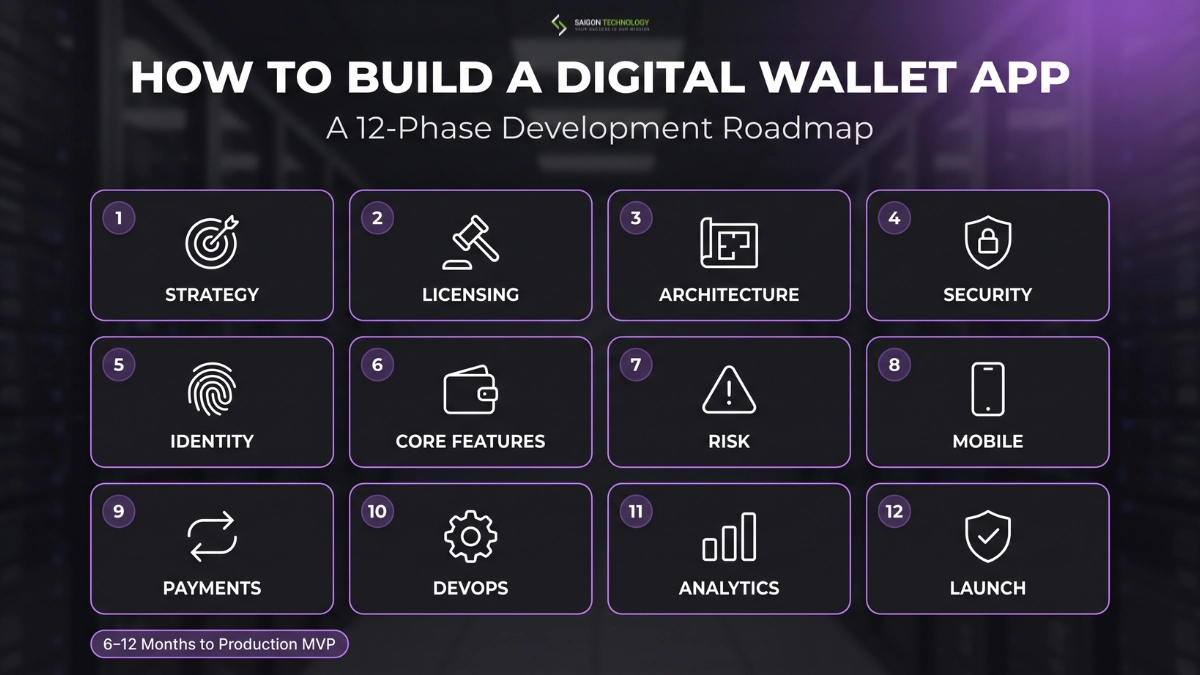
Digital wallet app development takes coordinated work across product strategy, compliance, engineering and security. The 12 phases below run partly in parallel; licensing and security run alongside engineering from the start.
Phase 1: Product Strategy and Scope
Define target users, wallet type, launch markets, business model and MVP features. Choose a BaaS, sponsored or fully licensed approach.
Phase 2: Licensing and Regulatory Planning
Confirm regulatory requirements, licensing obligations, and banking or card-issuing partners. This track starts on day one and runs in parallel with engineering.
Phase 3: Architecture and Ledger Design
Design the double-entry ledger, payment flows, event-driven architecture and account hierarchy, so balances stay accurate and duplicate transactions cannot post.
Phase 4: Security and Compliance
Implement encryption, key management, access controls, audit logging and the PCI DSS safeguards that apply. This work is continuous.
Phase 5: Identity Verification and Funding
Integrate KYC, sanctions screening and funding methods such as cards, ACH or open banking. Build tools to handle failed verifications and failed payments.
Phase 6: Core Wallet Features
Develop P2P transfers, QR and NFC payments, bill pay, transaction history and notifications.
Phase 7: Risk and Fraud Prevention
Combine rule-based detection with ML scoring where it helps. Add fraud case management, dispute handling and chargeback workflows.
Phase 8: Mobile and Frontend Development
Digital wallet mobile app development usually means native iOS and Android apps or Flutter, with secure storage, biometric authentication and push notifications, built in parallel with Phase 6.
Phase 9: Payment Processing and Reconciliation
Integrate payment processors, reconcile transactions against partner reports, and detect discrepancies automatically. For the processor side, see our guide to payment gateway development.
Phase 10: DevOps and Release Engineering
Set up secure deployment pipelines, monitoring, incident response and resilience testing.
Phase 11: Analytics and Personalization
Track activation, transaction volume, retention and fraud, and use them to improve the product and personalize offers.
Phase 12: Testing and Launch Readiness
Complete functional, performance and penetration testing, the compliance assessments that apply, and production readiness checks.
Digital Wallet App Development Cost and Timeline
The cost of digital wallet app development is driven by scope, integrations and the licensing path, not by the mobile UI. Because Saigon Technology publishes its $22-$46 per hour rate, the tiers below are calculated openly: team size × months × 160 hours × that rate.
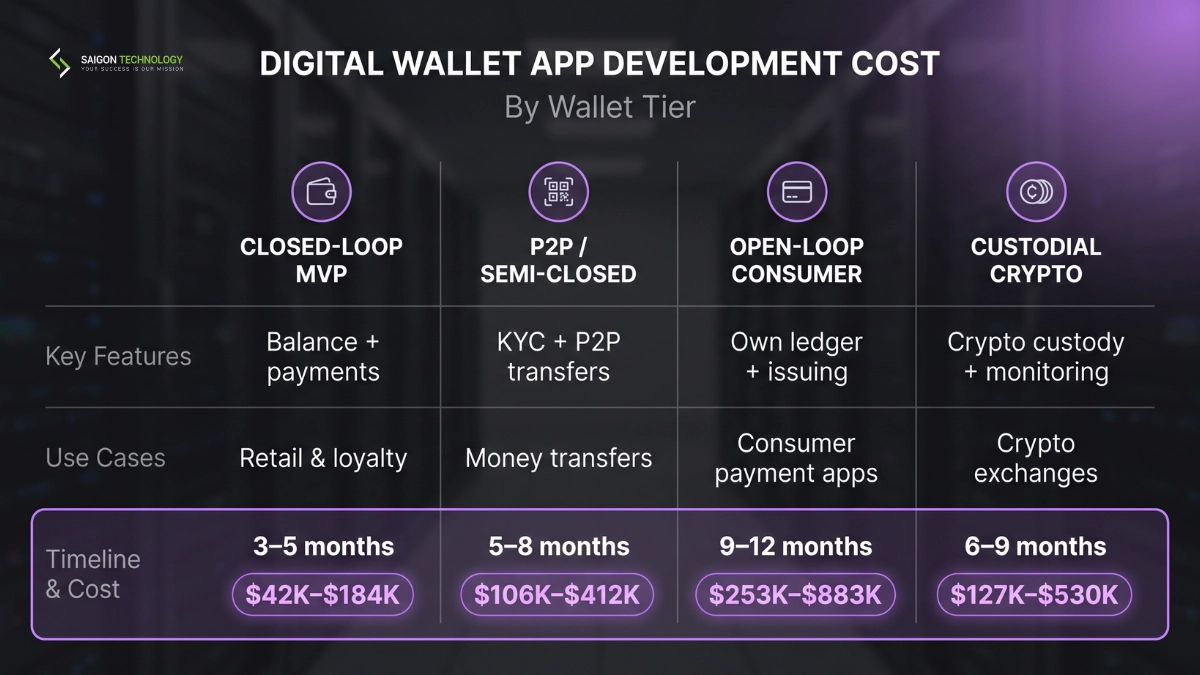
| Wallet tier | Team | Timeline | Engineering build cost |
| Closed-loop MVP (one market, BaaS partner, one app plus admin) | 4-5 people | 3-5 months | About $42K-$184K |
| P2P or semi-closed wallet (KYC, bank linking, P2P and QR, iOS and Android) | 6-7 people | 5-8 months | About $106K-$412K |
| Open-loop consumer wallet (own ledger, card issuing through a partner, many integrations) | 8-10 people | 9-12 months | About $253K-$883K |
| Custodial crypto wallet (one or two chains, admin fee and limit controls) | 6-8 people | 6-9 months | About $127K-$530K |
These are planning estimates for engineering only, not quotes. They exclude licensing, audits and legal work, third-party fees such as per-check KYC, card issuing and BaaS charges, and infrastructure. The real figure depends on scope, integrations and the licensing path.
What moves wallet cost up or down
| Cost driver | Lower end | Higher end | Why it moves |
| Feature scope | MVP only | MVP plus cards, BNPL and crypto | Each advanced feature adds integrations, testing and compliance work |
| Platforms and markets | One platform, one country | iOS, Android and web in several countries | QA, compliance and localization multiply |
| Licensing path | Agent of a licensed partner | Own e-money or money transmission license | Legal work, audits and controls grow with direct licensing |
| Security architecture | Hosted fields and tokenization | HSMs and custom key management | Dedicated hardware and key ceremonies add build and running cost |
| Integrations | Two or three providers | Ten or more banks, KYC, FX, card and open banking providers | Every integration needs its own contract, testing and fallback |
| Crypto support | None | Several chains with custody | Each chain adds node, signing and custody work |
| Hosting and operations | Shared, non-PCI environment | Dedicated PCI-scoped environment across regions | Isolation, redundancy and around-the-clock monitoring raise running cost |
For a broader view of fintech cost drivers, see cost to build a fintech app.
Key Development Challenges
Wallet projects rarely fail on mobile code. They fail on the systemic issues below, so flag them in sprint zero.
1. Regulatory approvals move slower than engineering
Licensing and sponsor-bank onboarding can block go-live after the code is ready. Start the regulatory track in parallel on day one.
2. The complexity is systemic, not local
A wallet touches identity, money movement, risk, cards, reconciliation and compliance, and one weak link breaks the whole. Engineers who have shipped regulated workloads before are the strongest de-risker.
3. Ecosystem integration is fragile
APIs across card networks, payment gateways, KYC vendors, open banking aggregators and legacy systems change and fail independently. Treat every third party as potentially unavailable and design for degradation.
“A wallet depends on services you don’t control. On a US lending platform we built, users dropped off during bank linking and verification APIs ran slow, so we kept a manual path beside Plaid, normalized each provider’s data, and retried failed checks in the background.”
– Linh Pham, Senior Solution Architect, Saigon Technology
4. Interoperability with POS systems and card networks
Card acceptance adds a hidden certification layer. Contactless EMV, tap-to-pay on iOS and Android, and merchant acceptance all go through formal certification.
5. Legacy systems on the bank side
Bank partners often expose SOAP, flat-file or batch interfaces. Expect to build an anti-corruption layer so the wallet’s code stays clean.
6. Integration with ERP, CRM, POS or blockchain systems
B2B wallets need their own data contracts and reconciliation for these systems. Scope it separately from the consumer wallet.
7. Scaling beyond the MVP
Growth is a different engineering problem from launch. Real-time analytics, fraud at scale, round-the-clock operations and ledger integrity under growth are easy to defer and painful to retrofit.
8. Security threats keep changing
Account takeover, SIM swap, synthetic identity and authorized push payment fraud all target wallets, so the fraud strategy needs regular review.
9. Cloud infrastructure gets complex fast
Infrastructure complexity rises sharply once PCI scope, multi-region failover and data residency apply. Plan site reliability engineering from the start, not after launch.
For patterns we have seen across 850+ projects, see common mobile app development mistakes startups need to avoid.
Monetization Strategies
A wallet rarely makes money from one source. Successful operators layer several revenue streams that grow with the user base.
| Monetization model | Typical revenue driver | When it works |
| Transaction fees | A percentage or flat fee on P2P, remittance or merchant payments | Semi-closed and open-loop wallets at scale |
| Interchange sharing | A share of card interchange on issued cards | Open-loop wallets with virtual or physical cards |
| Interest on wallet balances | Net interest margin on customer float | Regulated custody and a strong treasury function |
| Cross-border payments and FX | Spread on currency conversion | Travel, remittance and remote-work segments |
| Merchant partnerships | Revenue share with partner merchants | Mature rewards and loyalty programs |
| Premium subscriptions | Monthly tier with higher limits, support or insurance | Highly engaged user bases |
| Buy now, pay later | Merchant fees, late fees and interest | Checkout integration plus credit decisioning |
| Advertising and promotions | Sponsored offers in the wallet feed | A large, highly engaged user base |
| Embedded insurance | Commission on policies sold in the app | Travel, device or purchase protection |
| Value-added services | Bill pay fees, top-ups, tax filing | Market-dependent |
| Partner APIs | API fees for merchants and partners | B2B2C wallets |
The common pattern is to anchor on one or two margin streams, such as interchange plus FX or subscriptions plus BNPL, and treat the rest as features that lift engagement.
FAQ
How much does it cost to develop a digital wallet app?
At Saigon Technology’s published $22-$46 per hour, engineering for a wallet ranges from about $42K-$184K for a closed-loop MVP to about $253K-$883K for an open-loop consumer wallet, with P2P wallets at about $106K-$412K. Licensing, audits, third-party fees and infrastructure come on top. Wallet type, licensing path and the number of integrations move the figure most.
How do I build a digital wallet app?
Start with four decisions: wallet type, launch geography, licensing model (your own license or a sponsor), and build versus white-label or BaaS. Then run the 12 phases above, with licensing and security in parallel from day one. A closed-loop MVP typically takes 3-5 months, a P2P wallet 5-8 months, and an open-loop consumer wallet 9-12 months. The most valuable early hires are a backend engineer with ledger experience and a compliance lead who has shipped a regulated product.
What are the top digital wallet apps?
Widely used examples include Apple Pay, Google Wallet, Samsung Wallet, PayPal, Venmo, Cash App, Alipay, WeChat Pay and Paytm, with regional leaders such as GrabPay and GoPay in Southeast Asia, MoMo and ZaloPay in Vietnam, and UPI apps in India. Each illustrates a different model: brand wallets, super-apps, card-backed open-loop wallets and real-time payment apps.
How do digital wallet companies make money?
Wallet companies combine transaction fees, card interchange sharing, FX spreads on cross-border payments, interest on customer float, subscription tiers, BNPL fees, merchant partnerships, embedded insurance and advertising. Most profitable wallets anchor on one or two high-margin streams and use the rest for engagement and retention. P2P fees alone rarely pay at consumer scale.
How does a digital wallet work?
A digital wallet stores tokenized payment credentials, authenticates the user with biometrics or a PIN, and sends each transaction to card networks, bank rails or a blockchain. A backend ledger records every movement as a double-entry transaction and reconciles it against partner reports. Card numbers are replaced with network or device tokens, so the raw numbers never pass through the operator’s systems.
Should I build a digital wallet in-house or hire a digital wallet app development company?
Hire a digital wallet app development company if your team has not yet shipped payments, KYC, ledger engineering and PCI-scoped operations. The surface is wide, the regulatory exposure is real, and mistakes made early are expensive to unwind. Saigon Technology works with senior engineers, a two-week risk-free trial, ISO 9001 and ISO 27001 certified processes, and a published $22-$46 per hour rate. If you already run production payment infrastructure and only need extra capacity, a hybrid model works too.
Build Your Digital Wallet App with Saigon Technology
Saigon Technology is an AI-native software engineering partner with 14+ years of experience, 850+ projects, 350+ global clients and 400+ engineers across three Vietnam development centers and offices in the US, Singapore and Australia.
We have built digital wallet and payment apps for clients, and our fintech teams have delivered KYC and identity verification, lending and wealth management platforms for US fintech companies. Every engagement starts with a two-week risk-free trial, an NDA and full IP transfer, with senior engineers from day one.
Our digital wallet app development services help you:
- Pick the right wallet model and shape the product
- Design the ledger, risk engine and compliance stack
- Deliver iOS, Android and web apps with secure NFC, biometric and tokenized payments
- Integrate KYC, card networks, payment processors, open banking and real-time rails
- Run the platform under ISO 27001 certified processes
See how we approach fintech software development, or talk to our fintech engineering team →


Related articles
How to Build a Fintech App in 2026: A Step-by-Step Guide
 Toan (Ted) Do - Project Manager
 14 Apr 2026
PCI DSS Compliance in Fintech Software Development: A 2026 Guide
03 May 2026 
AI in Fintech: A 2026 Builder’s Guide to Use Cases, Architecture and Regional Rules
04 May 2026 
KYC AML Automation: How to Build It Into Your Fintech Product
13 Jul 2026 
Fintech Cybersecurity: 2026 Threats, Compliance & Controls
13 Aug 2026 
8 Fintech Software Development Trends Reshaping 2026
26 Aug 2026