



Outsource App Development in 2026: Risks & Vendor Checks

 Updated on Oct 07, 2026
Most guides to outsourcing an app build tell you what it costs and rank a list of vendors. Both are easy to find and neither helps much at the moment you actually have to decide. The harder questions come later: which risks stay with you under each contract, who owns testing, and what happens to your source code if the relationship ends. This guide covers that layer. It assumes you have already decided to outsource app development and now need to do it without losing control of the parts that matter.
Key Takeaways
- Outsourced app projects usually fail quietly, through scope drift and quality erosion, rather than in a visible blow-up.
- Your engagement model decides which risks transfer to the vendor and which stay with you. Pick it before you pick a company.
- Mobile testing is broader than web testing, and it is the first budget line clients cut.
- Security, intellectual property, and exit terms are cheaper to settle before signing than to renegotiate later.
- Saigon Technology publishes its implementation rates at $22 to $46 per hour, which is unusual in this market and worth asking any vendor to match in transparency.
The three ways outsourced app projects fail
Teams that outsource app development rarely watch a project collapse in one visible event. It degrades along three predictable paths: scope that drifts because nobody owns the decision, quality that erodes while the reported metrics still look healthy, and knowledge that never transfers back to you. Each is survivable alone. All three together is how a project quietly becomes unrecoverable.
Scope drift is the most familiar. A feature gets described in a sentence, estimated in a day, and built to an interpretation nobody wrote down. The cost lands in rework rather than in the original quote, so it never appears as an overrun. It appears as a schedule that keeps moving.
Quality erosion is harder to see, because the numbers that would reveal it are usually the last to change.
“Clients watch defect counts. They stay flat while test quality quietly drops, because the suite still passes once it has stopped asserting anything difficult. The numbers only move when the regression suite is already hollow.” – Khoa Hoang, QC Lead at Saigon Technology
That is the trap in watching a dashboard. A regression suite that has weakened still reports green, and the defect count stays flat because the tests are no longer looking hard enough to find anything. By the time the trend turns, the weakness is months old.
The third path is knowledge that never comes home. A vendor can deliver working software and still leave you unable to change it, because the reasoning behind the architecture, the rejected alternatives, and the reasons a particular shortcut was taken all live in their heads and their private channels rather than in anything you were given. You own the code. You do not own the understanding. That gap surfaces only when you try to leave, which is exactly when it costs the most to discover.
Engagement models compared: which risks you keep
The contract decides more about your exposure than the company does. Three models cover most application development outsourcing arrangements, and each one draws the line between your risk and the vendor’s in a different place, which is why comparing companies before you have chosen a model tends to produce confusion rather than clarity. Read the table below with one question in mind. If this goes wrong, whose problem is it?
|
|
Staff augmentation
|
Dedicated team
|
Project-based
|
|
Who owns delivery
|
You
|
Shared
|
Vendor
|
|
Who owns QA
|
You
|
Usually shared, must be stated
|
Vendor
|
|
Who owns IP
|
You, by default
|
You, if the contract says so
|
You, only if the contract says so
|
|
Cost of a scope change
|
Low
|
Low to moderate
|
High, via change request
|
|
Ramp-up time
|
Days to weeks
|
Weeks
|
Weeks, plus discovery
|
|
Best when
|
You have engineering management and a skills gap
|
You need continuity over years
|
Scope is genuinely fixed and well specified
|
Staff augmentation means adding specialists to an existing team you already run. It keeps control with you, which is an advantage only if you have the management capacity to use it. Without a technical owner on your side, this model fails fastest, because nobody is making the decisions the added engineers need.
A full-time offshore team gives you continuity. The same engineers stay on the product long enough to build real context, which reduces the rework that comes from re-explaining decisions. It costs more over a long horizon. For a short, well-bounded piece of work, it is the wrong shape entirely.
Project-based delivery moves the most risk to the vendor and the least flexibility to you. It works when the specification is genuinely stable. When it is not, every adjustment becomes a change request, and the commercial friction of raising one is often what stops teams from fixing things they know are wrong. The pricing choice underneath it, fixed price versus time and materials, is worth settling on its own terms.
A vendor that can move you between these engagement models for outsourced delivery as the work changes is more useful than one that only sells the model it prefers.
What it costs to outsource app development in 2026
Rates for app development outsourcing vary more by what you are buying than by where you buy it. Country comparison tables circulate widely, and most of them cite each other rather than any primary research, which is why a regional average published without a named source and a date is better treated as decoration than as data. Three things reliably move the number. Seniority mix, platform count, and how much of the testing and project management sits inside the quoted rate.
Four factors do most of the work:
- Seniority mix. A quoted blended rate means little until you know the ratio behind it. Ask how many senior engineers are on the team and what they are actually doing.
- Platform count. Two native builds cost close to twice one. A single shared codebase changes that arithmetic, and also changes what your testing has to cover.
- Scope of the rate. Some rates include QA, project management, and DevOps. Some quote engineering hours alone and bill the rest separately. These are not comparable numbers.
- Change handling. A low rate attached to an expensive change process can cost more than a higher rate with flexible scope.
Saigon Technology publishes its implementation rates at $22 to $46 per hour, with oversight by senior personnel included. Most providers do not publish rates at all. Treat that less as a price claim than as a test. A vendor unwilling to give you a defensible range before a discovery call is telling you something about how the eventual quote will be constructed.
For what a mobile build actually costs, rather than what an hour costs, the estimate depends on feature scope in ways an hourly figure cannot capture.
How to outsource app development in seven steps
The sequence below front-loads the decisions that are expensive to reverse. Most published guides to mobile app development outsourcing run to ten or more steps, and spend several of them on activities you can compress into an afternoon. These seven are the ones where getting it wrong costs real money.
- Write down what the app must do, and what it must not. A feature list is not a specification. The useful document states what the product is for, who uses it, which constraints cannot move, and, just as importantly, what falls outside scope entirely, because exclusions are what a vendor prices against later and what every change request will be measured from.
- Decide your platform approach before you shortlist. One shared codebase or two native builds changes cost, testing scope, and the kind of team you need. Settle it early. Proposals built on different assumptions cannot be compared.
- Choose the engagement model. Use the table above, and settle it before you speak to any company, because otherwise you end up comparing unlike things against each other while being sold whichever model the vendor sitting in front of you happens to prefer.
- Set acceptance criteria you can test. Every deliverable needs a condition that is either met or not met. “Works well on mobile” is not one. “Loads in under two seconds on the three OS versions we support” is. Vague acceptance criteria are how scope drift becomes billable.
- Shortlist on evidence rather than portfolio. Portfolios are curated, and easy to borrow. Section seven covers what to ask instead.
- Settle security, IP, and exit terms before commercial terms. They are cheap to agree while a vendor is still trying to win your business. Afterwards they are expensive, and sometimes impossible.
- Plan the handover from day one. Decide where documentation lives, who can access the repository, and what a complete handover contains. A vendor who treats this as routine carries less risk than one who treats it as an ending.
Two steps get skipped under time pressure more than any others: acceptance criteria and handover planning. They are also the two that decide whether the work you paid for stays useful once the contract ends. Skip them and you have bought a delivery, not an asset.
Outsourcing app QA and testing: the step teams skip
Testing is where mobile projects diverge most sharply from web projects. It is also the first line teams cut. A web application runs in a small number of browsers you can enumerate. A mobile application runs on hardware you do not control, under an operating system that updates without asking you, distributed through a store that can refuse it, and reviewed in public by people who will never file a ticket. Teams who outsource mobile app development often scope testing as though none of that were true.
“Fund real-device testing on your top OS versions before anything else. Simulators miss permissions, background behavior and memory pressure. Those failures arrive as one-star reviews after an OS update, not as bugs during the build.” – Vien Nguyen, Tech Lead (iOS-Android) at Saigon Technology
The point in that answer is the timing. Simulator-only testing does not produce visible failures during development. It produces them after release, on real hardware, in the hands of users who report them publicly rather than to your issue tracker. The cost arrives after the invoice has been paid.
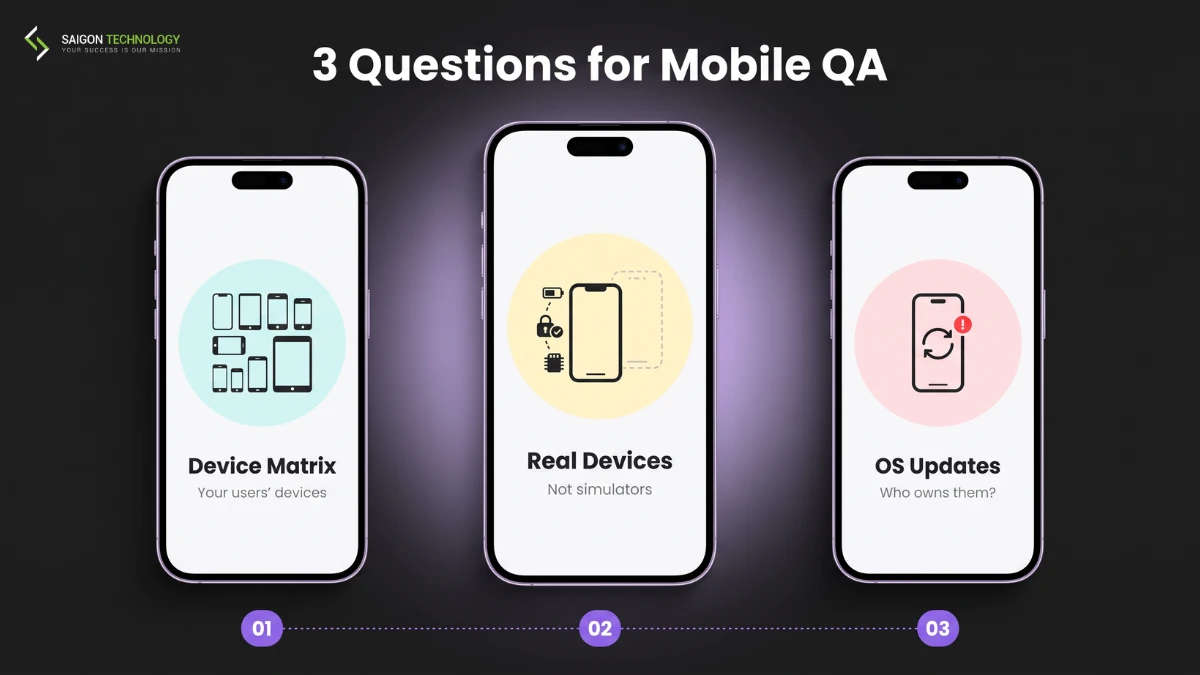
Three questions separate a mobile QA plan that will hold from one that will not:
- What is on the device matrix, and who chose it? A device matrix should reflect your users’ actual hardware and OS distribution, not the devices the vendor happens to own.
- What runs on real devices rather than simulators? Permissions, background behavior, battery, and memory pressure all need physical hardware. Simulators cannot see them.
- Who tests after an OS release? Operating system updates break shipped applications retroactively. If nobody owns that, your users will find it first.
You can buy independent QA and testing services separately from development. For some teams that separation is worth the coordination cost it adds, because the people who wrote the code are rarely the best judges of whether it works.
Security, IP, and compliance checks before you sign
Every check here is straightforward to agree before a contract is signed and awkward to introduce afterwards, which is the whole argument for raising them while a vendor is still competing for the work rather than once it already holds it. None of this is unusual to ask for in application development outsourcing. A vendor that hesitates is giving you information. Note which row causes the pause.
|
Check
|
Why it matters
|
How to verify
|
|
Data processing agreement
|
Defines how your data is handled and under whose law
|
Ask for their standard DPA before you ask for a quote
|
|
IP assignment in writing
|
Ownership of code does not transfer by default in every arrangement
|
Read the clause; confirm it covers work product and derivative material
|
|
Named security certification
|
Distinguishes a documented practice from a stated intention
|
Ask for the certificate and issuing body, then check the registry
|
|
Access control and offboarding
|
Departing engineers should lose repository access on their last day
|
Ask what the offboarding process is and who executes it
|
|
Source-code escrow or repository ownership
|
Determines whether you can continue without them
|
Own the repository yourself where possible
|
|
Subcontracting disclosure
|
You may be buying a broker rather than a team
|
Ask directly whether any work is subcontracted, and to whom
|
Saigon Technology holds ISO 9001 and ISO 27001 certifications issued by BSI in the UK, and works under NDAs with role-based access and a secure development lifecycle aligned to GDPR and PDPA. HIPAA and HL7 support is available for healthcare engagements. The specific standards matter less than the pattern. A named certification with a named issuer can be checked against a public registry, whereas a claim of “military-grade security” cannot be checked against anything. Ask which one you are being offered. Most of where offshore projects go wrong is process rather than technology, and contracts are where process gets fixed.
How to evaluate an app development outsourcing company
By this point you have a specification, an engagement model, and a set of contractual requirements. Evaluation becomes a matter of testing claims rather than reading marketing. Every firm competing to build your product will describe senior engineers and strong QA. The useful questions are the ones a weak team cannot answer smoothly, because answering requires having actually done the work.
“Ask how they handled a native module they had to write themselves. Portfolios are easy to borrow. A team that has genuinely shipped cross-platform will have opinions about where the bridge broke and why.” – Hong Hoang, Tech Lead (React Native) at Saigon Technology
That test generalizes. Ask about the part of the work that went wrong, not the part that went well. A team with real delivery history has specific, slightly unflattering answers ready, because those are the problems they remember solving. A rehearsed answer stays general.
|
What to check
|
Evidence to demand
|
Red flag
|
|
Platform depth
|
A specific technical problem they solved and why the first approach failed
|
Only polished case studies, no failures
|
|
Team continuity
|
Average tenure, and who exactly will work on your project
|
Named seniors in the pitch who vanish after signing
|
|
QA practice
|
Their device matrix and what runs on real hardware
|
Testing described only as “thorough”
|
|
Communication
|
Time-zone overlap in hours, and who your decision-maker contacts
|
A single account manager as the only channel
|
|
Reference quality
|
A client with a project structurally like yours
|
References only from a different industry or size
|
|
Rate transparency
|
A defensible range before discovery
|
A quote that cannot be explained line by line
|
Choosing between a single shared codebase and two native builds is a related decision with its own trade-offs, and it is worth settling separately rather than letting a vendor’s existing skill set decide it for you. If cross-platform is the direction you land on, our React Native practice sets out what that team is built from.
Working with Saigon Technology
Saigon Technology has delivered 850+ projects for 350+ clients since 2012, with 400+ developers across three development centers in Ho Chi Minh City and Da Nang. Our mobile app development practice runs those builds, and the published case studies show what came out of them. Engagements run as staff augmentation, dedicated teams, fixed-price projects, or build-operate-transfer, so the model can change as the work does.
Two things are worth knowing before a first conversation. Implementation rates are published rather than quoted on request. Candidates can also be interviewed before onboarding, with a two-week trial available ahead of any longer commitment, which shifts the early risk away from you.
If you are weighing whether to outsource mobile app development at all, the sections above are deliberately vendor-neutral. Use them on us as readily as on anyone else.
Frequently asked questions
1. Should you outsource app development or hire in-house?
Mobile app development outsourcing suits work with a defined horizon, a skills gap you cannot hire into quickly, or a product that has not yet proven it needs a permanent team. In-house suits a product that sits at the core of the business and will keep changing for years. The deciding factor is rarely cost. It is whether you have the engineering management capacity to direct an external team, because an undirected one will drift.
2. How do you protect your source code when outsourcing?
Own the repository yourself and grant vendor access to it, rather than receiving code at the end. Get intellectual property assignment in writing, covering work product and derivative material. Confirm the offboarding process removes access on an engineer’s last day. Where the vendor controls infrastructure, arrange escrow.
3. What does it cost to outsource an app in 2026?
Rates to outsource app development depend on seniority mix, platform count, and whether QA and project management sit inside the quoted figure. Saigon Technology publishes $22 to $46 per hour for implementation work. Total build cost tracks feature scope rather than hourly rate. Ask for both numbers, and ask what the first one excludes.
4. Can you outsource only QA or only design?
Yes, and separating QA from development is sometimes an advantage, because the people who wrote the code are not the best judges of whether it works. Design is more commonly separated than QA. Both require clear acceptance criteria, since a partial engagement has more handoff points than a full one.
5. How long does an outsourced app take to build?
Timelines depend on scope, platform count, and how quickly you make decisions. Client-side decision latency is a common cause of delay, and it is the one variable a vendor cannot manage for you. Ask any estimate to state its assumptions about your response times.


Related articles
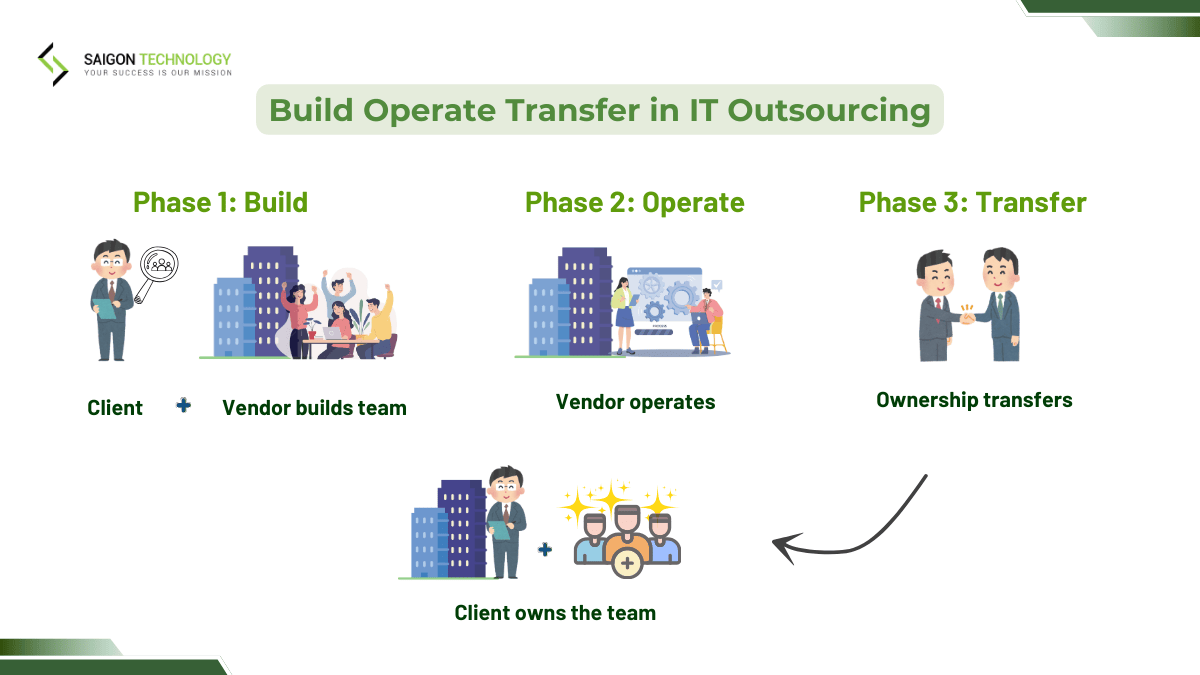
Build Operate Transfer (BOT) IT Outsourcing: Complete Guide for Global Tech Companies
 Thanh (Bruce) Pham - CEO of Saigon Technology
  03 Oct 2024
12 Key IT Outsourcing Trends 2026 for Business Growth
16 Sep 2024 
Decoding Software Outsourcing Costs and Strategies
11 Sep 2024 
IT Project Outsourcing: Effective Strategies & Key Insights
29 May 2024 
Choosing the Right Outsourcing Partner: Strategic Guide
26 Sep 2024