


Loan Management Software Development: Features, Costs & Build vs. Buy in 2026

 Updated on Nov 09, 2026
Loan management software development is the engineering process of building a custom platform that automates loan origination, servicing, collections, reporting, and compliance across the full lending lifecycle. It fits US lenders, banks, NBFCs, and fintech startups that need deeper integrations or multi-state scale beyond off-the-shelf SaaS. Saigon Technology delivers AI-native LMS builds with senior fintech engineers, production case studies including the Loan City loan servicing platform, and a 2-week risk-free trial. Book a scoping call to start.
Key Takeaways
- Loan management software development builds a custom platform handling origination, servicing, collections, reporting, and compliance across the loan lifecycle.
- LOS vs LMS: origination handles application through approval; management handles everything after, disbursement through closure. Most lenders need both, often on one platform.
- A production-grade custom build typically costs $30,000–$400,000+ and takes 4–14 months, depending on build tier (MVP, Standard, or Enterprise)
- Build wins for distinctive products, deep integrations, or multi-state operations; buy wins for commodity products at low volume.
- AI-native development, agentic underwriting, predictive collections, LLM borrower communications, is the clearest 2026 differentiator between modern and traditional engineering partners.
Difference Between Loan Origination System (LOS) and Loan Management System (LMS)
A loan origination system (LOS) manages the loan application and approval process, including application intake, digital KYC, credit bureau checks, automated decisioning, underwriting rules, and loan approval. A loan management system (LMS) manages the post-origination lifecycle, including disbursement, repayment schedules, EMI tracking, loan servicing, collections, portfolio reporting, and loan closure. Together, they cover the full loan lifecycle.
| Dimension | Loan Origination System (LOS) | Loan Management System (LMS) |
| Lifecycle stage | Application through approval | Post-origination through loan closure |
| Core jobs | KYC, credit scoring, decisioning, underwriting, approval | Disbursement, servicing, repayments, collections, reporting |
| Users | Underwriters, risk teams, loan officers, applicants | Servicing teams, collections, finance teams, borrowers repaying loans |
| Key data | Applicant data, credit bureau records, underwriting rules | Loan ledger, repayment schedules, outstanding balances, portfolio reports |
| Integrations | Credit bureaus, KYC providers, fraud detection services | Banking APIs, payment gateways, accounting systems, regulatory reporting systems |
| Example question answered | Should we approve this loan? | How is the loan performing? |
Most lenders need both sets of capabilities, but they do not necessarily need two separate platforms. Smaller lending operations may use an integrated LOS and LMS, while larger banks and NBFCs may deploy specialized systems connected through shared customer and loan identifiers.
A custom loan management software development project gives lenders greater control over how data and workflows move between origination and servicing, particularly when integrating legacy systems, third-party services, and institution-specific lending rules.
Key Benefits of Loan Management Software
A modern LMS improves lending operations across five dimensions:
- Fewer manual errors. A centralized ledger replaces spreadsheets and email workflows, cutting duplicate-entry mistakes. Automated reconciliation and system-generated filings reduce rework and audit exceptions.
- Faster approvals. Connected to an LOS, automated decisioning and credit bureau checks move low-risk applications from submission to approval in minutes instead of days, lifting conversion to funded loans.
- Real-time reporting. One source of truth gives finance, risk, and executive teams the same live numbers, with portfolio reports updating as repayments post rather than overnight.
- Better risk management. Historical repayment and delinquency data, fed into credit scoring and ML models, sharpens risk assessment and supports faster model refinement.
- A loan book that scales. A platform built for 50,000 active loans and multi-state operation grows through infrastructure and automation, not proportional headcount.
Core Features of a Modern Loan Management System
A modern loan management system (LMS) typically includes six capability clusters. The exact feature set depends on the lender’s loan products, asset classes, and operational requirements, and some capabilities may sit in integrated systems rather than the LMS itself.
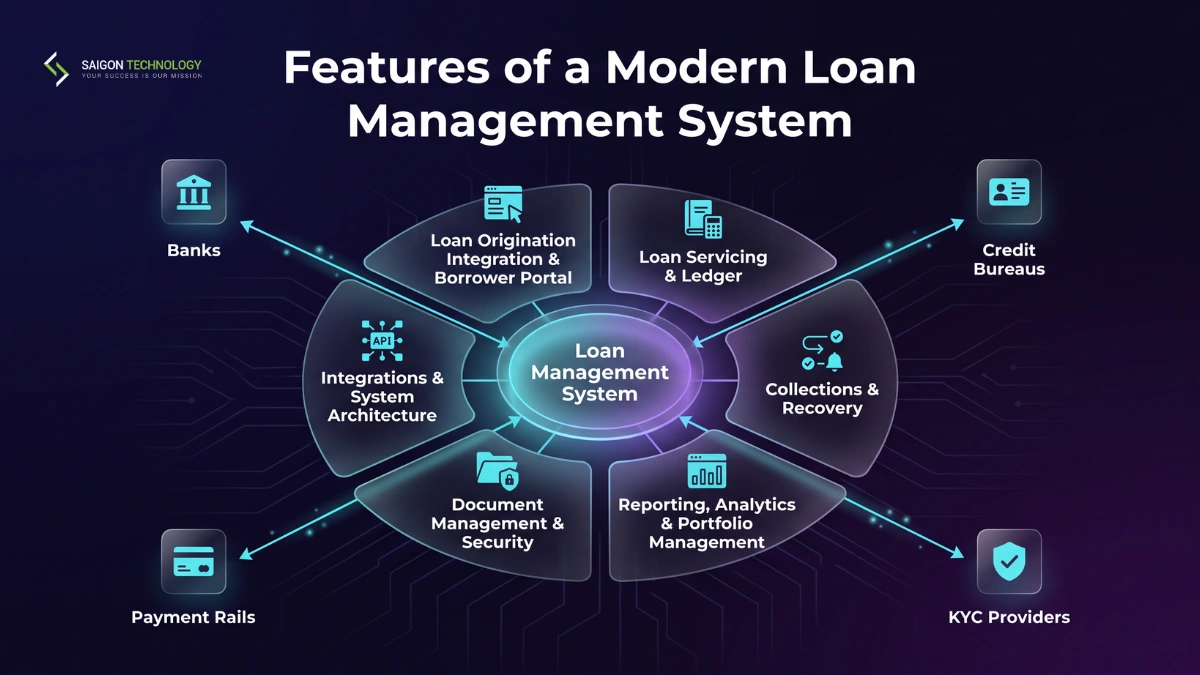
Loan Origination Integration and Borrower Portal
Connects to loan origination systems (LOS), digital KYC providers, document verification services, and credit bureau APIs. A borrower portal lets applicants track status, submit documents, and view existing loan details.
Loan Servicing and Ledger
Handles disbursement scheduling, repayment schedules, EMI calculation, interest accrual, and custom repayment plans. A centralized ledger records payments, fees, and balances for consistent data across servicing and reporting.
Collections and Recovery
Automates dunning workflows, promise-to-pay tracking, and dispute handling. Predictive analytics can prioritize outreach based on delinquency patterns and repayment behavior.
Reporting, Analytics, and Portfolio Management
Delivers portfolio reports by product, vintage, state, and risk band to support regulatory filings, investor reporting, and delinquency monitoring.
Document Management and Security
Centralizes loan agreements, KYC documents, and disclosures, with role-based access, encryption, and audit logs tracking changes and user activity.
Integrations and System Architecture
Connects to bank APIs, credit bureaus, KYC and fraud detection providers, and accounting systems. A modular architecture with clear service boundaries makes it easier to extend as lending needs evolve.
Custom Loan Management Software Development: Process & Timeline
A disciplined custom build follows seven phases, running 5 to 11 months end-to-end. MVPs for a focused loan product ship in 4 to 5 months; multi-product enterprise platforms run 9 to 14 months.
Discovery and Requirements
Maps loan products, jurisdictions, integrations, and decisioning logic, and locks the compliance perimeter early (AML, KYC, SOC 2, PCI DSS, GDPR/CCPA/DPDP). Typical duration: 2 to 4 weeks.
Architecture and Compliance Planning
Defines the stack, data model, ledger, audit log, and storage model. SOC 2 Type II readiness should be designed in from day one, not retrofitted.
UI/UX for Both Sides
Designs the servicing console and borrower portal in parallel. Complexity here drives a meaningful share of total cost, especially for multi-persona or embedded experiences. Typical duration: 3 to 6 weeks.
MVP Engineering
Builds the ledger, scheduler, borrower portal, admin console, and critical integrations. Bank, credit bureau, and payment rail integrations usually take longer than expected. Typical duration: 8 to 16 weeks.
Testing and Compliance Review
Unit, integration, and end-to-end tests validate the math, state transitions, and regulatory filings, followed by a compliance review against the target jurisdiction and asset class. Typical duration: 3 to 5 weeks.
Launch and Migration
Soft-launches on a limited book, validates reporting and reconciliation against the legacy system, then cuts over. A 2-week risk-free trial, paired with dedicated software migration services, helps teams migrating from SaaS or spreadsheets.
Ongoing Maintenance and Feature Releases
Covers monthly feature releases, quarterly compliance updates, and an annual security audit through ongoing software maintenance and support, typically running 15 to 20 percent of the original build cost per year.
How Much Does Loan Management Software Development Cost?
Estimated 2026 budgets for custom loan management software typically range from $30,000 to $400,000+, depending on loan product complexity, integrations, automation requirements, and regulatory scope.
| Build tier | Core features included | Estimated cost | Timeline | Best suited for |
| MVP | Loan applications, basic underwriting, repayment schedules, payment tracking | $30K–$60K | 3–4 months | Fintech startups, new lenders |
| Standard | Multi-product management, automated underwriting, KYC/AML, payment processing, reporting | $60K–$150K | 5–8 months | Growing lenders, embedded finance providers |
| Enterprise | AI risk scoring, fraud detection, automated collections, advanced integrations, analytics | $150K–$400K+ | 9–14+ months | Banks, large lenders |
| Ongoing maintenance | Bug fixes, security updates, performance optimization, API maintenance | 15%–20% of build cost/year | Continuous | All tiers |
Hourly rates drive most of the variance. US and Australia-based teams typically charge $120–$200/hour, while offshore partners in Asia, including Saigon Technology, offer $22–$46/hour, helping US fintechs manage budgets while accessing experienced engineering teams.
Five factors shift a project within these ranges:
- Loan products. A single installment product is simpler than one supporting installment, revolving credit, BNPL, and construction loans together.
- Jurisdiction. Each additional US state or country adds licensing, disclosure, and reporting requirements.
- Underwriting rules. ML-based scoring adds model integration, validation, and governance beyond rule-based decisioning.
- Integrations. Each credit bureau, bank, KYC, or fraud detection integration typically adds one to three weeks.
- Reporting and tax. Investor reporting, multi-regulator requirements, and loan-specific tax and accounting integration add effort, best addressed early to avoid costly rework.
Budget an additional 25%–35% contingency for security assessments, compliance work (including SOC 2 readiness where applicable), and post-launch monitoring, evaluated case-by-case rather than assumed for every project.
LMS for Small Business vs. Enterprise Lenders
The right LMS architecture should fit a lender’s current scale while leaving room to grow without a rebuild.
| Dimension | Small lender / fintech startup | Enterprise lender / bank |
| Active loans | Up to 10,000 | 50,000 to millions |
| Loan products | 1–2 focused products | 5+ across multiple asset classes |
| Deployment | Cloud-native, managed services | Cloud, hybrid, or private cloud |
| Compliance scope | 1–2 jurisdictions | Multiple states and regulatory frameworks |
| Build approach | MVP first, 4–5 months | Specialized architecture, 9–14 months |
| Typical budget | $80K–$150K | $350K–$900K+ |
| AI underwriting | Rule-based initially, added as data grows | Advanced models with validation and governance |
Loan management software for small business typically prioritizes a focused MVP covering one or two products and up to 10,000 active loans, validating the model before expanding. Enterprise lenders need scalable architecture, centralized data, and stronger governance to support millions of accounts and complex integrations. Both paths should leave room to grow without a full rebuild.
Build vs. Buy: When Custom LMS Development Wins
Off-the-shelf SaaS LMS products exist for good reasons. For commodity loan products at low volume, they are often the right call. For most other lenders in 2026, building custom loan management software wins on four specific grounds.
Custom wins when:
- The lender has a distinctive loan product that the SaaS vendor cannot model without charging for custom development anyway.
- Deep integrations with banks, warehouse lines, or proprietary scoring are required, and the SaaS vendor’s API is a bottleneck.
- The lender operates in multiple states or asset classes and needs one platform to serve them without licensing every module from the vendor.
- The business is big enough that SaaS per-loan pricing is more expensive than owning the platform, usually above 10,000 to 15,000 active loans.
- Customer lock-in on a SaaS platform is a strategic risk, specifically for lenders who expect to raise, be acquired, or build the LMS into an embedded finance offering they resell.
Buy wins when:
- The lender is piloting a single commodity product at low volume and needs to be in-market in weeks, not months.
- The budget cannot absorb an $80K–$150K initial build and a 15%-20% annual maintenance line.
- The team has no in-house product or engineering leadership to steward a custom platform.
The decision is rarely permanent. Many lenders start on a SaaS LMS to validate the product, then migrate to custom when volume, product mix, or integration depth outgrows the vendor. The useful discipline is to make the choice explicitly, with the migration path mapped from day one.
Best Loan Management Software: Market Overview
Lenders evaluating loan management software in 2026 can consider several established platforms. Each serves different lending models, from consumer finance and short-term lending to enterprise banking.
| Platform | Primary focus | Best suited for |
| LoanPro | Cloud-based loan servicing and API-driven infrastructure | Fintech companies and consumer lenders |
| TurnKey Lender | End-to-end lending automation and decisioning | Digital lenders seeking an integrated lending platform |
| Finastra Fusion | Enterprise banking and lending solutions | Banks and large financial institutions |
| nCino | Cloud banking software and commercial lending workflows | Banks and commercial lenders |
| Nortridge | Loan servicing and portfolio management | Consumer, commercial, and installment lenders |
| Vergent LMS | Loan management and servicing | Short-term, consumer, and small-business lenders |
| Frappe Lending | Open-source lending management | Organizations seeking greater control over their software and infrastructure |
These platforms provide starting points for a build-vs-buy evaluation. The right choice depends on loan products, jurisdiction, integration requirements, scalability, and total cost of ownership.
When standard platforms cannot support specialized lending workflows or integration requirements efficiently, custom loan management software development offers greater control over system architecture and business logic.
AI-Native LMS: What Changes in 2026
AI is changing how loan management systems process lending decisions, manage borrower relationships, and support engineering teams. A well-designed custom LMS can integrate AI across four areas to improve efficiency and support more informed lending decisions.
AI-assisted underwriting. Machine learning models analyze historical repayment data, borrower profiles, and credit information to support risk assessment. AI agents can retrieve supporting documents, check applications against lending policies, and summarize findings for human underwriters, who remain essential for complex cases requiring additional oversight.
Predictive collections. Instead of applying one workflow to every overdue account, predictive models prioritize outreach based on repayment history, delinquency patterns, and recovery likelihood, helping teams focus resources on accounts most likely to benefit from early intervention.
LLM-powered borrower communications. Large language models help draft personalized payment reminders and repayment plan communications across languages and channels through generative AI integration, with human review ensuring messages meet communication policies and regulatory requirements.
AI-assisted software engineering. AI coding assistants, automated test generation, and code review tools support development teams throughout the delivery lifecycle, accelerating routine tasks and freeing engineers to focus on architecture and complex business logic.
The value of AI-native LMS development goes beyond adding AI features. It means designing the platform so these capabilities work reliably with existing loan data, workflows, security controls, and human oversight. Saigon Technology’s AI development services help fintech companies and lenders integrate these capabilities into custom loan management platforms based on their business requirements.
Frequently Asked Questions
How much does loan management software development cost?
A custom loan management software development project in 2026 typically costs:
- MVP: $30,000–$60,000 for a single loan product.
- Standard: $60,000–$150,000 for a multi-product lending platform.
- Enterprise: $150,000–$400,000+ for advanced integrations, AI-assisted risk assessment, and complex lending workflows.
How long does it take to build a loan management system?
Expect 4 to 5 months for an MVP, 6 to 9 months for a standard multi-product build, and 9 to 14 months for an enterprise platform. Most of the schedule risk sits in integrations with banks, credit bureaus, and KYC providers, and in compliance review for the specific jurisdiction and asset class.
What’s the difference between loan origination and loan management software?
A loan origination system handles the pre-approval side, application, KYC, credit bureau pulls, underwriting rules, and decisioning. A loan management system handles the post-approval side: disbursement, repayment schedule, servicing, collections, portfolio reports, and regulatory filings. Most lenders need both, and modern builds integrate them cleanly on one platform.
What features should an MVP loan management system include?
A credible MVP includes the loan ledger, repayment schedule management with EMI calculation, a borrower self service portal, digital KYC and document upload, at least one bank API for auto debit, credit bureau pulls, portfolio reports, and a role-based admin console. Everything else, agentic underwriting, predictive collections, multi-jurisdiction support, can be sequenced into later feature releases.
Is custom loan management software worth building instead of buying a SaaS?
Custom wins when the lender has a distinctive loan product, needs deep integrations, operates in multiple states or asset classes, or has outgrown SaaS per-loan pricing. SaaS wins for commodity products at low volume, for lenders without in-house product leadership, and for pilots that need to be in-market in weeks. The right discipline is to make the choice explicitly and map the migration path either direction.
How is AI changing loan management software in 2026?
AI-augmented underwriting, predictive collections, and LLM-powered borrower communications are now realistic in production. On the engineering side, AI-driven delivery shortens build timelines by 30 to 40 percent. The AI-native shift is the clearest differentiator between modern engineering partners and traditional build shops when selecting a loan management software development partner.
What compliance frameworks apply to loan management software in the US?
A US-facing LMS typically needs to handle AML, KYC, SOC 2 Type II, PCI DSS for payment data, state-level lending licenses, CFPB-aligned disclosures, and data privacy laws including CCPA and, for cross-border operations, GDPR and DPDP. Role-based storage, AES-256 encryption at rest, and a complete audit log of loan actions and document access are standard.
How do you choose the right partner for custom loan management software development?
Evaluate on four dimensions: fintech domain depth, with named case studies in lending; end-to-end engineering capability, not just staffing; compliance literacy for the specific jurisdiction and asset class; and AI-native delivery practices. A partner should share a phased build plan, transparent pricing, and references for high-volume lending platforms in production.
Ready to Build Your Loan Management Platform?
Saigon Technology helps US lenders, banks, and fintech startups build custom loan management software engineered for the AI era. Start with a 2-week risk-free trial, full IP transfer under NDA, and a senior engineering team with named fintech case studies, including a personal loans platform and a loan servicing platform, in production.
Talk to our fintech engineering team or explore our fintech software development services to scope your loan management software development project.


Related articles

AI in Fintech: A 2026 Builder’s Guide to Use Cases, Architecture and Regional Rules
 Huy (Harvey) Bui - Project Manager
 04 May 2026
Neobank App Development: A Complete Guide for Founders and Product Teams
10 Jul 2026 
8 Fintech Software Development Trends Reshaping 2026
26 Aug 2026 
Insurance Portal Development in 2026: Types, Features, Cost
07 Oct 2026 
Digital Wallet App Development: Cost, Stack & Compliance
28 Oct 2026 
Investment Management Software: Features, Cost & Build vs Buy (2026)
29 Oct 2026 
Embedded Finance Platform: A Buyer’s Guide to Features, Costs, and Providers
05 Nov 2026