


























































- OVERVIEW
- SERVICES
- WHY CHOOSE US?
- MODELS
- TECHNOLOGIES
- OUR PROCESS
- FAQS
What Is Construction Software Development?
- Construction software development is the practice of designing and building custom software applications for the construction industry: project management, field operations, equipment tracking, estimating, and compliance, rather than configuring a general-purpose platform to approximate them. It spans the full lifecycle: requirements, architecture, development, integration with existing finance and ERP systems, and post-launch support. It is a separate discipline from software construction, which is the coding phase of the general software engineering lifecycle.
- The distinction matters because construction runs on exceptions. Two general contractors of identical size price work differently, sequence trades differently, and close a month differently. Off-the-shelf construction management software solutions encode one set of assumptions, and every contractor whose core business processes fall outside them pays for it in spreadsheets, re-keying, and workarounds nobody documents.
- Custom construction software development starts from your actual process instead. We map the critical business challenges first, where data stops moving, where a crew abandons the tool, where margin leaks, then build only what earns its keep. That is what makes digital innovation stick in an industry that has watched a lot of software get installed and ignored.
Our Construction Software Development Services
Construction Project Management Software
Equipment & Asset Management Systems
Field & Crew Mobile Apps
Inspection, Safety & Compliance Software
Construction ERP & Systems Integration
Bid, Estimating & Procurement Tools
AI, Computer Vision & AR for Job Sites
Analytics, Dashboards & BI
Case Studies - Field Operations, Equipment and Spatial Data
These three projects were delivered for adjacent field-operations, equipment-monitoring, and spatial-computing clients rather than for a construction firm we can name. The engineering problems, disconnected crews, multi-site equipment, on-site measurement are the same ones construction software has to solve.
We have executed projects for major construction corporations; however, due to non-disclosure agreements (NDAs) that prohibit the publication of specific details, we cannot showcase these projects here. Nevertheless, our extensive experience in the construction sector speaks for itself. Please feel free to contact us to discuss this further.
Mobile Team Manager - field and office operations in one platform
- Challenge: A Sydney-based traffic-management operator ran field and office operations on disconnected processes and was unsure how to approach product development at all.Â
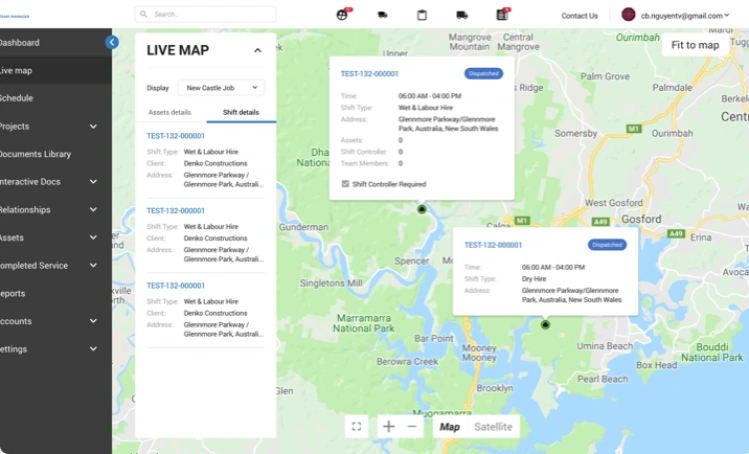
- What we built: Job scheduling, shift and resource allocation, and asset delivery and management; a live map with real-time vehicle and shift tracking; offline-mode iOS and Android apps for team leaders and crew members; e-signature; role-based access with licence and document expiry tracking; custom scheduled reports; and a multi-tenant architecture. Delivered in three phases, starting from an MVP with only the features the product needed to function.Â
- Engagement / timeline: Engaged 2017; phased MVP → feature expansion → advanced differentiation. [PLACEHOLDER: engagement model, team size, total duration]Â
- Outcome: The client's business model was transformed into a SaaS product now used across multiple industries and geographies. [PLACEHOLDER: quantified outcome]Â
- Stack: React Native, ASP.NET Web API, .NET, SQL Server, SQLite, SignalR, Hangfire, Angular, Jenkins.Â
Why it reads across: this is the field-crew stack: dispatch, time entries, offline capture, that contractors ask about first. Source: /case-studies/mobile-team-manager/Â
Visit DA - equipment health monitoring across distributed sites
- Challenge: The client needed an accurate audit of machine storage across many locations, delivered through a multi-tenant web application usable on any device.
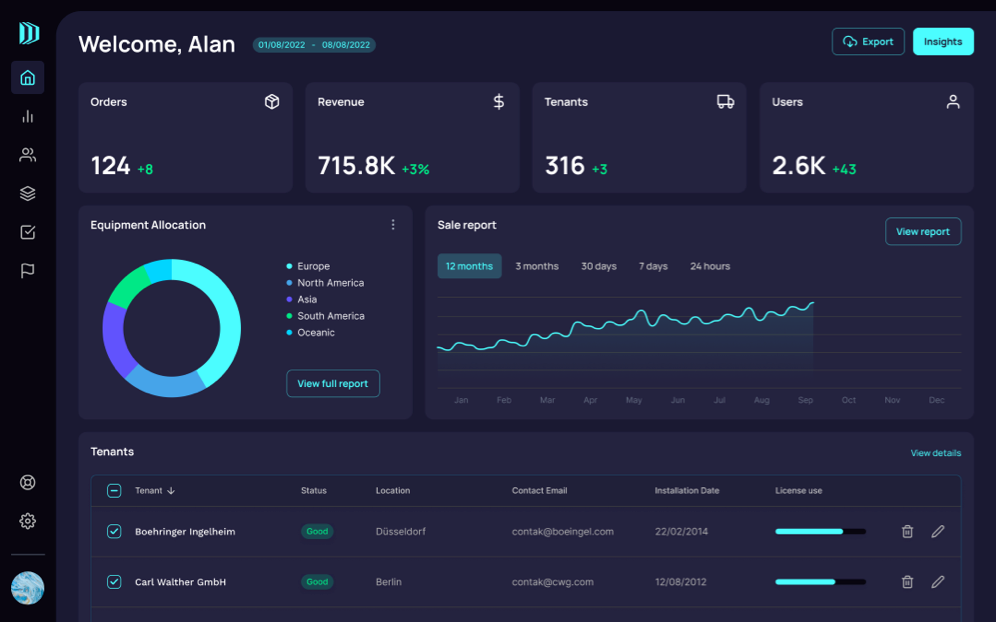
- What we built: A data management and visualization platform with tenant, user, role, and settings management, plus a report dashboard covering current data, errors, downtime, period, energy, and maintenance scheduling reports. Fully cross-platform. Complex cross-table calculations required deep work on the existing database to extract and present figures accurately.
- Outcome: Consolidated equipment-health data enabled informed decisions on storage allocation.
- Stack: .NET Core 3.1, Entity Framework, MSSQL, Bootstrap, jQuery, CanvasJS, multi-tenancy.
Why it reads across: downtime and maintenance reporting across sites is the core of equipment management, the module contractors ask for right after project management. The team also delivered across a German–English language barrier, validating report logic with sample reports at each step. Source: /case-studies/visit-da/Â
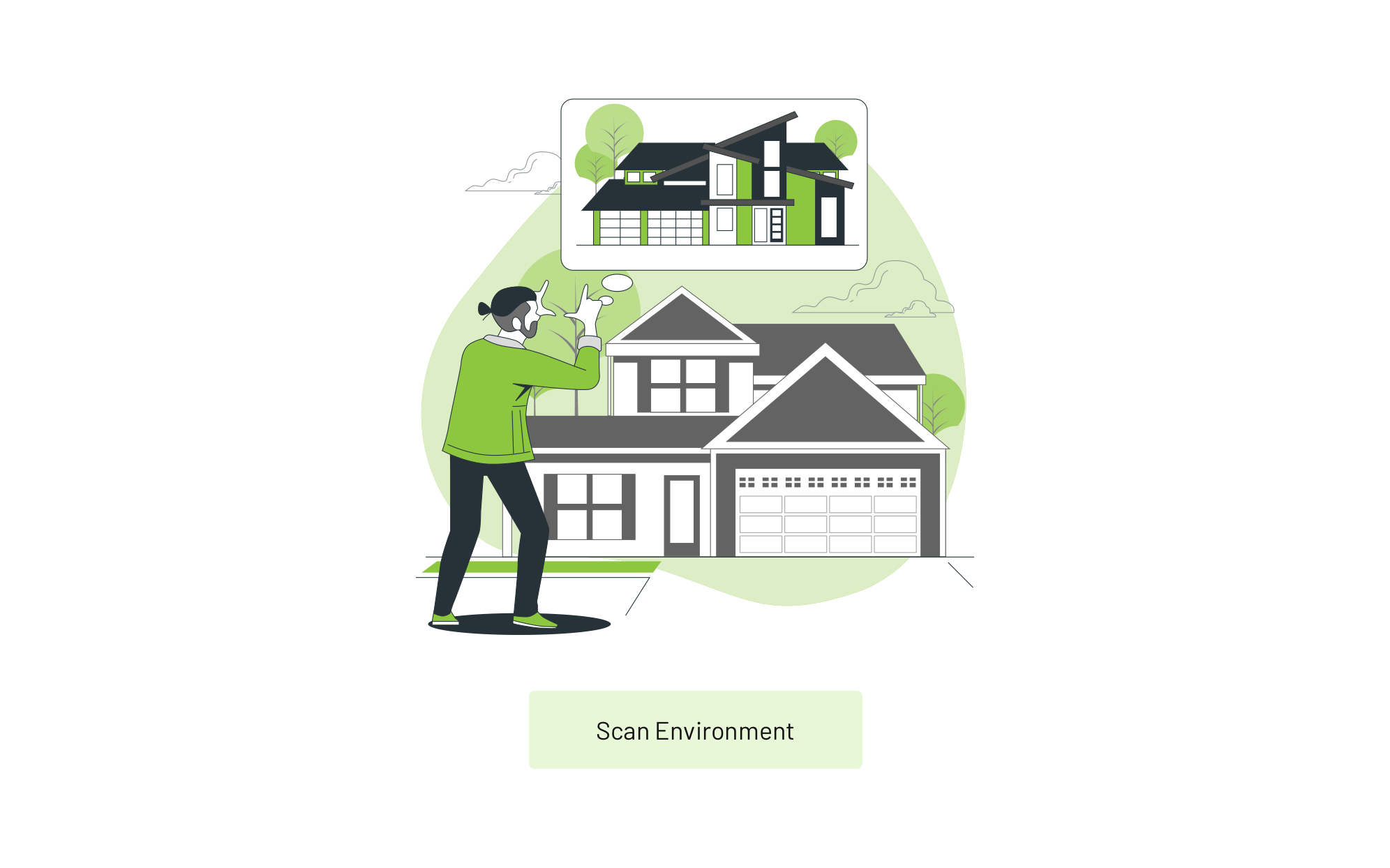
HoloLens - spatial scanning and on-site measurement
- Challenge: Build a mixed-reality application combining computer vision and augmented reality for environment capture and precise measurement. The published case study notes the client "might work in fields such as building design, interior decoration, or architecture."
- What we built: Scan Environment, Measure Straight Line, Measure Area, Measure Room, Detect Text, Read Text, and Detect Objects, with real-time data synchronization across multi-user sessions so one user's change is immediately visible to everyone else.
- Stack: Unity, UWP 10, Mixed Reality Toolkit, Azure Vision APIs.
- As project imagery is confidential, we share only the project details.Â
Worth stating plainly: no UI/UX prototypes were supplied, so our team designed the interface from scratch; and no physical headset was available, so we built against a simulator and staged validation on real hardware with the client. Both constraints are in the published case study. Source: /case-studies/hololens/Â
Send Us the Brief. See Your Workflow Running in 48 Hours.
- Clickable prototype of your field, scheduling, or job-costing flow
- Workflow visualization mapping the full field-to-finance chain
- Architecture direction covering offline sync, ERP integrations, and scale
- Technical recommendation call with our engineering team
Why Choose Saigon Technology as Your Construction Software Development Company?
A good construction software development company understands both codebases and job sites: it ships software that works without signal, integrates with the finance system you already run, and stays supportable for years. Saigon Technology has built field-operations, equipment-monitoring, and spatial-computing systems since 2012 under ISO 9001 and ISO 27001 certification.Â
Senior engineers plus AI, at a published rate
Our listed rate for implementation work is $22–$46 per hour with senior personnel overseeing delivery, 10–12 hours of daily overlap with US East and West Coast teams, and developers holding CEFR or IELTS-certified English. One senior engineer working with AI tooling replaces roughly three juniors, fewer people, less rework.
Why that matters on a construction build: at premium onshore rates, the first line items cut are offline sync, conflict resolution, and field-device hardening. Those are exactly the parts that decide whether a foreman uses your app or goes back to a clipboard.Â
Software built for job-site conditions, not office conditions
Most construction software fails at the edge of the network, not in the data center. We design offline-first - local write, queued sync, explicit conflict resolution on reconnect, so a daily report filed in a basement is not lost when the device reconnects. Around that we build custom security mechanisms: role-based access, encryption at rest, and full audit trails, delivered through DevSecOps practices and a secure SDLC aligned with GDPR and PDPA. An app that assumes connectivity fails quietly, and the missing hours surface weeks later in compliance reviews and job costing, when they are expensive to reconstruct.
The team that built it is still there when it has to change
Construction platforms are long-lived. Schemas shift as you add trades, seasonal features ship every year, and a rollout to a second region rewrites assumptions made in year one. Churn breaks what you already shipped, the engineer who designed your scheduling logic is the cheapest person to change it. Saigon Technology ranked #10 in the Medium category of the Southeast Asia Best Workplacesâ„¢ in Technology 2026 list from Great Place To Work, appears on Fortune 100 Best Companies to Work Forâ„¢ Southeast Asia 2025, and shortlists from the top 1% of engineers screened.
ISO 9001 and ISO 27001 certified, and a Microsoft Gold Partner
Both certifications are issued and audited by BSI (UK), not self-declared. In practice that means subcontractor records, payroll hours, and client financial data are handled under a documented information-security regime rather than a promise.
14+ years · 400+ developers · 850+ projects · 300+ clients · 3 development centers
On proof, plainly: the three projects above are field-operations, equipment-monitoring, and spatial-computing builds, not named construction jobs. We would rather show verifiable adjacent work you can read in full on our own site than invent a construction metric. Detailed, named construction references are available under NDA on request.
Architecture advice from day one - including when not to build
Sometimes the answer is Procore. If a platform already covers your workflow, we say so on the first call rather than bill you to rebuild it. Where custom is the right call, you get architecture direction before any code is written.
A two-week risk-free trial, and engagement models that fit the phase
Interview the engineers yourself, then run a two-week risk-free trial before any long-term commitment. Staff augmentation, dedicated team, fixed-price, or ODC, teams scale up for a rollout and back down for maintenance.
Trusted by Contractors, Builders and Product Teams
In Our Clients' Words
Who We Build For
General contractors
Specialty & trade contractors (mechanical, electrical, plumbing)
Civil & infrastructure firms
Real-estate developers & owners
Construction software product companies (ISVs)
Why Custom Construction Software Beats an Off-the-Shelf Platform
It fits the process that wins you work
A tailored solution encodes your sequencing, your cost codes, and your approval chain, no workarounds to fit someone else's data model.Â
Crews actually adopt it
Built for gloves, glare, and no signal. Team adoption is the single biggest predictor of whether construction software returns anything at all.
One source of truth
Field data flows into finance without re-keying, which is where most of the day-to-day operational efficiency gain actually comes from.
Equipment pays for itself
Utilization, downtime, and maintenance become visible before they cost you a schedule.
Lower TCO at scale
No per-seat licence escalation across a seasonal headcount, and no annual increase on a module you barely use.
Smooth & cost-efficient integration
Built to connect to the systems you already run, rather than forcing a migration you did not budget for.
You own the IP and the roadmap
Full scalability on your terms, with no vendor deprecating the one feature your process depends on.
Our Construction Software Development ProcessÂ
Discovery & consulting
We map workflows, systems, and data migration requirements, then agree what is in and out of scope.Â
Solution design
Architecture, tech stack, integration map, and a technology roadmap with a phased implementation plan, so you can see what ships when.
UX & product design
Prototyped with the people who will use it in the field, not only the people buying it.
Agile development
Two-week sprints, CI/CD, and a working build you can open at every review. Where an AI component is in scope, our Research Labs can de-risk it before you fund the full build.
QA & testing
Functional, integration, performance, and real-device field testing under actual site conditions.
Launch, onboarding & adoption
Deployment, staff training for crews and office users, and a pilot with one crew or one site before company-wide rollout, the adoption risk in construction is human, not technical.
Maintenance & support
Deployment and post-launch support, monitoring, and ongoing maintenance & support as your process and portfolio change.
Our InsightsÂ
FAQs
What is construction software development?
Construction software development is the practice of building custom software applications for the construction industry: project management, field operations, equipment tracking, estimating, and compliance, instead of configuring a general-purpose platform to approximate them. It spans requirements, architecture, development, integration with existing finance systems, and post-launch support.Â
What does a construction software development company do?
A construction software development company designs, builds, integrates, and maintains software for contractors, builders, and developers. That covers discovery and solution design, mobile and web development, integration with ERP and accounting systems, quality assurance, deployment, user onboarding, and ongoing maintenance & support after launch.
How much does custom construction software cost?
Cost depends on scope, integration complexity, data migration requirements, and team seniority. Saigon Technology's published rate for implementation work is $22–$46 per hour with senior oversight. A focused field app costs materially less than a multi-module platform, and most clients scope an MVP first to establish a real number before committing to the full build.
How long does a construction software project take?
Projects are delivered in phases, each reaching production before the next begins, the pattern we used on Mobile Team Manager, where an MVP carried only the features the product needed to function, then expanded. Multi-module platforms covering project management, field operations, and finance integration run longer than a single field app.
Should we build custom construction software or buy Procore or Buildertrend?
Buy when your workflow matches the platform's assumptions and you can live with its data model: many contractors can, and we will tell you so. Build when you have a process that wins you work, need to own data across several systems, or keep paying for workarounds. Plenty of clients do both: buy the platform, build what it cannot do.
What technologies, integrations, and standards do we work with?
Backend: .NET, Java, Node.js, Python Frontend: React, Angular, Vue.js, TypeScript Mobile: iOS, Android, React Native, Flutter AI/ML & spatial: Python, TensorFlow, PyTorch, OpenCV, LLMs, Unity, Mixed Reality Toolkit, Azure Vision APIs Cloud & DevOps: AWS, Azure, Google Cloud, Docker, Kubernetes, Terraform, Jenkins
Integrations. System integrations are scoped per platform against its published APIs or file-based exchange. Common targets include project management tools and accounting systems, Procore, Autodesk Construction Cloud, Sage 300 CRE, ComputerEase, and QuickBooks, plus BIM/IFC data exchange and IoT telematics feeds. Where a system exposes no API, we build a documented integration layer rather than a brittle one-off script.
Standards & compliance. ISO 9001 (quality) and ISO 27001 (information security), both BSI-certified; secure SDLC aligned with GDPR and PDPA; NDAs and role-based access as standard; WCAG 2.2 AA for client- and owner-facing portals.
Can you integrate with Procore, Autodesk Construction Cloud, Sage, or ComputerEase?
Yes, integration is scoped per platform against its published API or file-based exchange, and those four are common targets alongside QuickBooks and BIM/IFC data. Where a system exposes no API, we build a documented integration layer instead of a one-off script, so the connection survives a version change on either side.
How do you handle offline job sites and construction data security?
Field apps are built offline-first: work is written locally, queued, and synchronized on reconnect with explicit conflict resolution, so nothing is lost when signal drops. Security mechanisms include role-based access, encryption at rest, and audit trails, delivered under ISO 27001-certified practices and a secure SDLC aligned with GDPR and PDPA.