


Core Banking Software Development: Platforms, Build vs Buy, and Modernization (2026)

 Updated on Nov 19, 2026
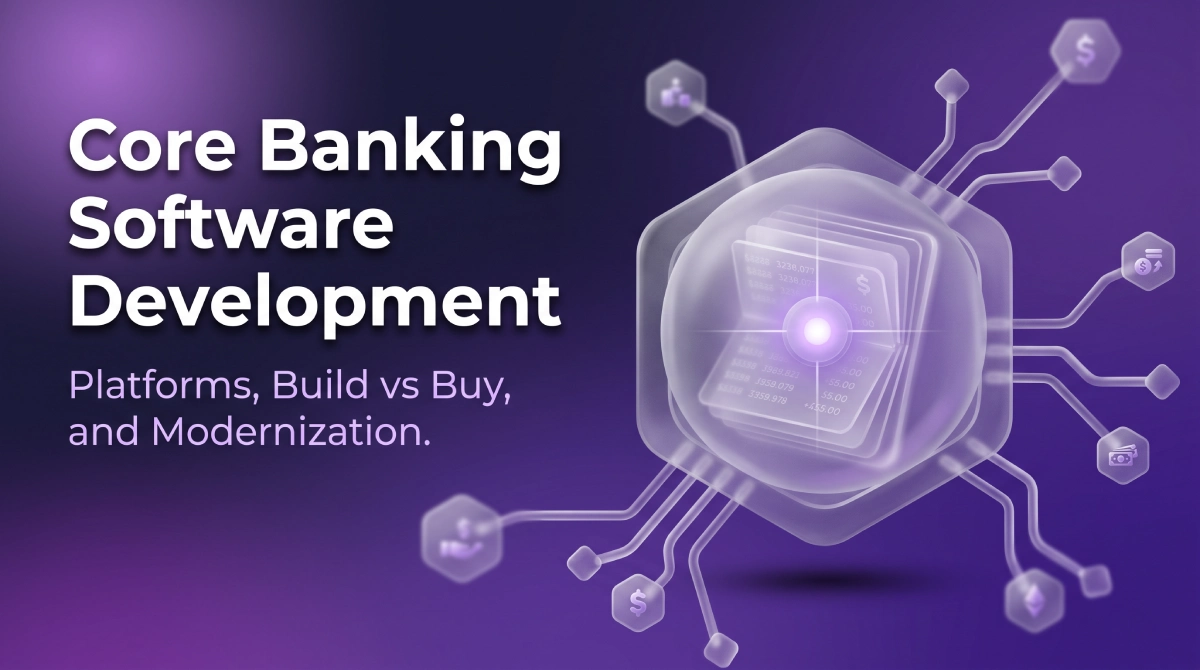
Core banking software development is the process of building, customizing, or modernizing the back-end systems that process a bank’s accounts, deposits, and loans in real time. Legacy core systems can consume 15–20% of a bank’s IT budget, making modernization an important step toward reducing maintenance costs and accelerating product development. Saigon Technology scopes and builds these systems with senior engineering teams. See how the build-vs-buy decision plays out below.
Key Takeaways
- Core banking software is the back-end ledger, account, and transaction engine that every customer-facing banking product depends on.
- No vendor or platform seller can give honest build-versus-buy advice, since they are structurally biased toward their own answer.
- Composable, API-first architectures and AI-assisted development have changed the five-year cost picture. Custom development is now viable for fintechs and digital-first banks that would have licensed a platform in 2022.
- Legacy COBOL mainframes still run most tier-one US banks. Strangler-fig modernization, not a big-bang rewrite, is the pattern that actually ships.
- Realistic engineering rates for core banking software development sit at $22 to $46 per hour with a senior offshore partner, versus $150 to $250 with a US-based firm.
Core Banking Software vs Digital Banking Software
These two terms get mixed up constantly, but they sit at different layers of a bank’s technology stack. The ledger, the accounts, and the loan servicing engine make up core banking. Digital banking, by contrast, is the mobile banking app, the web portal, and the customer-facing experience that calls into the core underneath it.
| Dimension | Core banking software | Digital banking software |
| What it is | Back-end ledger, account, and transaction engine | Front-end customer experience layer (app, web portal) |
| Who interacts with it directly | Internal systems, tellers, back-office staff | Customers, via mobile and web |
| Data relationship | System of record, owns the authoritative balance | Consumer of core data via API, holds no ledger truth |
| Replacement timeline | 18 to 36 months, with migration and parallel-run risk | Weeks to a few months for a front-end rebuild |
| Failure risk | Existential. A broken core can corrupt account balances or halt transactions bank-wide | Contained. A broken app degrades experience but does not touch the ledger |
| Typical vendors | Temenos, FIS, Fiserv, Mambu, Thought Machine | Backbase, Q2, in-house React/React Native builds |
The practical takeaway: a bank can replace its digital banking front end in months with comparatively low risk. Replacing the core is a different order of project entirely, and it is why most modernization programs choose to wrap or progressively replace the core rather than touch it directly.
Key Features of Core Banking Software
These are the functional modules every core banking software development project has to account for, whether built custom or sourced from a vendor.
Account Management
Account management handles opening, closing, and lifecycle changes for checking, savings, and term deposit accounts. Modern cores add automated account onboarding with document-AI checks, cutting manual review time and reducing errors in identity and eligibility verification.
Real-Time Transaction Processing
Real-time transaction processing posts deposits, withdrawals, transfers, and inter-branch settlements directly against the ledger as they happen. AI-native cores pair this with straight-through processing and anomaly scoring, flagging suspicious activity before a transaction settles rather than after.
Loan and Credit Processing
Loan and credit processing covers origination, servicing, interest calculations, and payoff for both consumer and commercial loans. AI-driven credit decisioning and dynamic pricing now sit inside this module, scoring risk and setting terms faster than manual underwriting allows.
General Ledger and Accounting
The general ledger handles double-entry bookkeeping, period close, and reconciliation across every product the bank offers. This is where regulators look first, so continuous reconciliation and audit-trail validation matter more here than anywhere else in the system.
Customer Management
Customer management runs on a single-entity model that unifies a customer’s profile across every product and channel they touch. AI-native cores extend this with real-time access to customer information, so support agents see the full relationship instantly.
Reporting and Analytics
Reporting and analytics covers regulatory reporting, management dashboards, and operational metrics that keep the bank compliant and informed. Natural-language query over live data is the AI-native upgrade, letting non-technical staff ask questions directly instead of waiting on a report.
Compliance and Risk
Compliance and risk functions include audit trails, automated KYC and AML checks, and fraud detection built into the transaction flow itself. Continuous transaction-level fraud scoring replaces periodic batch reviews, catching patterns as they occur rather than days later, a practice closely tied to fintech cybersecurity.
API and Integration Layer
The API and integration layer exposes secure endpoints that let internal systems and approved partners call core functions directly. This is the layer vendors underdeliver on most often, and model-serving hooks here decide whether the core can support AI decisions in-flight.
Core Banking System Architecture: Legacy vs Modern
Core banking system architecture has evolved through three generations, and the choice between legacy and modern shapes every decision that follows.
| Dimension | Legacy core | Modern cloud-native core |
| Deployment | On-premises mainframe, often COBOL | Cloud-based or hybrid, microservices |
| Scaling | Vertical, through bigger hardware | Horizontal, through container orchestration |
| Release cadence | Quarterly to annual | Continuous deployment |
| Data model | Monolithic, batch-oriented | Event-driven, real-time |
| Integration | File-based or point-to-point | API-first, often with event streams |
| Change cost | High, with decades of patches | Lower, with modular components |
Are banks still using COBOL? Yes. Most large US banks still run legacy cores on COBOL mainframes, and the shrinking specialist talent pool is why modernization now favors a strangler-fig approach: new services wrap the legacy core instead of replacing it outright.
Modern core banking systems are called AI-ready when three things hold: real-time event streams, low-latency data access for models, and hooks where a model’s output can shape a live transaction. Without these, AI stays peripheral instead of driving decisions.
Three deployment models exist for core banking platforms: on-premises (full control, high cost), cloud-based (scalable, but vendor-dependent), and hybrid (a mainframe-cloud bridge that lets a bank modernize incrementally).
Best Core Banking Software Providers in 2026
Picking from the best core banking software providers means choosing among four groups: incumbent enterprise platforms, cloud-native entrants, US community-bank specialists, and composable cores for embedded finance. Saigon Technology sells no core banking platform, so this list of top core banking software companies is vendor-neutral.
| Vendor | Best for | Deployment | Target institution | Pricing model | AI maturity |
| Temenos | Large and mid-size banks, universal banking | Cloud and on-prem | Tier 1 to 3 | License plus per-account | Medium |
| FIS | Large US and global banks | On-prem and private cloud | Tier 1 to 2 | Enterprise license | Medium |
| Fiserv / Finxact | US banks and credit unions | Cloud and on-prem | Community to mid-size | Per-account SaaS | Medium |
| Oracle FLEXCUBE | Global universal banks | On-prem and cloud | Tier 1 to 2 | Enterprise license | Medium |
| Finacle (Infosys) | Global and digital-first banks | Cloud and on-prem | Tier 1 to 3 | License plus modules | Medium |
| Mambu | Digital banks and lenders | SaaS, cloud-native | Fintech, neobanks | Per-account SaaS | High |
| Thought Machine | Modern banks replatforming | Cloud-native | Mid-size to large | SaaS, usage-based | High |
| Jack Henry | US community banks | Hybrid | Community banks | License plus services | Medium |
| 10x Banking | Transformation programs | Cloud-native | Large banks | SaaS, enterprise | High |
| Finastra | Lending, payments, treasury | Cloud and on-prem | Mid to large | License plus modules | Medium |
| TCS BaNCS | Large institutions globally | On-prem and cloud | Tier 1 to 2 | Enterprise license | Medium |
AI maturity is where core banking software vendors diverge most. A vendor can have a strong cloud story and still ship a core that is not ready for AI workloads.
How to Choose a Core Banking Vendor
When evaluating core banking solution providers, check these six things:
- Regulatory jurisdictions. A US community bank has a different list than a global digital bank serving the EU and SEA.
- API maturity, not just the feature list. A core with no clean API will block every product initiative for the next decade.
- The real data model. Vendor demos hide the schema. Insist on the actual tables and events.
- Five-year cost, not year one. License, implementation, integration, and run-the-bank costs together.
- Recent migration references. A vendor’s last tier-two migration in 2019 is a different risk than three in-flight today.
- AI-readiness, per the architecture section: event streams, low-latency reads, model-serving hooks.
Build vs Buy: When Custom Core Banking Software Development Makes Sense
Financial institutions can license an existing core, combine modular or BaaS solutions, or build custom core banking software. The right choice depends on product requirements, technical capabilities, regulatory obligations, and long-term costs.
| Scenario | Recommended approach | Key consideration |
| Community bank with standard retail products | License a vendor core | Prioritize proven banking features, regulatory support, and operational stability. |
| Digital bank with differentiated products | Composable core + custom layer | Customize customer-facing products while integrating established banking services. |
| Fintech lender with a unique credit model | Custom credit layer + third-party lending services | Differentiate credit decisioning without rebuilding the entire banking infrastructure. |
| Incumbent bank replacing a legacy core | Progressive modernization | Replace legacy components incrementally to reduce migration and operational risks. |
| Embedded finance provider | BaaS + custom layer | Use a licensed banking partner and APIs instead of building a full banking infrastructure. |
Saigon Technology’s Personal Loans Platform demonstrates custom fintech engineering for lending workflows. Built over three years using Java Spring Boot, Next.js, and AWS, it integrates Oscilar for credit risk assessment and LoanPro for loan servicing. This shows how fintech companies can customize lending capabilities while leveraging specialized third-party services.
For core banking software development services, the key is identifying which capabilities require custom engineering, often through a dedicated development team, and which are better integrated from an existing provider.
How Core Banking Software Gets Built: AI-Native Process and Stack
A real core banking software development program follows seven phases, each gating the next with a specific output.
- Discovery and regulatory scoping. Capture jurisdictions, product scope, licensing constraints, and data residency requirements. Output: a regulatory matrix every later decision gets checked against.
- Ledger design and double-entry correctness. Design the ledger schema, event model, and reconciliation procedures. Output: a formal specification auditors can review, since the ledger is what regulators scrutinize most.
- Microservices decomposition. Split the system into services along clear ownership boundaries: accounts, ledger, loans, payments, identity, compliance. Each service gets an explicit contract so teams can work in parallel without conflict.
- Integration layer. Build the APIs and event infrastructure connecting to payment rails, KYC/AML providers, credit bureaus, and partner systems. Output: a documented integration surface.
- AI-assisted development inside the delivery workflow. Senior engineers use AI development for code generation, test synthesis, and legacy comprehension, with human review on every change. The result is faster delivery, not fewer engineers.
- Security and compliance implementation. PCI-DSS where card data applies, SOC 2 Type II, AES-256 at rest, OAuth 2.1, with ISO 27001 as the governing framework. Output: a passed audit, not a checklist.
- Testing, parallel run, and cutover. Run the new core alongside the legacy system against live transactions, reconcile daily, and cut over only once divergence hits zero for an agreed period.
Team composition: a ledger-experienced solution architect, two to three senior backend engineers per service domain, a DevOps engineer, and a QA automation lead. We run senior-first, since ledger correctness does not tolerate learning on the job. Rates run $22 to $46 per hour, with a two-week risk-free trial and full IP transfer standard.
Core Banking Migration and Modernization with AI
Replacing a legacy core banking system involves complex data dependencies, integrations, and operational risks. A progressive approach, such as strangler-fig modernization, allows banks to introduce new services alongside legacy systems and replace components incrementally, an approach core to our legacy application modernization practice.
A typical modernization program involves four phases:
- Assessment and target architecture: Map legacy capabilities, data structures, integrations, and technical dependencies. Define the target architecture and prioritize migration steps.
- Coexistence layer: Introduce an API or integration layer to route requests between legacy components and new services during migration.
- Data migration and reconciliation: Transfer customer, account, and transaction data in controlled batches. Validate balances and transaction records between old and new systems.
- Parallel run and cutover: Test both systems, reconcile transaction results, and migrate business capabilities progressively.
AI can support legacy modernization in two key areas:
- COBOL analysis: AI tools can help engineers understand legacy code, identify business logic, and document application dependencies. IBM reports that one customer reduced application-understanding time by 79% using watsonx Code Assistant for Z. (IBM Research)
- Test generation: AI can assist with generating functional tests and validating migrated code against legacy behavior. However, engineers must review outputs and verify functional equivalence. (Microsoft)
Core banking modernization helps institutions in BFSI software development address legacy technology, complex integrations, and maintenance challenges. Modular, cloud-native, and API-first architectures can improve flexibility and support capabilities such as open banking and real-time fraud detection.
How Much Does Core Banking Software Cost?
Core banking software costs vary significantly depending on the institution’s size, implementation scope, and deployment model. The following figures provide planning benchmarks rather than fixed market prices.
| Approach | Estimated Cost | Main Cost Drivers |
| Core banking provider conversion | $50K–$350K upfront | Provider setup, migration, and system complexity |
| BaaS platform provider | Around $50K initial + $50K/year | Platform fees, integrations, and transaction volume |
| Direct bank partnership for BaaS | Around $2M launch + $2.5M/year | Bank integration, compliance, and operations |
| Custom development with an offshore engineering partner | $460K–$2.26M engineering cost under a 12–24-month team model | Team size, development scope, integrations, and testing |
| Full core banking replacement | Millions to hundreds of millions | Bank size, legacy integration, data migration, and deployment complexity |
These figures cover different project scopes and should not be treated as direct equivalents. For example, a provider conversion is not the same as building a new core banking platform, while engineering costs exclude ongoing operations and regulatory expenses.
For custom core banking software development, the biggest cost drivers include regulatory jurisdictions, payment and card network integrations, product complexity, data migration, security requirements, and long-term maintenance. A discovery phase helps establish a realistic budget and implementation roadmap.
Frequently Asked Questions
What is core banking software?
Core banking software is the back-end system that processes a bank’s accounts, deposits, loans, and general ledger entries in real time. It is not the mobile app, web portal, or ATM interface customers use; those are front ends that call the core banking system underneath to post every transaction.
Are banks still using COBOL?
Yes. Many of the largest US banks still run production core ledgers in COBOL on IBM z-series mainframes. The specialist talent pool is shrinking every year, which is the forcing function behind most modernization programs. Strangler-fig modernization around a COBOL core, rather than a direct rewrite, is the current pattern that ships.
Which core banking system does JP Morgan use?
JP Morgan has built and operated significant in-house core banking infrastructure alongside third-party systems, and has invested in Thought Machine as part of its retail transformation. Public disclosures indicate the retail banking stack is modernizing on a cloud-native core, but the firm does not publish a single-vendor answer because its stack spans multiple platforms by business unit.
How long does core banking software development take?
The timeline depends on the scope, complexity, and implementation approach. A focused fintech platform may take 12–24 months to develop, while a mid-sized bank’s core banking replacement can take 2–3 years or longer. Large-scale modernization programs may span several years, particularly when they involve legacy integrations, extensive data migration, and phased deployment.
What are the main risks of core banking migration?
The main risks are data corruption during migration, reconciliation failures between the old and new systems, and extended downtime that disrupts customer transactions. Most failures trace back to skipping the parallel-run phase, where the new core processes live transactions alongside the legacy system before cutover. Rushing this step is the single biggest predictor of a failed migration.
Can a core banking system integrate with third-party fintech services?
Yes. A modern core banking system integrates with third-party fintech services through an API layer that exposes account, ledger, and transaction data to approved external systems. This is how banks connect to payment processors, KYC providers, and credit bureaus. Legacy cores without this API layer require custom point-to-point integrations instead, which are slower and harder to maintain.
How do core banking systems handle high transaction volumes?
Modern core banking systems handle high transaction volumes through horizontal scaling, event-driven architecture, and real-time processing instead of batch jobs. Cloud-native cores add containers and queues that absorb traffic spikes without manual intervention. Legacy mainframe cores instead scale vertically, adding more powerful hardware, which caps how much volume growth they can absorb before requiring a rebuild.
Conclusion
Build versus buy is no longer a default choice to license a platform. Custom development costs have shifted, modernization patterns have matured, and cloud-native vendors now offer real alternatives. The real question is where differentiation lives in the stack, what your team can credibly own, and how the five-year cost compares to the alternative’s maintenance burden.
Whether you are evaluating a build, a buy, or a modernization program, Saigon Technology brings 14+ years and 850+ projects of engineering experience, with dedicated financial services engineering expertise, backed by Microsoft Solutions Partner status, ISO 27001 and ISO 9001 certification, and a two-week risk-free trial on any engineer we propose. Get in touch to scope your core banking software development project.


Related articles
AI in Fintech: A 2026 Builder’s Guide to Use Cases, Architecture and Regional Rules
 Huy (Harvey) Bui - Project Manager
 04 May 2026
Fintech Cybersecurity: 2026 Threats, Compliance & Controls
13 Aug 2026 
8 Fintech Software Development Trends Reshaping 2026
26 Aug 2026 
Digital Wallet App Development: Cost, Stack & Compliance
28 Oct 2026 
Investment Management Software: Features, Cost & Build vs Buy (2026)
29 Oct 2026 
Embedded Finance Platform: A Buyer’s Guide to Features, Costs, and Providers
05 Nov 2026 
Loan Management Software Development: Features, Costs & Build vs. Buy in 2026
09 Nov 2026 
Banking as a Service Platform: How It Works, Key Features & How to Choose One
17 Nov 2026