




Fintech Cybersecurity: 2026 Threats, Compliance & Controls

 Updated on Aug 13, 2026
Fintech cybersecurity is the set of engineering practices, security controls, and compliance safeguards that protect your platform, customer data, and money movement from cyberattacks, fraud, and regulatory failure. However, it is not the same as generic enterprise security. In fact, your product runs on APIs, mobile apps, third-party integrations, and highly regulated transactions, and each layer needs its own defenses.
If you are building or scaling a fintech product, security cannot sit at the end of the launch checklist. Instead, it has to live inside your architecture from day one. This guide walks you through the major fintech cybersecurity threats in 2026, the compliance stack you need to know, the AI risks most teams underestimate, and the engineering controls that hold up in production. It is written for cybersecurity fintech leaders, CTOs, and product owners who need a working reference, not another surface-level overview.
Key Takeaways
- Financial services is one of the highest-cost sectors for data breaches, averaging $5.56 million per incident, roughly 25% above the $4.44 million global average (IBM Cost of a Data Breach Report 2025).
- API abuse, account takeover, insider threats, phishing, third-party compromise, mobile attacks, and AI-powered fraud are the top risk categories you need to plan for.
- PCI DSS, GDPR, SOC 2, PSD2, KYC/AML, CCPA, SOX, and FINRA may apply, depending on your products, customers, and markets.
- Zero trust, phishing-resistant MFA, encryption, API security, continuous monitoring, and secure SDLC form the foundation of modern fintech security architecture.
- AI expands both defense and attack, introducing deepfake KYC bypass, synthetic identity fraud, automated attacks, and LLM prompt injection.
- A fintech breach can extend beyond direct losses to regulatory action, customer churn, reputational damage, and lost enterprise partnerships.
What Is Fintech Cybersecurity?
Cybersecurity in fintech covers your entire product lifecycle. Specifically, it starts at customer onboarding and KYC, then runs through authentication, payment processing, account management, data storage, and transaction monitoring. Importantly, every step needs its own controls.
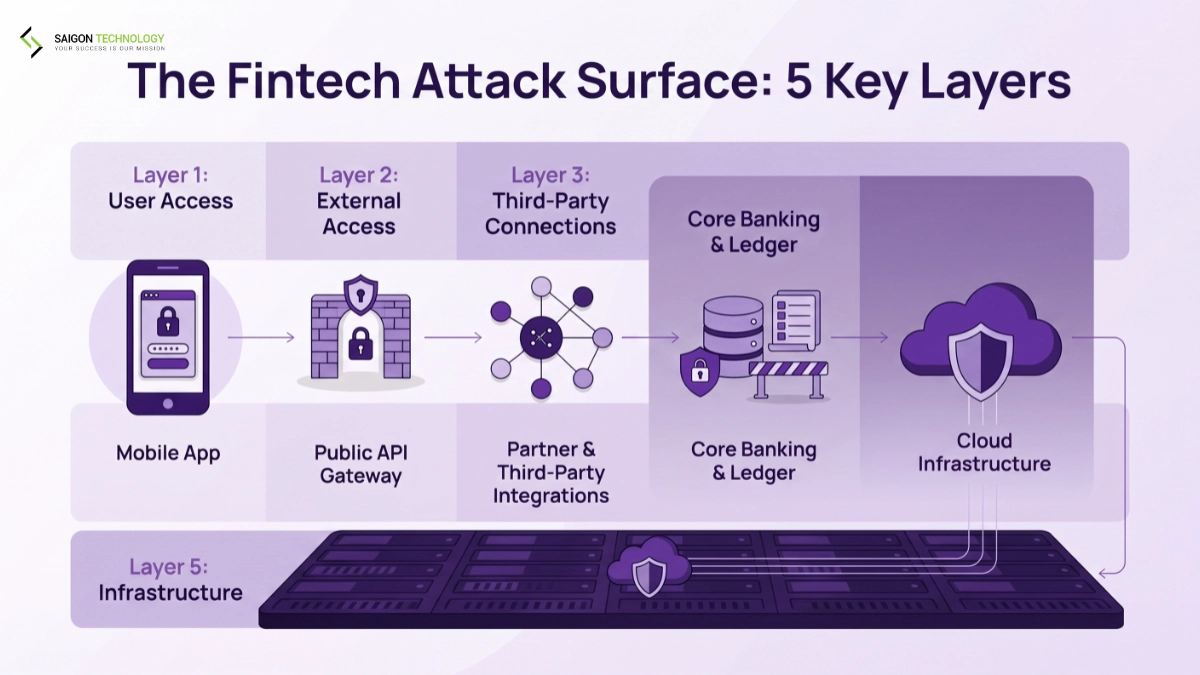
It also extends beyond your core app. In addition, public and partner APIs, mobile SDKs, cloud infrastructure, payment processors, identity providers, and banking integrations all sit inside the attack surface. Because these components are interconnected, a weakness in one place creates risk everywhere. As a result, a single compromised vendor can expose customer data across your entire platform.
Cybersecurity in fintech matters more than in most industries for three reasons.
- First, you hold money and personal data at the same time. That means any breach becomes a fraud event, a privacy event, and a regulatory event in one.
- Second, your business model depends on APIs, which exposes far more machine-readable surface than a traditional bank ever did.
- Third, you ship faster. In older shops, that meant security became a launch blocker instead of a build discipline. Fortunately, modern cybersecurity fintech teams are working hard to leave that mindset behind.
How fintech cybersecurity differs from traditional bank security
| Dimension | Traditional bank security | Fintech cybersecurity |
| Primary attack surface | Branch networks, core banking mainframes | Public APIs, mobile apps, cloud infrastructure |
| Release velocity | Quarterly to yearly | Weekly to daily |
| Third-party exposure | Limited, negotiated deeply | High, dozens of KYC, payment, and data vendors |
| Compliance posture | Regulator-led, audit-heavy | Multi-framework, self-attestation heavy (SOC 2, PCI DSS) |
| Talent model | In-house SOC and IT security | Mixed in-house plus embedded engineering partners |
The Fintech Threat Landscape in 2026
The eight threats below account for most of what we see hit fintech platforms in production. Notably, they are not new categories so much as sharper versions of familiar attacks, plus a growing class of AI-driven ones. Overall, cybersecurity in fintech starts with knowing what you are up against, so each one below deserves a spot on your risk register.
API Abuse and Business Logic Attacks
Your APIs are the main attack surface. Specifically, exposed endpoints, broken object-level authorization, IDOR vulnerabilities, and integration loopholes let attackers read balances or move money that should be out of reach. Moreover, business logic attacks skip authentication entirely by abusing legitimate workflows. For engineering-level detail, see our guides on application security and APIs in payments.
Credential Stuffing and Account Takeover
Attackers replay leaked credentials against fintech logins by the millions. Without continuous authentication checks and real-time anomaly detection, these attacks succeed at scale. Additionally, account takeover is also the on-ramp for most transaction fraud, so keep it high on your risk register.
Insider Threats
Anyone with production access is a risk. That includes your engineers, support agents, and third-party contractors. Therefore, least-privilege access, separation of duties, and full audit trails matter here as much as any external control. Insider incidents are also harder to detect, because the actions look legitimate on the surface. That is why they slip past standard alerts.
Phishing and Social Engineering
Attackers now go after your KYC operations team directly, hoping to trick them into approving fraudulent accounts. Consequently, employee training, targeted awareness programs, and clear escalation rules cut this risk. Your customers face the same threats. Therefore, give them tools to spot suspicious emails and verify requests before they click.
Supply Chain and Third-Party Risks
A breach at your KYC vendor, your Plaid or GIACT integration, or a widely used dependency can flow straight into your platform. To manage this, keep an inventory of every integration and scan the components you pull in. In addition, contract-level security requirements and periodic vendor reviews close the rest of the gap.
Mobile App Tampering and Reverse Engineering
Attackers repackage, decompile, and probe fintech apps for hardcoded secrets. Accordingly, certificate pinning, root and jailbreak detection, and code obfuscation are baseline defenses. For a full walkthrough, see our guide on mobile banking app security.
AI-Powered Attacks
Deepfake video and voice bypass live KYC checks. Meanwhile, generative AI creates synthetic identity documents at scale. Furthermore, prompt injection turns fintech chatbots into data exfiltration channels. These attacks are still emerging, but they are moving from proof-of-concept to live incidents fast. For deeper coverage, see our posts on LLM security risks and vibe coding security.
Ransomware and Malware
Ransomware crews now target fintechs directly. They encrypt core lending or transaction systems and demand payment in cryptocurrency. Typically, the entry point is an application breach, and identity theft follows if customer data leaks. Backup integrity and incident response readiness are the two controls that matter most.
Ultimately, these threats compound. For example, one exposed API endpoint plus a stuffed credential plus a weak MFA policy adds up to a full account takeover. In turn, that becomes transaction fraud, then a financial data breach, then a regulatory disclosure. In short, cybersecurity in fintech is fundamentally about breaking those chains early, before the small failures cascade.
Fintech Compliance and Regulatory Standards You Cannot Skip
Compliance in fintech is not one framework. Rather, it is a stack. Importantly, get any layer wrong and the others do not save you. The table below covers the regulatory frameworks that most commonly shape fintech operations across major global markets.
Compliance at a glance
| Regulation | Applies to | Core requirement | Typical penalty range |
| PCI DSS | Any fintech touching cardholder data | 12 control areas across network security, access, monitoring, and policy | Card-brand fines up to $100,000 per month |
| GDPR | Any fintech with EU/EEA users | Lawful basis, consent, right to erasure, 72-hour breach notification | Up to 4% of global annual revenue or €20M, whichever is higher |
| SOC 2 | US B2B fintechs and their vendors | Trust services criteria: security, availability, processing integrity, confidentiality, privacy | Not a fine, but loss of enterprise contracts |
| PSD2 / Open Banking | EU payment and account providers | Strong customer authentication (SCA), dedicated APIs, TPP access | Regulator-dependent |
| KYC / AML | All fintechs handling money | Customer identity verification, sanctions screening, transaction monitoring | Multi-million-dollar civil penalties |
| CCPA | Fintechs with California users | Consumer data rights, opt-out of sale | Up to $7,500 per intentional violation |
| SOX | Public fintechs and their auditors | Financial reporting controls, IT general controls | Criminal penalties for executives, up to $5M |
| FINRA guidelines | US broker-dealers and adjacent fintech | Cybersecurity program, incident reporting, supervisory controls | Fines, censures, suspensions |
PCI DSS
PCI DSS defines what has to happen from the moment your platform touches a credit card number. Specifically, it covers network segmentation, encryption in transit and at rest, access control, vulnerability management, and monitoring. Our PCI DSS compliance for fintech guide walks through all 12 requirement areas and the engineering patterns that pass audit.
GDPR and CCPA
GDPR governs EU personal data, and Article 83 sets the penalty ceiling at 4% of global annual turnover or €20 million, whichever is higher. Similarly, CCPA covers California consumers. Both give users rights over their data and require you to notify them when a breach happens. Data protection tooling and access controls handle the technical side, while policy, legal review, and audit trails cover the rest.
SOC 2
SOC 2 is what US enterprise buyers screen fintech vendors against. Specifically, achieving SOC 2 Type II means showing that your controls have worked as designed for six to twelve months. In practice, that forces disciplined logging, regular access reviews, and clean change management.
PSD2 and Open Banking
PSD2 requires strong customer authentication on most payment operations. It also mandates dedicated APIs for third-party providers. In practice, the boundary between banks and fintechs became a design surface as much as a compliance one.
KYC and AML
KYC and AML controls verify who your customers are and monitor their money movements against sanctions lists and known fraud patterns. Because rules in this area change faster than any other, treat KYC as a service layer, not a fixed integration. That way, you can swap providers, plug in region-specific identity verification like Singpass, and tune risk scoring without rebuilding the flow.
The Fintech Cybersecurity Engineering Playbook
Compliance frameworks tell you what to prove. Engineering tells you how to deliver it. The playbook below is the security architecture we deploy on fintech engagements. It is refined across 85+ dedicated offshore teams and 400+ engineers, and it aligns with the NIST Cybersecurity Framework and the OWASP API Security Top 10. Modern cybersecurity fintech teams treat these controls as a floor, not a ceiling.
1. Zero trust as the default
Every service authenticates and authorizes every request. Notably, there is no trusted zone, no “internal is safe” assumption, and no default allow. Instead, mutual TLS between services, short-lived tokens, and continuous verification of both users and machines close the gaps a perimeter-only model leaves open. Today, zero trust is the baseline for most new fintech builds, not an advanced upgrade.
2. Secure API design and API security controls
Your APIs are where fintech either wins or loses on security. For every fintech build, we deploy:
- OAuth 2.1 for authorization with short-lived access tokens and rotating refresh tokens.
- Mutual TLS on service-to-service calls inside the platform.
- Per-endpoint rate limits and request throttling to blunt credential stuffing and scraping.
- Schema validation on every request payload to shut down injection.
- Full API inventory documentation, so every endpoint has a known owner and threat model.
- API security automation in CI/CD: dependency scanning, SAST, DAST, and AI-driven fuzzing against public endpoints.
Above all, multi-factor authentication for API access, especially for privileged administrative APIs, is non-negotiable.
3. Phishing-resistant MFA (not SMS OTP)
SMS one-time passwords no longer hold up. In fact, SIM swap attacks and modern phishing kits defeat them easily. Instead, phishing-resistant MFA means FIDO2, WebAuthn, and passkeys for your consumer flows, plus hardware security keys for administrative access. For B2B and enterprise partner access, strong customer authentication under PSD2 is the same discipline applied to payments.
4. Encryption everywhere: AES-256 at rest, TLS 1.3 in transit
AES-256 at rest and TLS 1.3 in transit are the minimum standard for fintech data security. Equally important, key management matters just as much as the encryption itself. Depending on your cloud posture, we use AWS KMS, Azure Key Vault, or HashiCorp Vault. Rotation is strict, and the team that holds the decryption keys is separate from the team that owns the data.
However, blockchain security is only relevant if your platform uses distributed ledger for settlement or asset custody. In that case, key management and smart contract audit become your primary controls, not add-ons to a standard security posture.
5. Continuous logging, monitoring, and anomaly detection
You cannot respond to what you cannot see. Therefore, a production fintech needs centralized logging, a SIEM that correlates events across services, and real-time analysis of transaction and login patterns. Today, AI-driven fraud detection is common in leading fintech stacks. Specifically, the models watch for behavioral drift and flag anomalies before the loss lands. Since that kind of detection needs historical data to train on, plan log retention early.
6. Real-time fraud detection and prevention
Fintech fraud prevention lives one layer above monitoring. The goal is to stop the fraudulent transaction, not just log it. Specifically, a production-grade fraud stack combines four things: transaction monitoring (velocity checks, amount thresholds, geo-pattern rules), behavioral analytics that model each user’s normal activity, device intelligence that fingerprints the device and its risk signals, and continuous risk scoring on every login and every money movement.
In addition, anomaly detection catches the edge cases your rule engine misses. Meanwhile, dedicated synthetic identity detection stops AI-generated identities that pass first-line KYC. Account takeover prevention chains this together by flagging suspicious login patterns, requiring step-up authentication, and locking accounts before an attacker moves money. Ultimately, the payoff is real-time decisions in the underwriting flow, not after-the-fact review queues.
7. Secure mobile app engineering
Certificate pinning, runtime application self-protection, root and jailbreak detection, and code obfuscation are baseline for any fintech mobile app. Moreover, sensitive operations should live behind biometric plus device-bound key material. Secrets never belong in the app bundle in plaintext.
8. Secure SDLC on money-movement code paths
In fintech, shift-left is not a general engineering nicety. Rather, it is how you keep PCI DSS Requirement 6 satisfiable and your money-movement paths auditable. The code that touches cardholder data, KYC decisions, and ledger writes carries a different review bar than the rest of your product.
In practice, that means SAST on every commit, SCA on every dependency change, IaC scanning on every infrastructure PR, and mandatory second-engineer review on any diff that touches payment, onboarding, or balance logic. Notably, your product security team should sit inside delivery, not next to it.
Talent matters here. A secure-by-design approach only works if the engineers doing the design understand both the threat model and the regulation behind it. That is why our fintech pods pair senior product engineers with security engineers, rather than treating security as a downstream check.
9. Collaborative threat intelligence and information sharing
No single fintech sees the full threat landscape. Instead, sharing intelligence across peer companies, cybersecurity providers, and industry ISACs shortens the time between “first observed” and “everyone patched.” Additionally, threat modeling exercises with real historical data catch cascading risks that isolated analysis misses.
10. Customer education and awareness
Even a perfectly engineered platform loses to social engineering if your customers are unprepared. Therefore, in-product prompts, contextual warnings, and periodic awareness campaigns train users to spot phishing, protect personal data, and verify any request before they act. Ultimately, customer trust is the compounding return on all of that work.
How to Build a Fintech Cybersecurity Roadmap
Knowing every control that exists is one problem. Deciding which to build first, and in what order, is another. In fact, that second problem is what most CTOs and founders actually wrestle with. A cybersecurity roadmap gives you a phased sequence, from unknown risk posture to production-ready resilience, without leaving critical gaps open along the way.
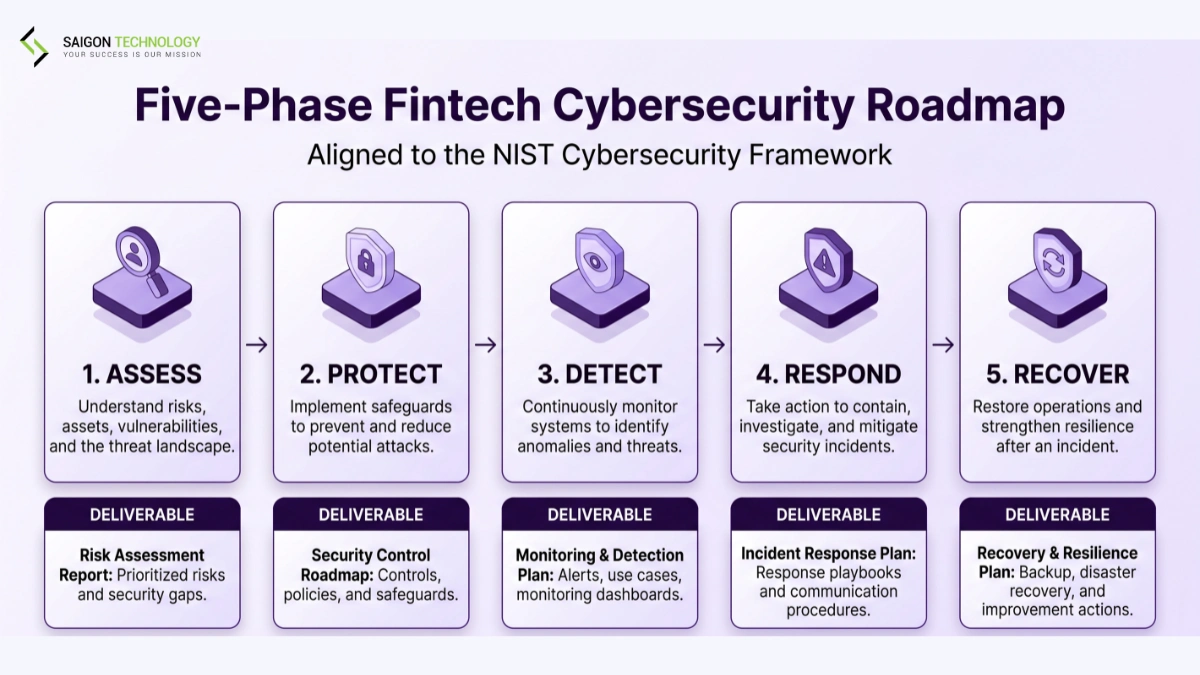
We structure fintech roadmaps in five phases, aligned with the NIST Cybersecurity Framework functions: Identify, Protect, Detect, Respond, and Recover. Each phase builds on the one before, and skipping ahead almost always creates rework later.
Phase 1: Assess
You cannot protect what you do not know exists. Accordingly, Phase 1 establishes ground truth. Build an asset inventory, run threat modeling on every critical flow (onboarding, KYC, payment, withdrawal), classify your data, and map applicable regulations to specific systems.
Deliverable: a risk register with prioritized gaps.
Phase 2: Protect
Roll out IAM, MFA, encryption, API security, and secure SDLC in the order your risk register suggests. Each control set is already detailed in the Engineering Playbook above. Here, the point of this phase is sequencing, not choice.
Deliverable: preventive controls covering the top-priority risks.
Phase 3: Detect
Prevention is not enough. Accordingly, Phase 3 assumes some attacks will land, and focuses on catching them fast. Stand up a SIEM, wire in real-time fraud monitoring, add anomaly detection, and integrate threat intelligence feeds.
Deliverable: mean time to detect (MTTD) measured in minutes, not days.
Phase 4: Respond
When something is confirmed bad, your response speed determines the total damage. Therefore, Phase 4 makes response a rehearsed capability, not a scramble. That means documented incident playbooks, pre-approved containment actions, a regulatory notification workflow that respects GDPR’s 72-hour clock and PCI DSS reporting, and structured post-incident reviews.
Deliverable: mean time to contain (MTTC) measured in hours.
Phase 5: Recover
The worst case is losing production data or availability. Accordingly, Phase 5 makes recovery predictable. That means immutable backups with restore testing, documented RTO and RPO per service, continuity procedures for partial outages, and resilience testing (chaos engineering, full DR drills) at least twice a year.
Deliverable: proven ability to restore the platform to full production within your stated RTO.
Overall, run the phases in this order and you build a defensible security posture over time. Conversely, try to tackle all five in parallel and you tend to end up with uneven coverage and shallow control depth.
How AI Is Reshaping Fintech Cybersecurity
Artificial intelligence and machine learning have joined the cybersecurity fintech toolkit on both sides of the fight. Consequently, if you ignore either one, you leave gaps.
On the defense side. AI-driven security systems spot fraud patterns humans cannot. Specifically, machine learning models score identity events in real time, flag anomalous transactions, and adapt to new attack patterns without waiting for manual rule updates. In addition, cloud configuration automation removes whole classes of misconfigurations that used to require human audit. Today, AI-based tools also handle a growing share of penetration testing coverage.
On the offense side. The same technologies fuel the attacks. For example, deepfake video defeats live liveness checks. Meanwhile, synthetic identity fraud uses generative models to fabricate document sets that pass first-line KYC. Automated business logic testing tools probe your APIs faster than any manual attacker could. Attackers also use LLMs to draft convincing phishing and social engineering messages at scale.
What that means for your engineering team. Every AI capability you add to a fintech product, from chatbots to internal copilots, expands your attack surface. Indeed, prompt injection is now a legitimate application security risk. Therefore, every AI system in production needs the same data governance, logging, and access review as any other critical service. Our AI development services team and forward deployed AI engineer offering both bake AI security review into every engagement.
Case Study: Security-First Engineering for Loan City
Business challenge. Loan City is a Singapore-based fintech that needed a digital loan comparison platform. Specifically, the platform had to connect borrowers, lenders, and administrators, and handle sensitive financial and personal data across the full loan application journey. That journey runs from borrower applications and verification to lender offers and final disbursement.
Solution. We built a multi-portal platform with dedicated experiences for borrowers, lenders, and administrators, delivered as a three-month initial build by a nine-member cross-functional team. Importantly, security sat inside the architecture from the start. That included role-based access control, independent portal authentication, automatic session timeouts, encrypted communication, secure data storage, and Singpass-based identity verification for borrowers. In addition, centralized compliance and audit management gave every step of the lending workflow a clear trail, in line with Singapore’s regulatory requirements for financial systems.
Security and operational outcome. The platform’s loan matching engine connects borrowers with suitable lenders based on predefined criteria. In production, it delivers under-3-second average match generation, 90% match accuracy validated through UAT, and 60% faster loan approval compared with manual matching. Furthermore, the matching process is fully traceable, and manual processing time dropped by 40%. To date, the platform has onboarded 50+ lenders and 2,000+ borrowers, giving the compliance team stronger transparency and audit readiness.
Explore the full Loan City case study for the architecture, development process, and results. For more fintech capabilities and project examples, download Saigon Technology’s Fintech AI Integration Pitch Deck.
Choosing a Fintech Development Partner: A Security-Focused Checklist
Picking the wrong development partner is itself a fintech security risk. Accordingly, the checklist below is what we recommend enterprise fintech buyers screen against.
| Criterion | What to look for |
| Fintech domain experience | Named case studies with real client work, not generic portfolios |
| Compliance track record | Delivered PCI DSS, GDPR, SOC 2, KYC/AML systems in production |
| Security engineering culture | DevSecOps, mandatory code review, secure SDLC, in-house security engineers |
| Team seniority | Senior engineers on the critical paths, not junior-heavy staff augmentation |
| IP and legal posture | Full IP transfer at delivery, NDA-first engagement, transparent contracts |
| Certifications | ISO 27001 and Microsoft Gold Partner as baseline |
| AI-era readiness | In-house AI-native engineering, LLM security capability, forward-deployed AI engineers |
| Trial period | Willingness to start with a paid pilot before long-term commitment |
Saigon Technology is ISO 27001 and ISO 9001 certified (issued by BSI, UK) and a Microsoft Gold Partner. Additionally, we were ranked #10 in the Medium category of Southeast Asia Best Workplaces™ in Technology 2026 by Great Place To Work, and named to Fortune’s 100 Best Companies to Work For™ Southeast Asia 2025. Overall, we staff senior-first pods across 400+ engineers, offer a two-week risk-free trial, and transfer full IP at delivery under NDA.
If you want to go a level deeper on any of this, here are useful next reads:
- Fintech software development: how we structure end-to-end fintech engagements
- BFSI software development: our broader work across banking, financial services, and insurance
- DevOps development services: the delivery discipline behind secure SDLC and continuous monitoring
- Fintech development outsourcing: engagement models, team structures, and typical costs
FAQs
1. What is fintech cybersecurity in simple terms?
Cybersecurity in fintech is the engineering discipline that protects financial-technology platforms and the data they handle from breaches, fraud, and regulatory failure. Specifically, it combines application security, cloud security, identity management, and compliance controls, all tuned for an API-first, mobile-heavy attack surface.
2. What are the biggest cybersecurity risks in fintech?
The most important attack vectors today are API abuse, credential stuffing and account takeover, insider threats, phishing that targets KYC operations, third-party and supply chain compromise, mobile app tampering, AI-powered attacks like deepfake KYC bypass, and ransomware against core lending or transaction platforms.
3. What compliance standards apply to fintech companies?
Most fintechs operate under PCI DSS for card data, GDPR and CCPA for personal data, SOC 2 for enterprise trust, PSD2 for EU payment services, KYC and AML for identity and transaction monitoring, and SOX and FINRA guidelines for public and broker-dealer entities.
4. What security measures should a fintech application have?
A fintech application should use strong authentication and authorization, phishing-resistant MFA, secure API design, encryption, fraud detection, continuous monitoring, mobile app protection, and secure SDLC practices. In addition, your security program should also include regular penetration testing, vulnerability management, access reviews, and compliance controls such as PCI DSS or GDPR.
5. How do you secure APIs in fintech applications?
Fintech APIs need strong authentication and authorization, short-lived tokens, least-privilege access, encryption, rate limiting, input validation, and continuous monitoring. Additionally, your team should maintain a live API inventory and test regularly for vulnerabilities like broken access control, IDOR/BOLA, injection, and business-logic abuse.
6. How much does a fintech data breach cost?
Financial services averaged $5.56 million per data breach in 2025, about 25% above the $4.44 million cross-industry average, according to the IBM Cost of a Data Breach Report 2025. However, direct remediation is only part of it. In fact, regulatory penalties, customer churn, and lost enterprise partnerships often exceed the incident cost itself.
Conclusion
Fintech cybersecurity in 2026 rewards teams that treat security as an engineering discipline, not a compliance chore. Today, the threat landscape includes AI-era attacks that traditional stacks miss. Moreover, the compliance stack has more layers than ever. And the controls that hold up in production are the ones baked into the architecture from day one: zero trust, secure APIs, phishing-resistant MFA, encryption everywhere, continuous monitoring, and secure SDLC.
Building or scaling a fintech product? Talk to our fintech engineering team. Book a 30-minute technical scoping call with a senior engineer. No sales pitch, no obligation. We will walk your architecture, flag the security gaps we see most often, and share the controls that would close them.


Related articles

5 Big FinTech Trends That Shape the Banking Industry
 Thanh (Bruce) Pham - CEO of Saigon Technology
  12 Jun 2024
Fintech Development Outsourcing: The Complete Guide for 2026
26 Sep 2024 
Fintech App Development Cost in 2026: An Honest Breakdown
24 Apr 2026 
How to Build a Fintech App in 2026: A Step-by-Step Guide
14 Apr 2026 
PCI DSS Compliance in Fintech Software Development: A 2026 Guide
03 May 2026 
AI in Fintech: A 2026 Builder’s Guide to Use Cases, Architecture and Regional Rules
04 May 2026 
KYC AML Automation: How to Build It Into Your Fintech Product
13 Jul 2026