


Banking as a Service Platform: How It Works, Key Features & How to Choose One

 Updated on Nov 17, 2026
A banking as a service platform is API-based infrastructure that lets software companies and fintechs offer accounts, cards, payments, and lending without holding a banking license. A chartered sponsor bank holds the deposits and the regulatory accountability; the platform exposes those functions as APIs. Since Synapse’s 2024 Chapter 11 bankruptcy, choosing one has become a risk decision as much as a speed decision.
This guide covers how the model works, the features to confirm, the four platform types, and when to buy, integrate, or build. It draws on Saigon Technology’s work building lending and wealth platforms for US fintech clients.
Key Takeaways
- Banking-as-a-service (BaaS) exposes regulated banking functions through APIs, so a non-bank can embed financial products while a sponsor bank holds the charter.
- BaaS platforms fall into four types: core banking or ledger platforms, card issuing platforms, compliance-as-a-service layers, and full-stack providers.
- Compliance does not transfer to the vendor. The sponsor bank answers to regulators, and every party in the chain must document its own controls.
- The build-vs-buy signal tracks product stage: pre-product-market-fit teams usually buy a full stack; teams at scale with vendor-concentration risk often unbundle.
- The Synapse collapse showed that customer funds can sit safely at a bank and still be unreachable for months when the middleware fails.
How Does a Banking as a Service Platform Work?
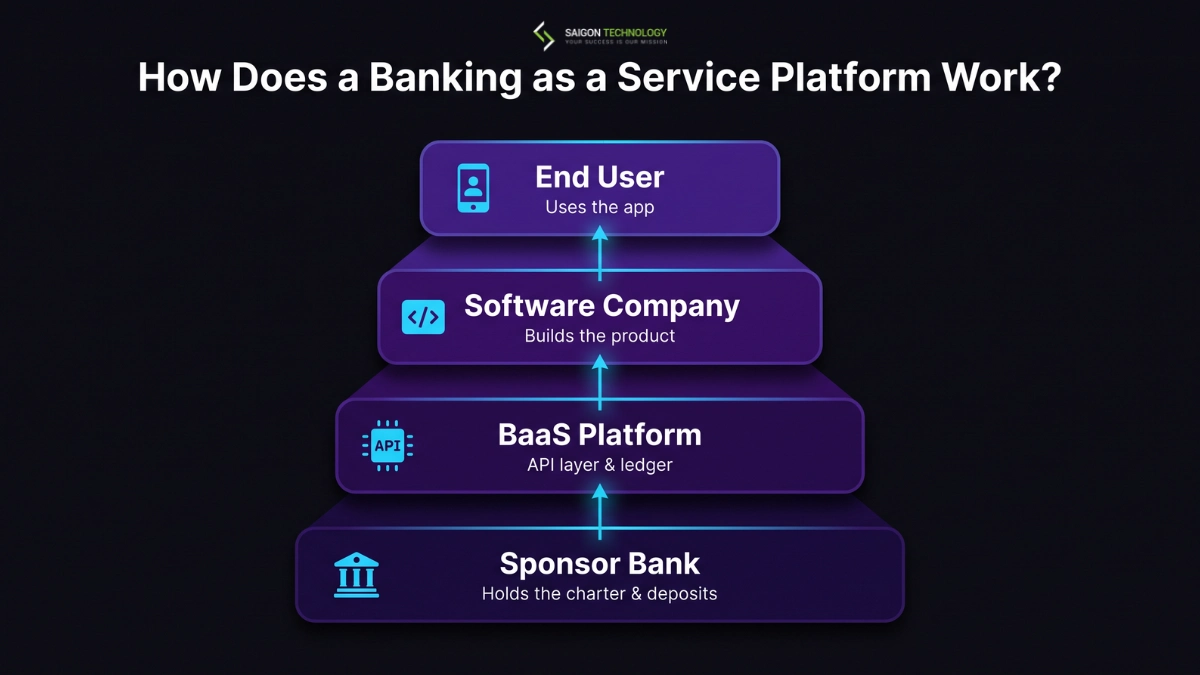
A banking as a service platform works as a four-party chain. A sponsor bank holds the charter and the deposits, a BaaS platform turns bank functions into APIs, a software company builds the product on those APIs, and the end user sees only the software brand. Each party owns a different slice of the customer relationship and the compliance work.
| Party | Role |
| Sponsor bank | Holds the banking charter and the deposits |
| BaaS platform (middleware) | Provides the API layer, developer tooling, and often the ledger |
| Software company | Builds the end-user product experience |
| End user | Uses the product; rarely deals with the bank directly |
How a request flows through the chain
A sponsor bank is the chartered, regulated bank whose balance sheet and licenses sit underneath a BaaS product. When the software company calls an API such as “open a checking account” or “issue a card,” the platform translates that request into banking operations the sponsor bank can execute and record.
This is a business-to-business-to-consumer (B2B2C) model:
- The software company owns the customer relationship.
- The sponsor bank owns the regulated infrastructure underneath.
- The BaaS platform owns the API layer that connects the two.
Who owns compliance
Compliance responsibility splits across the chain, and the split varies by contract. The common pattern looks like this:
- Sponsor bank: accountable to regulators for anti-money laundering (AML) and know-your-customer (KYC) outcomes, transaction reporting, and consumer protection.
- BaaS platform: operates the fraud monitoring tooling and runs the KYC flows day to day.
- Software company: collects customer data and surfaces compliance actions inside the product.
Confirm in writing who owns each step before you sign. US bank regulators expect banks to manage third-party risk across the whole relationship, and many sponsor banks now ask partners for that documentation.
The technical stack underneath
Modern BaaS platforms share a common set of engineering patterns:
- APIs: REST, sometimes GraphQL, with versioned schemas
- Authentication: OAuth 2.0 with current best practices such as short-lived tokens and PKCE (OAuth 2.1 is still an IETF draft)
- Architecture: event-driven messaging (Kafka or an equivalent broker) that keeps ledgers, cards, and reconciliation services in sync
Saigon Technology builds on this stack for US fintech clients, including the Personal Loans Application covered later in this article. For a deeper look at how APIs move money across this chain, see our guide to APIs in payments.
Banking as a Service Platform Features to Confirm Before You Sign
Eight capabilities decide whether a banking as a service platform launches quickly and operates safely: core banking, payment rails, card issuing, wallet provisioning, KYC and AML, APIs and webhooks, transaction monitoring, and security controls. Confirm each one in the contract and in the sandbox, because marketing pages rarely show which features a given sponsor bank actually permits.
Core Banking and Account Management
The ledger holds balances and records every transaction. It should expose APIs to open checking, savings, and high-yield treasury accounts, manage sub-ledgers for embedded balance management, and return real-time balances instead of overnight batch figures.
Payment Processing and Money Transfers
Payment coverage spans ACH transfers, wires, instant payments through FedNow or RTP, and cross-border payments via SWIFT or local partners. The same rails power payout automation, earned wage access, and treasury workflows. Match the rails to your product roadmap, not to the vendor’s feature list.
Card Issuing and Management
Debit, credit, prepaid, and virtual cards are issued on Visa or Mastercard networks. Look for tokenization, programmable spend controls, real-time authorization decisions, and per-card transaction visibility, for both consumer and B2B card programs.
Digital Wallet Integration
Push provisioning sends a newly issued card straight into Apple Pay, Google Pay, or Samsung Wallet, so users never retype card details. It reduces first-use drop-off and supports retention from the moment of issuance.
KYC and AML Verification
Identity verification, document capture, sanctions screening, and ongoing AML monitoring should be built into onboarding and transaction flows. Configurable rules let your risk team tune thresholds without redeploying code, which matters when false positives hit your core user segment.
API Integration and Webhooks
Expect documented REST endpoints, versioned schemas, and webhooks with retry logic and idempotency keys, so a retried request never moves money twice. A production-fidelity sandbox is non-negotiable, and official SDKs in your team’s languages shorten integration work.
Transaction Monitoring and Reporting
Real-time transaction visibility, configurable alerting, and audit-ready logs support SOC 2 and ISO 27001 reviews. The platform should also produce data for FinCEN suspicious activity report (SAR) filings and daily reconciliation files that match the ledger, the card processor, and the sponsor bank.
Security and Access Management
Role-based access control, multi-factor authentication, encryption in transit and at rest, and documented alignment with PCI DSS v4.0.1 and ISO 27001 controls are the baseline. Audit logs should record who changed what, when, and from which IP address, which enterprise buyers treat as table stakes.
Types of BaaS Platforms
BaaS platforms come in four types: core banking or ledger platforms, card issuing platforms, compliance-as-a-service layers, and full-stack providers that bundle all three with a sponsor bank. Each solves a different part of the stack. Picking the wrong type is a common integration mistake.
Core Banking or Ledger Platforms
These platforms run the general ledger, deposit accounts, and transaction posting as the system of record for balances. They focus on correctness, auditability, and support for checking, savings, and treasury accounts. Cards and KYC are rarely included.
Card Issuing Platforms
Card issuing platforms create and manage debit, credit, and prepaid cards. They connect to Visa and Mastercard, handle tokenization, and expose APIs for spend controls and authorization decisions. They usually sit beside a ledger platform rather than replacing it.
Compliance-as-a-Service Layers
These layers handle KYC, AML, sanctions screening, fraud monitoring, and regulatory filings without holding funds. They plug into a sponsor bank and a ledger, so the software company does not build its compliance tooling from scratch.
Full-Stack BaaS Platforms
Full-stack providers bundle the ledger, card issuing, compliance, and the sponsor bank relationship into one contract. They offer the fastest launch and the simplest commercial agreement. The trade-off is vendor concentration risk, which the 2024 Synapse collapse made impossible to ignore.
Comparison
| Platform type | What it provides | Best fit |
| Core banking / ledger | Ledger, accounts, deposit records | Teams that already have card and compliance partners |
| Card issuing | Debit, credit, prepaid card issuing, spend controls | Platforms launching a card product alongside an existing bank partner |
| Compliance-as-a-service | KYC, AML, fraud monitoring, sanctions | Teams holding their own charter or sponsor relationship |
| Full-stack BaaS | Ledger, cards, compliance, sponsor bank | Early-stage teams prioritizing speed over vendor diversification |
Banking as a Service vs. Open Banking vs. Embedded Finance
The difference is direction. BaaS pushes regulated banking products out to non-banks through APIs. Banking as a platform pulls third-party fintech services into a bank’s own offering. Embedded finance is what the end user experiences inside a non-financial app, and open banking is a consent-based regime for sharing account data and initiating payments.
| Concept | What it is | Who runs it | Who owns the end user |
| Banking as a service (BaaS) | Regulated banking services delivered through APIs to non-banks | Sponsor bank + BaaS middleware provider | Usually the non-bank brand |
| Banking as a platform (BaaP) | A bank integrates third-party fintech services into its own ecosystem | Banks + fintech providers | The bank |
| Embedded finance | Financial services integrated into non-financial applications | Non-financial businesses + financial providers | Usually the non-financial business |
| Open banking | Consent-based financial data sharing and payment initiation | Banks + authorized third-party providers | The customer’s bank (data accessed with consent) |
The terms get used interchangeably, and that imprecision is expensive in vendor conversations. A vendor selling a “banking platform as a service” may mean a BaaS API layer for non-banks or a cloud core for banks, so ask which direction the product flows before comparing prices.
For the full BaaS-vs-embedded-finance comparison, including how providers package banking capabilities for software vendors, see our guide on embedded finance.
BaaS Use Cases
Most production BaaS use falls into seven patterns: marketplace payouts, B2B spend management, lending, gig-worker pay, crypto on-ramps, cross-border payroll, and SMB treasury. The table below maps each pattern to what teams build and which platform features they lean on.
| Industry / Product type | What they build on BaaS | Key BaaS features used |
| E-commerce and marketplaces | Instant seller payouts, platform-branded accounts, buy-now-pay-later | Payout automation, card issuing, real-time transaction visibility |
| B2B SaaS and spend management | Corporate cards with category-locked spend, embedded treasury workflows | Spend controls, embedded balance management |
| Lending and credit products | Personal loans, invoice financing, revenue-based credit for SMBs | Lending rails, revolving credit, card issuing |
| Gig economy and workforce platforms | Earned wage access, instant tips, prepaid payroll cards | Real-time payments, card issuing, payout automation |
| Crypto and digital asset exchanges | Fiat on-ramp and off-ramp, custody-backed accounts, debit cards | Account management, card issuing, sponsor bank fiat handling |
| Cross-border payments and global payroll | Multi-corridor payouts, FX conversion, local account issuance | Cross-border payments, multi-region sponsor bank relationships |
| Treasury and financial planning for SMBs | High-yield treasury accounts, cash flow forecasting, bill pay in accounting tools | Treasury workflows, real-time transaction visibility |
No single provider covers every use case well. Validate per-corridor coverage and per-product licensing before committing to one.
Key Benefits of BaaS
The main benefit of a banking as a service platform is speed without a charter: a software company can launch accounts, cards, or payments in months rather than spending years and significant capital on a de novo bank charter. BaaS also opens new revenue lines and moves financial products into the workflow users already run.
- Faster time-to-market. A working product can reach users without the capital raise, application, and supervisory review a new bank charter requires.
- New revenue streams. Interchange on card issuing, a share of net interest margin on deposits, and fees on cross-border payments become addressable without a banking license.
- Lower fixed overhead. No bank capital requirements, no bank examination program, and no in-house regulatory filing infrastructure to staff.
- Better retention. Financial products sit inside the workflow the user already runs, which raises switching costs.
- Inclusive access. Platforms can serve groups that traditional banks underserve, including gig workers, SMBs without credit history, and cross-border freelancers.
- A modern integration surface. Standardized APIs replace batch files and legacy bank portals.
Challenges and Risks to Consider When Implementing a BaaS Platform
BaaS removes the charter but not the risk. The five risks that hurt most are unclear compliance ownership, the wrong license type, dependence on one intermediary, multi-vendor reconciliation, and API-level fraud. Each should be addressed in system design and contract terms before launch, not after the first incident or exam.
Compliance Ownership Ambiguity
AML, KYC, and consumer protection duties are shared across sponsor banks, BaaS providers, and fintech companies. Unclear ownership leads to gaps in customer verification, suspicious activity reporting, and Regulation E dispute handling.
The Interagency Guidance on Third-Party Relationships (FDIC, Federal Reserve, and OCC, June 2023) sets out how banks must manage these relationships. Our KYC/AML automation work covers how to build those responsibilities into the integration itself. Our KYC/AML automation work covers how to build those responsibilities into the integration itself.
EMI Licence vs. Full Banking Licence
For teams also launching in Europe or the UK, the license type matters. An Electronic Money Institution (EMI) licence covers e-money issuance and payment services, while a full banking licence also allows deposit-taking and lending.
EMI customer funds are safeguarded rather than deposit-insured. When e-money and payment institutions place client funds with banks, the European Banking Authority found in 2021 that deposit guarantee schemes across the EU protect those funds unevenly. In the US, the equivalent question is whether funds sit in an insured bank account; see the FDIC deposit insurance guide.
Vendor Concentration Risk
Synapse’s 2024 Chapter 11 filing showed how dependence on a single intermediary can cut customers off from their funds, even when those funds sit at insured banks. In August 2025 the CFPB sued Synapse and proposed using its victims relief fund to repay affected end users (Banking Dive, 2025). Teams running on a single banking as a service platform should prepare an exit plan before launch.
Key safeguards include:
- Daily ledger exports stored independently of the provider.
- Backup providers for critical services.
- Contractual exit rights and migration support.
In September 2024 the FDIC proposed recordkeeping rules for custodial deposit accounts (FIL-64-2024) in response to this failure pattern.
Integration and Operational Complexity
A typical BaaS integration connects identity verification, the ledger, a card processor, fraud monitoring, and one or more sponsor banks. Every extra vendor adds reconciliation, monitoring, and maintenance work.
“On a US lending platform we built, identity checks, bank verification and fraud scoring came from four vendors: Plaid, GIACT, Oscilar and Equifax. Each fails in its own way, so the integration must treat every provider as replaceable and keep a record of each result.”
– Linh Pham, Senior Solution Architect, Saigon Technology
Establish three-way reconciliation (ledger, processor, and bank) on a daily cadence, centralized audit logs, and incident escalation paths. The same controls produce the evidence SOC 2 and ISO 27001 auditors ask for.
Security and Fraud Risks
Every API integration adds attack surface. Prioritize controls against:
- API key leakage: exposed credentials and misconfigured secrets.
- Account takeover: weak identity verification at onboarding and login.
- Card-not-present fraud: suspicious online card transactions.
Align controls with ISO 27001 and PCI DSS. For implementation detail, see our PCI DSS compliance for fintech guide and fintech cybersecurity playbook.
Geographic and Licensing Limitations
A provider licensed in the EU cannot automatically offer the same services in the US. Banking products, payment capabilities, and regulatory obligations vary by jurisdiction.
Verify licensing coverage, supported products, and reporting capabilities in every target market. The OCC Bulletin 2023-17 on third-party relationships is a useful reference for how US banks assess partners.
How to Evaluate and Choose a Banking as a Service Platform
Evaluate banking as a service providers by mapping licenses and capabilities, not brands. Two banking as a service solutions with similar marketing pages can carry very different product permissions in your target market. Confirm eight criteria in writing: licensing, compliance split, API quality, data portability, timeline, pricing, support, and regulatory reporting.
| Evaluation criterion | What to confirm in writing |
| Licensing model (per jurisdiction) | US: the sponsor bank’s charter and state money transmitter license coverage. EU/UK: whether the provider holds an EMI licence (payments and e-money) or a full banking licence (adds deposits and lending). |
| Compliance-ownership split | Who runs KYC, AML, transaction reporting, and complaint handling. Document every handoff. |
| API and sandbox quality | OpenAPI spec coverage, sandbox fidelity, rate limits, versioning, backward-compatibility guarantees. |
| Data portability and exit terms | Ledger export format and cadence, contractual exit window, successor-provider cooperation. |
| Integration timeline | Realistic weeks to production for your team size. Ask for references at similar scale. |
| Pricing and revenue-share model | Fixed fees vs. revenue share vs. interchange split; minimums; growth-tier triggers; repricing rights. |
| Provider support | Named technical contact, SLAs, escalation path, incident history, public status page. |
| Regulatory and reporting capabilities | OFAC sanctions screening, fraud monitoring, FinCEN SAR and CTR filing support, Reg E dispute workflows, audit-ready evidence. |
How this looked in a real build
Several of these criteria shaped the Personal Loans Application we built for a US fintech client on Java Spring Boot, Next.js, and AWS. The platform covers identity verification, KYC document recognition, bank-account verification with Plaid and GIACT, and fraud scoring with Oscilar and Equifax, delivered through a dedicated team over an engagement of more than three years.
Our Wealth Management Application work followed the same criteria-first approach, consolidating account data into an event-sourced history so every position could be audited end to end. The lesson from both: these criteria matter more than brand recognition when you shortlist banking as a service providers.
Shortlist tip
Apply the first four rows of the table before your first sales call with any vendor of banking as a service solutions. Those four filter out most mismatches before they cost you a sprint.
Build vs. Buy: Do You Need a Full BaaS Platform or an Integration Partner?
Buy a full-stack banking as a service platform before product-market fit, and buy specialists and integrate them once you have one strong product line and engineering depth. Build a composable stack only at scale, when single-vendor risk tops your risk register. The right answer depends on product stage, not on vendor features.
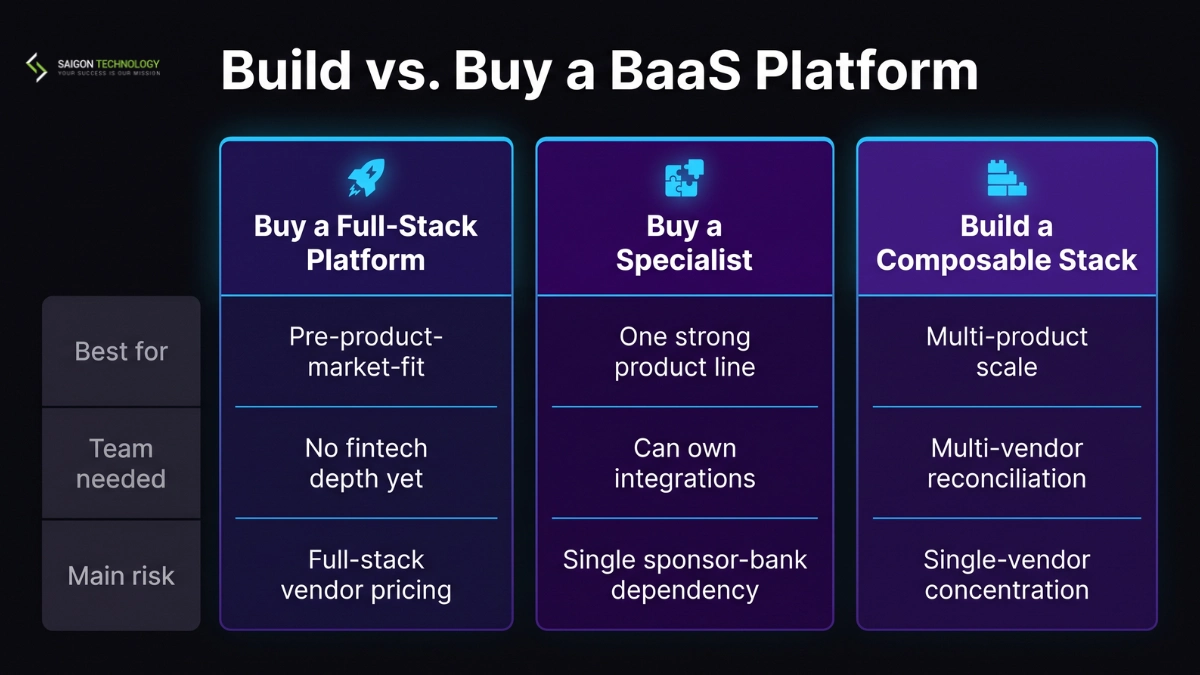
Buy a full-stack BaaS platform when
- You are pre-product-market-fit and need to validate the financial product in weeks, not quarters.
- Your team has no fintech-specific engineering depth yet.
- The revenue model can absorb full-stack pricing (interchange minus the vendor share, net interest minus the vendor cut).
Buy a specialist and integrate it yourself when
- You have one financial product line, not five, and a specialist delivers it better.
- You already have a sponsor bank relationship.
- Your engineering team can own API integrations, reconciliation, and incident response.
Build a composable stack when
- You are past scale and single-vendor concentration is now the biggest item in your risk register.
- Your products span cards, lending, and deposits, and no single vendor is strong across all three.
- You have the headcount to operate multi-vendor reconciliation and a dedicated control layer. Our fintech software development trends piece covers this composable-core pattern in more depth.
Saigon Technology, an AI-Native Software Engineering Partner with 14+ years of delivery and US fintech builds in lending and wealth, supports the buy or the build path, and our build vs. buy decision framework covers the general decision.
Frequently Asked Questions
Do I need a banking license to use a BaaS platform?
No. The sponsor bank behind a banking as a service platform holds the charter, so the software company does not need one. You may still need other licenses depending on your product and market. In the US, that typically means state money transmitter licenses for handling customer funds and state lending licenses for credit products. Confirm in writing which licenses the provider covers and which remain yours.
Are deposits held through BaaS FDIC-insured?
It depends on the account structure. Deposits held at a US sponsor bank in a properly structured for-benefit-of (FBO) account can qualify for FDIC pass-through insurance up to standard limits, but only if the records identify each owner. That insurance covers the failure of the bank, not the failure of the fintech or the middleware. Funds held by a non-bank or an EMI are not FDIC-insured. Confirm the structure and insurance status in writing before telling customers their deposits are insured.
How long does it take to integrate a BaaS platform?
It depends on scope more than on the vendor. A card-only integration is the shortest path; a full build with accounts, payments, KYC, and ledger reconciliation takes the longest, because reconciliation and compliance sign-off sit on the critical path. Saigon Technology typically scopes the first two weeks around sandbox validation, compliance mapping, and reconciliation design before committing to a production date.
What happens if my BaaS provider shuts down?
Account access, payments, card services, and reconciliation can all stop, even when customer funds sit at the sponsor bank. After Synapse failed, some end users waited months while trustees reconciled records. To reduce exposure, keep daily data exports outside the provider, name a backup provider per layer (ledger, cards, compliance), write exit clauses into the contract, and tell customers where their funds are held.
How is customer data protected across a BaaS integration?
Data protection is shared across your application, the BaaS provider, and the sponsor bank, and defined by both technical controls and contracts. The common baseline is OAuth 2.0 authentication, TLS 1.2 or higher in transit, AES-256 at rest, role-based access logs, and provider attestations such as ISO 27001, SOC 2 Type II, and PCI DSS v4.0.1. Map the security requirement at every API handoff and build breach notification and audit logging into the integration.
Conclusion
A banking as a service platform is the quickest legal path for a non-bank to offer banking products, but compliance obligations do not disappear. They move into a vendor contract and an integration plan. Teams that choose well start with the four-party chain, the four platform types, and the evaluation table. Teams that choose badly find the gaps during an incident or an exam.
If you are weighing a BaaS decision or want a second opinion on an existing integration, our fintech software engineering practice at Saigon Technology works with US teams across lending, wealth, and payments.


Related articles
AI in Fintech: A 2026 Builder’s Guide to Use Cases, Architecture and Regional Rules
 Huy (Harvey) Bui - Project Manager
 04 May 2026
8 Fintech Software Development Trends Reshaping 2026
26 Aug 2026 
Insurance Portal Development in 2026: Types, Features, Cost
07 Oct 2026 
Digital Wallet App Development: Cost, Stack & Compliance
28 Oct 2026 
Investment Management Software: Features, Cost & Build vs Buy (2026)
29 Oct 2026 
Embedded Finance Platform: A Buyer’s Guide to Features, Costs, and Providers
05 Nov 2026 
Loan Management Software Development: Features, Costs & Build vs. Buy in 2026
09 Nov 2026