




AI in Fintech: A 2026 Builder’s Guide to Use Cases, Architecture and Regional Rules

 Updated on May 08, 2026
AI in fintech is the use of predictive machine learning, generative AI, and increasingly agentic AI inside financial services products to detect fraud, score credit, automate KYC and AML, personalise experiences, and power customer-and-employee copilots. In 2026, it is shaped as much by regulation – the EU AI Act, MAS FEAT, APRA’s AI Safety Standard, and the NIST AI Risk Management Framework, as by model capability.
What “AI in Fintech” Means in 2026: Predictive ML, Generative AI, Agentic AI
Most ranking pages conflate three very different model families. Treating them as one is the gap to close.
Three distinct model families power fintech features today:
- Predictive ML (supervised + unsupervised machine learning algorithms) – fraud scores, credit scores, churn, propensity. In production across virtually every fintech.
- Generative AI (LLMs and multimodal, built on natural language processing) – copilots, document AI for loan ops and KYC, summary generation, code assistants. Most fintechs are piloting this in 2025 – 26.
- Agentic AI (LLM + tool use + memory) – autonomous agents that read account data, call APIs, and act on the customer’s behalf. Experimental, ramping fast.
Underneath, the same data-science-and-analytics building blocks recur: predictive analytics, anomaly detection, sentiment analysis, and AI-driven analytics over customer data, recombined per use case.
These stack, not substitute. Generative AI in fintech rarely replaces predictive ML for high-stakes decisions; it sits next to a gradient-boosted scorer to explain it, draft the customer email, or fetch the supporting document.
Fintech is not banking. Fintechs ship faster on cleaner cloud-native data estates and reach the same regulatory end-state under tighter timelines. AI in banking covers the same use cases but with deeper legacy debt and slower change cycles. This article is written for the fintech build clock.
Sources: BIS Insights on AI and the financial services industry (2024), the IMF working paper on Generative AI in finance, and recent MAS and EBA speeches converge on the same triad.
If your team is scoping where AI fits in the roadmap, see Saigon Technology’s fintech software development services for end-to-end engineering capacity.
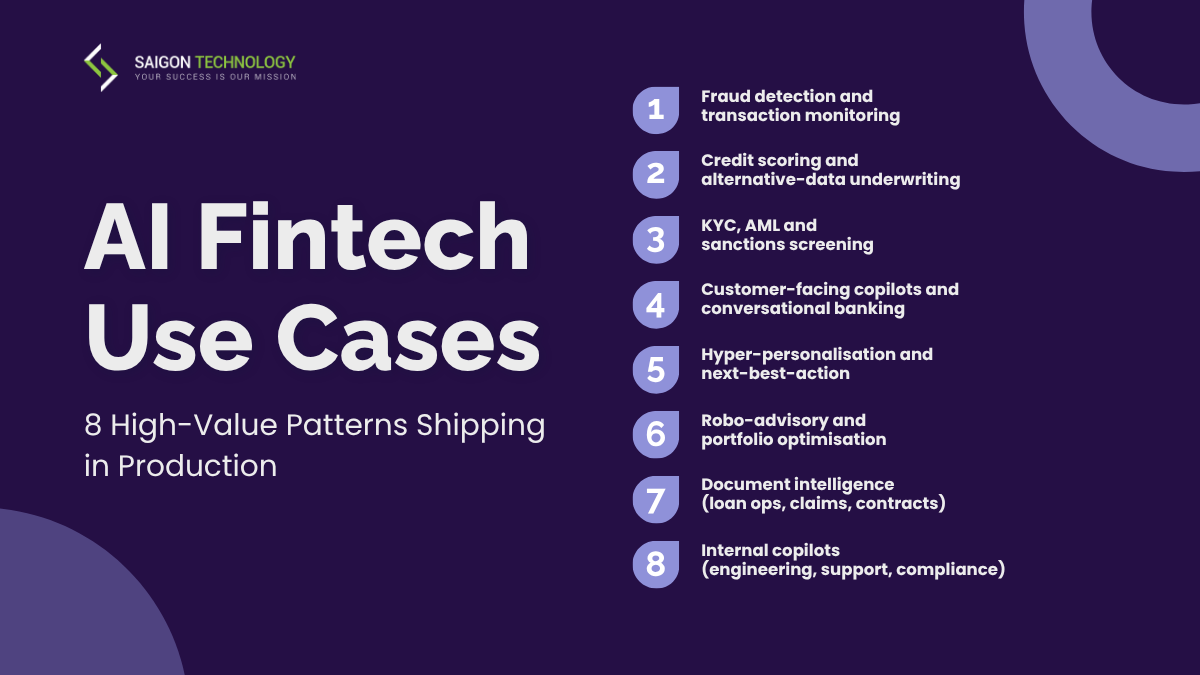
AI Fintech Use Cases: 8 High-Value Patterns Shipping in Production
Eight production-grade AI fintech use cases, each with the same five-line structure for 90-second scanning.
1. Fraud detection and transaction monitoring
- Problem: real-time fraud at swipe / tap / API call without alert fatigue.
- Approach: gradient-boosted trees plus graph neural networks for anomaly detection on streaming features – AI fraud detection called from the payment path.
- Outcome: 30 – 50% reduction in false positives at constant catch rate (BCG, Fraud in Financial Services, 2024).
- Failure: model drift after a payment-rail or merchant-mix change; threshold retuning is a launch gate.
- Example: Stripe Radar, PayPal graph fraud (vendor disclosures, 2023–24).
2. Credit scoring and alternative-data underwriting
- Problem: approve thin-file applicants without raising default rates.
- Approach: AI credit scoring on transaction, telco, and payroll-API data; monotonic models for the score, LLM only for the explanation.
- Outcome: 10 – 25% approval-rate lift at constant default for thin-file segments (McKinsey, The next horizon for credit decisioning, 2024).
- Failure: proxy discrimination through correlated features (zip, device, merchant category), auditable under EU AI Act Annex III.
- Example: neobanks and BNPL providers using cash-flow underwriting; cite a public investor deck.
3. KYC, AML and sanctions screening
- Problem: onboard customers and clear alerts without ballooning ops cost – a textbook case for compliance process automation.
- Approach: document AI for ID extraction and identity verification, entity resolution for sanctions, LLM-assisted SAR drafting and regulatory reporting grounded on canonical evidence.
- Outcome: 40-70% reduction in manual review time per onboarding (LexisNexis, AML Cost of Compliance, 2024).
- Failure: hallucinated SAR narrative when the LLM is not grounded, regulators read SARs.
- Example: HSBC AML overhaul, Quantexa entity resolution (public case studies).
4. Customer-facing copilots and conversational banking
- Problem: deflect tier-1 contacts without breaching financial-advice rules.
- Approach: generative AI in fintech with RAG over customer data and product docs, tool calling for transactional intents, deterministic guardrails on advice and PII.
- Outcome: 30 – 50% tier-1 deflection with CSAT flat or up when grounded, measurable customer-experience optimization through AI chatbots and virtual assistants delivering personalized customer support; Klarna’s AI assistant reported workload equivalent to 700 FTE deflected (Klarna press, 2024).
- Failure: the virtual assistant offering unlicensed investment advice, or jailbreaks revealing PII.
- Example: Klarna’s customer assistant, Bunq’s GPT-powered Finn, Kasisto (banking conversational-AI platform).
5. Hyper-personalisation and next-best-action
- Problem: Raise engagement without nudging users into worse outcomes, hyper-personalized product recommendations grounded in real customer data analysis, not vibes.
- Approach: contextual bandits and propensity models over app events; LLM writes the copy, not the decision.
- Outcome: 5–15% lift in engagement metrics (Forrester, Personalisation in Financial Services, 2024).
- Failure: dark-pattern adjacency – nudging into high-fee products invites scrutiny under CFPB UDAAP and EU DSA.
- Example: challenger-bank “smart suggestions” feeds (cite vendor blog).
6. Robo-advisory and portfolio optimisation
- Problem: scale advice at lower cost-to-serve while keeping suitability and personalized investment strategies intact under market volatility.
- Approach: constrained optimisation plus reinforcement learning for rebalancing, market-trend prediction from sentiment analysis on news and filings, and dynamic-scenario simulation via market-prediction models for stress paths; LLM front-end for explanation.
- Outcome: 30–60% lower cost-to-serve vs human advisor at equivalent suitability (Deloitte, Robo-advisor economics, 2023).
- Failure: explanation hallucination – the number is right, the reason text is fabricated.
- Example: Wealthfront, Betterment, Singapore-domiciled StashAway as the regional reference.
7. Document intelligence (loan ops, claims, contracts)
- Problem: straight-through-process more files without silent extraction errors, another lever for compliance process automation in loan ops and claims.
- Approach: layout-aware OCR plus LLM extraction with per-field confidence scoring.
- Outcome: 50–80% reduction in STP drop-out for clean documents (vendor benchmarks, 2024).
- Failure: silent errors on edge cases – handwriting, low-DPI scans, multi-page contracts.
- Example: SME-lending fintechs using document AI; cite a vendor case study.
8. Internal copilots (engineering, support, compliance)
- Problem: unlock measured productivity and operational efficiency without a licence or leakage risk.
- Approach: code copilots, ticket summarisation, policy-search RAG, regulatory-change alerts, plus AI-enhanced RPA solutions wrapping legacy robotic process automation (RPA) bots in LLM judgement.
- Outcome: 15–30% productivity uplift on measured tasks (GitHub, Copilot productivity study, 2023).
- Failure: secret leakage if the index includes sensitive material; AI-generated code raises open-source licence questions.
- Example: Goldman Sachs internal LLM, Morgan Stanley’s GPT-4 for advisors.
Trading desks and treasury sit outside this list, algorithmic trading, high-frequency trading, and AI-driven financial forecasting and planning pair the same predictive insights with trading-strategies optimization, covered in our [trading-AI explainer].

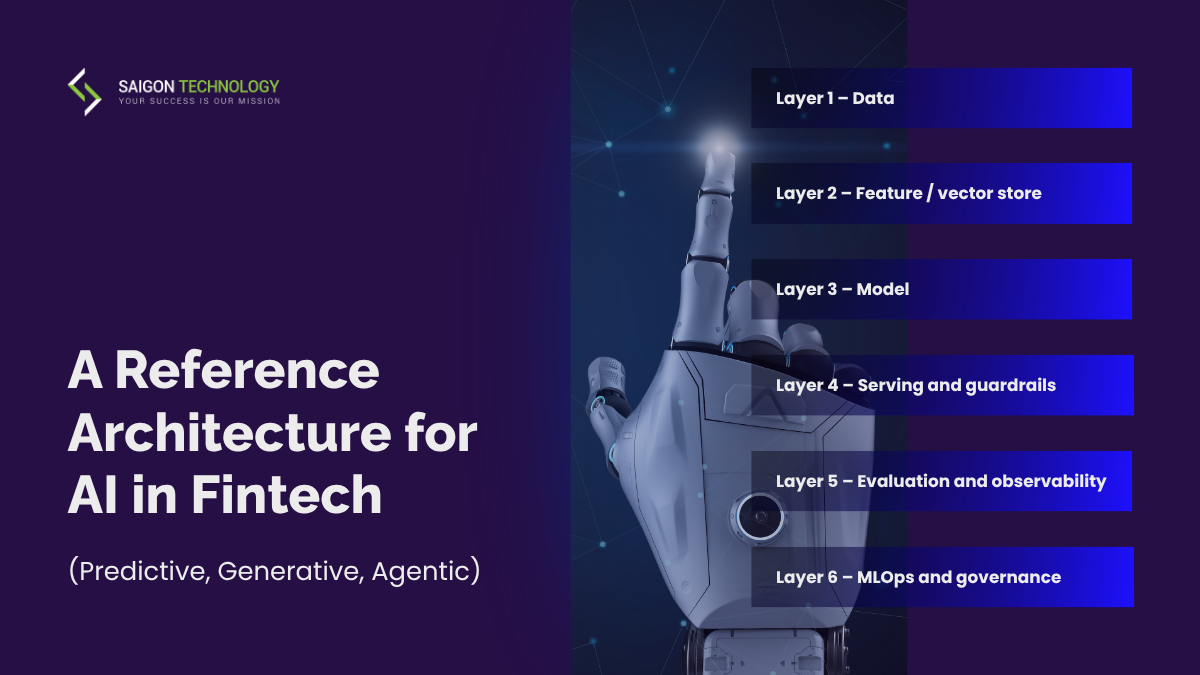
A Reference Architecture for AI in Fintech (Predictive, Generative, Agentic)
Six layers, each with the failure mode that shows up in real post-mortems.
Layer 1 – Data
- Customer, transaction, and product data with consent flags and retention enforcement, usually consolidated through cloud data integration services.
- Lineage that survives an audit – required under EU AI Act Article 10 for high-risk systems.
- Failure: training data with PII bleeding into LLM prompts.
Layer 2 – Feature/vector store
- Online plus offline feature consistency for predictive ML; vector store for RAG-grounded GenAI.
- Failure: train-serve skew – a top-three production failure across financial-services ML (Google, Rules of ML).
Layer 3 – Model
- Mix of in-house predictive models, fine-tuned open-weight LLMs, and foundation-model APIs (common stacks: PyTorch and TensorFlow for advanced ML algorithms, LangChain for orchestration; open-source AI tools dominate the predictive-ML side).
- Build vs. buy per use case (see the table below).
- Failure: vendor lock-in through undocumented prompt-and-tool wiring.
Layer 4 – Serving and guardrails
- Latency SLAs, PII redaction, output filters, tool-call allow-listing for agentic flows, plus a zero-trust approach to tool calls and multi-factor authentication on agent-initiated transactions.
- Failure: jailbreaks bypassing weak system-prompt guardrails, back them with a deterministic policy layer.
Layer 5 – Evaluation and observability
- Offline eval harness + online A/B + shadow deployment; LLM-as-judge with human spot-checks; drift and cost monitoring.
- Failure: “We shipped it because the demo looked great”, no quantitative gate.
Layer 6 – MLOps and governance
- Model registry, approval workflows, model cards, and a change-management trail.
- Failure: a model retrained ad-hoc with no versioned pipeline – an instant audit finding under EU AI Act and NIST AI RMF.
These six layers map onto machine learning in fintech programmes that pass third-party audits.

AI in Fintech Across Markets: US, EU, Australia, Singapore
Each market has named, specific obligations. Use them as a checklist before any production launch.
United States
- NIST AI Risk Management Framework (AI RMF 1.0 + Generative AI Profile) – voluntary but de facto baseline; expected by federal regulators and bank partners.
- CFPB Circular 2022-03 – adverse-action notices must explain the specific reasons for credit denial, even when the model is opaque.
- State-level laws and data protection laws – the Colorado AI Act (high-risk consumer AI, in force 2026), NYC Local Law 144 (bias audits – read across to AI-driven hiring and KYC tooling), and the evolving California SB 1047 debate.
- Federal financial regulators – the OCC, Federal Reserve, and FDIC apply SR 11-7 Model Risk Management to AI models the same way they do to traditional models.
European Union
- EU AI Act (in force August 2024, phased through 2026–27) – creditworthiness assessment is classified as high-risk AI in Annex III, triggering risk management, data governance, technical documentation, transparency, human oversight, and cybersecurity controls.
- GDPR Article 22 – the right not to be subject to solely automated decisions still applies and stacks on top.
- DORA (in force January 2025) – ICT third-party risk obligations apply to foundation-model API providers used in production paths.
- EBA and ECB – guidance on AI in credit-risk model use; supervisory scrutiny is rising.
Australia
- APRA Voluntary AI Safety Standard (2024) sets the tone; CPS 230 (operational risk, in force July 2025) covers material AI services as third-party arrangements; CPS 234 (information security) covers AI training data and inference paths.
- Privacy Act reforms (2024 tranche, more in 2026) – tighter automated-decision-making notices for consumers.
- AUSTRAC – AML/CTF reform 2026 implications for AI-based monitoring and SAR drafting.
Singapore
- MAS FEAT principles (Fairness, Ethics, Accountability, Transparency) – the operating frame for AI in financial services.
- MAS Veritas Toolkit – open-source FEAT assessment methodology, increasingly referenced in supervisory dialogue.
- MAS Information Paper on Generative AI risk (2024) – concrete control expectations for GenAI deployments in regulated firms.
- PDPA – personal-data protection, including AI training data and downstream inference logs.
If your roadmap spans more than one market, build the architecture once and the governance evidence pack per region. Treat EU AI Act, MAS FEAT, and APRA CPS 230 as parallel checklists, not a Venn diagram.
7 Reasons Fintech AI Pilots Don’t Reach Production
Most pilots fail for a small number of repeated reasons. Each item below is observable in the field and has a concrete fix.
- Poor data quality. Inconsistent customer master, broken lineage. Result: models look good in dev and fail in prod. Fix: lineage and contract tests on training inputs.
- No model risk management. No model card, no review board, no registry. Result: an SR 11-7 or EU AI Act audit finding. Fix: a lightweight MRM that scales with risk tier. Underlying causes are usually high implementation costs, ROI uncertainty, and a workforce skill gap rather than model capability.
- Hallucination in customer-facing copilots. The LLM gives unauthorised financial advice. Result: regulator complaint and brand damage. Fix: RAG grounding plus a deterministic policy layer plus LLM-as-judge gating.
- Explainability gap on high-risk decisions. A credit denial the team cannot explain. Result: CFPB Circular 2022-03 violation in the US, GDPR Article 22 plus EU AI Act high-risk obligations in Europe. Fix: monotonic or generalised additive models for the score; LLM only for narrative.
- Vendor lock-in on foundation-model APIs. Prompts and tool wiring depend on one vendor’s quirks. Result: a six-month rewrite when pricing or policy changes. Fix: an abstraction layer plus nightly cross-vendor evaluations.
- Evaluation debt. “Ship it because the demo looked great.” Result: silent regressions on every model swap. Fix: an offline eval harness, online shadow deployment, and drift monitoring as launch gates.
- Third-party AI risk. A vendor model touching the cardholder data environment with no contractual right of audit. Result: a DORA or APRA CPS 230 finding; the same vendor pathway is also the most likely cyberattack ingress. Fix: AI-specific addenda in vendor contracts and a documented exit plan.
None of these are exotic. All are avoidable with the architecture above.
Build vs Buy vs Partner: Choosing the Right AI Path for a Fintech Feature
Few features warrant the same path. Use the table to choose, not to argue.
|
Path
|
When it fits
|
Cost shape
|
Watch-outs
|
|
Foundation-model API (OpenAI, Anthropic, Google, AWS Bedrock)
|
Fast pilots, copilots, document AI, RAG-grounded answers; non-real-time, non-PII-only flows.
|
Variable per token; low fixed. Plan for 3–10× model price drops over 18 months.
|
Vendor lock-in; data residency (US, EU, AU, SG); rate limits; mid-deal policy changes.
|
|
Fine-tuned open-weight model (Llama, Mistral, Qwen)
|
Domain language, predictable workloads, on-prem / VPC requirements.
|
Higher fixed (GPU, MLOps); lower marginal.
|
MLOps discipline required; eval cost; fine-tuning alone does not solve hallucination.
|
|
Bespoke predictive model in-house
|
Credit, fraud, scoring – anything regulated as a high-risk decision.
|
Highest fixed; engineering plus risk team.
|
Model risk management overhead is real and compounds with every retrain.
|
|
External delivery partner or AI consultants
|
When the team needs MLOps maturity, regional regulation familiarity, or speed to a defensible pilot.
|
Project or dedicated-team economics.
|
Choose someone who has shipped AI in fintech, not just “AI.”
|
Caption: Build/buy/partner trade-offs for AI fintech use cases, by feature type and cost shape.
Each path is in active use across the fintech industry. The right answer for fraud scoring is rarely the right answer for an internal compliance copilot.
What to Look for in an AI-Fintech Delivery Partner
If you are evaluating an AI development provider rather than hiring in, treat each item below as a binary.
- Demonstrable fintech AI delivery – engineers and AI consultants with at least two production references and measurable outcomes.
- Engineers with both ML / data-engineering credentials and financial-services regulation literacy – not one or the other.
- MLOps maturity – model registry, model cards, eval harness, drift monitoring; sample artefacts shareable under NDA.
- Regional overlay familiarity – NIST AI RMF + CFPB (US), EU AI Act + DORA (EU), APRA + AU AI Safety Standard (AU), MAS FEAT + Veritas (SG).
- Clear stance on data handling – PII redaction, training-data consent, vendor data-residency selection.
- Build-vs-buy honesty – willing to recommend a foundation-model API or off-the-shelf when bespoke is overkill.
- Evaluation rigour – offline plus online plus LLM-as-judge plus human spot-checks, with reports retained per audit cadence.
- Delivery model that doesn’t blow your data scope wide open – dedicated team, segregated networks, no unmanaged BYOD on customer data.
Saigon Technology has shipped AI-powered features for fintechs across the US, EU, Australia, and Singapore – fraud-scoring services, GenAI loan-ops copilots, document-intelligence pipelines. If you are scoping a roadmap, see our services or request an AI-readiness review.
FAQs
1. What is AI in fintech?
AI in fintech is the use of predictive ML, generative AI, and agentic AI inside financial services products, for fraud detection, credit scoring, KYC and AML, personalisation, robo-advisory, document intelligence, and copilots. It is regulated under the EU AI Act, MAS FEAT, APRA CPS 230, and the NIST AI RMF, on top of existing model-risk and data-protection rules.
2. What are the top AI fintech use cases in 2026?
The eight production-grade patterns are: fraud detection and transaction monitoring, credit scoring with alternative data, KYC and AML automation, customer-facing copilots, hyper-personalisation, robo-advisory, document intelligence for loan ops and claims, and internal copilots for engineering, support, and compliance. Each pairs a model class — predictive analytics, NLP, anomaly detection, sentiment analysis, with a measurable KPI and a known failure mode.
3. Is AI taking over fintech?
No, but it is reshaping cost-to-serve and fraud economics. AI absorbs repetitive cognitive work – tier-1 support, document extraction, alert triage, while licensed advice, capital decisions, and regulatory accountability stay with humans. Headcount mix shifts; regulated decisions do not.
4. What is the difference between predictive ML, generative AI, and agentic AI in fintech?
Predictive ML scores or classifies – fraud, credit, churn, using machine learning algorithms trained on labelled outcomes. Generative AI produces text, code, or summaries from large pre-trained models, usually grounded with RAG. Agentic AI combines an LLM with tool calls and memory so the system can take multi-step actions, such as gathering documents or filing forms on the customer’s behalf.
5. Does the EU AI Act apply to my fintech?
Almost certainly yes if you use AI for creditworthiness assessment, that is classified high-risk in Annex III. You owe risk management, data governance, technical documentation, human oversight, and cybersecurity controls. Non-high-risk uses still owe transparency obligations. Effective dates phase through 2026–27.
6. How do MAS FEAT and the Veritas toolkit shape AI deployment in Singapore?
The MAS FEAT principles (Fairness, Ethics, Accountability, Transparency) frame supervisory expectations for AI in financial services. The MAS Veritas Toolkit is the open-source assessment methodology firms use to evidence FEAT compliance, with phased modules for fairness, ethics, and accountability. The 2024 MAS Information Paper on Generative AI risk adds concrete GenAI controls.
7. What does APRA expect from Australian fintechs using AI?
APRA’s Voluntary AI Safety Standard sets the principles, while CPS 230 (operational risk, in force July 2025) makes material AI services third-party arrangements with documented controls and exit plans. CPS 234 covers information security for AI training data and inference paths. Privacy Act reforms add automated-decision notice obligations downstream.
8. Should fintechs build their own AI model or use foundation-model APIs?
It depends on the use case. APIs win on time-to-value for pilots, copilots, and document AI. For regulated decisions – credit, fraud, bespoke predictive models with explicit risk-management overhead remain the default. Fine-tuned open-weight models sit in between for domain-specific, predictable workloads.
9. Is generative AI safe for customer-facing banking apps?
Yes, when grounded with RAG, gated by a deterministic policy layer, identity verification on transactional intents, monitored via LLM-as-judge plus human spot-checks, and escalated to humans on edge cases, all under the relevant data protection laws. Without those controls, the same model that deflects tier-1 contacts will eventually issue unauthorised advice or leak PII. Safety is an architecture property, not a model property.
10. How much does it cost to build an AI feature in a fintech app?
Realistic 2026 ranges: an API-based pilot lands at USD 30k – 120k; a fine-tuned open-weight deployment runs USD 150k – 500k+ with MLOps and eval; a bespoke predictive model with full model-risk-management evidence typically exceeds USD 500k with ongoing retraining cost. Token prices have dropped 3–10× per model generation, plan for the curve.
Ship AI in Fintech as Product, Not as Demo
The order matters: pick the use case, design the architecture, instrument the evaluation, then map the regional regulation. Inverting that order ships demos that fail audits.
For end-to-end engineering across the build-buy-partner choices, talk to our team.
Next reads in this cluster:
- PCI DSS for fintech engineering teams – where AI training data touches cardholder data.
Table of contents


Copied
Want to start a project?
Our team is ready to implement your ideas. Contact us now to discuss your roadmap!
Get In Touch
Related articles

Methodology
5 Big FinTech Trends That Shape the Banking Industry
FinTech companies create software to streamline bank operations and automate transactions. The FinTech trends listed in this article are shaping the future of banking.
 Thanh (Bruce) Pham - CEO of Saigon Technology
  12 Jun 2024
Industry
Partnerships and The Growing Fintech Ecosystem
The fintech ecosystem is growing rapidly, and partnerships are becoming more and more important. Partnerships benefit both businesses and consumers.
13 Jun 2024 
Artificial Intelligence
AI-Powered Banking: Revolutionizing the Financial Landscape
Explore the challenges and strategies for implementing AI and ML in banking, covering job impact, security risks, and balancing technology with human touch.
12 Jun 2024 
Industry
Fintech App Development Cost in 2026: An Honest Breakdown
Uncover the fintech app development cost ranging from $50,000 to $500,000+. Learn what affects the pricing.
24 Apr 2026 
Industry
How to Build a Fintech App in 2026: A Step-by-Step Guide
Learn how to build a fintech app in 2026, from niche selection and compliance planning to MVP development and launch. Includes tech stack, cost breakdown ($50K–$500K+), and 7 actionable steps from a team with 800+ projects delivered.
14 Apr 2026 
Industry
PCI DSS Compliance in Fintech Software Development: A 2026 Guide
How fintechs in the US, EU, AU and Singapore build PCI DSS-compliant software - v4.0 changes, SDLC controls, regional overlays, and partner criteria.
03 May 2026 Want to stay updated on industry trends for your project?
We're here to support you. Reach out to us now.