




8 Fintech Software Development Trends Reshaping 2026

 Updated on Sep 03, 2026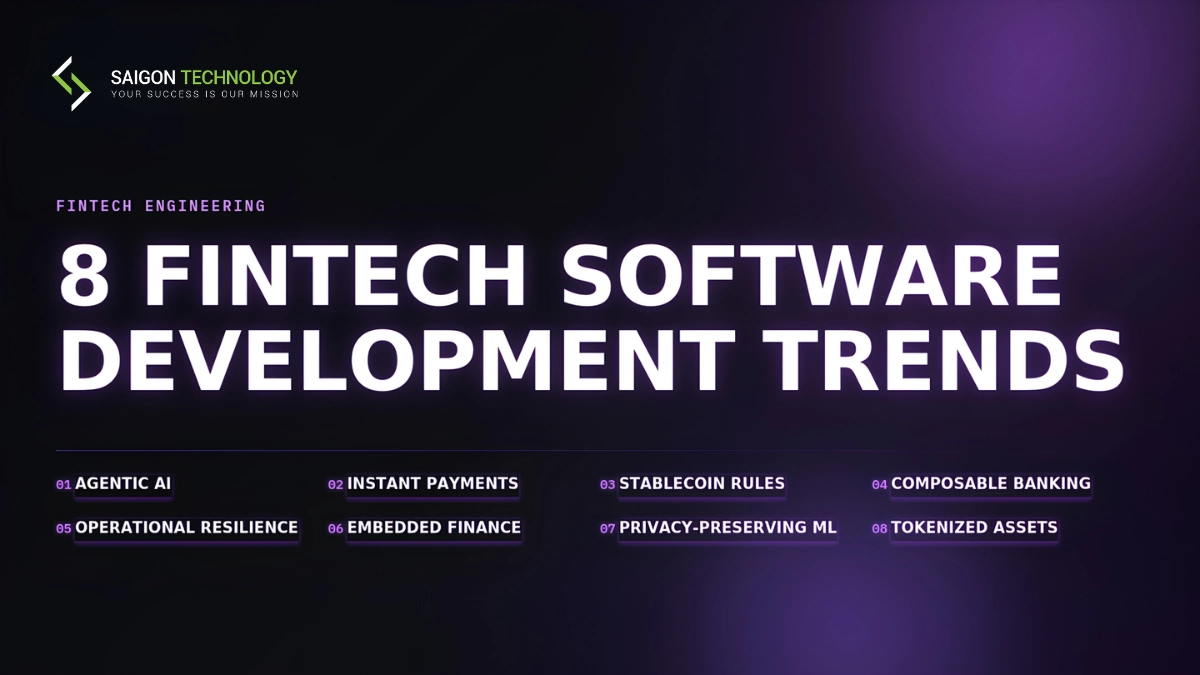
Fintech software development trends 2026 are the technology, architecture, and regulatory shifts changing how fintech teams build and scale financial products. They matter to engineering leaders working across payments, wealthtech, insurtech, PFM, and embedded finance. Explore the eight fintech trends 2026 below to see what matters most for your roadmap.
These shifts come from different corners of fintech: AI, payments, regulation, banking infrastructure, embedded finance, privacy, and tokenization. What ties them together is simple: they all change what your team needs to build, secure, connect, or get ready for in 2026.
Trend 1: Agentic AI Moves From Copilot to Operator
What changed. Two years ago, generative AI in fintech mostly worked like a copilot: it made suggestions, and a human decided what to do next. In 2026, that has changed. “Agentic” AI now handles multi-step work by itself. It pulls the data it needs, calls your internal systems, applies your business rules, and makes decisions you can review later.
You’ll see this AI running fraud checks, sorting KYC (know-your-customer) exceptions, and handling basic customer service, all without a person stepping in for every case. People still review the tricky ones. Think of it as a step up from older automation tools (RPA) that just followed a fixed script. This new AI actually reasons through a decision and adjusts when things change.
Engineering implication. Your team needs new infrastructure to support this. Here’s what that includes, in plain terms:
- A system that coordinates the AI’s outputs with your other models, so everything works together instead of clashing
- A way to test the AI regularly and catch it if it starts making worse decisions over time
- Safety limits so the AI can’t call too many tools too fast or go outside the bounds you’ve set
- Clear logs that explain why the AI approved or blocked a customer, so you can show a regulator the reasoning if asked
Done well, this setup also gives you more than just automation. It can surface useful insights for underwriting and risk decisions, and help you offer more personalized recommendations to customers.
Regulation is catching up, too. Under the EU AI Act (Regulation 2024/1689), AI that makes credit or underwriting decisions counts as “high-risk.” That means you need documented processes, risk management, and a human checking the AI’s work. Fraud-detection AI doesn’t fall into that high-risk category, but it still has to keep records and explain what it’s doing. One more thing to keep in mind: the same AI tools that help you catch fraud can also be used by attackers against you.
Build signal. Start small. Use AI for internal tasks first, like sorting fraud cases, before letting it make decisions that directly affect customers. This gives your team time to build trust in the system, learn how to track its decisions, and get comfortable reporting on it to regulators. For the full technical breakdown, see our AI in fintech deep dive.
Trend 2: Instant Payments and the ISO 20022 Migration Year
What changed. Real-time payments aren’t a nice-to-have anymore. They’re expected. FedNow launched in the US in July 2023 and more banks keep joining. In the EU, the EU Instant Payments Regulation (Regulation 2024/886) is rolling out SEPA Instant, with different deadlines depending on your provider type and region across 2025 and 2026. Meanwhile, Pix in Brazil and UPI in India already handle billions of payments every month (according to the Central Bank of Brazil and NPCI).
Fast payments, cross-border transfers, and digital wallets now run on these instant systems by default. There’s also a messaging change worth knowing about: SWIFT finished switching from its old messaging format (MT) to a newer, richer one (ISO 20022 MX) in November 2025. If your systems still aren’t reading that richer data correctly, fixing that should be a 2026 priority.
Engineering implication. Old batch-processing systems, the kind that settle payments once a day, can’t keep up anymore. Here’s what your platform needs instead:
- Liquidity that’s available around the clock, not just settled once a day
- A way to make sure the same payment never gets processed twice by accident
- Refund and reversal steps built for instant payments, not next-day fixes
- Fraud-monitoring (AML) systems that can actually read and use the richer payment data ISO 20022 provides
On top of that, some payment systems now use AI to automatically pick the best route for a transaction. Cross-border payments are also starting to move through blockchain-based currency exchange in some cases. If you’re still translating old-format payment data into the new format by hand, get that finished this year.
Build signal. Check what payment methods your systems support and make sure your data mapping is done before mid-2026. If you’re building anything new, treat instant payments as a must-have from day one, not something you bolt on later. For more detail, see modern payment gateway architecture.
Real-time payment rails at a glance
| Rail | Region | Launched | Mandate status | Source |
| FedNow | US | Jul 2023 | Voluntary | Federal Reserve |
| SEPA Instant | EU | 2017 | Phased mandate (2025-2026) | EU Regulation 2024/886 |
| Pix | Brazil | Nov 2020 | Market-driven | Central Bank of Brazil |
| UPI | India | 2016 | Market-driven | NPCI |
| RTP (TCH) | US | 2017 | Voluntary | The Clearing House |
Trend 3: Stablecoin Regulation Reshapes Money Movement
What changed. For the first time, the rules around stablecoins (cryptocurrencies pegged to a stable value like the US dollar) are clear enough to actually build on. In the US, the GENIUS Act became law in July 2025, giving companies a legal path to issue stablecoins with clear rules about reserves and disclosures. In the EU, MiCA covers similar ground for asset-backed and e-money tokens, and it’s been in effect since June 2024. The Financial Stability Board has also put out global guidance on the topic.
Together, these rules give more clarity to how stablecoins can be used in lending, borrowing, and payments. What used to be a legal gray area now has real guardrails, which is why stablecoin infrastructure sits so high on most fintech trends 2026 shortlists.
Engineering implication. Regulated stablecoins tied to the dollar or euro can now be used for business payments and cross-border transfers in more countries than before. That reopens some architecture decisions your team might have put on hold. Here’s what to plan for:
- Making sure your on-chain records match your bank records
- Deciding how you’ll hold digital assets: manage the keys yourself, split control across multiple parties, or use a licensed custody provider
- Managing your cryptographic keys with the same rigor as any other production system
- Building the on-ramps and off-ramps that let money move between crypto and traditional banking
- Screening blockchain transactions for sanctions risks, just like you would with regular payments
The smart contracts that control how stablecoins are issued, redeemed, or paused also need a thorough review, just like any other piece of core banking code. And if you’re working across multiple blockchains, you’ll need to think carefully about how they talk to each other and who’s allowed to participate.
Build signal. Run a feasibility study on stablecoin rails versus correspondent banking if you handle cross-border or high-friction settlement flows. Domestic consumer payments are not worth building for yet, so keep watching instead. Institutional and B2B settlement is where the business case already makes sense.
Trend 4: Composable Core Banking Replaces Monolithic Cores
What changed. When Synapse Financial Technologies collapsed in 2024, it showed just how risky it is to depend on a single vendor for your entire banking infrastructure (called Banking-as-a-Service, or BaaS). Since then, more teams have moved away from all-in-one platforms. Instead of one system handling your ledger, cards, KYC, and payments, you now pick the best tool for each job and connect them yourself. For example: Thought Machine, Mambu, or 10x for your ledger; Modern Treasury for moving money; and a separate platform for card issuing.
Engineering implication. This approach is really a cloud modernization decision, and it comes with real orchestration work:
- Small, independent services that communicate through a shared messaging system (like Kafka or Kinesis), with clear rules for how they talk to each vendor
- An infrastructure setup where a bad deployment can be rolled back cleanly, without leaving a mess behind
- The ability to scale up during traffic spikes without being locked into one vendor’s limits
- Strong security that follows the customer’s data everywhere: encryption, masking sensitive fields, and requiring authentication for every internal service call
- A reconciliation process that trusts each vendor as the source of truth for its own piece of the puzzle
You’ll also need to build good habits into every vendor contract: staying aligned with regulations, being ready to respond to incidents, and having a documented plan for switching vendors if you need to. Just know that launching this way usually takes longer than going with a single all-in-one provider.
Build signal. If you’re past your MVP stage and planning to scale, we’d recommend treating this piece-by-piece approach as your default. An all-in-one platform gets you to market faster at first, but make sure you understand what it would cost to leave before you sign anything.
Monolithic BaaS vs composable core
| Dimension | Monolithic BaaS | Composable core |
| Time to launch | Faster | Longer, more flexible |
| Vendor concentration | High | Distributed |
| Cost trajectory at scale | Rises sharply | Elastic scalability |
| Best fit | Early MVP | Post-MVP growth |
Trend 5: Operational Resilience Becomes a Build Requirement
What changed. Resilience used to just live in a policy document somewhere. Now it’s something regulators actually check for, with real deadlines attached. The Digital Operational Resilience Act (DORA, EU Regulation 2022/2554) has applied since January 17, 2025. In Australia, CPS 230 took effect on July 1, 2026, with requirements covering operational risk, business continuity, and third-party risk management.
All four share the same basic idea: you need a way to manage IT risk, a list of your third-party vendors, tested plans for when things go wrong, and clear timelines for reporting incidents. Expectations around compliance tracking and keeping detailed records have gone up across the board, which is why resilience shows up on every serious list of fintech trends 2026 worth watching.
Engineering implication. These rules aren’t just paperwork anymore. Here’s what they mean for your engineering team:
- Deliberately breaking things in a controlled way (called “chaos engineering”) to test how your systems respond. This becomes a normal part of shipping code
- Every service needs a documented map of what it depends on, plus a written plan for recovering it if it fails
- Teams need to track how fast they can recover a service (RTO) and how much data they could afford to lose (RPO)
- Things like vendor monitoring, compliance reporting, and sanctions screening become real engineering work you can be audited on, not just slides in a deck
Rules still differ a bit by region, which makes rolling this out harder. But everywhere you look, regulators want proof, not promises. Building this discipline in pays off.
Build signal. Build resilience checks into your architecture reviews from the very start. If you operate in the EU or Australia, treat these requirements as non-negotiable for anything new you launch. For more on the security side, see PCI-DSS compliance for fintech.
Resilience mandates by region
| Region | Framework | Effective | Source |
| EU | DORA | 17 Jan 2025 | EU Regulation 2022/2554 |
| Australia | APRA CPS 230 | 1 Jul 2025 | APRA |
| US | OCC third-party risk guidance | 2023 | OCC |
| Singapore | MAS TRM | Ongoing | MAS |
Trend 6: Embedded Finance Goes Vertical
What changed. A few years back, the pitch for embedded finance was broad: “every app can be a fintech.” That idea has narrowed. Now, financial features are being built directly into software made for a specific industry, think restaurant checkout systems, home-services scheduling tools, construction management software, freight logistics platforms, insurance software, and wealth management tools.
Toast, ServiceTitan, Procore, and Flexport all do this. They’ve built financial services directly into workflows their customers already use. BCG expects the share of small-business payment revenue going through software platforms like these to grow from 36% in 2024 to 45% by 2028, a sign embedded finance is only getting bigger.
Engineering implication. Two decisions matter early on when you’re adding finance features to industry-specific software:
- Should you partner with a licensed provider, or get your own license? Working capital loans, embedded insurance, payroll-linked products, and buy now pay later (BNPL) each have different regulatory paths. Choosing wrong can cost you months, so getting your partner onboarding right matters as much as the product itself.
- Does the finance feature feel native to the workflow? It should live inside the tool people already use every day, not sit in a separate app. Using open banking tools like Plaid, Tink, or TrueLayer lets you connect to banking data without building all those connections yourself.
Keep in mind your risk models need adjusting for the industry you’re in too. A standard credit-scoring model built for salaried employees won’t work well for a plumbing contractor whose income varies month to month.
Build signal. If you run software for a specific industry, adding finance features is a strong way to lock in customers and grow revenue. If you’re a general-purpose fintech, expect these industry-specific players to compete hard for your customers in their strongest markets.
Trend 7: Privacy-Preserving ML for KYC and Fraud
What changed. The way machine learning handles KYC (know-your-customer) checks and fraud detection is changing. Models can now be trained and run without ever exposing raw customer data. In practice, that means two banks can build a shared fraud-detection model together without either one seeing the other’s customer records. It also means fingerprint or face matching can happen right on your phone instead of on a company’s server.
Three techniques make this possible:
- Federated learning: models learn from data in multiple locations without that data ever having to move
- Differential privacy: adds a small amount of statistical “noise” so no individual record can be identified, while overall patterns stay accurate
- Homomorphic encryption: lets a system run calculations on data while it’s still encrypted, so nobody ever sees the raw information
Pressure from privacy laws like GDPR, along with banks teaming up to fight fraud together, is pushing more companies to adopt these methods. As a result, tools for automating KYC and compliance are increasingly being built around this kind of privacy-first approach.
Engineering implication. Adding these techniques means new pieces in your tech stack:
- A framework for training models across locations, like Flower or TensorFlow Federated
- A way to combine data securely so attackers can’t reverse-engineer the training data from the model’s outputs
- A record of exactly which version of the model made each decision, so you can prove it later if needed
On the device side, running facial or fingerprint recognition locally on a phone makes the process smoother for real users, and it also gives attackers less to steal. At the same time, real-time fraud and anti-money-laundering monitoring works alongside privacy-preserving identity tools to cut down on how much personal data companies need to store centrally. Every step still needs to be logged so you can show a regulator exactly what happened.
Build signal. Before launching any AI feature that touches fraud, KYC, or credit decisions this year, ask one simple question: does this customer’s personal data actually need to leave their device or your institution? Regulators are asking the same question. For more on how these workflows fit together, see KYC and AML automation.
Trend 8: Tokenized Deposits and Real-World Assets Move Toward Production
What changed. Not everything built on blockchain is a stablecoin, and that difference matters more now. Tokenized deposits are just regular bank deposits represented on a private, permissioned blockchain. They carry the same backing as money in a normal bank account. Tokenized real-world assets (RWAs) are different: these are traditional investments like money market funds, government bonds, or corporate bonds, issued as digital tokens instead of paper or electronic records.
Both are moving from small pilot projects into real, everyday use. Major banks are already running production systems: JPMorgan Kinexys (previously called Onyx) handles same-day tokenized deposits, Citi Token Services manages cross-border cash, and HSBC Orion issues digital bonds. BlackRock BUIDL offers a tokenized money-market fund, and Franklin Templeton BENJI does something similar. According to tracking sites like RWA.xyz, tokenized assets on public blockchains are already worth tens of billions of dollars. BCG’s 2026 tokenization report predicts that figure could grow to around $14 trillion by 2030.
This matters right now if you build wealth-management or robo-advisory products. It means your customers’ portfolios could draw liquidity from tokenized assets without ever leaving properly regulated systems.
Engineering implication. If your product will touch tokenized assets, plan for these pieces:
- A settlement system that can work across different blockchain networks, not just one
- Proof of who owns and controls each asset, so only approved participants can interact with it
- Key and custody management tested to the same standard as any large financial institution
- The ability to work across different networks and legal jurisdictions
- A way to connect your new system to older custody and treasury tools that weren’t built with digital assets in mind
The smart contracts that handle issuing and redeeming these tokens need just as much review as any piece of core banking software.
Build signal. If you handle institutional settlement or corporate treasury, tokenization is a realistic option today. If you’re focused purely on retail customers, it’s still worth watching rather than building in 2026.
How to Sequence a 2026 Fintech Build
Not every fintech software development trend 2026 deserves investment this year. To figure out where to start, weigh each of these fintech trends 2026 against two simple questions: does it come with a regulatory deadline, and how big is the business impact for your product? That gives you an easy way to set priorities.
2026 fintech build priority matrix
| Trend | Regulatory pressure | Business impact | Recommended action |
| Instant payments + ISO 20022 | Deadline in 2026 | High for any payments flow | Build now |
| Operational resilience (DORA, CPS 230) | In force since 2025 | Mandatory in EU / AU | Build now |
| Stablecoin regulation | Trigger-based | High for cross-border, B2B | Build now if in scope |
| Agentic AI in operations | None yet | High for fraud / KYC-heavy | Invest post-MVP |
| Composable core banking | None | High for scale-up | Invest post-MVP |
| Vertical embedded finance | None | High for vertical SaaS | Invest if applicable |
| Privacy-preserving ML | GDPR-shaped | Medium to high | Invest for ML-heavy flows |
| Tokenized deposits / RWAs | None yet | High for institutional | Monitor unless institutional |
These priorities apply whether you’re building for payments, wealthtech, insurtech, PFM apps, or embedded lending. Being ready for compliance is behind nearly every “build now” recommendation here. How fast you move on the rest should depend on your risk tolerance, your customers’ needs, and what you already have in place.
Regulatory-driven projects also need engineers who understand financial workflows, integrations, security, and compliance all at once. If you’re a US fintech company that needs to move faster without growing your internal team right away, working with a senior-first engineering partner can give you that extra capacity. Saigon Technology supports fintech teams with fintech software development services, including cloud-native platforms, AI-powered workflows, and financial system integrations. Recent examples include a Wealth Management Platform built on Azure with AKS, Dapr, and Kafka, and a Personal Loans Platform using Oscilar AI, Plaid, GIACT, and LoanPro for KYC and AML automation.
FAQs
What are the key fintech software development trends in 2026?
The eight main fintech software development trends 2026 are: agentic AI in operations, instant payments plus ISO 20022, stablecoin regulation, and composable core banking. The list continues with operational resilience mandates, vertical-SaaS embedded finance, privacy-preserving ML, and tokenized deposits and RWAs. Each one changes what your engineering team should actually build, not just what analysts like to talk about.
Which of these should I prioritize first?
Start with anything tied to a regulatory deadline. That means ISO 20022 remediation, DORA or CPS 230 if you operate in Europe or Australia, and stablecoin rules if you touch stablecoins at all. Everything else can wait until after your MVP is validated or you have a clear business case.
Why is 2026 different from previous years?
A lot of major regulations landed in a short window of time. DORA took effect in early 2025. CPS 230 followed in mid-2025. MiCA rolled out across 2024. The GENIUS Act was signed in mid-2025. On top of all that, the global switch from the old SWIFT messaging format to ISO 20022 finished in late 2025. Together, these changes are pushing engineering priorities away from just building new features and toward compliance and rebuilding older systems.
Is fintech still a good place to build in 2026?
Yes, especially if you’re building something regulated, workflow-native, or infrastructure-focused. It’s tougher going if you’re building a generic consumer neobank with little differentiation. According to KPMG’s Pulse of Fintech, global fintech investment reached $103.1 billion in H1 2026, up from $72.2 billion in H2 2025. However, investors are becoming more selective, favoring fintechs with proven business models, scalable platforms, and clear value propositions, particularly across payments, AI, digital assets, and financial infrastructure.
How does agentic AI differ from generative AI in fintech?
Generative AI writes or summarizes things for you. Agentic AI goes a step further. It plans out a sequence of actions, calls the tools it needs, and actually carries them out. In fintech, that means it can handle multi-step decisions like sorting fraud cases or KYC exceptions from start to finish, with a human only stepping in to review the exceptions rather than every single case.
Where to Go Next
The fintech trends 2026 above are likely to shape what fintech teams build over the next 12 months. Turning these shifts into real, production-ready software takes experience across financial systems, regulatory compliance, and cloud-native architecture.
That’s where Saigon Technology comes in. With 14+ years of software engineering experience, 400+ engineers, and 850+ projects delivered, we bring proven experience across fintech and other regulated industries. We’re ISO 9001 and ISO 27001 certified and a Microsoft Gold Partner. Our senior-first teams help US companies build and modernize financial software, from AI-powered workflows to cloud-native platforms.
Ready to talk through how these trends apply to your roadmap? Connect with our fintech engineering team.


Related articles
Fintech App Development Cost in 2026: An Honest Breakdown
 Toan (Ted) Do - Project Manager
  24 Apr 2026
How to Build a Fintech App in 2026: A Step-by-Step Guide
14 Apr 2026 
AI in Fintech: A 2026 Builder’s Guide to Use Cases, Architecture and Regional Rules
04 May 2026 
KYC AML Automation: How to Build It Into Your Fintech Product
13 Jul 2026 
Fintech Cybersecurity: 2026 Threats, Compliance & Controls
13 Aug 2026