




Neobank App Development: A Complete Guide for Founders and Product Teams

 Updated on Jul 15, 2026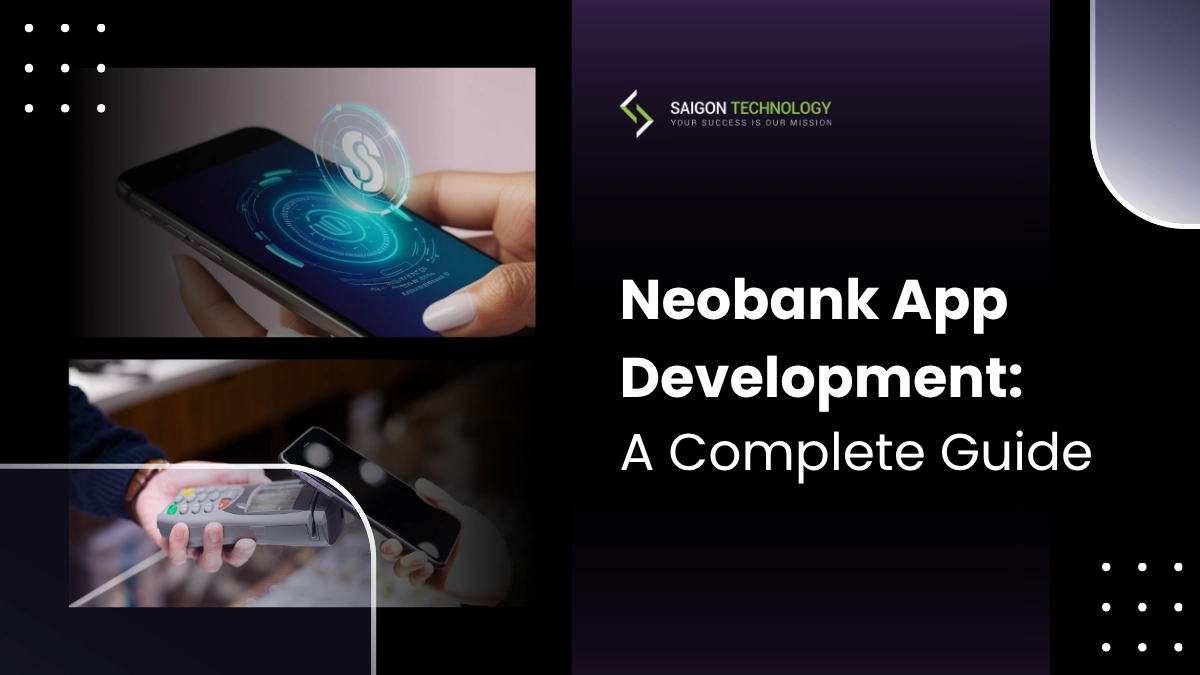
Neobank app development is the process of designing, building, and launching a digital-only banking product, from customer onboarding and KYC to accounts, payments, and cards, without physical branches. Most teams launch a first version in 4–6 months of engineering on a Banking-as-a-Service (BaaS) platform for roughly $150,000–$400,000, while a fully custom banking core takes 12 months or more and $600,000+.
This guide walks through the decisions that actually determine whether a neobank ships: build path, licensing and regulatory strategy, feature scope, cost, and how to choose a development partner. As digital-first banking platforms keep pulling users away from branch banking, the winners are the teams that treat planning and customer trust as engineering requirements, not marketing slogans. The recommendations draw on Saigon Technology’s delivered fintech work: a full loan-lifecycle lending platform, a high-load crypto exchange, and a six-year build-operate-transfer engagement with a European finance company that scaled from 2 to roughly 50 engineers.
Key takeaways
- Neobank app development means building a regulated financial system, not just a mobile app – your licensing model (sponsor bank, EMI licensing, or full charter) shapes the architecture, timeline, and budget before design begins.
- Most first launches should start on a Banking-as-a-Service platform: roughly $150K–$400K and 4–6 months of engineering, with sponsor-bank onboarding sometimes extending go-live to ~9 months. A custom core runs $600K–$1.5M+ over 12–18 months.
- Compliance is designed first, retrofitted never. KYC AML implementation, data protection (GDPR/PDPA), and evolving regulatory frameworks like DORA in the EU must precede UI design; compliance failures kill more neobank projects than engineering does.
- Scope the minimum viable product ruthlessly: onboarding, accounts, cards, and payments first; lending, crypto, and deep AI features after you have users and data.
What Is a Neobank? (And What Makes Development Different)
A neobank is a digital-only institution, a financial technology company that delivers banking services entirely through mobile apps and APIs, typically partnering with a licensed bank rather than holding its own charter.
That last clause is what makes neobank development different from ordinary app work. You are not just building software; you are building a regulated system. Your licensing model shapes your architecture, your roadmap, and your budget before a single screen is designed.
|
|
Digital bank
|
Challenger bank
|
Neobank
|
|
What it is
|
The online-only arm of a chartered, often traditional bank
|
A fully licensed new bank competing head-on with incumbents
|
A digital-only fintech product on a partner bank’s license
|
|
Banking license
|
Parent bank’s charter
|
Own full banking license
|
Usually a partner/sponsor bank (BaaS)
|
|
Physical branches
|
Parent bank has them
|
Rarely
|
No
|
|
Technology
|
Digital layer on legacy systems
|
Modern tech stack, built new
|
Cloud-native, API-first from day one
|
|
Speed to launch
|
1–2 years
|
2–3+ years (licensing)
|
4–12 months
|
|
Regulatory burden
|
Full (via parent)
|
Full
|
Shared with BaaS sponsor
|
A “digital bank” is usually the online extension of a traditional financial institution, and a challenger bank holds its own charter to compete directly with the incumbents. A neobank is born digital and rents the regulated layer, which is exactly why the build-path decision below matters more than any feature list.
Neobank Market Snapshot: Why Founders Are Building Now
Three signals explain the steady founder interest in neobank app development:
- Sustained user growth. Digital-only banking adoption continues to climb globally, with hundreds of millions of users expected on digital-first banking products in the coming years (industry analyst consensus, 2025–2026).
- BaaS lowered the entry barrier. Sponsor-bank platforms expose accounts, cards, and payments as APIs, so new entrants build on existing rails instead of years of infrastructure work.
- Niche beats broad. The market leaders of the last wave (SMB banking, teen banking, freelancer banking, cross-border workers) won by serving a niche vertical the incumbents ignored, not by out-featuring them.
The takeaway for a product team: run honest competitive analysis, pick a segment with a real unmet pain, and pair a focused product with airtight compliance. The market does not reward the longest feature list.
Three Ways to Build a Neobank: BaaS, Custom Core, or White Label
The single most consequential decision in neobank app development is the build path. Your licensing choices and core banking system determine roughly 80% of your budget, and they must match your business model.
|
Build path
|
How it works
|
Licensing burden
|
Typical timeline
|
Typical budget
|
Choose when
|
|
BaaS wrapper
|
Your app + a sponsor bank’s APIs (accounts, cards, payments)
|
Low – sponsor holds the license
|
4–6 months to MVP
|
~$150K–$400K
|
Validating a niche; speed matters most
|
|
Custom core
|
Your own cloud-native core (or a modern core platform) + your compliance stack
|
High – your licenses or an EMI-style authorization
|
12–18 months
|
$600K–$1.5M
|
Differentiation lives in the core product; scale economics matter
|
|
White-label core
|
A pre-built neobank platform rebranded as yours
|
Low–medium
|
3–5 months
|
~$60K–$150K + fees
|
Fastest possible launch; limited differentiation acceptable
|
Two practical rules from delivered projects:
- Start on Banking-as-a-Service unless the core is your moat. Most teams that begin with a custom core spend their first year on plumbing instead of customers. Migrating off BaaS later is a solved problem if your architecture keeps the provider behind an abstraction layer.
- Model the unit economics before choosing. BaaS per-transaction and per-account fees are cheap at 10,000 users and expensive at 1 million. If you plan to build a neobank for a mass-market audience, run the fee model to the scale you actually expect.
Must-Have Features of a Neobank App
Feature complexity is the second-largest cost driver after the build path. Group your roadmap into these five buckets and be ruthless about what makes the minimum viable product.
Core banking
- Account management and profile controls – checking/current and savings accounts, limits, statements, and settings users can actually find
- Real-time transaction history with clear merchant names and smart categorization
- Virtual and physical card issuance with card controls (freeze, limits, dynamic restrictions)
Onboarding and KYC
- Digital identity verification (document scan + liveness checks)
- Automated KYC/AML screening with a manual-review fallback
- Progressive onboarding, let users in before every check clears, restrict actions until it does
Payments and money movement
- Payment tools and templates – domestic transfers (ACH/SEPA/local rails), P2P payments, bill pay, scheduled and recurring payments
- Multi-currency and cross-border payments with FX, if your segment needs them
Engagement and money management
- Spending analytics and budgeting built on real transaction behavior
- Savings goals, round-ups, and notifications and alerts that are useful rather than noisy – push notifications for payments, low balances, and suspicious activity
- Cashback, rewards, and referrals to drive organic growth
- Crypto, stocks, and extra asset classes as optional later-stage additions
- Customer support in-app: chat, dispute filing, and smooth human escalation
- Open banking and third-party integrations – connect accounting, payroll, or tax tools via APIs
Admin and operations (the bucket teams forget to budget)
- Back-office console: user management, transaction monitoring, dispute workflows
- Compliance dashboards and audit logs
- Fraud monitoring with rules, risk scoring, and case management
Cost note: KYC automation, card issuance, and cross-border payments are the three features that most often push a project from the low end of a budget band to the high end, each adds third-party contracts, certification work, and edge cases.
For the MVP, split this list into what earns customer trust on day one and what can wait for real user data:
|
Build first (MVP)
|
Defer to v2/v3
|
|
Onboarding with automated KYC
|
Lending and credit lines (they need mature risk engines)
|
|
Accounts, balances, real-time history
|
Crypto and stock trading
|
|
Virtual card (physical can follow)
|
Shared/joint accounts
|
|
P2P and domestic transfers
|
Deep AI budgeting and advice
|
|
Push alerts and in-app support
|
Rewards and referral programs
|
A simple product that works flawlessly beats a feature-rich one that ships late, in banking, system reliability is the feature.
How to Build a Neobank App: 8-Step Development Process
Here is the process in one view, then each step in detail:
- Discovery and business model: niche, revenue model, unit economics
- Licensing and BaaS partner selection: the decision that shapes everything
- Compliance planning: KYC/AML program design before UI design
- UI/UX design and prototyping: prototype the golden paths, test with real users
- Architecture and tech stack: API-first, provider-abstracted, audit-ready
- MVP build and integrations: core flows first, sprint-based delivery
- Testing and security hardening: a multi-layered strategy, not a final checkbox
- Launch and iteration: beta cohort, monitoring, roadmap by data
1. Discovery and business model
Discovery defines the segment, the problem, and how the product earns money. The common revenue models are:
- Interchange-le: a share of every card swipe
- Subscription: paid tiers for premium cards, rates, or perks
- Lending margin: credit lines and BNPL (adds risk-engine complexity)
- Value-added services: FX fees, insurance, tax automation
Market validation here means more than surveys: check regional competition, regulatory feasibility, and BaaS availability in your target markets, and make data-driven decisions about scope before committing budget. At Saigon Technology, discovery for fintech builds ends with a clickable prototype and an architecture direction, so stakeholders react to something concrete rather than a document.
2. Licensing and BaaS partner selection
Choose the build path (see above) and settle your licensing and regulatory strategy. For BaaS, shortlist sponsor platforms by geography, product coverage (cards? lending? FX?), fee model, and compliance support. Contract timelines here often exceed engineering timelines; start early.
3. Compliance planning (KYC/AML)
Design the compliance program before the interface: identity-verification flow, sanctions and PEP screening, transaction-monitoring rules, record-keeping, and reporting duties. Decision-making here defines data models and integrations downstream; retrofitting compliance is the most expensive mistake in this domain.
4. UI/UX design and prototyping
Bank-grade trust is a design problem as much as an engineering one. Good neobank UI/UX design & prototyping aims at three things:
- Instant trust: clear feedback on every money movement, simple language, clean mobile-first design
- Mental effort reduction: users find their balance, card controls, and payments in seconds, not through menus
- Inclusive design: high-contrast modes, screen-reader support, and tap targets that work for everyone
Build mobile app prototypes of the golden paths, onboarding, first deposit, first payment, and usability-test them before writing production code. Onboarding drop-off is the metric that kills neobanks quietly.
5. Architecture and tech stack selection
Choose a microservices architecture (or at minimum a modular architecture) so payments, onboarding, cards, and analytics can evolve independently, with the BaaS provider and every third-party service behind an abstraction layer so you can renegotiate or migrate later. Event-driven design pays off for real-time balances and audit trails. Expose clean REST APIs (or GraphQL APIs where the client benefits), because disciplined API development is what lets you swap payment processors and KYC providers without a rewrite. (Stack recommendations in the next section.)
6. MVP build and integrations
Build the core flows of the MVP first: onboarding → account → card → payment. We run this phase in Agile sprints with senior-led teams; a compact engineering squad structure (a tech lead/architect, senior backend engineers, mobile developers, and QA working alongside a product manager and a compliance owner) consistently outperforms a larger junior team on regulated systems, with less rework in exactly the places (payments, ledger logic) where rework is dangerous. On the frontend, patterns like optimistic UI and local caching keep the app feeling instant even while the backend confirms in the background; speed equals trust when money is involved.
7. Testing and security hardening
Fintech demands a multi-layered software testing strategy, not a single QA pass:
- Functional testing of every flow, including edge cases (zero-value transfers, insufficient funds)
- Integration testing of partner APIs – if the KYC provider approves a user, does your backend record it correctly?
- E2E (end-to-end) testing of complete journeys: sign up → verify → fund → pay
- Performance testing – load testing for salary-day spikes and endurance testing for slow degradation
- QA automation in CI/CD so every release re-runs the suite
Security work runs in parallel: independent penetration testing, vulnerability scans, API probing, and attempts to decompile the mobile app to hunt for exposed secrets. Security hardening measures, certificate pinning, code obfuscation, rate limiting, close the doors those tests find. If card data touches your systems, PCI DSS scoping happens here; most BaaS-path teams keep card data entirely with the provider, which is cheaper and safer.
8. Launch and post-launch iteration
Launch to a controlled beta cohort, watch onboarding conversion, transaction success rates, and support volume, then iterate. Post-launch, budget for permanent maintenance: monitoring, regulatory-change updates, and roadmap work never stop, a neobank is never “done.”
Anyone researching how to build a neobank should read this list with one caveat: the steps are sequential on paper but overlapping in practice. Compliance planning, design, and architecture run concurrently in a well-managed program.
Compliance, Licensing, and Security: The Part That Sinks Neobank Projects
More neobank projects die from compliance failures than from engineering problems. Plan for four layers:
- Licensing model. In the US, most neobanks operate on a sponsor-bank model rather than pursuing a charter, and regulators have tightened oversight of sponsor-bank programs, so expect the partner bank’s compliance audits to scrutinize your product, not just theirs. In the EU/UK, EMI licensing is a common middle path; PSD2 established today’s open-banking and strong-authentication baseline, DORA now requires demonstrable ICT resilience, and the PSD3 package continues to reshape payments rules. In APAC, several markets (including Singapore) operate specific digital-bank licensing regimes. Pick the target market first; the regulatory requirements follow, not the reverse. (Educational overview – engage regulatory counsel for your specific case.)
- KYC AML implementation. Identity verification with document scanning, liveness checks, and database matching against sanctions and PEP lists; ongoing transaction monitoring and suspicious-activity reporting. The 2026 direction is perpetual KYC and AML, continuous re-screening rather than a one-time onboarding check. Automate the 95% happy path; staff a compliance team and risk team review queue for the rest. (Emerging approaches like decentralized IDs are worth watching, but regulators still expect the classic controls.)
- Data protection. GDPR in Europe, PDPA in Singapore and much of Southeast Asia, and US state regimes such as CCPA. Data residency can constrain your cloud-region choices, decide before, not after, architecture.
- Security engineering. Encryption in transit and at rest; secure authentication combining biometric login, device binding, and one-time codes; role-based access; immutable audit logs meeting audit requirements; behavior monitoring with security alarms for anomalous activity; screen masking so balances aren’t exposed when users switch apps; and a tested incident-response plan.
The strongest teams treat this as compliance as code: controls, evidence, and reporting built into the system from day one, so audits read from logs instead of interviews. How a vendor handles this layer is a fast filter for partner selection, Saigon Technology runs fintech engagements under ISO 27001-certified security frameworks (certified by BSI, UK) with NDAs, role-based access, and a secure SDLC as the governance framework, aligned with GDPR and PDPA, the same discipline we apply to healthcare builds under HIPAA.
Neobank App Tech Stack
There is no single correct stack, but there are proven combinations. What matters is API-first design and clean provider abstraction, the components below are ones our teams use in production fintech systems.
|
Layer
|
Recommended options
|
|
Backend
|
.NET, Java, or Node.js – services organized around banking domains (accounts, payments, cards)
|
|
Mobile
|
React Native or Flutter for one codebase across iOS/Android; native Swift/Kotlin when you need maximum platform control
|
|
Web front end
|
React or Angular with TypeScript
|
|
Cloud infrastructure and DevOps
|
AWS or Azure cloud hosting; Docker + Kubernetes; Terraform for reproducible, auditable infrastructure; CI/CD with automated testing frameworks
|
|
Banking integrations
|
BaaS/sponsor-bank APIs, core platforms (e.g., Mambu, Thought Machine), account aggregation (e.g., Plaid), payment gateways, card issuing/processing (e.g., Marqeta, Galileo)
|
|
Compliance and risk
|
KYC/identity verification (e.g., Onfido, Sumsub), sanctions-screening APIs, fraud-detection tooling (rules + ML)
|
Provider names are common market examples, not endorsements – shortlist against your regions, product scope, and fee model.
Two stack rules for neobank app development specifically:
- Ledger integrity beats framework fashion. Double-entry design, idempotent payment operations, and an append-only transaction log are worth more than any framework choice.
- Buy compliance tooling, build product. Mature third-party integrations for KYC, screening, and fraud exist so your custom software development effort goes into the product experience that differentiates you.
How Much Does Neobank App Development Cost in 2026?
Short answer: a BaaS-based neobank MVP typically costs $150,000–$400,000 and takes 4–6 months of engineering; a custom-core build runs $600,000–$1.5M+ over 12–18 months.
|
Build path
|
Timeline
|
Budget band
|
|
White-label platform
|
3–5 months
|
~$60K–$150K + licensing fees
|
|
BaaS-based MVP
|
4–6 months
|
~$150K–$400K
|
|
Custom digital-banking core
|
12–18 months
|
$600K–$1.5M
|
|
Full challenger bank (own licenses, multi-region)
|
24+ months
|
$5M+
|
Most published cost articles stop at budget ranges like these. Here is what the money actually buys, a typical BaaS-path MVP team, priced at Saigon Technology’s published rates of $28–$46/hour (monthly cost per full-time engineer: $3,200–$10,500 depending on seniority):
|
Role
|
Allocation
|
~6-month cost
|
|
Solution architect / tech lead
|
50%
|
~$25K–$40K
|
|
Backend engineers (×2, senior)
|
100%
|
~$70K–$110K
|
|
Mobile engineers (×2)
|
100%
|
~$65K–$100K
|
|
QA / test automation
|
100%
|
~$25K–$40K
|
|
UI/UX designer
|
50%
|
~$15K–$25K
|
|
Project manager / BA
|
50%
|
~$15K–$25K
|
|
Team total
|
~6 FTE avg
|
~$215K–$340K
|
On top of the engineering budget, plan for non-engineering costs that founders regularly miss: BaaS platform fees (setup + per-account/per-transaction), KYC verification fees (per check), penetration testing, compliance/legal counsel, and cloud hosting. Together these commonly add 15–30% to year-one spend, and ongoing maintenance continues after launch.
A note on timeline: the 4–6 months above is engineering time. Sponsor-bank onboarding and compliance review run partly in parallel but often become the critical path, plan for go-live at 6–9 months if your BaaS contract isn’t signed when development starts.
The main cost drivers that move you inside a band:
- Scope and feature complexity: cards, lending, and cross-border/FX each add integrations and certification work
- Geography: every additional market multiplies regulatory requirements and localization effort
- Tech stack decisions: buying proven third-party integrations is almost always cheaper than building them
- Team composition: senior-led offshore teams deliver regulated systems with less rework; a junior-heavy team is cheaper per hour and more expensive per shipped feature
Neobank App Development Services: What’s Included
When you engage a partner for neobank app development services, the scope should cover the full lifecycle, not just coding. A complete service engagement includes:
- Product discovery and fintech consulting: niche validation, revenue modeling, build-path recommendation, and architecture direction
- UI/UX design: bank-grade design systems, prototyping, and usability testing of onboarding and payment flows
- Core engineering: backend services, mobile and web apps, and the admin/back-office console
- Third-party integrations: BaaS platform, KYC/AML providers, payment gateways, card processors, open-banking APIs
- QA and test automation: functional, integration, performance, and end-to-end coverage across the money-movement paths, with QA automation in the pipeline
- Security and compliance support: secure SDLC, audit-ready documentation, penetration-test coordination
- Post-launch maintenance: monitoring, regulatory-change updates, and roadmap iteration
At Saigon Technology, these map to established practice areas: custom software development, mobile app development, QA and testing, DevOps, and software maintenance, delivered by teams that have shipped regulated financial systems, not general-purpose developers learning banking on your budget. That distinction is what separates genuine neobank app development services from a generic app agency with a fintech page.
How to Choose a Neobank App Development Company
The “company” search is where most founders end up, and where the least useful content exists. When evaluating partners, here is the framework we recommend (including when the answer isn’t us):
1. Regulated-fintech track record – not just “fintech experience.”
Ask for delivered systems where money moved and regulators mattered. For context, Saigon Technology’s references include a full loan-lifecycle lending platform (onboarding → underwriting → fraud checks → collections, with senior engineers onboarded within 3 months) and Baibai, a cryptocurrency exchange built for high-load trading with 2FA wallet protection.
2. Security frameworks you can verify.
ISO 27001 at minimum for anyone touching financial data. Ask who issued it (ours: BSI, UK) and how it shows up in daily practice, access control, audit logging, secure code review, and the governance frameworks behind them.
3. Senior-engineer ratio.
Regulated systems punish junior-heavy teams. Ask what percentage of the proposed team is senior, and interview the actual engineers, not just a sales engineer. (We let clients interview and run a two-week risk-free trial before committing.)
4. Engagement-model flexibility and exit terms.
A good neobank app development company offers a model that matches your stage, dedicated team for a long build, staff augmentation to extend your own squad, or build-operate-transfer if you eventually want the team in-house. Our longest fintech engagement is a six-year BOT partnership with a Netherlands finance company that scaled from 2 to ~50 engineers and ended in a 100% team and IP transition with zero delivery disruption; the exit terms were part of the design from day one.
5. Time-zone overlap and communication.
For US teams, demand real overlap (we run 10–12 hours of overlap with US East and West Coast schedules) and English-fluent engineers who document decisions.
6. Architecture advice from day one.
The right partner challenges your build-path decision-making before taking your money. If a vendor quotes a custom core to a two-person startup without asking about your BaaS options, that is a red flag, as are guaranteed launch dates on regulated products, and quotes with no compliance line items.
If you are evaluating partners for a banking product, our fintech software development team can review your build-path decision and give you an architecture direction – including a working prototype within 24 hours of a full brief. Choosing a neobank app development company this way, evidence first, rates second, costs you a week of diligence and saves you a year of rework. For a broader look at engagement models, see our guide to fintech development outsourcing.
Common Pitfalls in Neobank Development (From Real Fintech Projects)
Lessons that recur across the financial-systems work we’ve delivered:
- Compliance scoped after design. Teams design the dream onboarding flow, then discover KYC requirements force a redesign. Sequence compliance planning before UI.
- The BaaS contract as an afterthought. Sponsor-bank onboarding and compliance review can take as long as the engineering build. Start vendor diligence in week one, not month four.
- Junior-heavy teams on ledger logic. Payment idempotency, reconciliation, and dispute handling are where inexperience becomes financial loss. Staff senior engineers on money movement even if juniors handle everything else.
- No admin console in the MVP. The customer app demos well; then the operations team has no tool to review flagged transactions or handle disputes. Budget the back office from the start.
- Scaling bottlenecks assumed away. An app that feels fine with thousands of users can buckle at hundreds of thousands, and slow balances erode customer trust overnight. Performance testing against the worst hour, salary days, campaign spikes, is a standing rule from our exchange work, because system reliability is what users are really buying.
Neobank development rewards teams that treat these as design constraints rather than launch-week surprises.
FAQs
1. How much does it cost to build a neobank app?
A BaaS-based MVP typically costs $150,000–$400,000 over 4–6 months. A custom banking core runs $600,000–$1.5M+ over 12–18 months, and a fully licensed multi-region challenger bank can exceed $5M. Feature scope (cards, lending, FX), regions, and team composition drive where you land.
2. How do I start a neobank?
Validate a niche, choose a build path (BaaS sponsor bank for most first launches), design the KYC/AML program, then build an MVP around onboarding, accounts, and payments. Regulatory setup and the BaaS contract usually gate the timeline more than engineering does.
3. Do I need a banking license to launch a neobank?
Usually not at launch. Most neobanks partner with a licensed sponsor bank (US) or operate under an EMI authorization (EU/UK) instead of holding a full charter. A direct license becomes relevant at scale, when sponsor fees outweigh the cost of your own regulated infrastructure.
4. How long does neobank app development take?
4–6 months for a BaaS-based MVP, 12–18 months for a custom core, 24+ months for a licensed challenger bank. Add sponsor-bank onboarding time, which can run in parallel but is often the critical path.
5. Are neobanks profitable?
Increasingly, yes – several large neobanks reached profitability once they diversified beyond interchange into lending, subscriptions, and FX. For a new entrant, the realistic path is a focused niche with strong unit economics rather than mass-market scale.
6. What is the difference between a neobank and a digital bank?
A digital bank is typically the online arm of a chartered bank. A neobank is a standalone, digital-only product that usually rents its regulated layer from a partner bank and competes on experience, speed, and niche focus.
Ready to Build Your Neobank?
Saigon Technology has delivered lending platforms, a high-load crypto exchange, and multi-year finance engagements under ISO 9001/27001-certified practice , with senior-led teams at published rates of $28–$46/hour. Send your RFP and see it built in 24 hours: a clickable prototype of your core user flow, an end-to-end workflow visualization, and an architecture direction from our senior engineering team. Or start with a conversation about your build path, our software development services for finance cover the full lifecycle from discovery to post-launch compliance updates.


Related articles

AI-Powered Banking: Revolutionizing the Financial Landscape
 Thanh (Bruce) Pham - CEO of Saigon Technology
  12 Jun 2024
Fintech Development Outsourcing: The Complete Guide for 2026
26 Sep 2024 
Mobile Banking App Development: A Complete Guide
04 Feb 2025 
Finance App Development: The Complete Guide
12 Feb 2025 
Fintech App Development Cost in 2026: An Honest Breakdown
24 Apr 2026 
How to Build a Fintech App in 2026: A Step-by-Step Guide
14 Apr 2026 
PCI DSS Compliance in Fintech Software Development: A 2026 Guide
03 May 2026 
AI in Fintech: A 2026 Builder’s Guide to Use Cases, Architecture and Regional Rules
04 May 2026 
KYC AML Automation: How to Build It Into Your Fintech Product
13 Jul 2026