




How To Enhance Mobile Banking Apps Security?

 Updated on Nov 11, 2025
As more and more people move away from traditional banking methods and towards mobile banking, the need for better security measures on banking apps becomes increasingly important – a key part of overall application security in the fintech industry.. App building companies are constantly looking for ways to improve the security of their mobile apps, and agile development processes play a big role in that. In this blog post, we will discuss some of the ways that app builders are improving security on mobile banking apps and how you can benefit from those improvements.
Advocate the Use of NFC-enabled SIM Cards
One of the ways that app-building companies are looking to improve security on mobile banking apps is by advocating the use of NFC-enabled SIM cards. These SIM cards come with a number of security features that can help to protect your information and transactions. For example, NFC-enabled SIM cards can be used to create a secure connection between your phone and the banking app. This connection can help prevent hackers from intercepting your data or accessing your account without permission.
In addition, NFC-enabled SIM cards can also be used to store your banking information in a secure location that can only be accessed by authorized personnel. There are a number of benefits that come with using an NFC-enabled SIM card for your mobile banking needs:
- First, it can help to keep your information safe and secure.
- Second, it can help to prevent unauthorized access to your account.
- And third, it can help ensure that your transactions are processed more securely. If you’re looking for a way to improve the security of your mobile banking app, advocate using NFC-enabled SIM cards.
Use App Transport
Security App transport security is another important way to improve the security of mobile banking apps. App transport security (ATS) is a set of features designed to protect your data while in transit.
For example, ATS can help to prevent man-in-the-middle attacks, which are a type of attack where a hacker intercepts the communication between your phone and the banking app. ATS can also help to protect your data from being intercepted while it’s being transmitted over an unsecured network. App transport security is an important part of keeping your mobile banking app safe and secure, so make sure that your app is using ATS.
Include Two-Factor Authentication
Another way to improve the security of mobile banking apps is by including two-factor authentication. Two-factor authentication (also known as two-step verification) is an extra layer of security that requires you to enter a second code in addition to your password when you’re logging into your account. This second code can be sent to your phone via text message or generated by an app.
Two-factor authentication can help to prevent someone from accessing your account even if they know your password, which makes it an essential security measure for mobile banking apps. If you’re looking for a way to improve the security of your app, then include two-factor authentication.
Utilize Biometric Authentication
Another way to improve the security of mobile banking apps is by utilizing biometric authentication. Biometric authentication is a type of security that uses your physical characteristics (such as your fingerprint or iris scan) to verify your identity. This type of authentication is becoming more common on mobile devices, and it’s an excellent way to improve the security of your mobile banking app.
Utilizing biometric authentication can help to prevent someone from accessing your account even if they have your password, which makes it an essential security measure for mobile banking apps. If you’re looking for a way to improve the security of your app, then utilize biometric authentication.
Use End-to-end Encryption
End-to-end encryption is the most foolproof method to prevent information leakage that can be used for mobile banking apps. This type of encryption scrambles your data so the recipient can only read it. This means that even if someone were to intercept your data, they would not be able to make sense of it. End-to-end encryption is an essential security measure for mobile banking apps, so make sure that your app is using this type of encryption.
Apply Behavior Analysis
Applying behavior analysis is another way to improve the security of mobile banking apps. Behavior analysis is a type of security that looks at the behavior of users to identify suspicious activity.
For example, behavior analysis can be used to detect if someone is trying to log into your account from an unfamiliar location or if they’re trying to access your account at odd hours. Applying behavior analysis can help to improve the security of your mobile banking app by detecting suspicious activity and preventing it from happening.
Setting Up Real-Time Report
Another way to improve the security of mobile banking apps is by setting up real-time report alerts. Real-time report alerts allow you to get a notification via phone or email if there is suspicious activity on your account. For example, you can get an alert if someone is trying to log into your account from an unfamiliar location or trying to access it at odd hours. Getting real-time report alerts can help you to improve the security of your mobile banking app by allowing you to detect and respond to suspicious activity quickly.
Final Thoughts
If you’re looking for ways to improve the security of your mobile banking app, then consider implementing some of the measures that we’ve discussed. Applying ATS, including two-factor authentication, utilizing biometric authentication, and using end-to-end encryption can all help to improve the security of your app.
In addition, setting up real-time report alerts can help you to detect and respond to any suspicious activity quickly. By taking these measures, you can help to ensure that your mobile banking app is secure.


Related articles

AI Route Optimization: How It Works, Benefits, and Use Cases 2026
 Quy Truong - Software Architect
  14 Oct 2026
Student Information System: A 2026 Guide for Schools
09 Oct 2026 
Insurance Portal Development in 2026: Types, Features, Cost
07 Oct 2026 
Insurance Claims Automation in 2026: Build, Buy, or Hybrid
01 Oct 2026 
IoT in Healthcare: How Healthcare IoT Systems Work in 2026
25 Sep 2026 
AI in Real Estate: 9 Use Cases and How to Build It (2026)
16 Sep 2026 
AI Healthcare Software Development: Architecture & Cost
13 Sep 2026 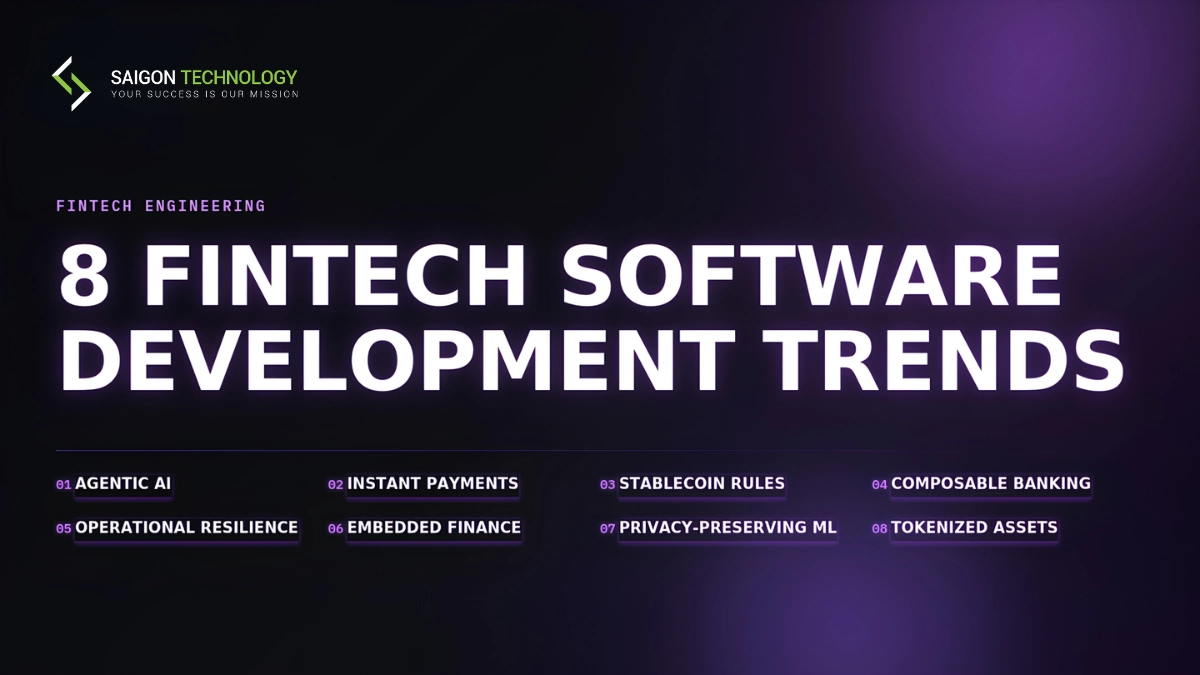
8 Fintech Software Development Trends Reshaping 2026
26 Aug 2026 
Legacy Application Migration: How to Move Legacy Apps to the Cloud
21 Aug 2026