




Insurance Claims Automation in 2026: Build, Buy, or Hybrid

 Updated on Oct 01, 2026
Anyone running claims at a US carrier knows the squeeze. Experienced adjusters are hard to replace, loss-adjustment costs keep rising, and customers who can track a food delivery to the minute no longer accept three weeks of silence on a straightforward claim. Something has to give. Insurance claims automation is how carriers close that gap: software that moves a claim from first notice of loss (FNOL) through adjudication and payout with as little manual handling as the risk allows. This guide is for VPs of Claims, CIOs and claims transformation leads at carriers, MGAs and TPAs. It covers the six-stage workflow, which technology fits which bottleneck, how automation writes back into Guidewire or Duck Creek, what US regulators actually expect from an automated decision, and how to choose between buying a platform, building your own, or running a hybrid of the two.
Key Takeaways
- Claims automation spans four layers: intake, understanding, decisioning, and action. Most programs stall in the last one, when results have to write back into the core claims system.
- No single technology does the job. RPA, IDP, predictive ML, LLMs, computer vision and agentic orchestration each fit a different bottleneck.
- The NAIC AI Model Bulletin (December 2023) asks insurers for a written AI governance program. Existing claims law already requires a reasonable explanation for every denial, automated or not.
- Hybrid (licensed core plus a custom AI layer) suits carriers whose claims speed is a differentiator but whose core platform is standard.
- A first pilot on one line of business usually fits inside a quarter; production rollout takes months, not weeks.
Why US Carriers Are Automating Claims in 2026
Five pressures are pushing the decision this year rather than next. None of them is new. What’s new is that they arrive together, and together they turn insurance claims automation from an efficiency project into an operating requirement. The table summarizes them; the evidence column shows where a figure exists and where the pressure is qualitative.
Five pressures driving claims automation
| Pressure | What changes for claims | Evidence |
| Adjuster capacity | Hiring experienced adjusters is slow, and much of their judgment lives in their heads rather than in systems | Qualitative. You can’t recruit your way through the next hard market |
| Loss-adjustment cost | Manual investigation and adjustment is one of the largest controllable expense lines | Homeowners carriers spent 6.6% of premiums on adjusting and other expenses in 2024 (Triple-I, NAIC data). That ratio is for homeowners only; don’t assume it for auto, health or life |
| Customer expectations | Digital FNOL, live claim status and fast payout on simple claims are now baseline | Qualitative. A slow cycle on a straightforward claim is a churn signal |
| Fraud | Scoring at intake beats recovering money after payment | The Coalition Against Insurance Fraud’s 2022 study puts US insurance fraud at $308.6 billion a year across all lines, including health and life |
| Unstructured data | LLMs and modern document processing can read medical records, police reports and adjuster notes well enough to widen touchless handling | Qualitative. Accuracy still varies by document type and needs testing on your own files |
One caution. The fraud figure covers every line of insurance, so use it to size the problem, not to forecast what a single P&C program will recover.
What Insurance Claims Automation Covers
Insurance claims automation is the use of AI, robotic process automation, intelligent document processing and rules engines to do claims work that adjusters used to do by hand. The goal is straight-through processing: a claim that moves from intake to payout with no human touch, except for exceptions and complex cases. It’s a spectrum. Not a switch.
In practice there are two operating modes:
Operating modes
| Mode | What happens | Typical example |
| Touchless | The claim runs end to end with no adjuster in the loop | A $400 windshield chip, or a clean life-policy match |
| Augmented | An adjuster decides, but automation pre-fills the case file, extracts documents, scores fraud risk and drafts correspondence | A bodily-injury claim with medical records attached |
Most carriers start with augmented. Touchless comes later, one claim type at a time.
A mature program runs across four connected layers:
- Intake: capturing FNOL from web, mobile, chatbot, telephony, IoT and telematics.
- Understanding: extracting structured data from documents, images and voice.
- Decisioning: applying business rules, ML models and LLM reasoning to score, triage and adjudicate.
- Action: settling, paying, notifying, and writing back to the core claims management system.
The End-to-End Automated Claims Workflow
An automated claims processing pipeline moves each claim through six connected stages. The sequence below works as a reference architecture whether you build or buy, because every platform and every custom build has to cover the same six jobs, and what differs between them is who owns each stage and how cleanly each stage hands its data to the next one.
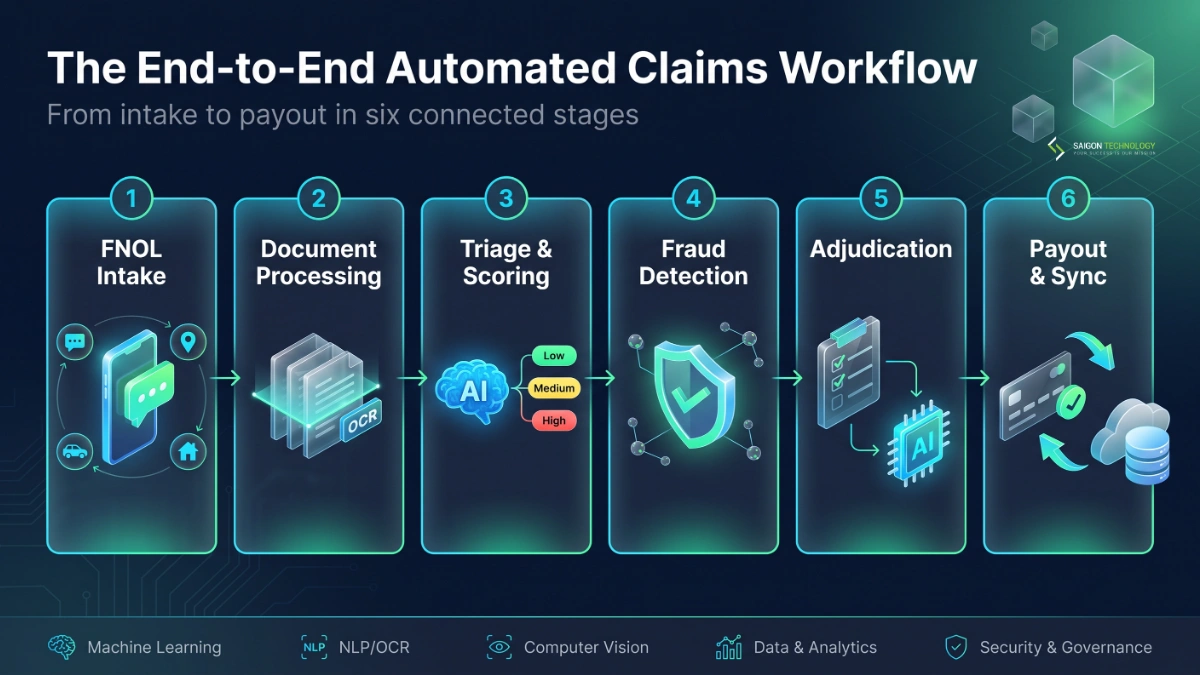
Step 1: FNOL Intake
The claim arrives through a chatbot, mobile app, web form, IVR, agent portal, or an IoT signal such as vehicle telematics or a smart-home leak sensor. Structured data at the first touch pays off twice. It cuts rework later, and it gives every downstream stage, from document extraction to fraud scoring to the payment run, cleaner inputs than a transcribed phone call ever could.
How far digital intake can go shows up in one carrier’s numbers. On a Guidewire customer page, Tryg’s SVP of Claims says around 80% of its claims are filed digitally by customers, and almost half of those are handled straight through. That’s vendor-published data from one Nordic carrier. Treat it as a ceiling. Not a benchmark.
Step 2: Intelligent Document Processing
Intelligent document processing (IDP) pulls policy numbers, claimant details, damage descriptions and coverage data out of PDFs, photos and scans. It combines OCR, natural language processing and computer vision to turn claims paperwork into structured data that rules and models can act on. The same pipeline pattern (clean the image, detect text regions, recognize, then extract fields) is what we built in our OCR document-processing work.
Step 3: Automated Triage and Severity Scoring
ML models classify each claim by complexity, severity and the adjuster skill it needs. Simple claims route straight through. The rest wait for a person. Complex or high-severity claims go to the right specialist with the file already assembled, so senior adjusters spend their hours on judgment.
Step 4: Fraud Detection and Risk Scoring
Anomaly detection, entity resolution (matching the same claimant, provider or vehicle across records that don’t share an ID) and graph analytics score the claim against historical fraud patterns and external data. Duplicate submissions and unusual billing get flagged for special-investigations review before payout, not after.
Step 5: Adjudication and Decisioning
A rules engine handles coverage validation and policy checks. That part is old technology, and it works. Where a decision needs reasoning over unstructured facts, an LLM co-pilot can draft a recommendation. Every one of those recommendations should be logged with its inputs and reasoning, for reasons the governance section explains.
Step 6: Payout and Core-System Sync
The approved claim triggers payment by ACH, card or wallet. The outcome then writes back to the core claims system (Guidewire ClaimCenter, Duck Creek Claims, Sapiens, or Salesforce Financial Services Cloud) through APIs or event streams.
This is where insurance claims automation software either delivers or disappoints. Disconnect any one of the six stages and the cycle-time gains vanish.
AI vs. RPA vs. IDP: Which Technology Solves Which Claims Problem?
Claims automation is a stack, not one product. Buy the wrong layer and nothing else helps. The most common reason programs underdeliver is using the wrong tool on a bottleneck, such as screen-scraping bots on documents that need reading, or an LLM on a decision that a rules table handles perfectly. Match each technology to the job it’s actually good at.
Technology comparison
| Technology | Best for | Weakness | Example use in claims |
| RPA | Deterministic, high-volume rule work over legacy screens | Breaks when the UI changes; no reasoning | Keying a claim record into Guidewire ClaimCenter |
| IDP (OCR + NLP + CV) | Unstructured document intake and extraction | Accuracy varies with document quality; needs training | Extracting fields from medical bills, police reports, invoices |
| Predictive ML | Scoring, prioritization, pattern detection | Needs labeled history; drifts over time | Fraud scoring, severity triage, subrogation likelihood |
| LLMs / GenAI | Reading narrative, drafting, summarizing | Can hallucinate; needs guardrails and citations | Adjuster co-pilot, coverage summaries, policy Q&A |
| Computer vision | Image-based damage assessment | Needs domain-specific training data | Vehicle damage estimates, roof inspection from drone imagery |
| Agentic AI | Orchestrating multi-step work across the stack | Early; governance-heavy; needs human-in-the-loop | End-to-end handling of low-complexity auto claims |
RPA-only programs often struggled. Bots can copy a field, but they can’t read a handwritten repair estimate or weigh a police narrative against a policy clause. Modern AI insurance claims processing layers IDP, ML, LLMs and agents on top of RPA, with each doing what it’s good at. The layering is where the engineering effort goes, which is why carriers often bring in partners with AI development services and agentic AI development experience.
Claims Automation by Line of Business
Each line of business needs different levers. Treat each one as its own program, not as one enterprise initiative. The data, the documents, the regulators and the payout logic all differ, and a pilot that works on auto glass tells you little about bodily injury or dental.
Auto Insurance
Telematics feeds crash signals in real time. Computer vision assesses vehicle damage from claimant photos. Straight-through payout handles low-severity glass, minor collision and roadside claims without an adjuster.
Health Insurance Claims Automation
Health claims run on EDI 837 (the claim) and 835 (the remittance) transactions, medical coding, and HIPAA rules for protected health information. The usual automation targets are eligibility checks, coding validation, prior-authorization workflows and summaries of clinical notes. Any LLM that touches PHI has to run on infrastructure covered by a business associate agreement, and training on that data needs its own review.
Life Insurance
Automation targets death-certificate verification, beneficiary matching against policy records, and beneficiary onboarding. Volume is predictable and payout logic is mostly deterministic once the documents check out, which is why life claims are often a stronger early candidate than the auto or property lines that get most of the attention in vendor demos.
Property and Casualty
Catastrophe events benefit most. By far. Satellite and drone imagery combined with computer vision let carriers triage thousands of property claims in the days after a hurricane or hailstorm, and send their limited field adjusters only to the homes that actually need a person on site.
Dental
Computer vision on X-rays, procedure-code validation and eligibility checks against benefit plans can compress a multi-day adjudication cycle into a same-day decision.
Integrating Claims Automation with Guidewire, Duck Creek, and Legacy Cores
Integration quality, not the AI, decides whether an insurance claims automation program succeeds. That surprises people. A strong decisioning layer is worthless if it can’t write back to the core claims system in near real time, because the adjuster, the payment run and the regulator all read from the core. Plan the integration first and pick models second.
Four integration patterns dominate:
Integration patterns
| Pattern | When to use it | Trade-off |
| Event-driven (Kafka, EventBridge) | The modern default: FNOL events publish to a stream, downstream services subscribe | Loose coupling and easy to add consumers; needs event governance |
| REST and GraphQL APIs | Synchronous calls into Guidewire Cloud Platform, Duck Creek Claims OnDemand, Sapiens | The workhorse; limited to the fields the vendor exposes |
| iPaaS middleware (MuleSoft, Boomi) | Many legacy systems that need governed integration | Extra licensing and another layer to operate |
| Direct database or file transfer | Legacy cores with no real API surface | Last resort; brittle and hard to audit |
Three pitfalls come up again and again. First, teams assume the core platform’s out-of-the-box APIs expose every field the automation layer needs. They rarely do. Second, they underestimate the work of keeping policy administration and claims data in sync. Third, they skip observability, the tracing and alerting that tells you a claim is stuck between systems. Getting integration right often needs legacy application modernization work upstream of the automation itself, so plan for it early.
AI Governance, Fraud Detection, and Compliance
Fraud detection is usually where AI pays back fastest in claims. Governance is what lets you keep it running. In insurance claims automation, the two can’t be separated for long, because the fraud model is exactly the kind of system a regulator asks about. Treat them as one problem: every model that scores or recommends has to be explainable to an adjuster, to the claimant, and to a market-conduct examiner.
AI-Powered Fraud Detection
Anomaly detection flags statistical outliers. Entity resolution links claimants and providers across historical claims, and graph analytics then surfaces the organized rings that no single claim reveals on its own, such as one clinic, one tow operator and one attorney appearing together across dozens of unrelated accidents. Scoring at intake, against duplicate submissions and suspicious billing patterns, keeps money from leaving before anyone looks.
Explainable AI and Human Oversight
Claims law already requires a reason for every denial. The NAIC’s Unfair Claims Settlement Practices Act, the model most states follow, lists failing to give a “reasonable and accurate explanation of the basis” for a denial as an unfair practice. Automation doesn’t change that duty. It just makes the explanation harder to produce, unless you design for it from the first sprint.
So every ML or LLM decision needs an explainable AI (XAI) layer that records inputs, model version, confidence score and the reasoning trace. High-severity and adverse outcomes should go to a human reviewer before the claimant hears about them.
“A claims model that can’t show which inputs and which model version produced a decision isn’t ready for production. We log those alongside the confidence score for every recommendation, so an adjuster or a regulator can replay it later.”
— Phong Le, AI Tech Lead, Saigon Technology
Carriers that get this right treat model governance as engineering work, which means bias testing, drift monitoring, denial-reason generation and audit trails live in the delivery pipeline from day one instead of being bolted on in the weeks before launch. The NIST AI Risk Management Framework, which is voluntary and not insurance-specific, is a common reference for structuring those controls. Our AI governance framework guide covers the same controls in more detail.
US Compliance Requirements
The rules around automated claims processing are stricter than many 2020-era projects assumed. Design for these:
Rules and standards to design for
| Rule or standard | What it is | Impact on automation design |
| NAIC AI Model Bulletin (adopted December 4, 2023) | Model bulletin asking insurers for a written AIS Program: governance, risk controls, testing for bias and unfair discrimination, and oversight of third-party AI | State adoption varies. Your governance documentation, testing and vendor oversight should map to it |
| NAIC AI Systems Evaluation Tool | A structured regulator questionnaire on how insurers use and govern AI | Piloted by 12 states from March 2, 2026 through September 2026, with adoption expected at the NAIC fall meeting in November 2026 |
| State unfair claims settlement practices laws | Require prompt, reasonable explanations for denials and compromise offers | Every automated denial or delay needs a claimant-facing reason your team can defend |
| HIPAA | PHI safeguards for health claims | Limits where claims LLMs can run; requires BAA-covered infrastructure; restricts training-data use |
| SOC 2 Type II | Security controls report for service providers | Enterprise carriers commonly ask platform vendors for one during procurement |
| GDPR / CCPA | Privacy law for EU and California claimants | Governs retention, deletion rights and cross-border transfer |
Saigon Technology delivers to ISO 27001 and ISO 9001 standards, and structures engagements to meet HIPAA and PCI-DSS requirements where the workload needs them.
Build vs. Buy: How to Choose Your Claims Automation Approach
For VPs of Claims and CIOs evaluating insurance claims automation software, the real question is rarely whether to automate. It’s whether to license a platform, build your own, or combine the two. There’s no universal answer. Three factors decide it: how standard your lines of business are, how much engineering capacity you have in-house, and whether claims speed is part of how you compete.
Build vs. buy vs. hybrid
| Approach | Best when | What drives cost | Time to value | Differentiation |
| Buy a platform (Guidewire, Duck Creek, Sapiens, Salesforce FSC with partner add-ons) | Standard lines, a small internal engineering team, no competitive edge sought in claims | Vendor licensing, configuration scope, data migration | Depends on vendor and configuration scope | Low: you get what the vendor ships |
| Build custom (custom software development) | Specialty lines, MGA programs, a proprietary core, claims speed as a moat | Team size and seniority, number of core-system integrations, governance work | A proof of concept can land in weeks; the full platform takes much longer | High: every process is yours |
| Hybrid (licensed core plus a custom AI layer) | Standard core, but AI decisioning and the adjuster co-pilot are differentiators | The custom layer’s scope and integration depth, on top of platform licensing | Proof of concept in 6–12 weeks; production in 3–9 months, depending on data quality and integration complexity | Medium to high: differentiation sits in the custom layer |
Hybrid is usually the pragmatic default for mid-market carriers, because it pairs a predictable licensed core that handles policy, reserves and payments with a custom layer that sits exactly where speed and adjuster judgment decide the customer’s experience. The same extend-don’t-replace pattern shows up outside claims. In our multi-asset capital markets engagement, engineers extended a regulated platform the client already ran with new services and partner APIs, instead of replacing it.
For the custom layer, rate and seniority drive cost more than headcount. Saigon Technology publishes its rate: $22–$46/hr for senior-led teams. Whichever path you pick, make the build vs buy decision on purpose. The programs that disappoint are usually the ones where nobody actually made it.
A 90-Day Pilot Roadmap
A credible first phase proves value on one line of business within a quarter and lays the foundation for enterprise rollout. Don’t try to automate everything in 90 days. Prove one bottleneck, with numbers against a baseline, and build the integration and governance pieces every later phase will reuse.
90-day pilot plan
| Weeks | Focus | What you should have at the end |
| 1–2 | Discovery and baseline | Process mining on FNOL and adjudication. Current cycle time, straight-through rate, cost per claim and adjuster productivity. The line of business and bottleneck with the strongest return |
| 3–4 | Pilot scope | One line of business, one bottleneck (IDP on medical bills, FNOL triage on auto, or fraud scoring on high-volume health). Success metrics fixed up front: touchless rate, cycle time, loss-adjustment expense per claim, customer satisfaction |
| 5–8 | Build and integrate | IDP, a rules engine and one core-system connector in place. Historical claims loaded for model training. Observability wired from the start |
| 9–10 | Governance and guardrails | XAI logging, human review for exceptions, audit trail and denial-reason generation. Bias and drift tests complete before any production traffic |
| 11–12 | Measure and plan scale | Results reported against the baseline. The next two lines or bottlenecks named, with a phased rollout plan and clear gates |
An AI readiness assessment before week 1 surfaces data quality, integration and governance gaps early. Common AI implementation challenges, such as fragmented data and legacy integration, deserve explicit mitigation in the pilot scope.
FAQs
How can I automate claims processing?
Start with IDP on your highest-volume document type, usually medical bills, invoices or FNOL forms. Add a rules engine for claims that qualify for straight-through handling, then layer ML for triage and fraud scoring. Wire write-back to your core claims system early. A pilot on one line of business proves the pattern, and the integration and governance pieces it forces you to build are the same ones every later line of business will reuse.
What software do insurance companies use for claims?
Most US carriers run a core claims platform such as Guidewire ClaimCenter, Duck Creek Claims, Sapiens or Salesforce Financial Services Cloud. Around it sit automation tools such as Automation Anywhere, Blue Prism or Kognitos, or custom AI and agentic layers. The mix depends on your lines of business, your size, and whether claims speed is a differentiator.
Can AI handle insurance claims?
Yes, within limits. For low-complexity, low-severity claims, AI insurance claims processing can run end to end. For high-severity, contested or ambiguous claims, it supports adjusters rather than replacing them. Any denial still needs a reasonable, accurate explanation under state claims law, and the NAIC AI Model Bulletin expects governance and testing around the models involved. So full autonomy isn’t the goal even where it’s technically possible.
What is the best software for processing insurance claims?
There’s no single best product. Anyone who names one is selling it. The right choice depends on your line of business, your policy administration system, your engineering capacity and whether claims speed is a moat. Carriers with standard lines and small engineering teams usually pick a licensed core with a partner-built AI layer. Carriers with specialty lines often build custom.
How much does claims automation cost?
It depends on scope. The main cost drivers for insurance claims automation are how many lines of business, how many core-system integrations, how much document variety, and how much governance work the models need. Platform licensing is quoted by each vendor. For custom work, team seniority and integration depth matter more than headcount. Saigon Technology’s published rate for senior-led teams is $22–$46/hr.
How long does it take to implement?
For AI integration work, typical ranges are 6–12 weeks for a proof of concept and 3–9 months to production. Data quality and integration complexity move those numbers more than the AI does. Usually by a lot. Full multi-line coverage is a longer, phased program, and change management usually sets its pace.
Conclusion
Insurance claims automation in 2026 isn’t about AI arriving. AI arrived years ago. The stack has matured: agentic AI orchestrating RPA, IDP, ML and LLMs; explainability as a legal duty rather than a nice-to-have; and hybrid build-buy as the practical path for many US carriers.
If you take one thing from this guide, take this. Claims automation is an engineering program with business outcomes. It isn’t a software purchase.
Want a second opinion on your claims roadmap? Talk to our insurance engineering team. Saigon Technology brings 14+ years, 850+ projects, and Microsoft Solutions Partner, ISO 27001 and ISO 9001 credentials to programs built around governance, integration and measurable outcomes. Our insurance engagements are under NDA, so we don’t publish those clients or their numbers here. See how we approach custom insurance software →


Related articles
AI in Fintech: A 2026 Builder’s Guide to Use Cases, Architecture and Regional Rules
 Huy (Harvey) Bui - Project Manager
  04 May 2026
AI-Augmented Software Development: A Practical Guide for Engineering Leaders (2026)
08 Jul 2026 
AI Readiness Assessment: Scoring Whether You Can Actually Build
20 Aug 2026 
AI Governance Framework: A Practical Guide for Enterprises (2026)
04 Sep 2026 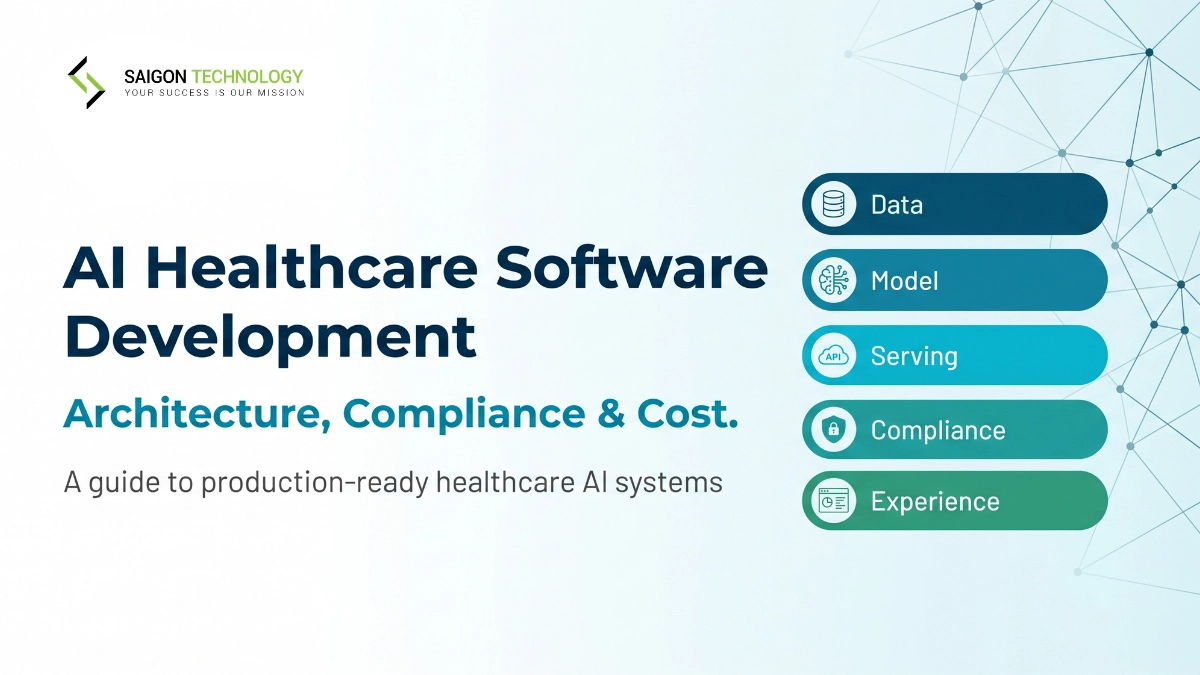
AI Healthcare Software Development: Architecture & Cost
13 Sep 2026