




What Is Agile Methodology? A Complete Guide for 2026

 Updated on May 28, 2026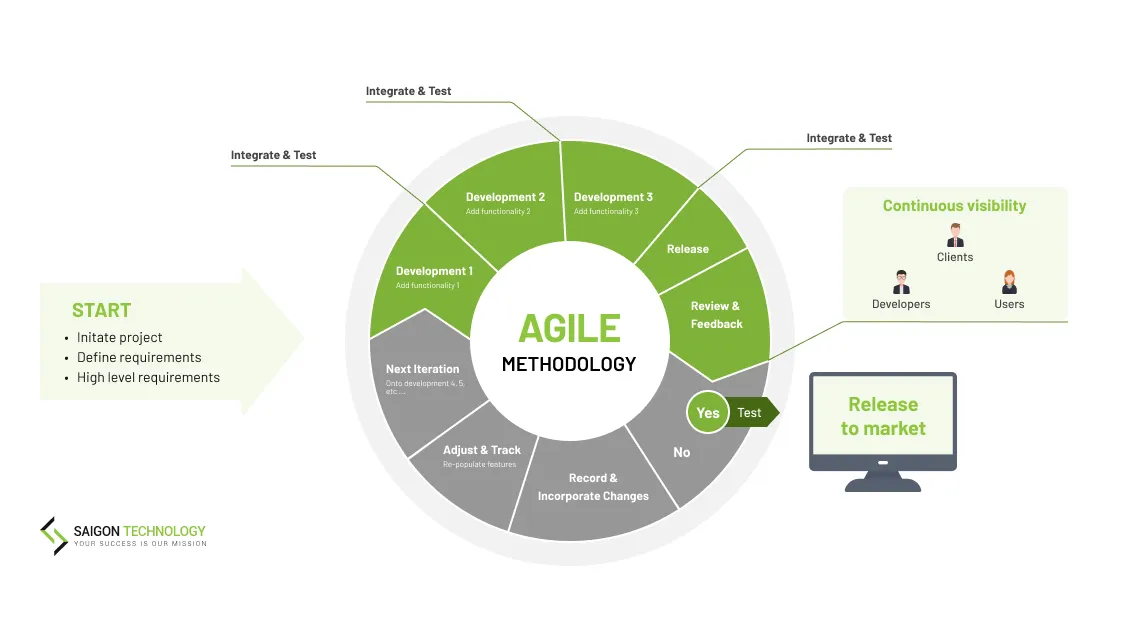
Most large software projects still miss their original budget, timeline, or scope, according to the Standish Group’s long-running CHAOS research. The pattern has held for three decades, and the root cause hasn’t changed: rigid, plan-everything-upfront approaches break the moment requirements shift – which, in software, is always.
Agile methodology is the response. It replaces the locked, linear plan with short cycles of build-test-learn, and it has become the default operating model for teams shipping software in 2026. In our 14 years and 900+ projects at Saigon Technology, we’ve rarely seen a successful long-running build that didn’t run on some form of agile.
Agile methodology is an iterative approach to software development and project management that breaks work into small, time-boxed cycles called sprints. Teams deliver working increments frequently, gather feedback from stakeholders, and adapt – prioritizing collaboration, customer value, and responding to change over rigid plans.
This guide covers what agile is, the four values of agile and 12 principles of agile, the main agile frameworks (Scrum, Kanban, XP, Lean, SAFe), how the agile life cycle runs in practice, when to use agile and when not to, and how to make it work with distributed and offshore teams.
What Is Agile Methodology?
Agile methodology is a project management methodology for building software (and increasingly, non-software products) in small, working increments. Instead of a single big release at the end of a year-long plan, an agile team ships something usable every one to four weeks, learns from it, and adjusts.
A useful clarification: iterative and incremental are not the same.
- Iterative = revisiting and refining the same work over multiple passes.
- Incremental = adding a new working piece each cycle.
Good agile software development does both. You ship a small piece this sprint, learn from real usage, and refine it next sprint.
The approach was formalized in February 2001, when 17 software practitioners met in Snowbird, Utah, and published the Agile Manifesto – a one-page document with four values and 12 principles. The agile mindset has since spread beyond software into marketing, HR, hardware, and education.
Callout: Agile is a mindset, not a fixed step-by-step process. Teams that copy a framework’s ceremonies without absorbing the underlying values usually end up with “faux agile” – the meetings without the benefits.
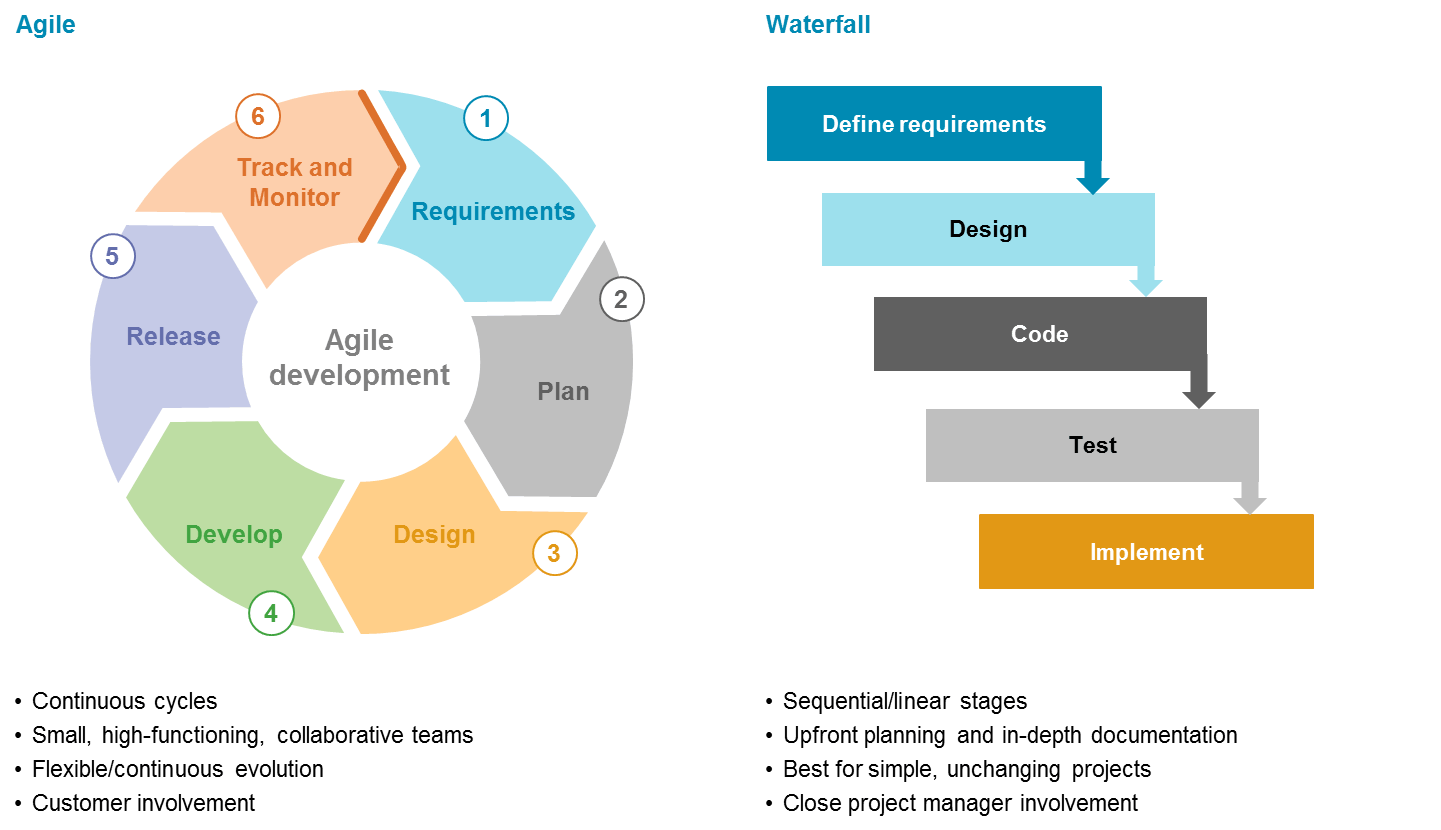
Agile vs. Waterfall – Key Differences
The clearest way to understand agile is to compare it to the waterfall methodology it replaced. Waterfall moves through fixed phases (requirements → design → build → test → deploy) with no return path. Agile loops through those phases every sprint.
|
Dimension
|
Waterfall
|
Agile
|
|
Approach
|
Linear, sequential
|
Iterative, incremental
|
|
Planning
|
All scope locked upfront
|
Continuous, sprint-by-sprint
|
|
Flexibility
|
Change is costly
|
Change is expected
|
|
Customer involvement
|
Mostly at start and end
|
Continuous throughout
|
|
Documentation
|
Heavy, upfront
|
Just enough, ongoing
|
|
Delivery cadence
|
One large release
|
Small releases every 1–4 weeks
|
|
Risk handling
|
Risk surfaces late
|
Risk surfaces early, sprint by sprint
|
|
Best for
|
Stable, regulated, well-understood scope
|
Evolving, complex, customer-facing products
|
Real-world example: When we built an electronic medical records platform for a US healthcare client, the regulatory requirements were stable, but the clinician workflows kept evolving as users tested the system. Waterfall would have produced software that matched the spec, but not the actual job. Agile let us refactor workflow-by-workflow as feedback came in, and we cut development cycle time by 40% in the process.
The 4 Core Values of the Agile Manifesto
The agile manifesto opens with four short value statements. Each one places one thing above another, but the wording matters: it is “over,” not “instead of.”
The four values of agile:
- Individuals and interactions over processes and tools.
- Working software over comprehensive documentation.
- Customer collaboration over contract negotiation.
- Responding to change over following a plan.
A common misreading: “agile means no documentation.” It doesn’t. It means working software is the primary measure of progress, and documentation exists to serve the software, not the other way around. The same applies to processes, contracts, and plans: they are still useful, just secondary to the things on the left.
The 12 Principles of Agile Methodology
The 12 principles of agile unpack the four values into practical guidance. They are the operating rules underneath every agile framework.
- Customer satisfaction through early and continuous delivery of valuable software.
- Welcome changing requirements, even late in development.
- Deliver working software frequently: every few weeks rather than every few months.
- Stakeholder collaboration: business people and developers work together daily.
- Build projects around motivated, self-organizing teams and give them the environment and support they need.
- Face-to-face communication is the most effective way to convey information (today, this includes high-quality video for remote teams).
- Working software is the primary measure of progress.
- Agile promotes sustainable development: teams should maintain a constant pace indefinitely.
- Continuous attention to technical excellence and good design.
- Simplicity: maximizing the amount of work not done.
- The best architectures, requirements, and designs emerge from self-organizing teams.
- At regular intervals, the team reflects on how to become more effective and adjusts accordingly. This is the engine of continuous improvement.
Most-quoted principles: #1 (customer satisfaction through continuous delivery) and #12 (regular reflection and adjustment). If you remember only two, remember these.
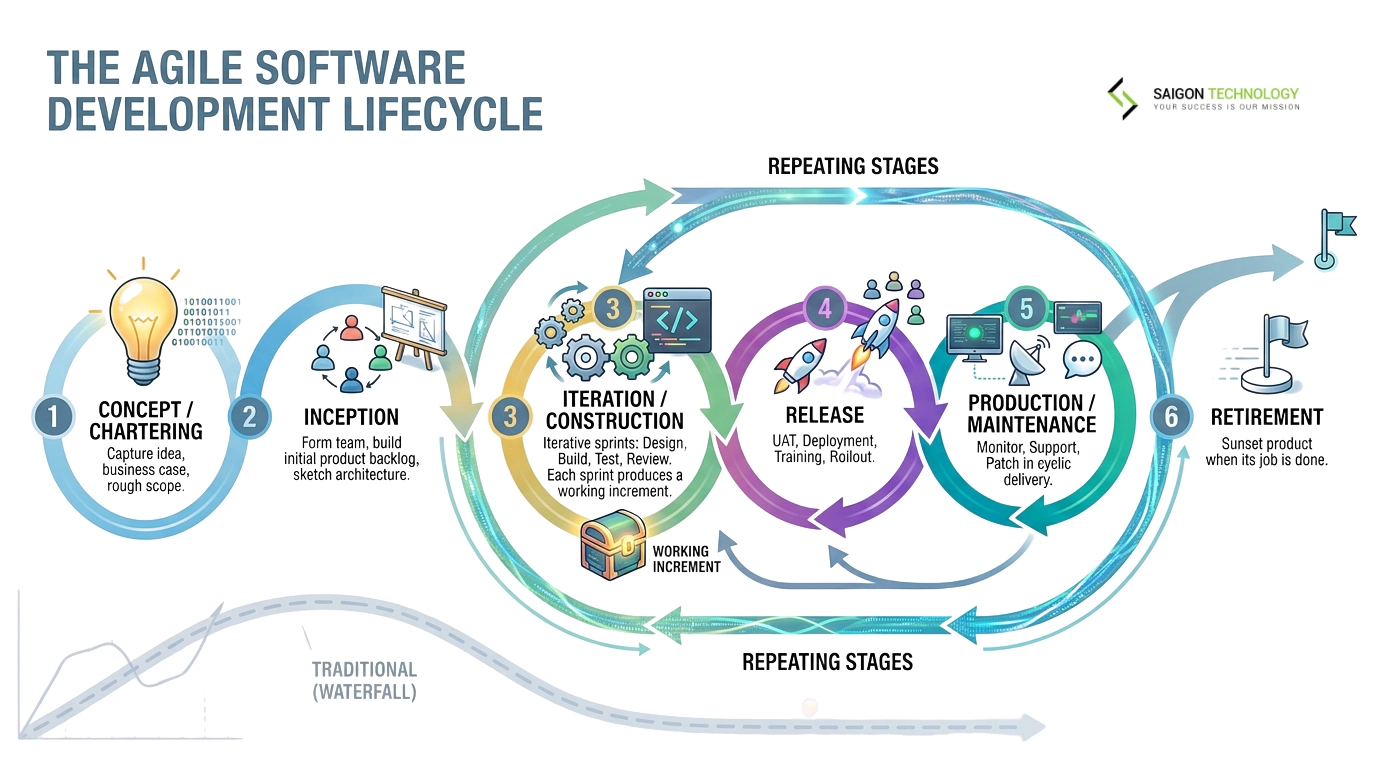
The Agile Development Lifecycle (6 Stages)
The agile software development lifecycle runs as a loop, not a line. Most teams move through these six stages, and then start over.
- Concept / chartering – define the product vision, the problem, and who it serves.
- Inception – assemble the team, set up the product backlog, pick the framework, agree on the definition of done.
- Iteration / construction – build the highest-priority backlog items in iterative sprints. This stage repeats.
- Testing and QA – every increment is tested as it is built (not parked for a “testing phase”).
- Deployment / release – push the increment to users, ideally through continuous integration and continuous delivery pipelines.
- Review / retrospective – inspect what was built, gather feedback, and identify process improvements. Then loop back.
How a 2-week sprint actually runs:
- Day 0 – Sprint planning: the team pulls items from the product backlog into the sprint backlog. Each item is estimated, usually in story points.
- Days 1-9 – Build, test, integrate. Stand-ups (15 minutes max) every morning to surface blockers.
- Day 10 – Sprint review with stakeholders, then sprint retrospective with the team to discuss what to change next sprint.
That cadence is the agile life cycle in miniature, and it is what makes iterative development work in practice.
Framework vs Methodology – Why the Distinction Matters
The terms “agile framework” and “agile methodology” are used interchangeably, but they aren’t the same thing.
- A framework is a structural guide. It tells you the shape of the work but not every step.
- A methodology is more prescriptive. It defines specific practices and steps.
This matters when evaluating vendors or consultants. A team that says “we do Scrum” is naming a framework, the specifics of how they run sprints, write user stories, and handle blockers still need to be unpacked. There is no universal best framework; the right choice depends on team size, work type, and industry context (covered below).
Popular Agile Frameworks and Methodologies
Dozens of agile methodologies are in use. The ones below cover roughly 90% of real-world implementations.
Scrum
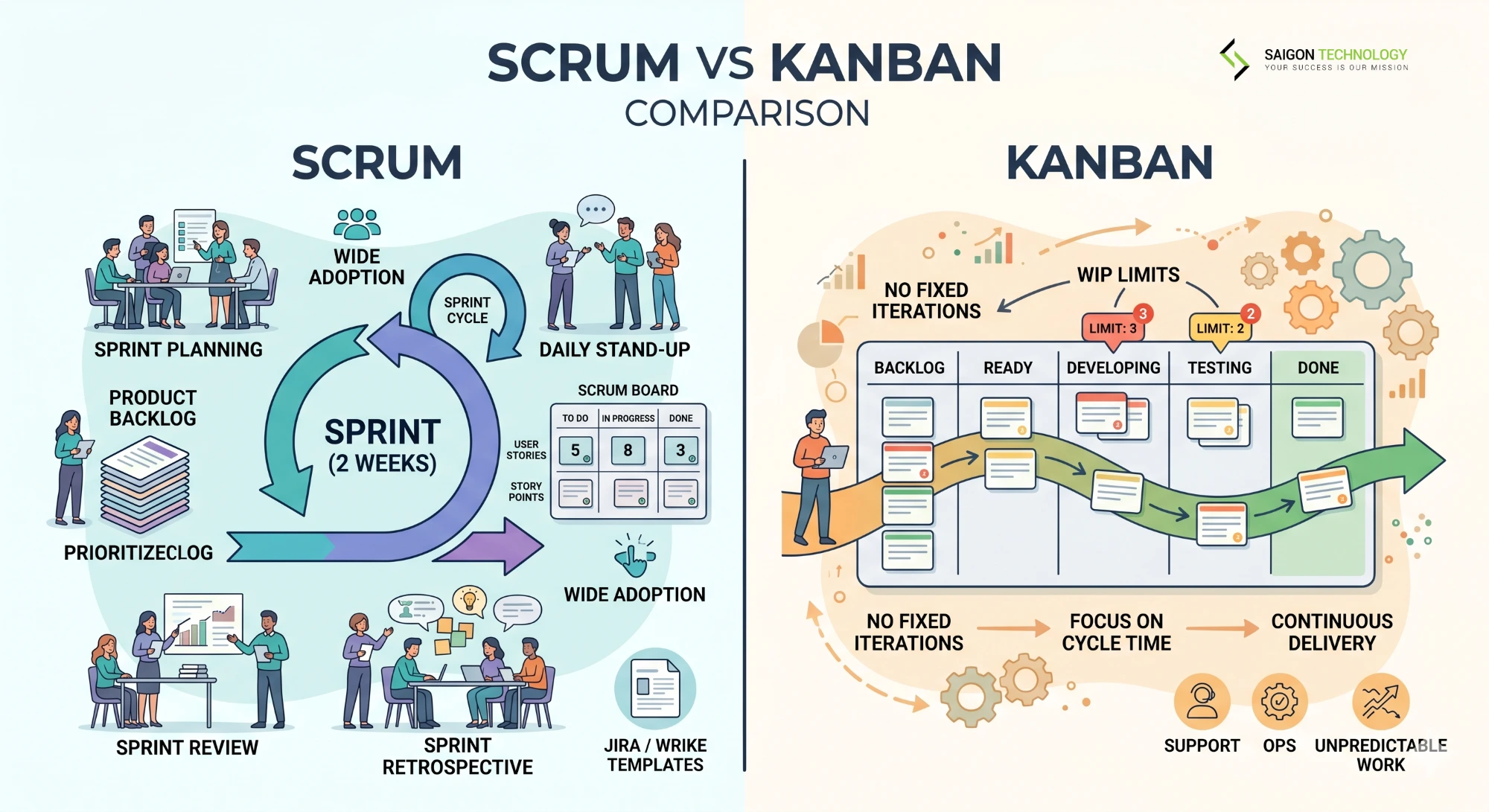
The most widely adopted agile framework. Scrum uses fixed-length sprints (usually two weeks), three roles, and five events.
- Roles: Product Owner (priorities and backlog), Scrum Master (process and removing blockers), Development Team (cross-functional, self-organizing).
- Events: Sprint, sprint planning, daily standups, sprint review, sprint retrospective.
- Artifacts: Product backlog, sprint backlog, increment.
Best for cross-functional product teams building something new. Less suitable for queue-driven work like customer support, where the next priority changes hourly.
Reference: Scrum Guide.
Kanban
A pull-based system focused on visualizing flow and limiting work in progress (WIP).
- A Kanban board (or scrum task boards in hybrid setups) shows columns like “To Do → In Progress → Review → Done.”
- WIP limits prevent the team from starting more work than it can finish.
- No fixed sprints, work flows continuously.
Best for ops, support, IT, and marketing teams with steady incoming requests. Less suitable for teams that need long-term roadmap visibility, since Kanban is tactical by design.
Extreme Programming (XP)
An engineering-quality-focused methodology with strict technical practices.
- Pair programming, test-driven development, continuous integration, refactoring, collective code ownership.
- Short release cycles, strong customer involvement.
Best for small teams where code quality is non-negotiable (safety-critical systems, financial calculations). Less suitable for non-engineering teams.
Lean Software Development
Rooted in the Toyota Production System, Lean focuses on eliminating waste and maximizing learning.
- Seven principles: eliminate waste, amplify learning, decide as late as possible, deliver as fast as possible, empower the team, build integrity in, see the whole.
- Heavy emphasis on the minimum viable product (MVP) concept.
Best for startups and innovation teams. Less suitable for highly regulated industries requiring upfront documentation.
Other named methodologies
- Feature-Driven Development (FDD) – five-step process organized around client-valued features. Best for large teams on long projects.
- Dynamic Systems Development Method (DSDM) – covers the full project lifecycle including governance and budgeting. Common in UK government and enterprise.
- Crystal Method – a family of methodologies that scale with team size and project criticality.
- Adaptive Project Framework (APF) and Extreme Project Management (XPM) – designed for highly uncertain projects with rapid iteration.
Scaling frameworks
When you need to coordinate multiple agile teams across a large organization, you move into scaling agile practices:
|
Framework
|
Team scope
|
Notes
|
|
SAFe (Scaled Agile Framework)
|
Enterprise
|
Most prescriptive; common in Fortune 500
|
|
LeSS (Large-Scale Scrum)
|
Multiple Scrum teams
|
Minimal extension of Scrum
|
|
Nexus
|
3-9 Scrum teams
|
Adds a Nexus Integration Team
|
|
Scrum@Scale
|
Networks of teams
|
Lightweight and flexible
|
|
Disciplined Agile (DA)
|
Toolkit, not framework
|
Mixes practices across methods
|
Reference: scaledagileframework.com.
Hybrid approaches
In practice, most teams blend. Scrumban combines Scrum’s planning cadence with Kanban’s flow visualization. “Water-Scrum-Fall” wraps a Scrum delivery layer inside a Waterfall governance shell, common in regulated enterprises. The 16th State of Agile Report found teams use 2.3 frameworks on average. That number reflects reality, not confusion: there is no single right framework.
Framework comparison at a glance
|
Framework
|
Team size
|
Best for
|
Cadence
|
Prescriptiveness
|
|
Scrum
|
3-9
|
Product development
|
1-4 wk sprints
|
Medium
|
|
Kanban
|
Any
|
Continuous flow / support
|
Continuous
|
Low
|
|
XP
|
3-12
|
Quality-critical engineering
|
1-2 wk releases
|
High
|
|
Lean
|
Any
|
Waste reduction, startups
|
Continuous
|
Low
|
|
SAFe
|
50-125+
|
Large enterprise
|
Quarterly + sprints
|
Very high
|
|
LeSS
|
2-8 teams
|
Multi-team Scrum
|
1-4 wk sprints
|
Medium
|
Benefits of Agile Methodology
When agile is implemented well, the gains are measurable rather than abstract.
- Faster time-to-market – small, incremental releases mean users see value early. On our AxiaGram healthcare engagement, switching to a tighter agile cadence cut development cycle time by 40%.
- Higher quality – continuous integration and continuous testing catch defects within hours, not months.
- Better stakeholder visibility – project dashboards, scrum task boards, and sprint reviews give business stakeholders a working view of progress every two weeks.
- Lower project risk – risk surfaces sprint by sprint, not at the end. Course corrections are cheap when caught early.
- Improved team morale – self-organizing teams with ownership tend to retain people longer than teams running under heavy command-and-control.
- Cost predictability – small batches with frequent iteration make budget forecasting more accurate than long fixed-bid contracts.
- Customer-centric approach – direct feedback loops mean you build what users actually need, not what the spec said 18 months ago.
Limitations and Challenges of Agile
Agile isn’t a silver bullet. Pretending it is, which the marketing of some frameworks encourages, is how teams end up with the meetings but none of the outcomes.
- Less upfront documentation can clash with regulated industries needing audit trails (HIPAA, PCI-DSS, FDA submissions). Solvable, but requires discipline.
- Requires experienced teams – agile assumes engineers can make sound design decisions sprint by sprint. Junior-heavy teams without senior guidance struggle.
- Requires an engaged customer – if the Product Owner is absent or undecided, the team builds the wrong thing fast.
- Scope creep – without strong product ownership, “we can always change it next sprint” becomes “we never finish anything.”
- Hard to forecast fixed budgets – agile fits time-and-materials engagements better than fixed-price contracts. Mitigation: capped-scope sprints with a fixed delivery envelope.
- Cultural resistance to change – organizations used to a traditional development process often resist losing the comfort of a Gantt chart. Executive buy-in is non-negotiable.
- Faux-agile risk – adopting stand-ups, retrospective meetings, and a scrum board without the underlying mindset produces theater, not results.
- Micromanagement creep – daily standups can mutate into status reports if checks and balances aren’t respected.
When to Use Agile (and When Not To)
Use agile when:
- Requirements are evolving or partially unknown.
- The product is complex, novel, or customer-facing.
- Time-to-market matters more than locked scope.
- You’re building an MVP and need real-user feedback to shape the roadmap.
- Stakeholders can be involved continuously.
Avoid pure agile when:
- The deliverable is a rigid regulatory artifact (e.g., medical-device 510(k) submission, building blueprints).
- Scope is fully fixed and cannot change (some government and defense contracts).
- The work is heavily hardware-dependent with long lead times.
- The team is smaller than three people without process maturity to sustain ceremonies.
- The organization cannot tolerate iterative discovery – some industries genuinely cannot.
For mixed cases (regulated software, fixed-budget products with discovery risk), hybrid approaches like Water-Scrum-Fall or Disciplined Agile usually fit better than pure Scrum.
How to Choose the Right Agile Framework for Your Team
There’s no universal best framework. There’s a best fit for your context. Walk through these questions in order:
- Team size and distribution – Co-located or remote? Single team or multiple? Small teams (3-9) fit Scrum or XP. Large coordinated efforts need SAFe, LeSS, or Nexus.
- Work type – Building a new product (Scrum), running a service queue (Kanban), or quality-critical engineering (XP)?
- Industry regulations – Healthcare and fintech need an agile flavor with stronger documentation discipline. See the section below.
- Team maturity with agile – New to agile? Start with vanilla Scrum or Kanban. Mature teams can blend safely.
- Customer availability – Can the customer participate in sprint reviews every two weeks? If not, Scrum will struggle.
- Engagement model with vendors – Time-and-materials, dedicated team, or fixed-price will each shape which framework is realistic.
Most teams end up tailoring. Start narrow, run for two or three sprints, and use retrospectives to adjust.
Agile with Distributed and Offshore Teams
This is where most generic agile guides stop being useful. Real agile project management at Saigon Technology runs across a 12-hour time gap with clients in the US, Europe, and Australia. Here’s what we have learned across 800+ projects.
1. Designate a 3-4 hour daily overlap window. Schedule sprint planning, reviews, and standups in that window. Everything else can be asynchronous.
2. Documentation discipline is what makes remote agile work. The “less documentation” principle still applies, but the documentation that does exist must be high-signal. Decisions, definitions of done, and architectural choices get written down, not held in the heads of one timezone.
3. Tooling matters more here than for co-located teams. Our default stack: Jira for backlog and sprint boards, Confluence for living documentation, Slack or Teams for fast-cycle communication, Loom for async standups when overlap is impossible.
4. Watch for ceremony theater. A daily standup at 11 PM local time isn’t a daily standup. Replace it with an async video update or move the timing.
5. Treat the Product Owner as the single source of truth. With distributed teams, ambiguity multiplies. A decisive PO is worth more than a perfect process.
Case in point: Wealth management platform. Our engineering team delivered a full-scale wealth management platform – portfolio management, trading, and fund operations, over a 2+ year engagement with a US fintech client. The work ran on two-week sprints, a US-based Product Owner, and a senior engineering team in Vietnam. The model worked because the stakeholder collaboration rhythms were rigorous: weekly demos, clearly documented user stories, and a Scrum Master with authority to push back on scope changes mid-sprint.
Agile in Regulated Industries (Healthcare and Fintech)
Regulated industries are where “we can’t use agile, we need documentation” gets repeated most often. It isn’t true, but it does require a different flavor of agile.
Healthcare (HIPAA, HL7, FHIR):
- Generate audit-trail documentation as you go, not in a separate phase. Most modern tooling does this automatically.
- Treat compliance acceptance criteria as first-class user story requirements, not a separate “compliance phase.”
- Architecture and threat-modeling reviews happen at the start of every epic, not at the end of the project.
Fintech (PCI-DSS, KYC/AML, SOX):
- Build continuous compliance into the CI/CD pipeline – static analysis, dependency scanning, secrets scanning on every commit.
- Penetration testing every quarter, not “at the end.”
- Tight role-based access control on production environments. Agile speed doesn’t mean loose access control.
Case in point: AxiaGram (US healthcare). We built and now maintain an electronic medical records platform handling over 6 million medical records under HIPAA. The build runs on agile, but with adjusted ceremonies: a compliance officer is part of sprint planning, every story has explicit HIPAA acceptance criteria, and architecture decisions are recorded in a separate compliance log. Result: 40% reduction in development cycle time vs. the client’s previous Waterfall vendor, with a clean compliance audit history.
The point: agile and regulation aren’t incompatible. They require intent.
Agile Tools and Software
Plenty of agile tools exist. The categories below cover what most teams actually need.
- Backlog and sprint management: Jira, Azure DevOps, ClickUp, Asana, Monday.com, Trello.
- Documentation: Confluence, Notion, Google Docs.
- CI/CD and DevOps: GitHub Actions, GitLab CI, Jenkins, CircleCI.
- Collaboration and whiteboarding: Miro, Mural, FigJam.
- Async video and standups: Loom, Slack huddles.
Pick the smallest stack that covers your needs. Tool sprawl is its own form of process drag.
How to Successfully Implement Agile (5 Steps)
Most agile adoptions fail not because of the framework but because of how they were rolled out. Five practical steps for implementation:
- Assess current state and pick a pilot team. Choose a small team with a real (but not critical-path) project. Document where they start.
- Train leadership first, not just engineers. Without executive buy-in, sprint commitments get overridden by management requests within a month.
- Start with one framework. Resist mixing too early. Run vanilla Scrum or Kanban for at least three sprints before you customize.
- Invest in retrospectives. Continuous learning is what separates real agile from agile theater. Every sprint, change one thing.
- Scale only after the pilot proves repeatable. Premature scaling is the most common failure mode.
A practical signal we use at Saigon Technology: a new client team should be running productive sprints by sprint two. If they aren’t, the issue is almost always cultural (resistance, micromanagement, undefined ownership), not technical.
FAQs
1. What is agile methodology in simple terms?
Agile methodology is a way of running projects in short, repeated cycles instead of one long plan. Teams build a small piece, test it with users, learn from the feedback, and improve it in the next cycle. The goal is to deliver useful working software quickly and adapt to change.
2. What are the 4 values and 12 principles of agile?
The four values of agile prioritize individuals, working software, customer collaboration, and responding to change over processes, documentation, contracts, and rigid plans. The 12 principles expand these values into practical rules: deliver early and often, welcome change, work in small teams, measure progress by working software, and reflect regularly to improve.
3. Is Scrum the same as Agile?
No. Agile is the overarching philosophy defined by the Agile Manifesto. Scrum is one specific agile framework that uses sprints, defined roles, and ceremonies. You can be agile without using Scrum, and you can technically use Scrum mechanics without being truly agile if you ignore the underlying values.
4. What is the difference between Agile and DevOps?
Agile is a project management and product development approach focused on iterative delivery. DevOps is a set of practices and culture that automate the path from code to production. The two complement each other: agile decides what to build next, DevOps makes sure each increment ships safely. Most modern teams run both together.
5. How long is an Agile sprint?
A sprint is usually two weeks. Some teams run one-week sprints for very fast feedback or three- to four-week sprints for larger, more stable work. The Scrum Guide caps sprints at one month. Whatever length you pick, keep it fixed. Varying sprint length defeats the cadence.
6. What are the 5 C’s of Agile?
The 5 C’s of Agile are Communication, Collaboration, Commitment, Customer, and Continuous Improvement. They summarize the cultural priorities that distinguish a mature agile team from a team that simply follows the ceremonies. Some sources list slightly different versions, but these five are the most commonly cited.
7. Can agile be used outside software development?
Yes. Marketing teams use agile for campaign planning, HR teams use it for hiring sprints, hardware teams use it for prototype iteration, and even education uses it for curriculum design. Anywhere the work is complex, requirements evolve, and feedback loops matter, agile principles apply.
8. What are the disadvantages of agile methodology?
Agile requires experienced teams, engaged customers, and strong executive buy-in. It can be hard to budget for fixed-price contracts, can suffer from scope creep without a strong Product Owner, and can clash with regulated industries needing heavy upfront documentation. Done poorly, it produces all the ceremonies and none of the benefits.
9. Is agile suitable for fixed-budget projects?
It can be, with the right structure. Pure time-and-materials engagements fit agile most naturally, but fixed-budget agile works when you fix the budget and timeline and let scope flex. The customer agrees on the highest-priority items first, and lower-priority items only ship if time allows. This is sometimes called “capped-scope agile” or “Agile Fixed Price.”
10. How does agile work with offshore teams?
Agile works well with offshore teams when three conditions are met: a daily 3-4 hour timezone overlap for ceremonies, disciplined written documentation of decisions, and a single Product Owner with clear authority. Tools like Jira, Confluence, and Loom replace the spontaneous hallway conversations that co-located teams rely on. Done right, offshore agile can match or exceed the productivity of co-located agile.
Conclusion
Agile methodology isn’t a manual. It’s a mindset built on four values, 12 principles, and a commitment to delivering working software in short cycles. Framework choice – Scrum, Kanban, XP, Lean, SAFe, is a tactical decision that depends on team size, work type, regulatory context, and customer availability. Mature teams almost always blend.
The teams that get the most out of agile share three habits: they run retrospectives as if their performance depended on it, they protect the Product Owner’s role from being diluted, and they keep ceremonies short and high-signal.
If you’re evaluating a development partner to run agile on your behalf, especially across timezones or under regulatory pressure, those three habits are worth more than any certification on a resume.
Want to talk through how agile would run on your project? Talk to our delivery lead. We’ll share what has worked (and what hasn’t) on similar engagements.


Related articles
Agile Vs. Waterfall in Software Development
 Thanh (Bruce) Pham - CEO of Saigon Technology
  12 Jun 2024
Top 6 Reasons Why Web Development Getting Better Thanks to Agile
12 Apr 2024 
How to Form A Perfect Scrum Team
13 Oct 2023 
Top 10 New Product Development Life Cycle Software
13 Jun 2024 
8 Basic Software Development Models and Methodologies You Should Know
12 Jun 2024 
What is SDLC? Knowledge of the Software Development Life Cycle
12 Jun 2024 
Things to Know about Software Product Development Cycle
13 Jun 2024 
List of 5 Software Product Development Approaches You Should Know
13 Jun 2024 
The Strategy and Process of Software Product Development
13 Jun 2024 
An Overview of the Software Product Development Architecture
12 Jun 2024 
8 Top Ways to Reduce Costs with Agile and DevOps
12 Jun 2024