




Real Estate App Development in 2026: Cost, Features, Process & Technology Guide

 Updated on Jul 31, 2026
Let’s talk real estate app development. Buying a house used to mean driving around, chasing agents, and squinting at blurry listing photos. Now people expect to do it from their couch, the same way they order dinner or book a flight. That’s exactly why this space has exploded.
Here’s the deal: whether you’re a founder with a great idea, a real estate company tired of watching Zillow eat your leads, or an enterprise buyer scoping out a vendor, the question isn’t “should we build an app” anymore. It’s “how do we build one that actually works, doesn’t blow the budget, and doesn’t get deleted five minutes after download.”
That’s what this guide covers: cost, features, tech stack, MLS integration (the part everyone underestimates), and how the whole build process actually goes.
What Is Real Estate App Development?
Real estate app development is the process of building software, mobile or web, that lets people search properties, manage listings, chat with agents, or handle transactions without picking up the phone. It covers everything from a basic property listing app to a full brokerage CRM to a commercial investment platform.
This whole category sits under PropTech, and PropTech has moved way past “here’s a list of houses.” Buyers now expect AI-driven search, virtual tours, automated valuations, and payments built right into the app. If you’re researching this space, you’ve probably seen the terms real estate app development, property app development, and real estate software development used almost interchangeably. They’re not quite the same thing, but they overlap enough that most vendors treat them as one conversation.
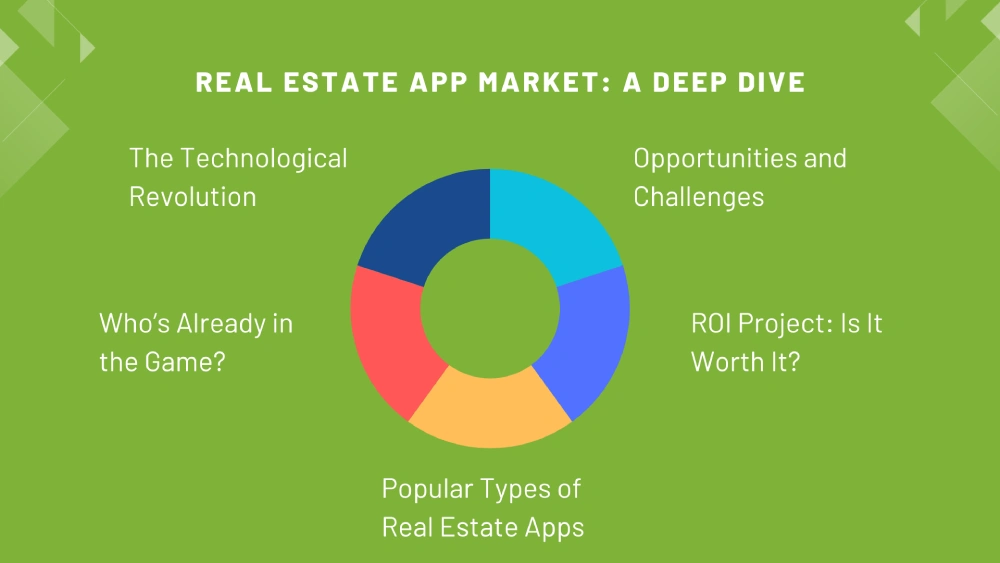
Real Estate App Market: A Deep Dive
The real estate software market continues to expand as businesses accelerate digital transformation. According to Grand View Research, the global market was valued at USD 12.8 billion in 2025 and is projected to reach USD 32.0 billion by 2033, growing at a CAGR of 12.2%. Growth is fueled by increasing adoption of AI-powered solutions, cloud-based platforms, mobile applications, and data-driven property management technologies.
The Technological Revolution
Next are augmented reality (AR) and virtual reality (VR). Instead of having to deal with aggressive brokers or go around town, picture being able to visit a property from the comfort of your couch.
These technologies are no longer just cool extras; they’re becoming essential for staying competitive.
Who’s Already in the Game?
There is a lot of competition in the market. Large firms with years of experience, such as Realtor, Redfin, and Zillow, have some impressive features. Think about advanced search filters, mortgage calculators, and local information. These competitors also rely heavily on MLS integration to keep their listings fresh and comprehensive. So what makes you special?
Determining your area of expertise is essential. You may focus on luxury real estate or the rental market. Or maybe you target foreign buyers who need help navigating foreign markets. There is still plenty of room for innovation if you know where to seek.
Popular Types of Real Estate Apps
Not every real estate app development is made equally. Some of the most well-liked categories are as follows:
- Property Listing Apps: These are the cornerstone of the market, enabling buyers and renters to find properties using location-based searches, filters, and detailed listings. Revenue usually comes from ads, which is exactly how Zillow built its business.
- Rental Marketplace Apps: Built for renters first, these apps connect people looking for a place to stay with hosts or landlords, and take a commission on every booking. Airbnb is the obvious example, but the same model works for long-term rentals too.
- Property Management Apps: Designed for landlords who are tired of chasing rent payments and maintenance requests through text messages and spreadsheets. These platforms run on subscriptions and centralize everything in one place.
- Broker CRM Apps: Built for agents, not buyers. These streamline client management with real estate CRM systems, lead tracking, and follow-ups, usually sold as SaaS. Follow Up Boss is the go-to example here.
- Commercial Real Estate Apps: Aimed at enterprise users, not casual house-hunters. Think office space, retail units, industrial properties. These run on subscription pricing because the buyers are businesses, not individuals, and LoopNet has owned this space for years.
- Property Investment Apps: Built for investors who want exposure to real estate without buying a whole property outright. These monetize through premium tiers or transaction fees, and Fundrise is the clearest example of the model working at scale.
Opportunities and Challenges
Yes, a lot of opportunities exist. There are challenges, though, so let’s not mince words. Consumer preferences are ever-changing, and the industry is fiercely competitive. Furthermore, understanding real estate laws can be difficult.
But here’s the good news: if you can innovate, you can win. Think about integrating AI for predictive analytics or adding sustainability-driven features that appeal to eco-conscious buyers. The key is to stay ahead of the curve.
ROI Project: Is It Worth It?
Here’s the bottom line: investing in real estate app development can pay off big time, especially if you focus on high-growth areas like AI-driven tools or VR-based experiences. With the right strategy, your app can tap into the growing demand for tech-enabled real estate solutions and carve out a profitable niche in the market.
Why Invest in Real Estate App Development? A Smart Move for Growth
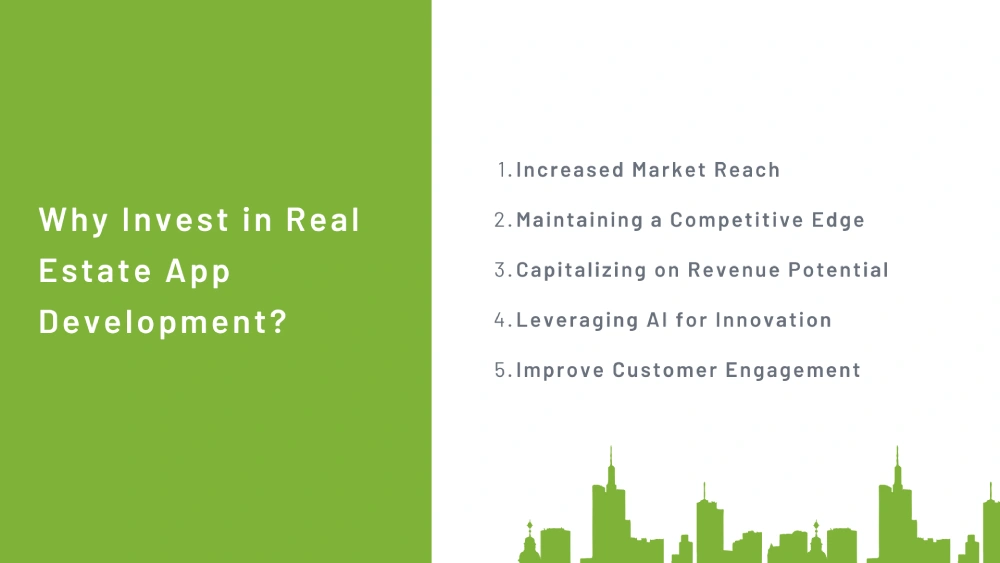
Developing a real estate app isn’t just a trend; it’s a strategic investment with significant potential for return. Here’s a breakdown of why it’s a smart move:
Increased Market Reach
Real estate app development is like giving your business a megaphone to reach the masses. Think about it—an app puts your services directly in people’s pockets.
- Startups can tap into niche markets and address specific needs that others may overlook. Whether it’s simplifying apartment hunting or targeting first-time homebuyers, apps give you the chance to make an impression where it matters most.
- Established businesses have the power to innovate, introducing features like virtual property tours or in-app consultations. These value-added services not only attract users but turn them into loyal customers. Specializing in key real estate areas—like luxury properties or short-term rentals—helps you stand out and cater to specific audiences.
By widening your real estate app market reach, you’re positioning yourself to grow alongside the ever-expanding digital landscape.
Maintaining a Competitive Edge
Let’s face it: competition is fierce, and staying ahead requires effort. But with the right focus, your app can become a leader in the industry. Here’s how:
- Startups: Create apps that are intuitive, easy to use, and actually solve people’s problems. Think of features that make the app indispensable—like a personalized dashboard or a “favorite properties” list.
- Established businesses: Constant updates and improvements are key. Focus on:
- User-friendly design: People want sleek, simple, and stress-free interfaces.
- Flawless performance: Bugs and crashes? Not here.
- Data security: Trust is everything. Show users that their information is safe with you.
- Staying relevant: Listen to feedback, stay in tune with trends, and adapt quickly.
By prioritizing these areas, you’re not just keeping up—you’re setting the standard in real estate app development.
Capitalizing on Revenue Potential
Here’s the fun part—making your app profitable. There are so many ways to monetize real estate apps:
- Startups can attract users with free, value-packed features, and then introduce premium options for those who want more.
- Established businesses can diversify revenue streams through:
- Exclusive premium features: Think advanced search tools or insider property listings.
- Transaction fees: Earn a percentage from deals made through the app.
- Partnerships: Team up with mortgage providers or property maintenance services to offer even more value.
These strategies don’t just help you make money – they also enhance user experience and keep people coming back.
Leveraging AI for Innovation
Artificial intelligence is transforming the real estate industry, and integrating AI into your app can provide a significant advantage.
- Startups: Utilize AI to personalize the user experience. AI-powered property recommendations based on user preferences are a game-changer.
- Established Businesses: Enhance customer service with AI-driven chatbots or virtual assistants for instant support. Leverage predictive analytics to provide users with valuable market insights and property forecasts.
Improve Customer Engagement
Engaged users are more likely to become loyal customers and brand advocates.
- Startups: Focus on personalized features like alerts for new listings, price changes, and market updates tailored to individual user preferences.
- Established Businesses: Foster a sense of community by incorporating in-app communication tools such as chat, video calls, and real-time property updates. Interactive features keep users invested and coming back for more.
By strategically investing in real estate app development, you can expand your market reach, gain a competitive edge, unlock revenue potential, leverage the power of AI, and boost customer engagement. A well-executed app is not just an expense; it’s a valuable asset that drives growth and profitability in the dynamic real estate market.
Must-Have Features for a Real Estate App
If your app doesn’t nail the basics, users bounce. Fast. Here’s what each type of user actually needs.
For Buyers
- Search with real filters (price, location, size, type)
- Saved searches and alerts
- Interactive map, not just a pin
- Mortgage calculator and pre-qualification
- Virtual tour / 3D walkthrough
- Appointment scheduling for viewings
- Secure document upload and e-signature
- Push notifications
For Agents
- Listing management
- Lead pipeline tracking
- A real CRM, not a spreadsheet
- Calendar and appointment management
- In-app chat
- Listing performance dashboard
For Admins
- User and role management
- Central dashboard
- CMS
- Payment and subscription management
- Content moderation
- Security controls and audit logs
| Feature Set | MVP | Advanced | Enterprise |
| Search & filters | Yes | Yes | Yes |
| Map view | Basic | Interactive with clustering | Custom GIS layers |
| CRM | No | Basic pipeline | Full CRM with automation |
| AI recommendations | No | Basic | Full personalization engine |
| MLS/IDX integration | No | Single MLS | Multi-MLS, RESO-compliant |
Market Insights
The feature people search for by name, “Zillow features,” “Redfin features,” but plenty of real estate apps skip it.
- Historical property prices
- Neighborhood trends
- Investment potential
- Comparable property analysis
Buyers use it to check if they’re paying a fair price. Investors use it to bet on a neighborhood. Either way, it’s what makes your app feel trustworthy, not just a listing search.
AI Features in Modern Real Estate Apps
AI in real estate apps stopped being a flex a while ago. Now it’s just expected. Here’s what’s actually getting built into 2026 apps:
- AI property recommendation. Ranks listings against what a buyer actually does in the app, not just what filters they typed in.
- AI chatbot. Answers the same 20 questions buyers always ask, and pre-qualifies leads before an agent has to get involved.
- AI price prediction. Estimates fair market value using comps, location data, and historical trends, so buyers stop guessing.
- AI image recognition. Auto-tags photos (kitchen, bathroom, exterior) and flags the blurry, dark, 2010-era shots nobody wants to see.
- AI document extraction. Pulls structured data out of listing sheets, leases, and disclosures instead of someone retyping it by hand.
- AI search. Lets people type “3-bedroom near good schools under $500K” instead of clicking through eight filter menus.
Not every real estate app needs every AI feature. The key is choosing the right capabilities for your business model and target users.

MLS Integration for Real Estate Apps
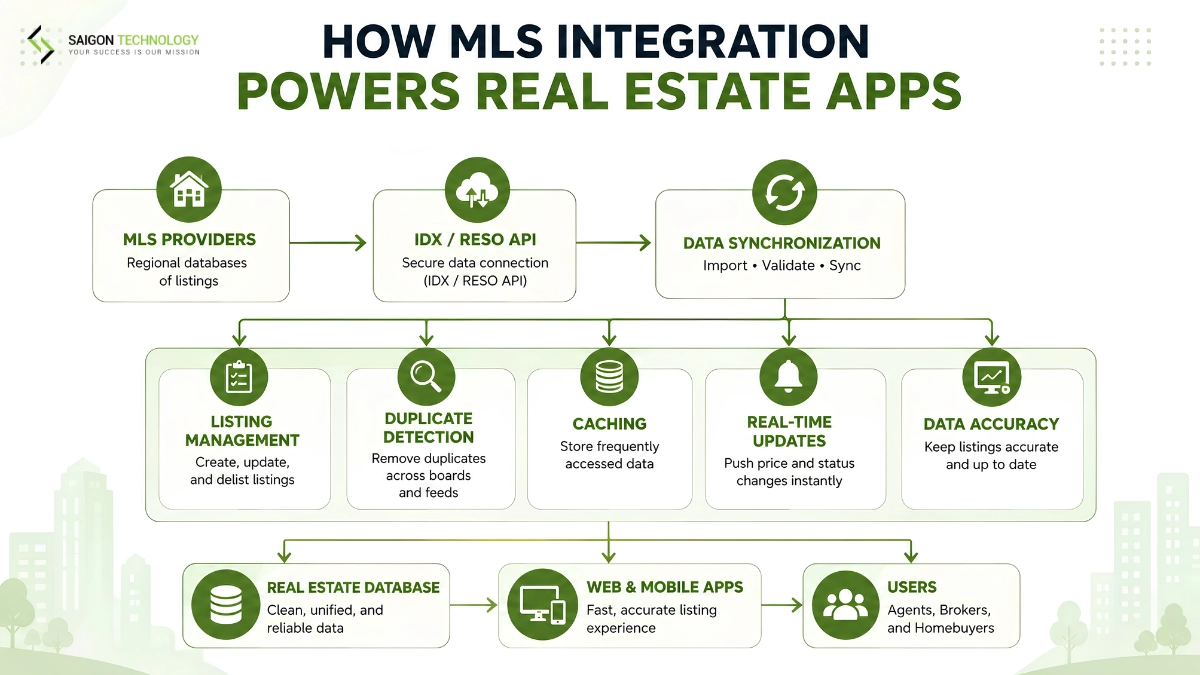
MLS integration is what connects your app to a Multiple Listing Service so the listings you’re showing are actually current. If you’re building anything US-facing that touches listings, this isn’t a nice-to-have feature. It’s the whole data layer underneath the product.
Here’s what you need to plan for:
- MLS (Multiple Listing Service): a regional database of listings maintained by licensed brokers and agents.
- IDX (Internet Data Exchange): the standard that lets brokers display MLS listings on third-party sites and apps.
- RESO API: the modern data standard most MLS providers now use instead of the older RETS feeds.
- Data synchronization: keeping listing status, price, and photos current across your app and the source MLS, whether that’s real-time or scheduled.
- Listing management: handling creates, updates, and delists without leaving orphaned or duplicate records behind.
- Duplicate detection: de-duping listings that show up across multiple boards or syndication feeds.
- Caching: storing frequently hit listing data locally so you’re not hammering the API every time someone opens the app.
- Real-time updates: pushing price and status changes to users without them having to pull down and refresh.
If you’re pitching this to a US enterprise buyer or procurement team, expect MLS/IDX compliance to come up in the very first technical conversation. It’s not a detail. It’s table stakes.
Tech Stack Selection for Real Estate App Development
Choosing the right technology stack is a crucial step in real estate app development. Your app’s performance, scalability, and user experience are directly influenced by the tools and technologies you integrate. Whether you’re building a property listing platform, a rental management app, or an AI-powered real estate solution, selecting the best programming languages, frameworks, databases, and additional technologies will shape your app’s long-term success.
Programming Languages
The choice of programming language impacts your app’s efficiency, interactivity, and ease of maintenance. Here are some of the top languages used in real estate app development:
- JavaScript: A dominant language for both front-end and back-end development, JavaScript enables seamless performance across devices. With Node.js, developers can create scalable server-side applications, while cross-platform frameworks like React Native and Flutter ensures cross-platform mobile compatibility.
- Python: With its clean syntax and powerful libraries, Python is widely used for handling data-driven applications. Frameworks like Django and Flask provide scalability and security, making Python a great choice for real estate platforms.
- Ruby: When combined with Ruby on Rails, this language accelerates development, offering a developer-friendly environment for startups and enterprises alike.
- Swift and Kotlin: For native app development on iOS and Android, Swift and Kotlin deliver high performance, ensuring a seamless experience for end users.
Frameworks
Frameworks streamline development, reducing complexity and ensuring smooth app functionality. Depending on your project’s needs, you may choose:
Front-End Frameworks:
- React.js: A component-based framework that enhances user interactivity and delivers high-speed applications.
- Vue.js: A lightweight framework offering simplicity and flexibility for dynamic real estate platforms.
Back-End Frameworks:
- Express.js: A minimalistic yet powerful framework for Node.js that provides speed and scalability.
- Django: A Python-based framework that prioritizes security, efficiency, and rapid development.
- Ruby on Rails: An excellent choice for fast-tracked real estate app development, emphasizing convention over configuration.
Database Technologies
Real estate apps require efficient databases to manage vast amounts of property listings, user profiles, and transactional data. Here’s a look at the top choices:
Relational Databases (SQL):
- MySQL: Known for reliability and robustness, MySQL is perfect for structured data storage.
- PostgreSQL: A highly scalable database with advanced features like geospatial data handling, making it ideal for location-based services.
- MongoDB: A flexible NoSQL database, well-suited for handling large volumes of unstructured data, ensuring scalability for growing real estate apps.
Additional Technologies
To make your real estate app feature-rich and competitive, incorporating cutting-edge tools is essential:
APIs
- Mapbox: Integrating interactive mapping and geolocation features enhances property search experiences.
- Geolocation Tech: Enables precise location tracking, helping users find properties in their desired areas.
Cloud Solutions
- AWS (Amazon Web Services): Provides scalable cloud storage and hosting solutions, ensuring seamless performance.
- Google Cloud: Offers real-time synchronization and robust data management capabilities.
Augmented Reality (AR)
- AR technology allows users to experience immersive virtual property tours, bridging the gap between online searches and real-life visits.
Microservice Architecture
- Implementing a microservices approach ensures flexibility by enabling independent scaling of different app components, reducing downtime and increasing efficiency.
How to Build a Real Estate App: A 7-Step Process?
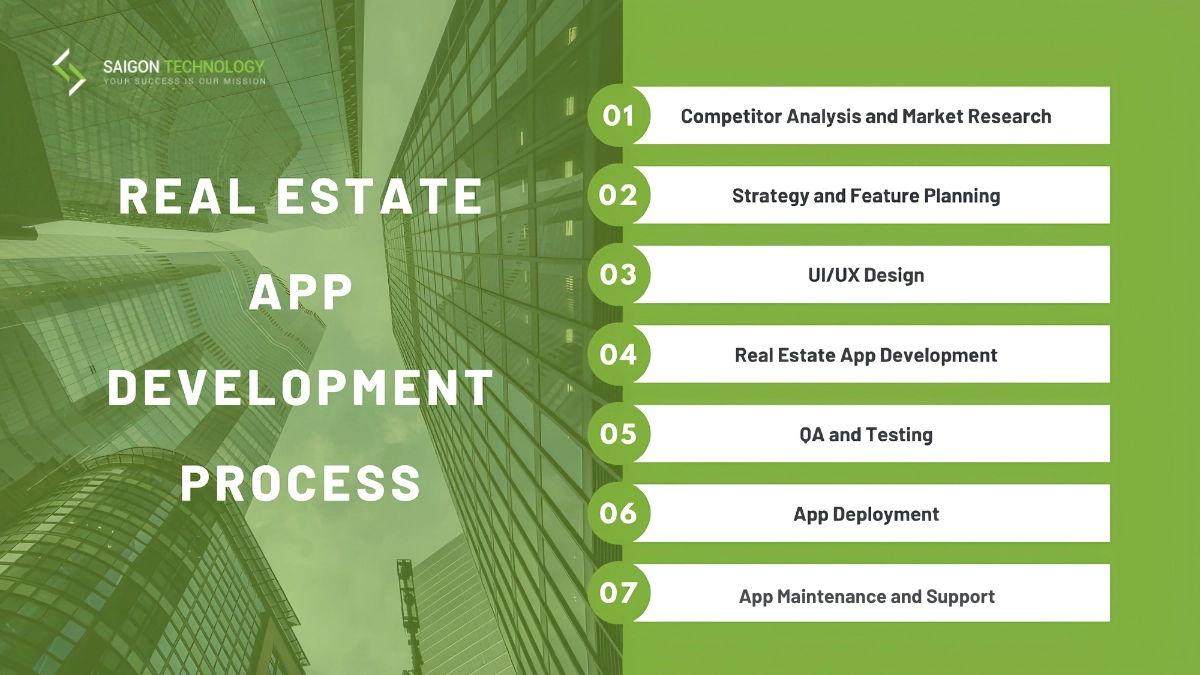
Step 1: Competitor Analysis and Market Research
You wouldn’t start building a house without a blueprint, right? The same goes for your app. Before you do anything, take time to understand the market and your competitors. This is what’s known as the discovery phase, and it’s essential for creating something unique.
- Dig into Your Competitors: Take a close look at other real estate apps. What do they offer? What’s working well for them? More importantly, what’s not? These gaps are opportunities for your app to shine.
- Understand Your Audience: Who are you building this app for? First-time homebuyers? Renters? Agents? Knowing your audience helps you design features that truly solve their problems.
- Follow Market Trends: What’s hot in real estate tech? Virtual tours, AI-powered recommendations, and advanced property search filters are just a few of the trends shaping the industry.
Starting with strong research ensures you’re not just building another app—you’re building the app people actually need.
Step 2: Strategy and Feature Planning
Now that you’ve done your homework, it’s time to put a plan in place. Think of this as the “blueprint” for your app.
- Set Milestones: Break the project into stages—design, development, testing, and launch. This roadmap keeps everyone on the same page and helps you track progress.
- Start with the MVP Development: An MVP (Minimum Viable Product) is a stripped-down version of your app that includes only the essentials. This might mean focusing on property listings, search filters, and a contact form at first. Once you’ve validated the concept, you can add advanced features.
- Plan Monetization: Will your app make money through ads? Subscriptions? A commission on property sales? Figure this out early so you can bake it into your app’s structure via monetization strategy.
- Integrate with Real Estate Systems: Want to offer users real-time property updates? Connect your app with MLS (Multiple Listing Service) platforms or build partnerships with brokers and landlords.
A solid plan is your key to building a useful app without unnecessary delays or bloated costs.
Step 3: UI/UX Design
Let’s be honest about user-centric design—if your app doesn’t look good or feels clunky to use, no one’s going to stick around. This is where UI/UX design comes in.
- Keep It Simple: Your app should be intuitive and easy to navigate. Users should be able to search for properties, view details, and contact sellers without any confusion.
- Make It Visually Appealing: Real estate is all about visuals. High-quality property images, sleek design elements, and a clean layout make a huge difference.
- Think Cross-Platform: Whether your users are on iOS, Android, or a tablet, the app needs to look and work flawlessly everywhere.
- Add Interactive Features: Virtual tours, property comparison tools, and interactive maps are great ways to keep users engaged and excited.
Good design isn’t just about aesthetics—it’s about creating an experience that keeps users coming back.
Step 4: Real Estate App Development
This is where the magic happens. Development is about turning all your planning and design work into a fully functional app.
- Front-End Development: This is what your users see and interact with, so it needs to be smooth, fast, and responsive.
- Back-End Development: This is the behind-the-scenes work that powers your app—managing data, integrating with systems like MLS, and handling secure transactions.
- Integrate Payment Gateways: If your app includes subscriptions or transactions, make sure users can pay securely and easily via real estate management systems.
- Stick to the Roadmap: Refer back to your plan to make sure the app is being developed on schedule and aligns with your goals.
Teaming up with experienced developers can save you a lot of headaches during this phase.
Step 5: QA and Testing
No app is perfect on the first try—that’s why testing is so important.
- Catch Bugs Early: Run tests to find and fix bugs before users ever see them.
- Test Performance: Does the app load quickly? Can it handle lots of users at once?
- Focus on Security: With sensitive data like payment information, security has to be airtight.
Testing isn’t the most glamorous step, but it’s critical for launching a polished, reliable app.
Step 6: App Deployment
Finally, it’s time to share your app with the world!
- Launch on App Stores: Publish your app on platforms like the App Store and Google Play. Follow their guidelines to avoid delays.
- Optimize for Visibility: Use App Store Optimization (ASO) strategies to help people find your app. This includes writing a catchy description, choosing the right keywords, and adding eye-catching visuals.
- Promote the App: Don’t just launch and hope for the best—use social media, ads, and email campaigns to let people know about your app.
A strong launch strategy sets the stage for early success.
Step 7: App Maintenance and Support
Once your app is live, the work doesn’t stop.
- Provide Support: Be ready to handle user questions, troubleshoot issues, and release quick fixes when needed.
- Listen to Feedback: Pay attention to reviews and analytics to understand what’s working and what’s not.
- Keep It Fresh: Regularly update your app with new features, bug fixes, and design improvements to keep users engaged.
Think of this step as ongoing care for your app—it’s how you ensure it stays relevant and valuable over time.
Strategies for Real Estate App Development Monetization
You have a real estate app idea, which is fantastic! The true query, though, is: how do you profit from it?
Although there are many prospects in the real estate industry, just releasing an app won’t cover all of the costs. A strong revenue plan that benefits both you and your users is essential. There are three tried-and-true methods to make money off of your real estate app if it assists users in renting, buying, or selling homes:
1. Premium Subscriptions: Charging for Extra Perks
Think of this as the Netflix model for real estate apps. You let users download the app for free, but if they want extra features, they pay a monthly or annual fee. The trick is making sure what you offer is actually worth paying for.
How to Make It Work Without Annoying Users:
- Offer a free trial so users can test premium features.
- Use tiered pricing—basic plans for casual users, pro plans for serious buyers/investors.
- Keep the core app free, so users still get value even if they don’t subscribe.
2. Advertising: Making Money Without Charging Users
Ads are the easiest way to monetize an app—if done right. Users don’t have to pay anything, and you get a steady stream of revenue from advertisers. But here’s the catch: nobody likes annoying ads.
How to Keep Ads From Being Annoying:
- Limit pop-ups—they frustrate users.
- Show only relevant ads (no random, spammy promotions).
- Offer a paid “ad-free” version for users who hate ads.
3. Commissions: Earning a Cut From Deals
If your app helps people rent, buy, or sell properties, you can take a small commission from every successful transaction. This is how real estate agents make money, so why not apply it to your app?
How to Do It Right:
- Be transparent about commissions—no hidden fees!
- Offer extras like legal assistance or mortgage calculators to justify the cut.
- Make transactions seamless—the easier it is to close deals, the more transactions happen.
How Much Does It Cost to Develop a Real Estate App?
Here’s the honest range: $20,000 to $250,000+. Where you land depends on scope, feature complexity, platforms, integrations, and how tight your security needs to be. An MVP with the basics costs a fraction of what an enterprise platform with AI and MLS integration runs, so the first question isn’t “how much” – it’s “which one are you actually building.”
Estimated Development Cost
| App Type | Typical Scope | Estimated Cost |
| MVP | Property search, listings, user authentication | $20,000–$40,000 |
| Startup App | User accounts, interactive maps, chat, push notifications | $40,000–$80,000 |
| Marketplace Platform | Payments, CRM, MLS/IDX integration, analytics | $80,000–$150,000 |
| Enterprise Platform | AI features, workflow automation, multi-tenant architecture, advanced security | $150,000–$250,000+ |
What Actually Drives the Cost Up (or Down)
A few key factors determine whether your project costs closer to $20K or exceeds $250K.
| Cost Factor | Lower-Cost Scenario | Higher-Cost Scenario | Estimated Cost Impact |
| Features & Complexity | Property search, listings, filters | AI features, AR/VR tours, recommendation engine, advanced analytics | $5,000–$25,000+ |
| Platforms | Single platform (iOS or Android) | iOS, Android, and Web | $5,000–$20,000 |
| UI/UX Design | Standard interface | Custom branded experience | $3,000–$10,000 |
| Technology Stack | Standard backend and APIs | Scalable cloud architecture, custom APIs, AI services | $5,000–$20,000+ |
| Third-Party Integrations | Maps, authentication | MLS/IDX, CRM, payment gateways, analytics | $5,000–$20,000+ |
| Security & Compliance | Basic authentication | Encryption, RBAC, audit logs, regulatory compliance | $3,000–$15,000+ |
| Development Team | Regional development team | Senior engineers with specialized expertise | $10,000–$30,000+ |
| Post-Launch Support | Bug fixes only | Continuous monitoring, updates, and feature enhancements | 15–25% of annual development cost |
How to Optimize Development Costs?
Keeping development costs under control doesn’t mean sacrificing quality. Here are a few practical ways to maximize your budget:
- Validate the idea with an AI-generated prototype or PoC before committing to full-scale development.
- Use cross-platform frameworks like Flutter or React Native so you’re not building two apps for the price of one.
- Prioritize the features that actually move the needle for your first release, and expand based on real user feedback, not guesses.
- Work with a development partner who’s done this before. It’s the difference between shipping on time and drowning in technical debt six months in.
Ready to build your real estate app? Contact Saigon Technology for a free consultation and project estimate.
Why Choose Saigon Technology for Your Real Estate App Development Project?
Saigon Technology is an AI-native engineering partner, not a staffing shop. 14+ years in business, 850+ projects shipped, 350+ global clients, 400+ engineers across 100+ dedicated teams.
Here’s the concrete stuff, not the marketing fluff:
- Certifications: Microsoft Gold Partner for Application Development, ISO 9001, ISO 27001, #2 ranking among Top AI Application Development Platforms, and a spot on Vietnam’s Top 10 ICT list (VINASA 2025).
- How we work: Agile, two-week sprints, full visibility into what’s being built and when, no surprises at the end.
- Security: AES-256 encryption, OAuth 2.1, Zero Trust principles baked into every project, not bolted on after the fact.
- Proof it works: Atrium, a real estate CRM platform we built to help agencies manage listings, leads, and client communication in one place. We’ve also shipped compliance-heavy platforms in healthcare and fintech under HIPAA and GDPR, the same kind of rigor MLS integration demands.
- Trust: standard NDAs, a 2-week risk-free trial, full IP transfer, and pricing that’s just $22–$46/hour, no hidden markup.
If you’re scoping a real estate app right now, a dedicated real estate app developer from Saigon Technology’s mobile app development team can take it from MVP through full MLS integration, without you having to babysit the process.
FAQs about Real Estate App Development
You probably have a lot of questions if you intend to create a real estate app. Here is all you need to know, from the technology used to the construction time.
How long does it take to build a real estate app?
Timeline depends on scope, but here’s roughly what to expect:
- MVP (property search, listings, basic authentication): 3–4 months
- Startup app (user accounts, maps, chat, notifications): 4–6 months
- Marketplace platform (payments, CRM, MLS integration, analytics): 6–8 months
- Enterprise platform (AI, automation, multi-tenant architecture, advanced security): 6–12 months
If someone tells you they can build the enterprise version in six weeks, be skeptical. That timeline usually means corners are getting cut somewhere, most often in QA, security, or MLS data accuracy, and those are exactly the things you don’t want to find out about after launch.
Should I use Flutter or React Native?
Both work well for cross-platform real estate apps. Flutter tends to handle custom UI and map-heavy screens a little better. React Native has a bigger talent pool and plugs into existing JavaScript backends more easily. The right pick usually comes down to what your team already knows.
What is MLS in the context of real estate apps?
MLS stands for Multiple Listing Service, a regional database of listings maintained by licensed brokers and agents. Real estate apps pull this data through IDX or RESO APIs to keep listings accurate and current.
How secure should a real estate app be?
Encryption for data at rest and in transit (AES-256 is the standard), secure authentication like OAuth 2.1, and compliance with whatever regulations apply to your markets, GDPR or CCPA depending on where your users are. These apps handle financial and personal data, so this isn’t optional.
Can I integrate third-party services into a real estate app?
Yes. Common integrations include Google Maps, MLS/IDX, payment gateways like Stripe, CRM systems, analytics tools, and AI services to enhance functionality.


Related articles
Property Management Software Development: The Complete Custom Build Guide (2026)
 Ba (Bill) Pham - Project Manager
  15 Jun 2026
Real Estate CRM Software Development: Architecture, Cost & Build Guide (2026)
17 Jun 2026 
Vibe Coding Security: Risks of AI Code
22 Jun 2026 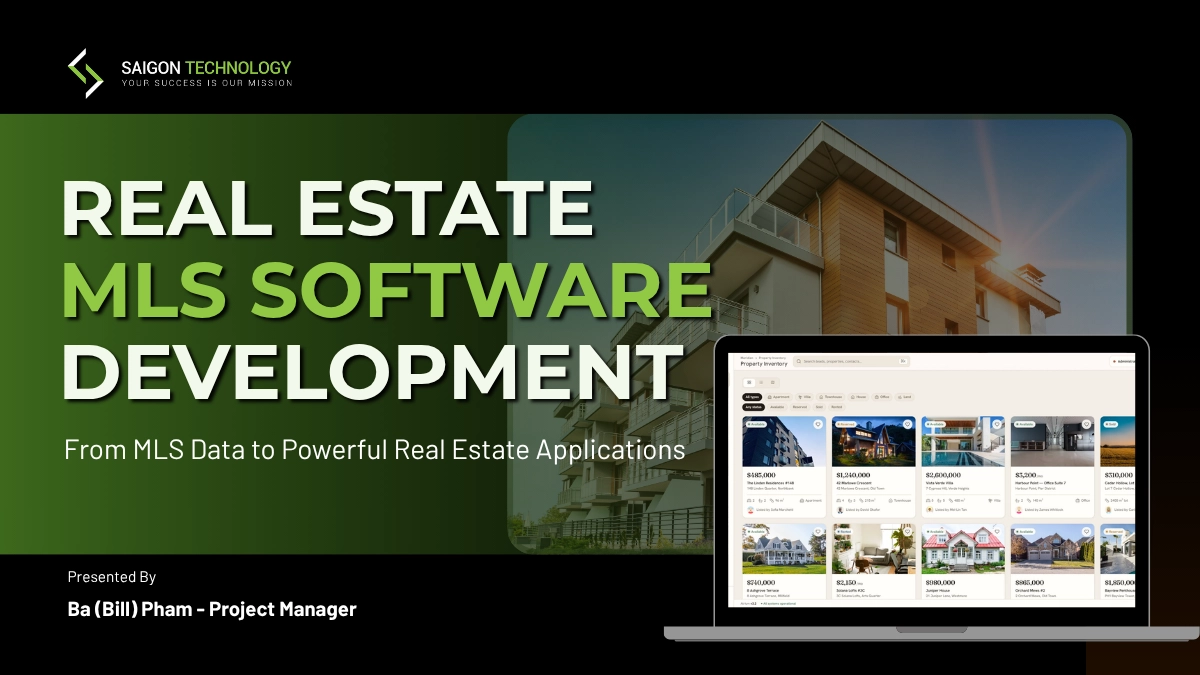
Real Estate MLS Software Development: A 2026 Guide
30 Jun 2026 
AI Code Review: Best Tools, Features, Pricing & Comparison Guide (2026)
03 Jul 2026 
ERP for Real Estate: Modules, Platforms & Custom Options
15 Jul 2026