




Real Estate CRM Software Development: Architecture, Cost & Build Guide (2026)

 Updated on Sep 16, 2026
Real estate CRM software development means building a custom CRM for property developers, brokerages, agents, and investors. It replaces generic CRMs with specialized automations, MLS integrations, and AI lead intelligence.
This guide covers cost, features by vertical, our 6-step build process, common challenges, use case scenarios, and the 2026 AI capabilities reshaping the category. If you want hands-on help scoping or executing a build, see our custom software development services.
Key Takeaways
- A custom real estate CRM takes 4 to 8 months for an MVP. Cost ranges from $60K to $250K+.
- Custom builds win when brokerages run 2+ verticals, 50+ agents, or need proprietary integrations.
- Core modules: lead management, MLS listings, transaction management, document management, AI lead qualification, and a mobile app.
- 2026 AI features are now table stakes: LLM lead scoring, agent automations, voice transcription.
- Industry research links top CRMs to meaningful gains in agent productivity and faster lead response.
Real Estate CRM Market Overview 2026
The US real estate technology market is estimated to have crossed $30 billion in 2025, with CRM as the largest spend category. Five trends define 2026:
- CRM systems are widely adopted across US real estate brokerages, with NAR research indicating that a significant share of agents and firms rely on digital tools for client and lead management.
- Custom builds outpace SaaS in mid-market and enterprise. PitchBook PropTech data indicates custom proptech CRM investment roughly doubled between 2023 and 2025.
- JLL’s 2025 Global Real Estate Technology Survey found that 88% of investors and 92% of occupiers are piloting AI, up from fewer than 5% in 2023.
- Lead response benchmarks have tightened. Zillow Group research shows agents who respond within 5 minutes are far more likely to convert.
- Top buyer priorities for 2026: AI lead qualification, mobile accessibility, and data ownership.
Buyers want a centralized database, real-time data, and AI-powered recommendations, not just contact lists.
What Is Real Estate CRM Software Development?
Real estate CRM software development is the engineering work to deliver a custom CRM. That includes system architecture design, UI/UX design, backend development, MLS and listing portal integration, mobile app development, QA and testing, deployment, and post-launch support.
Three delivery models dominate the market:
| Delivery model | What it means | Best fit |
| Custom build from scratch | Engineering team designs and codes a CRM tailored to your workflows | Enterprise brokerages, property developers, proptech founders |
| White-label and customization | Start from a pre-built CRM platform and customize heavily | Mid-market brokerages with limited build budget |
| Enterprise CRM extension | Build custom modules on Salesforce, HubSpot, or Microsoft Dynamics | Brokerages with existing enterprise CRM commitments |
Note the difference. “CRM implementation” means configuring an off-the-shelf product. “CRM development” means writing the software itself. Each model has different cost, ownership, and timeline.
Custom Build vs. Off-the-Shelf CRM: A Decision Framework
The build-versus-buy decision is the most important step before any code is written. Get it wrong and you burn six figures and twelve months.
| Criterion | SaaS CRM | Enterprise CRM extension | Custom build |
| Upfront cost | $0 to $5K | $15K to $60K | $60K to $250K+ |
| Time to launch | Days | 2 to 4 months | 4 to 8 months |
| Customization depth | Low | Medium | Total |
| IP ownership | None | Partial | Full |
| 3-year TCO (50 agents) | ~$60K to $120K | ~$120K to $240K | ~$140K to $300K |
| Vertical specificity | Generic | Configurable | Purpose-built |
| AI customization | Vendor’s roadmap | Limited | Unlimited |
| Best for | Under 20 agents, single vertical | Mid-market, multi-vertical | Enterprise, proprietary workflow |
You need custom real estate CRM software development if:
- You run 2+ verticals (residential plus CRE, or residential plus property management software).
- You manage 50+ agents and need team-level workflow automation.
- You need proprietary integration points.
- Data and IP ownership are non-negotiable.
- Your operational moat depends on workflows generic CRMs cannot model.
You don’t need it if you are a solo agent, your team is under 20 people, or your workflow fits a single vertical. The break-even point lands at year 2 for brokerages with 50+ users. Below that scale, SaaS wins on total cost of ownership. For a deeper read on the trade-offs, see our build vs. buy software guide.
Who Needs Custom Real Estate CRM Development? Use Cases by Vertical
Four buyer profiles drive most custom builds. Each has pain points generic CRMs cannot solve.
1. Property Developers
Generic CRMs were built for lead-and-listing workflows. Developers need unit-level inventory, project-stage pipelines, broker commissions, and staged buyer payments.
The best CRM for real estate developers includes a unit inventory engine and project-stage workflow (reserved, contracted, milestone-paid, handover). It also needs broker commission ladders and a buyer client portal.
2. Commercial Real Estate Brokerages
CRE deals involve tenant reps, landlord reps, lease abstracts, multi-tenant buildings, and complex commission splits. Residential CRMs cannot model these workflows.
A capable commercial real estate CRM platform must include stacking-plan visualization, lease abstract ingestion, deal-team commission splits, and market comp database integration.
3. Residential Brokerages and Teams
Off-the-shelf software works for solo agents. It breaks at 20+ agents.
Real estate agent CRM software for growing brokerages needs multi-tier lead routing, agent scorecards, recruiting modules, and team-level commission engines.
4. Real Estate Investors and Wholesalers
Investor CRMs need skip tracing, motivated-seller lead scoring, deal underwriting, and buyers-list segmentation. Generic CRMs do not model any of these.
Effective CRM software for real estate investors handles skip-trace APIs, deal underwriting calculators, buyers-list match engines, and temperature-based drip campaigns.
Core Features We Build Into Real Estate CRMs
A production-grade real estate CRM combines twelve core features across four layers.
Lead and Contact Layer
- Automated lead capture from web forms, IDX feeds, Zillow and Realtor.com APIs, social ads, and paid search.
- AI-powered lead scoring using LLM-based intent classification.
- Contact and lead management with property history and full deal history in a centralized database.
Sales and Transaction Layer
- Pipeline visualization with vertical-specific deal stages.
- Transaction management for offers, contingencies, closing dates, and disclosures.
- Document management with DocuSign or Adobe Sign.
- Commission split calculation with multi-party and tiered structures.
Engagement and Automation Layer
- Workflow automation for follow-ups, status changes, and team handoffs.
- Drip email and SMS automation via Twilio and SendGrid.
- AI agent assistant for follow-up drafting, call summarization, and conversation insights.
- Voice-tour transcription using OpenAI Whisper plus LLM summarization.
Mobile and Integration Layer
- Mobile app support: iOS and Android with offline mode, see our real estate app development playbook.
- MLS, IDX, RETS, and RESO Web API integrations for real-time data sync.
Each feature scales as the brokerage grows. Our AI development services and generative AI integration services power the AI recommendations and customer scoring inside our platforms.
Integrations in Real Estate CRM Systems
Modern real estate CRM platforms are integration-heavy. Below is the typical integration matrix.
| Category | Standards and vendors | Why it matters |
| MLS and listing data | RESO Web API, RETS, IDX Broker, iHomeFinder, Showcase IDX | Core property inventory data |
| Listing portals | Zillow API, Realtor.com, Trulia, Redfin, Apartments.com | Lead capture from major channels |
| E-signature and documents | DocuSign, Adobe Sign, Notarize, Dotloop | Contracts, disclosures, closings |
| Communication | Twilio, SendGrid, Mailchimp, RingCentral | Multi-channel outreach with TCPA logging |
| Marketing and ads | Facebook Lead Ads, Google Ads, TikTok Lead Ads, LinkedIn | Lead source unification |
| Calendar | Google Calendar, Outlook 365, Calendly | Tour and meeting scheduling |
| Identity and SSO | Auth0, Okta, Azure AD, OAuth 2.0 | Enterprise access with multi-factor authentication |
| Payments | Stripe, real estate trust-account systems, Earnnest | Earnest money and broker fees |
| Property data | ATTOM, CoreLogic, Black Knight, CoStar | Comps, valuations, market data |
| Accounting | QuickBooks, Xero, NetSuite | Commission and brokerage finance |
| AI and LLM APIs | OpenAI, Anthropic, OpenAI Whisper, ElevenLabs | AI-driven features |
We design every integration on five principles: API-first design, event-driven data sync, idempotent webhooks, per-portal rate-limit handling, and a normalization layer for RESO fields. Fields vary across 580+ US MLSs. If you’re modernizing the MLS layer itself rather than just connecting to it, our guide to building an MLS platform covers that architecture in depth.
Defensive integration matters. Zillow API limits, MLS field changes, and DocuSign endpoint updates happen without warning. Our integration points use retries with exponential backoff, circuit breakers, and CI smoke tests.
Some brokerages also pair their CRM with a broader ERP system built for real estate to unify finance, HR, and back-office operations under one roof.
Real Estate CRM Software Architecture (Scalable SaaS Design)
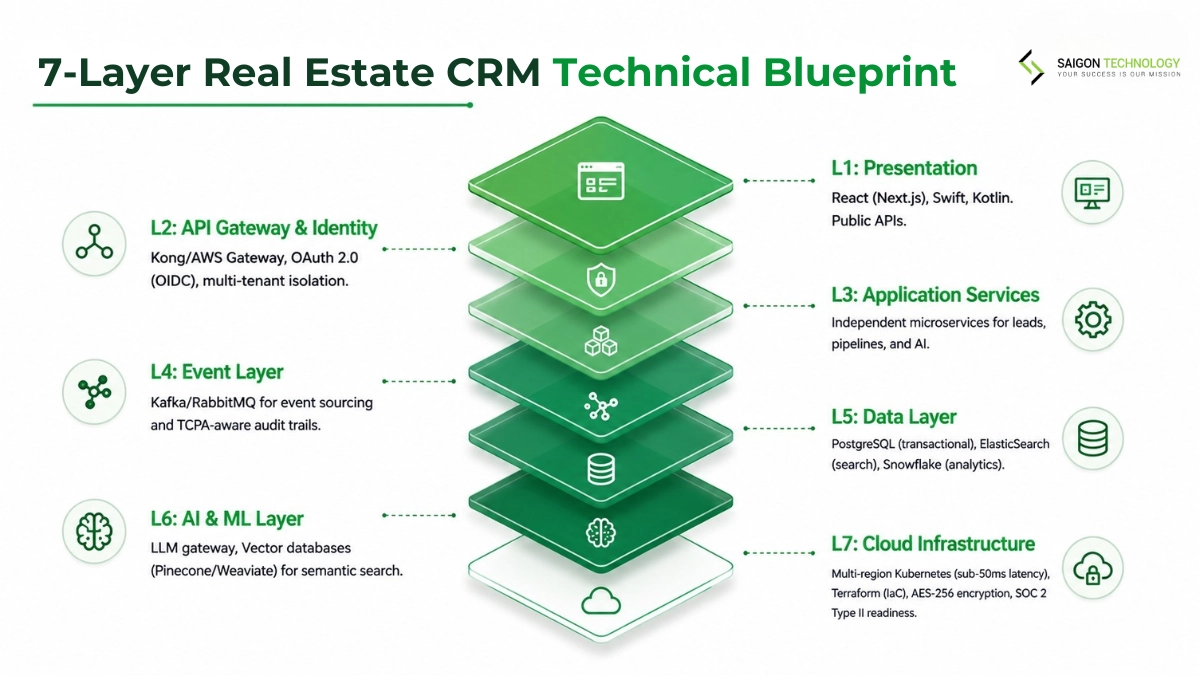
A scalable cloud-based CRM uses a seven-layer architecture.
- Presentation layer. Web in React with Next.js or Angular. Mobile in native Swift and Kotlin, or React Native and Flutter. Public APIs for integrators.
- API gateway and identity. API Gateway (Kong, AWS API Gateway, or Azure APIM) for routing and throttling. OAuth 2.0 with OIDC, multi-factor authentication, and role-based access. Multi-tenant isolation via per-tenant schema in PostgreSQL.
- Application services. Microservices for lead, contact, pipeline, transaction, document, communication, AI, and reporting. Each service deploys independently and owns its database structure.
- Event layer. Apache Kafka or RabbitMQ for inter-service events. Event sourcing on the communication service for TCPA-aware audit trails. Webhook delivery to external integrators.
- Data layer. PostgreSQL for transactional data. ElasticSearch for property search. Redis for caching and rate limiting. S3 or Azure Blob for documents. Snowflake or BigQuery for analytics.
- AI and ML layer. LLM gateway abstracting OpenAI and Anthropic. Vector database (Pinecone or Weaviate) for semantic search. Feature store for ML predictions.
- Cloud infrastructure. Multi-region Kubernetes for sub-50ms latency. Infrastructure as Code with Terraform. Observability with Datadog or New Relic.
Compliance is built into the architecture. Every enterprise software development engagement includes SOC 2 Type II readiness, AES-256 encryption at rest, TLS 1.3 in transit, and PII tokenization.
How Much Does Real Estate CRM Software Development Cost?
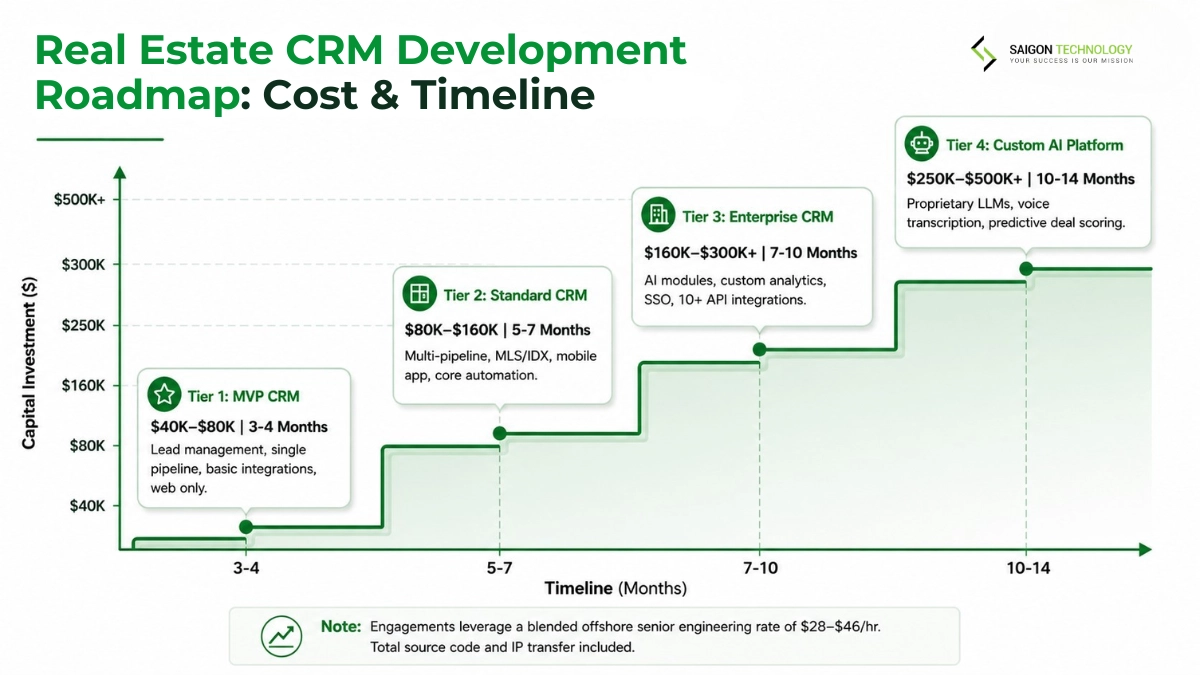
Cost depends on scope, integration count, AI depth, and team velocity. The table shows typical tier ranges based on our custom software cost benchmarks.
| Build tier | What’s included | Timeline | Cost range |
| MVP CRM | Lead management, 1 vertical pipeline, basic integrations, web only | 3 to 4 months | $40K to $80K |
| Standard CRM | Multi-pipeline, MLS/IDX, mobile app, automation, 5+ integrations | 5 to 7 months | $80K to $160K |
| Enterprise CRM | All above plus AI modules, custom analytics, SSO, 10+ integrations | 7 to 10 months | $160K to $300K+ |
| Custom AI Platform | Above plus proprietary LLM, voice transcription, predictive deal scoring | 10 to 14 months | $250K to $500K+ |
Five cost drivers shape every estimate:
- Integration count. Each MLS, portal, or API adds 1 to 3 weeks of engineering.
- AI and ML depth. Off-the-shelf LLM integration is cheap. Custom model training is not.
- User roles and permissions. A six-role matrix is more complex than two.
- Multi-tenancy. Per-tenant isolation adds architectural overhead.
- Compliance scope. SOC 2, state data-residency, and TCPA reporting each add work.
Saigon Technology offers fixed-price, time-and-material, and dedicated development team engagement models. Our blended offshore senior rate is $22 to $46 per hour.
Plan for ongoing costs. Third-party API fees, hosting, and maintenance run 15 to 20% of build cost per year.
Our Real Estate CRM Development Process: 6 Steps
We deliver every real estate CRM software development engagement through a six-phase agile process.
Step 1: Discovery and Requirement Gathering (2 to 3 Weeks)
Stakeholder interviews, workflow mapping, integration audit, and success metric definition. This phase ends with a confirmed scope document and a prioritized feature backlog.
Step 2: System Architecture Design and UX Design (3 to 4 Weeks)
We define system architecture, data models, integration points, wireframes, and the design system. Prototyping happens here. Stakeholders validate flows before code is written.
Step 3: Sprint-Based Iterative Development (12 to 28 Weeks)
We follow an agile methodology with 2-week sprints. A working demo ships at the end of every sprint.
Step 4: Integration and Data Migration (Parallel, 3 to 6 Weeks)
MLS, IDX, payment gateways, legacy CRM data migration, and identity providers. Data sync patterns get tested under realistic loads.
Step 5: QA and Testing (3 to 4 Weeks)
Rigorous testing covers functional, performance, security (OWASP audit), and load tests at 3x expected volume. Automated test coverage targets 80%+.
Step 6: Deployment, Training, and Hypercare (2 to 4 Weeks Plus 60-Day Hypercare)
Production deployment, admin and agent training, and 60 days of fast-response support.
This process is ISO 27001 aligned. Engagements include our 2-week risk-free trial and full IP transfer.
Common Challenges in Real Estate CRM Development (and How We Mitigate Them)
Real estate CRM software development has predictable failure modes. We address each one up front.
Legacy Data Migration
Brokerages carry 5 to 15 years of data in Top Producer, Wise Agent, or Excel. Duplicates and field mismatches are common. We use ML-assisted deduplication, parallel-run with the old system for 30+ days, and a full rollback plan. Migration is staged, not flipped.
MLS Data Normalization
The 580+ US MLSs report fields differently. Status codes, photo URLs, and property types vary. We build a per-MLS abstraction layer with nightly normalization jobs and a drift detector that flags new fields.
User Adoption Resistance
Agents are independent contractors with entrenched workflows. New CRMs often see under 30% adoption in year one. We mitigate with role-configurable UX, in-app onboarding, adoption reporting, and a phased rollout with champion agents.
Scalability Challenges
1M+ leads and 10M+ activities create performance cliffs. Our pattern: read-replica strategy, ElasticSearch for search, materialized views for analytics, and async processing for non-critical writes. We load-test at 3x expected volume.
TCPA, CCPA, and State Compliance
Federal TCPA, CCPA, and state-level rules carry per-violation fines. Our CRMs include consent tracking, immutable communication logs, automatic suppression lists, and jurisdiction-aware messaging rules.
Integration Reliability
Zillow API limits, MLS field changes, and DocuSign endpoint shifts happen without warning. Defensive integration is non-negotiable. We use retries with exponential backoff, circuit breakers, and CI smoke tests for every external API.
AI Hallucination Risk
LLMs can invent facts in lead summaries or property descriptions. That creates legal exposure. We use retrieval-augmented generation, constrained prompting, human-in-the-loop review, and a full AI-output audit trail.
Real Estate CRM Use Case Scenarios
These four scenarios reflect representative engagement patterns. Outcomes use published industry benchmarks, not client-specific metrics.
Scenario 1: Brokerage Lead-to-Close Workflow
- Context. Residential brokerage scaling operations across multiple offices.
- Challenge. Fragmented lead sources and slow first-touch response time.
- Solution. Unified lead inbox, AI-driven routing, automated lead capture with instant follow-up triggers.
- Outcome. Improved response time and conversion, approaching the sub-5-minute industry benchmark from Zillow Group.
Scenario 2: Property Matching and Buyer Portal System
- Context. Multi-project property developer managing inventory across off-plan developments.
- Challenge. Fragmented inventory and manual tracking. Broker commissions and buyer payments handled in email.
- Solution. Centralized CRM with a unit inventory engine, commission split calculation, and a buyer client portal.
- Outcome. Improved inventory accuracy and faster deal flow.
Scenario 3: Brokerage Pipeline Automation System
- Context. Multi-agent brokerage scaling beyond the 20-agent threshold.
- Challenge. Inconsistent pipeline tracking across agents. Limited manager visibility.
- Solution. Standardized pipeline visualization with automated stage transitions and task automation.
- Outcome. Improved visibility and workflow efficiency.
Scenario 4: Investor Deal Tracking System
- Context. Real estate investors and wholesalers running parallel deal pipelines.
- Challenge. Manual deal analysis. Skip-trace data, comps, and underwriting split across tools.
- Solution. Integrated deal scoring, CRM-native deal tracking, and data integration with property data providers.
- Outcome. Better deal prioritization through AI-powered recommendations.
See our real estate case studies portfolio for more CRM and PropTech implementations.
2026 AI-Native Features Reshaping Real Estate CRM
AI capabilities in 2026 go beyond chatbot widgets. Five advanced automations are now table stakes.
-
- LLM-powered lead qualification. Auto-classify inbound leads by intent and budget. SDR-equivalent triage time drops 50 to 70%.
- Agent-style automations. Multi-step AI agents draft follow-ups, schedule tours, and summarize calls.
- Voice-tour transcription. Record property tours, then auto-generate buyer-share recaps with Whisper plus an LLM summarizer.
- Predictive deal scoring. ML models trained on past pipeline data predict close probability per lead.
- Conversational property search. Natural-language queries replace clunky filter UIs.
These CRM-specific capabilities are one part of a larger shift. For a wider view of where AI is heading across the industry, see our breakdown of nine AI use cases running in production today.
FAQs
1. What is a CRM system in real estate?
A real estate CRM is a platform that manages leads, contacts, transactions, and communications for property professionals. It combines contact and lead management, pipeline visualization, automated marketing, and integrations with MLS databases, IDX feeds, and document signing into a single centralized database.
2. How long does it take to build a custom real estate CRM?
Custom real estate CRM software development takes 4 to 8 months for an MVP. Enterprise-grade builds with AI modules take 8 to 14 months. Timeline depends on scope, integration count, and team velocity.
3. How much does it cost to develop a real estate CRM?
MVP CRM: $40K to $80K (basic leads, single pipeline, core integrations). Standard CRM: $80K to $160K (multi-pipeline, MLS/IDX, mobile app, automation). Enterprise CRM: $160K to $300K+ (AI features, advanced workflows, scalable architecture). Offshore senior development rate: $28 to $46 per hour. Ongoing maintenance: 15% to 20% of build cost per year.
4. Should I build a custom CRM or buy a SaaS like Wise Agent or Follow Up Boss?
Build custom when you run multiple verticals, manage 50+ agents, need proprietary integrations, or require full data and IP ownership. Buy SaaS when you have under 20 agents, work in a single vertical, and do not need workflow customization. The break-even point arrives at year 2 for brokerages with 50+ users.
5. What is the best CRM for real estate developers vs. agents?
Developers need inventory-and-stage-driven CRMs with broker commission tracking and milestone payments. Agents need lead-and-pipeline-driven CRMs with MLS integration and automated drip campaigns. The two rarely fit the same product, so custom builds dominate enterprise real estate.
6. Can you integrate a custom CRM with our existing MLS, IDX, and DocuSign setup?
Yes. Standard scope covers MLS, IDX, RETS, and RESO Web API integration. We also handle DocuSign or Adobe Sign for contracts, Twilio for SMS, SendGrid and Mailchimp for email, and Auth0 or Okta for SSO. Integration points handle rate limits, schema drift, and outages.
7. What should I look for in a real estate CRM software development company?
Proven real estate domain experience (brokerages, developers, or investors); strong integration capability with MLS, IDX, and DocuSign systems; expertise in AI implementation (lead scoring, automation, predictive analytics); secure system architecture practices (data protection, compliance readiness); clear IP ownership and full source code transfer terms; experience with scalable CRM architecture for growing brokerages; transparent development process and agile delivery methodology; and a strong understanding of real estate workflows and user adoption challenges.
Ready to Build Your Real Estate CRM?
The decision to build a custom real estate CRM depends on scale, integration complexity, and long-term data ownership requirements.
For teams evaluating a solution, a free working demo can be provided within 24 hours to validate core workflows, system architecture, and integration feasibility before development begins.
Saigon Technology brings over 14 years of experience in enterprise software development, with a focus on scalable CRM systems, secure integrations, and long-term maintainability across our real estate software development practice.


Related articles

Custom Application Development: What Decision-Makers Need to Know Before They Build
 Thanh (Bruce) Pham - CEO of Saigon Technology
  17 Dec 2024
Real Estate App Development in 2026: Cost, Features, Process & Technology Guide
06 Feb 2025 
10 Best AI Coding Assistant Tools in 2026
23 Sep 2025 
Custom Software vs Off-the-Shelf Solutions: A Side-by-Side Evaluation Framework
26 Mar 2026 
How to Run a Long-Term Offshore Engagement End-to-End: A Setup-to-Handover Playbook
12 May 2026 
Staff Augmentation vs Dedicated Team: How to Choose the Right Model (2026)
08 Jun 2026 
Staff Augmentation vs Outsourcing: A CTO’s Decision Framework
09 Jun 2026 
Property Management Software Development: The Complete Custom Build Guide (2026)
15 Jun 2026