




AI Code Review: Best Tools, Features, Pricing & Comparison Guide (2026)

 Updated on Jul 14, 2026
AI code review is the use of large language models to automatically analyze pull requests, flag bugs and security issues, and leave review comments alongside a human reviewer. Engineering teams adopt it to shorten PR cycles and scale code quality without scaling headcount. It is not a replacement for human judgment. Used as a drop-in substitute, it causes more problems than it solves. For teams building or scaling AI-assisted delivery, see our AI development services.
Key Stats on AI Code Review (2026)
- Roughly 45% of AI-generated code samples introduced an OWASP Top 10 vulnerability in testing across 100+ LLMs (Veracode).
- AI-assisted teams saw review time rise 91% and PR size grow 154% even as code generation increased 2 to 5 times (Faros AI).
- At scale, a well-tuned AI reviewer can be cheap and fast: Cloudflare reports a median review cost of $0.98 and median completion of 3m 39s across 131,000+ review runs (Cloudflare).
- The takeaway across all of this data: AI review adds a fast first pass, but raises, not removes, the need for disciplined human review.
Key Takeaways
- AI code review is not a replacement for human review. It handles routine issues (bugs, style, common security patterns) so senior engineers can focus on architecture and business logic.
- It runs at the pull request stage, integrated with GitHub, GitLab, Bitbucket, or Azure DevOps, usually alongside existing static analysis tools.
- The biggest limitation is context. AI review reads diffs well but often misses architectural intent, business rules, and cross-service implications.
- Best-in-class rollouts pair AI review with human review, tune sensitivity to avoid false-positive fatigue, and measure impact on PR cycle time and defect escape rate.
- The tool market is fragmented. Choose based on your codebase, existing security tooling, your deployment model (self-hosted vs. SaaS), and whether you need PR-bot behavior, security scanning, or both.
How AI Code Review Works
AI code review works by analyzing the diff of a pull request through a large language model, comparing the changes against surrounding context and known patterns, and posting comments directly in the PR interface. The mechanism is straightforward in outline but varies significantly across tools in depth and accuracy.
Here is what typically happens when a developer opens a PR on a repository with an AI-powered code review bot enabled:
- The tool is triggered by a webhook from GitHub, GitLab, Bitbucket, or Azure DevOps when the PR is opened or updated.
- It pulls the diff and, in more advanced implementations, indexed context from related files in the codebase.
- An LLM analyzes the changes for defects, security issues, style violations, unused variables, missing tests, and sometimes performance concerns. Some tools also generate suggested fixes.
- Inline comments are posted in the PR, threaded to specific lines, alongside human reviewer feedback.
- Developers can respond to the bot, request re-analysis after fixes, or dismiss suggestions.
This differs from traditional static analysis (SAST) tools like SonarQube or Snyk in one important way: static analysis applies fixed rules to detect known patterns, while an LLM interprets the intent of the change and can flag issues no explicit rule was written for.
In practice, most mature teams use both. Static analysis handles deterministic checks (security scanners, linters, dependency vulnerability scanning), while AI code review adds a layer of judgment-based feedback on top.
Where It Fits in the Development Lifecycle
AI code review sits at the pull request stage, after the code has been written and pushed but before it is merged. It runs in parallel with CI/CD checks (unit tests, linters, security scanners) and human reviewers. In a mature workflow, the bot’s comments appear within seconds of the PR being opened, giving human reviewers a cleaner starting point and letting authors fix routine issues before a human ever looks.
How We Use AI Code Review at Saigon Technology
We don’t just survey these tools. We run AI code review inside our own client delivery. Here is how it actually plays out in practice, and how it shaped the rankings below.
Across our engineering teams, we deploy AI review as a first-pass gate ahead of human review, not as a replacement for it. Our standing configuration:
- On by default for most repositories, tuned to flag bugs, missing error handling, and common security patterns, and to stay quiet on style opinions that our linters already enforce.
- Always human-reviewed regardless of the bot: changes to authentication, payments, and any code touching sensitive personal data. These are encoded in branch protection and CODEOWNERS.
- Tuned within the first two weeks. Every new repo goes through a sensitivity-tuning pass, because an untuned bot that cries wolf gets muted, and a muted bot is wasted spend.
What we consistently see: the clearest win is cycle-time on routine feedback. Authors fix the obvious issues before a senior engineer is ever paged, so human review time is spent on architecture and business logic instead of nitpicks. The clearest limitation is exactly the one the data predicts: the bot is strong on single-file, single-diff issues and weak on cross-service impact. On one fintech client’s monorepo, AI review caught a class of null-handling and input-validation issues reliably, but it could not see that a change to a shared contract would break a downstream consumer. A human caught that.
That real-world usage (not vendor marketing) is the lens we used to evaluate the ten tools below.
AI Code Review vs. Manual Code Review
The most useful way to think about AI code review is not as a competitor to manual review, but as a different tool for a different job. AI is fast, consistent, and scales infinitely; humans understand intent, judgment calls, and business context. The table below breaks down where each approach wins.
| Criteria | AI code review | Manual code review |
| Speed | Seconds after PR opens | Hours to days, depending on reviewer availability |
| Consistency | Applies the same rules to every PR | Varies by reviewer experience, mood, and workload |
| Scale | Handles unlimited PR volume | Bounded by senior engineer time |
| Business context | Limited; struggles with domain logic and architectural intent | Strong; humans understand product goals and trade-offs |
| Security | Catches common patterns; not a substitute for dedicated SAST | Deep analysis possible but often skipped under time pressure |
| Mentoring | Can explain concepts but does not build team knowledge | Builds engineering culture and cross-team knowledge |
| Cost per PR | Low (fixed subscription) | High (senior engineer time) |
| False positive rate | Moderate to high, especially in noisy configurations | Low when done by an experienced reviewer |
| Detects novel bugs | Sometimes, based on pattern matching | Yes, when the reviewer understands the domain |
The pattern most engineering leaders converge on: use AI code review to eliminate the routine feedback loop (style, obvious bugs, missing tests, dead code) so human reviewers spend their limited time on the things that actually require judgment.
Benefits of AI Code Review
The upside of adopting AI code review is real when the tool is used to augment human oversight rather than replace it. The most consistent benefits reported by engineering teams:
- Faster PR turnaround. AI comments appear within seconds, letting authors iterate on routine feedback before a human reviewer is even paged. Teams commonly report shorter cycle times as the clearest win.
- Consistent enforcement of standards. Style guides, naming conventions, and common security patterns get applied uniformly across every PR, without depending on which reviewer picks up the ticket.
- Senior engineer time freed up. When the bot handles the nitpicks, senior engineers spend their PR feedback time on architecture, edge cases, and business logic, which is what they should be doing anyway.
- Scales feedback capacity without scaling headcount. Teams handling high PR volume (dozens per day) hit a bottleneck when quality gates depend solely on senior engineers. AI-powered code review absorbs the routine load.
- Documentation and onboarding side effects. Some tools generate PR summaries, changelog entries, and explanations of complex diffs, which help newer engineers ramp up and reduce the burden of documentation.
- Earlier bug detection. Catching a null-pointer risk or missing error handling at PR time is orders of magnitude cheaper than catching it in production.
None of these benefits arrive automatically. They depend heavily on how the tool is configured, how well the team integrates it into their existing workflow, and whether reviewers trust the bot enough to act on its comments.
Limitations and Risks of AI Code Review
The failure modes of AI code review are worth understanding before adoption, because most of them are invisible until you have deployed the tool and started measuring outcomes. The honest picture:
- False positives erode trust fast. A noisy bot that flags 20 non-issues for every real one gets muted within weeks, at which point the team is paying for a review tool nobody reads. Sensitivity tuning is non-optional.
- Limited grasp of business context. AI review can tell you a function is complex, but it usually cannot tell you the function is complex because the underlying business rule is genuinely complex. Judgment calls about trade-offs remain a human job.
- Security blind spots. AI code review catches common vulnerability patterns (SQL injection templates, unsanitized inputs, hardcoded secrets), but it is not a substitute for dedicated SAST or software composition analysis tools. Treating it as one creates a false sense of security. For a deeper look at AI-code security risks, see our vibe coding security guide.
- Over-reliance risk. If a team stops doing meaningful human review because “the bot handled it,” the quality of code shipping to production drops even as PR cycle time improves. The metric looks better; the outcome gets worse.
- Context window limits. Even tools that index the whole codebase have limits on how much context they can consider per review. Large or cross-service refactors often exceed what the model can hold in mind.
- Cost at scale. Per-developer pricing adds up. A 100-engineer org running a premium AI review tool at $30 per developer per month is spending $36,000 a year, which needs to be justified against measurable improvements in cycle time or defect rate.
None of these are reasons to avoid AI code review. They are reasons to adopt it deliberately, with clear success metrics and a rollback plan.
The Cross-Service Blind Spot: The Ceiling Every Tool Hits
One limitation deserves its own section, because it is the single most consistent failure mode across every AI code review tool (commercial and open source alike) and the one most likely to let a serious bug through.
AI reviewers analyze changes at the file and diff level. They do not reliably understand how a change ripples across service boundaries. A change to a shared authentication module, an API contract, or a common data schema can break three downstream consumers. The reviewer will happily approve the diff in front of it, because on its own terms the diff is correct.
This is not a tuning problem you can configure away. It is a structural limit of how most tools work. Two independent, large-scale sources confirm it:
- Cloudflare, running AI review across 48,000+ merge requests, lists “cross-system impact” as an explicit limitation: the reviewer can flag an API contract change but “can’t verify that all consumers have been updated” (Cloudflare).
- Augment Code, testing 10 tools on a 450,000-file monorepo, found that none of them detected cross-service breaking changes, even on architectures with 47+ service dependencies.
Practical implication: for microservice architectures and large monorepos, treat AI review as a per-file quality gate, not an architectural safety net. Keep human review mandatory on anything touching shared contracts, and lean on integration tests and contract testing to catch what the reviewer structurally cannot see. A small number of tools (e.g., Greptile) index the whole codebase to widen this context, which helps, but does not fully close, the gap.
10 Best AI Code Review Tools Compared
The market has moved fast, with new entrants and native platform features arriving every few months. Below is a summary comparison of the best AI code review tools, followed by a detailed breakdown of ten of the most-used options, aimed at helping engineering leaders shortlist candidates for their stack.
Note: This list focuses on AI code review tools built for pull request reviews. If you need tools for code generation, completion, and refactoring inside your IDE, see our AI coding assistant tools guide.
Pricing below is current and changes frequently, so verify on each vendor’s pricing page before budgeting.
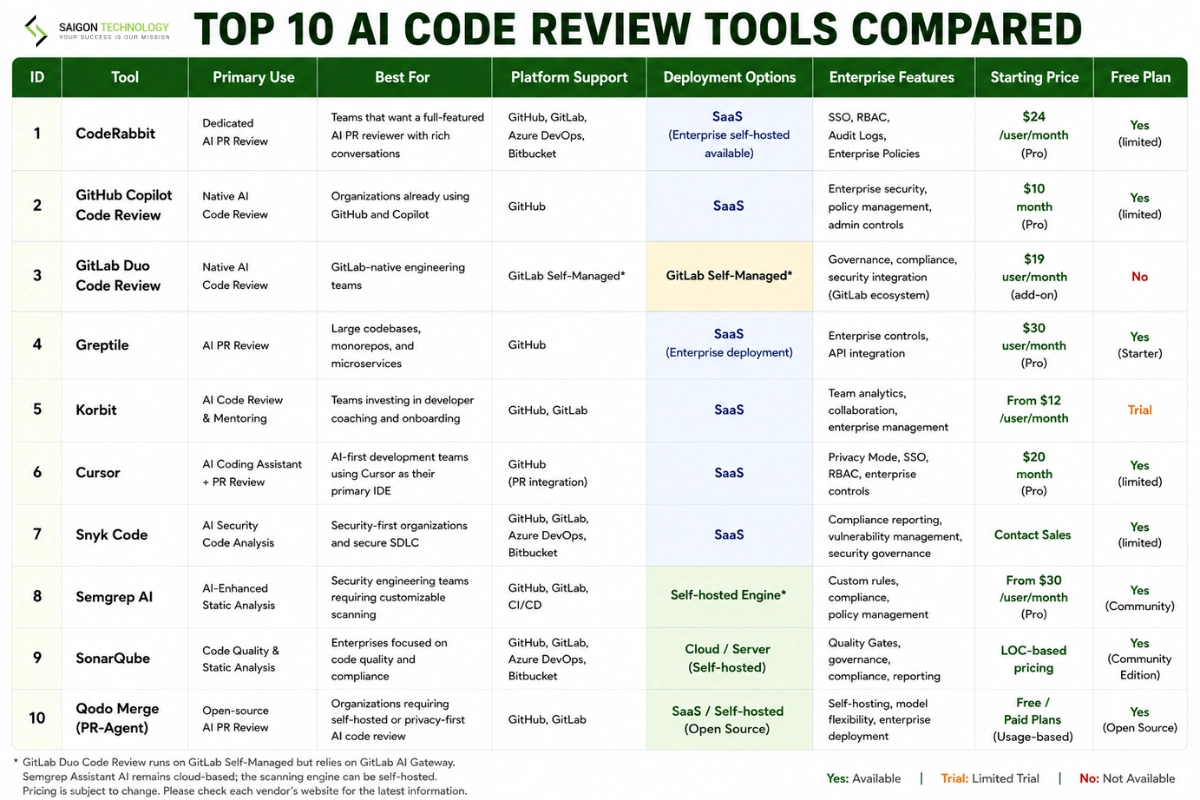
1. CodeRabbit
CodeRabbit is a dedicated AI PR review platform that integrates with GitHub, GitLab, Azure DevOps, and Bitbucket. It uses LLMs to review diffs, generate PR summaries, and hold conversations with developers directly in the PR interface.
Standout features:
- Chat interface directly inside PRs; developers can ask the bot to re-analyze a change, explain a comment, or generate a fix.
- Path-based instruction files let teams customize behavior per directory or file type.
- Learns from resolved conversations to reduce repeat false positives.
Advantages. Mature product with strong GitHub and GitLab integration. Detailed configuration options for teams that want to tune behavior. Frequent product updates.
Drawbacks. Can be noisy on default settings; teams typically need a week or two of tuning before it stops annoying reviewers. Premium features gated to higher tiers.
Pricing:
- Free: limited usage
- Pro: $24/user/month
- Pro Plus: $48/user/month
- Enterprise: custom pricing
Best for. Teams that want a full-featured PR analysis bot and are willing to invest in configuration to get the most out of it.
2. Cursor
Cursor is an AI-powered code editor designed to assist developers while writing code. Rather than acting as a dedicated pull request review tool, it provides real-time code analysis, refactoring suggestions, and team collaboration features throughout the development process.
Standout features:
- Deep integration with the editor, so feedback happens as code is written, not just at PR time.
- Model choice across Claude, GPT, and other frontier LLMs.
- Shared team rules and context to provide more consistent AI suggestions across projects.
Advantages. If your team already uses Cursor as its IDE, the AI capabilities feel natural and require no extra setup. Strong at surfacing suggestions during authoring.
Drawbacks. Not a dedicated PR analysis bot; teams needing GitHub or GitLab PR comments will want to combine Cursor with a purpose-built code review tool. Requires whole-team editor adoption to realize the benefit.
Pricing:
- Free: limited usage
- Pro: $20/month
- Ultra: $200/month
- Teams: $40/user/month
- Enterprise: custom pricing
Best for. Engineering teams that have standardized on Cursor and want AI feedback integrated into the authoring flow rather than the PR flow.
3. GitHub Copilot Code Review
GitHub Copilot Code Review is GitHub’s native AI-powered pull request reviewer. It analyzes pull request diffs, identifies potential bugs and code quality issues, and posts inline review comments directly within GitHub pull requests.
Standout features:
- Zero-integration setup for teams already on GitHub.
- Custom instructions per repository via
.github/copilot-instructions.md. - Aware of GitHub-native context (linked issues, project boards).
Advantages. Frictionless for GitHub shops. Enterprise-grade compliance and admin controls. Regularly improved as part of GitHub’s broader Copilot roadmap.
Drawbacks. Depth of analysis varies; some teams report it feels shallower than dedicated tools like CodeRabbit or Greptile. Locked to the GitHub platform.
Pricing:
- Free: limited usage
- Pro: $10/month
- Business: $19/user/month
- Enterprise: $39/user/month
Best for. Teams already using GitHub and GitHub Copilot that want native AI-powered pull request reviews without adopting a separate code review platform.
4. GitLab Duo Code Review
GitLab’s native AI code review, part of the GitLab Duo AI suite. Analyzes merge requests inside GitLab and integrates with GitLab’s existing security scanning and CI/CD tools.
Standout features:
- Native to GitLab merge requests, no extra integration required.
- Interacts with GitLab’s built-in SAST, DAST, and dependency scanning.
- GitLab Duo Chat lets developers query the codebase in natural language.
Advantages. Cohesive experience for GitLab-native shops. Data stays within the GitLab environment, which matters for teams with strict data residency requirements.
Drawbacks. Value depends on committing to the GitLab ecosystem. Duo Pro tier is a paid add-on on top of GitLab Premium or Ultimate.
Pricing:
- GitLab Duo Pro: $19/user/month (add-on to eligible GitLab plans)
- GitLab Duo Enterprise: 39/user/month (add-on to eligible GitLab plans)
Best for. Teams standardized on GitLab that want AI-powered code review inside their existing platform.
5. Greptile
Greptile is an AI code review tool built around codebase-wide context, positioning itself for teams working across many services or a large monolith where PR-only context is not enough.
Standout features:
- Indexes the full codebase so comments consider related files, not just the diff.
- Strong at cross-service impact analysis (which downstream services will be affected by this change).
- API access for custom workflow integrations.
Advantages. Notably good at catching issues that only become visible when you understand the surrounding files. Reduces false positives on codebases with heavy internal conventions. This wider context is the closest any tool gets to addressing the cross-service blind spot described above, though it narrows the gap rather than closing it entirely.
Drawbacks. Indexing large codebases takes setup time. Higher per-seat cost than some alternatives.
Pricing:
- Starter: Free
- Pro: $30/seat/month
- Enterprise: Custom pricing
Best for. Teams with microservice architectures or large monorepos where PR-only context regularly misses important issues.
6. Korbit
Korbit positions itself as an AI mentor as much as a code analysis tool, generating explanations and learning resources alongside its comments.
Standout features:
- Explanation-first comments that explain the underlying concept and suggest how to fix the issue.
- Korbit Insights provides team analytics and reports to identify recurring code quality issues and engineering trends.
- Integration with major Git platforms.
Advantages. Strong for teams with a mix of junior and senior engineers, where feedback can double as training. Helpful for engineering managers tracking team-level patterns.
Drawbacks. Mentoring-heavy comments can feel verbose to senior engineers who just want the flag, not the explanation. Configuration options are more limited than some competitors.
Pricing:
- Free Trial: 14 days
- Pro: $12/user/month (annual) or $15/month (monthly)
- Max: $18/user/month (annual) or $24/month (monthly)
- Enterprise: Custom pricing
Best for. Teams investing in junior engineer development, or engineering managers who want visibility into team-wide skill gaps.
7. Snyk Code
Snyk Code is the AI-enhanced static application security testing (SAST) tool from Snyk, focused on finding security vulnerabilities in first-party code. Not a general-purpose analysis tool, but a critical part of many mature stacks.
Standout features:
- Purpose-built for security: SQL injection, XSS, hardcoded secrets, unsafe deserialization, and dozens of other vulnerability classes.
- DeepCode AI engine trained on security-specific patterns.
- Integrates with the rest of the Snyk platform (Open Source, Container, IaC).
Advantages. Strong signal-to-noise ratio on security findings compared to general AI-powered code review tools. Enterprise-grade compliance and reporting.
Drawbacks. Not a substitute for a general PR analysis bot; it will not comment on style, structure, or business logic. Full platform pricing scales quickly.
Pricing:
- Free: $0/month
- Team: from $25/contributing developer/month
- Ignite: from $1,260/contributing developer/year
- Enterprise: Contact Sales
Pricing varies depending on the Snyk products and usage.
Best for. Teams that need dedicated AI security scanning as a layer alongside a general AI code review tool.
8. Semgrep AI
Semgrep is an open-source static analysis engine built around custom rule patterns; its AI features (Semgrep Assistant) add LLM-based enrichment on top of rules-based findings.
Standout features:
- Massive community rule library plus the ability to write custom Semgrep rules for organization-specific patterns.
- Semgrep Assistant uses AI to reduce false positives by evaluating whether a rule match is actually exploitable.
- Runs anywhere: CI, IDE, pre-commit hook, or as a GitHub App.
Advantages. Extremely customizable. Strong for teams with security engineers who want to codify their own rules. Free and open source at the core.
Drawbacks. Higher learning curve than turnkey PR bots. AI features are gated behind paid tiers. Note that Semgrep’s maintained rules moved to a proprietary license in 2024, so review terms for commercial or SaaS use.
Pricing:
- Community Edition: free
- Teams: starts from $30/user/month
- Enterprise: custom pricing
Best for. Security-conscious teams that want a customizable, rules-driven engine with AI enrichment on top.
9. SonarQube
SonarQube is the incumbent code quality platform, in market since 2007. Recent releases have added AI CodeFix, which uses LLMs to generate suggested fixes for the issues Sonar’s static analysis detects.
Standout features:
- Coverage across quality, security, and reliability metrics.
- SonarQube AI CodeFix generates one-click fix suggestions for detected issues.
- Both self-hosted and cloud-hosted options; wide language support (21+ languages).
Advantages. Deep, deterministic static analysis is more trustworthy for compliance than pure LLM-based inspection. Its rule-based detection produces near-zero false positives, which is why it remains a default quality gate at enterprise scale. Long track record and strong enterprise adoption.
Drawbacks. Not primarily an AI product; the AI layer is additive rather than the core value. Like all file-level tools, it is blind to cross-service architectural impact. Configuration is heavier than modern turnkey bots.
Pricing:
- Community Build: Free
- Team: Starts at $34/month
- Enterprise: Custom pricing
Best for. Teams with existing SonarQube adoption or strict compliance requirements who want AI as an enhancement to deterministic analysis.
10. Qodo Merge (PR-Agent)
Qodo Merge builds on the open-source PR-Agent project developed by Qodo (formerly CodiumAI), offering both a managed SaaS platform and self-hosted deployment options.
Standout features:
- Fully open source; teams can self-host on their own infrastructure for data-sensitive environments.
- Multiple modes: full PR analysis, incremental checks, PR description generation, similar-issue detection.
- Model-agnostic; supports OpenAI, Anthropic, and open-source LLMs.
Advantages. Transparency of an open-source tool. Attractive for teams with data residency concerns or regulated industries. Active community.
Drawbacks. Self-hosting requires engineering effort to set up and maintain. Plan for real DevOps capacity, and note that self-hosted local-model deployments can require significant configuration work. Managed service is less mature than closed competitors.
Pricing:
- Free Trial: 14 days
- Pro Team: Usage-based (starts at $0.012 per credit)
- Enterprise: custom pricing
- Open-source PR-Agent: Free (self-hosted; LLM API costs apply)
Best for. Teams that require self-hosted AI code review, open-source flexibility, or stricter data residency and compliance controls.
Choosing a Deployment Model: Self-Hosted vs. GitHub Action vs. Cloud SaaS
Before you compare individual tools, settle the deployment model. It eliminates most of the list for you. The choice comes down to where your code is allowed to go and how much infrastructure you want to own.
| Deployment model | Code leaves your infra? | Setup effort | Best for | Example tools |
| Cloud SaaS | Yes (to the vendor) | Lowest, connect and go | Most teams; fastest time-to-value | CodeRabbit, Greptile, Korbit |
| Native platform | Stays in your Git platform | Near-zero for existing users | GitHub- or GitLab-committed shops | Copilot Code Review, GitLab Duo |
| Self-hosted | No, stays on your infra | Highest, infra + maintenance | Regulated industries, data-sovereignty needs | Qodo Merge (PR-Agent), Semgrep, SonarQube |
- Cloud SaaS is the right default for most teams: the vendor handles infrastructure, model updates, and scaling, and pricing is predictable per seat. Every PR diff leaves your infrastructure for analysis, so it’s unsuitable where code confidentiality is a hard requirement.
- Native platform tools (GitHub Copilot Code Review, GitLab Duo) keep data inside the Git platform you already trust and require essentially no integration, but lock you to that ecosystem.
- Self-hosted is the only option for air-gapped environments, strict data residency, or regulatory obligations that prohibit sending code to external APIs. The trade-off is real: infrastructure cost, model-hosting overhead, and ongoing maintenance. For teams without existing infrastructure and DevOps capacity, the math usually favors SaaS.
For regulated industries such as healthcare, fintech, and platforms handling sensitive personal data, the deployment model is often decided by compliance before any feature comparison begins.
Best Practices for Implementing AI Code Review at Scale
Adopting AI code review across a large engineering organization is not a matter of enabling a bot on every repository. The teams that get real value from it treat rollout as a phased engineering initiative with clear success criteria and iteration built in.
- Start with a pilot team and one repository. Pick a team with high PR volume and a supportive tech lead. Run the tool for four to six weeks, gather feedback, and measure baseline metrics before expanding.
- Tune bot sensitivity. After the pilot, suppress noisy comment categories, adjust severity thresholds, and add path-based rules for legacy code. A noisy bot at scale is worse than no bot at all.
- Keep humans on critical PRs. Merges to main and changes to authentication, payment, or PHI-handling code should always require a human reviewer regardless of what the bot says. Encode this in branch protection rules and CODEOWNERS files.
- Integrate with existing CI/CD gates. The bot’s comments should appear alongside CI status checks, test results, and security scanner output, not in a separate dashboard developers have to remember to check.
- Measure ROI. Track PR cycle time, reviewer time-to-first-response, defect escape rate, and comment resolution rate against a pre-adoption baseline. Without measurement, you cannot tell whether the tool is worth its cost.
- Expand gradually. After a successful pilot, roll out to additional teams in waves, refining configuration and workflows before organization-wide adoption. Periodically revisit configuration and team feedback to ensure the tool continues delivering value.
Organizations achieve the greatest value when AI code review is integrated into existing DevOps workflows rather than treated as a standalone tool. At Saigon Technology, our AI-native engineering teams help embed AI into CI/CD pipelines while maintaining governance, code quality, and security across enterprise software delivery.
For regulated industries such as healthcare, fintech, and platforms handling sensitive personal data, AI code review should complement, not replace, dedicated QA, security testing, and human review. For a broader view of runtime LLM risks in production systems, see our LLM security risks guide.
FAQs
1. Does AI code review replace human reviewers?
No. AI code review augments human oversight, it does not replace it. AI handles routine feedback (style, common bugs, missing tests, obvious security patterns) so human reviewers can focus on architecture, business logic, and judgment calls. Teams that use AI as a full replacement typically see PR cycle time improve but defect escape rate and code quality decline. The goal is faster, better-targeted human oversight, not none at all.
2. Can AI code review catch security vulnerabilities?
Partially. It catches common patterns but is not a full security tool. Most code review AI tools detect common vulnerability patterns like SQL injection, unsanitized inputs, hardcoded credentials, and unsafe deserialization. They are not, however, a substitute for dedicated SAST (like Snyk Code or Semgrep) or software composition analysis for open-source dependency vulnerabilities. The best practice is to run AI-powered code review alongside dedicated security tooling, not in place of it.
3. Which AI code review tools integrate with GitHub and GitLab?
Most major tools integrate with both. CodeRabbit, Greptile, Korbit, Qodo Merge, Snyk Code, and Semgrep all support GitHub and GitLab. GitHub Copilot Code Review is GitHub-native only; GitLab Duo Code Review is GitLab-native only. Bitbucket and Azure DevOps support is more selective; CodeRabbit and Snyk are the strongest options for those platforms.
4. Is AI code review accurate enough to trust in production?
For routine issues, yes; for architectural and business-logic decisions, no. Independent tests and team-reported data suggest AI code review catches a high percentage of routine defects (missing null checks, unused variables, common security patterns) and misses roughly what you would expect on domain-specific bugs. It is also structurally blind to cross-service breaking changes. Teams that trust the AI for the mechanical layer and require human judgment for architectural decisions get the best of both.
5. How much does AI code review cost to implement?
Tool subscriptions range from free (for open-source projects and community editions) to roughly $40 per developer per month for premium tiers. A 100-engineer team spending $30 per developer per month is committing about $36,000 per year in licensing. The larger implementation cost is usually configuration and integration time (typically two to six weeks of engineering effort for a mature rollout), plus ongoing tuning. The ROI comes from shorter PR cycle time and reduced senior engineer workload, which for most teams pays back the licensing cost within the first quarter.
Conclusion
AI code review has become an essential part of modern software development, helping teams ship faster, improve consistency, and catch common issues before they reach production. The greatest value comes from using AI as a complement to, not a replacement for, human reviewers, and from being clear-eyed about its ceiling: it is strong on file-level issues and structurally weak on cross-service architectural impact. Combined with CI/CD automation, security testing, and experienced engineering judgment, AI-powered code review enables teams to scale software delivery without compromising quality.
Looking to implement AI code review in your engineering workflow? Explore our AI development services to talk to our AI and software engineering experts about how AI code review can fit into your development workflow.


Related articles
AI ERP in 2026: What Works, What Breaks, and How to Add It
 Phuc (Cris) Tran - Program Manager
  23 Sep 2026
AI Governance Framework: A Practical Guide for Enterprises (2026)
04 Sep 2026 
10 AI Implementation Challenges Derailing Projects in 2026
31 Aug 2026 
AI Readiness Assessment: Scoring Whether You Can Actually Build
20 Aug 2026 
AI-Augmented Software Development: A Practical Guide for Engineering Leaders (2026)
08 Jul 2026 
LLM Security Risks: What Every CTO Must Know Before Shipping AI Features
25 Jun 2026 
Vibe Coding Security: Risks of AI Code
22 Jun 2026 
AI in Fintech: A 2026 Builder’s Guide to Use Cases, Architecture and Regional Rules
04 May 2026 
Vietnam’s AI Ecosystem: Policy, Talent Pool & Market Growth
30 Mar 2026