




Vibe Coding Security: Risks of AI Code

 Updated on Jun 22, 2026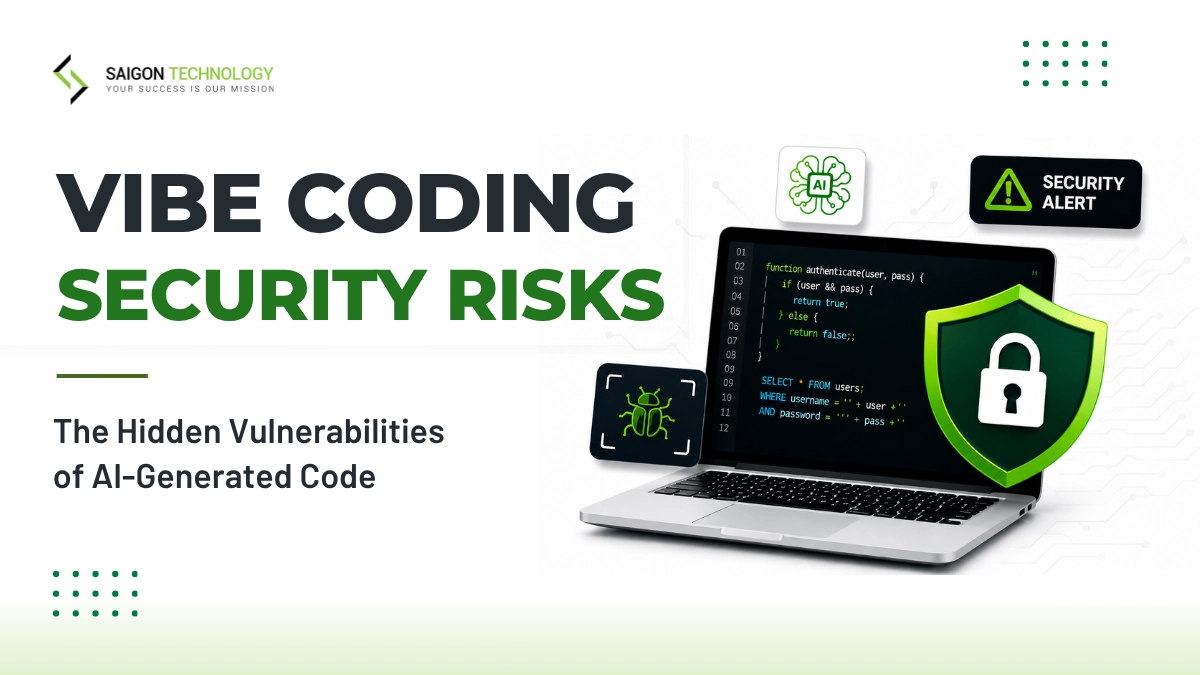
Vibe coding security is the practice of identifying and reducing the risks that appear when developers ship AI-generated code with little manual review. Vibe coding, the prompt-driven style of building software where you describe a feature in natural language and let a large language model write the code, has made shipping faster than ever. The problem is that the same speed often skips the steps that keep software safe: threat modeling, code review, and testing. The result is working code that may also be insecure.
This guide covers why AI assistants produce vulnerabilities, the most common risks of vibe coding, how prompts become an attack surface, and a workflow and checklist to ship safely before production. If you want a partner to help review or harden AI-assisted code, see our AI development services.
Key Takeaways
- Vibe coding is not inherently unsafe. Unreviewed AI output is the real risk, not the AI itself.
- AI assistants predict likely code, not secure code, and they lack the business context a security engineer brings.
- The most common vibe coding security issues include hardcoded secrets, injection flaws, broken access control, and insecure dependencies, most of which map to the OWASP Top 10.
- Prompts are a new attack surface. Prompt injection, system prompt leakage, and pasting secrets into AI tools are growing concerns.
- A repeatable secure workflow plus automated scanning in CI/CD catches most issues before deployment.
Is Vibe Coding Safe? The Honest Answer
Vibe coding is safe when teams review, test, and scan the AI output the same way they would any other code. However, it becomes risky when teams treat AI output as finished and ship it without security validation. The danger lives in the workflow, not in the technology.
Three patterns explain why so much vibe-coded software ends up vulnerable:
- Speed replaces scrutiny. Teams drop threat modeling, code review, and testing in the rush to ship.
- Non-developers ship production apps. Citizen developers and founders can launch a product with no security background, unaware of what they expose.
- The model lacks context. It cannot see your trust boundaries, your data sensitivity, or the compliance rules you operate under.
Still, none of this means you should stop vibe coding. It means teams now have to add back, on purpose, the human oversight that used to happen by default.
Why AI Coding Tools Generate Insecure Code
AI coding tools generate insecure code because vendors build them to produce plausible, working output, not security-validated output. Specifically, a large language model predicts the next token based on patterns in its training data, so it reproduces whatever conventions were common in that data, including insecure ones. Understanding the root causes explains every vulnerability class that follows.
| Cause | Why it produces insecure code |
| Trained on public code | Public repositories contain insecure examples, and the model learns and repeats those patterns |
| Pattern prediction, not reasoning | The model predicts the most likely code, which is not the same as the most secure code |
| No business context | It does not know your trust boundaries, which data is sensitive, or what an attacker would target |
| No threat modeling | It cannot reason about adversaries the way a security engineer does |
| Hallucinated dependencies | It may suggest packages that do not exist or that are unsafe, opening the door to supply chain attacks |
| Optimizes for “it works” | When security and functionality conflict, it tends to choose the version that simply runs |
There is also a comprehension gap. When a model writes code a developer does not fully understand, that developer cannot judge whether it is safe. Code generation has become easy, but code comprehension has not, and security lives in the gap between the two.
Common Vibe Coding Security Risks and Vulnerabilities
The most common vibe coding security vulnerabilities are familiar software security flaws that appear more often because no one is reviewing the output. For example, a 2023 study by Stanford University found that developers who used AI code assistants were significantly more likely to introduce security vulnerabilities than those who did not, and were also less likely to suspect their code was insecure.
Most of these vulnerabilities map directly to the OWASP Top 10 and the weakness classes in the MITRE CWE list, which makes them predictable and, fortunately, detectable. The table summarizes the recurring vibe coding security issues, why AI introduces them, and the impact when they reach production.
| Vulnerability | Why vibe coding causes it | OWASP mapping | Real impact |
| Hardcoded secrets and API keys | Models often embed keys directly to make code “just work” | A07 / sensitive data exposure | Leaked keys lead to account takeover and runaway cloud bills |
| SQL and command injection | Generated queries skip parameterization and input validation | A03 Injection | Data theft, data loss, full database compromise |
| Broken authentication and access control | The model rarely enforces least privilege or proper authorization checks | A01 Broken Access Control | Unauthorized access to other users’ data |
| Insecure or outdated dependencies | AI pulls in old or vulnerable packages, sometimes hallucinated ones | A06 Vulnerable Components | Known CVEs and supply chain attacks enter your app |
| Missing input validation and sanitization | Untrusted input is trusted by default | A03 Injection / XSS | Cross-site scripting, injection, data corruption |
| Exposed or over-permissive APIs | Endpoints ship without auth, rate limiting, or scoping | A01 / API security | Data scraping, abuse, denial of service |
| Secrets in client-side code | The model places config and tokens where the browser can read them | A02 Cryptographic Failures | Credentials exposed to anyone viewing source |
| Verbose error handling | Stack traces and internal details get returned to users | A05 Misconfiguration | Information leakage that helps attackers map the system |
Risks That Scanners Often Miss
Three risks deserve attention beyond the table. Automated scanners often miss them.
Business-Logic Flaws
AI-generated business logic can run correctly yet enforce the wrong rules. For example, it might let a user approve their own refund. In other words, scanners check syntax and known patterns, not intent. A function can pass every static analysis check and still grant the wrong user the wrong permission.
LLM Supply Chain Risks
Dependency risk now extends to LLM supply chains. A model can suggest typosquatted or malicious packages, and developers install them without a second thought. Moreover, the suggestion comes from a trusted assistant inside the editor, so few people verify whether the package is real, maintained, or safe.
Insecure Defaults and Leftover Code
Generated projects often ship with debug mode on, permissive CORS settings, or test credentials still in place. Each is an easy opening for an attacker. Importantly, these are not bugs the AI introduced maliciously. They are scaffolding it built to make the demo work, and no one stripped them out before deployment.
Prompt Security Risks in Vibe Coding
Prompt security risk is the set of threats where the prompt itself, rather than the AI output, becomes the attack surface. As a result, as teams move toward agentic coding environments where the AI reads files, runs commands, and edits projects, what you feed the model and what the model can reach both matter.
The main prompt-level risks include:
- Prompt injection. Malicious instructions hidden in a file, web page, or dependency trick the AI agent into running unintended actions or exposing data.
- System prompt leakage. Attackers extract the hidden instructions guiding the assistant, revealing logic, guardrails, or secrets baked into them.
- Secrets in prompts. Developers paste API keys, tokens, or credentials into a chat to “give context,” and those secrets leave your environment.
- Proprietary code exposure. Uploading internal source to a third-party AI tool can violate confidentiality and create shadow IT outside any security policy.
- Third-party provider risk. Your code and prompts travel to an external model provider, so their data handling becomes part of your attack surface.
The OWASP Top 10 for LLM Applications now catalogs these risks formally, and prompt injection sits at the top of that list. According to OWASP’s 2025 LLM threat data, prompt injection is the most critical vulnerability class for LLM-integrated applications, affecting systems across every industry that has adopted AI-assisted development. Therefore, secure prompt engineering and validating any untrusted input the model consumes are becoming core skills, not edge cases. For teams building agentic systems on top of LLMs, our generative AI integration services bake these controls in from day one.
AI-Generated Code vs Human-Written Code: Which Is More Secure?
Neither AI-generated nor human-written code is automatically more secure. Instead, the deciding factor is whether someone reviewed the code, not who or what wrote the first draft. AI brings speed and consistency, while experienced humans bring context and judgment about security and business logic.
| Area | AI-generated code | Human-written code |
| Speed | Faster | Slower |
| Consistency | High | Variable |
| Security awareness | Limited | Context-aware |
| Business logic security | Weak | Strong |
| Compliance understanding | Weak | Strong |
| Threat modeling | Weak | Strong |
The takeaway is worth quoting directly: vibe-coded output is not inherently less secure than human-written code. Unreviewed code is less secure than reviewed code. The most secure setup combines both, with the model acting as a fast pair-programming partner and a human providing the security review and final approval.
How to Secure Vibe Coding: A Step-by-Step Secure Workflow
Securing vibe coding means wrapping AI output in the same secure development lifecycle you would apply to any production code, with extra attention to review. Therefore, the workflow below is a repeatable sequence designed to shift security left, so teams catch problems during development rather than after deployment.
- Define security requirements before prompting. Decide what data the feature handles, what the trust boundaries are, and which compliance rules apply, before you write a single prompt.
- Prompt explicitly for secure patterns. Ask for parameterized queries, input validation, least privilege, and proper error handling instead of generic requests.
- Never trust model output by default. Treat every AI suggestion as untrusted input that requires post-generation review, the same way you would treat code from an unknown contributor.
- Scan automatically in your CI/CD pipeline. Run static analysis (SAST), software composition analysis (SCA) for dependencies, and secrets scanning on every commit. This turns review into a gate, not an afterthought.
- Add validation, authorization, and bounds checking. Confirm that input validation, sanitization, access control, and least privilege are present, because models often skip them.
- Manage secrets properly. Move keys out of code into environment variables or a secrets manager, and rotate anything you exposed.
- Require a human security review. Have an experienced engineer read and understand the code before merge. This closes the comprehension gap that automated tools cannot.
- Monitor in production. Add runtime security monitoring and logging so the team catches anomalies after release, and patch dependencies continuously.
This is the practical core of responsible AI-assisted development: keep the speed of code generation, but reintroduce the review and validation steps that speed tends to remove.
Vibe Coding Security Checklist
Use this checklist as a final gate before shipping any vibe-coded feature. We grouped each item by area so you can scan it fast.
Secrets and Keys
- No hardcoded API keys, passwords, or tokens in the code
- Secrets stored in environment variables or a secrets manager
- No credentials exposed in client-side or browser-readable code
Authentication and Access
- Authentication is enforced on every protected route
- Authorization follows the principle of least privilege
- No endpoint trusts the client to enforce permissions
Input and Output
- All untrusted input is validated and sanitized
- Database queries are parameterized, not string-concatenated
- Error messages do not leak stack traces or internal details
Dependencies
- All packages are real, current, and from trusted sources
- Dependency scanning (for example Dependabot) runs in CI
- No outdated packages with known CVEs
Infrastructure and APIs
- APIs enforce auth, rate limiting, and proper scoping
- Cloud deployment security and configuration reviewed
- Least privilege applied to service and cloud roles
Review and Monitoring
- A human engineer has read and understands the code
- SAST and secrets scanning passed
- Runtime monitoring and logging are in place
Governance Policies for AI-Assisted Development
Governance for AI-assisted development is the set of policies that define how teams may use AI coding tools, who reviews the output, and how AI-generated changes are tracked. For enterprises and regulated organizations, governance turns ad hoc vibe coding into a defensible, auditable process.
A workable policy covers five areas:
- Code ownership. Establish who owns AI output and confirm that licensing and intellectual property are clear before it enters the codebase.
- Approval workflows. Define when human review is mandatory. For example, high-risk areas such as authentication, payments, and data handling should always require a security expert sign-off.
- AI usage policy. Spell out what developers can and cannot do, including which tools you approve and what data they must never paste into a prompt. This reduces shadow IT.
- Audit trails. Track which changes the AI generated and who approved them, so auditability holds up under review.
- Compliance documentation. Map your process to recognized frameworks such as SOC 2, ISO 27001, GDPR, and the NIST Secure Software Development Framework.
Clear risk ownership matters most here. In practice, when everyone assumes the AI handled security, no one actually did. Naming an owner for each control is a simple compensating control that closes the gap.
Tools to Secure AI-Generated Code
The right tools catch different classes of vulnerability at different points in the workflow. In fact, no single tool covers everything, so integrated controls that combine several categories give the best coverage. The table maps each category to what it catches and when to run it.
| Tool category | What it catches | When in the workflow |
| SAST (static analysis) | Injection, insecure patterns, hardcoded secrets in source | On every commit, pre-production |
| SCA / dependency scanning | Vulnerable, outdated, or malicious packages | On every build, continuously |
| Secrets scanning | Keys, tokens, and credentials in code or history | On commit and in CI |
| DAST (dynamic testing) | Runtime flaws, exposed endpoints, misconfigurations | Against running staging builds |
| IaC scanning | Insecure cloud and infrastructure configuration | Before deployment |
| Runtime monitoring | Anomalies and attacks after release | In production |
Tools such as Semgrep for code scanning, Dependabot for dependency updates, and the secrets scanning built into GitHub give a strong baseline. Some AI coding platforms now add security checks directly into the editor, which pushes shift-left scanning earlier into developer workflows. This guide focuses on vibe coding specifically. For a broader look at how teams secure software across the full stack, see our DevSecOps in custom software development guide.
Building Secure Software in the AI Era
The teams that get the most from vibe coding treat AI as a capable pair-programming partner whose work still goes through review. Specifically, AI accelerates delivery, while experienced engineers own the security review and final approval. You do not have to choose between the speed of AI-assisted coding and a strong security posture. With the right workflow, the two reinforce each other.
“In practice, the risk is never the AI tool, it is the gap between what the model generates and what the team actually understands. Close that gap with review and scanning, and vibe coding becomes a genuine productivity advantage rather than a liability.” — Quy Truong, Software Architect (AI Agents & Cloud), Saigon Technology
Saigon Technology is a custom software development and IT outsourcing company founded in 2012 and headquartered in Ho Chi Minh City, Vietnam. With 400+ developers and 800+ projects delivered for 300+ global clients, it is ISO 9001 and ISO 27001 certified (BSI) and a Microsoft Gold Partner. Moreover, our engineering teams apply this secure-by-review model across AI-assisted projects for clients in the US, Europe, and Asia-Pacific, building to compliance standards including GDPR and PCI-DSS.
FAQs
1. Is vibe coding safe?
Vibe coding is safe when teams review, test, and scan the output before it ships. The risk comes from unreviewed code, not from the AI itself. Therefore, adding code review, automated scanning, and basic security validation removes most of the danger while keeping the speed advantage.
2. Is vibe-coded software secure enough for production?
Vibe-coded output can be production-ready, but not straight out of the model. Instead, it needs the same secure development lifecycle as any other code: SAST and dependency scanning, secrets management, and human review. Treat it as a reviewed first draft, not a finished product, and it is viable for production.
3. Can vibe-coded software pass a security audit?
Yes, if it goes through proper review and scanning first. For example, code that passed SAST and secrets scanning, that a human engineer validated, and that the team documented with clear audit trails can pass. Unreviewed AI output generally cannot.
4. What are the biggest security risks of vibe coding?
The biggest vibe coding risks are hardcoded secrets, injection flaws, broken access control, and insecure dependencies, most of which map to the OWASP Top 10. Moreover, prompt-level risks such as prompt injection and secrets leaking into prompts are growing fast as agentic AI environments spread.
5. Do AI coding assistants like GitHub Copilot generate vulnerabilities?
Yes. Indeed, any AI coding assistant can generate vulnerable code because it predicts likely patterns rather than secure ones. For example, a New York University study that examined code produced by GitHub Copilot found that roughly 40% of the sampled programs contained security weaknesses. This is not unique to one tool, which is why scanning and human review should apply to output from every assistant.
6. Who is responsible for the security of vibe-coded software?
The team that ships the code is responsible, not the AI tool or its vendor. In other words, the developer who accepts a suggestion owns it once it enters the codebase. Clear risk ownership and approval workflows make sure you assign security to a person rather than assume the model handles it.
Conclusion
Vibe coding helps teams build software faster, but AI output can still introduce serious security risks when shipped without proper review.
Instead, the solution is not to avoid AI but to combine its speed with proven engineering practices such as architecture validation, security testing, automated scanning, and human code review. AI can ship features quickly, but you still need experienced engineers to make code production-ready.
At Saigon Technology, we help businesses turn AI-assisted applications into secure, scalable software. If you’re exploring AI development, send us your use case and receive an AI prototype reviewed by our engineering team within 24 hours. Explore our AI development services to discuss your AI architecture with our team.
Written by Quy Truong, a Software Architect at Saigon Technology with 13 years of experience in enterprise software, microservices, and cloud-native architecture. He builds enterprise-grade AI Agent and LLM workflow systems on AWS and Azure.


Related articles

The Difference Between AI Software And Traditional Software Business
 Thanh (Bruce) Pham - CEO of Saigon Technology
  13 Jun 2024
The Differences Between AI and ML
13 Jun 2024 
Who Owns IP (Intellectual Property) When Outsourcing Software Development?
17 Jul 2024 
Multi-Agent Systems: The Future of AI Collaboration
29 Apr 2025 
10 Best AI Coding Assistant Tools in 2026
23 Sep 2025 
The Decision-Maker’s Guide to Outsourcing AI and Machine Learning Projects
18 Mar 2026 
Vietnam’s AI Ecosystem: Policy, Talent Pool & Market Growth
30 Mar 2026 
AI in Fintech: A 2026 Builder’s Guide to Use Cases, Architecture and Regional Rules
04 May 2026