




Property Management Software Development: The Complete Custom Build Guide (2026)

 Updated on Sep 16, 2026
Most property operators start with off-the-shelf tools, then outgrow them. Rent rules get complex, reports stop matching the books, and integrations break. That is when custom property management software development becomes the smarter path.
Property management software development is the work of designing and building a tailored application that runs tenant, lease, accounting, and maintenance operations for a real estate portfolio. This guide covers what to build, how it gets built, and what it costs.
Key Takeaways
- Property management software development creates a custom platform built around your exact workflows, not a vendor’s template.
- Build custom when off-the-shelf tools limit your accounting logic, integrations, or scale. Buy when your needs are standard and small.
- A strong PMS covers tenant and lease tracking, online rent collection, accounting, maintenance management, and reporting.
- A typical build runs through discovery, design, MVP, development, QA, and launch, then ongoing support.
- Engineering rates at Saigon Technology range from $22 to $46 per hour, and total cost depends on scope, platforms, and integrations.
What Is Property Management Software Development?
Property management software development is the process of building a custom digital platform that automates how landlords and real estate professionals manage properties. The system handles tenants, leases, rent, maintenance, and finances in one place.
Property management software (PMS) is the product. Development is how you create one that fits your business. Off-the-shelf tools like AppFolio or Buildium serve common needs. A custom build serves yours.
A custom PMS can support residential properties, commercial properties, and mixed-use properties in a single system. It can give each user the right view through user roles and permissions. An owner sees portfolio numbers. A manager sees daily tasks. A tenant sees only their unit. Role-based access keeps data clean and safe.
The goal is simple. Better tenant experiences, less manual work, and clear data you can trust.
Build vs. Buy: Should You Develop Custom Property Management Software?
Buy off-the-shelf when your portfolio is small and your needs are standard. Build custom when packaged tools force you to change how you work, or when they cannot scale with your growth expectations.
The table below compares the two paths across the factors that matter most.
| Factor | Off-the-Shelf SaaS | Custom Development | Recommended for |
| Time to launch | Days | Weeks to months | – Quick deployment → Off-the-Shelf – Scalable, tailored → Custom |
| Upfront cost | Low (monthly fee) | Higher (project-based) | – Small portfolio → Off-the-Shelf – Complex needs → Custom |
| Fit to your workflow | Generic | Exact | – Standard processes → Off-the-Shelf – Unique workflows → Custom |
| Third-party integrations | Limited to vendor’s list | Any system you need | – Simple integrations → Off-the-Shelf – Extensive integrations → Custom |
| Scalability | Capped by pricing tiers | Built for your portfolio size | – Small growth → Off-the-Shelf – Large growth → Custom |
| Data ownership | Vendor holds it | You own it | Data control needed → Custom |
| Hidden costs | Per-unit fees, add-ons | Maintenance & updates | – Watch growth fees → Off-the-Shelf – Budget ongoing support → Custom |
| Maintenance & updates | Provided by vendor | Planned & controlled by team | Predictable updates → Custom |
Off-the-shelf tools win on speed and low entry cost. They lose when you need deep customization, unusual property types, or full control of your data.
Custom property management software development wins when software shapes your competitive edge. You decide the features. The roadmap stays yours. Per-unit pricing that punishes growth is off the table. For teams weighing this choice, our custom software development team helps map needs to the right approach before any code is written.
Core Features of a Property Management System
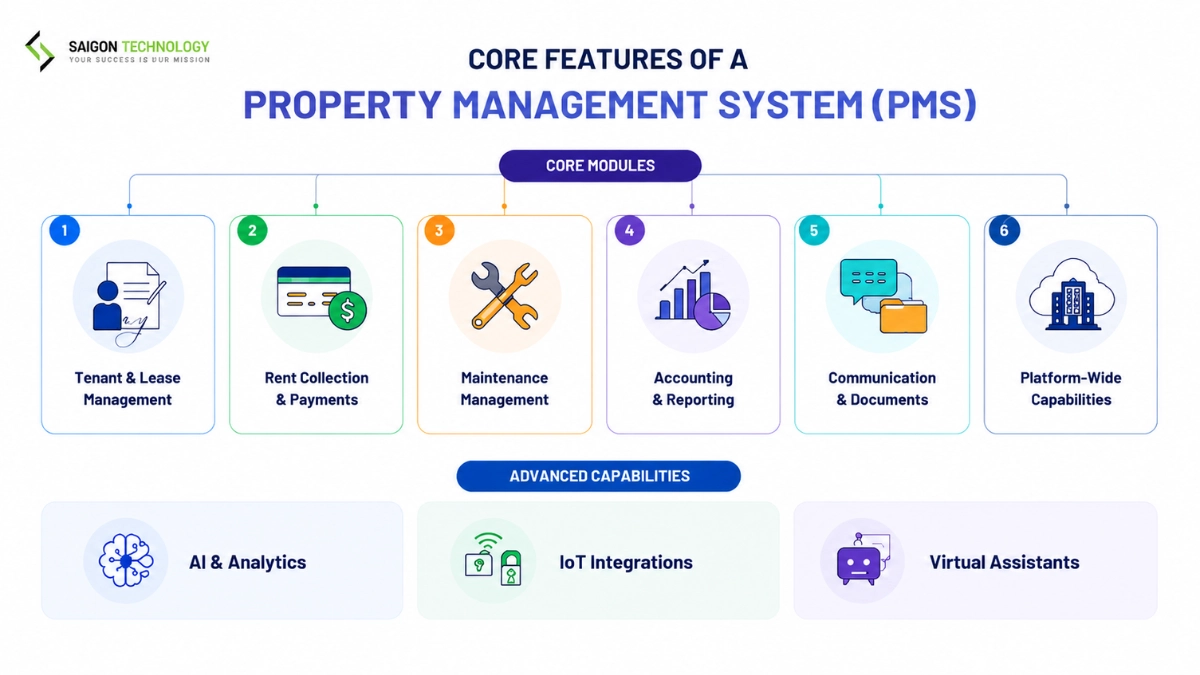
A strong PMS groups its work into clear modules. Each module solves one job. Together they replace spreadsheets, email threads, and manual accounting.
Tenant and lease management
The tenant management module stores tenant profiles, contact details, and history. The lease and contract management module tracks lease agreements, renewal dates, and expiration alerts. E-signatures let tenants sign online. Tenant and lease tracking keeps every record in one trusted place.
Rent collection and payments
The rent collection and payment gateway handles online rent payments by card or bank transfer. It supports recurring payment setup, automated invoicing, and late fee calculation. These payments must meet PCI DSS security standards to keep tenant data safe. Online rent collection cuts missed payments and saves hours each month.
Maintenance management
The maintenance request management module turns repair requests into trackable work orders. Tenants submit issues. Managers assign vendors. Everyone sees status in real time. Built-in ticketing systems and maintenance request handling keep nothing lost. Good maintenance tracking also extends the life of each asset.
Accounting and reporting
Integrated accounting modules track income and expenses against each unit. The system produces P&L reports, accounting and financial reports, and tax-ready reporting. Expense tracking and a clear dashboard and analytics view show portfolio health at a glance. Detailed reports replace late-night spreadsheet work. For enterprises that want finance, leasing, and operations in one place, these modules can grow into a full real estate ERP.
Communication and documents
A communication module and built-in messaging tools keep tenants, owners, and staff in sync. Document management stores leases, receipts, and notices. Audit trails record who changed what and when.
Platform-wide capabilities
Cloud-based accessibility lets your team work from anywhere with remote access control. Multi-property management runs many buildings from one login. Real-time data updates keep numbers current across users. Third-party integrations connect the PMS to the tools you already use, from a custom real estate CRM to MLS listing platforms
AI and IoT Features in Modern Property Management Software
Modern property management software now leans on AI and IoT to run properties, improve tenant experiences, and cut waste. These tools turn raw data into action. This is where 2026 systems pull ahead of older tools. This is where 2026 systems pull ahead of older tools. If you want a wider view of how AI is being used across real estate operations, our full guide covers the main use cases.
AI and predictive analytics
AI reads your data and tells you what to do next. It does not just store numbers. It finds patterns and turns them into decisions.
- Rental pricing prediction. AI studies local demand and market trends to suggest the right rent. You earn more while staying competitive.
- Maintenance forecasting. The system flags equipment likely to fail before it breaks. You fix issues early and avoid costly emergency repairs.
- Property performance and tenant behavior insights. Property performance analytics and customer behavior insights help owners make data-driven decisions about operations, marketing, and investment.
When AI is built inside the PMS, the system gets smarter over time. It responds to real use, instead of leaning on bolt-on tools. We deliver this through our AI development services, which embed AI in the product from day one.
IoT integrations
IoT connects the building itself to the software. Devices send live data, and the system acts on it.
- Smart devices. Smart locks, thermostats, and energy meters give remote access control, utility monitoring, and real-time alerts when something goes wrong.
- Operational efficiency. IoT lowers maintenance costs, supports energy efficiency initiatives, and strengthens security across every property.
- Tenant comfort. Real-time data lets your team fix problems fast. That means a better home or workplace for every tenant.
Virtual assistants
AI-powered virtual assistants handle routine work around the clock. They answer tenants when staff are offline.
- Automated communication. Assistants reply to common questions, share maintenance updates, and book appointments without a human in the loop.
- Staff productivity. Fewer manual replies free your managers to focus on the work that matters.
- Better tenant experience. Prompt, consistent answers raise tenant satisfaction and keep people engaged.
Tech Stack and Architecture for Property Management Software
A modern PMS uses a cloud-based, API-first architecture. This keeps the system fast, secure, and ready to scale. Scalability should be a design choice from day one, not a later fix.
The table below shows a common stack by layer.
| Layer | Common choices |
| Web frontend | React, Angular |
| Mobile apps | React Native, native iOS and Android |
| Backend | Node.js, .NET, Java |
| Database | PostgreSQL, SQL Server |
| Cloud | AWS, Azure |
| Payments | Stripe, Plaid |
| Architecture | REST APIs, microservices |
A microservices design lets each module grow on its own. Payments can scale without touching maintenance. Strong security matters too, since the system holds financial and personal data. Encryption, role-based access, and audit trails protect both. Teams that need a product mindset here can lean on our SaaS application development experience. Most portfolios also ship a dedicated mobile app, so tenants and managers can handle rent, requests, and approvals on the go.
How to Develop Property Management Software
You develop property management software in seven stages: discovery, UX/UI design, MVP definition, sprint development, QA, deployment, and ongoing maintenance. Each step has a goal, an outcome, and a rough time frame. The process below follows the Agile method we use across 800+ projects.
Saigon Technology enables enterprises to scale software development in the AI era through senior engineering teams, AI-driven delivery, and product execution expertise. In practice, that means senior engineers lead every step, and AI speeds up the work without cutting quality.
Step 1: Discovery and planning (1 to 2 weeks)
This stage focuses on understanding the business context and defining the project scope.
Key activities:
- Identify user roles (owners, tenants, managers, admins)
- Map property management workflows
- Define core business requirements
- Clarify property types and portfolio size
Outcome: A clear project scope, high-level requirements, and initial budget estimate.
Step 2: UX and UI design (2 to 4 weeks)
Once the requirements are understood, the product design phase begins.
Key activities:
- Design user flows for each role
- Create wireframes and clickable prototypes
- Define interface structure and navigation
- Ensure simplicity in multi-role usage
Outcome: A validated UI/UX prototype that represents how the system will work in practice.
Step 3: MVP definition (1 to 2 weeks)
In this stage, the team defines the Minimum Viable Product. Because AI shapes the product early, we build the scope around your core AI capability, not around it. This keeps the first release lean and focused on real value.
Key activities:
- Select the core features that deliver immediate value
- Identify the primary AI capability to prove first
- Remove non-essential or future-phase features
- Prioritize the development backlog from business and UX feedback
Outcome: A clearly defined scope, shaped by our AI MVP development approach, that guides the build.
Step 4: Development in sprints (8 to 16+ weeks)
The development phase is executed iteratively using Agile sprints, typically lasting 1–2 weeks each.
Key activities:
- Backend and frontend development
- API integration (payments, notifications, etc.)
- Continuous delivery of working features
- Regular sprint reviews and adjustments
Outcome: A functional MVP built incrementally with regular releases.
Step 5: QA and testing (Ongoing + 2–4 weeks final validation)
Testing is performed continuously during development and finalized before release.
Key activities:
- Functional testing (rent, payments, contracts)
- Regression testing
- Performance and security checks
- Bug fixing and validation
Outcome: A stable and production-ready system.
Step 6: Deployment and onboarding (about 1 week)
After testing is complete, the system is deployed to production.
Key activities:
- Cloud deployment setup
- Data migration (if needed)
- User onboarding and training
- Initial production monitoring
Outcome: The system is live and ready for real users.
Step 7: Maintenance and growth (ongoing)
After launch, the product continues to evolve.
Key activities:
- Bug fixes and system optimization
- Feature enhancements based on user feedback
- Performance monitoring and scaling
Outcome: A continuously improving product aligned with real business needs.
How Much Does It Cost to Develop Property Management Software?
Custom property management software development typically costs $9,000 to $140,000+, depending on scope, platforms, and integrations. There is no single price. A simple web tool costs far less than a full web and mobile platform with AI and IoT.
At Saigon Technology, engineering rates range from $22 to $46 per hour. Total project cost then follows the size of the build. The drivers below shape the final number.
| Cost driver | Effect on cost |
| Feature count | More modules raise cost |
| Platforms | Web plus mobile costs more than web alone |
| Third-party integrations | Each payment, accounting, or CRM link adds work |
| Team size and seniority | Senior-led teams cost more per hour and deliver faster |
| AI and IoT features | Predictive analytics and smart devices add scope |
The ranges below show typical costs by project type. Use them as a guide. A discovery phase gives you an exact figure for your scope.
| Project type | Features | Platform | What it includes | Estimated cost |
| Basic MVP | Tenant, lease, and basic accounting | Web | Core modules only, no mobile, no AI or IoT | $9,000 – $22,000 |
| Web + Mobile Basic | Core modules plus mobile apps | Web, iOS, Android | No AI or IoT, basic integrations only | $22,000 – $46,000 |
| Web + Mobile + Basic AI | Core plus predictive analytics | Web and mobile | Adds AI for rental pricing and maintenance forecasts | $46,000 – $70,000 |
| Full Platform + AI + IoT | All modules plus AI, IoT, and integrations | Web, mobile, IoT devices | Smart locks, energy meters, analytics | $70,000 – $140,000+ |
Watch for hidden costs in any path. Off-the-shelf tools add per-unit fees as your real estate portfolio grows. Custom builds carry maintenance and update costs after launch. Plan for both. Our engagement models let you match spend to scope, from a dedicated team to a fixed scope.
Common Challenges and How to Avoid Them
Custom builds fail for a few common reasons. Each one is easy to avoid with the right partner.
- Over-scoping the MVP. Teams try to build everything at once. Start with core modules, then grow.
- Weak accounting logic. Rent, fees, and taxes must be exact. Test financial rules hard before launch.
- Payment compliance gaps. Online payments must follow PCI standards. Build security in from the start.
- No maintenance plan. Software needs updates. Budget for support so the system stays healthy.
A senior-first engineering model prevents most of these issues. Experienced engineers catch risks early, when fixes are cheap.
FAQs
How long does it take to develop property management software?
Timeline depends on project scope and features:
- Basic MVP: 3–4 months
- Web + Mobile Basic: 4–6 months
- Web + Mobile + Basic AI: 6–8 months
- Full Platform + AI + IoT: 8–12 months
An MVP-first approach shortens the timeline, allowing early deployment and faster feedback.
How much does custom property management software cost?
Cost depends on project scope, platform, and integrations. Engineering rates at Saigon Technology run $22–$46 per hour, and total cost varies with feature count, team size, integrations, and AI/IoT scope.
Estimated cost by project type:
- Basic MVP: $9,000 – $22,000
- Web + Mobile Basic: $22,000 – $46,000
- Web + Mobile + Basic AI: $46,000 – $70,000
- Full Platform + AI + IoT: $70,000 – $140,000+
Note: Actual cost will depend on the specific requirements. A discovery phase is recommended to get an exact estimate.
How secure is a custom PMS?
A custom PMS can implement role-based access, encryption, and audit trails to protect tenant and financial data. Compliance with PCI standards for payments and regular security updates ensures your system remains safe.
How can a custom PMS integrate with other systems?
A custom PMS can connect with accounting software, CRM tools, payment gateways, and IoT devices. API-first design ensures smooth integration and reduces disruption to existing workflows.
What is the typical ROI of a custom PMS?
A custom PMS often reduces manual work, improves rent collection, minimizes maintenance costs, and provides actionable data. While upfront costs are higher than off-the-shelf tools, the long-term efficiency and scalability provide strong ROI.
Conclusion
Custom property management software development pays off when packaged tools start to hold you back. You get a platform built around your workflows, your integrations, and your growth. The path runs from discovery to MVP to launch, then ongoing support. Costs scale with scope, so an MVP-first plan keeps risk low.
If you manage real estate and want a system that fits, explore our real estate software development services or talk with our engineering team. As an ISO 9001 and ISO 27001 certified company with 14+ years of delivery, we help enterprises build faster, leaner, and smarter in the AI era.


Related articles
Real Estate App Development in 2026: Cost, Features, Process & Technology Guide
 Thanh (Bruce) Pham - CEO of Saigon Technology
  06 Feb 2025
Real Estate CRM Software Development: Architecture, Cost & Build Guide (2026)
17 Jun 2026 
Real Estate MLS Software Development: A 2026 Guide
30 Jun 2026 
ERP for Real Estate: Modules, Platforms & Custom Options
15 Jul 2026 
AI in Real Estate: 9 Use Cases and How to Build It (2026)
16 Sep 2026