




Real Estate MLS Software Development: A 2026 Guide

 Updated on Jul 14, 2026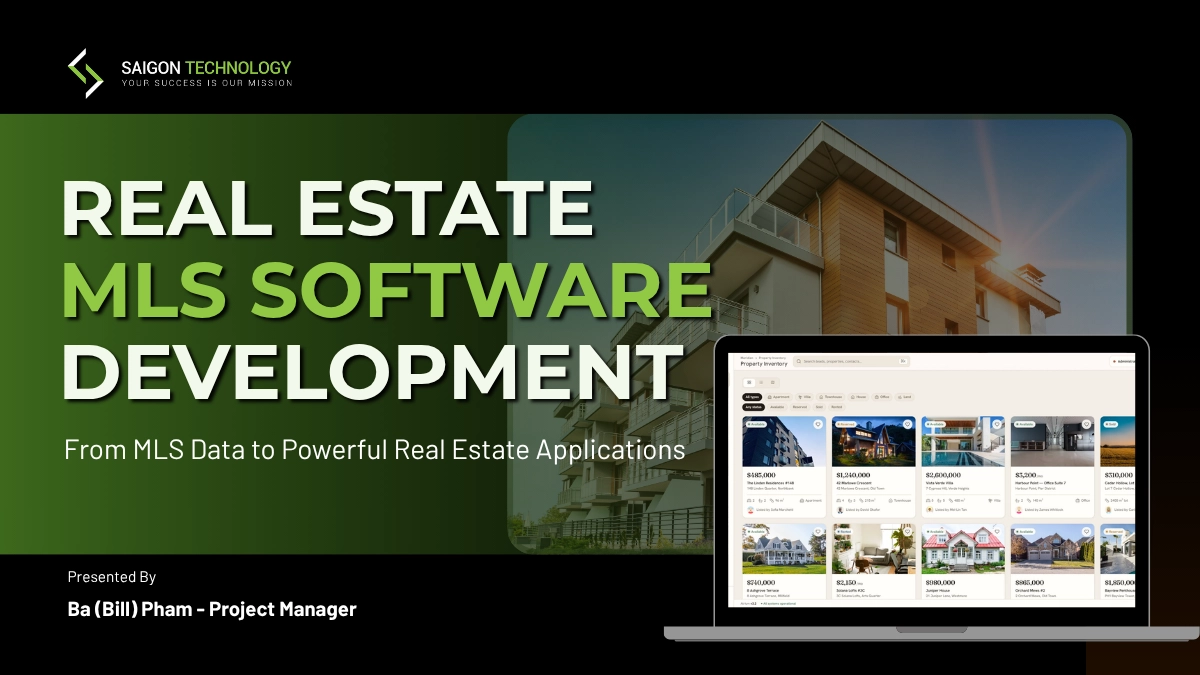
Real estate MLS software development is the design and engineering of custom software systems that connect to one or more Multiple Listing Service feeds, typically through the RESO Web API, to display, search, manage, and analyze property listing data. In practice, PropTech founders, brokerage CTOs, and MLS board IT leads commission custom real estate software development when off-the-shelf tools fall short on workflow, scale, or AI requirements.
Furthermore, the 2026 landscape looks different from even two years ago: RESO Web API 2.0 has replaced the deprecated RETS as the standard for new MLS builds, the August 2024 NAR settlement reshaped how compensation fields appear in MLS feeds, and AI-native features like semantic property search and computer-vision photo tagging are increasingly becoming a competitive differentiator.
Key Takeaways
- Real estate MLS software development covers custom platforms that ingest, normalize, and act on MLS data, typically through the RESO Web API rather than the deprecated RETS protocol.
- RETS has been retired, which means RESO Web API 2.0 is now the only industry standard worth targeting for new builds.
- Common product types include broker portals, IDX websites, agent CRMs, AVM and CMA tools, lead-generation apps, and transaction management systems.
- The 2024 NAR settlement changed how cooperation and compensation fields are handled in feeds, so new builds need to account for the updated schema.
- Typical custom real estate MLS software development projects run 4 to 9 months and cost $80,000 to $400,000 depending on scope, MLS count, and AI feature depth.
What Is Real Estate MLS Software Development?
Real estate MLS software development is the engineering of custom systems that ingest data from one or more Multiple Listing Service feeds and turn that raw data into searchable, workflow-aware applications for brokerages, agents, and consumers. The data usually flows through the RESO Web API, a RESTful OData-based standard governed by the Real Estate Standards Organization, although the real engineering work happens downstream of ingestion: normalization, search indexing, compliance enforcement, and AI augmentation.
Specifically, a multiple listing service is a private database operated by a local or regional MLS board, where member agents and brokers contribute listings under specific licensing rules. More than 500 MLS organizations operate across the United States, and because each one carries its own membership rules, data-dictionary extensions, and licensing terms, generalized multi-MLS platforms become substantially more complex to build than single-MLS systems.
Types of MLS Software You Can Build
In practice, the category spans both agent-facing tools and consumer-facing surfaces. The most common builds we see in 2026 fall into seven groups.
- Broker portal or branded MLS. An internal-use platform aggregating listings from multiple MLS boards, giving agents unified search, market analysis, and team coordination in a single interface.
- IDX (Internet Data Exchange) websites. Public-facing search sites pulling licensed MLS data for consumer lead capture, governed by per-board IDX rules on what data can appear publicly and how it must be attributed.
- VOW (Virtual Office Website). A registered-user portal showing a broader data subset than public IDX, including sold and expired listings, with consumer authentication and additional licensing required.
- Real estate CRM with MLS integration. Listing data, agent activity, and lead pipelines unified in one workflow. See our guide on real estate CRM software development for a deeper look at this category.
- AVM and CMA tools. Automated valuation models and comparative market analysis built on listing comparables, often enhanced with tax records and walkability scores.
- Transaction management platforms. Documents, e-signature, compliance tracking, and team collaboration layered on MLS data, often integrated with accounting and lockbox systems.
- AI-native listing platforms. Semantic property search, photo-tagging via computer vision, predictive lead scoring, and agent copilots that draft listing copy and market reports. The newest and fastest-growing category.
For broader real estate engineering coverage, see our guides on real estate app development and property management software development.
How MLS Data Actually Reaches Your Software: RESO Web API, RETS, IDX
The data path is the first decision in any real estate MLS software development project. Specifically, it involves a protocol, an authentication scheme, and a licensing agreement, and three protocols matter in 2026.
RESO Web API 2.0
RESO Web API 2.0 is the current industry standard, a RESTful API built on OData with OAuth 2.0 authentication. Most RESO-certified MLS organizations now provide Web API access, although implementation details vary by board, which is why new builds should target this protocol over older alternatives.
RETS (Real Estate Transaction Standard)
By contrast, RETS is the legacy protocol that RESO retired in favor of the Web API. Although some boards still expose RETS endpoints for backward compatibility, the standard is no longer maintained, so building on RETS creates technical debt on day one.
IDX Feed
Additionally, the IDX feed refers to a licensed subset of MLS data exposed for public-facing display under IDX rules, where vendors like IDX Broker and Showcase IDX aggregate and resell access.
VOW Feed
Similarly, the VOW feed is a broader data subset available to registered consumer users, including sold and expired listings, with stricter licensing obligations.
The protocols in a comparison view:
| Protocol | Status (2026) | Best for | Authentication | Data refresh |
| RESO Web API 2.0 | Current standard | All new builds | OAuth 2.0 | Real-time or near real-time |
| RETS | Deprecated | Legacy maintenance only | Username and password | Polled, typically every 15 minutes |
| IDX feed (via aggregator) | Active, licensed | Public-facing display | Aggregator-managed | Aggregator-dependent |
Each MLS board issues its own credentials and enforces its own data license, so a multi-MLS application needs separate agreements per board, separate OAuth credentials, and a normalization layer reconciling schema differences. For teams building this layer, our software integration services cover the connector, normalization, and synchronization patterns used in production.
Build vs. Buy vs. API-Only: Which Path Is Right for Your Business?
The build-or-buy question deserves a clear framework, since the decision shapes everything from time-to-launch to total cost of ownership. Overall, three paths exist in 2026, each with very different cost and timeline profiles.
| Approach | Time to launch | Typical cost (USD) | Best for | Typical use cases | Trade-offs |
| Custom Build (full platform) | 4 to 9 months | $80,000 to $400,000+ | PropTech SaaS companies, multi-state brokerages, businesses with unique workflows | Multi-MLS aggregation, AI-native search and recommendations, white-label SaaS platforms, deep back-office integrations | Highest upfront investment and longer delivery timeline, but offers full IP ownership, maximum flexibility, and complete roadmap control |
| White-Label Platform (kvCORE, BoomTown, IDX Broker) | 2 to 4 weeks | $200 to $1,500 per month + per-seat fees | Individual brokerages, small and mid-sized teams | Agent websites, consumer listing search, lead capture forms, basic CRM workflows, standard IDX integrations | Limited customization, vendor lock-in, and increasing costs as the team grows |
| API-Only Integration (RESO Web API into existing product) | 1 to 3 months | $20,000 to $80,000 | Companies that already have a CRM, portal, or application and need MLS data | Adding listings to an existing product, extending internal systems with MLS data, building custom workflows on top of an existing platform | Does not include UI/UX, lead generation, CRM features, or consumer-facing experiences |
Six Criteria for Choosing the Right Path
Ultimately, six criteria help decide which path fits:
- Required customization. Packaged tools cover roughly 80% of common needs. If your workflow lives in the remaining 20%, custom becomes the answer.
- Expected scale. A single brokerage with 50 agents has fundamentally different needs from a SaaS targeting thousands of brokers, which pushes high-scale operations toward custom real estate MLS software development.
- Regulatory exposure. Multi-state operations and specialized verticals (luxury, commercial, off-market) require custom compliance logic since no packaged tool ships with state-level rule variation built in.
- Time to market. A four-week launch leaves white-label as the only realistic path, although you will likely outgrow it within 18 to 24 months.
- Total cost of ownership. A five-year TCO comparison usually flips the math toward custom for any operation with 50 or more seats, since per-seat licensing scales linearly while a custom platform amortizes.
- IP ownership. SaaS founders and venture-backed PropTech companies typically cannot accept vendor lock-in on the core platform.
For teams choosing the custom path, our custom software development services cover the full discovery-to-delivery lifecycle that real estate MLS software development requires.
Key Features of Modern MLS Software in 2026
Typically, a modern listing platform combines three feature layers: traditional core functionality, deep data integration, and AI-native intelligence. Importantly, successful real estate MLS software development projects treat all three as first-class.
Core listing features. Advanced property search with filters, map-based browse with clustering, saved searches and alerts, photo and video galleries, virtual tours and 360° visualization, agent profiles, lead capture, and basic CRM workflows.
Data and integration features. RESO Web API ingestion, multi-MLS aggregation, schema normalization, IDX and VOW separation, two-way CRM sync, property management system integration, and lockbox or showing-system hooks.
AI-native features (the 2026 differentiator):
- Semantic property search. Natural-language queries parsed by NLP models against listing descriptions and feature data.
- AI image recognition. Computer vision that automatically tags listing photos (kitchen style, finishes, room types) and flags low-quality images.
- AI-driven price estimation. AVMs built on listing comparables plus external data sources, surfacing predicted sale ranges.
- Personalized recommendation engines. Ranking models that learn from user behavior and surface listings by intent rather than filters alone.
- Generative AI for property descriptions. LLM-assisted listing copy that respects character limits and brokerage style guides.
- Predictive lead scoring. Behavior-based scoring on search activity, time-on-listing, and saved-search patterns.
For teams building the AI layer, our AI development services cover the ML pipelines, computer-vision stacks, and LLM integration patterns this category requires.
Finally, compliance features. NAR-settlement-compliant display, audit trails, role-based access control, license tracking, attribution enforcement, and per-MLS display rules.
Step-by-Step MLS Software Development Process
Typically, a clean real estate MLS software development project moves through 6 stages, each with its own deliverables and decision gates.
- Discovery and MLS scoping. Identify target boards, licensing requirements, RESO Data Dictionary fields in scope, use cases, and integrations needed.
- Architecture design. Choose the ingestion pattern (real-time webhooks vs. polled sync), data store strategy, microservices vs. monolithic architecture, hosting (Azure, AWS, or GCP), and AI services design.
- Data integration build. Develop RESO Web API connectors per board, the normalization layer for multi-MLS aggregation, deduplication logic, error handling, and monitoring.
- Feature build. Implement search and UX, CRM and workflow features, AI features, and the compliance and audit layer. Usually the longest stage.
- QA, compliance review, and licensing audit. Functional, performance, security, and usability testing, plus final compliance review against NAR, IDX, VOW, and per-MLS attribution rules.
- Launch and ongoing maintenance. Performance monitoring, schema-update tracking, RESO standard updates, user support, and feature iteration.
In general, Agile and Scrum suit the feature build stage well, although the data integration stage benefits from a more incremental approach since each MLS exposes its own quirks during real integration work.
Common Challenges in MLS Software Development
Most articles on real estate MLS software development skip this section because it does not sell, although engineers and PropTech operators tend to value it most. The honest picture of what goes wrong:
Data Normalization Across MLSs
Field names, enumerations, and formats differ between MLSs even under the RESO Data Dictionary, since each board interprets the standard slightly differently. A normalization layer with per-MLS adapters, treated as a versioned artifact, prevents brittle one-to-one mapping that fails as soon as a second MLS is added.
Multiple MLS Integrations
Each board issues separate credentials, enforces its own rate limits, and updates its schema on its own cadence. Aggregating five or more MLS boards multiplies complexity rather than adding to it. As a result, a shared connector framework with scheduled re-sync and per-feed monitoring is the standard mitigation.
Compliance and Display Rules
IDX rules vary by MLS, VOW rules require registration tracking, and attribution requirements differ in placement and wording. Violations can revoke data access, so a rules engine enforcing per-MLS logic at the UI layer is far safer than ad-hoc compliance.
Performance and Scalability
A mid-sized board pushes 500,000 to 2 million listings; multi-MLS aggregation routinely crosses 10 million. Consequently, naive queries collapse under map-based search, making Elasticsearch or OpenSearch, CDN-cached detail pages, and geospatial indexing non-negotiable.
Licensing Restrictions
Some MLS licenses prohibit redistribution, cap caching windows, or restrict derivative products such as AVMs. Legal review during discovery prevents architectural decisions that later violate license terms.
Schema Drift
Furthermore, RESO updates its data dictionary annually, and individual boards lag by 0 to 24 months. Schema validation in CI/CD and automated alerts on feed changes catch drift before it breaks production.
MLS Software Architecture: A Reference Example
In practice, most real estate MLS software development projects converge on the same 6 layer architecture. The reference below is generic enough to apply across builds and concrete enough to anchor scoping conversations.
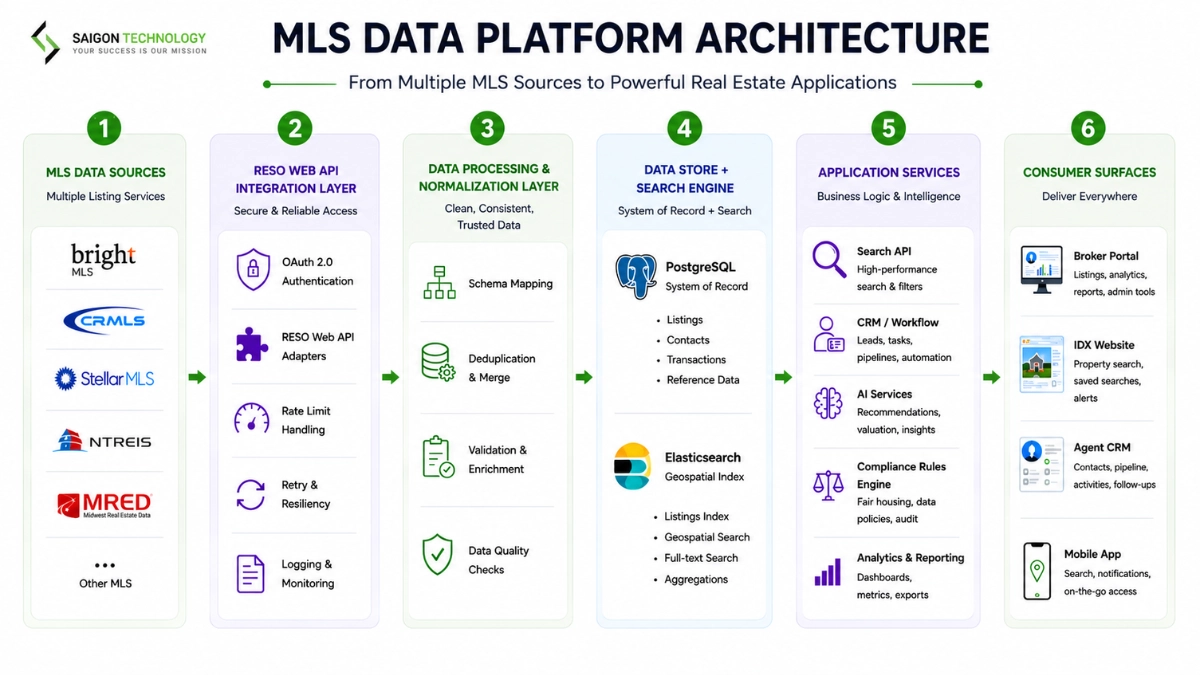
Layer by layer:
- Listing boards. The source of truth. Each MLS exposes a RESO Web API endpoint under its own credentials and license. Production examples include Bright MLS, CRMLS, FlexMLS, Paragon, and Matrix.
- RESO Web API connectors. Per-board adapters handling OAuth, pagination, rate-limit backoff, and incremental sync via the ModificationTimestamp field. Connectors run in isolation so a misbehaving feed cannot disrupt the pipeline.
- Integration and normalization layer. Maps each MLS’s RESO Data Dictionary fields to a unified internal schema, deduplicates cross-MLS overlap, and quarantines malformed records.
- Data store and search engine. PostgreSQL as the system of record, Elasticsearch or OpenSearch for the query workload with geospatial indexing. The split lets storage stay clean while search scales independently.
- Application services. Search API, CRM and workflow services, AI services (semantic search, AVM, photo tagging), and the compliance rules engine, typically organized as microservices.
- Consumer surfaces. Broker portal, IDX website, agent CRM, and mobile apps, each enforcing IDX or VOW rules via middleware reading the compliance rules engine.
In production, .NET Core or Node.js with PostgreSQL and Elasticsearch are the most common production stacks, with Azure favoring .NET teams and AWS favoring Node.js or Python.
Cost and Timeline: What Does MLS Software Development Actually Cost?
Vague pricing is the rule across most real estate MLS software development articles, but honest ranges are far more useful for scoping. Specifically, costs vary by board count, AI feature depth, regulatory scope, and team composition, although the breakdown below covers a typical custom build.
| Build component | Time | Cost range (USD) |
| Discovery and listing-board scoping | 2 to 4 weeks | $5,000 to $15,000 |
| RESO Web API integration (single board) | 4 to 6 weeks | $15,000 to $30,000 |
| Multi-board aggregation and normalization | +6 to 10 weeks | +$30,000 to $80,000 |
| Front-end (search, browse, agent UI) | 8 to 12 weeks | $25,000 to $70,000 |
| CRM and workflow features | 6 to 10 weeks | $20,000 to $60,000 |
| AI-native features (semantic search, AVM, photo tagging) | 6 to 12 weeks | $25,000 to $100,000 |
| Compliance, QA, launch | 3 to 5 weeks | $10,000 to $25,000 |
Biggest Cost Drivers in Order of Impact
The biggest cost drivers, in order of impact:
- Number of MLS boards. Each additional board adds 3 to 6 weeks of integration work plus ongoing maintenance.
- AI feature depth. A basic AVM is a few weeks of work; a semantic search engine combined with computer-vision photo tagging and a generative AI copilot is a multi-quarter investment.
- Multi-state regulatory scope. Each new state means a new set of board rules, NAR-settlement compliance considerations, and disclosure requirements.
- Mobile vs. web. A web-only build avoids 30 to 50% of the front-end cost, although mobile is rapidly becoming table stakes for consumer-facing products.
- White-label resale support. Tenancy logic, theming, and per-tenant data isolation add meaningful complexity.
- Ongoing maintenance. Plan for 15 to 25% of the build cost annually to cover schema updates and compliance refreshes.
Additionally, the engagement model also matters: fixed-price gives budget certainty but less flexibility, while a dedicated development team or modern ODC model suits multi-phase builds with evolving requirements. Our engagement models page walks through the common options.
Compliance and Data Licensing: RESO, NAR Settlement, and Display Rules
Compliance is where real estate MLS software development crosses from engineering into legal territory. Specifically, the 2026 picture has four moving pieces.
RESO Certification
Notably, MLS organizations certify against the RESO standard at platinum, gold, or silver levels. Verify your target board’s certification level during scoping, since lower levels often mean older field coverage and more normalization work.
NAR August 2024 Settlement Effects
The settlement that took effect in August 2024 changed how cooperation and compensation fields are handled in MLS feeds and moved buyer-broker agreements to a written-and-signed model. New builds should handle the updated schema by default and avoid assumptions about offer-of-compensation fields appearing in feeds. The NAR settlement FAQ covers current guidance.
IDX vs. VOW Display Rules
IDX rules govern what data can show publicly; VOW rules govern broader subsets available to registered users. Attribution requirements and minimum field display vary by board, so a rules engine enforcing these at the UI layer is far safer than scattered ad-hoc compliance.
Data Licensing Reality
Furthermore, each MLS has its own license agreement, and some restrict derivative products such as AVMs or data resale. Multi-MLS applications need separate agreements per board, and a legal review during discovery prevents architectural decisions that later violate license terms.
Finally, security practices that pair with compliance include AES-256 encryption at rest, OAuth 2.1 for API authentication, audit trails for every data access, role-based access control, and a documented incident response plan. Any partner you choose should hold ISO 27001 or equivalent.
Key Considerations Before Starting an MLS Development Project
Ultimately, 6 factors separate well-scoped real estate MLS software development projects from the ones that stall.
- RESO Web API hands-on experience. Verify the engineering team has shipped specific board integrations in the last 24 months. Generic “real estate experience” is not the same as hands-on RESO Web API work.
- Real estate domain expertise. Vertical case studies and documented prior listing-platform work matter, since a team without that background will learn on your timeline and budget.
- Security and compliance posture. ISO 27001 or equivalent certification, plus documented practices for data licensing, audit trails, and key management.
- AI engineering depth. Production experience with semantic search, computer vision, ML pipelines, and LLM integration, since this is the differentiator for most 2026 builds.
- Senior-first engineering model. Confirm the engineers building your platform are senior rather than 1 to 2 years out of school; junior-heavy teams tend to cost less per hour and more per project.
- Transparent pricing and engagement models. Clear rate ranges and defined engagement options. Transparency itself is a trust signal.
Moreover, beyond team selection, three project-level decisions deserve early attention: which MLS boards are in scope and whether their licensing terms allow your intended use, how compliance will be enforced as a single rules engine, and where AI features sit on the roadmap relative to core functionality. Settling these in discovery prevents architectural rework later.
FAQs
1. What is MLS software?
MLS software is any application that ingests, displays, or acts on data from a Multiple Listing Service. It ranges from packaged agent websites and CRMs to fully custom broker portals, IDX sites, AVM tools, and AI-native listing platforms, accessing data through the RESO Web API under a license agreement with each board.
2. What software do real estate developers use?
Real estate MLS software development teams typically work with backend languages (.NET Core, Node.js, Java, or Python), frontend frameworks (React or Angular), PostgreSQL or MySQL, Elasticsearch or OpenSearch, a cloud platform (Azure, AWS, or GCP), and AI frameworks (TensorFlow, PyTorch, or LLM APIs). The integration side relies on the RESO Web API, OAuth 2.0, and per-MLS connectors.
3. Does MLS have an API?
Yes. Each MLS exposes its data through the RESO Web API 2.0, a RESTful OData-based standard maintained by the Real Estate Standards Organization. Access requires a license agreement, OAuth credentials, and adherence to the board’s display rules. Although some boards still expose the legacy RETS protocol, RETS has been deprecated.
4. What is IDX integration?
IDX (Internet Data Exchange) integration is the process of pulling licensed MLS data into a public-facing website so consumers can search properties. The data subset under IDX rules is narrower than the full feed, and per-MLS rules dictate what can display publicly, what attribution must appear, and refresh cadence.
5. How long does it take to build custom MLS software?
A typical real estate MLS software development project runs 4 to 9 months from discovery to launch. API-only integrations take 1 to 3 months; multi-MLS aggregation platforms with AI-native features can stretch to 9 to 12 months. Board count, AI feature depth, and regulatory scope drive the timeline.
6. How much does MLS software development cost?
A custom real estate MLS software development project typically costs $80,000 to $400,000 or more. Single-MLS API-only integrations start around $20,000; multi-MLS platforms with AI features can exceed $400,000. The cost breakdown table above covers component-level estimates.
Conclusion
Ultimately, real estate MLS software development in 2026 is shaped by three forces: the deprecation of RETS in favor of the RESO Web API 2.0, post-NAR-settlement schema changes, and the growing role of AI-native features as a competitive differentiator. In short, teams that build well treat MLS data as a normalized, compliance-aware substrate rather than a feed to display.
Three takeaways worth carrying into your own build:
- Build on RESO Web API 2.0. Avoid RETS for new work, and treat the RESO Data Dictionary as a living schema.
- Design for multi-MLS from the start. Single-MLS architectures rarely stay single-MLS, and the normalization layer is far cheaper to build correctly on day one than to retrofit.
- Make compliance a rules engine, not a checklist. IDX rules, VOW rules, attribution requirements, and post-settlement field handling belong in a single enforcement layer.
Planning a custom MLS or real estate platform? Explore our real estate software development services to scope your build.


Related articles

Real Estate App Development in 2026: Cost, Features, Process & Technology Guide
 Thanh (Bruce) Pham - CEO of Saigon Technology
  06 Feb 2025
10 Best AI Coding Assistant Tools in 2026
23 Sep 2025 
Custom Software vs Off-the-Shelf Solutions: A Side-by-Side Evaluation Framework
26 Mar 2026 
Property Management Software Development: The Complete Custom Build Guide (2026)
15 Jun 2026 
Real Estate CRM Software Development: Architecture, Cost & Build Guide (2026)
17 Jun 2026 
Vibe Coding Security: Risks of AI Code
22 Jun 2026 
LLM Security Risks: What Every CTO Must Know Before Shipping AI Features
25 Jun 2026