




Wealth Management Software Development: A Complete Build Guide (2026)

 Updated on Jul 22, 2026
By Huy (Harvey) Bui, Project Manager at Saigon Technology. Huy has managed fintech delivery teams building portfolio, wealth, and digital-banking platforms for clients in the US, EU, and APAC.
Clients no longer compare their advisor’s technology to other advisors. They compare it to Schwab, Wealthfront, and the banking app on their phone. They expect a live view of their portfolio, mobile access, and advice that reflects their actual goals, and they notice when their advisor is stitching answers together from spreadsheets.
That gap is why wealth management software development has moved from an IT project to a board-level decision. Whether you run an RIA, a private bank, or a family office, or you’re a founder building a digital wealth product, this guide covers what to build, how the process works, what it really costs, and how to pick a development partner.
Key takeaways
- The global wealth management software market is projected to grow from $7.2 billion in 2026 to $18.8 billion by 2033, a 14.7% CAGR (Grand View Research, 2026).
- A focused MVP runs $40,000–$200,000 over 4–6 months; enterprise platforms exceed $600,000.
- Compliance architecture, not feature count, is what separates platforms that survive an audit from ones that don’t.
What Is Wealth Management Software?
Wealth management software is an integrated platform that lets an advisory firm run the whole client lifecycle from one system: onboarding, financial planning, portfolio management, reporting, and compliance. Instead of five disconnected tools, advisors, clients, and back-office teams work from a single source of truth.
Think of it as the firm’s operating system. A core ledger handles transactions, a CRM tracks relationships, and the platform orchestrates the client experience on top, with KYC checks, live dashboards, and alerts built in rather than bolted on.
Who actually uses it? Advisors and wealth managers who need a current view of every portfolio, and RIAs whose holistic planning depends on seeing the whole picture. Private banks and family offices use it to keep complex multi-account holdings straight. Fintech startups build on the same foundations to launch robo-advisory or hybrid-advice products.
Portfolio management vs. wealth management software
The two terms get used interchangeably, but they aren’t the same thing:
|
|
Portfolio management software
|
Wealth management software
|
|
Scope
|
Tracks, analyzes, and rebalances investments
|
Full client lifecycle: planning, CRM, compliance, reporting, plus portfolio management
|
|
Best for
|
Investment teams focused on assets
|
Firms managing the entire client relationship
|
In practice, portfolio management is usually one module inside the broader platform.
Why Firms Are Building Now
A few numbers frame the opportunity. The global market for this software category was valued at $6.3 billion in 2025 and is projected to reach $18.8 billion by 2033, a 14.7% annual growth rate (Grand View Research, 2026). Cloud adoption is effectively universal: Flexera’s State of the Cloud survey has found for several years running that 89% of organizations run multi-cloud environments (Flexera, 2024). And Cerulli Associates expects $84 trillion to change hands in the “great wealth transfer” through 2045 (Cerulli, 2022), pushing client expectations decisively toward digital-first advice.
Behind those headline figures, four pressures keep coming up in our client conversations:
- Personalization is now table stakes. Clients want advice tied to their values, life goals, and full financial picture, and they want it on demand.
- AI has raised the bar. A basic robo-advisor stopped being a differentiator years ago. Firms now want analytics that flag churn risk or surface a tax-loss-harvesting window before an advisor goes looking.
- Regulation keeps shifting. Manual compliance spot-checks don’t scale when the rules change quarterly.
- Legacy systems bleed hours. Advisors lose time to data entry and reconciliation instead of client conversations.
The decision to build is less about technology than about advisor productivity, client retention, and whether compliance can scale with the book of business.
Types of Platforms You Can Build
“Wealth management software” is a family of products, not one thing. Most projects either target a single category or combine several into one ecosystem.
The core categories look like this: portfolio management tools that track performance and automate rebalancing; financial planning tools for retirement and what-if scenarios; trading platforms with real-time market connectivity; and investment accounting systems that handle returns, taxes, and regulatory reporting.
Around them sit the relationship layers. Client lifecycle management covers onboarding, KYC/AML, and everything a client touches after signing. CRM tools track preferences and life events so outreach feels personal rather than scheduled, while analytics platforms turn raw positions data into trend analysis and reports a client can actually read.
Your build might be one focused tool or a unified platform spanning several categories. In our experience, firms that start with one category and expand deliberately ship faster and waste less than firms that spec everything on day one.
Must-Have Features
Certain capabilities are simply expected now. When we scope a wealth platform, these seven come up in nearly every discovery workshop:
- Portfolio management and analytics. Live portfolio views, automated rebalancing, and performance reporting clear enough that an advisor can explain the “why” behind every move.
- Financial planning tools. Goal-based planning and what-if scenarios that make a 30-year plan feel tangible.
- CRM and client portal. A portal clients actually want to log into, plus a CRM that remembers the details that make outreach personal. (The design bar here is set by consumer apps; our mobile banking app development guide covers what that takes.)
- Risk profiling and monitoring. Tools that flag when a portfolio drifts from a client’s stated tolerance.
- Reporting and compliance. Automated audit trails, compliance checks, and alerts that replace manual spot-checks.
- Open APIs. Connections to custodians, market data, banking, and accounting, so the platform shows one reconciled view.
- Security by default. Multi-factor authentication, encryption, role-based access, and disaster recovery from day one.
Why these seven? Real-time dashboards keep clients informed and advisors responsive. Automation frees advisors from grunt work. Data aggregation kills conflicting numbers. And compliance reporting cuts both regulatory risk and audit stress.
Advanced Capabilities That Differentiate in 2026
Beyond the baseline, a few newer capabilities are where platforms now compete.
AI is the big one. Robo-advisory flows handle repetitive tasks while advisors keep the complex decisions, and the same models power fraud detection, forecasting, and reconciliation. We’ve written separately about how AI is reshaping banking products; the wealth side follows the same trajectory about a year behind.
Three more capabilities keep coming up in roadmap conversations:
- ESG tooling, because clients increasingly want holdings measured against sustainability standards, with the impact reported in language they could repeat at a dinner party.
- Mobile-first, real-time analytics. Clients respond to markets from their phones, not their desks.
- Open architecture, which protects you from vendor lock-in and lets the platform absorb new rules, new tools, and eventually new asset classes. Tokenized illiquid assets are still early, but they’re worth designing for.
The Wealth Management Software Development Process
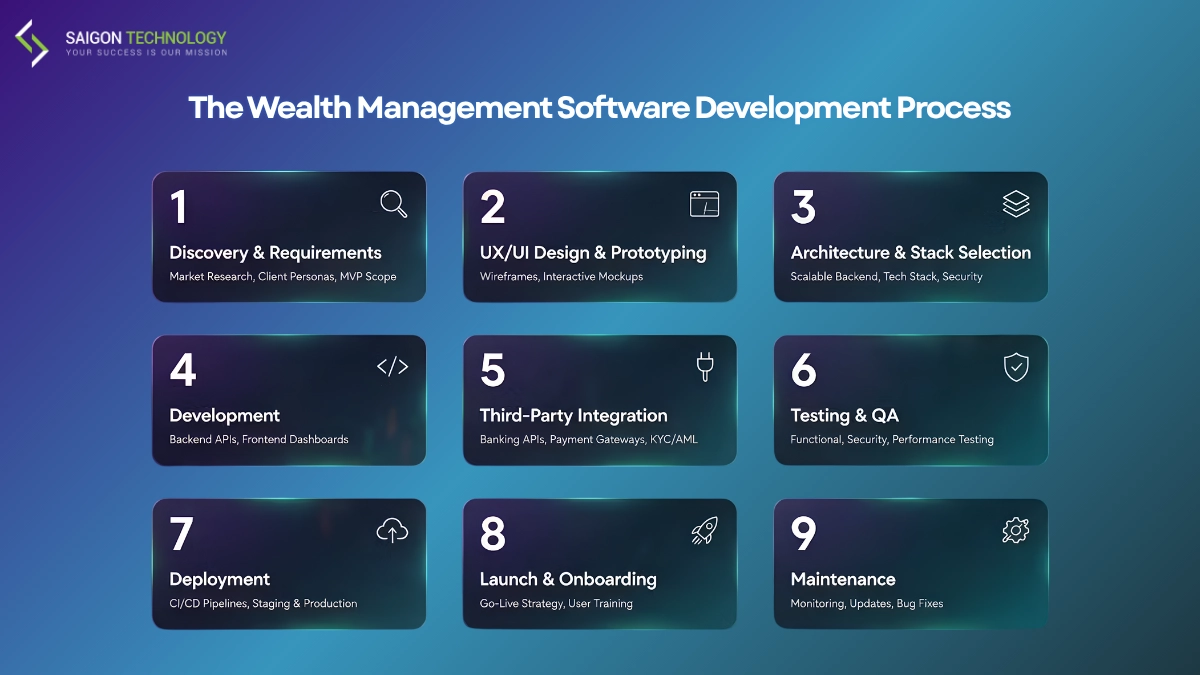
Building a platform is far more than writing code. Regulation, data security, and user experience shape the work at every step. Here’s the sequence experienced teams follow:
- Discovery and requirements. Talk to advisors and clients, study competitors, and document compliance requirements before anything else. Skipping this is how projects end up rebuilding onboarding three times.
- UX/UI design and prototyping. Wireframes and clickable prototypes, tested with real users, confirmed on mobile.
- Architecture and stack selection. Cloud-native, API-first decisions get made here, before code exists, because they’re expensive to reverse later.
- Development. Backend teams build APIs and data rules; frontend teams build dashboards and the client portal. Encryption and MFA go in early, not at the end.
- Third-party integration. Custodians, market data, and banking connect through APIs, then get tested until the numbers reconcile.
- Testing and QA. Unit tests, user acceptance testing, and penetration testing. In a regulated product, QA isn’t a phase; it’s insurance against fines.
- Deployment. Cloud, on-premises, or hybrid, with automated backups and rollback plans.
- Launch and onboarding. Walkthroughs, live support, and quick feedback surveys to catch friction early.
- Maintenance. Bug fixes, updates, and new features as markets and regulations shift.
One example of the kind of decision that happens at step 3: on a recent advisory-platform build, we had to choose between nightly batch syncs and event-driven streaming for custodian data. Batch was cheaper and simpler, but advisors would open the dashboard each morning to stale intraday positions. We went event-driven for holdings and kept batch for statements, which added roughly three weeks of integration work but eliminated the single biggest source of advisor complaints we see in legacy systems.
Tech Stack and Deployment Choices
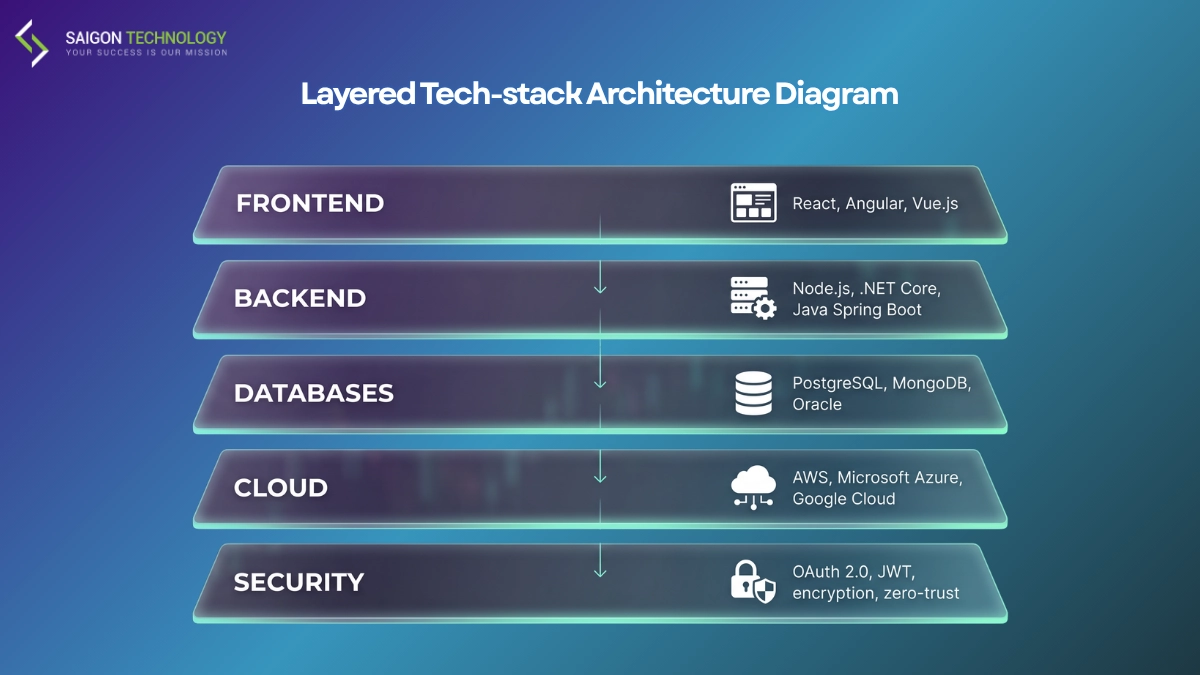
Modern wealth platforms favor cloud-native, API-first architecture with services that can scale and update independently.
|
Layer
|
Common choices
|
|
Frontend
|
React, Angular, or Vue.js
|
|
Backend
|
Node.js, .NET Core, or Java Spring Boot
|
|
Databases
|
PostgreSQL, MongoDB, or Oracle
|
|
Cloud
|
AWS, Microsoft Azure, or Google Cloud
|
|
Security
|
OAuth 2.0, JWT, encryption libraries, zero-trust patterns
|
Deployment is a business decision as much as a technical one:
|
Model
|
Strengths
|
Best for
|
|
Cloud
|
Fast scaling, lower upfront cost, easy disaster recovery
|
Firms prioritizing speed and flexibility
|
|
On-premises
|
Full data control, meets the strictest residency rules
|
Large institutions with dedicated IT
|
|
Hybrid
|
Control where it matters, agility everywhere else
|
Firms migrating off legacy systems gradually
|
Which one is right depends on firm size, the regulatory environment you operate in, and how much infrastructure you want to own. Most of our clients start cloud or hybrid.
Compliance, Security, and Risk Architecture
This is where a serious custom build earns its keep. Compliance can’t be an afterthought; it has to be designed into the architecture, regulation by regulation:
- SEC and FINRA record-keeping rules demand complete, tamper-evident records. That translates directly into immutable audit trails on every workflow (see FINRA’s books and records requirements).
- GDPR and data residency shape where client data physically lives, which constrains your cloud provider and region choices (Regulation (EU) 2016/679 on EUR-Lex).
- MiFID II drives transaction reporting and suitability checks for EU-facing firms.
- SOC 2 and ISO 27001 validate your security posture for enterprise clients.
On the security side, the essentials haven’t changed: encryption in transit and at rest, MFA with role-based access control, zero-trust design instead of perimeter-only defense, and regular penetration testing. We covered the practical checklist in our post on securing mobile banking apps, and nearly all of it transfers to wealth platforms.
A lesson we learned the hard way: on one engagement, immutable-storage requirements for trade records surfaced during a client’s audit preparation, months after the reporting module was built. Retrofitting write-once storage into a live system cost far more than designing for it would have. Since then, record-retention requirements get mapped in discovery, before the data layer is designed.
The end state you’re aiming for is automated compliance: rule engines that run checks continuously, generate reports in the background, and adapt via configuration when regulations change, so compliance stays proactive instead of reactive.
Build vs. Buy
The biggest early decision is whether to build custom or adopt an off-the-shelf platform. Neither is universally right.
|
Factor
|
Custom build
|
Off-the-shelf
|
|
Initial cost
|
$40K–$600K+
|
$50K–$500K implementation
|
|
Time to launch
|
4–36 months by scope
|
3–6 months
|
|
Customization
|
Complete flexibility
|
Limited to vendor options
|
|
Differentiation
|
High
|
Low
|
|
Vendor lock-in
|
Low – you own the code
|
High
|
|
Regulatory changes
|
You adapt the code
|
Vendor-dependent
|
Custom makes sense when you have a distinctive business model, want technology competitors can’t replicate, and can support the bigger investment. Off-the-shelf wins when your requirements match existing platforms and speed matters more than differentiation. Plenty of firms do both: buy the commodity layers, build the differentiating ones.
How Much Does Wealth Management Software Development Cost?
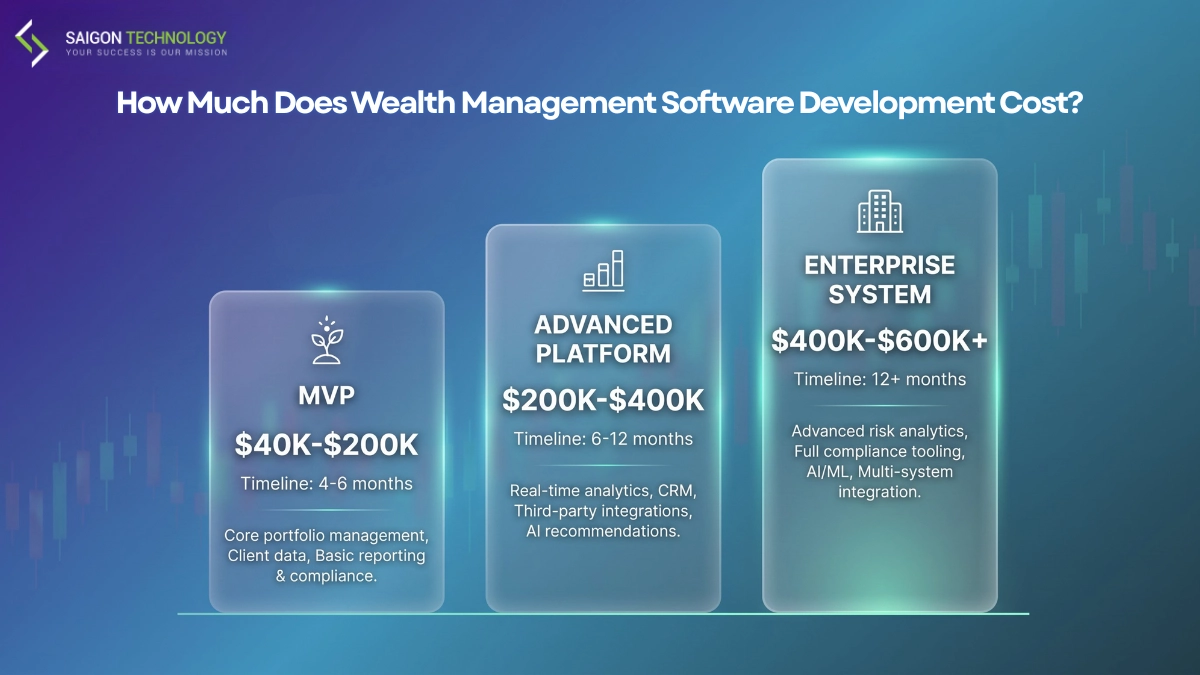
A custom build runs $40,000 to $600,000+, depending on scope. Anyone quoting a flat price before discovery is guessing, though. Three factors drive the number: complexity (a portfolio tracker is a fraction of a multi-custodial platform with AI analytics), integrations (every custodian and market-data API adds work), and the depth of security and compliance you need to prove, not just claim.
Benchmarks from projects we’ve scoped and delivered:
|
Platform type
|
What’s included
|
Cost range
|
Timeline
|
|
MVP
|
Core portfolio management, client data, basic reporting and compliance
|
$40,000 – $200,000
|
4–6 months
|
|
Advanced platform
|
Real-time analytics, CRM, third-party integrations, AI recommendations
|
$200,000 – $400,000
|
6–12 months
|
|
Enterprise system
|
Advanced risk analytics, full compliance tooling, AI/ML, multi-system integration
|
$400,000 – $600,000+
|
12+ months
|
For a concrete anchor: a recent MVP we delivered for an advisory firm, portfolio dashboard, client portal, and automated quarterly reporting against a single custodian, came in at roughly $170,000 over five and a half months with a team of six. Integration and compliance work consumed about 40% of that budget, which surprises most first-time buyers who expect features to be the main cost.
Choosing a Development Partner
You have three staffing paths: build in-house (maximum control, slow and expensive to hire for), outsource locally (faster, higher rates), or work with an offshore/nearshore team (strong engineering at lower cost, if the track record is real).
Whatever the model, the due-diligence checklist is the same:
- Proven fintech delivery: ask for a redacted SOC 2 or ISO 27001 report and two referenceable financial-services clients, not a logo wall
- Hands-on regulatory experience in your market (SEC/FINRA, GDPR, MAS)
- Designers who’ve worked on financial products
- Clear communication and post-launch support
- Experience modernizing legacy systems, since almost every wealth build has to integrate with at least one
Most partners offer dedicated-team, fixed-scope, or staff-augmentation engagement models. A typical platform team is a product owner, UX/UI designers, backend and frontend engineers, a security and compliance specialist, and QA.
This is the work Saigon Technology’s fintech teams do daily, combining financial-domain engineering with security-first delivery and a meaningful offshore cost advantage. If you’re evaluating partners, our fintech software development services page shows the relevant casework.
And for smaller firms wondering whether they need an enterprise suite at all: usually not. A focused MVP with portfolio management, a client portal, and clean reporting beats an expensive platform you’ll use 20% of.
Where the Market Is Heading
Three shifts are worth planning around. AI is moving from diagnostic to prescriptive: from “what happened” to “what should you do about it.” It’s augmenting advisors rather than replacing them, but platforms without an AI roadmap will look dated fast. Second, regulatory technology is becoming a valuation driver; platforms that automate compliance documentation command a premium. Third, the hybrid advice model is winning: clients self-serve most tasks digitally but want a human for the big moments, and platform design has to serve both modes.
Further out, event-driven data ecosystems and tokenized alternative assets will reshape portfolio construction. Neither requires action today; both reward architecture that can absorb them.
Conclusion
The firms winning right now aren’t the biggest. They’re the ones whose technology works the way clients already expect. Done well, wealth management software development automates the grunt work, delivers the real-time experience clients compare you against, and makes compliance a capability instead of a cost center.
Whether you start with a lean MVP or commit to a full custom program, success comes down to clear requirements, a compliance-first architecture, and an engineering partner who has shipped in this domain before. When you’re ready to scope your platform, talk to our finance technology team.
FAQ
1. What is wealth management software development?
It’s the process of designing and building platforms that help advisory firms manage portfolios, planning, CRM, reporting, and compliance, either as one focused tool or a unified system.
2. How much does it cost to build?
A basic MVP typically runs $40,000–$200,000, an advanced platform $200,000–$400,000, and an enterprise-grade AI-driven system $400,000–$600,000+. The final number depends on complexity, integrations, and compliance scope.
3. How long does it take?
Roughly 4–6 months for an MVP, 6–12 months for an advanced platform, and 12+ months for enterprise systems using an iterative, agile approach.
4. What features should the platform have at minimum?
Portfolio management and analytics, financial planning tools, a CRM and client portal, risk profiling, compliance reporting, open APIs, and strong security.
5. Is custom or off-the-shelf better?
Custom wins when you have unique workflows, want differentiation, and expect growth. Off-the-shelf is better for fast, lower-cost deployment against standard requirements. Many firms combine the two.
6. How do you handle security and compliance?
Through layered encryption, MFA, role-based access control, immutable audit trails, and alignment with GDPR, SEC/FINRA, MiFID II, and SOC 2, validated by regular penetration testing.
About the author
Huy (Harvey) Bui is a Project Manager at Saigon Technology, where he leads fintech delivery teams building portfolio, wealth, and digital-banking platforms for clients across the US, EU, and APAC under SEC/FINRA, GDPR, and SOC 2 requirements. Have a project? Talk to our finance technology team.


Related articles

AI-Powered Banking: Revolutionizing the Financial Landscape
 Thanh (Bruce) Pham - CEO of Saigon Technology
  12 Jun 2024
Fintech Development Outsourcing: The Complete Guide for 2026
26 Sep 2024 
Mobile Banking App Development: A Complete Guide
04 Feb 2025 
Finance App Development: The Complete Guide
12 Feb 2025 
Fintech App Development Cost in 2026: An Honest Breakdown
24 Apr 2026 
How to Build a Fintech App in 2026: A Step-by-Step Guide
14 Apr 2026 
PCI DSS Compliance in Fintech Software Development: A 2026 Guide
03 May 2026 
AI in Fintech: A 2026 Builder’s Guide to Use Cases, Architecture and Regional Rules
04 May 2026 
Neobank App Development: A Complete Guide for Founders and Product Teams
10 Jul 2026 
KYC AML Automation: How to Build It Into Your Fintech Product
13 Jul 2026