




How to Build a Fintech App in 2026: A Step-by-Step Guide

 Updated on Sep 21, 2026
So how do you actually build a fintech app that meets regulatory standards, earns user trust, and scales?
Drawing on over 13 years of experience delivering fintech platforms for clients across the US and Europe, including full-scale wealth management systems and lending applications, this guide walks through every phase of fintech app development, from initial concept to post-launch iteration.
Whether you’re a CTO evaluating development partners, a startup founder mapping your first MVP, or a product leader exploring new fintech verticals, the fintech app development steps outlined here will help you avoid the expensive mistakes we’ve seen across hundreds of projects.
What Is a Fintech App?
A fintech app is a software application that uses technology to deliver, automate, or improve financial services. It covers everything from the budgeting app on your phone to the enterprise-grade payment processing platform behind major e-commerce transactions, including:
- Mobile payments and digital banking
- Lending and investing platforms
- Insurance technology
- Personal finance management tools
What makes fintech apps different from traditional banking software is their design philosophy. Traditional systems are built around institutional processes and legacy infrastructure. Fintech applications are mobile-first, API-driven, and designed around user experience. They operate in real time, integrate with third-party fintech APIs, and serve users who may never visit a physical bank branch.
This distinction matters because building a fintech app means navigating a unique intersection, consumer-grade usability combined with enterprise-grade security and fintech application compliance. Every screen handling a user’s money falls under strict regulatory scrutiny, making the development process fundamentally different from building standard SaaS products.
The Fintech Market in 2026: Why Build Now?
The opportunity to build a fintech app in 2026 is driven by several converging trends.
Consumer expectations have shifted permanently, 78% of people under 40 say they would switch banks if their current provider didn’t offer a fully digital experience. That demand isn’t slowing down.
Fintech funding has recovered from the 2022–2023 correction, with venture capital flowing into AI-powered fintech, embedded finance, and regulatory technology. The market favors teams that move thoughtfully, building products that solve genuine problems rather than chasing hype.
Several technology shifts reinforce this timing:
- Open banking regulations and open finance APIs are creating new possibilities for financial data aggregation.
- Artificial intelligence has matured enough that fraud detection, credit scoring, and personalized guidance are accessible to startups, not just enterprise banks.
- Digital payment services continue expanding globally, with mobile payments and QR code payment systems becoming standard.
For businesses considering financial software development, the window is open, but the cost of entry is rising as compliance grows more complex. Starting now with the right development partner positions you ahead of teams facing stricter regulatory landscapes in future years.
Types of Fintech Apps
Before diving into how to create a fintech app, it helps to understand the landscape you’re entering. Each category carries distinct development requirements, compliance obligations, and monetization models.
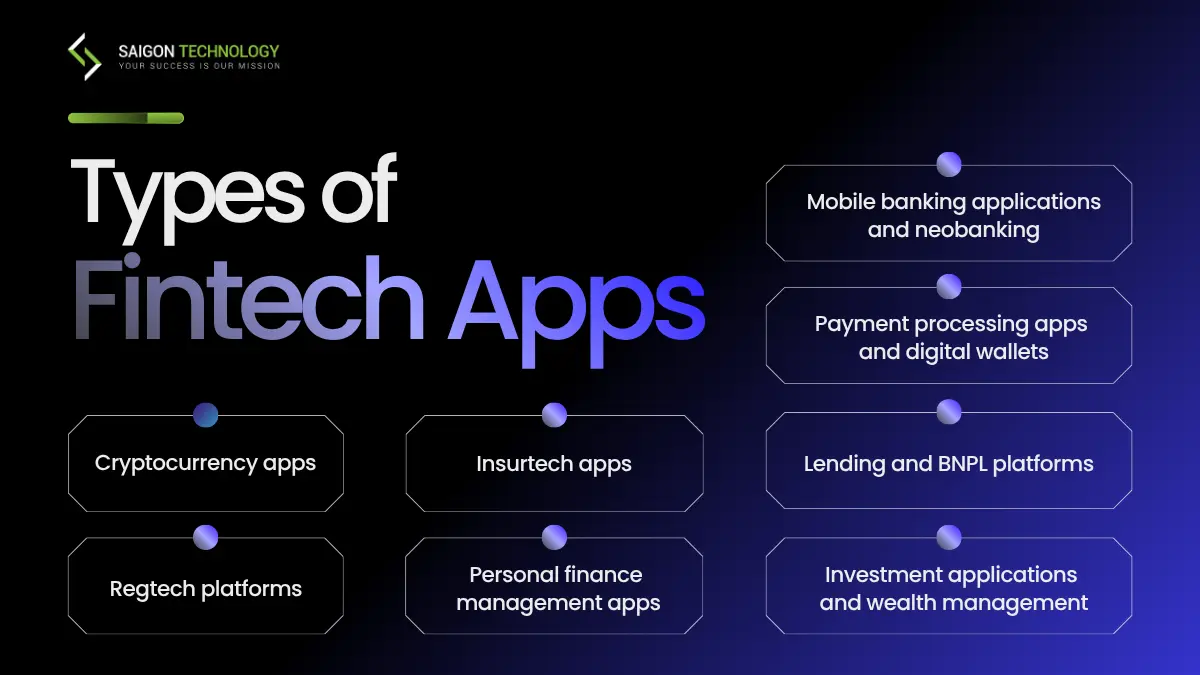
- Mobile banking applications and neobanking (Chime, Revolut, N26) – Offer full-service financial accounts without physical branches, including account management, virtual card issuance, and real-time notifications. Building here requires heavy investment in KYC (Know Your Customer) verification, secure authentication, and integration with payment methods and banks.
- Payment processing apps and digital wallets (PayPal, Stripe, Apple Pay) – Enable electronic money transfer between merchants and consumers. Development focuses on payment gateway integration, tokenization, and QR code payment functionality. PCI DSS compliance is non-negotiable for every component touching card data.
- Lending and BNPL platforms (LendingClub, Affirm, Klarna) – Automate underwriting using alternative data and machine learning. Digital money lending applications require fair lending algorithms, credit reporting obligations, and state-by-state licensing in the US.
- Investment applications and wealth management (Robinhood, Wealthfront, Betterment) – Have democratized capital markets access. Building robo-advisors means implementing real-time market data feeds, automated portfolio rebalancing, and SEC or FINRA compliance.
- Personal finance management apps (Mint, YNAB) – Focus on spending analytics and budgeting through open banking API integrations. Lighter compliance than transaction-processing apps, though data privacy laws like GDPR and CCPA still apply.
- Insurtech apps (Lemonade, Root) – Use AI-driven claims processing and usage-based pricing, requiring complex actuarial logic and digital policy management.
- Cryptocurrency apps (Coinbase, MetaMask) – Encompass digital asset exchanges, DeFi wallets, and blockchain technology platforms, facing rapidly evolving regulatory frameworks around cryptocurrency exchange licensing and AML requirements.
- Regtech platforms (ComplyAdvantage, Chainalysis) – Automate KYC/AML screening and regulatory reporting, one of the fastest-growing sub-sectors driven by increasing compliance complexity.
The type of fintech app you build determines your compliance roadmap, tech stack, and timeline. A peer-to-peer lending app and a personal finance tracker both qualify as “fintech,” but they live in entirely different regulatory worlds.

Core Features Every Fintech App Needs
Regardless of which fintech category you target, certain fintech app features are universal. Skipping any of them creates regulatory risk, security vulnerabilities, or a user experience that won’t survive contact with real customers.
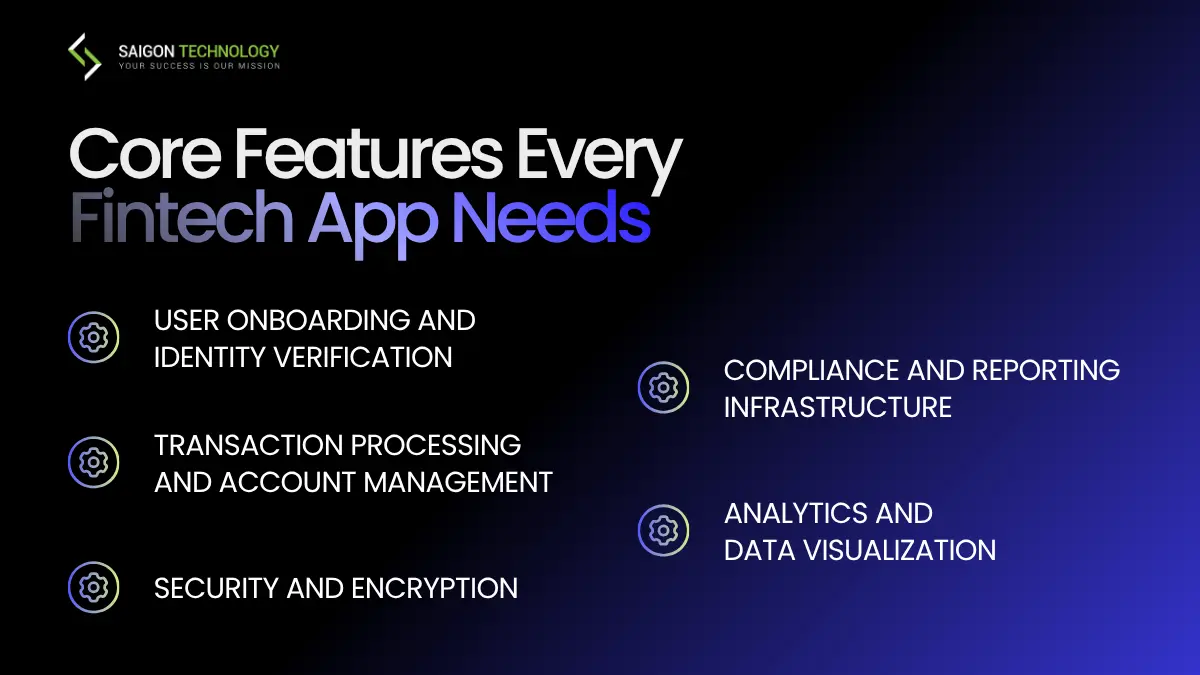
1. User Onboarding and Identity Verification
This is the most critical touchpoint. KYC verification includes:
- ID document scanning and liveness detection to prevent spoofing
- Database checks against sanctions and PEP (Politically Exposed Persons) lists
- Multi-factor authentication layering biometric security, one-time passwords, and device trust signals
This isn’t optional – it’s a regulatory requirement and your primary defense against identity fraud from day one.
2. Transaction Processing and Account Management
Users expect sub-second response times for payment processing, instant visibility into transaction history, and push notifications for every account change. The event-driven backend architecture supporting this is fundamentally different from a standard CRUD application.
For digital wallets or mobile banking applications, this layer also handles:
- Currency conversion
- Recurring transactions
- Integration with external payment rails
3. Security and Encryption
Fintech security goes beyond standard application requirements:
- AES-256 encryption at rest, TLS 1.3 in transit
- Tokenization for sensitive data like card numbers
- Session management, device fingerprinting, and behavioral anomaly detection
- OAuth 2.0 with OpenID Connect for secure authentication
- OWASP API Security standards as the baseline
These protections safeguard users even if credentials are compromised.
4. Compliance and Reporting Infrastructure
Automated regulatory reporting is essential, including:
- Suspicious Activity Reports (SARs) and Currency Transaction Reports (CTRs) for AML compliance
- Comprehensive audit trail logging for every data access and transaction
- Role-based access control (RBAC) ensuring operational staff access only what their role requires
5. Analytics and Data Visualization
This capability serves two audiences:
- End users need spending analytics and financial health insights
- Administrators need real-time dashboards for fraud monitoring and operational KPIs
Advanced features like AI-powered customer support chatbots, robo-advisors, e-signature integration, open banking API connections, and gamification elements can differentiate your app, but get the foundations right first. Nice-to-have features should come after your MVP validates core product-market fit.

Regulatory Compliance: The Non-Negotiable Foundation
If there’s one lesson we’ve learned from over 800 projects, including multiple fintech platforms for US clients, it’s this: compliance must be a design principle, not an afterthought.
We’ve seen projects where teams built features first and planned to “add compliance later.” The rework consistently added months to timelines and multiplied costs by 3–5x compared to teams that built compliance into the architecture from day one.
Fintech application compliance spans multiple frameworks depending on your app category and target markets:
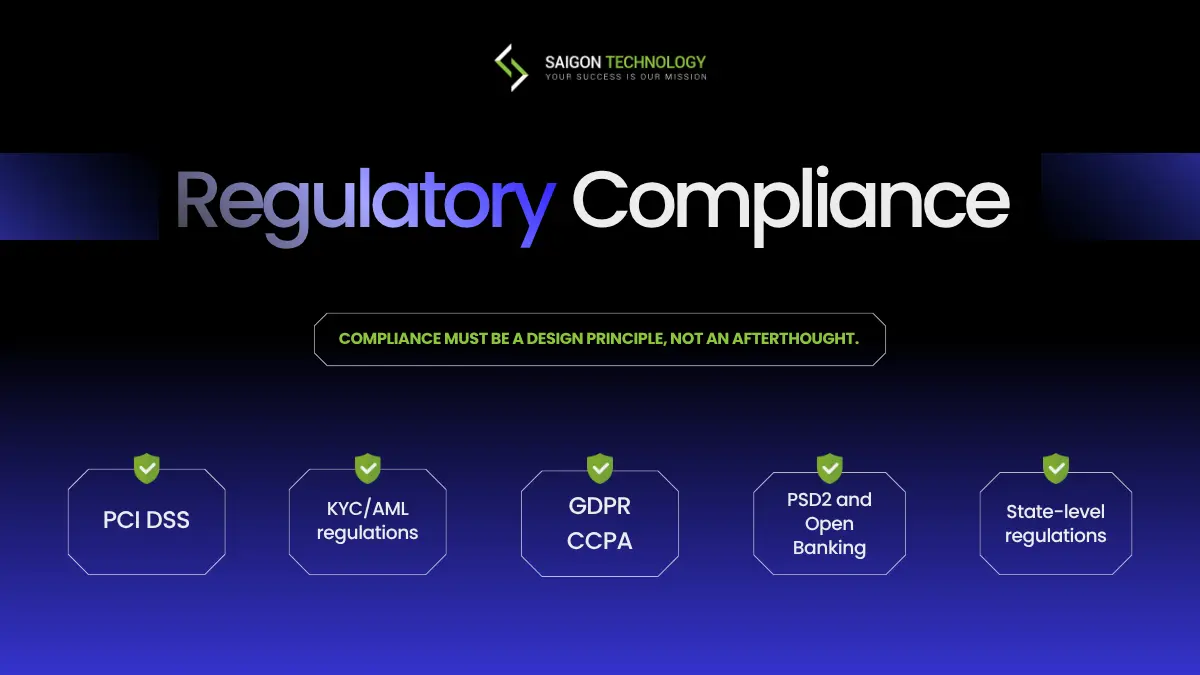
- PCI DSS – Applies to any application processing card payment data. Requirements include data encryption, network segmentation, access controls, and quarterly penetration testing. Using third-party processors like Stripe reduces PCI scope but doesn’t eliminate it.
- KYC/AML regulations – Applies to virtually all financial services: identity verification, transaction monitoring, suspicious activity reporting, and sanctions screening. FinCEN’s Bank Secrecy Act sets the US baseline; the EU’s Anti-Money Laundering Directives set similar or stricter requirements.
- GDPR – Governs apps serving EU users with data minimization, consent management, right to erasure, and data protection assessments. CCPA provides parallel protections for California residents.
- PSD2 and Open Banking – In the EU, mandates Strong Customer Authentication for payments and third-party API access. SOX applies to public companies requiring auditable internal controls.
- State-level regulations – In the US, they require money transmitter licenses that vary state to state, with FinCEN MSB registration as the federal baseline.
The practical approach starts during the product discovery workshop:
- Map every regulatory requirement to specific technical implementations.
- Embed automated security scans and compliance checks into your CI/CD pipeline.
- Budget for third-party security audits – any serious fintech app needs independent validation before launch.
Our team holds ISO 27001 certification and has implemented PCI-DSS compliant systems for multiple US fintech clients, including a personal loans platform processing thousands of applications with automated KYC verification and full audit trail logging.
How to Build a Fintech App: 7 Steps From Idea to Launch
These are the fintech app development steps that consistently lead to successful launches. Each step builds on the previous one, and skipping ahead, particularly on compliance planning, creates expensive problems later.
Step 1: Define Your Niche and Value Proposition
Start by identifying exactly which fintech category you’re entering and what gap you’re filling. “A better payment app” isn’t specific enough.
Ask yourself:
- Who is underserved by current options?
- What specific pain point will you solve that existing apps don’t?
Conduct target audience analysis through user interviews, not just market reports. Talk to 20–30 potential users before committing to a feature set. Document your findings in a software development brief that includes:
- A clear problem statement
- Target user persona
- Core value proposition
- Initial feature prioritization
This brief becomes the foundation for everything that follows.
Step 2: Research Compliance Requirements
With your niche defined, map the regulatory requirements for your specific use case and target markets. A digital wallet serving US consumers faces different licensing requirements than a lending platform operating in the EU.
Key actions at this stage:
- Identify required licenses early – money transmitter licenses in the US can take 6–12 months to obtain.
- Engage a compliance advisor who specializes in your specific fintech vertical.
- Produce a compliance framework checklist with a realistic timeline for certifications and a clear understanding of how regulatory requirements will shape your technical architecture.
Step 3: Assemble Your Development Team
You have three primary options for building your development team:
- Hiring in-house
- Engaging freelancers
- Partnering with a dedicated offshore development team
For fintech specifically, the critical factor isn’t just technical skill, it’s compliance experience and security certifications.
A typical fintech development team includes:
- Project Manager
- 2–3 Backend Engineers
- 1–2 Frontend Engineers
- QA Engineer
- DevOps Engineer
- UI/UX Designer
- For complex platforms: a dedicated security engineer and compliance specialist
When we built a personal loans platform for a US-based client, we assembled a dedicated team of 20 senior engineers within three months, covering .NET backend, React frontend, and comprehensive QA. That team has been working together continuously for over three years, which highlights an important point: fintech development is rarely a one-and-done project. Choose a team structure that supports long-term iteration, not just initial delivery.
Consider your engagement model carefully. A dedicated team model works well for ongoing fintech development where requirements evolve continuously. A fixed-price engagement can work for well-defined MVPs where scope is clear upfront.
Step 4: Design the User Experience
Fintech UX must balance simplicity with security, and that tension defines every design decision. Your onboarding flow needs to complete KYC verification while feeling as frictionless as signing up for a social media account.
Mobile-first design is non-negotiable for fintech mobile app development, as over 73% of fintech interactions happen on mobile devices.
Follow this design sequence:
- Build a design system with reusable components and a style guide for consistency
- Create wireframes
- Develop interactive prototypes
- Run usability testing with real users
- Iterate based on feedback
Prototype creation at this stage is far cheaper than redesigning after development begins.
Step 5: Develop Your Minimum Viable Product (MVP)
MVP development is where many fintech projects go off track, usually by trying to build too much. Your minimum viable product should include exactly enough to validate your core value proposition:
- One primary transaction flow
- Basic KYC verification
- Essential security features
- One complete user journey from sign-up to core action
Use Agile sprints, we typically run 2-week cycles with continuous integration and deployment through automated CI/CD pipelines. This approach provides regular checkpoints for feature prioritization adjustments and keeps the team focused on delivering working software rather than accumulating unfinished features.
Realistic MVP timelines:
- Standard fintech app: 4–6 months
- Complex platforms with multiple integration points, AI features, or multi-jurisdictional compliance: 9–12 months
Feature creep, the tendency to keep adding “just one more feature” before launch, is the number one reason fintech MVPs go over budget and over schedule. Resist it aggressively.
Step 6: Test Rigorously for Security and Compliance
Testing a fintech app goes well beyond functional and device testing. You need:
- Security testing – Penetration testing against live environments, OWASP Top 10 vulnerability scanning, and thorough code review focused on security-sensitive areas.
- Compliance testing – Verifies that every regulatory requirement identified in Step 2 is actually met in the production application, not just designed for, but working correctly with real data in real scenarios.
- Performance testing – Simulates peak transaction loads to ensure your scalable infrastructure handles spikes without degradation.
- User acceptance testing (UAT) – Real users in a sandbox environment catch usability issues before they become production problems.
For any application handling financial data, we recommend a third-party security audit before launch. The cost is modest compared to the reputational and financial risk of a post-launch security incident.
Step 7: Launch, Monitor, and Iterate
A soft launch to a limited user base lets you identify production issues at manageable scale. From day one, monitor:
- Transaction success rates
- API latency
- Error rates
- User drop-off points
Set up real-time alerting for security incidents, failed transactions, and performance degradation.
Plan your post-launch roadmap:
- Feature expansion based on user feedback
- New market entry requiring additional compliance certifications
- Targeted marketing campaigns to grow your user base
Don’t forget to create a pre-launch checklist covering infrastructure monitoring, incident response procedures, and customer support readiness.
Budget for ongoing app maintenance and support costs, typically 15–20% of initial development cost annually. This covers security patches, compliance updates, infrastructure scaling, and incremental feature development. Cloud hosting costs will also grow as your user base expands.
Recommended Tech Stack for Fintech Apps in 2026
Your fintech application tech stack should prioritize transaction integrity, security tooling, and compliance infrastructure. Here’s what we recommend based on delivering fintech platforms since 2012.
- Backend frameworks – These matter most because they handle core transaction processing and compliance logic. .NET Core and Java Spring Boot dominate enterprise fintech – both offer mature security libraries, ACID-compliant transaction management, and extensive compliance tooling. Node.js works well for real-time features and lighter API layers.
- Frontend frameworks – React.js (with Next.js) and Angular provide the component-based architecture needed for complex financial dashboards with real-time data binding. Vue.js is a viable alternative for smaller teams.
- Mobile development – React Native or Flutter for cross-platform fintech mobile app development. For performance-critical trading apps, native development with Swift (iOS) and Kotlin (Android) remains the better choice.
- Databases – PostgreSQL for ACID-compliant financial transactions combined with Redis for caching and real-time features. Never compromise on ACID compliance for financial data – eventual consistency models cause real problems when money is involved.
- Cloud infrastructure – AWS or Azure provides compliance-certified environments with financial services-specific programs and scalable infrastructure.
- Third-party APIs – This is where the build-versus-buy decision matters most. Stripe and Marqeta for payment processing, Plaid for banking connections, and Jumio or Onfido for KYC verification are battle-tested integrations that reduce development time and PCI scope. Most fintech apps should integrate rather than build from scratch.
- AI and automation – TensorFlow and PyTorch power fraud detection, credit scoring, and personalized recommendations. Automation and machine learning capabilities are increasingly a baseline expectation in modern fintech.
Our fintech projects typically run on .NET Core and React with AWS infrastructure, a stack our 400+ engineers have deep expertise in, backed by ISO 27001-certified security practices and DevOps pipelines using Docker, Kubernetes, and GitHub Actions for containerized, automated deployment.
How Much Does It Cost to Build a Fintech App?
The cost of a fintech app varies significantly based on complexity, compliance requirements, and team location. Here’s what realistic budgets look like across three tiers.
1. Basic MVP – $50,000–$120,000
A single-platform app with one core transaction flow, basic KYC, and essential security. Takes 3–4 months to build. This is your starting point for validating product-market fit with real users. Over 70% of successful fintech startups begin with an MVP at this level.
2. Standard Fintech Application – $120,000–$250,000
Includes multi-platform support (iOS, Android, web), full compliance implementation, two-factor authentication, payment gateway integration, and an admin panel. Takes 6–9 months. This tier represents most production-ready fintech apps that serve regulated markets.
3. Complex Platform – $250,000–$500,000+
AI-powered fraud detection, multi-currency support, open banking integrations, core banking system connectivity, and advanced data visualization. Takes 9–18 months.
Key Cost Drivers
- Compliance requirements — Typically 15–20% of total cost
- Third-party integrations — $5,000–$25,000 each
- AI/ML features — Require specialized talent and additional development time
- Security infrastructure — First-time founders often underestimate this
Development Team Rates by Location
- US teams: $100–$200/hour
- Vietnam teams: $22–$46/hour
- Indian teams: $25–$50/hour
Platform selection and team location together swing your total budget by 40–60%.
Practical Cost Optimization
- Use third-party fintech APIs instead of building payment processing or KYC from scratch.
- Phase compliance spending — build for your primary launch market first.
- Consider an offshore team with proven fintech experience for cost efficiency without sacrificing compliance standards.
At Saigon Technology, our rates of $22–$46/hour are backed by ISO 9001 and ISO 27001 certifications, a Clutch 4.9-star rating, and hands-on experience delivering fintech software development services, including a wealth management platform and a lending application, with a 20-engineer dedicated team operating continuously for over three years.
Common Mistakes When Building a Fintech App
Having delivered 800+ projects across multiple industries, we’ve seen certain patterns derail fintech projects more often than others. Here are the five most costly mistakes and how to avoid them.
- Treating compliance as an afterthought – This is the costliest mistake in fintech application development. Compliance shapes database design, API architecture, logging infrastructure, and user flows. It must be part of your technical architecture from the product discovery workshop onward. Teams that try to “layer it in later” face rework that doubles timelines and triples costs.
- Over-engineering the MVP – This kills more fintech startups than under-building. The temptation to launch a super-app with payments, lending, and investing all at once leads to scope creep and an unfocused product. Start with one value proposition, validate it, then expand. Feature prioritization discipline is the difference between a fintech app that launches and one that never ships.
- Underestimating security requirements – This shows up when teams apply standard web security to financial products. From the first release, you need biometric security via MFA, encryption at rest and in transit, tokenization, session management with anomaly detection, and regular penetration testing. Security and compliance risks compound when deferred.
- Choosing a development partner without fintech experience – A team that builds e-commerce apps may not understand PCI-DSS implementation or how to build audit trails that satisfy regulatory examiners. Ask for fintech case studies, security certifications, and compliance implementation experience.
- Ignoring post-launch costs – Plan for 15–20% of initial development annually for security patches, compliance updates, infrastructure scaling, and feature development. Include a budget for annual penetration testing and compliance re-certification in your maintenance plan.

Why Partner With an Experienced Fintech Development Vendor
Building a fintech app in-house requires recruiting specialized engineers, establishing security infrastructure, and maintaining the team through a multi-year lifecycle. For many companies entering fintech for the first time, partnering with a dedicated fintech software development services provider is the faster, more cost-effective path.
When evaluating partners, look for concrete evidence:
- ISO 27001 certification, the baseline for security practices
- Fintech-specific case studies with quantified outcomes
- Compliance implementation history — specific frameworks, not just familiarity
- Flexible engagement models that adapt to your needs
A thorough vendor assessment should cover all of these.
Saigon Technology brings 13+ years and 400+ engineers to fintech engagements, with ISO 9001 and ISO 27001 certifications from BSI UK. Our fintech track record includes a wealth management platform (2+ years continuous development) and a personal loans application where we scaled to 20 senior engineers within three months, a partnership now exceeding 3 years.
As Abe Jarrett, SVP at Origence (USA), noted: “World-class leadership in fintech.” We offer a 2-week risk-free trial to evaluate team quality and financial software development capabilities before committing.
FAQs
1. How long does it take to build a fintech app?
An MVP typically takes 3–6 months depending on complexity. A full-featured fintech app with multiple payment integrations, comprehensive KYC, and multi-platform support takes 9–18 months. Working with an experienced fintech team can reduce timelines by 20–30% compared to building from scratch, thanks to pre-built compliance modules and established integration patterns.
2. What is the minimum budget to build a fintech app?
A basic fintech MVP starts at $50,000–$80,000, covering one core function, basic KYC, and essential security. However, projects with full compliance for regulated markets rarely cost below $120,000 once you account for security infrastructure and audit preparation. Offshore development in Vietnam can reduce costs by 40–60% versus US-based teams.
3. Do I need a license to launch a fintech app?
Yes, in most jurisdictions. In the US, you need at minimum a Money Services Business (MSB) registration with FinCEN, and potentially state-by-state money transmitter licensing – a process that can take 6–12 months. In the EU, you need an e-money license or a payment institution license under PSD2. Engage a compliance advisor before development begins.
4. Can I build a fintech app with no-code tools?
No-code tools work for simple financial dashboards or internal reporting. They are not suitable for apps that process real financial transactions – fintech apps require custom security implementations, compliance-grade audit trails, and deep third-party API integrations that ready-made software platforms cannot support for regulated financial services.
5. What makes fintech app development different from regular app development?
Three factors set it apart:
- Regulatory compliance (PCI DSS, KYC/AML, licensing) adds requirements absent in other categories
- Financial-grade security extends to encryption, tokenization, and fraud detection
- Bugs have financial consequences – lost money and regulatory penalties, not just poor UX
These demand specialized testing, independent security audits, and a development team with compliance expertise.
5. How do I choose between building in-house vs. outsourcing fintech development?
- Build in-house if you have deep fintech talent, compliance expertise, and 12+ months to recruit.
- Outsource if you need faster launch timelines, fintech-specific skills, or cost reduction.
- Hybrid model – Many US companies succeed with strategic decisions in-house and development execution with an offshore partner through a dedicated team or staff augmentation model.
This guide is based on Saigon Technology’s experience delivering fintech platforms since 2012, including wealth management systems, lending platforms, and payment processing applications for clients in the US, Europe, and Asia-Pacific. For a detailed discussion of your fintech project requirements, contact our team for a free consultation.


Related articles

AI Route Optimization: How It Works, Benefits, and Use Cases 2026
 Quy Truong - Software Architect
  14 Oct 2026
Student Information System: A 2026 Guide for Schools
09 Oct 2026 
Insurance Portal Development in 2026: Types, Features, Cost
07 Oct 2026 
Insurance Claims Automation in 2026: Build, Buy, or Hybrid
01 Oct 2026 
IoT in Healthcare: How Healthcare IoT Systems Work in 2026
25 Sep 2026 
AI in Real Estate: 9 Use Cases and How to Build It (2026)
16 Sep 2026 
AI Healthcare Software Development: Architecture & Cost
13 Sep 2026 
8 Fintech Software Development Trends Reshaping 2026
26 Aug 2026 
Healthcare Chatbot Development: The Complete 2026 Guide
19 Aug 2026