











































- OVERVIEW
- SERVICES
- WHY CHOOSE US?
- MODELS
- TECHNOLOGIES
- OUR PROCESS
- FAQS
Custom Healthcare Software Development Built for Regulated Care
Protected health data: PHI is handled under ISO 27001 controls certified by BSI (UK), with HIPAA requirements met where the workload needs them. AxiaGram's platform holds 6M+ medical records under AES-256 encryption and role-based access.
Clean EHR and lab integration: Engineers build HL7 and FHIR interfaces to the EHR, lab, and billing systems you already run. HealthCare Connect automates lab-result delivery to multi-location clinics over HL7, with PDF reports.
Continuity on systems clinicians rely on: The same senior team stays on the product release after release, with one named Project Manager who works with you directly. AxiaGram has been an ongoing partnership since 2021.
Your code and IP: An NDA is signed before requirements are shared, and code and IP are assigned to you as work is delivered, so a vendor change leaves your roadmap intact.
Who we build for
- Enterprise teams: Modernize clinical, claims, and revenue cycle systems through an Offshore Development Center.
- Funded startups: Launch a digital health MVP built for HIPAA requirements on a fixed price scope.
- Mid-market companies: Extend your product team with healthcare engineers through IT staff augmentation.
End-to-End Healthcare Software Development Services
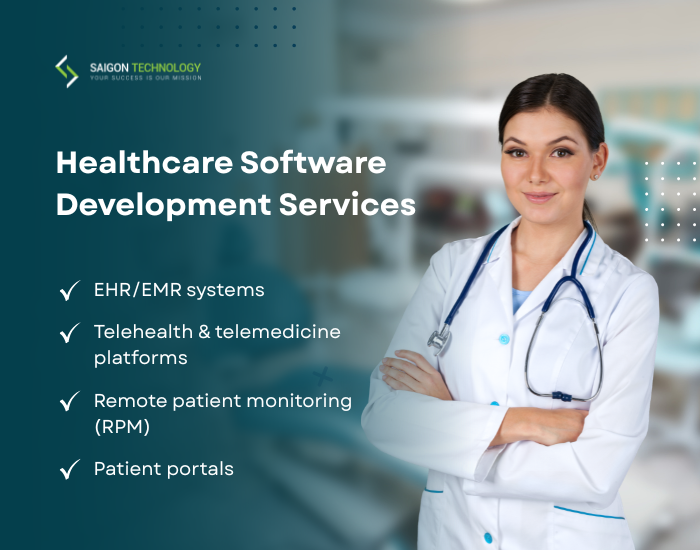
Healthcare software development services are the design, build, integration, and maintenance of digital systems that handle protected health information (PHI), including EHR/EMR, telehealth and telemedicine platforms, remote patient monitoring (RPM), and patient portals, under frameworks such as HIPAA, HITECH, the 21st Century Cures Act, and FDA Software as a Medical Device (SaMD) rules.
Saigon Technology delivers them across the full project lifecycle, from requirements analysis and technical design through development, medical software testing, and ongoing support, pairing healthcare software developers with business analysts, medtech consultants, and QA engineers on every engagement.
Custom Healthcare Software Development
Custom healthcare software development builds EHR/EMR extensions and clinical workflow modules, patient portals and engagement tools, healthcare CRM for care teams, hospital and medical practice management software, and telehealth platforms with self-service scheduling for providers, payers, and digital health teams.
Each build starts from a documented healthcare SRS (software requirements specification), a clear scope, and a realistic delivery schedule, with an MVP development plan and healthcare IT consulting up front when you need to validate market fit first. AxiaGram's telemedicine platform and EHR companion app for US clinics is one example.
Legacy Modernization, Cloud Migration & Support
Security, Compliance & Quality Engineering
Security and compliance engineering for PHI builds data encryption, role-based access and permissions, access controls, and audit trails into the architecture under ISO 27001 certification by BSI (UK), with HIPAA requirements met where the workload needs them and GDPR applied as standard when an engagement handles EU personal data.
Quality assurance and medical software testing run with CI/CD and DevOps practices, and a risk mitigation plan prepares your team for compliance audits. The Health Super App secures health records with AES-256 encryption, aligned with PDPA (Singapore).
Healthcare Data Platforms, Analytics & AI
Healthcare data analytics turns fragmented records into usable insight through data warehouses and dashboards for operational and quality reporting, BI and real-time data analysis, predictive analytics and population health platforms for risk stratification, and Azure Cognitive Search over clinical content.
AI features such as AxiaGram's AI-assisted voice-controlled note-taking draw on 50+ AI projects across healthcare, fintech, logistics, and business software, delivered with governance, explainability, and validation in mind.
mHealth & Connected Device Software
mHealth and connected-device software covers mobile care coordination apps and remote patient monitoring (RPM) for home care and chronic disease management, capturing and transmitting device data securely with the right PHI access controls.
Internet of Medical Things (IoMT) integrations connect wearables and sensors with Apple HealthKit, Google Fit, and Samsung Health, AI-powered monitoring raises clinician alerts, and patient engagement stays consistent across web and mobile journeys. For mobile builds, see healthcare mobile app development.
System Integration & Interoperability
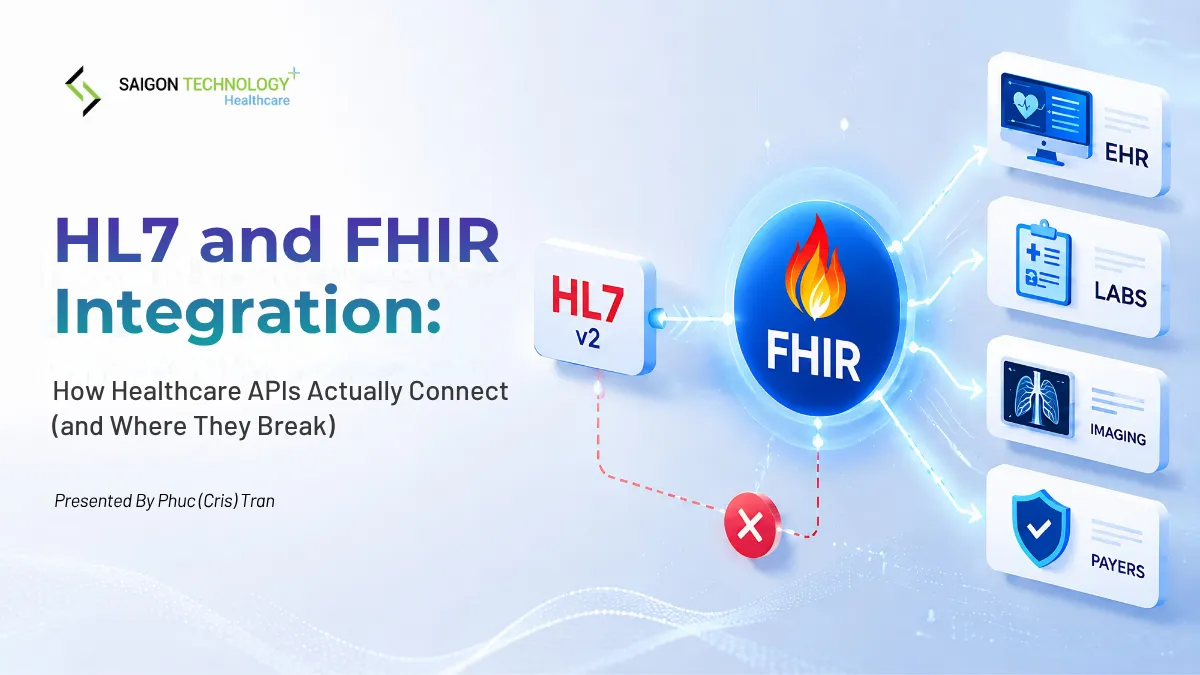
Healthcare interoperability connects clinical systems, devices, and third-party services through HL7 v2 and HL7 FHIR, EHR/EMR integration, DICOM and PACS for imaging, CCDA, NCPDP SCRIPT for pharmacy, and HIPAA X12 837/835 for claims, plus custom APIs, data migration, database interoperability, and health information exchange aligned with health IT standards.
Treated as a core deliverable, it removes data silos and gives clinicians one reliable view of patient information across locations. HealthCare Connect runs automated HL7 lab connectivity with PDF reporting for multi-location clinics.
Healthcare Case studies
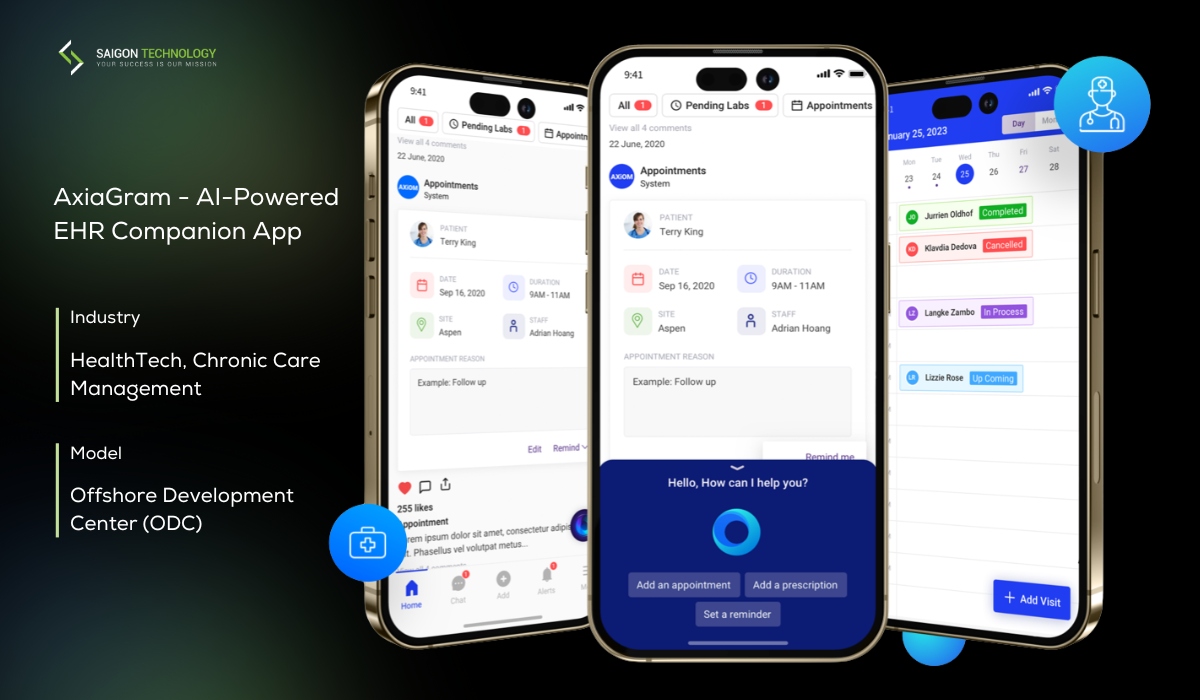
AxiaGram - AI-Powered EHR Companion App
- Challenge: Securely manage 6M+ medical records for US clinics and hospitals in chronic care management, with performance, auditability, role-based access, and stable real-time video.Â
- What we built: A HIPAA-aligned telemedicine platform with an integrated EHR companion experience: secure login and session controls, AI-assisted voice-controlled note-taking, and Electronic Visit Verification (EVV) with geo-tagging and digital signatures, with PHI protected by AES encryption and controlled access.Â
- Engagement / timeline: A dedicated offshore development center that integrates directly with US hospital EHR systems, in an ongoing partnership since 2021.Â
- Outcome: ~40% reduction in development time; clearer communication and more efficient documentation.Â
- Stack: .NET Core, Angular, Azure, HL7, Agora, and Wowza.Â
- Learn more | Read the AxiaGram case study (PDF)
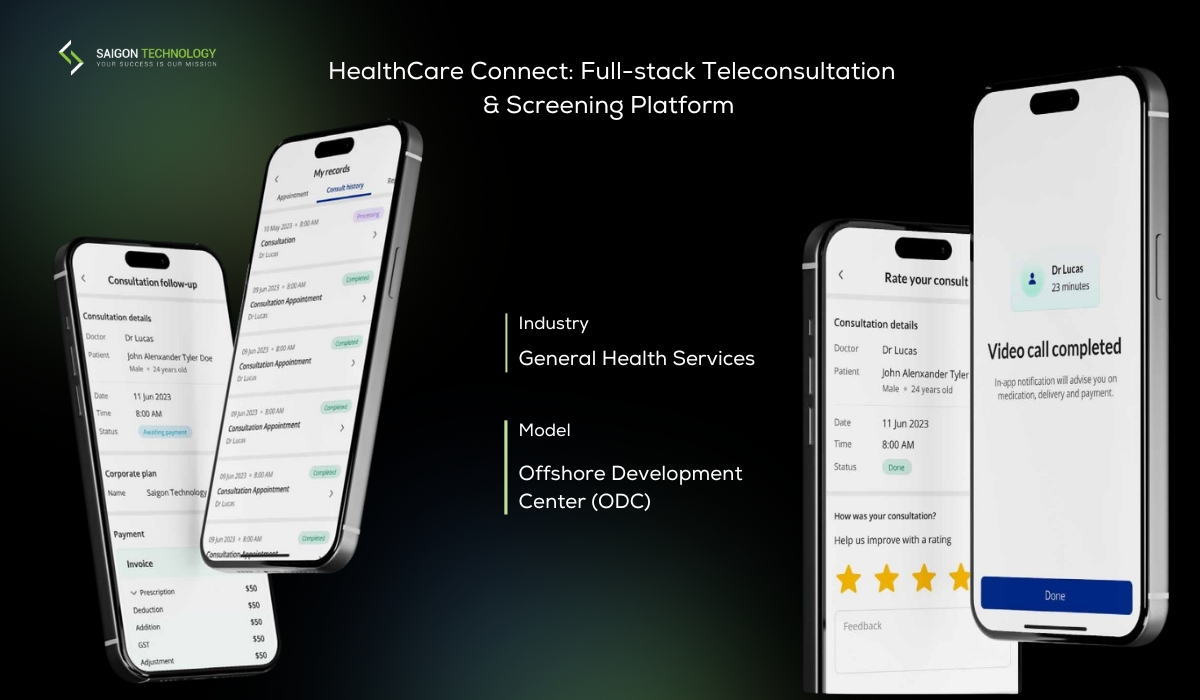
HealthCare Connect - Teleconsultation & Screening Platform
- Challenge: Real-time data exchange with lab systems, complex HL7 integration, and dependable multi-channel alerting for multi-location clinics.Â
- What we built: A full-stack platform connecting patients, clinicians, labs, and delivery services: screening booking with digital consent, QR-code check-in and payment reconciliation, real-time video and chat, and automated HL7 lab connectivity with PDF reporting, with end-to-end encryption and secure Stripe payments aligned with HIPAA and PDPA.Â
- Engagement / timeline: Continuous Agile releases through an offshore development center, ongoing since 2022.Â
- Outcome: 50,000+ patient interactions per month; fewer missed follow-ups; lower administrative overhead.Â
- Stack: Angular, Node.js, PostgreSQL, WebRTC, and Stripe.Â
- Read the HealthCare Connect case study (PDF)
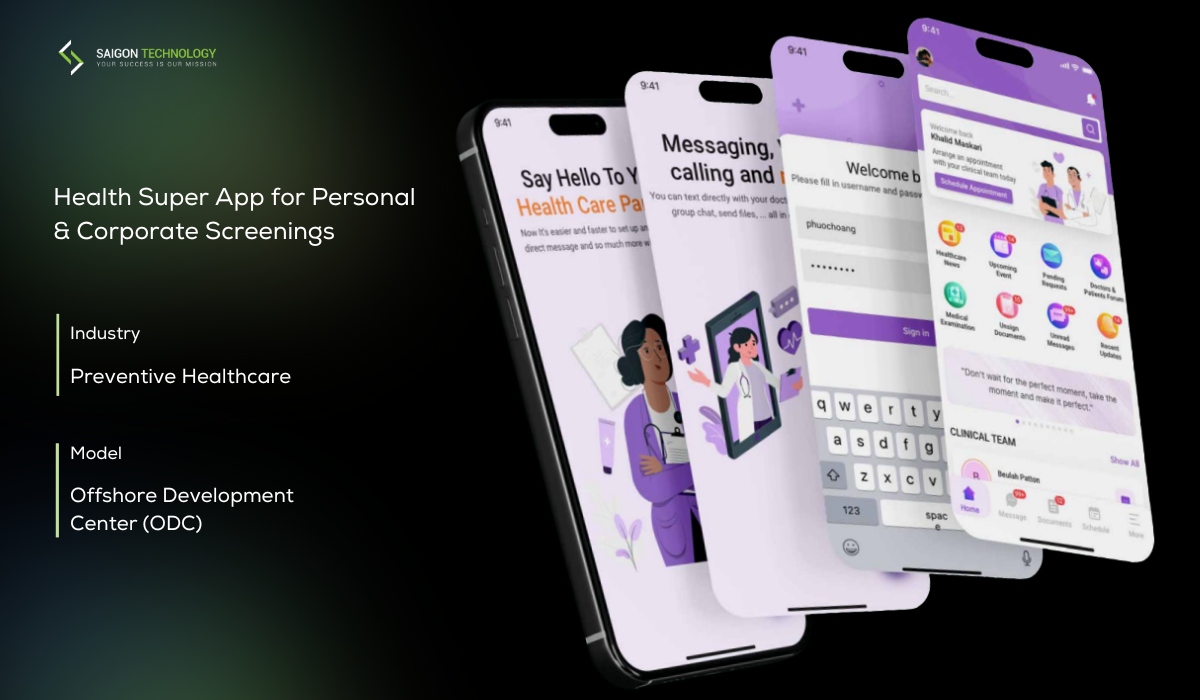
Health Super App - Personal & Corporate Screenings
- Challenge: Separate corporate and personal journeys, dependable appointment management, and accurate dynamic pricing and refunds for clinics and businesses.Â
- What we built: An all-in-one mobile platform for booking screenings, managing results, and tracking follow-ups across home-based, executive, and in-clinic programs, with company-code corporate booking, multi-option personal screenings with add-on tests, QR-code check-in, status tracking for complex states, and secure Stripe payments and reconciliation; records are secured with AES-256 encryption, aligned with PDPA.Â
- Outcome: Used by thousands of users every month; faster paperless check-in; consolidated records and better care coordination.Â
- Stack: React Native, Node.js, Firebase, and PostgreSQL.Â
- Read the Health Super App case study (PDF)
Send Your Healthcare RFP. See a Prototype in 48+ Hours.
Healthcare Software We Build
Our custom healthcare software development services span the systems providers, payers, and life-science teams rely on every day:
Electronic health records (EHR/EMR) and EHR/EMR integration
Telehealth & telemedicine platforms
Remote patient monitoring (RPM)
Patient portals and patient engagement tools
Hospital management software and medical practice management solutions
Pharmacy management solutions
Healthcare CRM and revenue cycle management software
Medical imaging and lab software
Population health platforms and healthcare data analytics / BI
Care coordination platforms
Trusted by Global Companies
Client Feedback and Testimonials
Why Choose Saigon Technology as Your Healthcare Software Development Company
A good healthcare software development company protects patient data by design, connects to the EHR and lab systems clinicians already use, and keeps the same senior team on the product for years. Saigon Technology builds custom healthcare software to that standard from 3 development centers in Vietnam.Â
"When a healthcare budget overruns, the cause is usually an integration nobody scoped, like an HL7 lab feed or an EHR interface. So my teams map every lab, EHR and billing connection, and every place PHI flows, before we price the first sprint." - Phuc (Cris) Tran, Program ManagerÂ
Security Built for PHI, in the Cloud and On Premises
Healthcare security starts with ISO 9001 and ISO 27001 certification by BSI (UK), NDAs, and a secure SDLC, with HIPAA and HITECH requirements met where the workload needs them and PDPA applied for Singapore projects. Cloud and on-premises builds use AES-256 data encryption, Zero Trust architecture, HashiCorp Vault, AWS KMS, role-based permissions, and audit trails.Â
HL7 & FHIR Interoperability
Interoperability engineers build HL7 v2 and FHIR interfaces, DICOM and PACS imaging links, LOINC and CPT code mapping, and secure API gateways for complex clinical networks. AxiaGram's platform integrates directly with US hospital EHR systems over HL7.Â
Senior Engineers and Applied AI at $22-$46/hr
Senior healthcare engineers work at a published senior-led rate of USD $22-$46/hr, so a smaller team ships with fewer rebuilds. Applied AI for predictive analytics, NLP for charting and intake, and medical imaging automation, validated with your clinical teams, is led by AI Tech Lead Phong Le. Learn more: Our Talents
A Team That Stays: Clinical Systems Outlive Releases
Clinical systems need the same engineers for years of releases, and team churn breaks software clinicians already depend on. Saigon Technology is ranked #10 in the Medium category of Southeast Asia Best Workplacesâ„¢ in Technology 2026 by Great Place To Work and was named one of the Fortune 100 Best Companies to Work Forâ„¢ Southeast Asia 2025.Â
Healthcare Software Development for the US Market
Healthcare software development for US organizations runs with 10-12 hours of daily overlap with US East and West Coast time zones (US business hours on request), one named Project Manager who works with you directly, and Jira and code repository access with the developers. For AxiaGram, an EHR companion and telemedicine platform for US clinics and hospitals, the team manages 6M+ medical records and delivers Electronic Visit Verification (EVV) with geo-tagging and digital signatures.
Day-One Architecture Advice, Including When Not to Build
Discovery starts with architecture advice from senior engineers, including a recommendation not to build when an existing platform or a smaller integration covers the clinical need. Research Labs demos at experiment.saigontechnology.vn show working concepts before you commit budget.
14+ Years, 400+ Developers, 850+ Projects
Saigon Technology has 14+ years in business, 400+ developers, 850+ projects for 350+ clients, and 3 development centers, delivering secure, interoperable products for clients in the US, UK, Australia, and Singapore. The case studies above name each client and show only results the client has cleared, because we'd rather show verifiable work than invent a metric.
Start With a Two-Week Risk-Free Trial
Start with a two-week risk-free trial to review the engineers, workflow, and communication through sprint demos before any long-term commitment. Then continue on the model that fits: staff augmentation, a dedicated team, fixed price, an Offshore Development Center (ODC), or build-operate-transfer (BOT).
Why Choose Custom Healthcare Software Over Platform-Based Tools?
Platform-based tools are quick to buy but slow to fit. Custom healthcare software development builds only what your clinicians, billing, and operations teams need, and you own the roadmap.
When does custom win? Choose custom when compliance control, deep integration, or a differentiated patient experience drive your business, and platform tools when needs are simple and short-term.
Workflow fit
Data & compliance control
Integrations
Differentiation
Long-term cost
Healthcare Software Development Cost and Timelines
Healthcare software development costs range from $30,000 for an MVP to $2,000,000 or more for an enterprise EHR/EMR platform, with typical timelines of 3 to 12+ months. Where a project lands depends mostly on scope, the number of clinical systems it integrates with, compliance scope, and engagement model.Â
| Solution type | Typical cost (USD) | Typical timeline |
|---|---|---|
| MVP / PoC | $30,000- |
3-6 months |
| Telehealth & telemedicine platform | $150,000- |
4-8 months |
| Remote patient monitoring (RPM) platform | $200,000- |
6-12 months |
| Enterprise EHR/EMR platform | $300,000- |
9-12+ months |
Saigon Technology planning ranges. Your quote follows a detailed requirements analysis and technical design.Â
Saigon Technology's published rate is $22-$46/hr with senior oversight, and regulated healthcare work sits toward the upper end because compliance engineering and validation take real effort. The healthcare software development cost guide breaks down each tier. Six factors move a project within these ranges:Â
Feature scope
Features, user roles, and clinical edge cases.Â
Integrations
EHR/EMR, lab/LIS, RIS/PACS, and billing; real HL7 connectivity is the usual underestimate.Â
Compliance scope
HIPAA and HITECH are the baseline for US PHI; GDPR, PDPA, and medical-device rules add documentation and validation effort.
Data complexity
Migration volume and the standards in play (HL7 v2, FHIR, DICOM).Â
Tech stack
Cloud-native or on-premises, plus any AI/ML features.Â
Engagement model
Dedicated team, staff augmentation, or fixed price.Â
Our Healthcare Software Development Process
Discovery & Consulting
Kick-off aligns goals, clinical outcomes, timelines, KPIs, and governance; business analysts and medtech consultants then map workflows, the PHI data flow, compliance scope, and EHR and integration touchpoints into a healthcare SRS (software requirements specification), user stories, a technical design, and a risk mitigation plan. Contract terms set the engagement model, SLAs, pricing, IP ownership, milestones, and acceptance criteria.Â
Exit criterion: SRS, technical design, and contract terms agreed.Â
Agile Development
Short Agile sprints with regular demos. Healthcare software developers follow secure coding, peer review, and UX design focused on real clinical workflows.Â
QA & Testing
QA engineers test every sprint for function, integration, performance, security, and usability, including security tests mapped to HIPAA safeguards, with CI/CD and DevOps practices and automated quality gates.Â
Software Deployment
Staged rollouts, monitoring, and rollback plans, coordinating data migration, user setup, and integrations.Â
Launch and Maintenance
Monitor stability and adoption, fix issues fast, release predictably, and keep security patches current.
Our Insights
FAQs
What is the average cost of custom healthcare software development?
Custom healthcare software development typically costs from $30,000 for an MVP to $2,000,000 or more for an enterprise EHR/EMR platform, based on Saigon Technology planning ranges. The final figure depends mainly on project scope, integrations (EHR/EMR, HL7/FHIR, labs, billing), compliance scope, data complexity, tech stack, and engagement model.
Saigon Technology's published rate is $22-$46/hr from delivery centers in Vietnam, and each estimate ties cost to requirements, milestones, and assumptions so you can evaluate total cost of ownership before committing.Â
How long does it take to develop and implement healthcare software?
Healthcare software typically takes 3 to 12+ months to develop and implement: an MVP or PoC takes 3-6 months, a telehealth platform 4-8 months, an RPM platform 6-12 months, and an enterprise EHR/EMR platform 9-12+ months. Regulatory needs, data migration, vendor dependencies, and stakeholder availability move these more than team size does, and Agile releases with frequent demos let you validate progress early.Â
Do you provide healthcare software development services for US healthcare organizations?
Saigon Technology provides healthcare software development services for US hospital networks, clinics, digital health startups, and payer-side teams, with HIPAA and HITECH requirements met where the workload needs them. Delivery teams work 10-12 hours of daily overlap with US time zones, with US business hours on request, and a named Project Manager works with you directly. AxiaGram, an EHR companion and telemedicine platform used by US clinics and hospitals, is one example.Â
Which countries do your healthcare software development services cover?
Saigon Technology's healthcare software development services cover the United States, the United Kingdom, Australia, and Singapore from one senior delivery organization, with compliance applied per market.
US projects meet HIPAA and HITECH requirements where the workload needs them; UK and European engagements apply GDPR as standard when they handle EU personal data, and the Vietnam afternoon matches the European morning. Vietnam is 3-4 hours behind Sydney and 1 hour behind Singapore, where projects follow PDPA.Â
How do you ensure the security and compliance of the medical software you develop?
Saigon Technology secures medical software by building privacy and security into every phase: data encryption in transit and at rest, role-based access, audit trails, secure coding, and automated testing under ISO 27001 certification by BSI (UK). HIPAA and HITECH requirements are met where the workload needs them, GDPR is applied as standard when an engagement handles EU personal data, and security reviews, documentation, and penetration testing help you pass compliance audits and internal governance.Â
Can your healthcare software solutions integrate with existing systems or third-party applications?
Saigon Technology's healthcare software integrates with EHR/EMR, LIS/labs, RIS/PACS, billing platforms, and third-party APIs using HL7, FHIR, DICOM, and RESTful services through purpose-built healthcare API integration solutions.
The goal is to reduce data silos and give clinicians a complete, reliable view of patient information. In the US, the 21st Century Cures Act and ONC's HTI-1 rule make standards-based data exchange a baseline requirement.Â
How do I choose the right healthcare software development company?
Choose a healthcare software development company that can show evidence: healthcare case studies with measurable outcomes, certified information security such as ISO 27001 and HIPAA-ready engineering practices, shipped HL7, FHIR, and DICOM integrations, clear IP ownership and PHI security practices, and a transparent process with a low-risk pilot to validate fit.
Saigon Technology answers each test on this page, from the AxiaGram, HealthCare Connect, and Health Super App case studies to a two-week risk-free trial.Â
What is healthcare software development, and why is it essential for medical institutions?
Healthcare software development is the design, build, and ongoing support of digital products that improve patient care and operations across clinical workflows, billing, scheduling, reporting, and care coordination.
For hospitals, clinics, and digital health teams, custom healthcare software development services are essential because they reduce administrative load, improve data accuracy, enable telehealth and remote patient monitoring, and support compliance. Demand keeps rising: the US healthcare IT software market was valued at USD 189.6 billion in 2025 and is projected to reach USD 634.0 billion by 2033, a 16.6% CAGR (Grand View Research, 2026).Â
What technologies and healthcare standards do you use?
Saigon Technology builds healthcare software with .NET, Java, Python, Node.js, and Ruby on Rails back ends, Angular, React, and Vue front ends, iOS, Android, React Native, and Flutter apps, and AWS, Azure, and Google Cloud, using HIPAA-eligible cloud services, with Docker, Kubernetes, Terraform, and Jenkins for DevOps.
AI work uses PyTorch, TensorFlow, scikit-learn, and large language models such as Claude, ChatGPT, and LLaMA. Healthcare standards include HL7 v2, HL7 FHIR, DICOM, CCDA, NCPDP SCRIPT, X12 837/835, LOINC, ICD-10, and CPT.Â