




Digital Transformation in Healthcare: A Complete Guide (2026)

 Updated on Jun 22, 2026
The global healthcare digital transformation market hit $343 billion in 2023. By 2030, it will reach $1.1 trillion (Grand View Research).
That is not a trend. That is a structural shift.
AI is automating repetitive development work. Engineering teams are getting leaner. Traditional, junior-heavy IT models cannot keep up with the speed healthcare organizations now demand.
Hospitals are replacing paper charts with AI-powered EHR systems. Physicians consult patients over HIPAA-compliant video platforms. Wearable devices send real-time vitals to care teams around the clock.
Healthcare is being rebuilt from the ground up.
This guide covers what digital transformation in healthcare means, the technologies behind it, and how to implement it. We have delivered 850+ projects over 14 years, including extensive healthcare software development work. We have seen what works firsthand.
Key Takeaways
- Healthcare digital transformation reshapes how care is delivered. It is not about scanning paperwork. It is about rebuilding the system.
- Six technologies power this shift: EHR/EMR systems, AI/ML, telehealth, cloud infrastructure, big data analytics, and patient portals.
- The biggest benefits: less admin work, better patient outcomes, and lower costs at scale.
- The biggest barriers: legacy systems, HIPAA compliance, and clinician resistance.
- ROI lives across four categories: clinical, operational, financial, and patient experience.
What Is Digital Transformation in Healthcare?
Digital transformation in healthcare is the use of digital technology to fundamentally change how care is planned, delivered, and measured across clinical, operational, and patient-facing processes.
Three terms get confused often. Here is how they differ:
| Term | Definition | Example | Impact / Note |
| Digitization | Turn analog data into digital format | Scan a paper prescription into a PDF | Process unchanged, just digital copy |
| Digitalization | Use digital data to improve existing workflows | Online appointment booking | Faster workflow, care model unchanged |
| Digital Transformation | Re-engineer the entire care model using digital tech | Unified EHR + predictive analytics + patient access to records | The how of care changes, not just tools |
Healthcare is the hardest industry to transform digitally. The reasons: strict federal regulations (HIPAA, HITECH), decades of legacy infrastructure, and stakes measured in human lives. A failed ERP rollout at a retailer costs money. A failed EHR migration at a hospital can delay patient care.
Why Healthcare Digital Transformation Matters in 2026
Five forces are pushing healthcare toward faster transformation.
Aging Population and Chronic Disease Load
By 2030, one in six people worldwide will be 60 or older (WHO). In the US, 60% of adults live with a chronic condition (CDC). Care models built for episodic visits cannot serve a population that needs continuous management.
Clinician Burnout and Staffing Shortage
Nearly half of US physicians report burnout. Documentation is a top cause. The US will face a shortage of up to 86,000 physicians by 2036 (AAMC). AI scribes are survival tools, not luxuries.
CMS Interoperability and Information-Blocking Rules
Federal rules now require providers and payers to share patient data through standardized APIs. The 21st Century Cures Act penalizes “information blocking.” Organizations without FHIR-ready systems face fines and lost contracts.
Patient Expectations Match Consumer Tech
Patients expect healthcare to look like Uber or Amazon. Online scheduling. Real-time updates. App-based messaging. Health systems still using fax machines are losing patients to digital-native competitors.
AI Maturity in Clinical Settings
Two years ago, clinical AI was mostly pilots. In 2026, ambient documentation and predictive analytics run in production at major health systems. The question is no longer “if” but “how fast.”
The Cost of Not Transforming
Doing nothing is not neutral. It is a choice with measurable costs:
- Lost revenue: Patients leave for digital-native providers.
- Compliance risk: CMS fines can reach $1 million per violation.
- Operational drag: Manual work consumes staff hours.
- Talent loss: Top clinicians prefer modern tools.
The cost of delay grows every year.
Core Pillars of Healthcare Digital Transformation
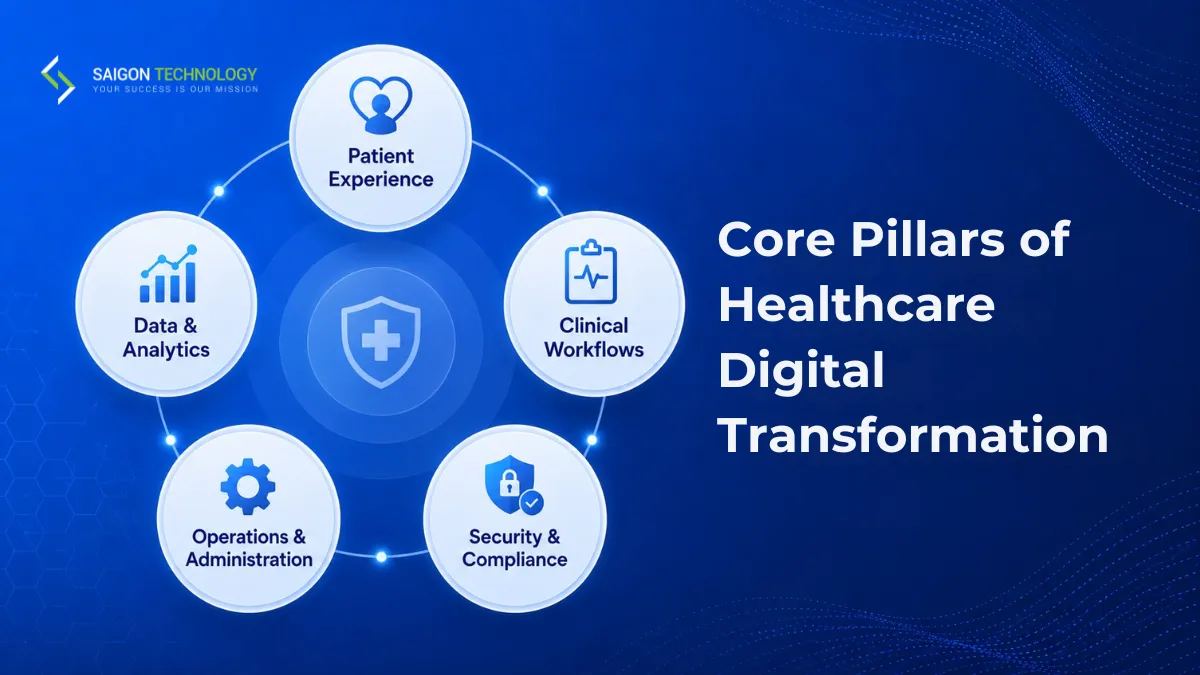
A useful framework groups healthcare digital transformation into five pillars. Each pillar represents a system that must be rebuilt for the AI era.
1. Patient Experience
The front door of healthcare. Covers patient portals, telehealth platforms, online scheduling, and remote patient monitoring. Goal: make access to care as easy as any modern consumer app.
2. Clinical Workflows
Where care is delivered. Covers clinical decision support, ambient AI scribing, e-prescribing, and integrated EHR workflows. Goal: reduce cognitive load on clinicians and improve diagnostic accuracy.
3. Data and Analytics
The backbone. Covers interoperability (HL7 FHIR), population health analytics, healthcare data lakehouse architecture, and predictive modeling. Goal: turn fragmented health data into clinical intelligence.
4. Operations and Administration
The hidden cost center. Covers revenue cycle management, robotic process automation (RPA), and supply chain digitization. Goal: cut admin overhead and accelerate claims processing.
5. Security and Compliance
The non-negotiable layer. Covers HIPAA and HITECH compliance, Zero Trust Architecture, and SaMD (Software as a Medical Device) readiness. Goal: protect patient data and clear regulatory audits.
Every healthcare digital transformation program touches all five pillars. The order of investment varies. The need for all five does not.
Key Technologies Driving Healthcare Digital Transformation
Six technology categories are doing the real work in healthcare digital transformation today.
Electronic Health Records (EHR/EMR) Systems
An EMR (Electronic Medical Record) stores a patient’s chart within one practice. An EHR (Electronic Health Record) is interoperable. Records follow the patient across providers.
Cloud-based EHR systems built on HL7 FHIR standards are now the benchmark. FHIR APIs let hospitals, labs, pharmacies, and insurers share health data instantly. The fax bottleneck is ending. Learn how we approach EHR software development for US clients.
We built AxiaGram for US physicians. It is a HIPAA-compliant telemedicine platform that connects directly to existing EHR systems. It combines remote consultations, AI note-taking, and EHR sync in one workflow.
Artificial Intelligence and Machine Learning (AI/ML)
AI in healthcare is past proof-of-concept. Here is what is working now:
- Clinical decision support: AI flags drug interactions and dosing errors at the point of care.
- Diagnostic imaging: Computer vision detects early cancer markers with accuracy that matches senior radiologists (Nature Medicine).
- AI scribes: LLMs transcribe physician-patient conversations in real time. Documentation time drops by up to 50%.
- Predictive analytics: ML models score patients for readmission risk and sepsis likelihood.
In 2026, AI agents handle scheduling, documentation, and follow-up inside clinical workflows. Saigon Technology applies these AI-driven principles when building healthcare platforms.
Telehealth and Remote Patient Monitoring (RPM)
Telehealth built during COVID-19 is now permanent.
HIPAA-compliant video platforms enable virtual visits across state lines. Modern telemedicine app development now supports multi-state licensing, secure messaging, and EHR integration. Remote patient monitoring takes it further. BLE-connected wearables send continuous vitals to care teams. Alerts fire when readings leave safe thresholds.
Our team has built RPM systems for older adults in the US and Australia. These systems track vitals through BLE sensors, detect abnormal readings, and send alerts to family members.
Cloud Computing and Data Infrastructure
On-premise healthcare IT cannot scale. AWS and Azure now offer HIPAA Business Associate Agreements (BAAs). PHI can be stored and processed in the cloud.
Cloud-native infrastructure delivers:
- Instant data access across distributed care teams
- Elastic scaling during high-demand periods
- Automated backup and disaster recovery
- AES-256 encryption and Zero Trust Architecture
It also cuts capital costs. No more physical hardware to maintain.
Big Data Analytics and Predictive Tools
Most healthcare data sits unused. That is changing.
Population health platforms pull EHR data, claims data, and social health factors together. They identify high-risk patients before those patients reach the ER. Predictive tools are used at the payer and provider level for readmission forecasts, surgical scheduling, and value-based care cost models.
Patient Portals and Mobile Health Apps
Patient engagement predicts outcomes. Patients who access their own health data adhere to treatment plans at higher rates (ONC).
Digital tools that work: online scheduling, lab results, direct messaging, and medication reminders. A well-designed patient portal ties these into one interface. Our healthcare mobile apps include AI-powered assistant features and wearable integration. We have also built mental health apps with self-assessment, therapist matching, and progress tracking.
Benefits of Digital Transformation in Healthcare
Here is what organizations are achieving through healthcare digital transformation.
Less Admin Work
Clinical documentation takes 35-40% of a physician’s day in traditional settings (Annals of Internal Medicine). AI scribes and workflow automation cut that to under 20% in early-adopter health systems.
Better Patient Outcomes
Predictive analytics enable earlier intervention. AI-assisted sepsis detection reduces ICU mortality by 18-20% when care teams act within the first hour (JAMA research).
Lower Operational Costs
Live data access eliminates duplicated tests and reduces coordination delays. For multi-site health systems, unified infrastructure cuts the cost of managing disconnected departmental tools.
Improved Patient Experience
Online scheduling, virtual visits, and instant lab access reduce friction. Patients who manage their health data digitally report higher satisfaction scores.
Stronger Compliance and Federal Incentive Alignment
Digital records are easier to audit. HIPAA documentation and breach detection are simpler than in paper-based systems. Digital infrastructure also unlocks CMS value-based care programs, which reward outcomes over volume. The right setup qualifies you for Medicare incentives and helps avoid MACRA/MIPS penalties.
Challenges and Barriers to Overcome
Healthcare digital transformation fails more often than it succeeds. The reason is rarely the technology. It is the organizational and compliance architecture.
Legacy System Integration
Most US hospitals run on EHR systems from the 1990s and 2000s. Migration to modern, cloud-native infrastructure requires careful data mapping and parallel-run periods. Compatibility between legacy formats and FHIR APIs adds months to timelines.
Data Security and HIPAA Compliance
Healthcare is the most targeted sector for cyberattacks. The average cost of a healthcare data breach hit $10.9 million in 2023 (IBM Cost of a Data Breach Report).
PHI is worth more on the black market than financial data.
Security must be built in from the start. Retrofitting it later is far more expensive. Treating healthcare data security as an engineering discipline, not a checkbox, is the difference between platforms that pass audits and platforms that make headlines.
At Saigon Technology, our ISO 27001-certified security framework includes:
- AES-256 encryption for data at rest and in transit
- Zero Trust Architecture with continuous verification
- Role-based access at the patient, physician, and nurse level
For teams building from scratch, our HIPAA-compliant app development playbook covers the technical controls and documentation needed for an audit.
Clinician Adoption Resistanc
Technology that clinicians will not use delivers zero value. EHR resistance is driven by poor UX and workflow disruption. Successful programs invest in change management as much as in technology.
AI Bias and Ethics
Diagnostic AI trained on non-representative datasets produces biased outputs (NIH study on AI bias). Informed consent frameworks for AI-assisted diagnostics are still evolving. Organizations need internal ethics review before deploying AI in clinical settings.
Interoperability Gaps
HL7 FHIR is the standard. Adoption is uneven. Many exchanges still use HL7 v2 or proprietary APIs. Building interoperable systems needs skilled interface engineering and rigorous healthcare application testing.
Regulatory Complexity
HIPAA and HITECH apply federally. State laws add more: California (CMIA), New York, and others. Multi-state health systems need legal review inside their engineering process.
These are challenges we work through on every healthcare digital transformation engagement. The solution is treating compliance as a first-class engineering concern.
Real-World Examples of Digital Transformation in Healthcare
Most writing on this subject comes from consultants and analysts. Here are three examples from our own engineering work.
AxiaGram: AI-Powered EHR Companion
Problem: US physicians spend hours on EHR documentation. Burnout rates exceed 60% in primary care (Mayo Clinic Proceedings). The admin burden is a clinical quality issue, not just an operational one.
Solution: We built AxiaGram as a HIPAA-compliant telemedicine platform. It connects to existing hospital EHR systems via FHIR APIs.
Core features:
- Secure video consultations
- Real-time AI voice documentation
- Asynchronous clinical messaging
Tech stack: .NET Core, Angular, Azure, HL7 integration, Agora and Wowza for live video streaming. Our senior engineering team runs it as an ongoing Offshore Development Center (ODC) engagement.
Result:
- 6+ million medical records processed
- Zero PHI breach
- 40% faster development vs. client’s previous vendor
- $70K monthly delivery, partnership ongoing and scaling
That is what execution-focused engineering looks like in practice.
See more case studies, our compliance framework, and how we build healthcare platforms end-to-end.
Download our Healthcare Pitch Deck →
How to Measure ROI of Digital Transformation in Healthcare
A program without ROI tracking is just spending. Healthcare digital transformation ROI lives across four categories. Pick the metrics that match your starting point.
KPI Framework by Category
| Category | Metric | What It Measures |
| Clinical | Readmission rate | Quality of post-discharge care |
| Clinical | Diagnostic accuracy | AI and decision support impact |
| Clinical | Time-to-treatment | Workflow efficiency |
| Operational | Clinician hours saved per week | AI scribes and automation gains |
| Operational | Claim denial rate | Revenue cycle health |
| Operational | Average length of stay | Care coordination efficiency |
| Financial | Cost per encounter | Total efficiency gain |
| Financial | RCM days outstanding | Cash flow improvement |
| Financial | Net new revenue | Growth from new digital services |
| Patient | HCAHPS score | Overall patient satisfaction |
| Patient | Net Promoter Score (NPS) | Patient advocacy |
| Patient | Portal adoption rate | Engagement infrastructure |
| Patient | No-show rate | Scheduling and reminders impact |
Worked ROI Example
A 200-bed community hospital deploys AI scribes across 150 physicians. Each physician saves 1.5 hours of documentation per day. That is 7.5 hours per week. At $200 per physician hour, weekly savings is $1,500 per physician. Across 150 physicians, the total is $11.7 million per year.
The platform costs $540,000 per year. Net annual savings: $11.16 million. Payback period: under 30 days.
Even with conservative assumptions, the math is hard to ignore. The harder work is picking the right KPIs and instrumenting your systems to measure them.
The Future of Digital Transformation in Healthcare (2026–2028)
Healthcare digital transformation is entering its second phase.
- Phase one (2015-2023): Digitizing records and building connectivity
- Phase two (2024-onward): Intelligence, automation, and outcomes
Market size
-
- The global healthcare IT market will reach $821 billion by 2026 (MarketsandMarkets)
- US digital health companies raised $10.7 billion across 492 deals in 2023, demonstrating continued investor confidence in healthcare innovation despite a challenging funding environment (Healthcare Dive).
Here are the five trends shaping the next two years.
1. AI Agents in Clinical Decision Support
AI is moving from suggestions to autonomous action. A gentic AI systems can pull patient history, cross-reference clinical guidelines, and propose differential diagnoses. The physician stays in the loop. The agent handles the heavy lifting.
2. Ambient Documentation as the New Standard
By 2028, ambient AI scribing will be the default in primary care. Microphones in exam rooms capture conversations. Models generate structured notes, billing codes, and after-visit summaries. The physician reviews and signs off.
3. Precision Medicine and Genomic Data Pipelines
EHR systems are starting to integrate genomic data. Pharmacogenomics tools match drug prescriptions to a patient’s genetic profile. The use case is moving from oncology into primary care. This needs new architecture: secure genomic storage, clinical decision integration, and consent management.
4. Regulated AI: FDA PCCPs and the EU AI Act
The FDA is rolling out Predetermined Change Control Plans (PCCPs) for AI-based Software as a Medical Device. Models can be updated without a new submission, if changes stay inside an approved envelope. The EU AI Act adds parallel requirements. Organizations deploying clinical AI need a regulatory affairs function from day one.
5. Decentralized Clinical Trials
Clinical trials are moving out of academic medical centers and into patients’ homes. RPM, telehealth visits, and digital consent enable trials that recruit globally. This expands patient access and speeds up drug development.
FAQs
What is healthcare digital transformation?
Healthcare digital transformation means using technology to rebuild how care works, not just going paperless. It covers clinical workflows, patient communication, and admin operations. The tools include EHR systems, AI, cloud platforms, and telehealth.
Why is digital transformation important in healthcare?
Healthcare faces rising costs, physician burnout, aging populations, and growing regulatory pressure. Digital transformation tackles each of these. It cuts admin overhead, enables earlier intervention, and provides the data infrastructure for value-based care.
What are the biggest challenges of healthcare digital transformation?
Three challenges come up on every engagement:
- Legacy system integration: Migration from old EHR infrastructure is expensive and complex.
- HIPAA compliance: Every technical decision has a compliance dimension. It requires specialized expertise.
- Clinician adoption: If physicians will not use the tools, the investment delivers zero value.
What are examples of digital transformation in healthcare?
Real examples include:
- AI scribes that cut documentation time by 50%
- HIPAA-compliant telemedicine platforms for cross-state virtual visits
- RPM systems that track vitals through BLE wearables
- Predictive analytics that flag sepsis risk in ICU patients
- AI imaging tools that detect early cancer markers
How long does healthcare digital transformation take?
It depends on scope. A focused initiative like a patient portal or telehealth activation delivers results in 3-6 months. A full hospital transformation spans 2-5 years. Most programs start with a 90-day pilot in one clinical unit, then scale.
How do you measure ROI of healthcare digital transformation?
ROI lives across four categories:
- Clinical: readmission rate, diagnostic accuracy
- Operational: clinician hours saved, claim denial rate
- Financial: cost per encounter, RCM days outstanding
- Patient: HCAHPS, NPS, portal adoption
Pick 2-3 KPIs per category. Baseline them before launch. Measure quarterly.
Conclusion
Digital transformation in healthcare is not optional. It is also not a single project.
It is a multi-year process of replacing fragmented systems with interoperable, AI-enabled infrastructure. When it works, patients get better care. Providers operate more efficiently. Costs come down.
Three things determine whether a program succeeds or fails:
- A compliance-first engineering approach from the start.
- An interoperability strategy built on HL7 FHIR.
- An AI-native engineering partner who builds faster, leaner, and smarter.
The organizations that get this right will define the next decade of patient care.
Saigon Technology is an AI-native engineering partner for healthcare organizations across the US. We bring senior engineering teams, AI-driven delivery, and 14+ years of execution to every engagement. Explore our healthcare software development services to see what that looks like in practice.


Related articles

What is the Importance of Using Cloud Computing in the Healthcare Sector?
 Thanh (Bruce) Pham - CEO of Saigon Technology
  13 Jun 2024
Benefits of a Health App for Patients & Doctors
12 Jun 2024 
EHR Software Development: A Practical Guide for Healthcare Organizations
30 Jan 2026 
Healthcare Application Testing: A Practical Multi-Market Guide (2026)
09 Feb 2026 
Mental Health App Development: A Complete Guide for 2026
11 Apr 2026 
Healthcare Data Security: Threats, Best Practices & Global Compliance Guide
22 Apr 2026 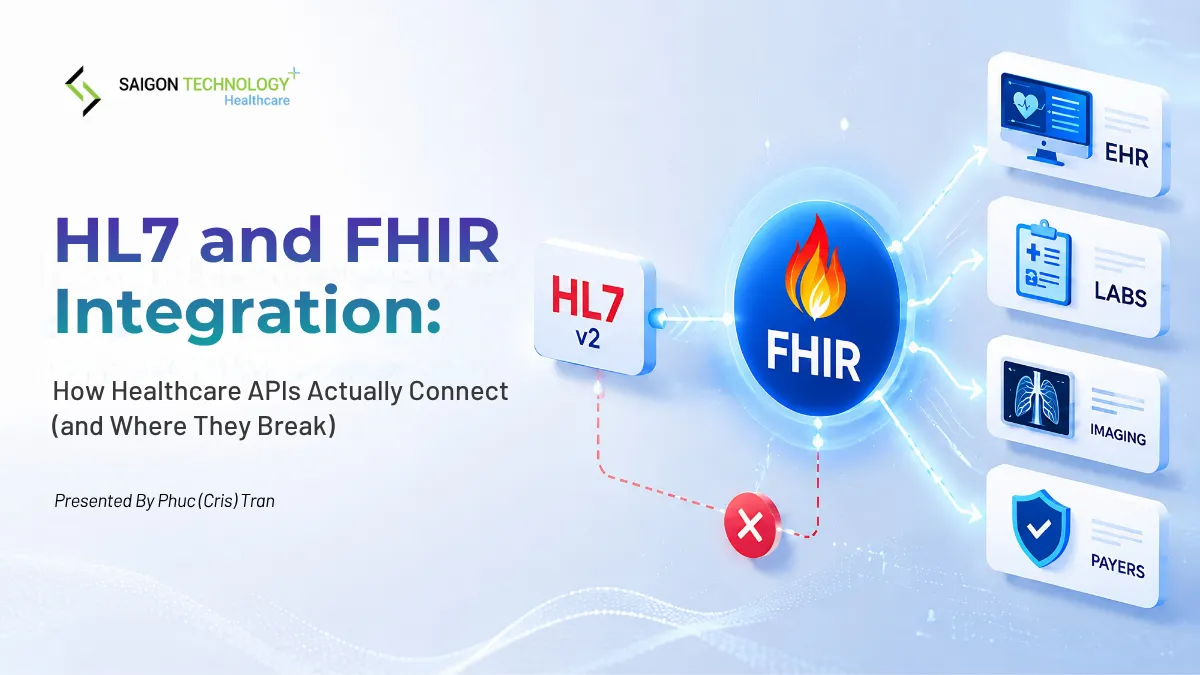
HL7 and FHIR Integration: How Healthcare APIs Actually Connect (and Where They Break)
20 May 2026