




AI Healthcare Software Development: Architecture & Cost

 Updated on Sep 13, 2026
Most healthcare AI projects do not fail at the model. They fail in the eighteen months after it. That is when the model meets a real EHR, a real clinician, and a real auditor. AI healthcare software development is the engineering discipline that covers this distance. It connects a trained model to clinical data, clinical workflow, and the controls regulators expect.
This guide maps where AI actually ships today. It walks through the five layers a production system needs. It also covers what HIPAA and the FDA require, and what the work costs.
Key Takeaways
- Ten AI use cases are in routine production across clinical, workflow, patient-facing, and research settings.
- A production system needs five connected layers. Selecting or training the model is roughly a third of the work.
- The hard parts are data quality, EHR integration, clinical validation, and monitoring after launch. Model architecture is not the hard part.
- Whether an AI feature is a regulated device turns on intended use, not on how advanced the model is.
- Budget from a team shape and a duration, not from a headline figure.
Where AI Actually Ships in Healthcare Software
Healthcare AI software development clusters into four families. Each one carries a different integration burden and a different oversight requirement. Clinical AI touches diagnosis. Workflow AI removes documentation and administrative load. Patient-facing AI talks to people directly. Monitoring and research AI runs on continuous device data.
Pick the family first. That single choice tells you more about cost, timeline, and regulatory exposure than any model architecture decision you will make later.
AI Use Case Families in Healthcare Software
| Family | Use case | What it does | Oversight required |
| Clinical AI | Medical imaging | Flags findings in X-ray, CT, MRI, mammography, and pathology slides | Clinician reads every output |
| Clinical AI | Clinical decision support | Surfaces risks, interactions, and guideline prompts at the point of care | Clinician-in-the-loop |
| Clinical AI | Predictive analytics | Estimates readmission, sepsis, deterioration, and no-show risk | Clinician reviews before action |
| Workflow AI | Ambient documentation | Turns an encounter into structured notes for EHR entry | Clinician signs the note |
| Workflow AI | Coding and billing | Extracts diagnoses and procedures, maps them to code sets | Coder reviews exceptions |
| Workflow AI | Administrative agents | Runs scheduling, referrals, prior authorization, follow-up | Human approval on high-risk steps |
| Patient-facing AI | Conversational intake | Collects symptoms, books appointments, routes to services | Escalation path to a human |
| Patient-facing AI | Patient education | Personalises discharge and medication material, translates it | Review before delivery |
| Monitoring AI | Remote monitoring | Reads wearable and device streams, flags anomalies | Clinical triage of alerts |
| Research AI | Discovery and trial matching | Screens compounds, matches patients to trial criteria | Research governance |
Clinical AI Carries the Heaviest Validation Burden
Imaging models work on DICOM studies. They also have to reach clinicians through the systems they already use. In practice that means a PACS integration, not a separate viewer. The FDA maintains a public list of AI-enabled medical devices it has authorised, and radiology dominates it (FDA, retrieved 2026-09-11).
That concentration is a useful signal. Imaging is where the evidence base and the regulatory path are most established.
Decision support is where good models most often get switched off. The failure is rarely accuracy. It is alert fatigue: set the threshold to catch everything and clinicians learn to dismiss the banner without reading it. Threshold selection is a clinical decision with an engineering consequence. It belongs in the design conversation, not in tuning after go-live.
Get it wrong and the model is still right. Nobody is looking.
Workflow AI Usually Pays Back First
Ambient documentation and coding assistance remove hours from a clinician’s week without changing a diagnostic pathway. The approval surface is smaller. The benefit is easier to measure.
The engineering problem is not transcription quality. Speech recognition solved that years ago. It is EHR write-back: getting structured output into the right fields of Epic, Cerner, or Meditech. The note still has to be attributable to the clinician who signed it. That last piece is what actually consumes the integration budget.
Autonomous agents extend this into multi-step work such as prior authorization and referral coordination. Plan for permissions, audit trails, and escalation paths at design time. Retrofitting them into a live agent is much more expensive than building them in.
Patient-Facing AI Raises the Trust Bar
Conversational systems handle intake, triage, scheduling, and pre-consultation questionnaires. Generative systems personalise discharge instructions and medication explanations. Both carry the same risk: confident wrong output reaching a patient.
The controls are grounding against approved clinical sources, retrieval rather than recall, and human review before anything patient-facing goes out. Skipping that review is the most common way these projects run into trouble after launch.
The Five Layers of a Production Healthcare AI System
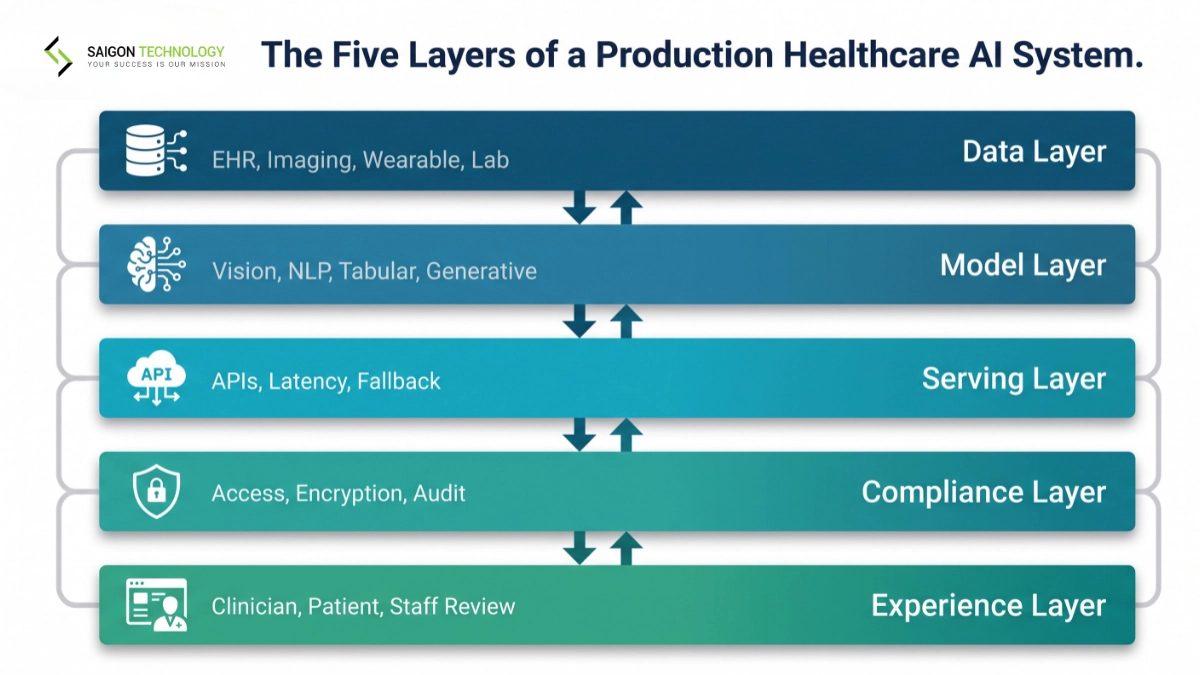
A working system connects five layers, and the model occupies one of them. Teams that scope only the model tend to discover the other four during integration. That is the worst time to find them.
- The data layer ingests and governs records from EHRs, imaging archives, wearables, and lab systems. It carries de-identification, consent handling, and data lineage. Any prediction can then be traced back to the records that produced it.
- The model layer holds the computer vision, natural language, tabular, and generative models, together with their versions and evaluation history.
- The serving layer delivers predictions to applications through APIs. It has to meet an inference latency budget that the workflow can tolerate. It also has to fall back gracefully when the model is unavailable.
- The compliance and security layer enforces access control, encryption, audit trail capture, and retention rules across every layer above and below it.
- The experience layer presents outputs to clinicians, patients, and staff. It carries the explainability and review controls the use case demands.
Layers three through five are where most of the schedule goes. A model that scores well offline still needs a serving path, an audit story, and an interface a clinician will actually use mid-consultation. That distinction matters when you are pricing AI healthcare software development. A vendor quoting only for the model is quoting for roughly a third of it.
Cloud, On-Premise, or Hybrid?
This is usually the first architectural decision, and it constrains everything downstream. Cloud gives elastic training capacity and managed health-data services. On-premise suits fixed infrastructure, data residency rules, and institutions that will not move protected health information off site. Hybrid keeps training in the cloud and inference local. That fits imaging workloads well.
There is no default answer. The inputs are data volume, residency obligations, the latency the workflow tolerates, and what the institution already runs. That is why AI in healthcare software development treats this as a scoping conversation, not a recommendation.
AWS, Azure, and Google Cloud all offer HIPAA-eligible services under a Business Associate Agreement. Each ships managed FHIR services:
Compare them against your own stack and your team’s existing skills, not against a general ranking.
For the integration side in more depth, see our guides on HL7 and FHIR integration and healthcare data security.
What HIPAA, HL7/FHIR and the FDA Require
Compliance belongs in the architecture from day one. This is a cost warning, not a legal disclaimer. Retrofitting controls into a system that already moves patient data is much more expensive than designing for them from the start. In our experience, it is also the single most common reason healthcare AI budgets overrun by a wide margin.
Regulatory and Interoperability Requirements
| Area | What it governs | What it means for the build |
| HIPAA | Protection of US health information | Access control, encryption at rest and in transit, audit logging, and a signed HIPAA BAA with every service provider touching PHI |
| HL7 and FHIR | Clinical data exchange | How the AI service reads from and writes to EHRs and other clinical systems |
| FDA | Software used for medical purposes | Whether the product is a regulated device, and what validation and change control follow from that |
| GDPR and PDPA | Personal and health data protection | Consent, subject access rights, and cross-border transfer constraints |
HL7 FHIR is the practical centre of this work. It defines the resources an AI service uses to read a patient record and write a result back. It is also what makes an integration portable across institutions, rather than bespoke to one.
The current published specification is R5 (HL7, retrieved 2026-09-11). Treat version alignment as a project constraint. Institutions rarely run the newest release.
Requirements also depend on the market. A patient-facing application serving US patients carries different obligations from an internal analytics platform used inside one hospital group. Confirm which you are building before scope and budget are fixed. That single question reshapes the compliance workload in healthcare AI software development more than any other input.
The HHS HIPAA guidance hub is the authoritative starting point for the US rules. Our field notes on HIPAA-compliant app development cover the engineering side of the same question.
When an AI Feature Becomes a Regulated Device
This is the question that most often gets answered wrong, and getting it wrong late is expensive. The FDA defines Software as a Medical Device, following the International Medical Device Regulators Forum, as “software intended to be used for one or more medical purposes that perform these purposes without being part of a hardware medical device” (FDA, retrieved 2026-09-11).
Read that definition carefully. The operative words are intended use. Classification does not turn on how advanced the model is, how it was trained, or whether it uses generative AI. It turns on the medical purpose the software is offered for. That means a simple rules engine can land inside the device pathway. A large language model sitting behind a clinician’s review may not.
For clinical decision support, the FDA has issued separate guidance. It sets out the criteria that distinguish decision-support software it does not regulate from software it does. One of those criteria is whether the software displays the basis for its recommendation. That basis has to let a clinician independently review the output, rather than simply rely on it.
Read that guidance directly against your intended-use statement before assuming your feature sits outside the device pathway.
Two practical consequences follow. First, write the intended-use statement early. It determines the validation and change-control burden for the life of the product. Second, if the answer is genuinely unclear, that is a regulatory question for qualified counsel, not an engineering judgement call.
How to Build It: Six Steps From Use Case to Monitoring
The process below is what AI healthcare software development looks like in practice. Each step exists because skipping it surfaces the same problem later at higher cost.
1. Define the Use Case, Not the Technology
Start from the clinical or operational problem. Teams that start from the technology tend to build something impressive that no one in the clinic needs. Define the users, the workflow position, the expected output, the success measure, and the level of human oversight required.
The deliverable is a scoped use case with measurable clinical and technical acceptance criteria. That includes latency and accuracy targets and the integration points involved.
2. Assess Data Readiness before Committing
Evaluate the data behind the use case honestly. Healthcare datasets often carry missing values, inconsistent labels, class imbalance, and gaps in provenance. Every one of those is cheaper to find now than during training. Build pipelines for cleaning, labelling, normalisation, validation, and de-identification. Separate training, validation, and test sets properly to avoid leakage.
The deliverable is a dataset you can defend. In custom healthcare AI software development, this step decides the schedule more often than model selection does. Our AI readiness assessment walks through the same evaluation we run before scoping a build.
3. Validate against Clinical Reality, Not Average Accuracy
Select and train the model. Then evaluate it on the measures that matter clinically. Average accuracy hides the failure that matters. A model can score well overall and still perform badly for a specific patient population, so subgroup performance is not optional. Validation progresses through a ladder:
- Retrospective validation on historical data
- Silent-mode validation, where the model runs live and its outputs are recorded but not shown
- Prospective evaluation under clinical oversight, where the use case warrants it
Silent mode is the step most teams skip. It is also the one that catches distribution mismatch before a clinician ever sees a prediction.
“A held-out test set is frozen; a clinic is not. Silent mode is the first time the model sees real ordering patterns, real missing fields, and the population as it actually presents, which is where offline accuracy and clinical accuracy come apart.”
– Phong Le, Tech Lead (AI, Python) at Saigon Technology
4. Productionise the Service
Move the validated model into a real service. This is where the model registry, containerisation, CI/CD, logging, monitoring, fallback behaviour, and rollback procedures get built. The serving architecture has to meet the inference speed, availability, and failure-handling the workflow demands. An imaging queue is very different from an ambient documentation stream.
5. Integrate into the Workflow
Connect the service to the systems where its output will be used. That usually means EHR, imaging, or patient platforms. Budget more time here than feels reasonable, then add some for good measure.
Institutional integration in AI in healthcare software development involves identity management, interface review, security sign-off, and scheduling around the hospital’s own release calendar. It routinely takes longer than the modelling did. The interface must make outputs reviewable, with the clinician clearly positioned as the decision-maker.
6. Monitor, and Keep Monitoring
AI healthcare software development does not end at launch. Track model performance, data drift, system reliability, and how the output is actually used. Establish controlled retraining, validation, and rollback processes before you need them.
Populations change, and coding practice changes with them. A model that was accurate at go-live can degrade quietly for months. Nothing breaks. No one complains. Then an audit asks how the last twelve months of predictions were produced.
What It Costs and How Long It Takes
Cost is usually the question behind the question. Here is how to build the number rather than a headline range. Most vendors quoting AI healthcare software development services will not publish a rate at all. Ours is $22 to $46 per hour for implementation work with senior oversight, depending on seniority and engagement model. Multiply a team shape by a duration and you have a defensible budget.
Cost Bands by Project Scope
| Scope | Example | Typical team | Duration | Illustrative range at the published band |
| Single use case pilot | Readmission risk in an existing dashboard | 3 engineers, 1 data scientist | 4 to 6 months | ~2,560 to 3,840 hours |
| Production clinical service | Imaging analysis integrated with a clinical workflow | 5 to 6 engineers plus clinical input | 6 to 9 months | ~5,760 to 8,640 hours |
| Multi use case platform | Documentation, decision support, and patient conversation | 8 or more across two workstreams | 9 to 12+ months | ~11,520 hours and up |
Apply the hourly band to the hours column for a range in your own currency and engagement model. A four-person team over five months, for example, is roughly 3,200 hours. At the published rate, that lands between $70,400 and $147,200.
The variables that move the number are EHR integration depth, how much data preparation and labelling the dataset needs, whether clinical validation extends to a prospective study, deployment constraints, and regulatory pathway. If your estimate does not account for at least two of those, revisit it before committing. For a broader breakdown, see our healthcare cost breakdown.
Shipped in Production
Saigon Technology has delivered 100+ AI projects with 30+ AI engineers across two dedicated AI teams. We hold ISO 27001 certification for information security and Microsoft Gold Partner status for application development. Two of those engagements show what custom healthcare AI software development looks like once it is running against real clinical systems.
EHR Companion with Voice-Assisted Documentation
A US chronic care provider needed to reduce documentation load for clinicians while supporting remote care against an existing EHR. We built the platform on .NET Core, Angular, and Azure, with HL7-based EHR integration, AI-assisted voice note taking, and real-time video. It also carries encryption, role-based access, and audit logging for protected health data.
For more details, see the HealthTech case study.
Teleconsultation and Screening Platform
A multi-location provider needed to connect patients, clinicians, labs, and services with teleconsultation and clinical data exchange. We built it on Angular, Node.js, PostgreSQL, and WebRTC. It includes screening booking, digital consent, payment reconciliation, and HL7 connectivity. It operates under HIPAA and PDPA aligned controls.
What Is AI Healthcare Software Development?
AI healthcare software development is the engineering discipline of building, integrating, and operating AI systems inside healthcare software. It runs under HIPAA, clinical interoperability standards such as HL7 and FHIR, and applicable FDA requirements. It spans six practice areas:
- Model development
- MLOps for regulated environments
- EHR and imaging integration
- Data governance and de-identification
- Clinical interface design
- Compliance implementation
The distinction worth holding onto is between healthcare AI and its development. Healthcare AI names the outcomes: faster reads, automated documentation, earlier risk signals. AI healthcare software development names the work that produces them under those constraints.
Licensing a medical AI product is not development. Building a system that integrates with an EHR, operates under a signed BAA, and passes clinical validation is. That is the whole difference. That is where budgets go.
Frequently Asked Questions
How Long Does It Take to Get a Healthcare AI Feature into Production?
Four to six months for a single use case pilot. Six to nine months for a production clinical service. Nine to twelve months or more for a multi use case platform. Institutional integration and validation, not modelling, usually determine which end of the range you land on.
What Actually Makes These Projects Fail?
Data readiness and integration, in that order. Datasets with inconsistent labels or unclear provenance force rework during training. EHR integration routinely takes longer than teams plan for. Model selection is rarely the constraint.
Which Cloud Should We Use for Healthcare AI?
All three major providers offer HIPAA-eligible services under a Business Associate Agreement and ship managed FHIR services: AWS HealthLake, Azure Health Data Services, and the Google Cloud Healthcare API. Decide on your existing infrastructure, your team’s familiarity, and your data residency obligations, rather than on a general ranking.
Is Generative AI in Healthcare Regulated?
It depends on intended use, the same test applied to any medical software. A system that drafts a discharge summary for a clinician to review sits in a different position from one that recommends a treatment plan without sign-off. Read the FDA’s clinical decision support guidance against your own intended-use statement. Take regulatory advice where the answer is unclear.
Do We Need Clinicians Involved during the Build?
Yes, and earlier than most plans assume. Threshold selection, subgroup validation, interface review, and escalation design are all clinical decisions with engineering consequences. Treating clinical input as an acceptance-stage activity is how systems get built that no one uses.
How Do We Keep a Model Reliable after Launch?
Monitor performance, data drift, and real usage continuously. Build controlled retraining, validation, and rollback before you need them. Degradation in healthcare is usually gradual and quiet, so it is caught by instrumentation, not by complaints.
Where to Go From Here
Healthcare AI is already running in production across imaging, documentation, monitoring, and patient communication. The difficulty is not the model. It never was. AI healthcare software development is everything around it: your data, your EHR, your clinical workflow, and the compliance obligations that follow all three.
Planning a build? Our engineering team offers a free 30-minute technical review to assess your architecture and data readiness and identify integration constraints before development starts. We also offer a two-week risk-free trial. You can evaluate the people who would deliver your AI healthcare software development services before committing to anything longer.
Talk to our healthcare engineering team
Continue Exploring
- Healthcare software development services for building and integrating clinical systems
- EHR software development for connecting AI to clinical data
- Remote patient monitoring for the device integration side
- AI development services for the wider AI engineering practice


Related articles
Medical Practice Management Software: Features & Costs 2026
 Van Le - Business Analyst
  21 Oct 2026
Logistics Optimization in 2026: Strategies, Software & AI
16 Oct 2026 
AI Route Optimization: How It Works, Benefits, and Use Cases 2026
14 Oct 2026 
Student Information System: A 2026 Guide for Schools
09 Oct 2026 
Insurance Portal Development in 2026: Types, Features, Cost
07 Oct 2026 
Insurance Claims Automation in 2026: Build, Buy, or Hybrid
01 Oct 2026 
IoT in Healthcare: How Healthcare IoT Systems Work in 2026
25 Sep 2026 
AI in Real Estate: 9 Use Cases and How to Build It (2026)
16 Sep 2026 
8 Fintech Software Development Trends Reshaping 2026
26 Aug 2026