




Healthcare Chatbot Development: The Complete 2026 Guide

 Updated on Aug 19, 2026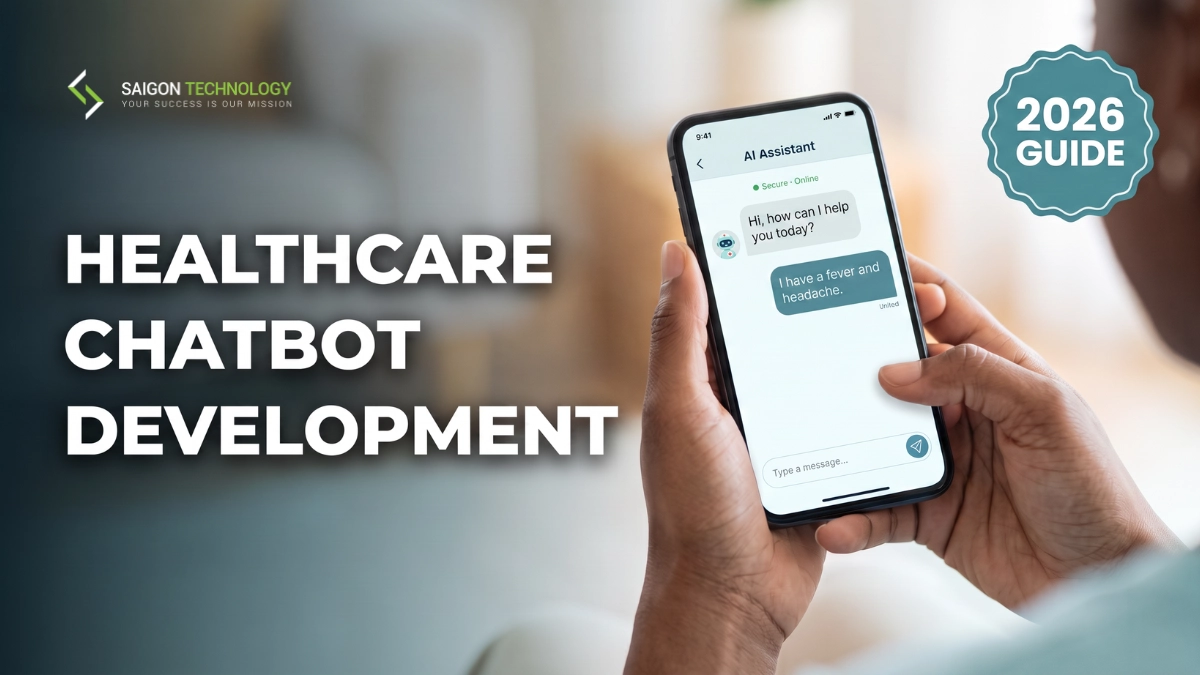
A healthcare chatbot is an AI-powered conversational application that helps patients and clinical staff handle tasks like triage, appointment scheduling, medication reminders, and benefits questions through text or voice, while staying compliant with HIPAA and other regulations. If you’re a healthcare CTO or product leader, this solves a real problem: your staff is stretched thin, and every new feature has to clear a HIPAA review before it ships. A well-built chatbot earns its keep here, and your team stops answering the same ten questions all day.
Healthcare chatbot development has also changed. Most teams now build on large language models with retrieval-augmented generation (RAG) and clinical guardrails instead of scripted, rule-based bots, which lets the chatbot handle open-ended questions without guessing at clinical facts.
What this guide adds: most healthcare chatbot guides stop at a use-case list and a generic cost range. This one is written from EHR-integrated builds our teams have run as offshore development centers since 2021, including a HIPAA-compliant US telemedicine platform that handles more than 6 million medical records. So the architecture, the integration order, and the cost tiers below reflect what actually took the time on those projects, not a market summary. We also correct a claim that appears in most competing guides: HIPAA does not require AES-256, TLS 1.3, or OAuth 2.1. More on why that matters in the compliance section.
Key Takeaways
- Start narrow. Pick one use case, triage, scheduling, or FAQs, and give it a KPI. Healthcare chatbot development fails on scope, not technology.
- Modern builds are hybrid. Deterministic rules run high-risk clinical flows; an LLM with RAG handles open questions. Rule-based scripting alone won’t cope with real patient phrasing.
- HIPAA compliance isn’t automatic, and it isn’t a cryptography checklist. You need signed Business Associate Agreements, access controls, and audit trails. The Security Rule asks for “reasonable and appropriate” safeguards, not named algorithms.
- Budget $15,000 to $300,000 or more. A rule-based MVP starts around $15,000; a full clinical assistant with bidirectional EHR write-back runs $180,000 and up.
- EHR integration is where schedules slip. On our own projects, HL7 and FHIR work consistently absorbed more calendar time than the conversational layer did.
- The market is growing fast. The global healthcare chatbots market is calculated at USD 1.49 billion in 2025, projected to reach roughly USD 11.99 billion by 2035 at a 23.19% CAGR (Precedence Research, retrieved 2026-08-18).
What Is a Healthcare Chatbot?
A healthcare chatbot is a conversational AI application deployed inside a clinical or patient-facing workflow to answer questions, guide users through healthcare processes, and reduce the workload on your staff. Some are external tools patients use from home. Others sit inside clinician workflows, handling tasks like clinical documentation or knowledge lookup.
The technology has shifted quickly. Older systems relied on predefined rules and scripts, so an unrecognized question meant a failed interaction. Modern healthcare chatbot development leans on generative AI and RAG instead, handling open-ended questions without scripting every phrasing. Most production systems still pair that generative layer with a rules layer for clinical flows where predictability matters most.
Two framings help keep the scope honest:
- A chatbot in healthcare is a workflow product, not a chat window. Its value comes from the systems it reaches, not from how fluent it sounds.
- A chatbot for healthcare is a regulated product. Every design decision carries a compliance consequence, which is why the security section below comes before the build steps.
We cover when each technical approach fits in Types of Healthcare Chatbots.
Healthcare Chatbot Use Cases: 8 That Work in Production
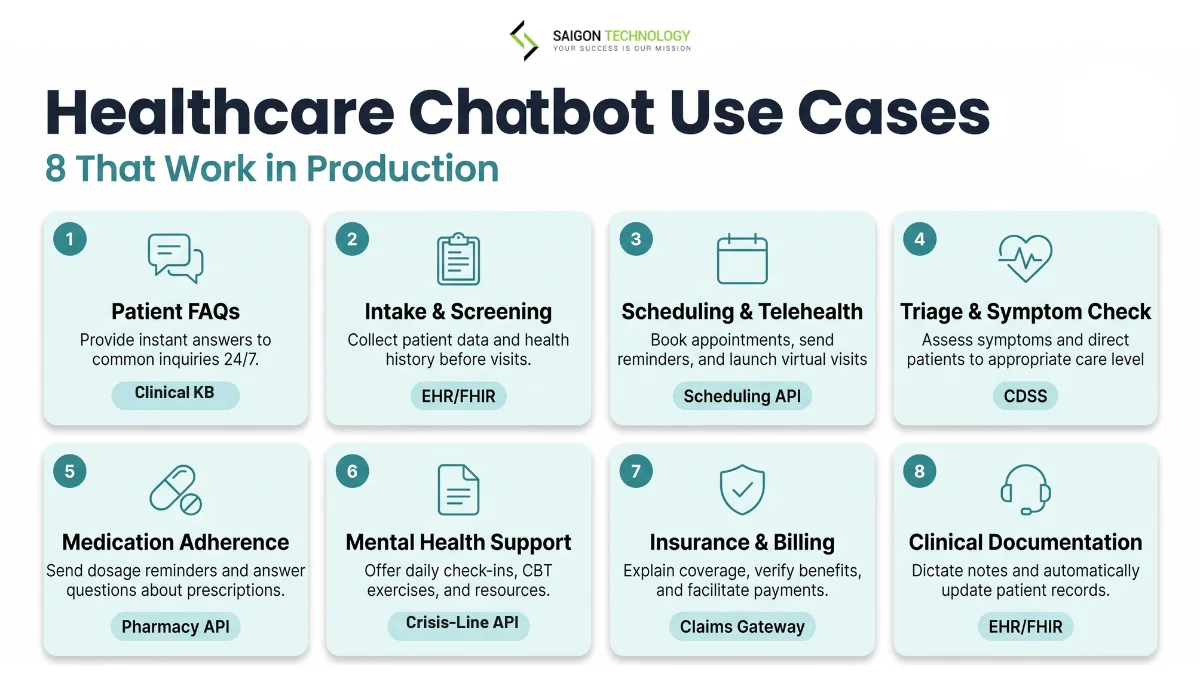
Healthcare chatbot use cases span the entire patient journey. The ones that work best pair a narrow task with a clear KPI, so you can measure whether the chatbot earns its keep. Here are the eight we see succeed in production, with what each does, its business value, and the systems it needs.
Note where the market is concentrated: the symptom-checking segment held the largest application share at 39% in 2025, and software accounted for 64% of the market that year (Precedence Research, retrieved 2026-08-18). Triage and custom build work, in other words, is where most healthcare chatbot development spending sits.
1. Patient FAQs and health information
What it does: Answers recurring questions. Think symptoms, appointment prep, hospital and clinic information, medication details, post-treatment instructions, and general health education. It draws answers from a curated clinical knowledge base through RAG, with output guardrails to prevent hallucination.
Business value: If your front desk and call center are fielding the same ten questions every day, this is where you start. It deflects that volume and gives you visibility into what patients are actually asking.
Key integrations:
- Clinical knowledge base (curated CMS or FHIR-based content service)
- Authentication for personalized answers
- Escalation to a live agent
2. Patient intake and pre-visit screening
What it does: Collects patient information, asks pre-visit screening questions, and gathers medical history. It also verifies insurance eligibility, captures consent, and posts a structured summary to the clinician before the appointment.
Business value: Paper intake forms slow every visit and frustrate patients who fill out the same information twice. Replacing them cuts visit time and gives your clinicians better data the moment they walk into the room.
Key integrations:
- EHR and EMR systems (write access through FHIR or HL7 v2.x)
- Practice management solutions
- Consent management
- Insurance eligibility APIs
3. Appointment scheduling and telehealth support
What it does: Books, confirms, and reminds patients about appointments. For virtual visits, it also handles telehealth check-in and delivers the video consultation link over a secure URL. It follows up after the visit, or troubleshoots a failed connection.
Business value: No-shows and missed telehealth connections both cost you a clinician slot you can’t get back. Combining scheduling with the telehealth workflow closes that gap in one conversational surface instead of two disconnected tools.
Key integrations:
- Practice management and scheduling software
- Telehealth platforms (WebRTC providers such as Agora or Vonage)
- SMS or notification provider
- Calendar APIs
On one nationwide outpatient platform, our team paired QR-code check-in with multichannel reminder alerts across email and SMS. That combination is what moved the no-show numbers, not the conversational layer by itself. Related reading: building a telehealth product end to end.
4. Patient triage and symptom screening
What it does: A medical triage chatbot classifies symptom severity through structured questions. Those questions run on clinical decision support system (CDSS) logic. The chatbot then routes the patient to the right care level, or escalates to a clinician.
Business value: Emergency departments and urgent-care clinics often see patients who could be treated at a lower level of care. Better routing fixes that. It also produces a documented triage record for the chart, which your compliance team will want.
Key integrations:
- CDSS for triage logic
- EHR write-back for the triage record
- Telehealth platforms for virtual visits
- Defined escalation paths to a live clinician
5. Medication adherence and chronic disease follow-up
What it does: Sends medication reminders on schedule. It routes refill requests to the pharmacy through a healthcare API. It also runs scheduled check-ins after discharge and ingests remote patient monitoring data from wearables. If a reading falls outside a safe range, it escalates to a clinician.
Business value: Non-adherence and post-discharge drop-off both drive readmissions, and neither problem scales with headcount the way an ai chatbot for healthcare does. Continuous, automated check-ins support care coordination and adherence targets without adding staff.
Key integrations:
- Pharmacy APIs
- EHR and EMR systems
- Wearable devices and remote patient monitoring platforms
- CDSS for alert logic
Our eldercare work is a useful reference point here. A BLE-connected monitoring app tracked SpO2, heart rate, body temperature, blood pressure, and weight, then pushed anomaly alerts to family members and caregivers with tiered access control. The hard part was never the alert logic. It was pairing reliably with multiple device types and designing an interface elderly users could actually operate. See our deeper look at remote patient monitoring for the broader pattern.
6. Mental health first-line support
What it does: A mental health chatbot in this category handles low-acuity check-ins and guided self-help exercises. It also screens for escalation to a human clinician.
Business value: If your mental health providers are booked out for weeks, this gives patients an accessible first touchpoint in the meantime. Treat safety design as non-negotiable here. Any chatbot solution for healthcare in this space needs a visible path to a live person, plus explicit AI disclaimers.
Key integrations:
- Crisis-line APIs
- EHR and EMR systems
- Human escalation routing
See our companion post on mental health app development for the broader product view.
7. Insurance and billing FAQs
What it does: An insurance chatbot delivers real-time claim status tracking, plan benefits, copay information, deductible balances, and prior-authorization status. It explains an explanation of benefits in plain language, flags what a patient actually owes, and routes disputes to a billing specialist with the conversation history attached.
Business value: Billing questions are high-volume, low-complexity, and they clog the same phone line as clinical calls. Deflecting them protects your clinical support capacity, and clearer cost conversations up front reduce the write-offs you take later.
Key integrations:
- Payer eligibility and claim status APIs
- Revenue cycle management and billing systems
- Payment processor for balance settlement
- Handoff to a human billing specialist
8. Clinical documentation and staff-facing support
What it does: This one faces your staff, not your patients. It captures clinical notes by voice during or after an encounter, drafts structured summaries for the chart, and answers internal questions about protocols, formulary, or coding. Voice AI handles the transcription; RAG grounds the protocol answers in your own approved documentation.
Business value: Documentation burden is a leading driver of clinician burnout, and it’s work that produces no revenue on its own. This is also the use case with the shortest path to adoption, because your staff are a captive, trainable audience and the compliance surface is narrower than a patient-facing bot.
Key integrations:
- Speech-to-text tuned for clinical vocabulary
- EHR write-back for note and encounter data
- Single sign-on and role-based access
- Internal knowledge base for protocol and coding lookup
We shipped voice-controlled, AI-powered note-taking on a US chronic-care telemedicine platform, alongside electronic visit verification with geo-tagging and digital signature. Clinicians adopted the voice notes faster than any patient-facing feature on the same product.
Key Features of a Healthcare Chatbot
Every production healthcare chatbot needs a defined feature set: core features every deployment needs on day one, and advanced features that separate an MVP from a full clinical assistant.
Core features:
- Intent recognition and entity extraction, the base layer for routing users correctly.
- Conversational flows with an explicit human handoff on every high-risk flow.
- Compliant data handling: PHI encryption, role-based access, and audit logging.
- Multi-channel delivery across web, mobile app, SMS, and messaging apps.
- Authentication and consent management before any personalized response.
Advanced features:
- RAG over verified clinical knowledge to reduce hallucination.
- Voice AI for telehealth and clinical documentation.
- Bidirectional EHR integration that writes to the record, not just reads it.
- Sentiment analysis to detect distress and trigger escalation.
- Predictive support for refill timing and follow-up scheduling.
- Multimodal input for lab results and document upload.
- Personalization based on patient history.
- Multilingual support for your target market.
The gap between those two tiers is roughly the gap between the MVP and the full production tiers in our cost table.
Types of Healthcare Chatbots
Healthcare chatbots split along two axes: how they generate answers (rule-based, LLM-based, or hybrid) and who they serve (patient-facing or staff-facing). This is the first real branch point in healthcare chatbot development, and switching architectures mid-build is expensive.
Rule-based chatbots match input to fixed intents and reply from a scripted set. Good for a fast MVP, but they break down outside bounded tasks like scheduling and FAQs.
LLM-based chatbots generate responses with a large language model, typically combined with RAG over verified clinical content to stay current and reduce hallucination. They handle open-ended questions well, but need careful guardrails or they’ll produce plausible-sounding, incorrect answers.
Hybrid chatbots run high-risk flows (triage, consent, medication guidance) through deterministic rules, with the LLM plus RAG stack handling open questions. This is the default for production US healthcare deployments, and it’s the approach we’d recommend for any chatbot in healthcare that touches clinical decisions.
| Type | Best for | Accuracy pattern | Where it maps in the cost table |
| Rule-based | FAQs, scheduling, structured intake | High on scripted paths, brittle outside them | Tier 1 (MVP) |
| LLM-based (RAG) | Symptom screening, open-ended questions | High with guardrails; lower without | Tier 2 |
| Hybrid | Production healthcare deployments | Predictability plus flexibility | Tier 2, or Tier 3 with EHR write-back |
Beyond answer style, think about audience. Patient-facing chatbots prioritize accessibility, safety, and clear escalation. Staff-facing chatbots prioritize accuracy, EHR integration depth, and single sign-on. Most enterprise deployments need both.
Healthcare Chatbot Architecture
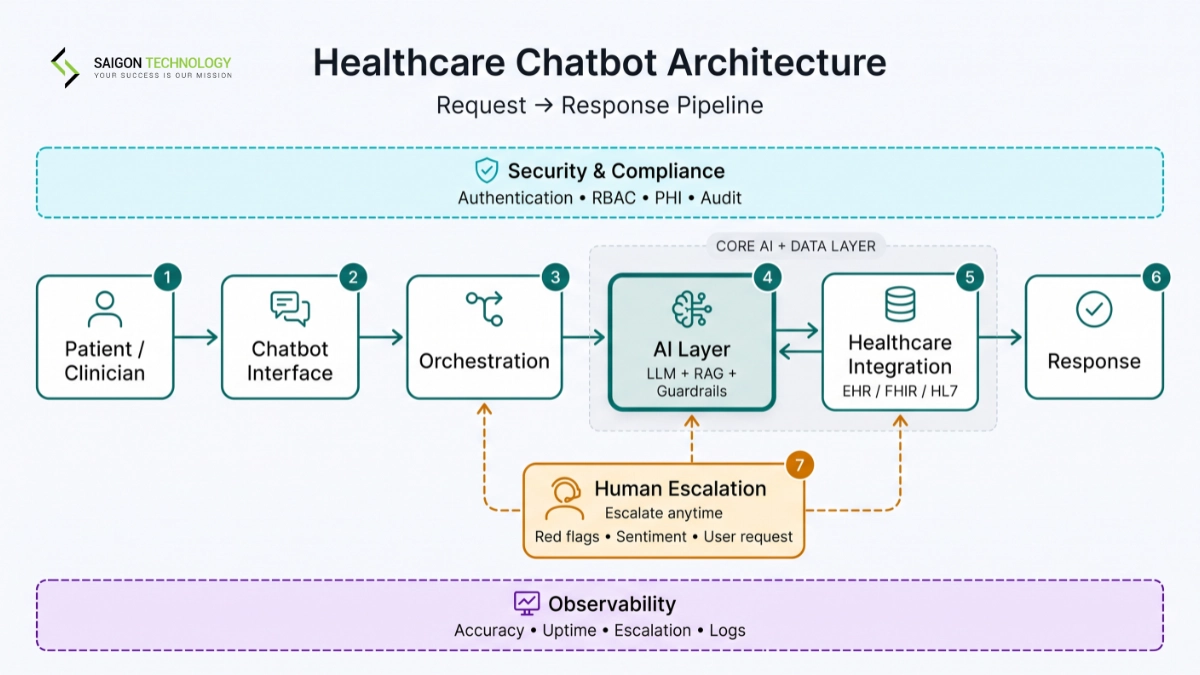
A production healthcare chatbot is a straight pipeline. A request comes in, an AI layer generates the answer, your healthcare systems supply data, and the response goes back, with security wrapped around every step and a human ready to step in.
The request path, in order:
- Patient or clinician sends a message through their channel of choice.
- Chatbot interface receives it: web widget, mobile app, SMS, or voice.
- Conversation and orchestration layer holds dialogue state and decides whether a rule-based flow or the generative layer handles this turn.
- AI layer combines the LLM, RAG retrieval, and guardrails to compose an answer.
- Healthcare integration layer reads and writes clinical data through EHR/EMR, FHIR, HL7, and other healthcare APIs.
- Clinical response returns to the user.
- Human escalation intercepts at any point when a red-flag symptom, a sentiment signal, or a direct request warrants it.
Two layers wrap the whole pipeline rather than sitting inside it:
| Cross-cutting layer | What it covers |
| Security and compliance | Authentication, role-based access control, PHI protection, audit logging |
| Observability | Response accuracy monitoring, uptime, escalation rate, conversation logs |
The layering matters more than any single component choice, and it’s the part of healthcare chatbot development that pays off latest. Get it right and the rest of your ai chatbot for healthcare becomes easier to extend, because each layer can change without forcing a rewrite of the others.
Technology Stack for Modern Healthcare Chatbots
The table below maps each architecture layer to the technologies our teams use on production healthcare chatbot development projects. Not every row applies to every build.
| Layer | Representative technologies | Purpose |
| LLM and orchestration | Azure OpenAI (HIPAA-eligible tiers), AWS Bedrock with Guardrails, self-hosted Llama or Mistral, LangChain/LlamaIndex | Generates responses; self-hosted models keep PHI from leaving your infrastructure |
| RAG (retrieval-augmented generation) | Pinecone, Weaviate, PGVector, Azure AI Search | Retrieves verified clinical content to ground answers |
| Voice AI | Whisper, Google Healthcare Speech, Azure Speech, Amazon Polly Neural | Powers telehealth interactions and clinical documentation |
| Platform layer (rules for hybrid builds) | Rasa, Microsoft Bot Framework, Azure Bot, Google Dialogflow CX, Amazon Lex, IBM Watson Assistant | Handles scripted, closed-domain intents alongside the LLM |
| Healthcare integration | HL7 v2.x, FHIR R4, DICOM, LOINC, CPT, SNOMED CT, AWS HealthLake, Azure Health Data Services, Google Cloud Healthcare API | Connects the chatbot to Epic, Cerner, Athena, and other EHRs |
| API gateway | Kong, Apigee with rate limiting and throttling | Controls and meters access to clinical endpoints |
| Security infrastructure | HashiCorp Vault, AWS KMS, Azure Key Vault, OAuth 2.1, SSO, MFA | Secrets management, identity, and access control |
Our own healthcare chatbot and NLP work has run on Rasa, Azure Bot, and Dialogflow for mental health and triage flows, with Whisper and Google Healthcare Speech behind clinical note-taking. For the surrounding platform, our US deployments run on AWS under a HIPAA Business Associate Agreement, Azure Health Data Services, and the Google Cloud Healthcare API.
For more on layering generative AI into existing enterprise systems, see our generative AI integration services.
Healthcare Chatbot Examples: What’s Already in Market
Before you scope a healthcare chatbot development project, it’s worth knowing what already exists. Some of these are products you could buy or partner with. Others are research systems that show where the field is heading. Either way, they set the expectation bar your own chatbot for healthcare will be measured against.
| Example | What it does | Why it’s relevant to a build decision |
| Ada Health | Consumer symptom assessment, then care-navigation guidance | The reference point for triage UX. If you’re building symptom screening, this is the comparison patients will make. |
| Buoy Health | AI symptom checker that routes to an appropriate care option | Shows the value of routing over diagnosis, which is also the safer regulatory position. |
| Sensely | Avatar-based virtual assistant for engagement, chronic care, and insurance queries | Demonstrates the multimodal and payer-facing end of the market. |
| Google AMIE | Research diagnostic dialogue system | Signals where clinical-grade reasoning is heading. Not a product you can deploy today. |
| Healthily (Dot) | Preventive-care information and symptom checks | Useful model for a content-and-education chatbot grounded in a curated knowledge base. |
Two honest observations from evaluating this category on client projects:
- Buying rarely removes the integration work. The conversational layer is the part vendors have solved. The EHR, scheduling, and billing connections are still yours to build, and that is where the schedule risk lives.
- General-purpose consumer assistants are not a shortcut. A public LLM assistant has no Business Associate Agreement covering your patient data, which rules it out for anything touching PHI regardless of how capable it seems. Any ai chatbot for healthcare that handles PHI needs that agreement in place first.
Healthcare Chatbot Security and Compliance
Building a HIPAA compliant chatbot is one of the more demanding parts of healthcare chatbot development, and requirements differ by market. The table below is an engineering starting point, not legal advice. Confirm scope with counsel in each market you deploy to.
| Market | Key regulation(s) | What it means for your chatbot |
| United States | HIPAA and HITECH | Signed BAA with every vendor that touches PHI; “reasonable and appropriate” safeguards; access controls and audit logs |
| UK / EU | GDPR and UK GDPR + Data Protection Act 2018 | Lawful basis for processing, explicit consent for special-category health data, a DPIA where processing is high-risk |
| Australia | Privacy Act 1988 plus My Health Records Act | Health information treated as sensitive information; breach notification under the NDB scheme |
| Singapore | PDPA plus MOH AI in Healthcare Guidelines | Data protection, governance, transparency, and human-oversight expectations for AI systems |
The point most guides get wrong
A covered entity can only share PHI with a Business Associate, a vendor that creates, receives, maintains, or transmits PHI on its behalf, and every Business Associate needs a signed BAA before touching real patient data.
Here’s the part worth reading twice. The HIPAA Security Rule requires “reasonable and appropriate” safeguards, not specific algorithms. HIPAA does not itself mandate AES-256, TLS 1.3, or OAuth 2.1. Encryption is an addressable implementation specification, not a required one, which means you must assess it and document your decision rather than tick a box. Most competing guides state or imply the opposite, and that misreading leads teams to treat a cryptography checklist as compliance while leaving the actual gaps, risk analysis, workforce access controls, and audit trails, unaddressed.
The controls below are engineering best practice. They are what we build to across every market above, regardless of which regulation is legally in force:
- Encryption in transit and at rest (we standardize on AES-256)
- Authentication, MFA, and role-based access control, scoped per role for doctors, nurses, and administrative staff
- PHI minimization and de-identification where appropriate, including synthetic data for model testing so PHI never enters a test environment
- Audit logging and monitoring, with trails that support licensed facilities and insurers
- Vendor and BAA assessment before any integration touches PHI
- Human escalation for high-risk clinical interactions
For more depth, see HIPAA-compliant app development and healthcare data security.
How to Build a Healthcare Chatbot
The five steps below are the framework our engineering teams use for healthcare chatbot development. Each step feeds back into the next.
1. Discovery and requirements
Start with the business outcome, not the technology. Define your target audience, your top two or three use cases, and the KPIs that tell you whether the chatbot works.
Pick metrics you can already measure today, so you have a baseline to compare against. Call deflection rate, task success rate, no-show rate, and average handle time all work. Vanity metrics like total conversations do not. Decide up front what number would make you shut the project down, because that forces an honest scope conversation before anyone writes code.
This is also where you decide patient-facing or staff-facing. Doing both at once roughly doubles the compliance surface and the testing matrix.
2. Define the use case, AI approach, and conversation design
Scope the first use case narrowly. Scheduling and billing FAQs are low-risk starters because a wrong answer is recoverable. Triage is not, so it rarely belongs in a first release.
Pick your architecture from the Types comparison, then map conversation flows with an explicit escalation path on every high-risk branch. Two design rules earn their keep:
- Design the failure path first. What the chatbot does when it doesn’t know matters more than its best-case answer.
- Write the AI disclosure into the flow, not the footer. Patients should know what they’re talking to before they describe a symptom.
Invite real patients and clinical staff to test the flows at this stage, while changes are still cheap.
3. Select the technology stack and build integrations
Choose your LLM, RAG framework, and platform layer from the Technology Stack section. Then build the EHR integrations through HL7 v2.x and FHIR.
This is the step that slips. On our own EHR-integrated projects, the interface work consistently absorbed more calendar time than the conversational layer, because it depends on other people’s systems, other people’s test environments, and other people’s release windows. Three things help:
- Start integration testing in week one, not after the chatbot works. Request sandbox credentials before you need them.
- Confirm read versus write scope early. Read-only is comparatively quick. Bidirectional write-back into Epic, Cerner, or Athena adds weeks.
- Budget for data mapping, not just connectivity. Lab result parsing and LOINC/CPT mapping is detailed, unglamorous work that no framework removes.
If your existing systems are legacy, factor modernization in before you commit to a date. Useful background: HL7 and FHIR integration and EHR software development.
4. Implement security, compliance, and audit controls
Run this in parallel with the build, never as a phase at the end. Sign the BAAs, wire in encryption and access controls, and stand up audit logging before real patient data touches the system.
Practical sequence that avoids rework:
- Get the BAAs moving first, because vendor legal review is the longest lead time and it gates everything else.
- Develop against synthetic data so PHI never enters a non-production environment.
- Treat the audit log as a feature with its own acceptance criteria. Retrofitting it later means touching every handler.
5. Test, validate, deploy, and monitor
Run clinical accuracy checks, red-team testing, and a pilot with real users before general release.
Testing an ai chatbot for healthcare differs from testing normal software in one important way: the same input can produce different output. So test at the behavior level, not the string level. Red-team specifically for the failure modes that matter clinically, prompts that try to extract a diagnosis, phrasing that masks an emergency, and attempts to get the bot to contradict its own guardrails.
After launch, monitor response accuracy, uptime, and escalation rate, and schedule regular re-validation as your RAG knowledge base grows. A knowledge base is a living asset, and a stale one quietly degrades answer quality without throwing a single error.
How Much Does It Cost to Develop a Healthcare Chatbot?
Healthcare chatbot development typically costs $15,000 to $300,000 or more, depending on the technology approach, EHR integration depth, compliance surface, and whether voice AI is included. The three tiers below reflect scopes we’ve delivered for US healthcare clients.
| Tier | Scope | Typical range (USD) | Timeline |
| Tier 1: MVP rule-based FAQ bot | Fixed intents, single channel, basic HIPAA hosting, no EHR write | $15,000 to $40,000 | 6 to 10 weeks |
| Tier 2: Production chatbot with LLM and RAG | LLM plus RAG over verified content, HIPAA infrastructure, hybrid rules for clinical flows, voice optional, basic EHR read | $60,000 to $150,000 | 3 to 5 months |
| Tier 3: Full clinical assistant with EHR write-back | LLM, RAG, voice AI, bidirectional HL7 and FHIR EHR integration, audit and monitoring | $180,000 to $300,000 or more | 6 to 9 months |
A hybrid build is not a separate tier. It lands in Tier 2 when it reads from your EHR, and moves into Tier 3 once it writes back.
What actually moves the number:
- LLM choice. A foundation model API ships faster. A self-hosted LLM costs more up front but simplifies PHI handling at scale.
- EHR integration complexity. Read-only moves quickly. Bidirectional write-back adds weeks, and it is the most common cause of a Tier 2 budget becoming a Tier 3 one.
- Voice AI. Cost depends on the speech providers and how much clinical-vocabulary tuning you need.
- Compliance depth. HIPAA is the floor. SOC 2 or GDPR alignment adds scope.
- Ongoing operations. LLM API usage, monitoring, and re-validation are recurring, not one-time.
If you want the wider picture on budgeting engineering work in this sector, see our breakdown of what drives medical software budgets. For a fast, scoped first build, AI MVP development is the usual entry point.
Common Challenges and Best Practices
Every healthcare chatbot development project runs into some version of the same four problems.
Clinical accuracy and safety. LLMs can hallucinate or mishandle complex medical questions. Ground responses in RAG over verified sources, run red-team testing, and route ambiguous or high-stakes cases to a clinician. Never let a chatbot deliver a diagnosis.
Multi-system integration. Healthcare runs on layered legacy systems, EHR, practice management, telehealth, and billing, that all need to interoperate. This is where most projects fall behind. Scope your first release around one or two systems and add the rest once the pattern is proven.
Knowledge base currency. A RAG knowledge base that isn’t kept current will quietly surface outdated guidance. This is the maintenance cost people forget to budget: a chatbot solution for healthcare is only as accurate as the content behind it. Version every update with clinical sign-off, and re-run red-team testing after major changes.
Human tone on sensitive topics. A chatbot that reads as robotic erodes trust on emotionally weighted topics. Write flows that acknowledge the topic’s weight and hand off gracefully. Sentiment detection helps, but a visible “talk to a person” option helps more.
Choosing a Development Partner
Vendor selection comes down to evidence you can check against shipped work rather than slides. The short version: ask for production HL7 and FHIR integrations you can discuss in technical detail, a documented BAA and security posture, and a clear answer on hallucination control and PHI handling. If a prospective partner can’t describe how they kept PHI out of a test environment, they haven’t done this before.
For our own approach to that work, see AI development services or the healthcare industry hub.
FAQs
1. What is a chatbot in healthcare?
A chatbot in healthcare is an AI-powered conversational application that helps patients or staff with tasks like booking appointments, checking symptoms, or answering benefits questions, through text or voice, while staying HIPAA-compliant. Most modern systems combine an LLM with RAG over verified clinical content, plus guardrails and human escalation.
2. How much does it cost to develop a healthcare chatbot?
Typically $15,000 to $40,000 for a rule-based MVP, $60,000 to $150,000 for a production chatbot with LLM and RAG, and $180,000 to $300,000 or more for a full clinical assistant with bidirectional EHR integration and voice AI. Ongoing LLM usage and monitoring add recurring costs.
3. Are there medical AI chatbots that use large language models today?
Yes, including HIPAA-eligible deployments on Azure OpenAI and AWS Bedrock. General-purpose consumer AI assistants aren’t built for clinical use. Any medical chatbot touching real patient data needs a signed HIPAA Business Associate Agreement and clinical guardrails.
4. Is a healthcare chatbot HIPAA-compliant by default?
No. It’s HIPAA-compliant only when every vendor touching PHI operates under a signed Business Associate Agreement, PHI is protected in transit and at rest, and access controls and audit trails are in place. Note that the Security Rule asks for “reasonable and appropriate” safeguards rather than named algorithms, so compliance is a documented risk-management process, not a cryptography checklist.
5. Can a chatbot integrate with our EHR system?
Yes, through HL7 v2.x messaging, FHIR APIs, and code sets like LOINC and CPT, often via cloud platforms such as AWS HealthLake or Azure Health Data Services, connecting to Epic, Cerner, Athena, and other major EHRs. Read access is comparatively quick. Bidirectional write-back is the part that needs real schedule allowance.
6. What are the top healthcare chatbot examples to benchmark against?
Ada Health and Buoy Health are the usual reference points for symptom assessment and care navigation, Sensely for avatar-based engagement and payer workflows, and Healthily for preventive-care information. Google AMIE is a research system worth watching for clinical reasoning, though it isn’t deployable today.
7. How long does a healthcare chatbot take to build?
Six to ten weeks for a rule-based MVP, three to five months for a production build with LLM and RAG, and six to nine months for a full clinical assistant with EHR write-back. In healthcare chatbot development, EHR integration is the single largest driver of that range.
Ready to Build Your Healthcare Chatbot?
Healthcare chatbot development in 2026 is an engineering problem, not a chatbot-platform problem. You need an AI-native architecture (LLM plus RAG plus guardrails), real HL7 and FHIR integration, HIPAA-ready infrastructure, and disciplined post-launch operations.
Saigon Technology brings 14+ years of software engineering experience, 400+ engineers, and ISO 9001 and ISO 27001-certified processes. Our healthcare delivery includes a HIPAA-compliant US telemedicine platform running as an offshore development center since 2021, handling more than 6 million medical records with HL7 EHR integration and AI voice clinical documentation, plus a nationwide teleconsultation and screening platform supporting over 50,000 patient interactions a month.
If you’re scoping a chatbot solution for healthcare, our engineering team can walk you through the reference architecture, cost tiers, and a project plan in one session. Review our HealthTech case study or explore patient portal development for adjacent product patterns.
Book a scoping session with our healthcare engineering team →


Related articles
Mental Health App Development: A Complete Guide for 2026
 Phuc (Cris) Tran - Program Manager
  11 Apr 2026
Healthcare Data Security: Threats, Best Practices & Global Compliance Guide
22 Apr 2026 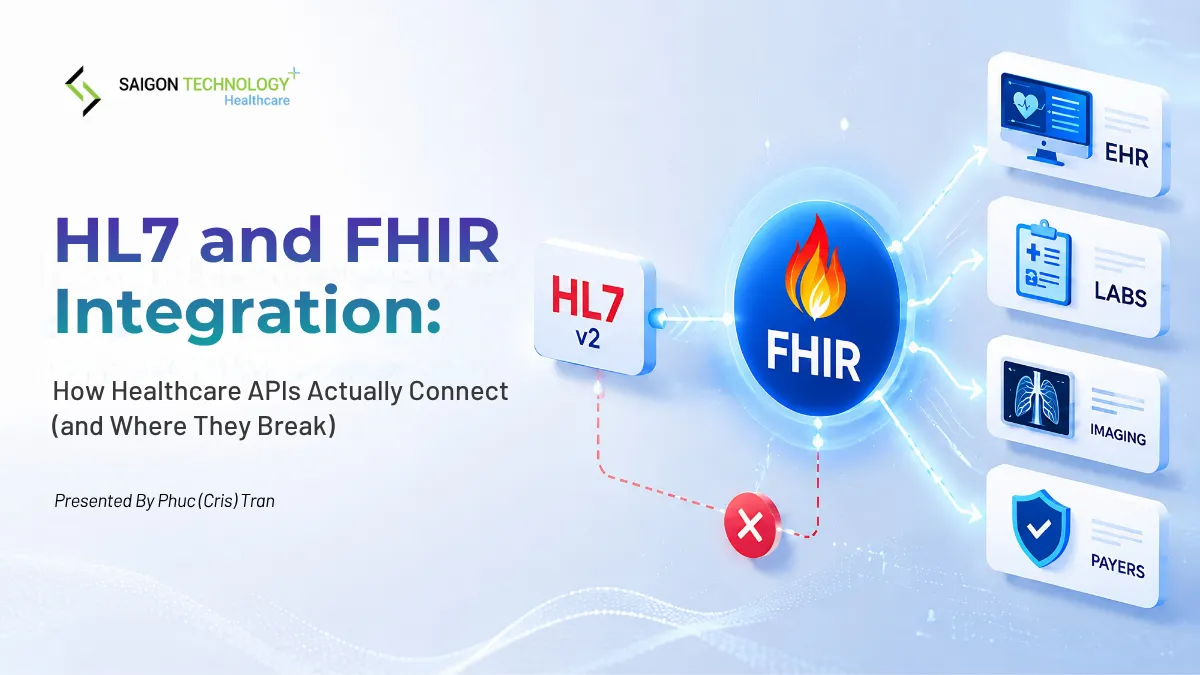
HL7 and FHIR Integration: How Healthcare APIs Actually Connect (and Where They Break)
20 May 2026 
Digital Transformation in Healthcare: A Complete Guide (2026)
25 May 2026 
What It Actually Takes to Build a Health Screening & Lab Integration Platform
11 Jun 2026 
How Much Does Healthcare Software Development Cost? A 2026 Budgeting Guide for Decision-Makers
23 Jun 2026 
Healthcare Cloud Migration: A HIPAA-Ready Roadmap from Real-World Builds
14 Jul 2026