




AI-Augmented Software Development: A Practical Guide for Engineering Leaders (2026)

 Updated on Jul 22, 2026
A delivery-first framework for adopting AI across the SDLC, backed by real project data, not another tool roundup.
Most guides to AI-augmented software development stop at a definition and a list of tools. This one goes further. Drawing on 850+ projects delivered and a senior-first delivery model, we lay out how AI actually changes each stage of the software development life cycle, what the measured productivity gains look like, where the real risks sit, and a step-by-step roadmap you can run.
If you are a CTO, VP of Engineering, or technical founder deciding how, not whether, to adopt AI in delivery, this is the disciplined, outcomes-first view. The headline lesson from our own work: on one HIPAA telemedicine build, AI-augmented delivery cut development time by 40%, a result that came from process discipline, not hype.
What Is AI-Augmented Software Development?
AI-augmented software development is a delivery approach where engineers use AI tools – for code generation, code review, testing, and documentation – to amplify their work, while humans keep control of architecture, judgment, and final validation. It is augmentation, not replacement: AI accelerates the work; senior engineers own the outcome.
The same idea is often called AI-augmented software engineering, the engineering-side synonym for the same practice. Both describe a human-in-the-loop strategy where generative AI handles repetitive, well-specified work so people can focus on system-level thinking, architecture thinking, and the trade-offs a model cannot own. This is the thesis of the whole guide: AI amplifies engineers; it does not replace engineering discipline.
AI-augmented vs. AI-generated (“vibe coding”) vs. traditional development
The distinction that matters most is who holds control and where the quality bar sits.
|
Approach
|
Who’s in control
|
Quality bar
|
Best use
|
|
Traditional development
|
Humans write every line
|
Set by team review & tests
|
Deep, novel, or high-risk systems where no AI leverage exists yet
|
|
AI-augmented development
|
Human-in-the-loop; AI drafts, engineers decide
|
Engineer review + quality gates + tests on all AI output
|
Production software at scale, the disciplined default
|
|
AI-generated (“vibe coding”)
|
AI drives; human prompts loosely
|
Often unchecked; false confidence risk
|
Throwaway prototypes and rapid prototyping tools only
|
Vibe coding: accepting AI output with little review – is fine for a weekend demo and dangerous in production. AI-augmented development keeps the speed while restoring the code review and validation that production systems require.
How AI Augments Each Stage of the SDLC
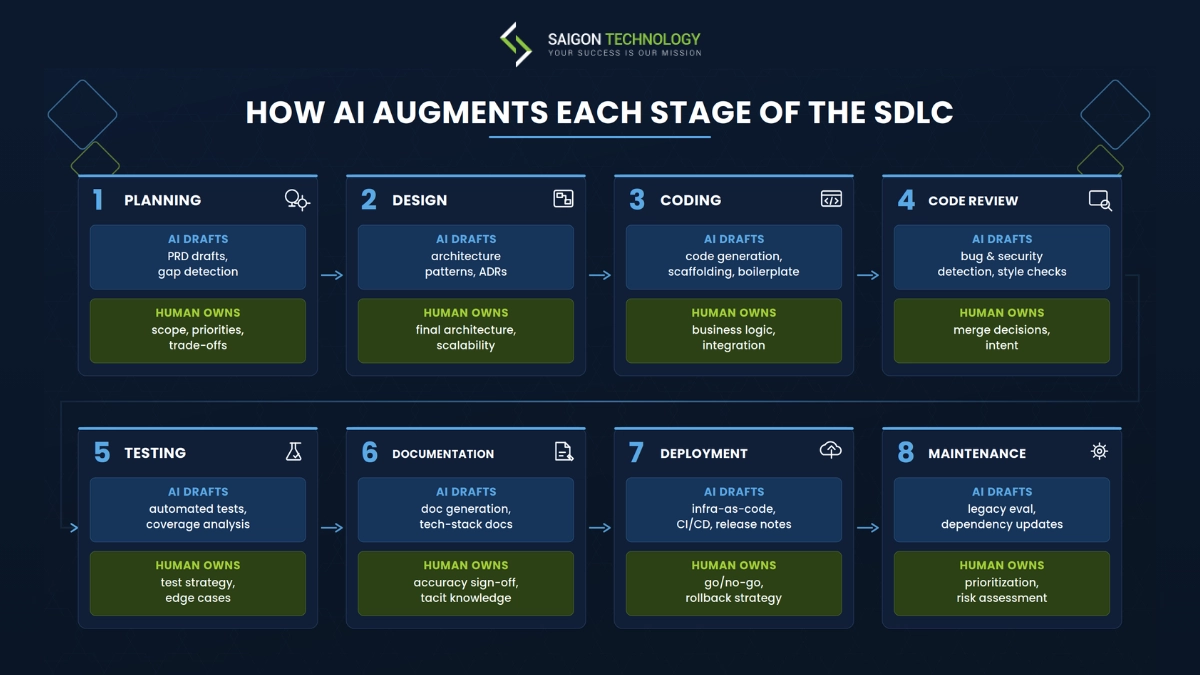
Answering the common question “What is AI-augmented SDLC?”It is the application of AI across every phase of delivery, with a clear split between what AI does and what stays human at each step. This per-stage view is where most competing guides go shallow. Effective AI augmented development treats AI as a co-pilot at every stage, never the pilot.
|
SDLC stage
|
What AI does
|
What stays human
|
|
Planning & requirements
|
Drafts the product requirements document (PRD), runs requirement consistency checking, surfaces gaps
|
Scope, priorities, business trade-offs
|
|
System design & architecture
|
Suggests system design and architecture patterns, drafts architecture decision records (ADRs), does architecture research
|
Final architecture, scalability considerations, the solution architect’s framework
|
|
Coding
|
Code generation, scaffolding, automated refactoring solution, boilerplate
|
Business logic ownership, review, integration
|
|
Code review
|
Bug detection & debugging, security risk detection, style checks against code review criteria
|
Merge decisions, judgment on intent
|
|
Testing
|
Automated testing, test-case generation, coverage analysis
|
Testing strategy, edge-case design, see our software QA & testing
|
|
Documentation
|
Documentation generation, systematic documentation, technology stack documentation
|
Accuracy sign-off, tacit knowledge
|
|
Deployment
|
Generates infrastructure as code, CI/CD pipelines, release notes
|
Go/no-go, rollback strategy
|
|
Maintenance
|
Legacy code evaluation, dependency updates, performance benchmarks
|
Prioritization, risk assessment and mitigation planning
|
The pattern is consistent: AI compresses the mechanical work; humans keep the decisions. That division is what turns raw speed into maintainable systems.
Two stages deserve extra care. In coding, AI is fastest at well-specified, repetitive work, scaffolding API endpoints with proper validation, generating database models and relationships, and helping stand up authentication with AI assistance, but a senior still has to scaffold primary business logic and confirm it fits the chosen technology stack. In testing, AI can generate broad coverage quickly, yet only an engineer can decide which edge cases actually matter for the product. Get this split right and AI becomes a genuine force multiplier; get it wrong and you simply automate the production of defects.
The Real Productivity Gains and the “30% Rule”
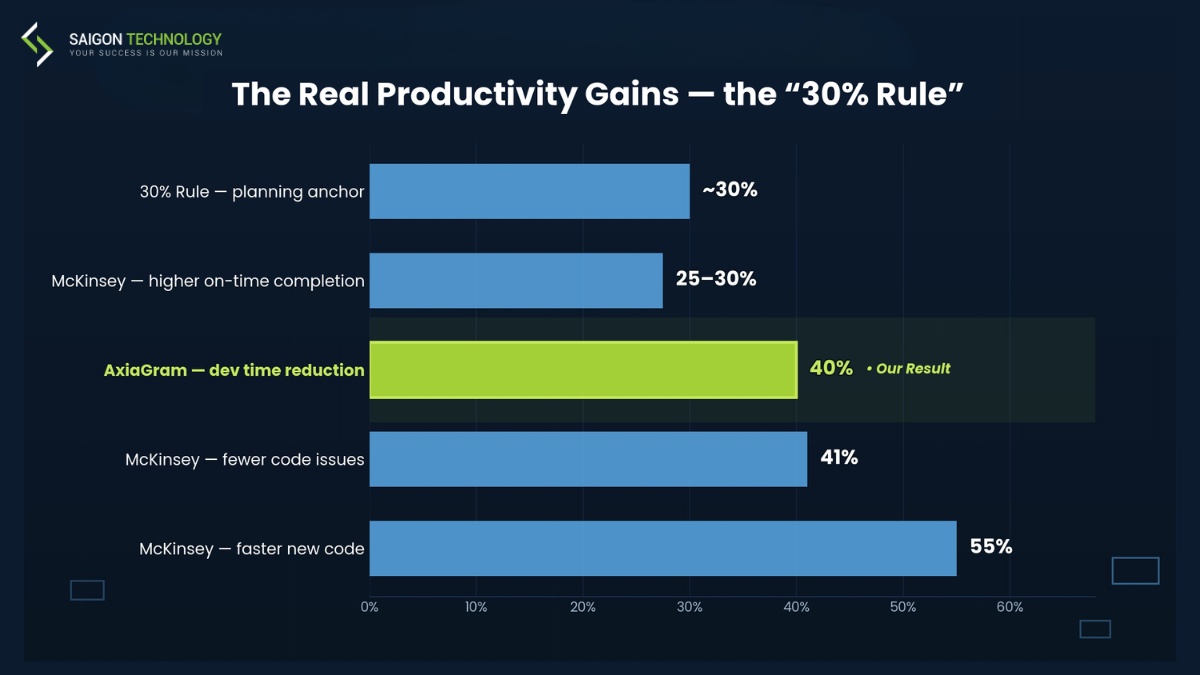
The “30% rule” is a practical rule of thumb: AI assistance tends to lift developer productivity on suitable tasks by roughly 30%, real, meaningful, but far from the “10x” often claimed. Treat it as a planning anchor, not a ceiling.
The credible third-party data backs a similar range:
- McKinsey (2023): developers completed complex tasks with 25-30% higher on-time completion, and were up to 55% faster at writing new code in one controlled test, with roughly 41% fewer code issues on some tasks.
- Gartner (2024 forecast): 75% of enterprise software engineers will use AI code assistants by 2028, up from less than 10% in early 2023.
Then the information-gain payload, our own measured outcome. On AxiaGram, a HIPAA-compliant telemedicine platform for US physicians, our dedicated team delivered a 40% reduction in development time using AI-augmented workflows, alongside streamlined EHR-integrated workflows. That number is not a vendor estimate, it is a delivered result on regulated healthcare software, where the quality bar is unforgiving.
Why did AxiaGram hit 40% when many teams see far less? Because the gain came from process, not raw AI volume: a senior-led team applied AI to the repeatable 60% of the build, scaffolding, tests, and documentation, while reserving human effort for the HIPAA-sensitive workflows where a mistake is expensive. The lesson generalizes. The biggest gains show up on well-specified, high-repetition work; the smallest show up on novel architecture and ambiguous requirements. Set expectations by task type, and the 30% rule becomes a floor you can plan around rather than a number you chase. The gains are real; they are also bounded by the discipline you put around them.
Read the AxiaGram Case Study →
What AI-Augmented Development Changes for Engineers and Teams
The biggest shift is not tooling, it is team shape. AI raises the floor on routine work, which changes what each engineer is for.
Our model is senior-first: one senior engineer plus AI outperforms three juniors. A senior directs the AI, catches its mistakes, and owns the architecture; AI absorbs the boilerplate that juniors used to grind through. Fewer people, more output, less rework, and no padding teams with headcount that AI now covers.
That reshapes the ideal skill profile toward a T-shaped skillset:
- Deep in one domain: real systems design skills, architecture thinking, and the judgment to reject bad AI output.
- Broad across the lifecycle: prompting algorithm fluency, structured AI collaboration, cross-team collaboration, and continuous learning as models change monthly.
The risk to guard against is systemic blindness, trusting AI output you no longer understand. The differentiator between teams that win and teams that stall is engineering discipline: quality processes, review criteria, and knowledge sharing that keep humans genuinely in the loop.
Benefits of AI-Augmented Software Development
Framed as business outcomes, not features, disciplined AI augmented development delivers:
- Faster time to market: more iterations per sprint from code generation and rapid prototyping tools, so you ship and learn sooner.
- Higher ROI on engineering spend: the senior-first model converts fewer, better people into more output.
- Lower delivery cost: AI-augmented delivery cuts headcount on routine work; a leaner team ships the same scope.
- Better code quality: automated testing, bug detection & debugging, and consistent code review catch defects earlier.
- Faster onboarding: systematic documentation and AI-assisted knowledge sharing raise onboarding speed for new engineers.
- More resilient systems: self-optimizing workflows and continuous legacy code evaluation keep technical debt visible and managed.
The through-line: productivity gains only convert to ROI when the output stays maintainable. Speed without discipline just ships debt faster.
Risks, Limitations, and Guardrails
Balanced adoption means naming the failure modes and engineering around them.
- Security & IP leakage. Pasting proprietary code into public models can expose it, Samsung famously banned employee use of ChatGPT after an internal leak. Watch for data leakage, malware generation, and weak dependency security and updates.
- Unreviewed output. A meaningful share of AI-generated lines needs human correction; unchecked, models introduce security vulnerabilities, missing input validation and sanitization, weak authentication and authorization implementations, and gaps in SQL injection and XSS prevention.
- Hallucination & data inconsistencies. Models invent plausible-but-wrong APIs and facts.
- Technical debt. Carnegie Mellon’s Software Engineering Institute (SEI) has warned that AI-accelerated code generation can quietly increase long-term technical debt when volume outpaces review.
- False confidence & over-reliance. The subtlest risk: teams stop understanding their own systems.
Guardrails checklist:
- Use private/vetted models; enforce a corporate AI policy with forbidden patterns and clear standards for AI-assisted coding.
- Mandatory human review on all AI output, no direct-to-merge.
- Output tests and quality gates on everything AI produces.
- Audit trail for AI-assisted changes, plus security best practices and compliance checks for regulatory needs.
For YMYL domains like healthcare and fintech, treat these as non-negotiable.
The AI-Augmented Development Tool Landscape
The market is crowded; what matters is the category and the human-in-the-loop framing. Choose tools that assist review, not replace it.
|
Category
|
Representative tools
|
Human-in-the-loop role
|
|
Code generation & co-piloting
|
GitHub Copilot, Cursor, Claude, GPT-4, Amazon CodeWhisperer / Q Developer, Google Codey, Tabnine
|
Engineer accepts, edits, and integrates, never blind-merges
|
|
Code review & bug detection
|
SonarQube, Intel ControlFlag, CodeRabbit
|
Flags issues; humans decide severity and fixes
|
|
Testing
|
Testim, Mabl
|
Generates tests; engineers own testing strategy
|
|
Migration & refactoring
|
CodeConvert, IDE refactor assistants
|
Suggests an automated refactoring solution; humans validate behavior
|
|
Documentation
|
Copilot Docs, Mintlify
|
Drafts modular documentation; humans sign off on accuracy
|
Tools wired into CI/CD pipelines with quality gates deliver reliable automation; tools bolted on without process just accelerate mistakes.
How to Adopt AI-Augmented Development: A Practical Roadmap
A CTO can roll this out in four disciplined phases, pilot small, govern early, measure honestly, then scale.
- Pilot on low-risk tasks. Start where a mistake is cheap, internal tooling, test generation, documentation. Establish a foundation setup and baseline performance benchmarks so you can measure lift.
- Define policy and guardrails. Before scaling, publish your corporate AI policy: approved tools, forbidden patterns, review requirements, and quality gates. Align it with security best practices and any regulatory needs.
- Measure outcomes, not activity. Track cycle time, defect rate, and rework, not “lines generated.” Watch technical debt and requirement consistency checking so speed does not erode quality.
- Scale with structure. Roll the proven AI-augmented development workflows across teams, invest in continuous learning and prompting algorithm skills, and bake structured AI collaboration into your systematic methodology.
The goal is engineering excellence at scale, not maximum AI usage. Adoption succeeds when organizational culture treats AI as a disciplined co-worker, not a shortcut.
How Saigon Technology Delivers AI-Augmented Software Development
We are an AI-native engineering partner: 14+ years in business, 900+ projects delivered for 300+ clients, ISO 9001 and ISO 27001 certified, and a Microsoft Gold Partner. Our senior-first, AI-augmented model – one senior engineer plus AI, backed by AI-assisted engineering practices – is how we shipped AxiaGram’s HIPAA telemedicine platform with a 40% reduction in development time without compromising security or compliance.
We embed guardrails, quality gates, and human review into every engagement, so AI-augmented software development produces maintainable systems, not accelerated debt. Explore our AI development services and generative AI integration, or scale delivery with a dedicated development team or offshore software development.
FAQs
1. What is the 30% rule for AI?
It is a rule of thumb that AI assistance tends to raise developer productivity on suitable tasks by roughly 30%, a real, meaningful gain, but not the “10x” often marketed. Use it as a planning anchor, and validate with your own performance benchmarks.
2. What is AI-augmented SDLC?
It is applying AI across every phase of the software development life cycle, planning, design, coding, review, testing, documentation, deployment, and maintenance – with a clear split between what AI drafts and what humans decide.
3. Will AI replace software developers?
No. It shifts the work toward judgment, architecture, and review. AI-augmented development amplifies engineers, especially seniors; it does not remove the need for engineering discipline and system-level thinking.
4. Is AI-augmented development secure?
It can be, with guardrails: private/vetted models, mandatory human review, tests and quality gates on all output, and an audit trail. Without those, it introduces security vulnerabilities and data leakage risk.
5. How is AI-augmented development different from vibe coding?
“Vibe coding” accepts AI output with little review and suits throwaway prototypes. AI-augmented development keeps humans in the loop with review, tests, and quality gates, the disciplined default for production software.
Conclusion
AI-augmented software development is not about how much AI you use – it is about the discipline you put around it. The teams that win pair AI’s speed with senior judgment, quality gates, and honest measurement, turning productivity gains into maintainable systems and real ROI. Adopt it deliberately: pilot small, govern early, measure outcomes, scale with structure.
Ready to adopt AI-augmented delivery with a senior-led partner? Schedule a Consultation →


Related articles
How Artificial Intelligence Will Transform Business
 Thanh (Bruce) Pham - CEO of Saigon Technology
  13 Jun 2024
A Detailed Comparison between Software Developer and Software Engineer
12 Apr 2024 
How To Do Market Research Like A Professional?
10 Apr 2024 
Multi-Agent Systems: The Future of AI Collaboration
29 Apr 2025 
The Decision-Maker’s Guide to Outsourcing AI and Machine Learning Projects
18 Mar 2026 
Vietnam’s AI Ecosystem: Policy, Talent Pool & Market Growth
30 Mar 2026 
AI in Fintech: A 2026 Builder’s Guide to Use Cases, Architecture and Regional Rules
04 May 2026 
Vibe Coding Security: Risks of AI Code
22 Jun 2026 
LLM Security Risks: What Every CTO Must Know Before Shipping AI Features
25 Jun 2026 
AI Code Review: Best Tools, Features, Pricing & Comparison Guide (2026)
03 Jul 2026