• OVERVIEW
  • SERVICES
  • WHY CHOOSE US?
  • MODELS
  • TECHNOLOGIES
  • OUR PROCESS
  • FAQS

What Is Pharmacy Management Software?

What Is Pharmacy Management Software?
Pharmacy management software is an integrated platform that automates prescription processing, drug inventory, insurance claims, patient profiles, and regulatory reporting for retail, hospital, specialty, and PBM operations. A modern pharmacy management system also adds demand forecasting, dispensing error checks, and DSCSA-ready drug traceability. We cover the full build, from workflow map to post-launch support:
  • Consulting: we map prescription, inventory, and claims flows before anyone writes code.
  • Custom development: retail, hospital, specialty, and PBM modules built around how your pharmacy works.
  • Integration: EHR, Surescripts e-prescribing, PBM claims, and payment connections.
  • Mobile apps: refill, reminder, and pickup apps for patients, plus handheld tools for staff.
  • Support and modernization: updates, security fixes, and cloud migration.
Senior engineers use AI tooling for coding, testing, and documentation, which takes the routine work off their desks and leaves the reviewers who know pharmacy rules free to spend their hours on dispensing, claims, and controlled-substance logic. That is where errors cost money.
Talk to Our Pharmacy Software Leads
Phuc Tran - Program Manager
Meet Phuc (Cris) Tran
Program Manager with 10+ years specializing in healthcare platforms built to HIPAA, HL7, and PDPA standards, with a career leading 60+ engineers and $3.9M budgets overall
Book an Appointment More Detail
Van Le - Business Analyst
Meet Van Le
Business Analyst turning complex healthcare workflows into clear requirements, backed by 6+ years of cross-industry analysis
Book an Appointment
over 400 software developers
400+
Software Developers
Over 14 years of experience
14+
Years in Business
Over 850 Projects Successfully Delivered
850+
Projects Successfully Delivered
rating on Clutch
4.8
Star Rating on Clutch

Our Pharmacy Management Software Development Services 

Our pharmacy software development work covers six system types, from a single retail store to a PBM platform. Each build starts from your current workflow and connects to the EHR, payer, and supplier systems you already use.
healthcare - icon 3

Retail Pharmacy Software

Run prescriptions, point of sale, and stock from one system, whether you have one store or a chain.

  • Prescription queue: intake, verification, and pickup status in one view.
  • Point of sale: co-pays, insurance splits, and front-store items on one ticket.
  • Chain controls: shared formularies, pricing, and transfers between stores.

Built as custom software around your workflow. Vendor templates stay out.

chevron-up.svg
healthcare - icon 1

Hospital Pharmacy Software

Run hospital medication inventory, dispensing, and stock transfers from one system.

  • Dispensing: unit dose and automated cabinets, tracked from pharmacy to ward.
  • Order sync: medication orders flow in from the EHR over HL7 or FHIR.
  • Stock transfers: central pharmacy to satellite units, each with an audit trail.

Hospital pharmacy modules often sit next to a hospital information system we build or integrate.

chevron-up.svg
healthcare - icon 10

Specialty Pharmacy Management Software

Handle complex therapies requiring prior authorization, onboarding, and follow-up.

  • Intake: referral, benefits check, and payer approval in one case.
  • Patient management: adherence calls, refill reminders, and outcome notes.
  • Limited-distribution stock: lot, expiry, and shipping temperature records.
chevron-up.svg
healthcare - icon 7

Pharmacy Benefit Management (PBM) Platforms

Help pharmacy benefit managers run claims, formularies, and member services at volume.

  • Claims processing: real-time adjudication over the NCPDP Telecommunication Standard.
  • Formulary rules: tiers, step therapy, and prior authorization logic kept in one versioned rule set.
  • Member portals: benefits, claims history, and reports for employers and health plans.

Long-running PBM programs get a dedicated development team that stays with the platform for years, through every formulary season and every change to the claims rules your plans depend on.

chevron-up.svg
healthcare - icon 2

Pharmacy Inventory Management Software

Keep shelves stocked. Free the cash tied up in slow movers.

  • Expiry and lot tracking: short-dated stock flagged before it becomes waste.
  • Automated reordering: par levels and supplier orders from real dispensing data.
  • Multi-location view: stock across warehouses and stores in one dashboard.

Demand forecasting can be added through our AI development services.

chevron-up.svg
healthcare - icon 6

Online Pharmacy and E-Pharmacy Platforms

Sell and deliver medications online within prescription rules.

  • Prescription check: pharmacist verification before an order is filled.
  • Storefront: medication catalog, cart, and payment integration.
  • Delivery: courier coordination and order tracking.

Patient apps come from our mobile app development team.

chevron-up.svg

Case Studies: Healthcare Platforms Behind Our Pharmacy Work

Our pharmacy software projects are covered by NDAs, so we can't publish them here. The three healthcare builds below share the problems pharmacy systems face: HL7 data exchange, HIPAA-grade access control, and patient-facing mobile apps. Contact us to discuss the pharmacy work itself.
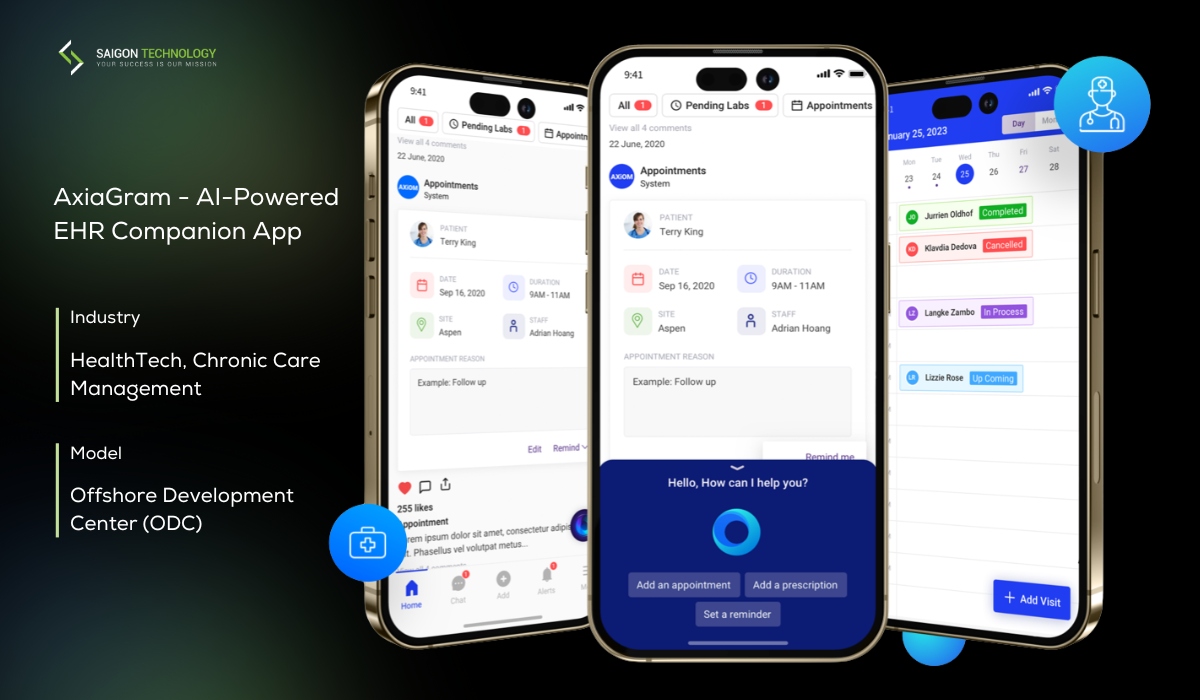
AxiaGram - AI-Powered EHR Companion Appy

AxiaGram: AI-Powered EHR Companion for US Clinics

  • Challenge: US clinics and hospitals in chronic care needed faster documentation and secure access to more than 6M medical records.
  • What we built: EHR integration, AI voice-driven documentation, and Electronic Visit Verification with geo-tagging and digital signatures.
  • Engagement / timeline: ongoing partnership since 2021 (read the AxiaGram case study).
  • Outcome: a 40% reduction in development time and 6M+ medical records under AES-256 encryption and HIPAA controls.
  • Stack: .NET Core, Angular, Azure, HL7. 
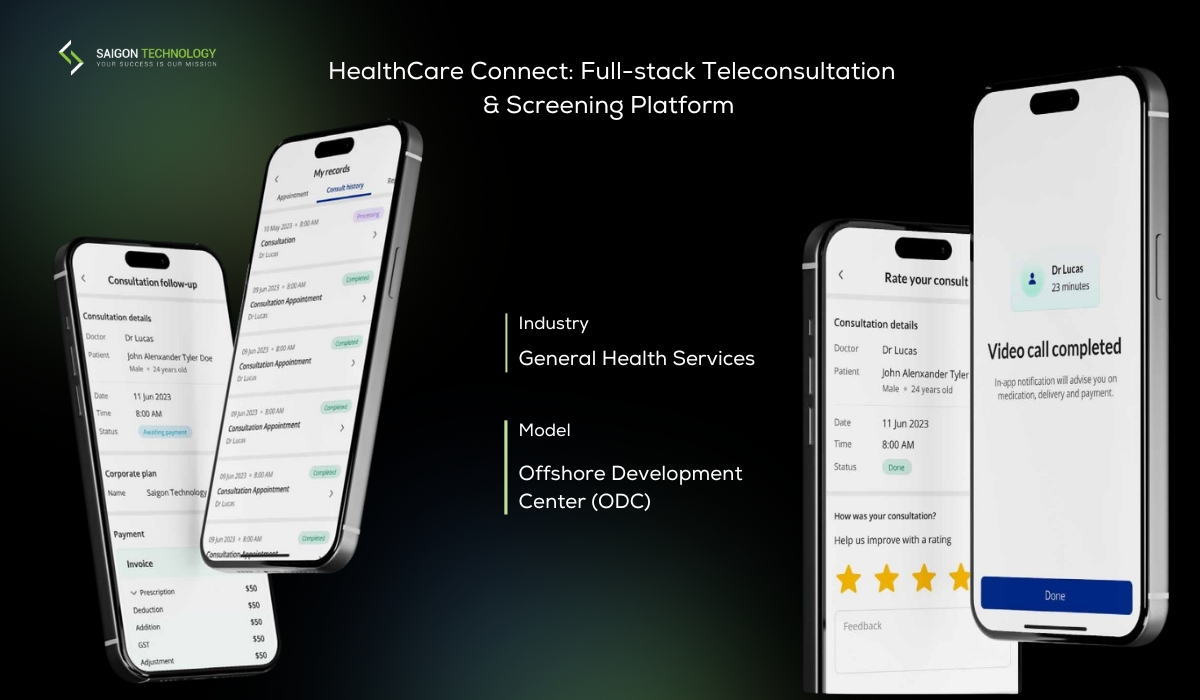
HealthCare Connect: Full-stack Teleconsultation & Screening Platform

HealthCare Connect: Teleconsultation and Screening Platform

  • Challenge: lab results moved slowly between clinic systems, and patients missed follow-ups.
  • What we built: HL7 lab integration, automated appointment reminders, and QR-code check-in with payment reconciliation.
  • Engagement / timeline: offshore development center (ODC) since 2022.
  • Outcome: more than 50,000 patient interactions each month, fewer missed follow-ups, and paperless check-in. Patient data privacy is aligned with HIPAA and PDPA.
  • Stack: Angular, Node.js, PostgreSQL, WebRTC.
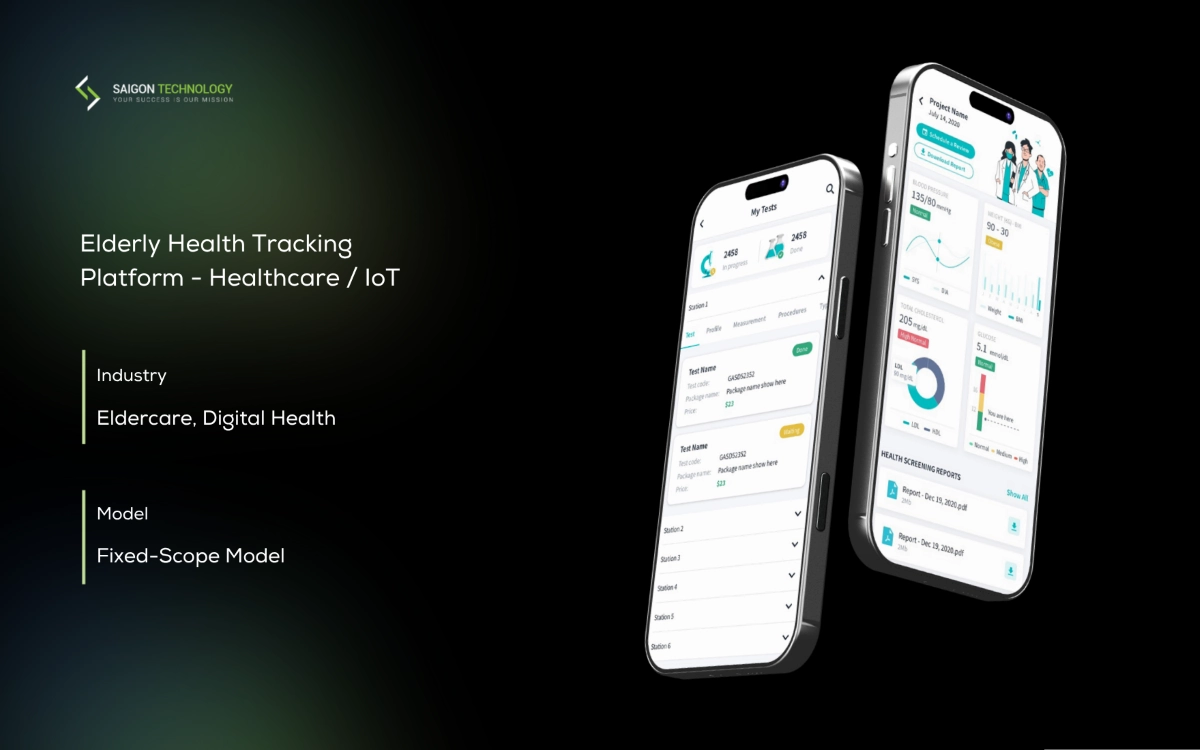
Elderly Health Tracking Platform — Healthcare / IoT

Elderly Health Tracking Platform: Connected Home Monitoring

  • Challenge: families and caregivers needed home vital-sign monitoring with instant alerts on abnormal readings.
  • What we built: a mobile app syncing several types of Bluetooth Low Energy devices in real time, with separate access for family, caregivers, and medical staff.
  • Engagement / timeline: fixed-scope, 6 months.
  • Outcome: improved response time in health emergencies, with all data secured by AES-256 under HIPAA-aligned practices.
  • Stack: React Native, MongoDB, BLE.

Send Your Pharmacy RFP. See a Working Prototype in 48 Hours.

Share your pharmacy workflow and integration list. Linh Pham, our Senior Solution Architect, reviews every RFP personally, so an engineer answers you from the first reply. Our AI-accelerated process turns a full brief into a clickable prototype in 48 hours or more.


  • Clickable prototype of your prescription intake, dispensing, or claims flow.
  • Workflow visualization mapping the full e-prescription-to-claim chain.
  • Architecture direction covering Surescripts and EHR integrations, DSCSA traceability, and scale.
  • Technical recommendation call with our engineering team.
Fee live demo - Saigon Technology

Why Choose Saigon Technology as Your Pharmacy Management Software Development Company?

A good pharmacy management software development company has shipped the hard connections before, protects PHI and controlled-substance records by design, and keeps the same senior team on the platform for years. Saigon Technology brings all three, at published rates. 

Our teams have built Surescripts e-prescribing, NCPDP claims, and DSCSA traceability for pharmacy clients under NDA. That matters because a failed claim or a rejected e-prescription stops the counter, and those connections need certification testing that first-time vendors underestimate. 

Pharmacy data mixes PHI with DEA-regulated prescribing records. One missing audit entry becomes a regulatory problem. Auditors check for exactly that. We build role-based access, AES-256 encryption, and tamper-evident audit trails, with HIPAA requirements met where the workload needs them. 

Senior engineers work with AI tooling at $22-$46/hr, with 10-12 hours of overlap with US East and West Coast teams and US business hours on request. At onshore rates, testing and hardening are the first line items cut. Here they stay in scope.

Pharmacy systems run for years, and every engineer who leaves takes knowledge of your claims rules with them. Saigon Technology ranks #10 in the Medium category of Southeast Asia Best Workplacesâ„¢ in Technology 2026 and is on the Fortune 100 Best Companies to Work Forâ„¢ Southeast Asia 2025 list.

Some pharmacies need an off-the-shelf system plus a few integrations. We say so. When custom is the right call, our architects settle data models and integration contracts first, because changing them after go-live costs the most.

Saigon Technology is ISO 9001 and ISO 27001 certified by BSI (UK) and is a Microsoft Solutions Partner. For pharmacy buyers, that means documented change control and information security that auditors can check, with an NDA signed before any project details are shared.

Three development centers in Vietnam deliver this work. Our pharmacy engagements stay under NDA, so we show verifiable healthcare work instead of a pharmacy metric we can't publish.

Start with a two-week risk-free trial to test skills and teamwork before a long-term commitment. Then choose a dedicated team, fixed-price, ODC, or staff augmentation model on our engagement models page.

Why choose Saigon Technology 2026

Trusted by Healthcare and Technology Clients

Partner-logo2 Partner-logo3 Partner-logo4 Partner-logo6 Partner-logo1 Partner-logo5 Partner-logo9 Partner logo

What Our Clients Say

We value Saigon Technology’s strong support in managing the engagement from an internal delivery perspective. They were able to maintain team performance across a relatively large team, provide additional resources when required, and work collaboratively with us on matters such as gap time, discount proposals, and improvements to the working process. Their flexibility and consistent management support contributed positively to the overall partnership.
Sri Vijayasarathy
CTO of Axiagram
star.svg star.svg star.svg star.svg star.svg
Saigon Technology has been a reliable and committed partner in our telehealth project. They consistently delivered on time, provided responsive 24/7 support, and were always available on WhatsApp, even after working hours, whenever we needed urgent assistance. What stood out most was their continuous attention to security and speed, which are essential for a healthcare platform. Their strong ownership and responsiveness made a real difference to the success of the project.
Eric Chiam
CEO of Minmed, Telehealth
star.svg star.svg star.svg star.svg star.svg
Over the past year, collaborating with Saigon Technology Solution company, we have brought high-quality financial software solutions. STS helps us meet the strict requirements of the IT market with software engineers, software testers, and internal system control. And all of these are evidence that we have chosen a good software outsourcing partner.
Mr. Corbin van Amelsvoort
Director at Topicus Vietnam
star.svg star.svg star.svg star.svg star.svg
During our collaboration, Mr. Thanh and his company, Saigon Technology, have consistently demonstrated world-class leadership and execution in complex fintech projects. His ability to scale and lead high-performing engineering teams, while maintaining cost-efficiency and product quality, has been critical to our technology operations. His strategic insights and leadership enabled us to significantly improve system stability and deployment velocity. What sets Mr. Thanh apart is not only his technical vision but also his business leadership. He has built Saigon Technology into one of the leading offshore development companies in Vietnam, serving global clients across the U.S., Europe, and Australia.

Abe Jarrett
Senior Vice President of Software Engineering at Origence, USA
star.svg star.svg star.svg star.svg star.svg
I would recommend companies to work with Saigon Technology for their Software development or service needs. The project team is very responsible for their work and would recommend solutions in the interest of the client. The team also responds very quickly to requests, bugs, and questions. One exceptional quality of Saigon Technology was their patience with clients. There were several times when we were slow to respond or test our apps, but the project team was still very accommodating towards us.
Jeremy Heng
Development Manager - Rehau Group PTE
star.svg star.svg star.svg star.svg star.svg

Features and Integrations of a Pharmacy Management System

A pharmacy platform has three layers. Staff use the modules daily, integrations reach outside networks, and compliance controls sit under both.

  • Prescription management: e-prescriptions, refills, interaction checks, and verification.
  • Inventory: stock levels, expiry dates, batches, and automated reordering.
  • Patient profiles: patient records, prescription history, and allergies in one database.
  • Billing and claims: co-pays, insurance claims, and PBM connections.
  • Reporting and compliance: dashboards, audit logs, and compliance reports.
  • AI modules: demand forecasting, fraud detection, and dispensing checks.
  • EHR and HIS: Epic, Oracle Health (Cerner), Allscripts, and Meditech (EHR software guide).
  • E-prescribing: Surescripts network certification and the NCPDP SCRIPT standard.
  • Claims: NCPDP Telecommunication transactions, PBM gateways, and adjudication APIs.
  • Interoperability: HL7 v2, FHIR R4, and LOINC for lab results; DICOM for imaging (HL7 and FHIR integration guide).
  • Compliance infrastructure: HIPAA BAA on AWS and Azure, DSCSA serialization providers, and 21 CFR Part 1311 workflows for controlled-substance e-prescriptions.
  • Devices: BLE adherence devices and Apple HealthKit.

Interop is where most pharmacy builds slip. Our teams have built Surescripts e-prescribing, NCPDP claims, and DSCSA traceability for pharmacy clients. Each connection is designed on day one through our software integration practice.

Why Build Custom Pharmacy Software Instead of Buying Off the Shelf?

Off-the-shelf systems suit many independent pharmacies. Custom pharmacy software pays off when your workflows, integrations, or growth plans no longer fit a vendor's template, because you stop paying for workarounds and own the system your staff use every day.
Safer Dispensing

Safer Dispensing

Barcode scanning and verification reduce dispensing errors at every step of the filling process.
Fewer Stock-Outs

Fewer Stock-Outs

Reorder rules based on dispensing data help maintain optimal inventory levels.
Faster Payments

Faster Payments

Claim rejections are flagged before the patient leaves, helping reduce payment delays.
Audit Readiness

Audit Readiness

Manage controlled-substance, DSCSA, and HIPAA logs in one place.
Code Ownership

Code Ownership

You own the source code, so adding another pharmacy location incurs no additional license fees.

How Much Does Pharmacy Management Software Development Cost?

Custom pharmacy software projects typically run from $20,000 for a scoped MVP to $300,000+ for an enterprise platform, with senior engineers billed at $22-$46 per hour. Projects start from $10,000. 

Pharmacy Software Cost by Tier

  • MVP / Core Modules: 1–2 core modules with basic workflows. Estimated cost: $20K–$45K, timeline: 1–2 months.
  • Mid-Scale Platform: Retail or hospital pharmacy workflows with selected integrations. Estimated cost: $60K–$130K, timeline: 3–6 months.
  • Enterprise Platform: Multi-location operations, complex integrations, and advanced compliance requirements. Estimated cost: $130K–$300K+, timeline: 6–12+ months.
  • Ongoing Development & Support: Dedicated engineering team and continuous improvements. Cost depends on team size; ongoing timeline.

These are planning estimates. Scope and integrations set the final cost. 

chevron-up.svg

Key Cost Factors

What drives pharmacy software cost:

  • Feature complexity: AI modules, computer vision, and clinical decision support.
  • Regulatory scope: DSCSA serialization, DEA rules, and USP 795, 797, and 800 for compounding.
  • Scale: locations, PBM claim volumes, and transactions per second.
  • Integration load: EHR, Surescripts, lab, and third-party connections.
  • Delivery model: fixed scope, dedicated team, or ODC.

We quote on scope. Full IP transfers on completion.  

chevron-up.svg

Technologies, Standards & Compliance

Our Pharmacy Software Development Process

Each stage ends with a deliverable for your approval before the next stage begins.
app ideation and planning

Discovery and Requirements

We map pharmacy workflows, user roles, and regulatory requirements, including HIPAA and DSCSA.

Deliverable: Requirements document.

app development

Architecture and Planning

We design data models, cloud infrastructure, and integration plans for EHRs, PBMs, and e-prescribing systems.

Deliverable: Technical blueprint.

ui ux app design

UI/UX Design and Prototyping

We design interfaces for pharmacists, technicians, administrators, and patients, then validate them through a clickable prototype.

Deliverable: Validated prototype.

mobile app launch and optimization

Agile Development with AI Assistance

We build the software in agile sprints, using AI-assisted coding, testing, and documentation. For products with AI features, we apply our AI MVP development approach where appropriate.

Deliverable: Working software.

qa and app testing

QA and Security Testing

We conduct functional, integration, performance, and security testing, followed by user acceptance testing (UAT).

Deliverable: Release candidate.

understanding client app needs

Deployment, Training, and Support

We deploy the system, train staff, provide documentation, and support ongoing maintenance.

Deliverable: Live system.

Our Insights

FAQs

Pharmacy management software development at Saigon Technology typically costs $20,000-$45,000 for an MVP with one or two core modules, $60,000-$130,000 for a mid-scale retail or hospital platform, and $130,000-$300,000+ for a multi-location enterprise system. Senior engineers bill $22-$46 per hour, and final cost depends on scope and integrations. 

A scoped MVP with one or two core modules typically takes 1-2 months. A mid-scale retail or hospital platform takes 3-6 months, and a multi-location enterprise platform with complex integrations and compliance requirements takes 6-12 months or more. Integration certification, such as Surescripts testing, can set the critical path.

Buy when a standard system covers your workflows and growth plans. Build when you need specialty workflows, PBM or claims logic a vendor won't support, or integrations across many locations. A common middle path is to keep a commercial dispensing system and build custom modules and integrations around it.

We design for them from discovery: role-based access, encryption in transit and at rest, and audit trails for every PHI access. DSCSA serialization and traceability data, and DEA rules for electronic prescriptions of controlled substances (EPCS), are scoped into the architecture. Security reviews and penetration testing run before release.

Pharmacy platforms are commonly built on .NET Core or Node.js back ends, React or Angular web apps, Flutter or React Native mobile apps, and AWS or Azure under a HIPAA BAA. HL7 v2, FHIR R4, and NCPDP SCRIPT handle data exchange, and AI modules use TensorFlow or PyTorch.

It depends on the pharmacy type. Large US chains mostly run proprietary or enterprise systems built for their own scale. Independent pharmacies often use commercial systems such as PioneerRx, Liberty, or RX30. Hospital pharmacies usually work inside the hospital's EHR pharmacy module, and specialty pharmacies add dedicated specialty platforms.

A typical team pairs a project manager and business analyst with a tech lead matched to your stack, senior engineers, and QA, with UI/UX joining when the product needs it. You can engage us as a dedicated team, a fixed-price project, an ODC, or through staff augmentation.

Build Your Pharmacy Platform With an AI-Native Engineering Partner

Partner with Saigon Technology for pharmacy management software development led by senior engineers who work with AI across every sprint. Start with a two-week risk-free trial, keep full IP ownership of the code, and sign an NDA on day one.

    Contact Message Box

    Schedule a Demo with Our Industry Experts

    Book a free 30-minute call

    • See case studies aligned with your requirements
    • Validate our industry experience
    • Confirm technical fit for your project
    Schedule a Demo

      Your RFP, reviewed by experts in 48 hours

      AI-accelerated path from brief to working prototype. Engineers, not sales.
      • Clickable prototype of your core user flow
      • Workflow visualization mapping the full system
      • Architecture direction covering stack, integrations, and scale
      • Technical recommendation call with our engineering team
      Free Demo Campaign