




IoT in Transportation and Logistics: 12 Use Cases, Benefits & ROI Guide (2026)

 Updated on Jul 30, 2026
If you run a logistics operation in 2026, you’re being squeezed on fuel costs, driver availability, and customer expectations all at once. The global IoT in transportation market was worth USD 119.3 billion in 2022 and is projected to reach USD 372.7 billion by 2028, a 19.8% CAGR (Research and Markets via GlobeNewswire, 2023). The enterprises capturing that value treat IoT as an operations platform, not a hardware purchase.
IoT in transportation and logistics is a network of connected sensors, GPS trackers, RFID tags, and telematics devices embedded in vehicles, cargo, and warehouses that stream real-time data to cloud platforms. That connected layer lets you track assets, predict failures, optimize routes, and cut operating costs. Across the sourced use cases below, the gains run 10 to 30 percent on fuel, downtime, and delivery delays.
This guide covers what IoT delivers across the logistics lifecycle: 12 use cases, honest cost tiers, ROI payback windows, and a build-vs-buy decision framework.
Key Takeaways
- IoT in transportation is a $372.7B market by 2028 (19.8% CAGR), driven by 5G, LPWAN, and AI integration.
- 12 proven use cases span planning, transportation, warehousing, cold chain, maintenance, and last-mile.
- Typical KPI gains: fuel down 10–20%, unplanned downtime down 20–40%, delivery delays down 15–30%.
- Real cost tiers: PoC from $30K; enterprise platforms $200K–$800K+. Payback often 6–12 months.
- Build custom for fleets over 200 vehicles or unique workflows; buy off-the-shelf under 50 with standard needs.
What Is IoT in Transportation and Logistics?
IoT in transportation and logistics is the sensing and decision layer that sits on top of the operation you already run. Connected devices monitor your vehicles, cargo, and warehouses, then feed that data into analytics and AI systems that drive real operational decisions. In practice, it moves your operation off paperwork and phone calls and onto evidence.
The industry often calls the vehicle side of this “telematics,” the foundational technology behind fleet tracking. IoT is the broader layer: it extends that connectivity out to cargo, warehouses, and fixed assets, not just the truck. Four things get connected in a typical setup:
- Connected vehicles: trucks, ships, aircraft, and rail cars fitted with telematics, OBD, GPS trackers, and black boxes
- Connected warehouses: RFID readers, edge devices, robotic systems, and automated stock updates
- Connected assets: forklifts, containers, pallets, and yard equipment tracked with battery-powered sensors and BLE beacons
- Connected cargo: sensitive goods monitored by temperature, humidity, vibration, and shock sensors
How does the IoT stack work?
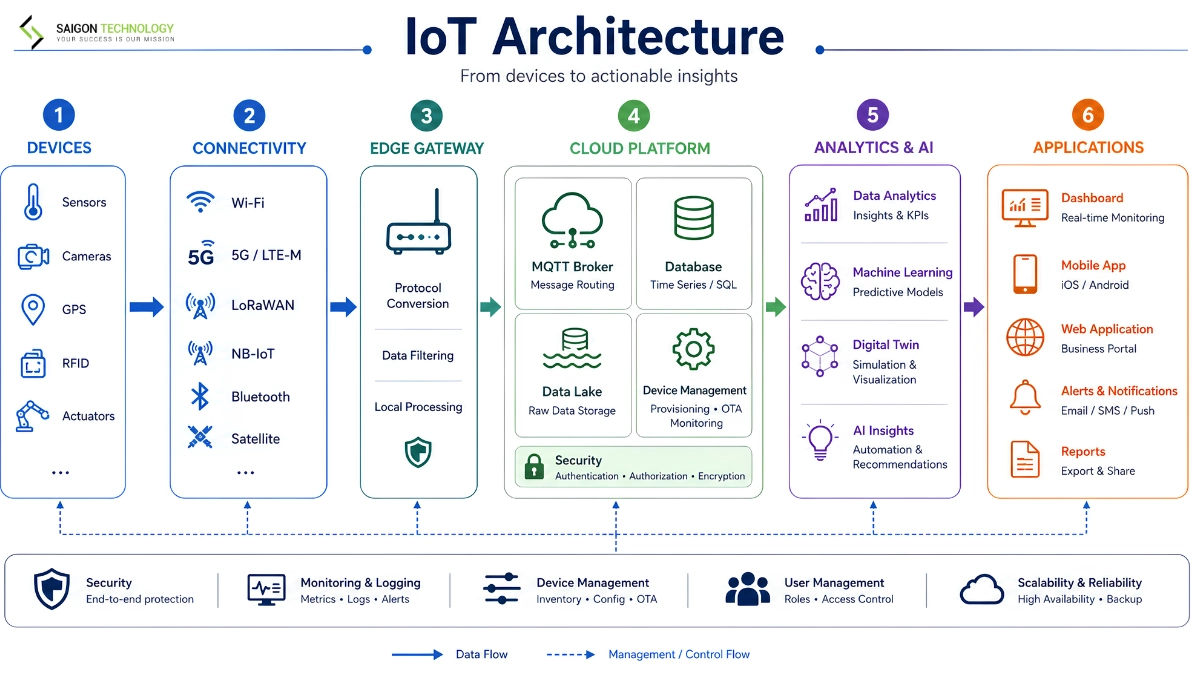
A modern IoT logistics platform has five layers, and each talks to the next through standardized protocols:
- Devices (Sensors, Cameras, GPS, RFID)
- Connectivity (5G, LTE-M, NB-IoT, LoRaWAN, Satellite)
- Data Exchange (MQTT, CoAP, AMQP, HTTP/HTTPS, Middleware)
- Cloud Platform (AWS IoT, Azure IoT Hub, Google Cloud)
- Analytics & AI (Streaming Pipelines, ML Models, Digital Twins)
- Business Applications (Dashboards, TMS, WMS, ERP, Driver Apps, Customer Portals)
Layers communicate through protocols such as MQTT, CoAP, AMQP, and HTTP/HTTPS. Middleware normalizes the data before it lands in your TMS, WMS, or ERP.
IoT vs GPS vs Telematics
You’ll hear the three terms used interchangeably. They aren’t the same.
| Capability | GPS | Telematics | IoT |
| Location tracking | Yes | Yes | Yes |
| Vehicle diagnostics | No | Yes | Yes |
| Cargo & environmental monitoring | No | Limited | Yes |
| Remote control & automation | No | Limited | Yes |
| AI & predictive analytics | No | Limited | Yes |
| Warehouse & asset tracking | No | Limited | Yes |
The short version: GPS answers “where.” Telematics answers “where and how the vehicle is running.” IoT answers “where, how, what condition the cargo is in, and what to do next.” If your problem is only location, you don’t need the full stack. If it’s anything more, you do.
12 Real-World IoT Use Cases Across the Logistics Lifecycle
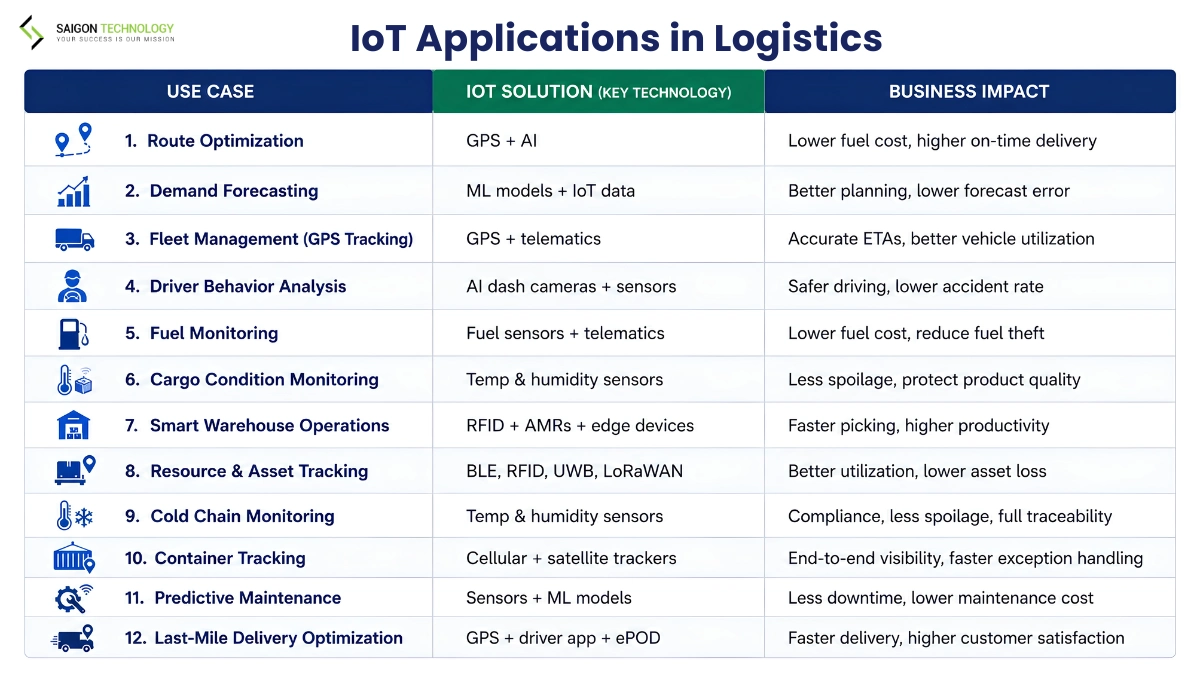
A flat feature list won’t help you prioritize. So the 12 IoT use cases below map to your logistics lifecycle. Each one covers the operational problem, the IoT solution that addresses it, the business impact you can reasonably expect, and a source worth citing. Together they cover the highest-value applications of IoT in logistics today.
1. Route Optimization
Problem: Static route plans can’t adapt to congestion, closures, or last-minute pickups. The cost is wasted mileage and missed windows.
IoT Solution: Fleet platforms combine GPS with live traffic, weather, and shipment priority. AI recommends the best route as conditions change.
Business Impact: Lower fuel spend and higher on-time delivery. The U.S. Department of Energy lists routing efficiency and idle reduction as the highest-impact fuel-saving strategies for commercial fleets.
Source: U.S. DOE, Alternative Fuels Data Center. Related: Smart GIS case study.
2. Demand Forecasting
Problem: Forecasting from historical shipment volumes alone leaves you exposed to seasonal swings and disruptions.
IoT Solution: Feed IoT operational data alongside historical demand, weather, and market signals into ML models for sharper forecasts.
Business Impact: Better fleet allocation and inventory planning. McKinsey reports digital supply chains reduce forecasting errors by 30 to 50 percent.
Source: McKinsey, Supply Chain 4.0.
3. Fleet Management with Real-Time GPS Tracking
Problem: Without real-time visibility, dispatchers rely on driver phone calls and scheduled updates.
IoT Solution: GPS trackers, telematics, and onboard diagnostics stream location, engine health, fuel use, and driver activity into a single dashboard.
Business Impact: Faster dispatch decisions, accurate ETAs, and better vehicle utilization.
Source: Geotab, Fleet Management Solutions. Related: Fleet Management Platform case study.
4. Driver Behavior Analysis
Problem: Speeding, harsh braking, and distracted driving push up insurance, fuel, and maintenance costs.
IoT Solution: AI dash cameras, accelerometers, and telematics score risky events and generate safety scores plus coaching recommendations.
Business Impact: Safer habits, lower incident rates, and objective data for coaching and compliance.
Source: Samsara, State of Connected Operations.
5. Fuel Monitoring
Problem: Excessive idling, inefficient driving, and fuel theft quietly erode margin on one of the largest fleet expenses.
IoT Solution: Fuel level sensors, engine diagnostics, and telematics detect abnormal loss and idling in real time, with alerts for suspicious activity.
Business Impact: Tighter cost control and better efficiency. The U.S. DOE identifies idle reduction as one of the highest-impact fuel-saving interventions.
Source: U.S. DOE, Idling Reduction.
6. Cargo Condition Monitoring
Problem: High-value and temperature-sensitive shipments (pharma, food, chemicals, electronics) are vulnerable to temperature, humidity, and shock exposure in transit.
IoT Solution: Connected multi-sensor devices monitor conditions continuously and alert operators when thresholds are breached.
Business Impact: Better shipment visibility, fewer spoilage claims, and a defensible compliance record.
Source: DHL, Logistics Trend Radar.
7. Smart Warehouse Operations
Problem: Manual counting and paper workflows introduce picking errors and slow fulfillment as you scale.
IoT Solution: RFID, connected forklifts, AMRs, and edge devices capture inventory movement in real time and sync with your WMS.
Business Impact: Higher inventory accuracy, shorter picking cycles, and better labor productivity.
Source: McKinsey, Supply Chain 4.0.
8. Resource and Asset Tracking
Problem: Trailers, pallets, containers, and forklifts wander. Employees waste time searching instead of doing operational work.
IoT Solution: BLE, RFID, UWB, and LoRaWAN tags stream location through gateways, with alerts when assets leave designated zones.
Business Impact: Better utilization, lower asset loss, and less search time across warehouse operations.
Source: IBM Maximo Application Suite. Related: SCM Portal case study.
9. Cold Chain Monitoring
Problem: Small temperature deviations compromise pharma, vaccines, and fresh food. Manual inspection catches problems too late.
IoT Solution: Connected temperature and humidity sensors monitor refrigerated vehicles and containers continuously, with alerts and a digital audit trail.
Business Impact: Reduced spoilage, food-safety and pharma compliance, and complete traceability per shipment.
Source: WHO, Vaccine Cold Chain Monitoring.
10. Container Tracking
Problem: Containers move between ships, trucks, rail, and ports. Without continuous visibility, you can’t pinpoint delays or trace responsibility across handoffs.
IoT Solution: Satellite and cellular IoT trackers report location, door events, and environmental conditions, integrated with your TMS.
Business Impact: Better shipment visibility, fewer customer inquiries, and faster exception management.
Source: DHL, Logistics Trend Radar.
11. Predictive Maintenance
Problem: Reactive maintenance means unexpected breakdowns, higher repair bills, and reduced fleet availability.
IoT Solution: Engine diagnostics, TPMS, vibration sensors, and telematics feed ML models that predict failures before they happen.
Business Impact: McKinsey benchmarks show predictive maintenance cuts maintenance costs 10 to 40%, reduces downtime up to 50%, and extends machine life 20 to 40%.
Source: McKinsey, Manufacturing Analytics & Predictive Maintenance.
12. Last-Mile Delivery Optimization
Problem: Urban congestion, failed attempts, and rising expectations make last-mile expensive and complex.
IoT Solution: Mobile driver apps, GPS, smart lockers, ePOD, and AI dispatch that reroutes on the fly reduce failed attempts and improve productivity.
Business Impact: McKinsey estimates the last mile accounts for about 53% of total shipping cost, making it one of the highest-impact optimization targets.
Source:McKinsey, Parcel Delivery: The Future of Last Mile.
How Do AI and Machine Learning Enhance IoT in Transportation and Logistics?
Here’s a distinction worth getting straight before you scope a project. IoT continuously collects your operational data. AI and machine learning are what turn that data into predictions, recommendations, and automated decisions. Without AI, IoT mostly gives you visibility. With it, IoT becomes a decision system, and that’s where the ROI actually lives.
1. Predictive Maintenance
Analyze engine diagnostics, vibration, tire pressure, and maintenance history to predict component failures before they occur. A fleet platform flags early engine or brake issues before a breakdown. Predictive programs cut unplanned downtime 20 to 40% (Deloitte).
2. Intelligent Route Optimization
Combine GPS, live traffic, weather, delivery schedules, and historical travel patterns to optimize routes in real time. When congestion or weather disrupts deliveries, AI recommends alternatives that cut travel time and fuel while preserving commitments.
3. Driver Behavior Analysis
Monitor speeding, harsh braking, acceleration, distraction, and fatigue using AI cameras, telematics, and onboard sensors. Managers receive driver safety scores and coaching recommendations that improve habits, cut accident risk, and lower insurance.
4. Fuel Consumption Optimization
Analyze engine performance, idle time, vehicle load, road conditions, and driver behavior to find fuel-reduction opportunities. AI recommends efficient driving practices and maintenance schedules that reduce fuel 10 to 20%, per Gartner and McKinsey fleet benchmarks.
5. Cargo Condition Monitoring
Continuously analyze temperature, humidity, vibration, and shock sensor data to detect conditions that may damage cargo. For pharma or food shipments, AI detects abnormal temperature swings and alerts operators before spoilage, cutting loss and compliance risk.
6. Demand Forecasting
Use shipment history, seasonal demand, inventory levels, weather, and market signals to forecast transportation and inventory needs. AI helps allocate vehicles, warehouse space, and inventory more accurately during peaks, reducing shortages and improving utilization.
7. Smart Warehouse Optimization
Analyze RFID events, smart shelf activity, forklift movement, and warehouse traffic patterns to improve layouts and picking efficiency. AI identifies optimal inventory placement and workflows that shorten picking times and increase throughput.
8. Anomaly Detection
Analyze real-time IoT data streams to catch unauthorized vehicle movement, cargo tampering, route deviations, and unexpected equipment behavior. If a container is opened outside a geofenced zone or a vehicle deviates from its route, AI triggers alerts so operators can respond before issues escalate.
AI-Native IoT Development
Here’s the trap most teams walk into: they treat AI as a Phase 2 project bolted onto IoT in logistics after the platform is already live. That decision costs you twice, because you end up re-architecting data pipelines you could have built right the first time.
We design AI as part of the IoT architecture from day one. Our engineering teams build ML pipelines alongside sensor selection and data integration, so your operational data supports predictive analytics immediately instead of a year later. Digital twins let you simulate fleet operations and warehouse workflows before any change hits production. And as your operation matures, autonomous vehicles, computer vision, drone inspections, and blockchain-enabled freight tracking fold into the same architecture rather than fighting it.
What Are the Common IoT Implementation Challenges?
Every deployment of IoT in transportation hits the same obstacles. Each challenge below comes paired with a proven mitigation.
| Challenge | Mitigation |
| Integration with legacy ERP, WMS, TMS | API-first architecture, middleware, canonical data model |
| Security and data privacy | Zero-trust, device certificates, encrypted OTA, ISO 27001 / SOC 2 |
| Interoperability across vendors | Adopt open protocols (MQTT, CoAP); avoid proprietary silos |
| Connectivity gaps in remote areas | Multi-carrier SIM + satellite fallback + edge cache-and-forward |
| Scalability for connected devices | Streaming architecture (Kafka, Kinesis), tiered cloud storage |
| Outdated hardware and software | Phased legacy replacement, containerized services |
| Operational disruption during rollout | Phased pilots, parallel-run periods, staged cutover |
| Adoption resistance and infrastructure cost | Start with one high-ROI use case; share early wins |
One thing worth being blunt about: the technical build isn’t the hard part. Change management is. The information flow between your drivers, warehouse staff, and customers needs the same discipline you put into the platform. Neglect it and you’ll end up with expensive shelfware nobody uses.
How to Implement an IoT Logistics Solution
The 8-step roadmap below is the sequence we use with enterprise clients. Each step is a decision, not just a task.
- Define objectives and KPIs. Pick the number you want to move: fuel, on-time delivery, downtime, claim rate.
- Audit current infrastructure. Know what you have before you spec what you buy. Surface integration risks early.
- Prioritize one or two high-value use cases. Fleet tracking and predictive maintenance are the two most common Phase 1 picks.
- Select devices, connectivity, and tech stack. Cover sensors, connectivity (5G, LTE-M, NB-IoT, LoRaWAN), cloud platforms, and protocols (MQTT, CoAP, HTTP/HTTPS).
- Integrate with ERP, WMS, TMS, and fleet systems. This is where projects stall. Plan for it. See our transportation management system guide.
- Pilot with a subset of assets. Four to eight weeks with 10 to 50 assets validates tech and workflow.
- Measure and refine. Compare pilot KPIs to pre-pilot baselines. Evidence shapes the scale plan.
- Scale in phased waves. Roll out by region, business unit, or fleet segment.
If you’d rather not learn every one of these lessons the expensive way, partnering with an experienced logistics software development team shortcuts most of them. Our Merit Logistics ODC case study shows an offshore pod delivering this exact roadmap for a US logistics operator.
One planning note that catches people off guard: IoT platforms rarely run alone. Expect integration with ERP (SAP, Oracle NetSuite, Dynamics 365), WMS (Manhattan, Blue Yonder), TMS (Oracle TMS, MercuryGate, Alpega), fleet platforms (Samsara, Geotab, Motive, Verizon Connect), and BI tools (Power BI, Tableau, Databricks). Budget for those connectors early.
Should You Build or Buy Your IoT Platform?
This is the decision that shapes your whole budget, so it’s worth slowing down on. Off-the-shelf IoT platforms have gotten a lot better, but they’re not a universal answer. The right choice comes down to three things: your fleet size, how unusual your workflows are, and how much of your data you want to own outright.
| Factor | Custom IoT Platform | Off-the-Shelf |
| Upfront cost | $30K to $800K+ depending on scope | $50 to $200 per vehicle per month |
| Flexibility | High, tailored to your ops | Limited to vendor workflows |
| Integration | Any ERP, WMS, TMS, proprietary systems | Vendor’s connector list only |
| Time to value | 3 to 6 months to MVP | 2 to 8 weeks |
| IP ownership | Full, 100% yours | Vendor-controlled |
| 5-year TCO | Lower for complex, long-term deployments | Lower for standard, short-term |
| Data ownership | Full control over architecture and governance | Vendor-owned or shared |
So how do you actually choose? Build custom when you have complex workflows, deep ERP/WMS/TMS integrations, proprietary processes, or a real need to own your data and IP long term. Buy off-the-shelf when your operations are standard, your engineering resources are thin, or you need a fast, lower-risk rollout more than you need customization.
There’s also a middle path that suits a lot of operations: custom software wrapped around commercial telematics hardware. You own the workflow and the analytics, without paying to engineer the devices yourself. For many clients, that’s the sweet spot.
How Much Does an IoT Transportation Solution Cost?
Custom IoT logistics builds fall into three tiers. These are one-time engineering costs; recurring costs (connectivity, cloud, support) are separate.
| Tier | Cost | Timeline | Fleet size fit |
| Proof of Concept | $30K to $80K | 4 to 8 weeks | Any (validation) |
| MVP | $80K to $200K | 3 to 6 months | 50 to 200 vehicles or assets |
| Enterprise Platform | $200K to $800K+ | 6 to 12 months | 200+ vehicles or multi-site |
Saigon Technology delivers these builds at $22 to $46 per hour through senior-first offshore teams.
Now for the part most business cases get wrong. Here are the hidden costs most teams miss:
- Cellular data overages: $5 to $25 per device per month; scales fast at 500+ devices
- Device attrition: 5 to 10% of hardware cost annually for damaged, lost, or end-of-life units
- Cloud data egress: $0.05 to $0.12 per GB at streaming scale
- Integration debt: legacy ERP and TMS connectors need constant maintenance
- ML retraining: 10 to 15% of initial AI dev cost annually
Miss these and your Year-2 payback estimate falls apart the moment reality shows up. Put them in the model now.
How Do You Measure ROI from IoT Investments?
Good news here: ROI for IoT isn’t a mystery, and you don’t need a finance team to model it. The math is straightforward and the payback windows are well documented.
ROI formula:
ROI (%) = (Annual Savings − Annualized Total Investment) ÷ Annualized Total Investment × 100
Illustrative example for a 200-vehicle fleet:
- Total investment: $250K build + $80K per year for connectivity, cloud, support
- Amortized over 3 years: $163K per year
- Annual savings: fuel $180K + maintenance $90K + downtime $60K + insurance $30K = $360K
- Net annual gain: $197K
- Year-1 ROI: 121% | Payback: about 10 months
Payback windows vary by use case, scope, and operational maturity. Typical estimates below:
| Use case | Typical payback | Year-1 ROI |
| Fleet tracking and management | 6 to 12 months | 100 to 200% |
| Fuel optimization | 6 to 12 months | 100 to 250% |
| Cold chain monitoring | 6 to 18 months | 150 to 300% |
| Cargo condition monitoring | 12 to 18 months | 80 to 150% |
| Driver behavior monitoring | 8 to 14 months | 80 to 140% |
| Predictive maintenance | 12 to 24 months | 50 to 100% |
| Warehouse IoT (RFID + smart shelves) | 24 to 36 months | 30 to 60% |
| Last-mile delivery optimization | 6 to 12 months | 100 to 180% |
See our Fleet Management Platform case study for a real-world example.
When IoT Is NOT Worth the Investment
Honest disclosure: not every operation benefits from IoT. Skip it if you match any of these profiles:
- Fleets under about 20 vehicles running local, predictable routes
- Non-time-sensitive cargo with low loss or spoilage risk
- Operations with no legacy system data to enrich or benchmark against
- Companies unwilling to redesign workflows around real-time data; the technology alone won’t deliver the savings
FAQs
1. Does IoT require 5G to work in logistics?
No, and don’t let a vendor tell you otherwise. Plenty of deployments run well on LTE-M, NB-IoT, LoRaWAN, Wi-Fi, or satellite. The right choice depends on your coverage, power consumption, data volume, and where your assets actually operate. For a rural long-haul fleet, satellite fallback often matters more than 5G. Match the connectivity to the use case, not to the marketing.
2. What is the difference between IoT, telematics, and fleet management software?
Telematics captures vehicle data like GPS and engine diagnostics. IoT extends that connectivity out to your cargo, warehouses, and other assets, so it’s a broader layer. Fleet management software is what analyzes all that data for monitoring, automation, and decisions. Think of telematics as the input, IoT as the network, and fleet software as the brain that acts on it.
3. Can existing fleets be upgraded with IoT devices?
Yes. Most commercial vehicles can be retrofitted with GPS trackers, OBD-II or CAN Bus devices, dashcams, and fuel sensors without replacement, which makes phased adoption practical.
4. How do you measure the success of an IoT implementation?
Track the KPIs that map to your goals: fuel consumption, fleet utilization, downtime, maintenance cost, on-time delivery, asset utilization, and customer satisfaction. The key is to capture a clean baseline before you deploy, then compare after. Without that before-and-after, you can’t quantify ROI or defend the investment to your board. Pick two or three KPIs that matter most and hold the team to them.
5. What technologies commonly pair with IoT in logistics?
AI and ML, edge computing, RFID, cloud analytics, digital twins, and warehouse automation. Each does a specific job. AI turns data into decisions, edge computing handles processing where connectivity is thin, and digital twins let you test changes before they hit production. Together they’re what enable predictive maintenance, live optimization, and a genuinely smarter supply chain rather than just more dashboards.
6. What is the market size of IoT in transportation and logistics?
The global IoT in transportation market was USD 119.3 billion in 2022 and is projected to reach USD 372.7 billion by 2028, a 19.8% CAGR (Research and Markets via GlobeNewswire, 2023). Growth is driven by 5G, LPWAN, and AI adoption across fleets, warehouses, and cold chain.
Conclusion
So where does this leave you? If you’re weighing whether to build a custom IoT platform, expand a pilot you’ve already got running, or integrate IoT data with your ERP, WMS, and TMS, that’s exactly the kind of decision our team helps enterprises make and then execute. Start by picking one high-ROI use case, prove it with a short pilot, and let the numbers guide the rest. Explore our logistics software development services or reach out for a scoped conversation about your operation.
With 14+ years of engineering experience, 850+ successful projects, and ISO 27001 certification, Saigon Technology partners with enterprises from solution consulting through AI-enabled IoT development and enterprise integration.


Related articles
Build vs Buy Software: How to Make the Right Decision for Your Business
 Khoa Nguyen - Offshore Development Consultant
  25 Mar 2026
Logistics Software Development Cost: $30K–$500K Guide
28 May 2026 
Fleet Management Software Development: Complete Guide (2026)
28 May 2026 
Warehouse Management System Development: Architecture, Workflows & Build Decisions for Engineering Teams
28 May 2026 
AI Code Review: Best Tools, Features, Pricing & Comparison Guide (2026)
03 Jul 2026 
Transportation Management System (TMS): The 2026 Guide
08 Jul 2026