




AI in Real Estate: 9 Use Cases and How to Build It (2026)

 Updated on Sep 16, 2026
AI in real estate is the use of machine learning, generative AI, and AI agents to automate property valuation, marketing, and operations. By 2026 it has moved out of pilot decks and into production systems that brokerages, investors, and property managers run every day. See how Saigon Technology supports real estate software development across the industry.
This guide covers the use cases that survive contact with production, how to build AI in real estate into a platform you already run, and what it actually takes to get there. Most of it is not about models. It draws on 14+ years of shipping real estate software, including the Atrium CRM platform.
Key Takeaways
- AI in real estate spans nine mature use cases across valuation, marketing, lead generation, transactions, operations, and portfolio management.
- Predictive analytics, generative AI, agentic AI, computer vision, and NLP each solve a different problem and each needs a different data foundation.
- Custom-built AI pays off when it plugs into the MLS, CRM, ERP, and property management systems you already run. Off-the-shelf tools rarely reach that depth.
- A production-ready feature typically ships in 6 to 16 weeks with a senior team. Full platform integration takes three to six months.
- The biggest risk is data readiness, not model choice. Most stalled projects die at the data layer, before a model is ever trained.
How AI Is Used in Real Estate: 9 Core Use Cases
Ask what AI in real estate actually does today, and the answer covers nine operational areas: automated valuation, market analytics, lead scoring, listing content, virtual staging, conversational and voice agents, contract intelligence, predictive maintenance, and portfolio risk. Each solves a distinct pain point. None of them is unusual now. Most brokerages, developers, and property managers now run at least two.
- Automated property valuation. AI reads property details, past sales, and market data, then estimates what a property is worth.
- Predictive market analytics. AI studies market data to catch trends early: price movement, rental demand, and emerging investment opportunities.
- Lead scoring and CRM automation. AI ranks leads by behavior and engagement. Sales teams work the best prospects first while AI handles follow-up on the rest.
- Generative AI for listing content. AI turns raw property details into descriptions, ads, and emails, giving agents back the hours they used to spend writing from scratch.
- Virtual staging and image enhancement. AI furnishes an empty room, clears clutter, and sharpens photos. No staging crew required.
- Conversational and voice agents. Chatbots and voice agents answer questions and book appointments around the clock, including after hours.
- Contract review and lease abstraction. AI pulls key terms, dates, and clauses out of leases so teams stop reading line by line.
- Predictive maintenance. AI reads building and sensor data, then flags equipment problems before they turn into expensive repairs.
- Portfolio and property risk analytics. AI reviews portfolio data for risk across tenants, market shifts, climate exposure, and financial performance.
What Counts as AI in Real Estate
AI in real estate means applying artificial intelligence, including machine learning, generative AI, computer vision, and natural language processing, to automate real estate work. Companies use it to value properties, score leads, write listings, review contracts, and assess portfolio risk.
Real estate AI behaves differently from generic business AI. It leans on two kinds of data in equal measure: structured data covering MLS records, transaction history, and geospatial data, and unstructured data covering photos, contracts, and floor plans. That mix shapes both the model you pick and the system you build around it. Ignore either half and the whole thing tilts.
The field also splits in two. Narrow AI solves one problem well, through predictive models, computer vision systems, and rules engines. General-purpose AI handles open-ended work such as drafting listing descriptions or qualifying leads in conversation, using large language models and agents. Most platforms combine both rather than betting on one.
How AI Is Used Across Different Real Estate Sectors
What AI does changes with the kind of business running it. Residential firms lean toward sales and customer engagement. Commercial operators lean toward portfolio and property management. Developers and investors use AI in real estate mainly for planning, forecasting, and investment decisions. The vocabulary overlaps. The priorities do not.
Commercial Real Estate
Here the focus is portfolio visibility and financial performance rather than individual transactions.
- Lease and document management, where AI extracts key terms, renewal dates, rent conditions, and tenant obligations from thousands of lease documents that nobody has time to read end to end.
- Portfolio monitoring, which pulls occupancy, tenant performance, rental income, and property-level detail into one view across every asset you hold.
- Risk analysis. AI flags tenant, market, climate, and concentration exposure early.
- Financial forecasting. AI models rental income, operating costs, and net operating income under different market conditions.
- Building operations. AI reads IoT and building data to predict equipment issues and tune maintenance schedules, often inside a broader property management software platform.
Business value: sharper portfolio visibility, leaner operations, faster financial decisions.
Residential Real Estate
Here the focus shifts to lead conversion and the property search experience.
- Lead prioritization, where AI reads behavioral and engagement signals so agents spend their hours on the buyers and sellers most likely to transact.
- Property recommendations. AI matches buyers to properties using preferences, search behavior, and past interactions, now a common feature in real estate app development.
- Listing content. Generative AI drafts descriptions, emails, ads, and social posts.
- Virtual staging. Computer vision furnishes empty rooms and cleans up photos.
- Customer communication. Chatbots and voice agents field common questions, qualify leads, and schedule viewings.
Business value: faster lead response, more personal property discovery, leaner marketing.
Development and Construction
AI supports decisions from early planning through construction, catching cost and schedule risk while it is still cheap to fix.
- Site selection, where AI weighs location, zoning, demographics, infrastructure, and market data against each other so a shortlist survives scrutiny before anyone commissions a feasibility study.
- Demand forecasting. AI estimates future demand by property type from market and demographic trends.
- Feasibility analysis. AI combines projected demand, costs, revenue, and market conditions for early-stage evaluation.
- Cost forecasting. AI flags the factors most likely to drive cost increases or budget overruns.
- Schedule risk. AI reads project data to surface likely causes of delay.
- Construction monitoring. Vision systems track progress and flag issues on site.
Business value: better planning, tighter cost control, stronger risk management before and during construction.
Investment and Portfolio Management
For investors, AI supports the full cycle from finding deals to managing them.
- Deal sourcing, where AI screens hundreds of listings against predefined investment criteria so the analyst only opens the handful that clear the bar.
- Investment analysis. AI evaluates property, financial, and market data to support underwriting.
- Scenario modeling. Investors compare returns across price, rent, vacancy, and cost assumptions.
- Risk assessment. AI surfaces factors that could move an investment’s expected return or downside.
- Portfolio monitoring. AI tracks asset performance and market change across multiple investments.
Business value: faster screening, steadier analysis, clearer visibility.
Types of AI Powering Real Estate Solutions
Five types of AI carry real estate today: predictive analytics, generative AI, agentic AI, computer vision, and natural language processing. Most production platforms run at least three together. Picking one of them and calling it AI in real estate is where teams go wrong, because each solves a different class of problem and each demands its own data foundation underneath it.
Predictive Analytics
Predictive analytics uses classical machine learning to forecast values, prices, and risk. Think regression, gradient boosting, and neural networks trained on transaction data. It powers automated valuation models, market forecasts, tenant success scoring, and dynamic pricing.
This is the most mature category in the field, and usually the strongest performer. It is also the least forgiving. Feed it inconsistent square footage, missing renovation dates, and three different spellings of the same street, and it will still hand back a confident number that no appraiser would put their name on. Learn more about Saigon Technology’s AI development services.
Generative AI
Generative AI uses large language models to create text, images, and code. In real estate it writes property descriptions, generates staged images, and produces market summaries.
Most text work runs on general-purpose LLMs. Image work needs specialized image models instead. Many teams now add retrieval augmented generation so the system answers from a brokerage’s own property data rather than from general training data. Explore generative AI integration services for platform work.
Agentic AI and AI Agents
Agentic AI plans and executes multi-step tasks without a human approving each step.
Picture one inbound lead. An agent qualifies it, updates the CRM, books a showing, sends the confirmation, and starts a follow-up sequence, all from a single natural-language message. This is the newest category, and adoption is moving fast. See agentic AI development and AI agent development.
Computer Vision
Computer vision reads images and video. In real estate that means virtual staging, image enhancement, floor plan generation from photos, drone inspection, and defect detection on older buildings. It quietly does most of the visual work behind property marketing and building inspection.
Natural Language Processing
NLP drives document processing, lease abstraction, contract search, chatbots, and voice agents. Real estate runs on unstructured paperwork: contracts, leases, disclosures, emails. NLP is what turns that pile into structured data a system can query.
Benefits of AI in Real Estate
The case for AI in real estate rests on four things that show up in operations rather than in demos.
- Operational efficiency. AI absorbs repetitive work across lease analysis, maintenance requests, reporting, and investment analysis. Teams decide faster and spend less time on manual handling.
- Higher NOI. In its own client work, McKinsey reports real estate companies gaining over 10 percent in net operating income through leaner operating models, stronger customer experience, tenant retention, new revenue streams, and smarter asset selection (McKinsey, November 2023).
- Better customer experience. Faster response times, personalized recommendations, stronger tenant services, and automated interaction across the property journey.
- Value at industry scale. A McKinsey Global Institute labour-productivity analysis of 48 countries estimates that automation, including AI applied to knowledge work, could unlock roughly $430 billion to $550 billion in annual value globally across real estate, construction, and development (McKinsey, March 2026).
One benefit deserves a caveat. Predictive maintenance does catch equipment failure before it happens, which shifts spend from emergency repair to scheduled work. Published savings figures vary widely by asset class and instrumentation, so treat vendor numbers as directional rather than as a benchmark.
How to Build AI Features into a Real Estate Platform
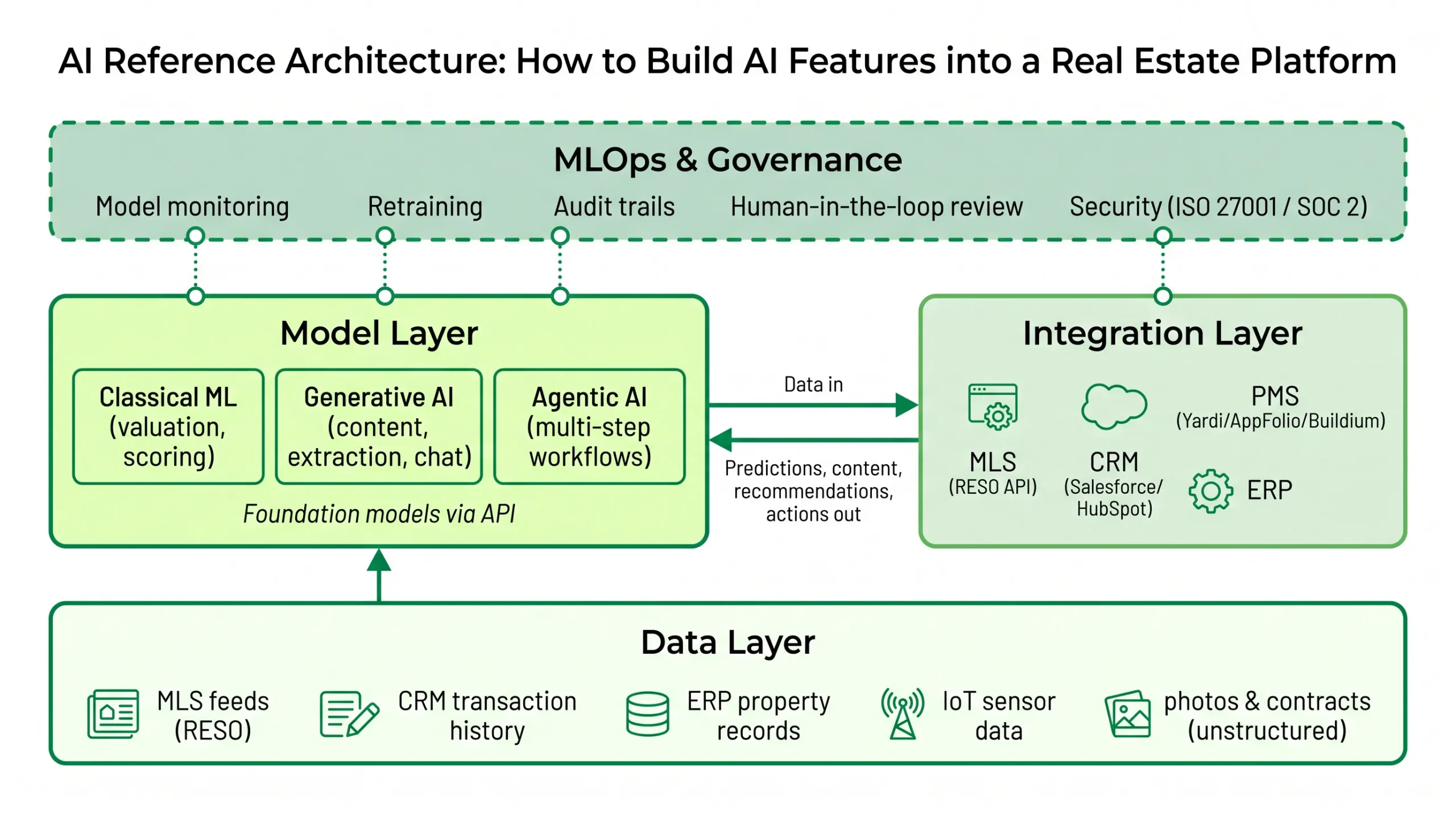
Building AI in real estate takes four layers. A data layer pulls MLS, CRM, and IoT sources together. A model layer picks the right approach per task. An integration layer wires it into the systems you already run. An MLOps and governance layer keeps it compliant, monitored, and current. Skip one and the system fails downstream.
Data Layer: The Foundation
The data layer assembles everything the AI needs: MLS feeds over RESO standards, transaction history from the CRM, property records from the ERP, sensor data from buildings, and unstructured content such as photos and contracts. The work is ingestion pipelines, cleaning, feature stores for structured machine learning, and vector databases for retrieval use cases.
This is where most teams underestimate the job. Data readiness, not model choice, is the single biggest reason projects stall. If listing addresses do not match across the MLS, CRM, and ERP, no model can produce a reliable valuation.
“Most real estate AI projects don’t stall on the model. They stall because the same property carries three different addresses across MLS, CRM and ERP. Until entity resolution is solved, every valuation the model returns is confidently wrong.”
– Phong Le, Tech Lead (AI, Python) at Saigon Technology

Assess data readiness first. Never shortcut it. Teams that skip this step usually discover the problem three months later, when a model that tested cleanly in a notebook starts returning valuations nobody in the business is willing to defend. Saigon Technology’s AI readiness assessment is a reasonable starting point.
Model Layer: Choosing the Right AI Approach
The model layer matches each problem to a type of AI. Classical machine learning handles valuation, scoring, and prediction when solid history exists. Generative AI handles content, extraction, and chat. Agentic AI handles workflows spanning multiple steps and tools. Most teams reach foundation models through an API rather than training their own. Custom training earns its cost only for something specific, such as a proprietary valuation model. A brokerage sitting on fifteen years of its own closed-transaction history holds something no foundation model has ever seen, and that asymmetry, rather than raw model quality, is what justifies the budget.
The build-versus-buy decision lives here too. Off-the-shelf models handle generic problems well. Custom models are worth building when they create a real edge.
Integration Layer: MLS, CRM, ERP, PMS
The integration layer connects AI to the systems already in place. MLS feeds run on RESO web APIs. CRMs such as Salesforce and HubSpot expose REST endpoints. Property management systems like Yardi, AppFolio, and Buildium each behave a little differently. Expect surprises there.
The design choice here matters more than teams expect. A nightly batch pipeline that refreshes lead scores is cheap, but it only supports reactive work. A real-time event architecture costs more and powers genuinely responsive experiences. This is why custom real estate CRM software, MLS software, and ERP for real estate often serve teams better than a generic platform.
MLOps and Governance
This layer keeps the system healthy over time. Monitoring catches drift as markets move. Retraining keeps valuations accurate. Audit trails document every AI-driven decision, which matters most when Fair Housing Act compliance is in play. Human-in-the-loop review keeps a person on high-stakes calls such as adverse action letters, where an unexplained automated denial is not merely an engineering defect but a regulatory liability with a paper trail attached.
Security carries equal weight. Real estate data holds a lot of personal information, and lenders increasingly expect SOC 2 controls from any vendor touching it. Saigon Technology builds this layer on ISO 27001 certification and standard NDAs as the baseline for every engagement.
Build vs. Buy: When Custom AI Is Worth It
The call comes down to integration depth, customization, and competitive differentiation. Buy when the use case is standard and speed matters. Build when it needs proprietary data, complex integrations, or workflows that create an advantage.
| Dimension | Off-the-shelf | Custom-built |
| Time to first value | 1 to 4 weeks | 6 to 16 weeks for an AI MVP |
| Cost structure | Licensing plus recurring subscription and usage fees | Engineering at $22–$46/hour, plus hosting, API usage, and maintenance |
| Integration | Standard connectors only | Custom work against CRM, MLS, ERP, PMS, and internal systems |
| Customization | Limited to vendor features | Built around your workflows |
| Differentiation | Low to medium | High |
| Best fit | Quick pilots, standard workflows | Custom AI features, PropTech products, complex workflows |
Five questions settle it. Does the AI need proprietary business data? Does it need deep integration with existing systems? Will customization create a real advantage? Could licensing costs climb sharply with usage? Do you need proprietary logic, reports, or workflows?
If several apply, build. If most do not, buy. That is the whole decision.
Saigon Technology delivers custom development at $22–$46/hour, backed by 850+ projects and Microsoft Gold Partner status. AI MVP engagements typically run 6 to 16 weeks depending on scope, data readiness, integrations, and security requirements.
Case Study: How Saigon Technology Built Atrium, a Real Estate CRM Platform
Business problem. A real estate client needed a CRM to handle high-volume lead intake, agent assignment, and pipeline reporting across multiple offices, with lead scoring and workflow automation in the core rather than bolted on later.
Engineering bottleneck. Off-the-shelf CRMs needed heavy customization to fit the client’s workflow, and that customization broke every time the vendor shipped an update.
The approach. The team built Atrium as a purpose-built real estate CRM with lead management, agent assignment, and pipeline reporting as core features. An API-first architecture means future integrations, whether MLS feeds or voice AI, slot in without a rebuild.
Operational improvement. Agents work from prioritized lead queues instead of raw feeds, which cuts time to first contact. Managers see pipeline across offices from one dashboard.
Business outcome. The client owns the platform outright, including every integration. Adding a capability such as AI-assisted lead scoring or an agentic follow-up sequence is weeks of engineering now, not months of vendor negotiation. Ownership changed the economics. Read the full Atrium real estate CRM case study.
Common Challenges and Risks
Six problems cause most failed deployments of AI in real estate: data quality gaps, Fair Housing bias risk, legacy integration, model drift, agent resistance, and vendor lock-in. Every one of them is well understood. Each has a known mitigation.
- Data readiness. Inconsistent addresses, missing fields, and stale records make any model unreliable. Audit and clean before you train.
- Fair Housing and bias. Any AI touching tenant screening, lending, or advertising has to document its logic. Audit trails and human review on adverse decisions are not optional.
- Legacy integration. Older property management systems and custom MLS forks rarely expose clean APIs, so budget real engineering time for adapters and expect the deployment phase to outlast the model-building phase by a wide margin.
- Model drift. Markets move. A valuation model trained in a 2021 market underperforms in a 2024 one. Set a retraining cadence and check performance monthly.
- Change management. Agents and property managers resist AI they do not trust. Roll out transparently, show the reasoning, and start with augmentation before automation.
- Vendor lock-in. Building on a single foundation model API creates real exposure if pricing or terms shift. Design the model layer to be swappable from day one.
Saigon Technology’s engagements standardize on NDAs, ISO 27001 controls, full IP transfer, and a two-week risk-free trial, which covers the trust and lock-in concerns for clients evaluating a build partner.
A 5-Step Adoption Roadmap for Real Estate Companies
Moving AI in real estate from experiment to impact takes structure. Start with one high-value use case. Prove it in production. Scale from there.
Step 1. Assess data readiness and pick one use case
Do not spread AI everywhere at once. Audit your CRM, MLS, and property records for accessibility, quality, and consistency. Then pick one use case that fits both your data and your business priorities.
Step 2. Run an AI MVP with clear success metrics
Define measurable outcomes before building. Depending on data readiness, integrations, and compliance needs, an MVP takes roughly 6 to 16 weeks. Measure against a real baseline: lead conversion, response time, cost, or prediction accuracy.
Step 3. Move the MVP into one production workflow
Once it proves out, roll it into production for one team, one unit, or one region. Monitor model performance, system reliability, and business metrics from day one so problems surface early.
Step 4. Scale to related use cases
With the first use case working and the pipeline stable, expand into adjacent workflows. A lead-scoring system, for instance, becomes the foundation for conversational qualification, personalized follow-up, and sales automation.
Step 5. Build in governance and keep improving
Add monitoring, evaluation, audit trails, privacy controls, and a retraining process. Run compliance reviews where needed, which in real estate means checking AI-driven decisions for fairness and housing-regulation compliance.
Saigon Technology’s forward-deployed AI engineers embed with client teams to accelerate steps 2 through 4, and AI modernization covers step 5 for teams adding governance around existing investments.
Frequently Asked Questions
Which AI use cases are real estate teams actually running in 2026?
Nine areas carry most production work: property valuation, market analytics, lead scoring, listing content, virtual staging, conversational and voice agents, contract intelligence, predictive maintenance, and portfolio risk analytics. Listing content, lead qualification, and market analysis are the usual entry points. They need the least integration work to get running.
Will AI replace real estate agents?
No, but it will pressure agents who refuse to use it. AI handles the repetitive half of the job well: lead qualification, listing content, market analysis, scheduling. Relationship work such as negotiation, trust building, and judgment on complex deals still needs a person. Agents who pair AI tools with strong client relationships simply get more done.
What is the best AI for real estate?
There is no single best choice, only a best fit per use case. Generative AI suits content and chat. Predictive machine learning suits valuation and scoring. Computer vision suits image work. Agentic AI suits multi-step workflows. Most production platforms combine at least three.
How much does it cost to build custom AI real estate software?
Cost tracks scope, data readiness, and integration depth rather than a fixed band. A focused feature such as lead scoring or listing generation sits well below a full AI-enhanced CRM or portfolio platform. Saigon Technology delivers custom development at $22–$46/hour through a scoped AI MVP development engagement, so a realistic number comes from scoping the use case, not from a price list.
How long does it take to deploy AI in a real estate platform?
Roughly 6 to 16 weeks for an MVP, and three to six months for full production integration. Data cleanup and integration with existing MLS and CRM systems usually take longer than building the model.
Is my real estate data ready for AI?
It is ready when addresses are standardized, key fields match across MLS, CRM, and ERP, historical records reach back at least 24 months, and personal data is properly segregated. Data readiness, not model choice, is the biggest reason projects stall. Saigon Technology’s AI readiness assessment covers this audit end to end.
Conclusion
The companies that win between 2026 and 2028 will pair use-case awareness with the ability to build. Knowing that AI can automate valuation, score leads, generate listings, and qualify prospects is table stakes now. Everyone has the list. The advantage comes from AI in real estate that plugs deeply into your MLS, CRM, ERP, and property management systems, so it improves on your own data rather than the generic data every competitor already has.
Deciding what to build first? Start with the use case backed by your cleanest data. Deciding whether to build at all? Run it through the five questions above. And if you want a partner that has shipped 850+ projects over 14+ years and holds Microsoft Gold Partner status and ISO 27001 certification, talk to Saigon Technology about your real estate AI roadmap.


Related articles

Real Estate App Development in 2026: Cost, Features, Process & Technology Guide
 Thanh (Bruce) Pham - CEO of Saigon Technology
  06 Feb 2025
Property Management Software Development: The Complete Custom Build Guide (2026)
15 Jun 2026 
Real Estate CRM Software Development: Architecture, Cost & Build Guide (2026)
17 Jun 2026 
Real Estate MLS Software Development: A 2026 Guide
30 Jun 2026 
ERP for Real Estate: Modules, Platforms & Custom Options
15 Jul 2026